


 by Tom Gurney
Tom Gurney BSc (Hons) is an art history expert with over 20 years experience
/
Email: tomgurney1@gmail.com / Phone: +44 7429 011000
Evelyn De Morgan: Introduction
Evelyn De Morgan built a long professional career from figures, colours and stories that were anything but passive. A woman reaches towards a rainbow while monsters circle below; another turns from an opulent room towards music outside; a scholar in gold studies a vessel. Beauty is never their only purpose. De Morgan used allegory to think about freedom, spiritual growth, material temptation and war.
Born Mary Evelyn Pickering in London in 1855, she trained rigorously, exhibited from the 1870s and worked until near the end of her life in 1919. Her paintings draw on Renaissance art, classical myth, Aestheticism and the later Pre-Raphaelites. Yet their ethical pressure, recurring female protagonists and distinctive symbols make her much more than a follower.[1][2]
At a Glance
- Identity and datesMary Evelyn Pickering, later Evelyn De Morgan, 1855–1919
- TrainingSouth Kensington National Art Training School, followed by the Slade School of Art from 1873
- MediaPrimarily oil painting, supported by an extensive practice of pencil, pastel and compositional drawing
- Movement relationClose to Aesthetic, late Pre-Raphaelite, Neo-Classical and Symbolist art, while pursuing an independent visual language
- Signature concernsFemale agency, spiritual transformation, the rejection of materialism and opposition to war
- Major collectionThe De Morgan Foundation, formed from the collection preserved by her sister Wilhelmina Stirling
Evelyn De Morgan in context
Pre-Raphaelite movement and later circles
1848–c. 1900Aesthetic Movement
c. 1860–1900Symbolism
c. 1880–1914George Frederic Watts
1817–1904John Roddam Spencer Stanhope
1829–1908Frederic Leighton
1830–1896Edward Burne-Jones
1833–1898William De Morgan
1839–1917Evelyn De Morgan
1855–1919Cadmus and Harmonia
1877Night and Sleep
1878Flora
1894The Gilded Cage
probably 1901–02The Love Potion
1903The Cadence of Autumn
1905Daughters of the Mist
c. 1905–10S.O.S.
1914–16Contents
- From Mary Pickering to Evelyn De Morgan
- Neither Label nor Isolation
- Drawing, Colour and the Art of Preparation
- Five Paintings to Begin With
- Women, Spirit and Moral Choice
- Evelyn, William and an Artistic Partnership
- Preservation and Return to View
From Mary Pickering to Evelyn De Morgan
De Morgan’s childhood gave her unusual intellectual resources but no simple path into professional art. Educated alongside her brothers, she studied languages, classical literature, mythology and science. Her uncle, the painter John Roddam Spencer Stanhope, encouraged her and accompanied study journeys to France and Italy. Early Italian Renaissance art remained a living resource for rhythmic figures, patterned surfaces and compositional ideas.[1]
After several months at South Kensington in 1872, she entered the Slade in 1873, when serious life drawing was newly available to women there. She won prizes, a silver medal and a scholarship. The Foundation records that she submitted work under her middle name, Evelyn, which could be read as male or female, so that it would be judged on merit rather than gender.[3] The artist known as Evelyn De Morgan first established herself professionally as Evelyn Pickering.
Her progress was swift. She sold a painting while still a student in 1875, exhibited at the Dudley Gallery in 1876 and was invited to the inaugural Grosvenor Gallery exhibition the following year. This was not a private accomplishment that later happened to attract notice. It was the beginning of a public career sustained through exhibitions, patrons and sales. The fuller biography follows that career from her training and Italian study to her final wartime exhibition.[3]
Neither Label nor Isolation
De Morgan is often placed near the Pre-Raphaelites, and the comparison is understandable. Her clear contours, jewel-like colour, medievalising details and carefully observed natural forms can recall their work. Family and friendship also connected her to artists in that wider circle. But she was born seven years after the Brotherhood was founded, trained in a different institutional moment and developed her mature art later. Calling her simply “a Pre-Raphaelite painter” obscures as much as it reveals.
Her early work resembles Aesthetic painting, with idealised figures and harmonious design, while her classical subjects have a Neo-Classical dimension. She made these inherited languages carry moral and spiritual arguments. Her figures do not merely decorate a dream world: they confront captivity, choice, knowledge, death and renewal. The result is best approached through her own symbolism and allegory, while keeping the useful comparisons in view.[2]
Drawing, Colour and the Art of Preparation
De Morgan’s luminous canvases began with sustained work on paper. Surviving drawings move from loose compositional ideas to exact studies of poses, drapery, faces, hands and feet. The Watts Gallery account notes her frequent use of grey or brown paper and her detailed studies of both clothed and nude figures. It also observes that the finished paintings show relatively little reworking, evidence that difficult decisions had often been settled before paint reached the final canvas.[2]
That method helps explain why elaborate scenes remain legible. Drapery guides the eye; repeated curves bind bodies to wind, water or vegetation; sharp colour changes separate moral or spiritual states. Gold can describe wealth, sacred illumination or deceptive luxury according to context. The discussion of colour, gold and technique looks closely at this construction rather than treating surface splendour as an end in itself.
Italy sharpened both design and colour. In Florence, De Morgan studied works she could adapt to new purposes. Botticelli matters especially, but her response was inventive rather than submissive: borrowed rhythms become vehicles for modern questions about freedom, conscience and change. Her classical learning likewise supplied stories that could be recast around women’s experience, as explored in mythology and transformation.
Five Paintings to Begin With
The paintings overview opens onto a wider researched online works census, but five pictures offer an especially clear route into her changing practice.
In Night and Sleep (1878), two winged personifications travel arm in arm across the evening sky. Sleep scatters poppies while Night’s cloak darkens the space behind them. The Foundation connects their entwined flight to Botticelli’s Zephyr and Chloris in The Birth of Venus. De Morgan turns that remembered movement into a gentle mechanism for changing daylight into darkness.[4]
Flora (1894) is both a mythological figure and a meditation on Florence. The goddess stands before a fruiting loquat tree, surrounded by birds, blossoms and patterned cloth. An Italian scroll announces her journey from Florence to a new home in Scotland, a reference to the painting’s patron, William Imrie. The model was Jane Hales, while the conception responds openly to Botticelli’s Primavera.[5]
The Love Potion (1903) is easy to reduce to a scene of witchcraft, but the object record argues for a more demanding reading. Its central woman is a learned alchemist surrounded by books and equipment. Black, white, red and golden yellow evoke successive stages in an alchemical and spiritual ascent. The distant couple matters, yet the intellectual authority of the solitary woman at work is the painting’s true centre.[6]
In The Gilded Cage, probably painted in 1901–1902, a young woman in gold looks towards dancers beyond a window while an older man remains inside. Discarded jewels, books and a caged canary make domestic luxury feel constricting. The Foundation reads the work through women’s suffrage, but it also acknowledges the older man’s unhappiness. That complication keeps the picture from becoming a one-note emblem and rewards the broader study of women, spiritualism and freedom.[7]
S.O.S. (1914–1916) belongs to De Morgan’s response to the First World War. A white-robed woman stands on an isolated rock amid waves and sea monsters, reaching towards a rainbow. The title invokes the new Morse distress call and, through its familiar expansion as “save our souls”, joins physical danger to spiritual crisis. This is Symbolist protest, not battlefield reportage: the war and pacifism study traces how monsters, darkness and distant light carry the argument.[8]
Women, Spirit and Moral Choice
Female figures dominate De Morgan’s art, but they do not all mean the same thing. Some are enclosed, some endangered, some scholarly and some powerfully transformative. Paintings can support feminist readings without turning every woman into a direct portrait of the suffrage campaign. The historical evidence remains important: De Morgan supported women’s suffrage, while her pictures repeatedly test the structures that restrict women’s action.[2]
Spiritualism also shaped her understanding of the material world as a temporary condition rather than the final measure of life. This belief intersects with her rejection of greed and her concern for moral development. It does not reduce the paintings to coded doctrine. Instead, bodies, light, thresholds and changes of state make ideas visible while leaving room for ambiguity. The same method enabled her pacifism: during the First World War she painted symbolic visions of peril and hope, then exhibited war pictures in her studio in 1916 to raise money for relief organisations.[1][2]
Evelyn, William and an Artistic Partnership
Evelyn married the ceramicist William De Morgan in 1887. Their partnership joined two established practices rather than absorbing hers into his. They shared friendships, political commitments and an interest in spiritualism, while maintaining distinct media and professional identities. From 1890 they spent winters in Florence, returning regularly until the First World War, and they welcomed visitors to joint studio displays in London.[3]
The account of Evelyn and William De Morgan considers both cooperation and difference. It also helps correct an older habit of introducing Evelyn primarily as a famous man’s wife. Her exhibition record, patrons and income make the direction of dependency more complex: the Foundation notes that her painting helped support the household when William’s ceramics business struggled.[1]
Preservation and Return to View
After Evelyn’s death in 1919, her younger sister Wilhelmina Stirling worked to preserve both De Morgans’ art and reputations. She gathered works, displayed them at Old Battersea House and wrote a biography of the couple. On her death in 1965, she left her collection in trust for public enjoyment, creating the basis of the De Morgan Foundation.[9]
That preservation partly explains why so many paintings and preparatory drawings can now be studied together. It also shaped the artist’s reception: a substantial body survived, but much remained outside broad public view for decades. Drawings can now be compared with oils, symbols followed across years and De Morgan’s intellectual ambition seen across a working life of roughly half a century.[1][9]
Follow Evelyn De Morgan’s career through four stages
Education, the Slade and professional ambition
Mary Evelyn Pickering developed a classical education before studying at South Kensington and the Slade. Prizes for drawing, repeated Italian travel and her first sale prepared a professional debut that resisted the expectations attached to her class and gender.
Classical stories, Renaissance looking and public success
Ariadne in Naxos and Cadmus and Harmonia placed female figures at the centre of classical stories. De Morgan combined close figure study with lessons drawn from Botticelli and other Italian Renaissance painters while exhibiting in ambitious London galleries.
Partnership, patronage and an independent visual language
Marriage to William De Morgan formed an equal artistic partnership rather than ending Evelyn’s career. Flora, The Gilded Cage and The Love Potion join meticulous surfaces to arguments about knowledge, material constraint, spiritual choice and female agency.
Prismatic colour, reform causes and wartime hope
Later paintings make colour, mist, bonds, dragons and rainbows increasingly symbolic. Suffrage, spiritualism and opposition to war informed the work, while the 1916 studio benefit turned pacifist imagery into practical support for Red Cross organisations.
Essential works
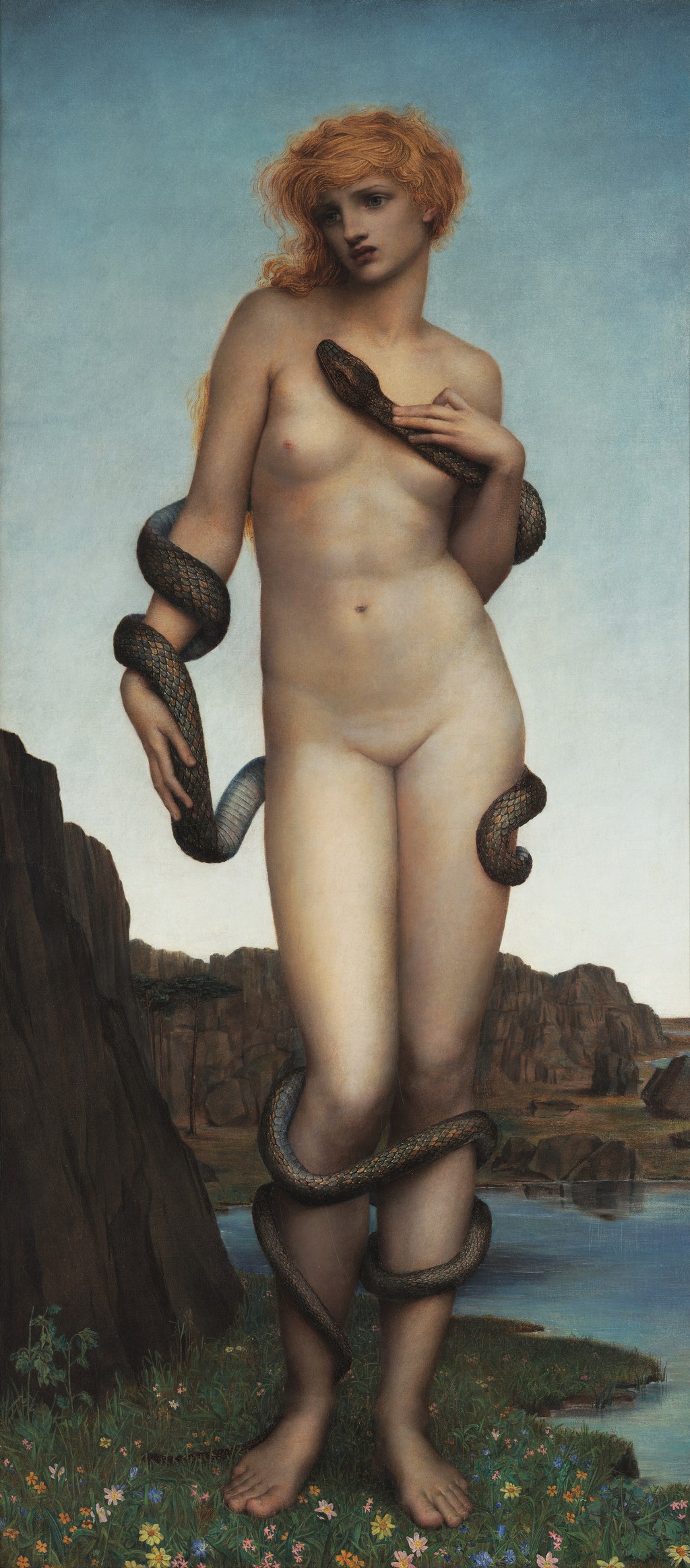
Cadmus and Harmonia
1877 · A transformed husband coils around Harmonia in an early myth painting shaped by Ovid, Italy and De Morgan’s decision to make the woman monumental.
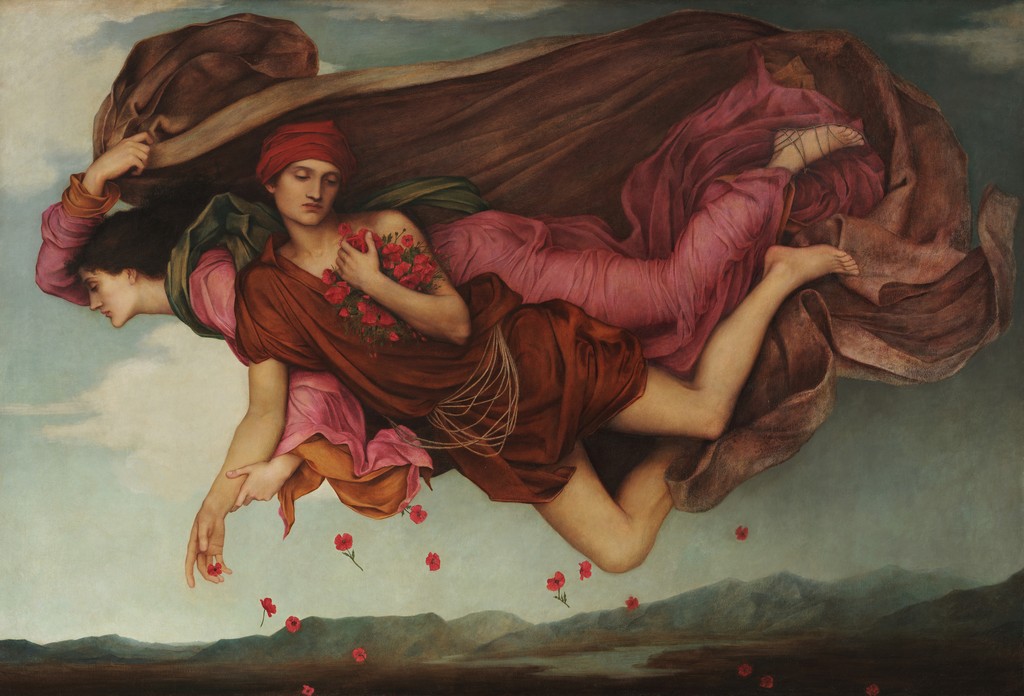
Night and Sleep
1878 · Two airborne personifications carry darkness across the landscape as Sleep scatters poppies below.
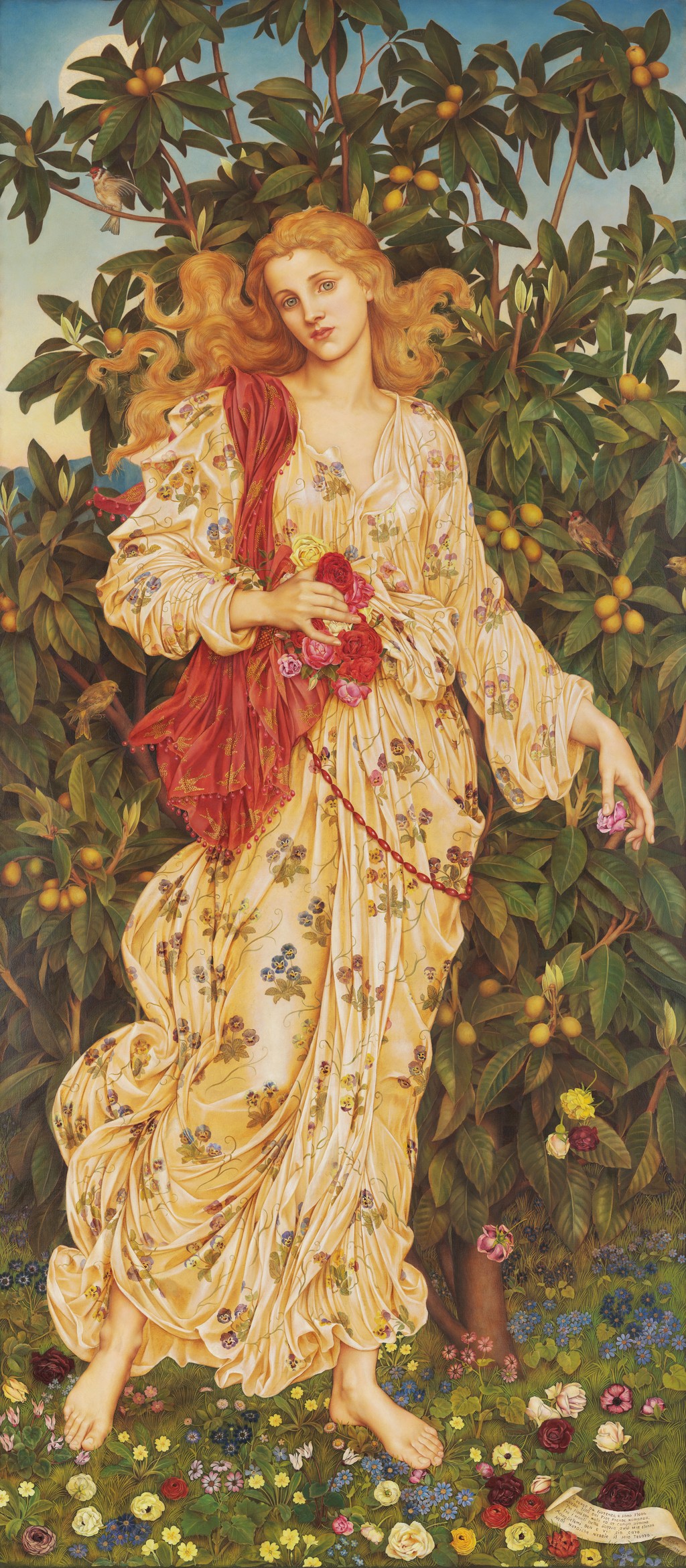
Flora
1894 · A tall Florentine goddess stands amid loquat, birds and a field of flowers in De Morgan’s sumptuous response to Botticelli.
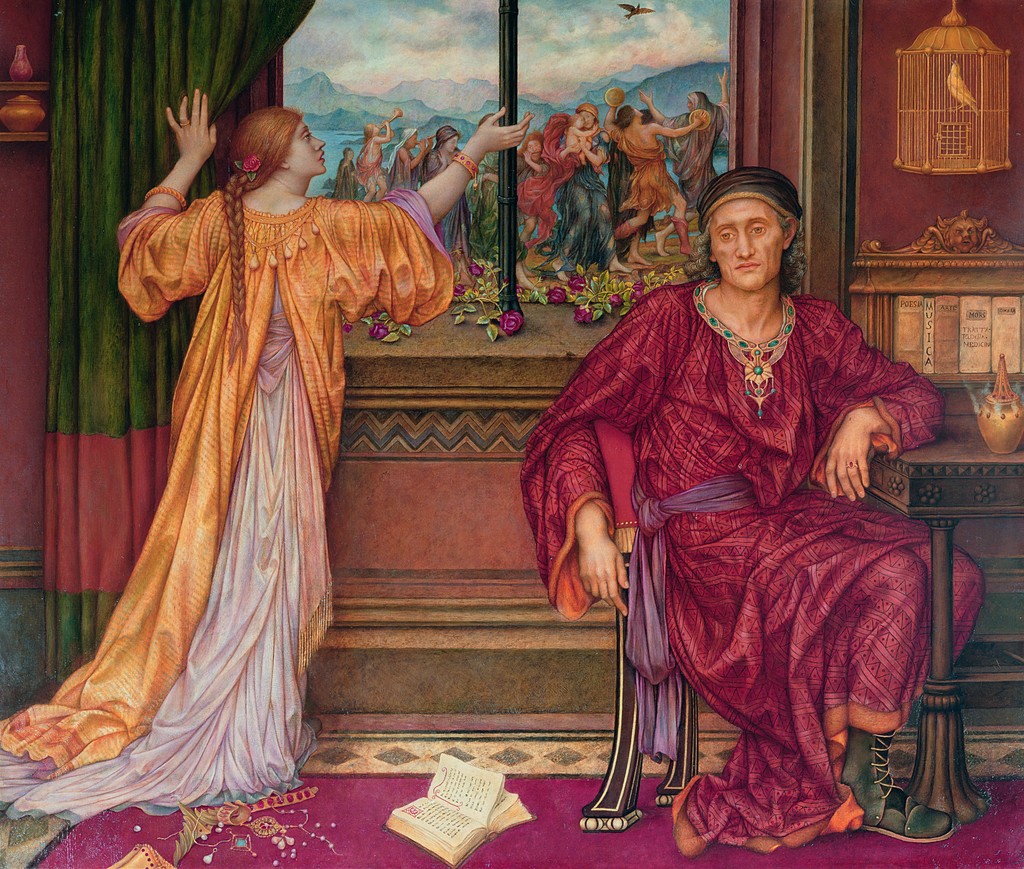
The Gilded Cage
probably 1901–02 · A woman turns from a rich interior towards music and movement beyond the window while a caged bird sharpens the painting’s argument about confinement.
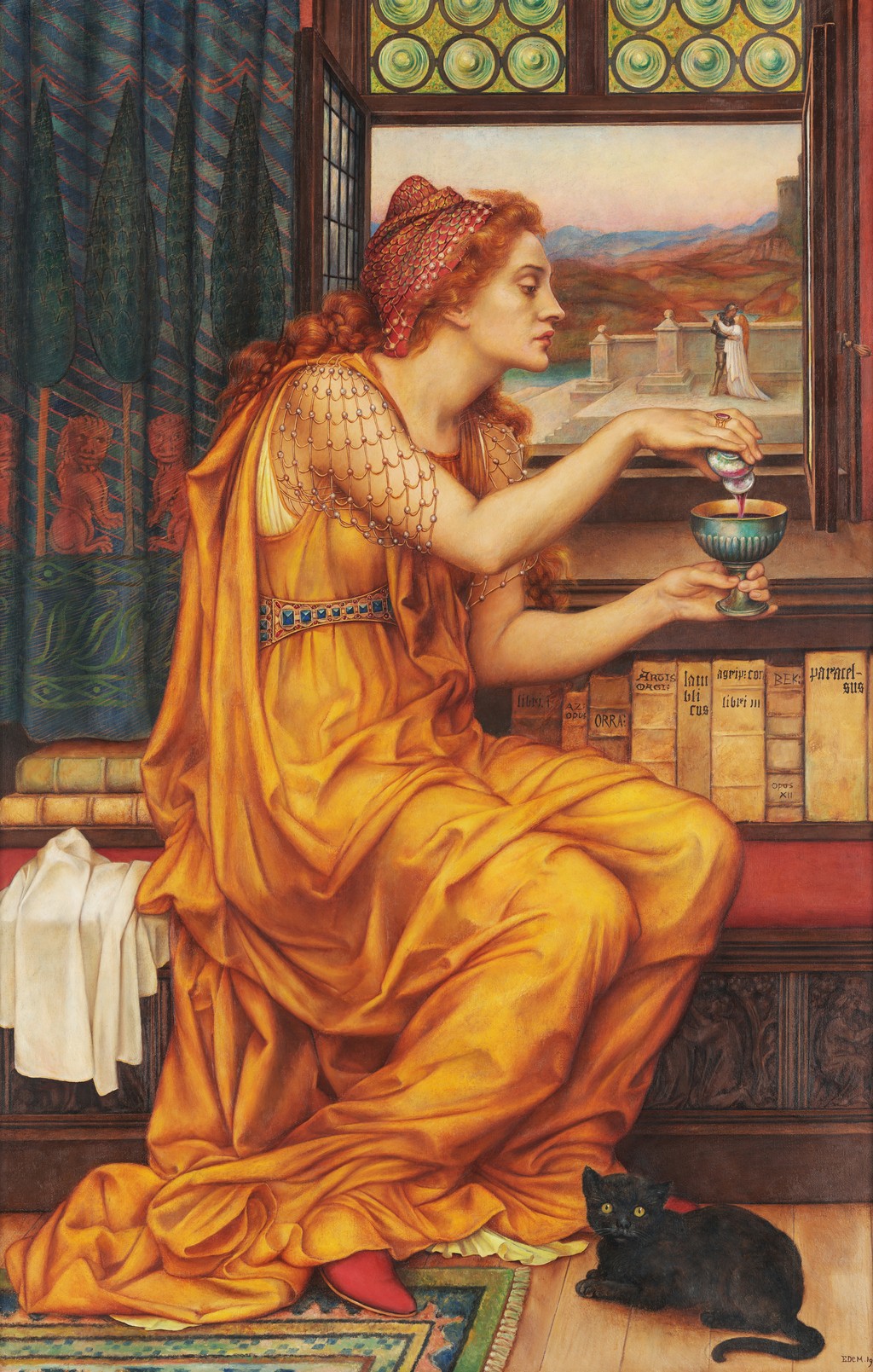
The Love Potion
1903 · A learned figure, a vessel, a book and distant lovers create a layered meditation on knowledge, desire and alchemical colour.
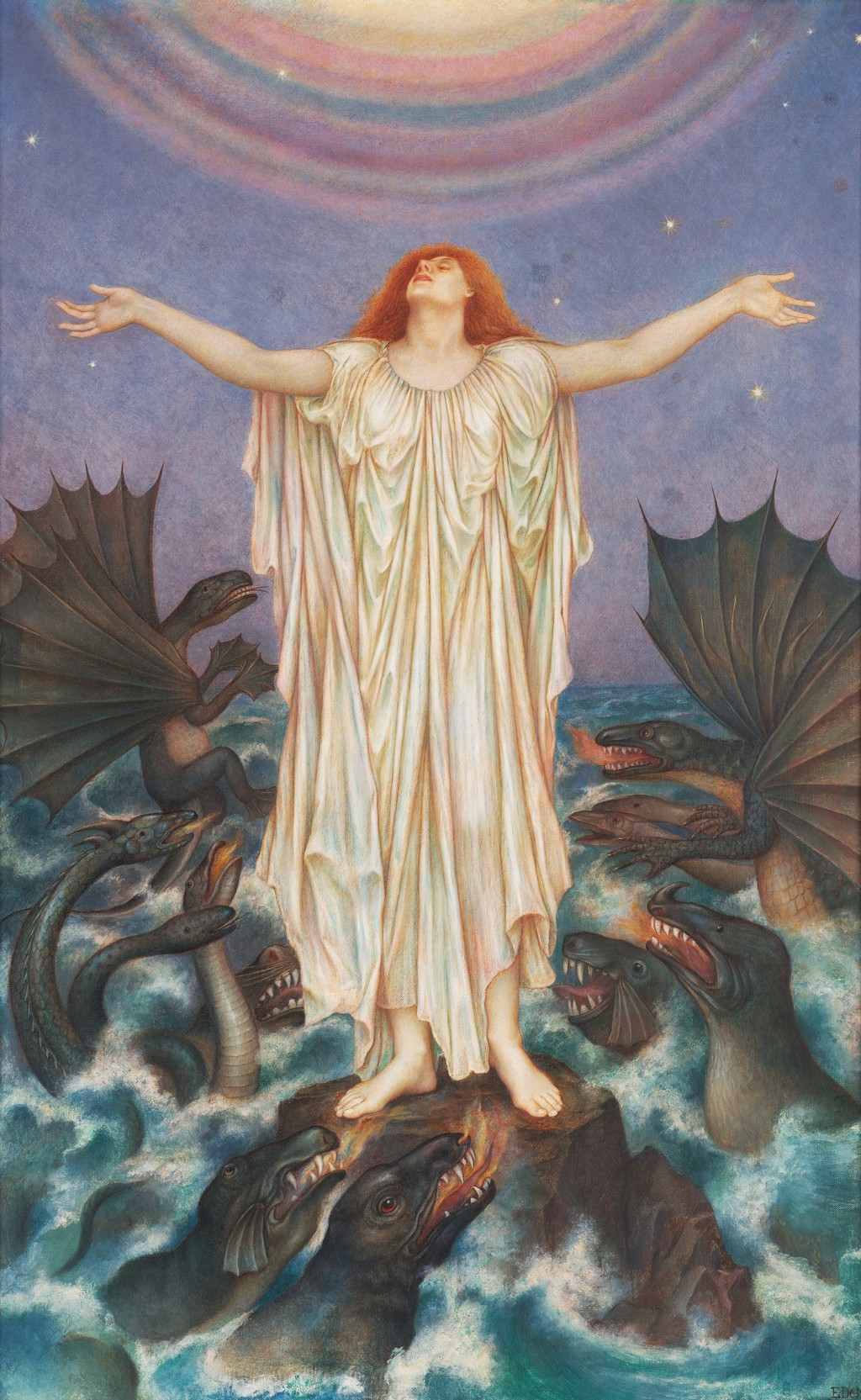
S.O.S.
1914–16 · A white-robed figure reaches towards a rainbow while sea monsters close in, turning wartime peril into a Symbolist appeal for rescue and peace.
About this directory: These 72 entries form a reproducible researched online works census assembled from current public records. It is not a catalogue raisonné and does not claim absolute completeness.
Artworks directory
| Name | Date | Medium |
|---|---|---|
| A Soul in Hell | Date unknown | Painting |
| Ariadne in Naxos | 1877 | Painting |
| Aurora Triumphans | 1877 | Painting |
| Blindness and Cupidity Chasing Joy from the City | 1897 | Painting |
| Boreas and Oreithyia | 1896 | Painting |
| Boreas and the Fallen Leaves | 1910 | Painting |
| By the Waters of Babylon | 1882 | Painting |
| Cadmus and Harmonia | 1877 | Painting |
| Cassandra | 1898 | Painting |
| Clytie | 1886 | Painting |
| Daughters of the Mist | 1909 | Painting |
| Death of a Butterfly | 1910 | Painting |
| Death of the Dragon | 1916 | Painting |
| Deianira | 1878 | Painting |
| Demeter Mourning for Persephone | 1906 | Painting |
| Drapery study | 1890 | Drawing |
| Earthbound | 1897 | Painting |
| Eos | 1895 | Painting |
| Evening Star over the Sea | 1910 | Painting |
| Flora | 1894 | Painting |
| Helen of Troy | 1898 | Painting |
| In Memoriam | 1904 | Painting |
| Life and Thought Emerging from the Tomb | 1893 | Painting |
| Love's Passing | 1883 | Painting |
| Luna (Moon) | 1885 | Painting |
| Lux in Tenebris | 1895 | Painting |
| Medea | 1889 | Painting |
| Medusa | 1879 | Painting |
| Mercury | Date unknown | Painting |
| Moonbeams dipping into the Sea | 1918 | Painting |
| 'Music Sweet Music' (Saint Cecilia) | 1884 | Painting |
| Night and Dawn | 1910 | Painting |
| Night and Sleep | 1878 | Painting |
| Our Lady of Peace | 1907 | Painting |
| Phosphorus and Hesperus | 1881 | Painting |
| Port after Stormy Seas | 1905 | Painting |
| Portrait John Roddam Spencer Stanhope | 1880 | Painting |
| Queen Eleanor and the Fair Rosamund | Date unknown | Painting |
| S.O.S. | 1914–1916 | Painting |
| Sleep and Death: the Children of Night | 1883 | Painting |
| Study for 'Saint Christina' | 1904 | Painting |
| Study from the life | 1890 | Drawing |
| Study of Arms for "The Cadence of Autumn | 1905 | Drawing |
| Sunbeam and Summer Shower | 1910 | Painting |
| The Angel of Death I | 1880 | Painting |
| The Barred Gate | 1910 | Painting |
| The Cadence of Autumn | 1905 | Painting |
| The Captives | Date unknown | Painting |
| The Dryad | 1884 | Painting |
| The Garden of Opportunity | 1892 | Painting |
| The Gilded Cage | probably 1901–1902 | Painting |
| The Grey Sisters | 1880 | Painting |
| The Hourglass | 1904 | Painting |
| The Kingdom of Heaven Suffereth Violence and the Violent Take It by Force | 1878 | Painting |
| The Light Shineth in Darkness and the Darkness Comprehendeth It Not | 1906 | Painting |
| The Little Sea Maid | 1880 | Painting |
| The Love Potion | 1903 | Painting |
| The Martyr (Nazuraea) | 1880 | Painting |
| The Mourners | 1915 | Painting |
| The Passing of the Soul at Death | 1910 | Painting |
| The Poor Man Who Saved the City | 1901 | Painting |
| The Prisoner | 1907 | Painting |
| The Red Cross | 1915 | Painting |
| The Salutation | 1883 | Painting |
| The Sea Maidens | 1885 | Painting |
| The Soul's Prison House | 1880 | Painting |
| The Storm Spirits | 1900 | Painting |
| The Worship of Mammon | 1909 | Painting |
| Twilight | 1910 | Painting |
| Venus and Cupid | 1878 | Painting |
| William De Morgan | 1909 | Painting |
| William De Morgan (1839–1917) | 1893 | Painting |
Frequently Asked Questions
She is known for richly coloured allegorical paintings in which idealised figures address spiritual transformation, women’s freedom, material temptation and war. Flora, The Love Potion, The Gilded Cage and S.O.S. show how widely that symbolic language could range.
Not in the strict historical sense. Her work shares some features with later Pre-Raphaelite art, and she knew artists in that world, but she trained later and combined those affinities with Aesthetic, Neo-Classical, Renaissance and Symbolist sources. Her mature visual arguments are distinctly her own.[2]
Yes. She married the ceramicist and designer William De Morgan in 1887. They shared artistic and political interests, lived between London and Florence for part of their marriage and remained independent professional artists.[3]
The De Morgan Foundation preserves the principal collection. Because individual paintings may appear in changing displays, visitors should check the Foundation’s current information before travelling. The collection exists in large part because Wilhelmina Stirling preserved and bequeathed the works.[1][9]
Discussion
What should readers notice when looking closely at Evelyn De Morgan?
Reader Insights
Compare the wind-driven drapery of Night and Sleep with the patterned stillness of Flora.
Track where training, patronage and reform beliefs meet rather than treating them as separate careers.
Which painting most clearly changes a familiar story by shifting attention to a woman’s viewpoint?
Join the Conversation
Share your reading below, keeping observations specific and evidence clear.
References
- De Morgan Foundation, Evelyn De Morgan (1855–1919), View source
- Watts Gallery Artists’ Village, Evelyn De Morgan, View source
- De Morgan Foundation, Evelyn De Morgan: The Modern Artist in Victorian London, View source
- De Morgan Foundation, Night and Sleep, View source
- De Morgan Foundation, Flora, View source
- De Morgan Foundation, The Love Potion, View source
- De Morgan Foundation, The Gilded Cage, View source
- De Morgan Foundation, S.O.S., View source
- De Morgan Foundation, Wilhelmina Stirling, View source