

 by Tom Gurney
Tom Gurney BSc (Hons) is an art history expert with over 20 years experience
/
Email: tomgurney1@gmail.com / Phone: +44 7429 011000
Colour, Gold and Technique: Introduction
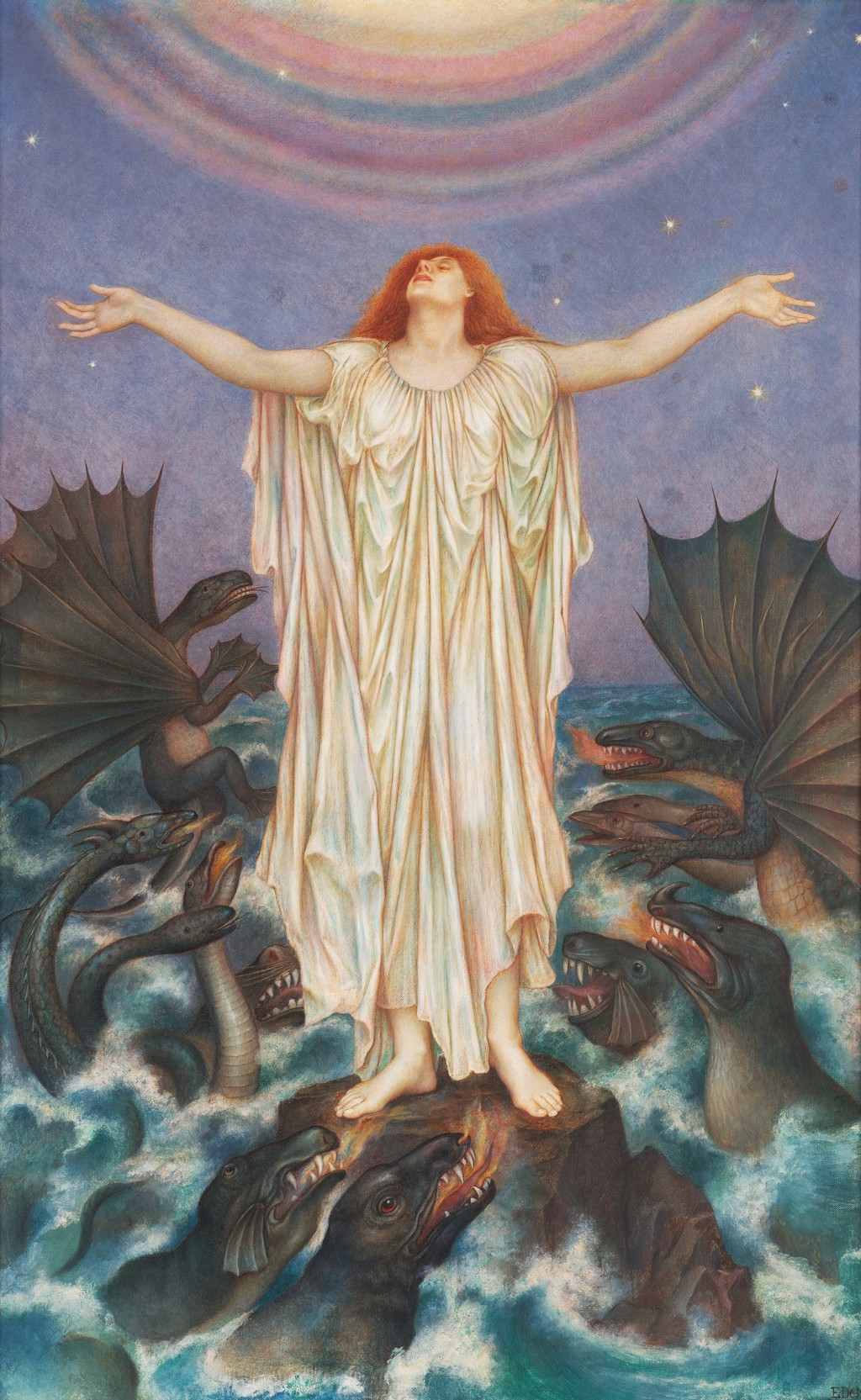
Evelyn De Morgan’s luminous paintings began with disciplined drawing. Before brilliant cloth, rainbow mist or reflected gold reached a finished surface, she worked through pose, anatomy, drapery, hands, faces and the distribution of light. The preparatory sequence matters because her colour is rarely an afterthought. It grows from decisions made while the composition is still being tested.
Materials surviving in collections and recorded in suppliers’ ledgers make that labour unusually tangible. They show a painter rooted in conventional oil-on-canvas practice who also tried unfamiliar supports, specialised fixatives, metallic colour and, in two tightly limited cases, a glycerine medium.
At a Glance
- Usual mediumOil paint on commercially prepared canvas.
- Drawing mediaPencil or graphite, chalk and pastel, often on grey or brown-toned paper.
- Gold-study purposeGold against dark grey tested tonal depth and the direction of illumination before painting.
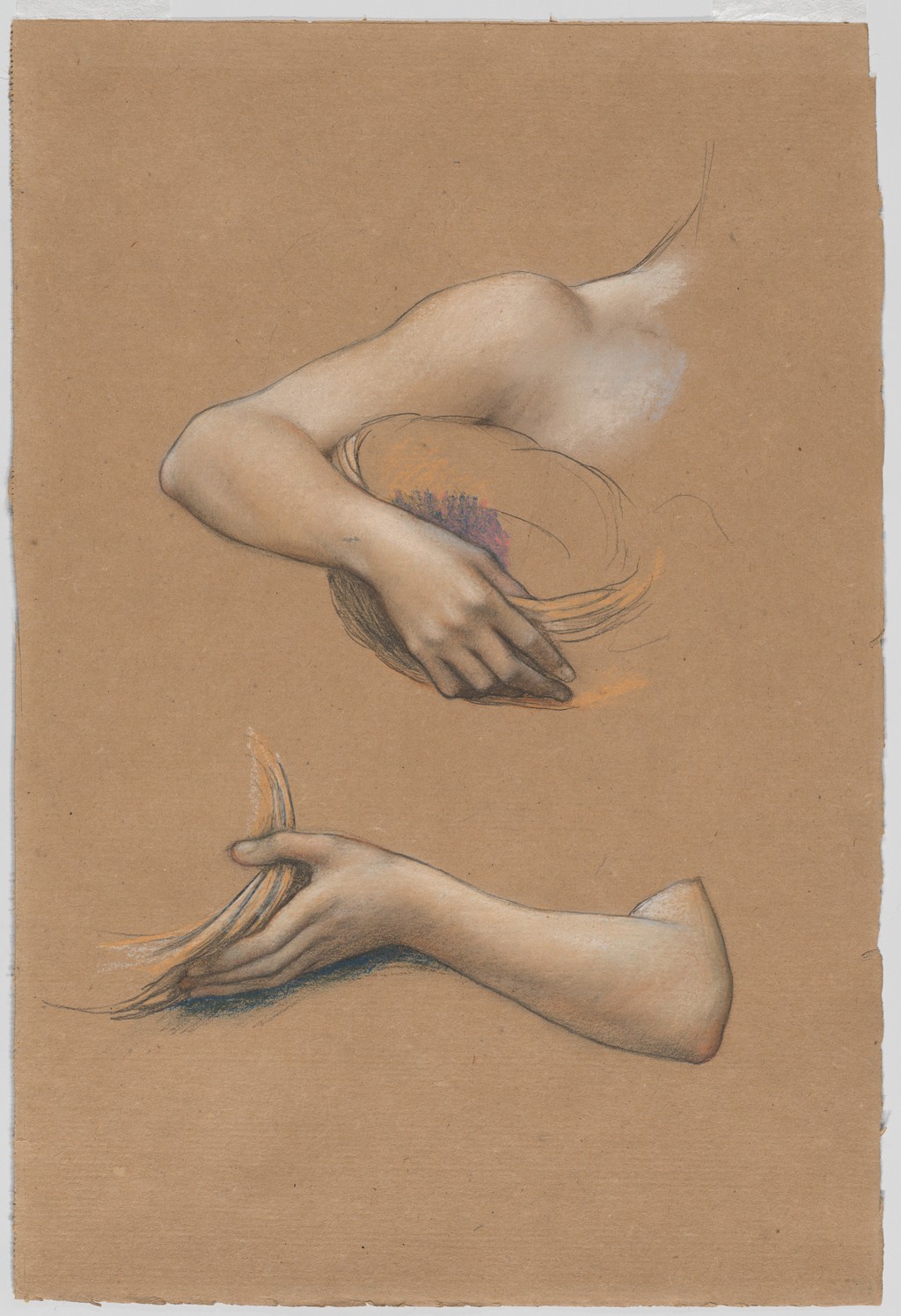
- Met objectStudy of Arms for “The Cadence of Autumn”, 1905, graphite and pastel, 37.8 × 25.6 cm,
2018.862. - Experimental limitThe glycerine “process” is documented only for Clytie and The Soul’s Prison House.
- Colour roleHue could describe flesh, fabric and season while also carrying moral or spiritual meaning.
Contents
- Drawing Before Colour
- Nude and Draped: Two Views of One Pose
- A Study Inside a Finished Composition
- Gold on Grey: Planning Illumination
- What the Colourman’s Ledgers Reveal
- The Usual Rule and the Glycerine Exception
- Flora: A Surface Built for Light
- When Colour Carries the Argument
Drawing Before Colour
De Morgan’s method was founded on the figure training she received at the Slade School of Fine Art. The Foundation records that the 1873–1874 syllabus required long daily periods drawing both draped and nude models and casts from the antique. She won prizes for life drawing, antique study and composition before gaining a full scholarship.[1] These were not ornamental accomplishments. They taught her to build a convincing body and organise several bodies across a surface.
She continued to draw after formal study. The Foundation describes a progression from loose arrangements to detailed studies from life, separate examinations of faces, hands and feet, and resolved compositional sheets.[1] This sequence let her isolate different problems. A gesture could be corrected without repainting a whole scene; a face could be developed apart from its costume; relationships among figures could be tested before colour complicated them.
The existence of so many preparatory works also changes how the paintings should be viewed. Their elongated bodies and elaborate folds are not evidence of casual idealisation. Even when the finished subject is mythic or visionary, its pose often rests on repeated observation. De Morgan’s biography explains how that routine became part of a professional life sustained across nearly five decades.
Nude and Draped: Two Views of One Pose
Among De Morgan’s most revealing sheets are paired studies of the same model nude and clothed. Drawing the undressed body established weight, joints, balance and the turn of the torso. Repeating the pose in costume then showed how fabric hung from that structure. The drapery could be invented, but it still had to answer to a body underneath.
This double process helps explain the combination of clarity and movement in her painted robes. A fold may arc dramatically, yet shoulders and hips continue to support it. The method also separated anatomical knowledge from decorative pattern. Fabric was not used to hide uncertainty; it became another designed layer once the physical pose was understood.
Grey wove paper was a frequent support for pencil and pastel studies.[1] Its middle tone offered a practical advantage. Dark marks could establish shadow while pale chalk or pastel pulled forms towards light, leaving the paper itself to supply much of the intermediate value. Modelling could therefore proceed in both directions rather than being built only from dark lines on white.
Close attention to the body should not be confused with a single stylistic allegiance. De Morgan absorbed academic figure discipline, Renaissance compositions, Neo-Classical practice and aspects of late Pre-Raphaelite art. Her technique belongs to the specific mixture she made from them.
A Study Inside a Finished Composition
The Metropolitan Museum of Art’s Study of Arms for “The Cadence of Autumn” makes the preparatory process concrete. Dated 1905, it is graphite and pastel on a sheet measuring 37.8 × 25.6 cm. The Met records it as object 2018.862 and identifies it as a study connected with The Cadence of Autumn.[2]
An isolated study of arms may appear minor beside a large painting, but limbs carry compositional rhythm. The angle of an elbow, the overlap of hands or the direction of a forearm can link one figure to the next. By removing costume, landscape and full bodies, the sheet lets De Morgan solve that sequence at close range.
The Met relates the finished composition’s ordered women to seasonal movement and human mortality.[2] That broader meaning depends on local craft. Allegory becomes legible because gestures guide the eye through the group. The drawing is thus not merely a record of what came before; it reveals how an abstract idea was assembled from observed parts.
Gold on Grey: Planning Illumination
De Morgan’s gold studies push tonal planning into a more unusual register. The Foundation’s compositional study for Earthbound, D_EDM_0228, is made with chalk and gold paint on grey paper. Its record connects the work to her Slade discipline and describes such studies of limbs, gestures and figural relationships as preparation for major paintings.[3]
Gold against a dark support has an immediate radiance, but its usefulness was not solely decorative. The contrast clarifies where light gathers and how separated figures relate at a glance. In a monochrome or restricted scheme, weak silhouettes and confused overlaps become difficult to disguise. A metallic highlight can test the intended hierarchy before a complex palette is introduced.
The Foundation also treats some resolved gold compositions as independent works that could be exhibited or sold.[1] “Study” therefore does not always mean unfinished or disposable. A sheet could assist the making of an oil painting and still have a complete visual life of its own.
Supplier records add material detail. Fiona Mann’s research finds repeated purchases of cakes of gold, including “red gold” in 1903 and 1904, and notes gold drawings on dark grey paper made from roughly 1884 to 1902.[4] The evidence supports actual metallic material, not simply yellow pigment, while avoiding the assumption that every golden area in every painting was produced in the same way.
What the Colourman’s Ledgers Reveal
Accounts from Charles Roberson, a leading artists’ colourman, show De Morgan ordering canvases, pigments, chalks, sketchbooks, brushes and fixative across her career. Some purchases appear in her own ledgers; others were placed through William De Morgan’s account after he had largely stopped oil painting.[4] These records document household and studio exchange without making William the author of Evelyn’s method.
The entries reveal both habit and experiment. She bought coarse-grained “Roman” canvas suitable for large pictures and continued to purchase powdered colours. Amber colours appear from 1897, followed by pale amber varnish. Canvases specially prepared with paraffin wax and plaster of Paris were ordered in 1902. Ferraguti fixative, used to stabilise chalk and charcoal, recurs between 1902 and 1915.[4]
Purchases do not identify a finished work automatically. A ledger can prove that a material entered the studio, but not where every quantity was used. Mann explicitly notes that some specially prepared supports have yet to be connected with particular paintings.[4] This boundary is useful: material history becomes strongest when an account, object examination and institutional record agree.
The Usual Rule and the Glycerine Exception
For most finished paintings, De Morgan used oil on prepared canvas.[1] She sometimes chose a panel, and the ledgers show interest in alternative grounds, but ordinary oil practice remained the rule. That proportion matters because technical novelty can easily overshadow the sustained competence required by her normal medium.
The best-known exception was a method developed with William in which oil colour was suspended in glycerine. De Morgan called it “the process”. The Foundation states that she found it unsatisfactory and used it for only two paintings: Clytie of 1886–1887 and The Soul’s Prison House.[1] It should not be expanded into a general explanation for her bright colour or applied to works merely because their surfaces look unusual.
The failed experiment is still informative. It places her within a household interested in the behaviour of materials and willing to test departures from convention. It also demonstrates selectivity: when a method did not deliver what she needed, she did not make it the basis of her practice.
Flora: A Surface Built for Light
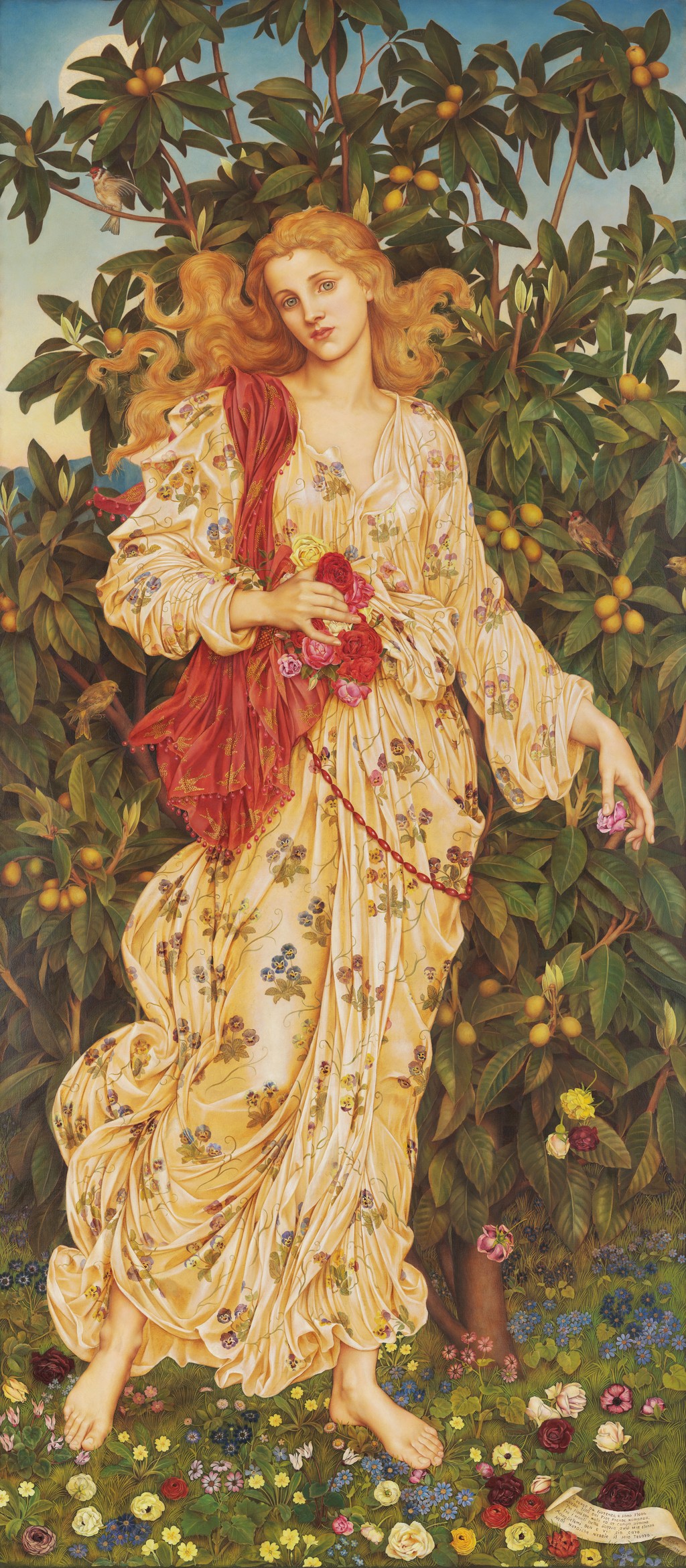
Flora brings drawing, pattern, colour and gold into a single vertical design. This oil painting dates to 1894 and bears the inscription EDeM Maggio 1894; the canvas is 1990 mm high by 880 mm wide, and the De Morgan Collection records it as P_EDM_0017.[5] Its scale demands control: the standing figure, fruiting loquat tree, small birds, patterned robe and scattered blossoms must remain distinct without breaking the upward unity.
The Foundation’s biography attributes the painting’s luminosity to coloured oils applied over gold leaf, a method inspired by medieval Florentine altarpieces.[1] That statement is specific to the work and should not be generalised to all her oils. Here it suits the subject. Flora is the Roman goddess of flowers, recast as an embodiment of Florence, and the radiant surface makes the city’s artistic past physically present.
Colour binds description to design. Green leaves and fruit establish living growth; flowers migrate from setting to dress; the figure’s pale skin and ornate robe stand forward against dense foliage. The scroll naming Florence and a future home in Scotland turns the image into a gift for its buyer, William Imrie.[5] Technique serves place, season and destination rather than existing as a display detached from meaning.
When Colour Carries the Argument
De Morgan could use colour naturalistically, rhythmically and symbolically within the same picture. A hue might model a fold, separate one body from another and indicate a stage of spiritual movement. The symbolism and allegory paintings rely on this accumulated labour: their radiance persuades because bodies and spatial relationships have already been made coherent.
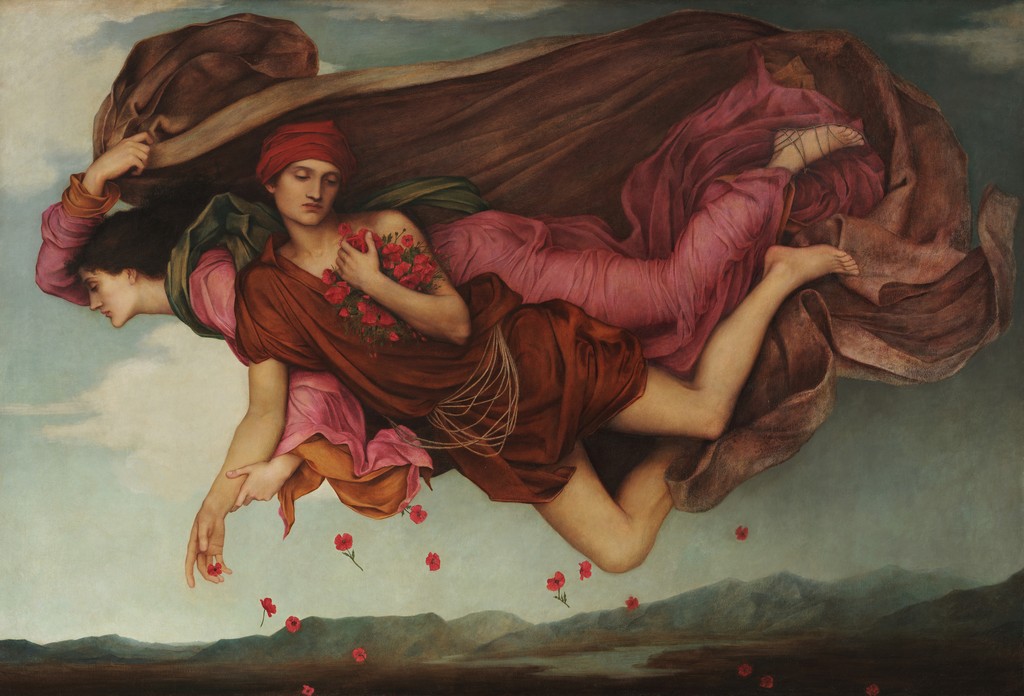
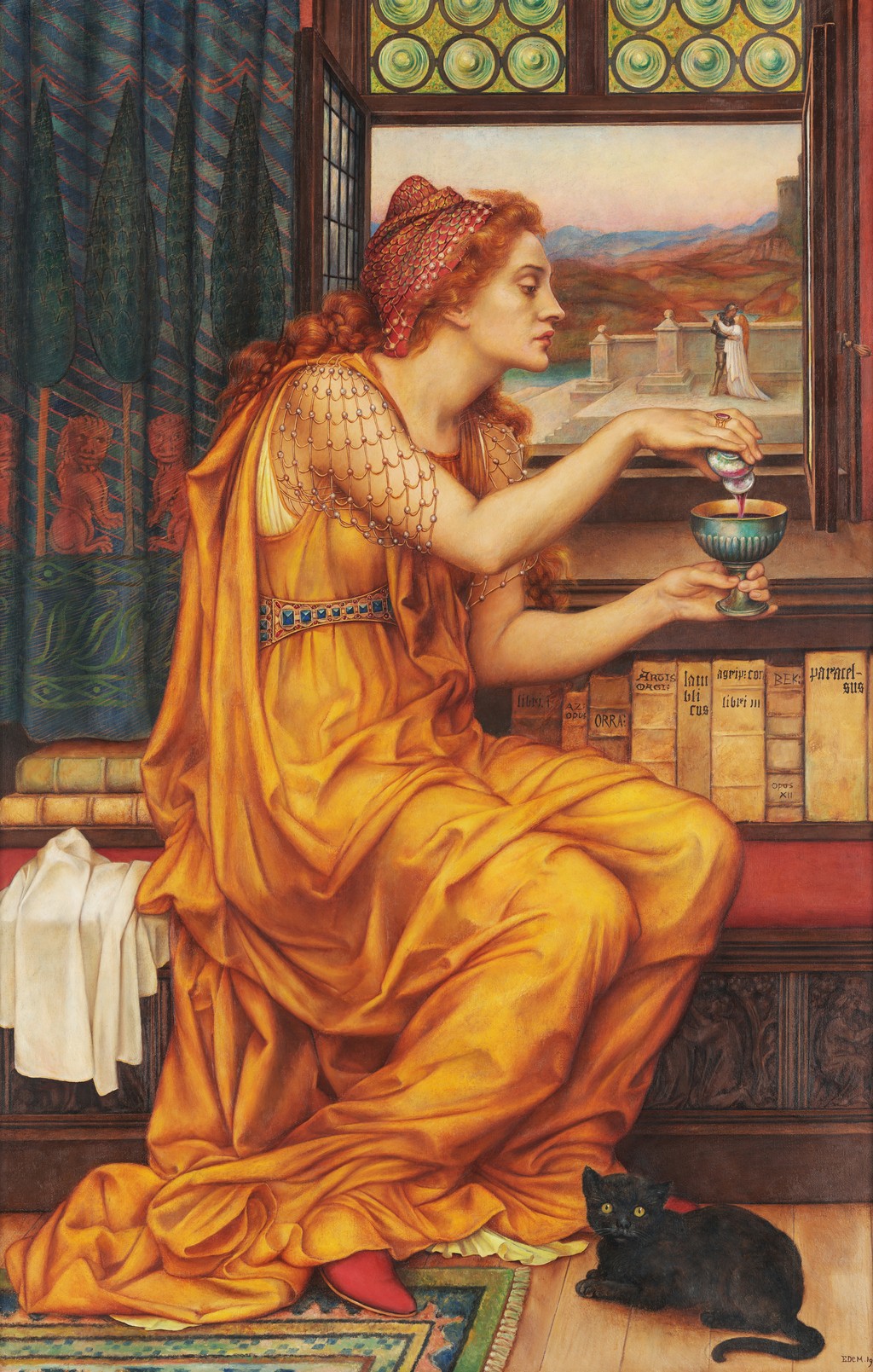
The Love Potion offers a concentrated example of colour organised as a sequence of states, while Night and Sleep uses the transition from warm evening red to encroaching darkness to make time visible. Neither effect is separable from composition. Colour follows the paths set by figures, cloth, horizon and gesture.
The word “luminous” can otherwise become evasive praise. In De Morgan’s work, it points to traceable choices: a toned support that makes light marks active, metallic material set against grey, coloured oil over a reflective layer in Flora, strongly contrasted pigments, and careful preparation of every figure that carries the light. Her technique turns glow from an impression into a constructed event.
About this directory: These 72 entries form a reproducible researched online works census assembled from current public records. It is not a catalogue raisonné and does not claim absolute completeness.
Artworks directory
| Name | Date | Medium |
|---|---|---|
| A Soul in Hell | Date unknown | Painting |
| Ariadne in Naxos | 1877 | Painting |
| Aurora Triumphans | 1877 | Painting |
| Blindness and Cupidity Chasing Joy from the City | 1897 | Painting |
| Boreas and Oreithyia | 1896 | Painting |
| Boreas and the Fallen Leaves | 1910 | Painting |
| By the Waters of Babylon | 1882 | Painting |
| Cadmus and Harmonia | 1877 | Painting |
| Cassandra | 1898 | Painting |
| Clytie | 1886 | Painting |
| Daughters of the Mist | 1909 | Painting |
| Death of a Butterfly | 1910 | Painting |
| Death of the Dragon | 1916 | Painting |
| Deianira | 1878 | Painting |
| Demeter Mourning for Persephone | 1906 | Painting |
| Drapery study | 1890 | Drawing |
| Earthbound | 1897 | Painting |
| Eos | 1895 | Painting |
| Evening Star over the Sea | 1910 | Painting |
| Flora | 1894 | Painting |
| Helen of Troy | 1898 | Painting |
| In Memoriam | 1904 | Painting |
| Life and Thought Emerging from the Tomb | 1893 | Painting |
| Love's Passing | 1883 | Painting |
| Luna (Moon) | 1885 | Painting |
| Lux in Tenebris | 1895 | Painting |
| Medea | 1889 | Painting |
| Medusa | 1879 | Painting |
| Mercury | Date unknown | Painting |
| Moonbeams dipping into the Sea | 1918 | Painting |
| 'Music Sweet Music' (Saint Cecilia) | 1884 | Painting |
| Night and Dawn | 1910 | Painting |
| Night and Sleep | 1878 | Painting |
| Our Lady of Peace | 1907 | Painting |
| Phosphorus and Hesperus | 1881 | Painting |
| Port after Stormy Seas | 1905 | Painting |
| Portrait John Roddam Spencer Stanhope | 1880 | Painting |
| Queen Eleanor and the Fair Rosamund | Date unknown | Painting |
| S.O.S. | 1914–1916 | Painting |
| Sleep and Death: the Children of Night | 1883 | Painting |
| Study for 'Saint Christina' | 1904 | Painting |
| Study from the life | 1890 | Drawing |
| Study of Arms for "The Cadence of Autumn | 1905 | Drawing |
| Sunbeam and Summer Shower | 1910 | Painting |
| The Angel of Death I | 1880 | Painting |
| The Barred Gate | 1910 | Painting |
| The Cadence of Autumn | 1905 | Painting |
| The Captives | Date unknown | Painting |
| The Dryad | 1884 | Painting |
| The Garden of Opportunity | 1892 | Painting |
| The Gilded Cage | probably 1901–1902 | Painting |
| The Grey Sisters | 1880 | Painting |
| The Hourglass | 1904 | Painting |
| The Kingdom of Heaven Suffereth Violence and the Violent Take It by Force | 1878 | Painting |
| The Light Shineth in Darkness and the Darkness Comprehendeth It Not | 1906 | Painting |
| The Little Sea Maid | 1880 | Painting |
| The Love Potion | 1903 | Painting |
| The Martyr (Nazuraea) | 1880 | Painting |
| The Mourners | 1915 | Painting |
| The Passing of the Soul at Death | 1910 | Painting |
| The Poor Man Who Saved the City | 1901 | Painting |
| The Prisoner | 1907 | Painting |
| The Red Cross | 1915 | Painting |
| The Salutation | 1883 | Painting |
| The Sea Maidens | 1885 | Painting |
| The Soul's Prison House | 1880 | Painting |
| The Storm Spirits | 1900 | Painting |
| The Worship of Mammon | 1909 | Painting |
| Twilight | 1910 | Painting |
| Venus and Cupid | 1878 | Painting |
| William De Morgan | 1909 | Painting |
| William De Morgan (1839–1917) | 1893 | Painting |
Frequently Asked Questions
Her finished paintings were usually made in oil on prepared canvas. For drawings she often used pencil or graphite, chalk and pastel on toned paper. Records also document panels, specialised grounds, metallic colour, fixatives and other experiments, but these do not replace the usual pattern.
Yes, in specific contexts. Object records identify gold paint in drawings, suppliers’ ledgers list cakes of gold, and the Foundation attributes Flora’s glow to coloured oil over gold leaf.[1][3][4] A gold-coloured passage should nevertheless be checked work by work rather than assumed to contain metal.
She moved from compositional sketches to studies from life, often drawing the same pose nude and clothed. Separate studies of faces, hands and feet refined details before a final arrangement brought the figures together.[1]
It was an experiment devised with William De Morgan in which oils were suspended in glycerine. The Foundation limits its use to Clytie and The Soul’s Prison House and reports that Evelyn did not consider it effective.[1]
There is no single cause. Tonal planning, strong contrasts, careful pigment choices, metallic gold in some drawings, reflective gold leaf in Flora and the clarity of the underlying composition all contribute. Different works require different technical explanations.
Discussion
What should readers notice when looking closely at Colour, Gold and Technique?
Reader Insights
Compare the Met arm study’s corrections and repetitions with the finish of a completed canvas.
Separate De Morgan’s normal oil-on-prepared-canvas practice from the two works made with the experimental process.
Where does colour describe a surface, and where does it begin to carry an argument?
Join the Conversation
Share your reading below, keeping observations specific and evidence clear.
References
- De Morgan Foundation, Evelyn De Morgan (1855–1919), View source
- Metropolitan Museum of Art, Study of Arms for “The Cadence of Autumn”, View source
- De Morgan Foundation, Gold Compositional Study of Male and Female Figures for “Earthbound”, View source
- De Morgan Foundation, Fiona Mann: Paint Detective, View source
- De Morgan Foundation, Flora, View source