

 by Tom Gurney
Tom Gurney BSc (Hons) is an art history expert with over 20 years experience
/
Email: tomgurney1@gmail.com / Phone: +44 7429 011000
The Gilded Cage: Introduction
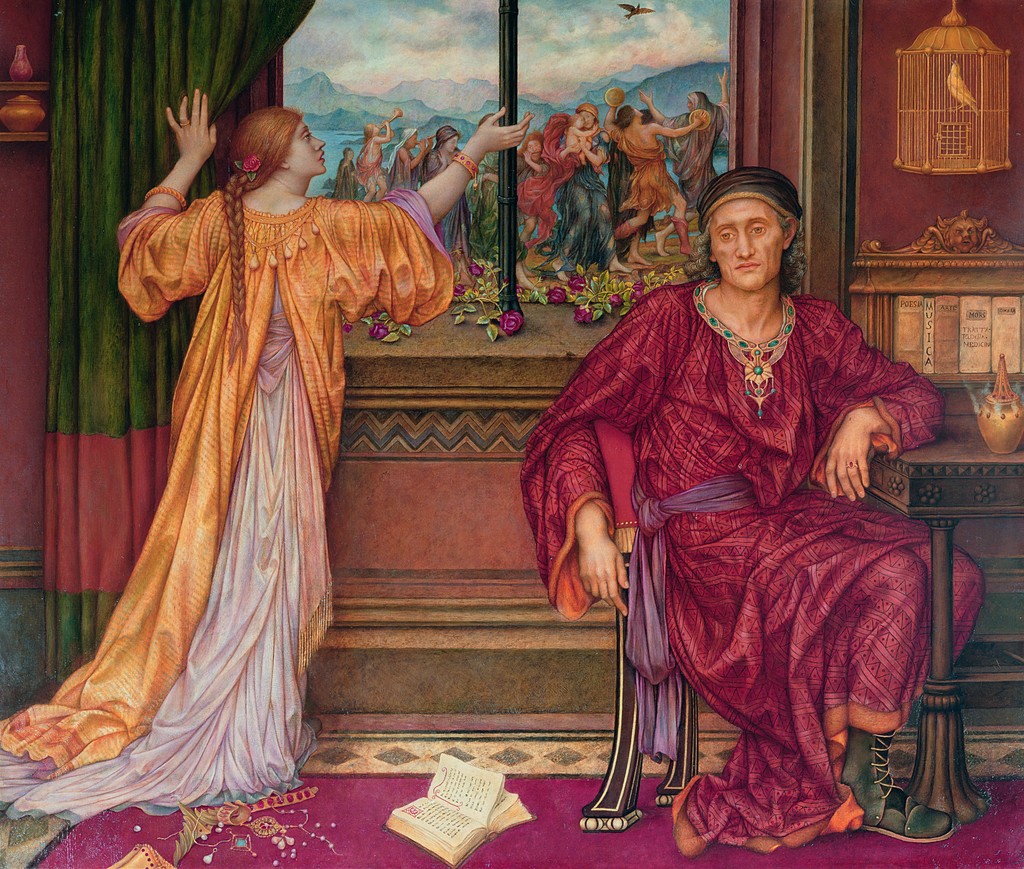
Evelyn De Morgan’s The Gilded Cage, probably painted in 1901–1902, sets material abundance against restricted choice. A young woman in gold reaches towards musicians and dancers beyond a window. An older man sits beside shelves of books and a costly interior, but he too appears despondent. Between them and the outdoor celebration hangs a canary in a gold cage. The painting makes confinement unmistakable while refusing a simple division between one happy captive and one satisfied jailer.
At a Glance
- ArtistEvelyn De Morgan
- DateProbably 1901–1902
- MediumOil on canvas
- DimensionsCanvas 910 × 1087 mm
- Identifier and collectionP_EDM_0037, De Morgan Collection
- Central themeConfinement, unequal marriage and the conflict between possession and freedom
Evelyn De Morgan in context
Cadmus and Harmonia
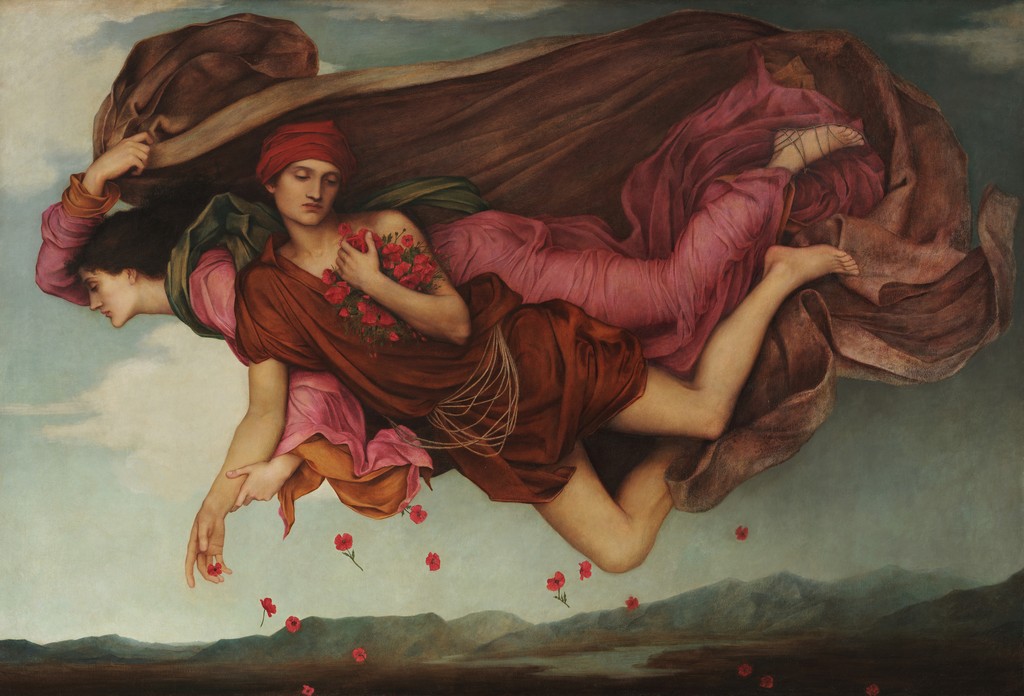
1877Night and Sleep
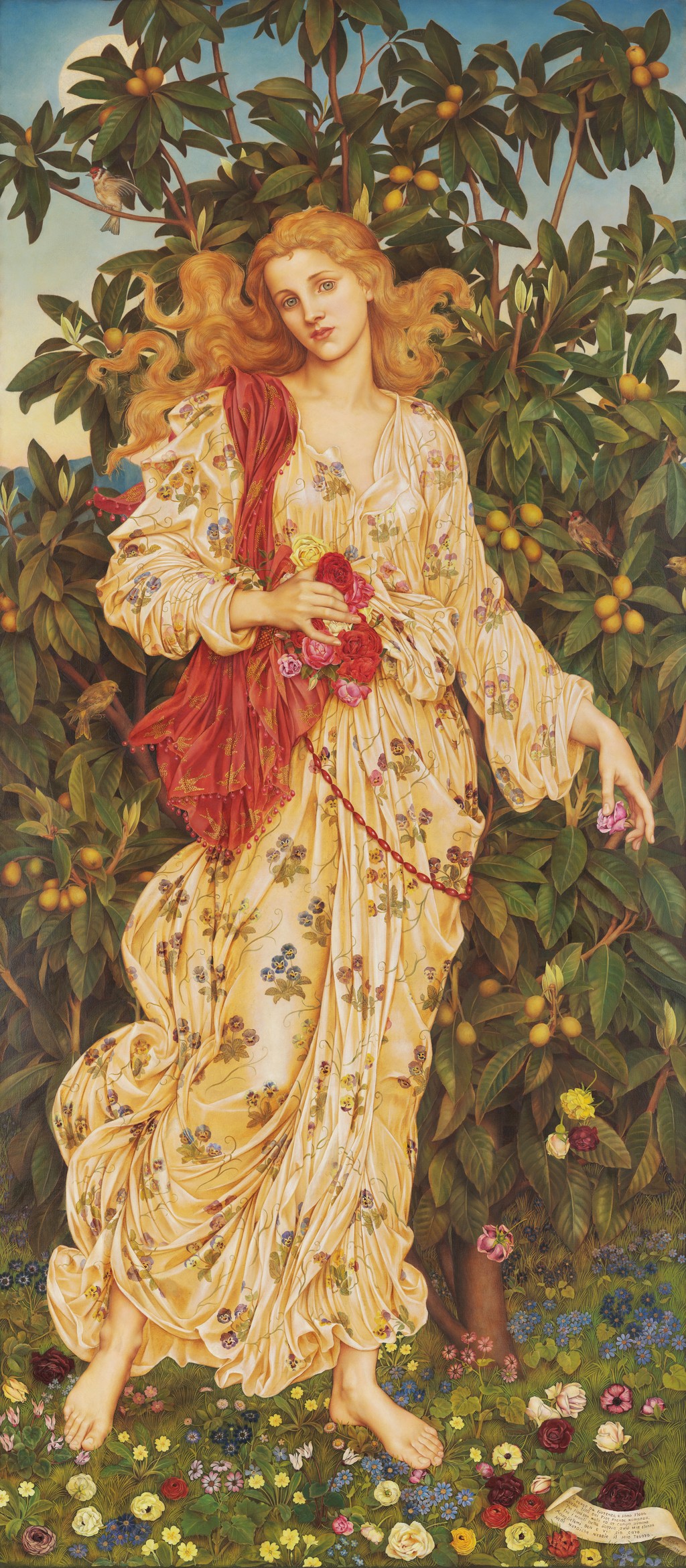
1878Flora
1894The Gilded Cage
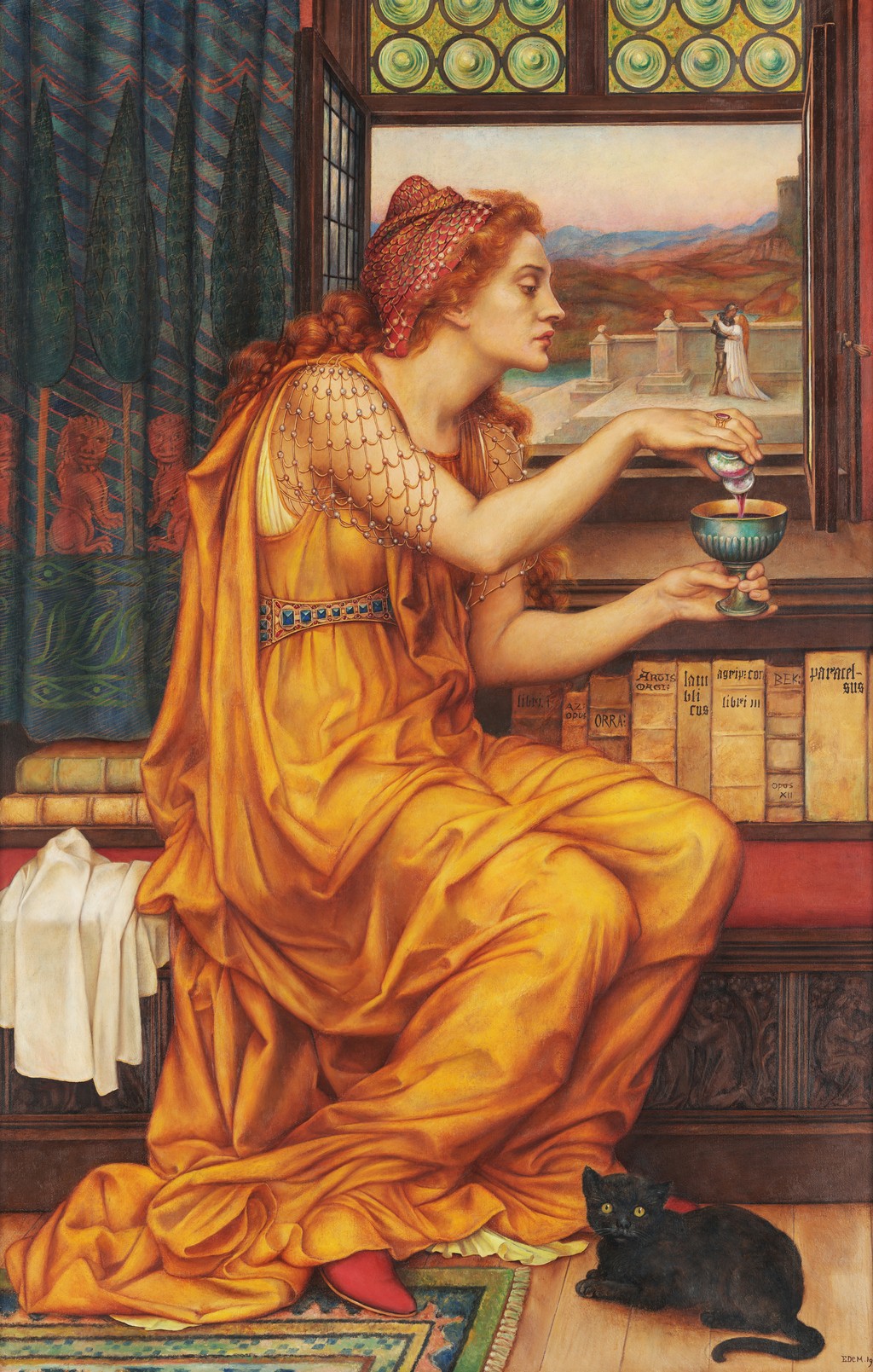
probably 1901–02The Love Potion
1903The Cadence of Autumn
1905Daughters of the Mist
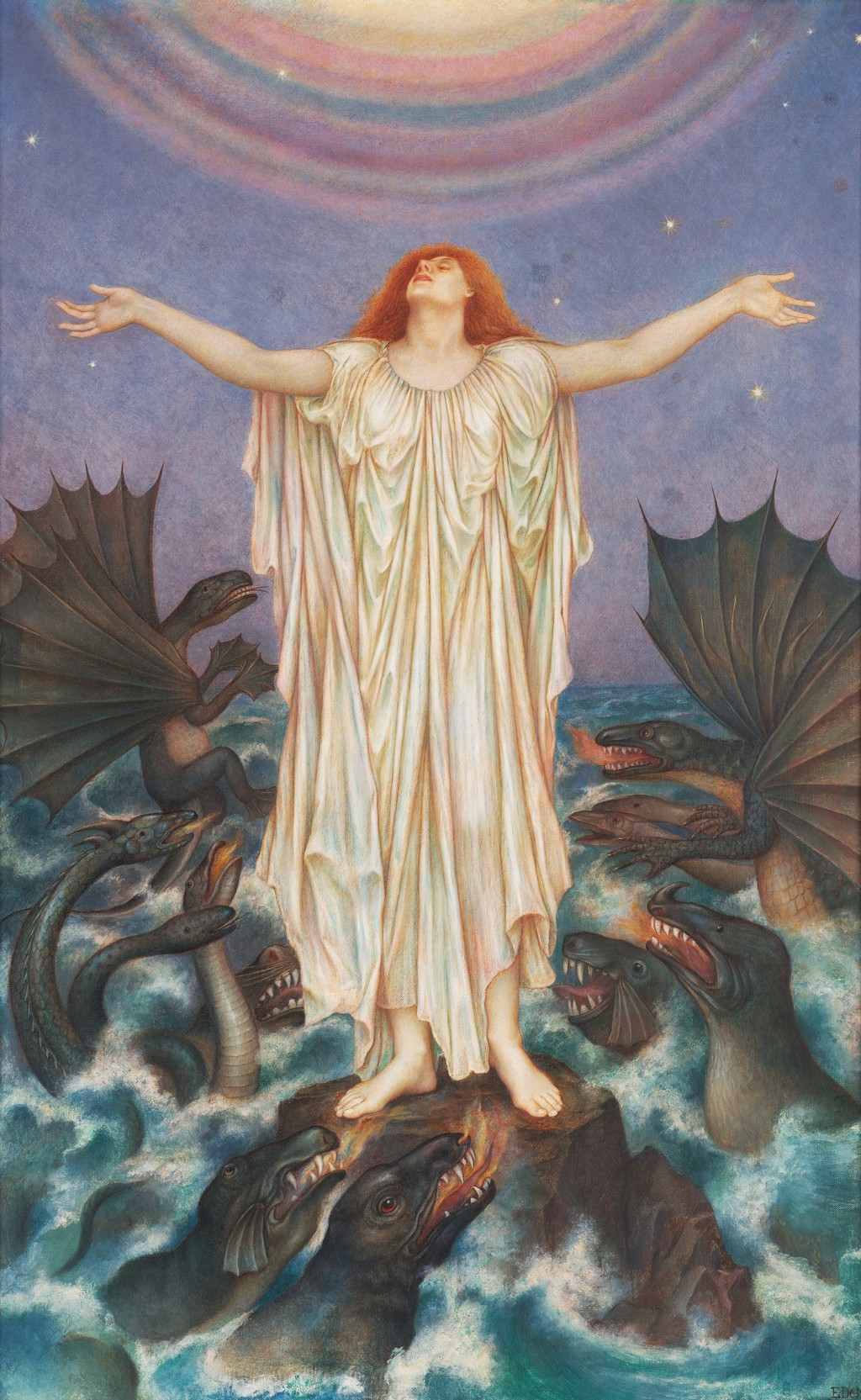
c. 1905–10S.O.S.
1914–16Contents
- An Interior Divided by a Window
- The Young Woman and What Lies at Her Feet
- The Older Man Is Not Simply Triumphant
- The Canary and the Meaning of the Title
- Books, Education and Unequal Choice
- The Suffrage Reading and Its Evidence
- Date, Identity and Autobiographical Limits
- Place among De Morgan’s Paintings
An Interior Divided by a Window
The broad canvas is organised around a large central window. To the left, the woman stands against a dark green curtain and raises both arms towards the opening. To the right, the man sits heavily in a chair beside a small table, books and decorative vessels. The difference in posture is immediate: her body reaches up and out, while his sinks down and remains inside.
Beyond them, a group in brightly coloured robes dances and makes music. Arms rise, fabric swings and figures overlap. The distant landscape opens into water, hills and a pale sky. This space is not naturalistic evidence of a specific place; it functions as a vivid alternative to the ordered room. Roses along the sill appear to cross the threshold, but the two principal figures do not.
The window therefore joins and separates two worlds. The woman can see the revellers clearly, making freedom psychologically near, while architecture keeps it physically remote. A vertical bar divides the view, and the sill rises across her body. The effect belongs to De Morgan’s broader use of symbolism and allegory: a domestic boundary carries an argument about social limitation.
The Young Woman and What Lies at Her Feet
The Foundation describes the woman as young and dressed in sumptuous gold robes. Her face turns towards the outdoor gathering, and her extended hands intensify the contrast between desire and enclosure.[1] Her exact thoughts remain inaccessible, but the direction and energy of the pose establish where her attention lies.
Jewellery and an open book are scattered on the carpet behind or near her trailing dress. These objects are valuable, beautiful and connected with cultivated life, yet she has not arranged herself to enjoy them. Their position on the floor makes them look rejected, displaced or simply unable to answer what she wants. Wealth has supplied possessions without bridging the window.
The jewellery worn on her body complicates the same idea. It advertises privilege, but abundance can also feel weighty. The painting does not argue that poverty would offer an easy solution, nor does it represent the experience of all women across class. Its target is a particular paradox: a woman may live amid luxury and still lack freedom over the direction of her life.
This is why the picture matters within De Morgan’s treatment of women, Spiritualism and freedom. The material beauty of the room cannot be used as proof that the person inside it is fulfilled.
The Older Man Is Not Simply Triumphant
The seated man occupies considerable space, yet he does not look victorious. His shoulders slope, one hand falls beside the chair and his expression meets the viewer without animation. The Foundation calls his appearance morose and suggests that he, too, may be unhappy with the arrangement.[1]
That observation prevents the allegory from becoming a cartoon of one villain and one uncomplicated victim. The age difference and unequal positions remain important, but the painting shows a relationship that fails both people. He possesses books, jewellery and an opulent household; none visibly produces companionship. She rejects or turns away from what he can offer; possession cannot create shared desire.
The Foundation offers a further possibility: the man may regret what he sees as the folly of youth, interpreting the woman’s longing as rejection of knowledge and riches.[1] This is an attributed reading, not a confirmed speech assigned to him. It gives his sadness intellectual content while exposing a gulf in values. What he considers an inheritance of culture may feel to her like another form of enclosure.
The Canary and the Meaning of the Title
The title directs attention to the small canary cage mounted high on the right wall. Its metal is gold, echoing the woman’s dress and the room’s luxury. The bird is protected, fed and ornamentally displayed, but its inability to leave defines its condition. The image makes the phrase “gilded cage” literal before extending it to the domestic interior.
The visual analogy is strong but not mechanically exact. The woman is not shown behind metal bars. She can move within the room, look outside and voice desire through gesture. Her confinement is social and relational rather than a physical prison represented without metaphor. That difference makes the symbolism sharper: invisible restrictions require a visible counterpart.
The canary also sits above the man’s side of the composition. It belongs to the possessions arranged around him, while the woman’s body occupies the opposing side. The Foundation reads the bird as an echo of patriarchal confinement within the domestic sphere.[1] Its gold surface binds beauty to control, asking whether protection and ownership can be separated when choice is absent.
Books, Education and Unequal Choice
Books appear in two places. One lies open on the floor near the woman; a row remains upright on the shelf behind the man. The Foundation transcribes Italian inscriptions on the spines including Poesia, Musica, Arte, Mors and Trattato della Medicin[a], alongside subjects it renders as poetry, music, art, death, interpretations and medicine.[1]
These are not trivial ornaments. They represent forms of knowledge and achievement that could enrich a life. Their placement, however, makes education part of the disagreement. The man sits beside preserved volumes; the woman reaches towards music performed by living bodies outside. The picture does not simply oppose dull learning to joyous ignorance, because music and art exist on both sides of the window. Instead, it contrasts possession of culture with participation in it.
The open book on the carpet is therefore ambiguous. It may signify a rejected education, an imposed ideal of refinement or a resource unable to compensate for restricted agency. The Foundation’s suggestion that the man mourns her refusal of knowledge deserves space beside the feminist reading.[1] Neither interpretation cancels the other. Knowledge offered without equality may be genuinely valuable and still fail as a substitute for freedom.
The Suffrage Reading and Its Evidence
The current object record presents women’s suffrage as an overriding theme in De Morgan’s work and calls The Gilded Cage a particularly clear example.[1] Dr Lucy Ella Rose’s Foundation essay gives that interpretation documentary ground. De Morgan signed the Declaration in Favour of Women’s Suffrage in 1889; in 1897 her signature appeared on a further appeal organised by the Central Committee of the National Society for Women’s Suffrage.[2]
Rose places this painting within a recurring group of female captivity images and reads them as statements about women’s confinement in Victorian and Edwardian domestic life.[2] That approach fits the window, bird and discarded wealth, but it remains an interpretation of pictorial form. A political signature proves De Morgan supported enfranchisement; it does not turn every detail into a one-to-one code.
The couple’s shared commitments provide further context without making the painted pair portraits. William De Morgan later served as vice-president of the Men’s League for Women’s Suffrage and supported the campaign publicly.[2] Their artistic partnership offers a significant contrast to the unequal relationship imagined here.
Date, Identity and Autobiographical Limits
The De Morgan Foundation’s current object record dates the unsigned painting “probably 1901–1902”.[1] The word “probably” is essential: it records scholarly judgement rather than a date written on the canvas. A later Foundation suffrage essay uses a much later approximate date, which demonstrates that the chronology has not always been stable.[2] The specific, current object record controls here, while its qualification preserves uncertainty.
No source in this evidence identifies the two figures as Evelyn and William De Morgan. Their difference in age is not sufficient to do so, and a symbolic marriage is not automatically an autobiographical one. The picture should be understood as an invented argument about unequal partnership unless firmer identification emerges.
That limit strengthens rather than weakens the reading. De Morgan could examine a social structure without illustrating her own household. Her documented suffrage support establishes political engagement, while the figures’ gestures, objects and setting carry the painting’s particular case.
Place among De Morgan’s Paintings
Within Evelyn De Morgan’s paintings, The Gilded Cage turns a furnished room into a debate about value. The roughly contemporary Love Potion also places a woman among books and costly objects, but there knowledge supports her agency. Here books sit within a relationship where education and wealth cannot resolve unequal choice.
A later comparison with S.O.S. shows De Morgan shifting from domestic enclosure to wartime danger. The woman in S.O.S. is isolated by monstrous seas; the woman here is isolated by social arrangement. In both, a boundary between confinement and hoped-for release structures the image without guaranteeing an easy escape.
The painting’s survival has its own history. After De Morgan’s death, her sister Wilhelmina Stirling fought to preserve works that others considered unworthy of sale. The Foundation names The Gilded Cage among the paintings she rescued and treasured; Stirling’s collection later formed the basis of the De Morgan Foundation.[3] A picture about denied value thus reached the public because another woman insisted on its value.
About this directory: These 72 entries form a reproducible researched online works census assembled from current public records. It is not a catalogue raisonné and does not claim absolute completeness.
Artworks directory
| Name | Date | Medium |
|---|---|---|
| A Soul in Hell | Date unknown | Painting |
| Ariadne in Naxos | 1877 | Painting |
| Aurora Triumphans | 1877 | Painting |
| Blindness and Cupidity Chasing Joy from the City | 1897 | Painting |
| Boreas and Oreithyia | 1896 | Painting |
| Boreas and the Fallen Leaves | 1910 | Painting |
| By the Waters of Babylon | 1882 | Painting |
| Cadmus and Harmonia | 1877 | Painting |
| Cassandra | 1898 | Painting |
| Clytie | 1886 | Painting |
| Daughters of the Mist | 1909 | Painting |
| Death of a Butterfly | 1910 | Painting |
| Death of the Dragon | 1916 | Painting |
| Deianira | 1878 | Painting |
| Demeter Mourning for Persephone | 1906 | Painting |
| Drapery study | 1890 | Drawing |
| Earthbound | 1897 | Painting |
| Eos | 1895 | Painting |
| Evening Star over the Sea | 1910 | Painting |
| Flora | 1894 | Painting |
| Helen of Troy | 1898 | Painting |
| In Memoriam | 1904 | Painting |
| Life and Thought Emerging from the Tomb | 1893 | Painting |
| Love's Passing | 1883 | Painting |
| Luna (Moon) | 1885 | Painting |
| Lux in Tenebris | 1895 | Painting |
| Medea | 1889 | Painting |
| Medusa | 1879 | Painting |
| Mercury | Date unknown | Painting |
| Moonbeams dipping into the Sea | 1918 | Painting |
| 'Music Sweet Music' (Saint Cecilia) | 1884 | Painting |
| Night and Dawn | 1910 | Painting |
| Night and Sleep | 1878 | Painting |
| Our Lady of Peace | 1907 | Painting |
| Phosphorus and Hesperus | 1881 | Painting |
| Port after Stormy Seas | 1905 | Painting |
| Portrait John Roddam Spencer Stanhope | 1880 | Painting |
| Queen Eleanor and the Fair Rosamund | Date unknown | Painting |
| S.O.S. | 1914–1916 | Painting |
| Sleep and Death: the Children of Night | 1883 | Painting |
| Study for 'Saint Christina' | 1904 | Painting |
| Study from the life | 1890 | Drawing |
| Study of Arms for "The Cadence of Autumn | 1905 | Drawing |
| Sunbeam and Summer Shower | 1910 | Painting |
| The Angel of Death I | 1880 | Painting |
| The Barred Gate | 1910 | Painting |
| The Cadence of Autumn | 1905 | Painting |
| The Captives | Date unknown | Painting |
| The Dryad | 1884 | Painting |
| The Garden of Opportunity | 1892 | Painting |
| The Gilded Cage | probably 1901–1902 | Painting |
| The Grey Sisters | 1880 | Painting |
| The Hourglass | 1904 | Painting |
| The Kingdom of Heaven Suffereth Violence and the Violent Take It by Force | 1878 | Painting |
| The Light Shineth in Darkness and the Darkness Comprehendeth It Not | 1906 | Painting |
| The Little Sea Maid | 1880 | Painting |
| The Love Potion | 1903 | Painting |
| The Martyr (Nazuraea) | 1880 | Painting |
| The Mourners | 1915 | Painting |
| The Passing of the Soul at Death | 1910 | Painting |
| The Poor Man Who Saved the City | 1901 | Painting |
| The Prisoner | 1907 | Painting |
| The Red Cross | 1915 | Painting |
| The Salutation | 1883 | Painting |
| The Sea Maidens | 1885 | Painting |
| The Soul's Prison House | 1880 | Painting |
| The Storm Spirits | 1900 | Painting |
| The Worship of Mammon | 1909 | Painting |
| Twilight | 1910 | Painting |
| Venus and Cupid | 1878 | Painting |
| William De Morgan | 1909 | Painting |
| William De Morgan (1839–1917) | 1893 | Painting |
Frequently Asked Questions
It is widely read as an allegory of a young woman confined within a wealthy but unequal marriage. The window, revellers, discarded possessions and caged canary contrast material comfort with freedom, while the older man’s unhappiness complicates the relationship.[1]
The canary makes the title visible. Like the woman, it is surrounded by beauty and care but lacks the freedom to leave. The Foundation uses this parallel to support a reading of patriarchal domestic confinement.[1]
The De Morgan Collection records the work under object number P_EDM_0037. Displays and loans can change, so current viewing information should be confirmed with the Foundation.[1]
Discussion
What should readers notice when looking closely at The Gilded Cage?
Reader Insights
Compare the young woman’s outward gesture with the older man’s stillness and the canary’s enclosure.
Use documented suffrage commitments as context while resisting an unsupported autobiographical claim.
Does the painting imagine freedom outside the room, or show how difficult that freedom is to reach?
Join the Conversation
Share your reading below, keeping observations specific and evidence clear.
References
- De Morgan Foundation, The Gilded Cage, View source
- De Morgan Foundation, The De Morgans and Suffrage, View source
- De Morgan Foundation, A Passion to Preserve Evelyn’s Paintings, View source