

 by Tom Gurney
Tom Gurney BSc (Hons) is an art history expert with over 20 years experience
/
Email: tomgurney1@gmail.com / Phone: +44 7429 011000
Evelyn De Morgan Biography: Introduction
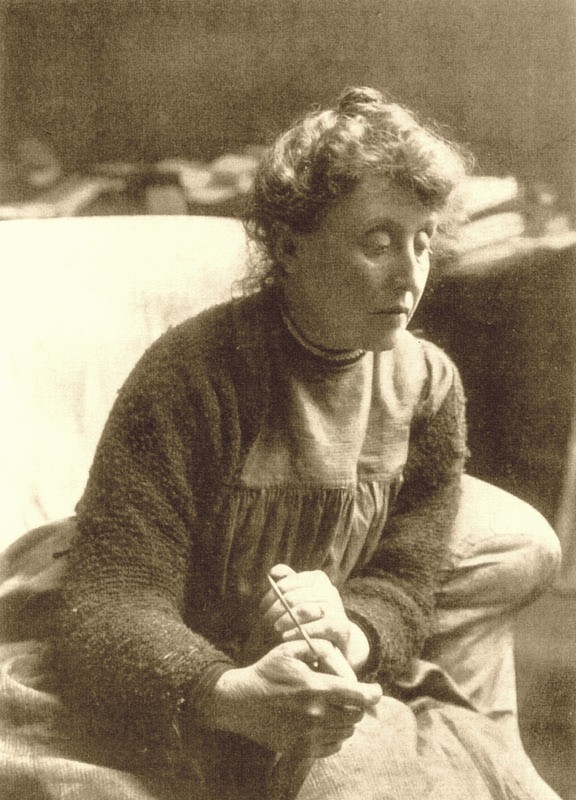
Evelyn De Morgan’s life was shaped by a sustained decision to work as a professional painter. Family wealth gave Mary Evelyn Pickering an unusually broad education, but her gender and social position also carried expectations that art would remain an accomplishment. She instead trained intensively, competed for prizes, exhibited in major galleries and earned money from her paintings for almost half a century.
Her career joined disciplined drawing to an increasingly independent symbolic language. Renaissance art, classical mythology, Aestheticism and the later Pre-Raphaelite world all mattered to her, but so did women’s freedom, spiritual development, opposition to materialism and pacifism. The result is a biography in which marriage, belief and artistic friendships are important without displacing the painter herself.[1][2]
At a Glance
- NameBorn Mary Evelyn Pickering; worked first as Evelyn Pickering and later as Evelyn De Morgan
- Dates1855–1919
- TrainingSouth Kensington National Art Training School in 1872; Slade School of Art from 1873
- Professional debutSt Catherine of Alexandria at the Dudley Gallery, London, in 1876
- SpouseWilliam De Morgan, ceramicist, designer and novelist; married in 1887
- LegacyAround 100 oil paintings according to the De Morgan Foundation, with a major body preserved through Wilhelmina Stirling’s collection
Evelyn De Morgan in context
Pre-Raphaelite movement and later circles
1848–c. 1900Aesthetic Movement
c. 1860–1900Symbolism
c. 1880–1914George Frederic Watts
1817–1904John Roddam Spencer Stanhope
1829–1908Frederic Leighton
1830–1896Edward Burne-Jones
1833–1898William De Morgan
1839–1917Evelyn De Morgan
1855–1919Cadmus and Harmonia
1877Night and Sleep
1878Flora
1894The Gilded Cage
probably 1901–02The Love Potion
1903The Cadence of Autumn
1905Daughters of the Mist
c. 1905–10S.O.S.
1914–16Contents
- Family, Education and an Ambitious Name
- South Kensington and the Slade
- A Professional Foothold, 1875–1877
- Italy, Patronage and a Mature Practice
- Marriage to William De Morgan
- Symbolism, Reform and Public Independence
- War, Loss and the Final Exhibition
- Wilhelmina Stirling and the Collection’s Survival
Family, Education and an Ambitious Name
Mary Evelyn Pickering was born in London in 1855, the eldest daughter of the barrister Percival Pickering QC and Anna Maria Spencer Stanhope. Her mother’s family included the painter John Roddam Spencer Stanhope, Evelyn’s uncle and an important artistic ally. Home education alongside her brothers gave her access to Latin, Greek, French, German and Italian, as well as classical literature, mythology and science. Those subjects later supplied more than titles: they gave her a store of stories and concepts that she could reshape through allegory.[1]
The record of family support is not simple. Wilhelmina Stirling later described her sister’s determination meeting strong opposition from their mother, including the often-repeated remark that she wanted a daughter rather than an artist. The Foundation contrasts that recollection with Percival Pickering’s surviving diary. It indicates that he paid for drawing tuition and permitted journeys with Spencer Stanhope to study Old Master paintings in France and Italy. The evidence therefore suggests negotiation within the family rather than a single, unchanging position.[1]
An anecdote preserved by institutional accounts says that Evelyn, embarrassed by arriving at art school in a family coach with an escort, asked to be dropped a short distance away and carried her own materials. It fits her resistance to the role prepared for a wealthy young woman, but it remains an anecdote rather than a dated milestone.[1][2] Firmer evidence lies in the education she pursued and the name under which she submitted her work. Around her Slade years she put aside “Mary” and used the gender-ambiguous “Evelyn Pickering”, which the Foundation interprets as a way to seek judgement on merit.[5]
South Kensington and the Slade
In 1872 De Morgan spent several months at the South Kensington National Art Training School. Its emphasis on art as a refined accomplishment did not match her professional aims, and in 1873 she entered the Slade School of Art at University College London. The Slade had opened in 1871 to both men and women. UCL records that women formed a majority of its early students and could draw from partially draped nude models, an important expansion of training otherwise restricted by gender.[4]
The opportunity was progressive but not fully equal in practice. The Foundation’s account of the 1873–1874 syllabus describes long daily sessions drawing from draped, nude and antique models, while noting restrictions on women’s access to nude study after 5pm. De Morgan nevertheless gained the anatomical and compositional discipline on which her later figures depended. She won prizes and medals for drawing from life, the antique and composition, as well as a scholarship worth £50 a year.[1]
Her studies did not end with formal education. She continued drawing throughout her career, moving from quick arrangements to detailed studies of bodies, drapery, faces, hands and feet. Grey or brown paper supported pencil and pastel; some highly finished compositional drawings were sold as works in their own right. The fuller account of colour, gold and technique follows this method into the finished oils. It also keeps her rare glycerine experiment in proportion: the jointly developed “process” was used only for Clytie and The Soul’s Prison House, according to the Foundation.[1][2]
A Professional Foothold, 1875–1877
De Morgan’s transition from student to exhibiting artist came early. She sold her first painting in 1875 while still at the Slade. In 1876 she made her professional exhibition debut at London’s Dudley Gallery with St Catherine of Alexandria. A contemporary review expressed surprise that “Evelyn Pickering” was a woman, a revealing response to the assumptions her chosen name had temporarily suspended. The painting sold to Lord Henry Somerset.[1][5]
Success at the Dudley led to an invitation to the inaugural Grosvenor Gallery exhibition in 1877. The Grosvenor offered an influential alternative to the Royal Academy and displayed De Morgan’s work beside established artists including Edward Burne-Jones, Frederic Leighton and George Frederic Watts. Her Ariadne in Naxos found a buyer there. Its classical subject, isolated heroine and carefully controlled design place it close to Aesthetic and Neo-Classical currents, while its narrative focus already presses beyond the idea of beauty without argument.[1][5]
These sales matter because they establish professional agency. De Morgan was not discovered only after her marriage, nor did she paint solely within a private domestic world. From the mid-1870s she exhibited, attracted patrons and managed the practical demands of a career. The paintings overview sets familiar works within that longer sequence, beginning with early mythological pictures rather than treating the 1890s as a sudden appearance.
Italy, Patronage and a Mature Practice
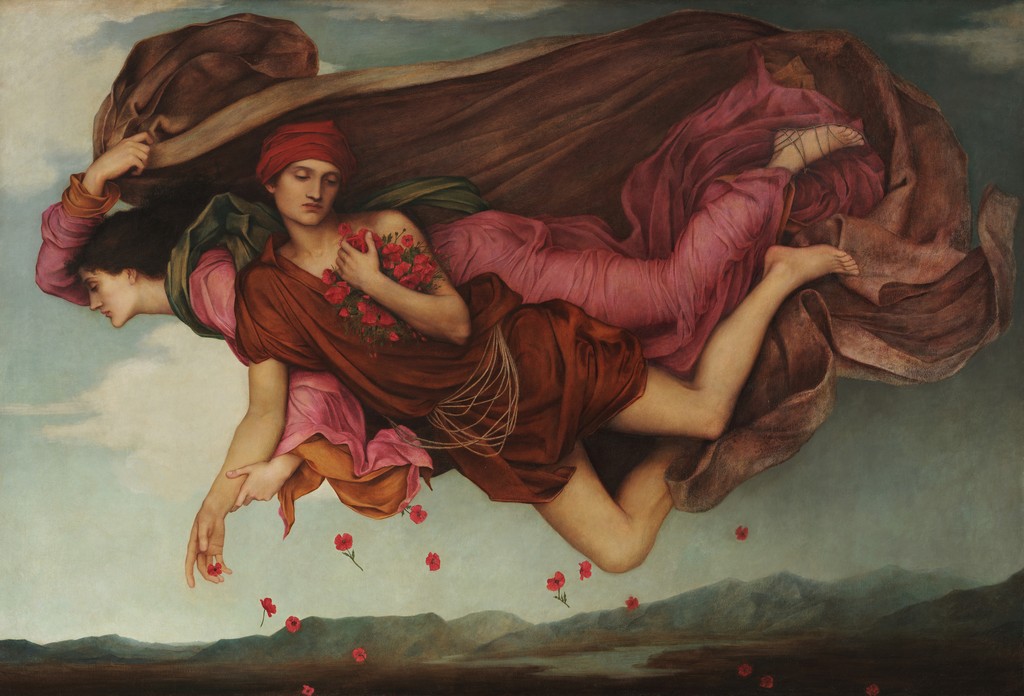
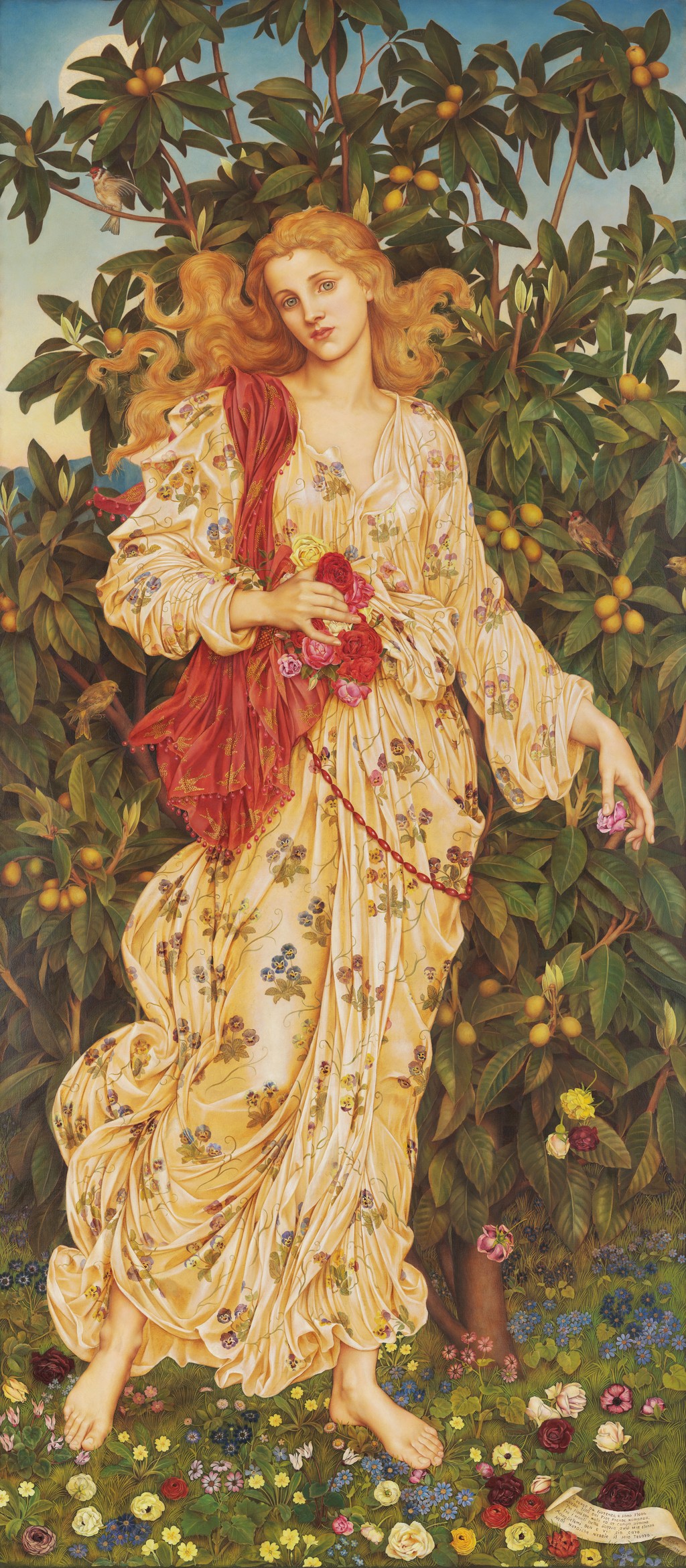
Italy entered De Morgan’s life first through study journeys with Spencer Stanhope. She examined Old Masters in France and Italy, and Botticelli became a particularly important point of reference. This did not amount to imitation. The intertwined flight of Night and Sleep recalls Renaissance figure design, while its poppies and descending darkness create a distinctly Victorian meditation on sleep. Later, Flora transformed the visual memory of Primavera into a painting rooted in Florence, modern patronage and De Morgan’s own richly patterned surface.[1][2]
Patrons made ambitious work economically possible, but their preferences also shaped what reached the easel. The Scottish shipping owner William Imrie became De Morgan’s most consistent patron and bought eight paintings. The Foundation argues that similarities among those works indicate his influence over their style. That interpretation is plausible evidence of a professional negotiation: sales enabled scale and continuity, while commissions could limit the freedom to depart from a buyer’s taste.[1]
De Morgan continued to exhibit in London and in regional centres. Her work appeared at the Grosvenor and New galleries, as well as exhibitions in Liverpool, Manchester and Birmingham. She held a solo exhibition in London in 1906 and another at Wolverhampton Art Gallery in 1907. Both the Watts Gallery and National Trust treat those exhibitions as exceptional achievements for a woman artist of the period.[2][3] This was a mature career supported by repeat buyers, public exposure and persistent production, not a sequence of isolated successes.
Marriage to William De Morgan
Evelyn Pickering married William De Morgan on 5 March 1887. By then she had already been exhibiting professionally for more than a decade. She had bought a home in Chelsea before the marriage, and William moved into it. Their life together later included joint Sunday studio visits at 45 Great Marlborough Street and, from around 1890, winters in Florence. They maintained connections with London and with friends including George and Mary Watts, William and Jane Morris, and May Morris.[5]
Their relationship is best understood as an artistic partnership between two working artists. William’s ceramics and Evelyn’s paintings remained distinct practices, even where shared beliefs, materials research or exhibition contexts connected them. The National Trust presents them as a creative couple while keeping their processes separate: her sketchbooks and preparatory drawings explain the construction of paintings, while his designs reveal the collaborative labour behind the pottery.[3]
The household economics also reverse a familiar Victorian assumption. William’s pottery business struggled to make a profit and eventually closed in 1907. The Foundation records that income from Evelyn’s paintings supported the couple, and its 2025 career account calls her the chief breadwinner.[1][5] William’s later success as a novelist changed their finances, but it does not erase her earlier contribution. Describing her primarily as “William De Morgan’s wife” therefore gets both chronology and economic reality wrong.
The couple had no children. Their shared life was organised around art, friendship, travel and reform causes rather than descendants. That fact also helps explain why Evelyn’s siblings and the wider artistic circle became so important to the later fate of both bodies of work.[5][6]
Symbolism, Reform and Public Independence
De Morgan’s mature paintings cannot be assigned neatly to one movement. Minute detail, saturated colour and medievalising elements connect her with later Pre-Raphaelite art. Idealised figures and harmonious design relate to Aestheticism, while classical subjects and Italian sources add Neo-Classical and Renaissance dimensions. The National Trust describes these stylistic affinities but emphasises that she used narrative to pursue her own social and political concerns.[3] The Evelyn De Morgan overview and her women, spiritualism and freedom study explore that independence through individual paintings.
Her interests included spiritualism, prison reform, women’s suffrage and pacifism. The Watts Gallery records that she signed the 1889 Declaration in Favour of Women’s Suffrage, while the Foundation notes that she became a founder member of the Women’s Guild of Arts in 1907.[2][5] This documentary evidence supports an account of her politics. It does not mean that every female figure is a direct suffrage emblem; the relationship between a public commitment and an individual painting still requires close reading.
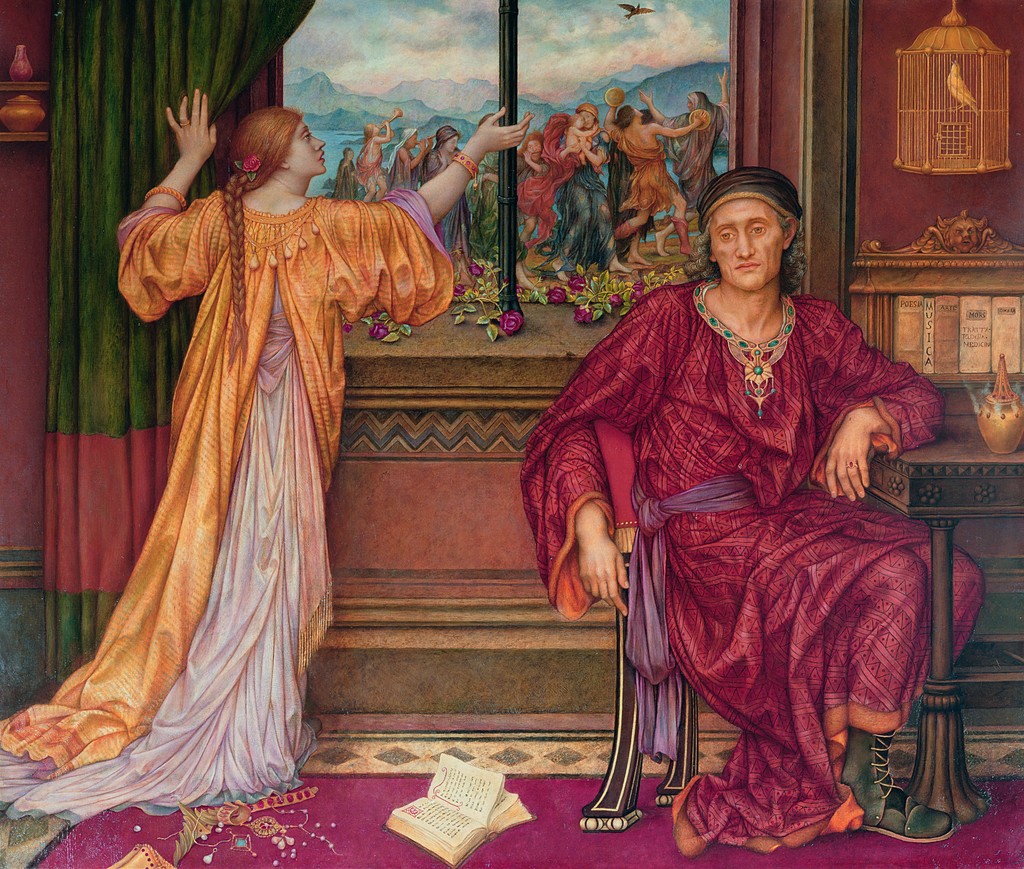
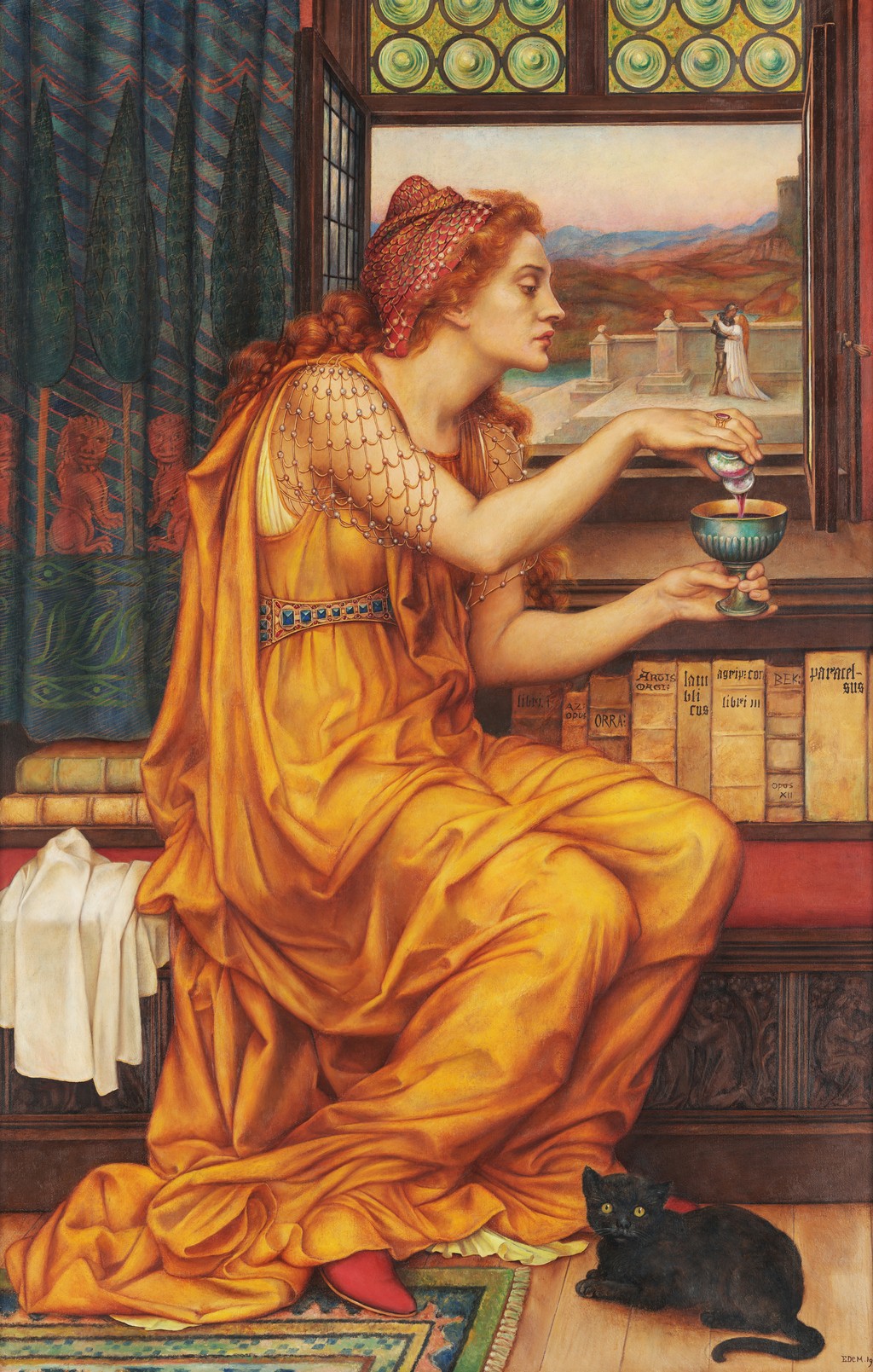
Works such as The Love Potion and The Gilded Cage show how differently that reading may operate. A learned woman surrounded by books and alchemical equipment raises questions about knowledge and spiritual ascent. A richly dressed woman looking away from an enclosed interior makes luxury resemble captivity. Neither painting is a simple illustration of a political slogan. Their symbols generate tensions among material comfort, intellectual agency and freedom.
War, Loss and the Final Exhibition
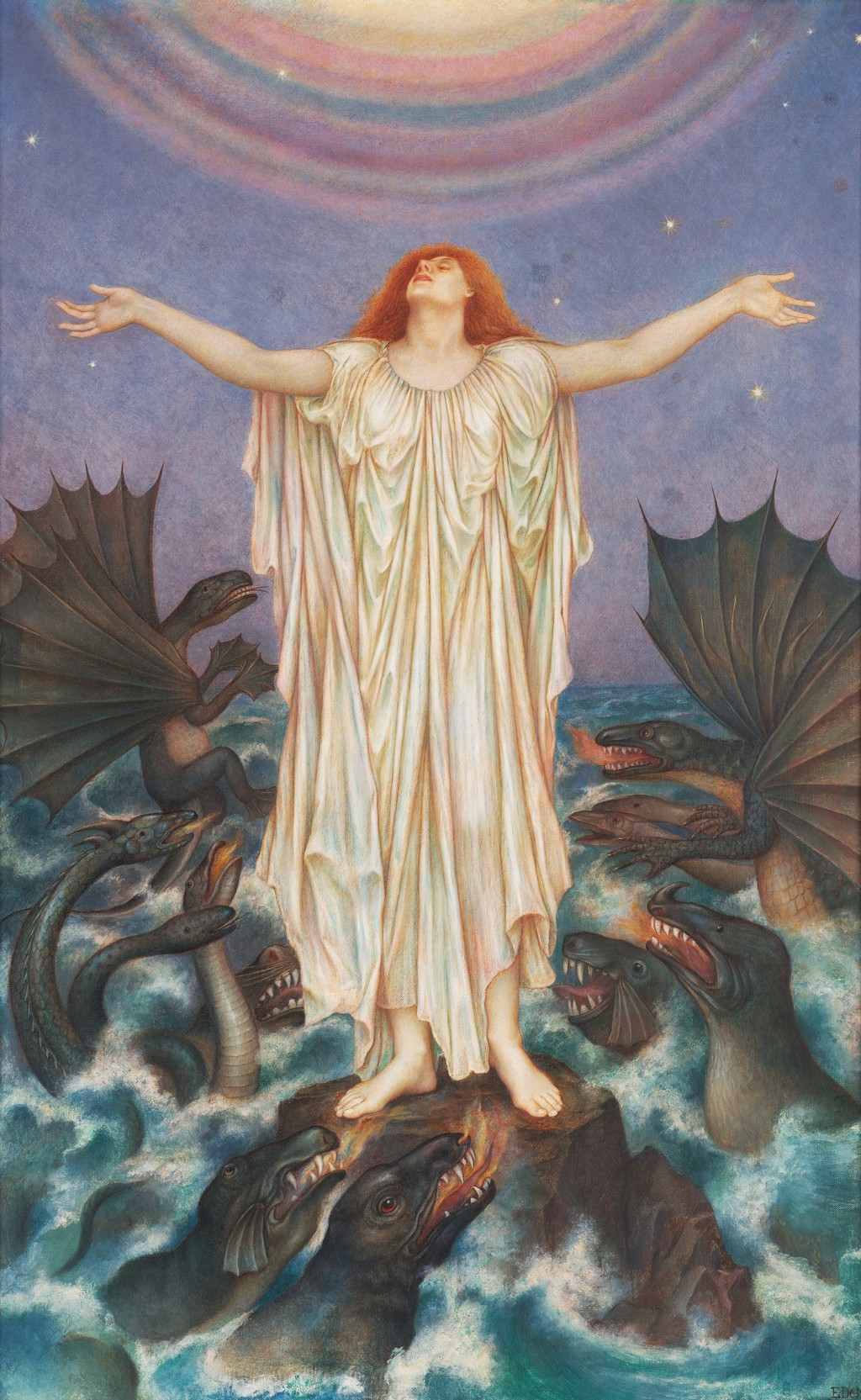
The First World War brought De Morgan’s pacifism into sharper public form. Her pictures did not report the battlefield. They used a Symbolist vocabulary of monsters, darkness, threatened bodies and distant light to address violence and the hope of release. S.O.S. places a white-robed figure on a rock amid a violent sea, reaching towards a rainbow while serpentine forms close in. Its spiritual imagery does not soften the danger; it gives De Morgan a language for rejecting war without reproducing its literal scenes.
In 1916 she showed war paintings in her studio to raise funds for the British Red Cross and the Italian Croce Rossa. The exhibition was both charitable action and a late assertion of artistic purpose. The dedicated account of war and pacifism follows the imagery across her conflict pictures rather than treating this event in isolation.[1][2]
William became ill late in 1916 and died on 15 January 1917. Evelyn responded to the problem of his artistic legacy with practical care: she gave 1,200 drawings and numerous ceramics to the Victoria and Albert Museum and asked May Morris to prepare an obituary for The Burlington Magazine.[7] De Morgan survived him by just over two years. She died on 2 May 1919 and was buried with William at Brookwood Cemetery beneath a headstone she had designed.[1][5]
The Foundation qualifies the scale of her production as around 100 oil paintings across a roughly 50-year career. It preserves 56 of those oils alongside a large body of preparatory drawings.[1] Those figures convey sustained labour without pretending that every work or date is settled.
Wilhelmina Stirling and the Collection’s Survival
De Morgan did not arrange for her remaining studio paintings to stay together. Her will directed that they be sold to benefit St Dunstan’s, now Blind Veterans UK. Some works were judged unsuitable for sale by the executors. Her younger sister Wilhelmina Stirling intervened, offering to buy paintings, arranging conservation and persisting through a family dispute over their disposal. Among the works she saved were St Christina Giving Her Father’s Jewels to the Poor and The Gilded Cage.[7]
Wilhelmina continued collecting work by Evelyn and William, wrote William De Morgan and his Wife in 1922 and displayed her holdings at Old Battersea House from the 1930s. During the Second World War, her connection with the Mander family allowed the collection to be stored away from the London Blitz at Wightwick Manor.[3][6] These actions preserved objects, but they also shaped the story available to later viewers. A collection assembled by a devoted sister inevitably reflects choices, family memories and opportunities to buy work back.
On Wilhelmina’s death in 1965, her collection was left in trust for public enjoyment and became the basis of the De Morgan Foundation.[6][7] That legacy has reunited paintings with drawings, made close study of De Morgan’s method possible and returned her to public view as an artist in her own right. The preservation story is therefore not an epilogue detached from the career. It is the reason much of that career can now be reconstructed.
Follow Evelyn De Morgan’s career through four stages
Education, the Slade and professional ambition
Mary Evelyn Pickering developed a classical education before studying at South Kensington and the Slade. Prizes for drawing, repeated Italian travel and her first sale prepared a professional debut that resisted the expectations attached to her class and gender.
Classical stories, Renaissance looking and public success
Ariadne in Naxos and Cadmus and Harmonia placed female figures at the centre of classical stories. De Morgan combined close figure study with lessons drawn from Botticelli and other Italian Renaissance painters while exhibiting in ambitious London galleries.
Partnership, patronage and an independent visual language
Marriage to William De Morgan formed an equal artistic partnership rather than ending Evelyn’s career. Flora, The Gilded Cage and The Love Potion join meticulous surfaces to arguments about knowledge, material constraint, spiritual choice and female agency.
Prismatic colour, reform causes and wartime hope
Later paintings make colour, mist, bonds, dragons and rainbows increasingly symbolic. Suffrage, spiritualism and opposition to war informed the work, while the 1916 studio benefit turned pacifist imagery into practical support for Red Cross organisations.
About this directory: These 72 entries form a reproducible researched online works census assembled from current public records. It is not a catalogue raisonné and does not claim absolute completeness.
Artworks directory
| Name | Date | Medium |
|---|---|---|
| A Soul in Hell | Date unknown | Painting |
| Ariadne in Naxos | 1877 | Painting |
| Aurora Triumphans | 1877 | Painting |
| Blindness and Cupidity Chasing Joy from the City | 1897 | Painting |
| Boreas and Oreithyia | 1896 | Painting |
| Boreas and the Fallen Leaves | 1910 | Painting |
| By the Waters of Babylon | 1882 | Painting |
| Cadmus and Harmonia | 1877 | Painting |
| Cassandra | 1898 | Painting |
| Clytie | 1886 | Painting |
| Daughters of the Mist | 1909 | Painting |
| Death of a Butterfly | 1910 | Painting |
| Death of the Dragon | 1916 | Painting |
| Deianira | 1878 | Painting |
| Demeter Mourning for Persephone | 1906 | Painting |
| Drapery study | 1890 | Drawing |
| Earthbound | 1897 | Painting |
| Eos | 1895 | Painting |
| Evening Star over the Sea | 1910 | Painting |
| Flora | 1894 | Painting |
| Helen of Troy | 1898 | Painting |
| In Memoriam | 1904 | Painting |
| Life and Thought Emerging from the Tomb | 1893 | Painting |
| Love's Passing | 1883 | Painting |
| Luna (Moon) | 1885 | Painting |
| Lux in Tenebris | 1895 | Painting |
| Medea | 1889 | Painting |
| Medusa | 1879 | Painting |
| Mercury | Date unknown | Painting |
| Moonbeams dipping into the Sea | 1918 | Painting |
| 'Music Sweet Music' (Saint Cecilia) | 1884 | Painting |
| Night and Dawn | 1910 | Painting |
| Night and Sleep | 1878 | Painting |
| Our Lady of Peace | 1907 | Painting |
| Phosphorus and Hesperus | 1881 | Painting |
| Port after Stormy Seas | 1905 | Painting |
| Portrait John Roddam Spencer Stanhope | 1880 | Painting |
| Queen Eleanor and the Fair Rosamund | Date unknown | Painting |
| S.O.S. | 1914–1916 | Painting |
| Sleep and Death: the Children of Night | 1883 | Painting |
| Study for 'Saint Christina' | 1904 | Painting |
| Study from the life | 1890 | Drawing |
| Study of Arms for "The Cadence of Autumn | 1905 | Drawing |
| Sunbeam and Summer Shower | 1910 | Painting |
| The Angel of Death I | 1880 | Painting |
| The Barred Gate | 1910 | Painting |
| The Cadence of Autumn | 1905 | Painting |
| The Captives | Date unknown | Painting |
| The Dryad | 1884 | Painting |
| The Garden of Opportunity | 1892 | Painting |
| The Gilded Cage | probably 1901–1902 | Painting |
| The Grey Sisters | 1880 | Painting |
| The Hourglass | 1904 | Painting |
| The Kingdom of Heaven Suffereth Violence and the Violent Take It by Force | 1878 | Painting |
| The Light Shineth in Darkness and the Darkness Comprehendeth It Not | 1906 | Painting |
| The Little Sea Maid | 1880 | Painting |
| The Love Potion | 1903 | Painting |
| The Martyr (Nazuraea) | 1880 | Painting |
| The Mourners | 1915 | Painting |
| The Passing of the Soul at Death | 1910 | Painting |
| The Poor Man Who Saved the City | 1901 | Painting |
| The Prisoner | 1907 | Painting |
| The Red Cross | 1915 | Painting |
| The Salutation | 1883 | Painting |
| The Sea Maidens | 1885 | Painting |
| The Soul's Prison House | 1880 | Painting |
| The Storm Spirits | 1900 | Painting |
| The Worship of Mammon | 1909 | Painting |
| Twilight | 1910 | Painting |
| Venus and Cupid | 1878 | Painting |
| William De Morgan | 1909 | Painting |
| William De Morgan (1839–1917) | 1893 | Painting |
Frequently Asked Questions
Yes. She sold a painting as a student, exhibited professionally from 1876, joined the inaugural Grosvenor Gallery exhibition in 1877 and developed a network of patrons. Solo exhibitions in London in 1906 and Wolverhampton in 1907 demonstrate that her reputation was established well before later revival.[2][5]
She died on 2 May 1919 and was buried beside William at Brookwood Cemetery. Her will called for studio paintings to be sold for charity, but Wilhelmina Stirling recovered and collected many works, eventually leaving her collection in trust. It formed the basis of the De Morgan Foundation and secured a substantial public legacy for both artists.[5][6][7]
Discussion
What should readers notice when looking closely at Evelyn De Morgan Biography?
Reader Insights
Notice how repeatedly drawing the figure joins De Morgan’s student years to her mature paintings.
Test the chronology against the easy but misleading story that marriage ended a Victorian woman’s career.
Which institution or person most changed the conditions under which De Morgan could work?
Join the Conversation
Share your reading below, keeping observations specific and evidence clear.
References
- De Morgan Foundation, Evelyn De Morgan (1855–1919), View source
- Watts Gallery Artists’ Village, Evelyn De Morgan, View source
- National Trust, The De Morgan Gallery at Wightwick, View source
- UCL, UCL Timeline: Slade School opens, View source
- De Morgan Foundation, Evelyn De Morgan: The Modern Artist in Victorian London, View source
- De Morgan Foundation, Wilhelmina Stirling, View source
- De Morgan Foundation, A Passion to Preserve Evelyn’s Paintings, View source