

 by Tom Gurney
Tom Gurney BSc (Hons) is an art history expert with over 20 years experience
/
Email: tomgurney1@gmail.com / Phone: +44 7429 011000
Night and Sleep: Introduction
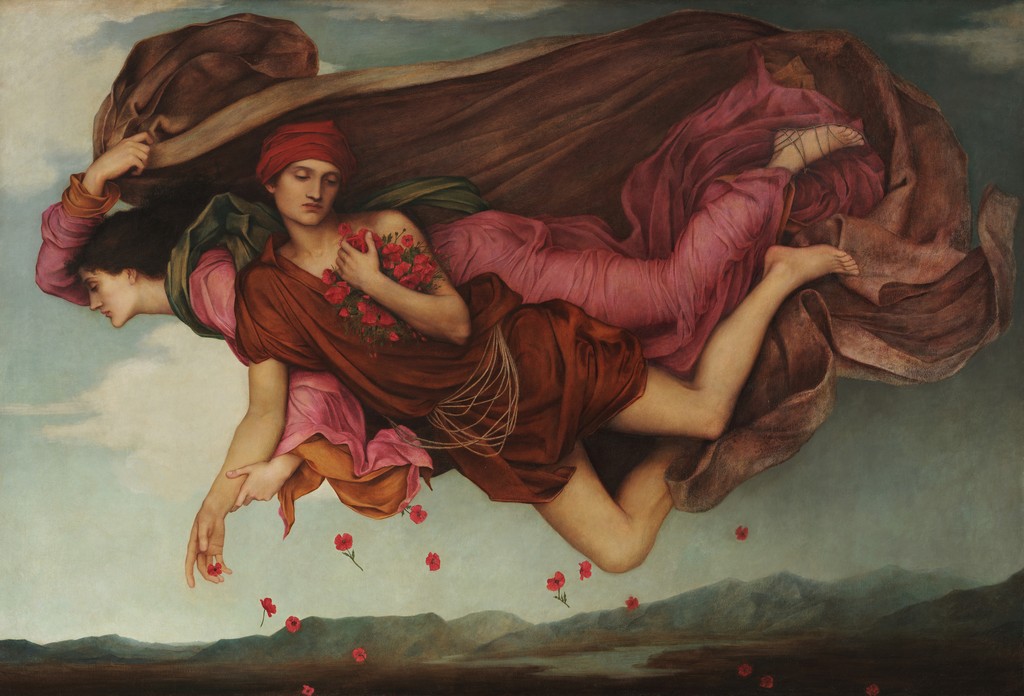
In Night and Sleep (1878), Evelyn De Morgan turns the daily arrival of darkness into a suspended procession. Two personifications pass above a low landscape, joined by their bodies and streaming clothes. One draws a vast cloak across the sky; the other lets red poppies fall towards the earth. The painting is immediately legible as an image of evening, yet its unusual pairing of stillness and flight rewards a slower look.
At a Glance
- ArtistEvelyn De Morgan
- Date1878
- MediumOil on canvas
- Dimensions1088 × 1578 mm
- Identifier and collectionP_EDM_0001, De Morgan Collection
- SubjectThe personifications of Night and Sleep crossing the evening sky
Evelyn De Morgan in context
Cadmus and Harmonia
1877Night and Sleep
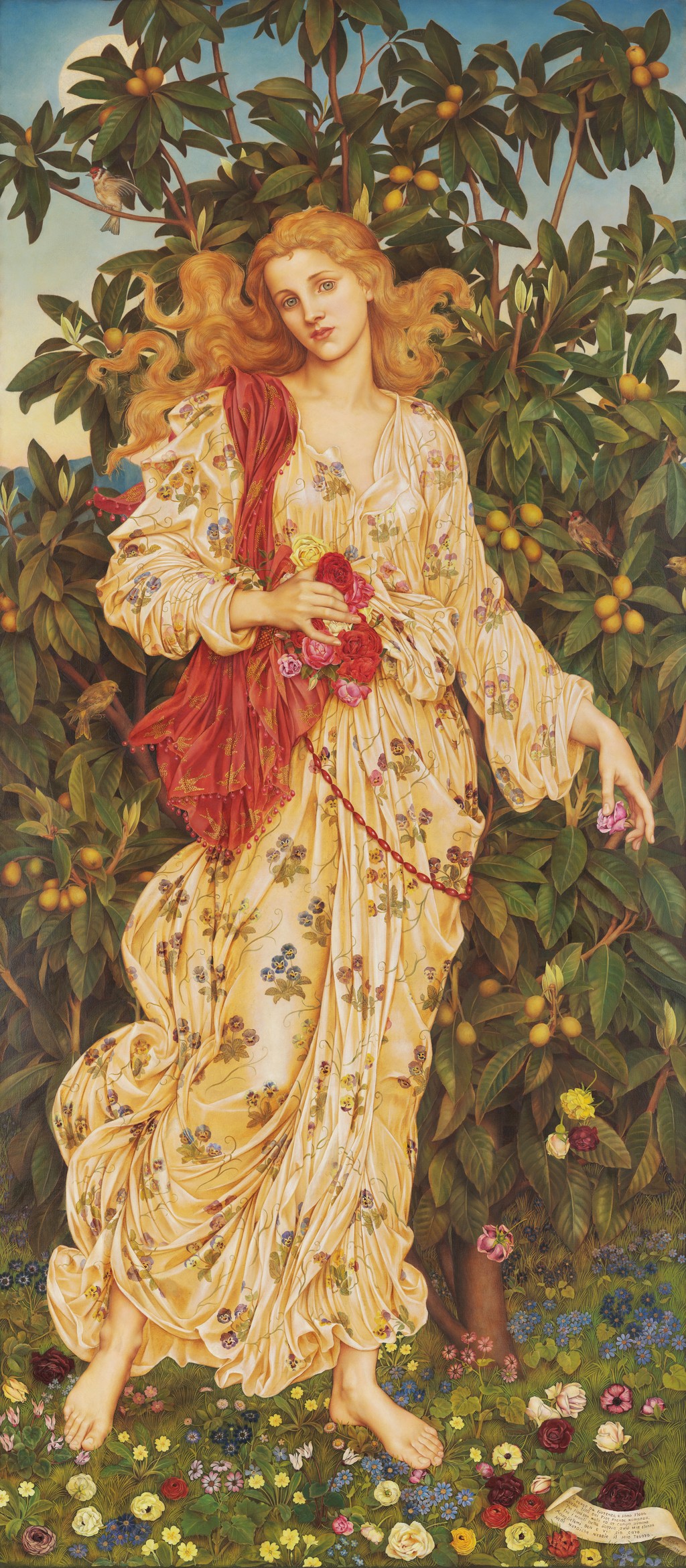
1878Flora
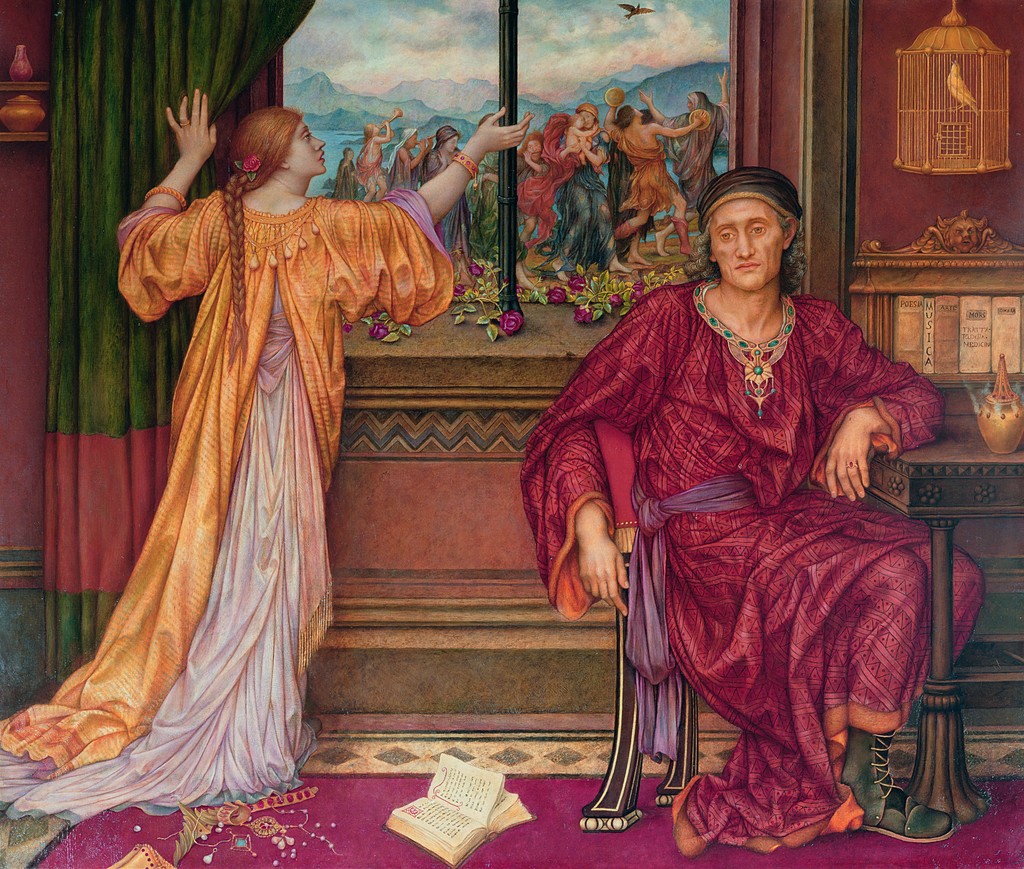
1894The Gilded Cage
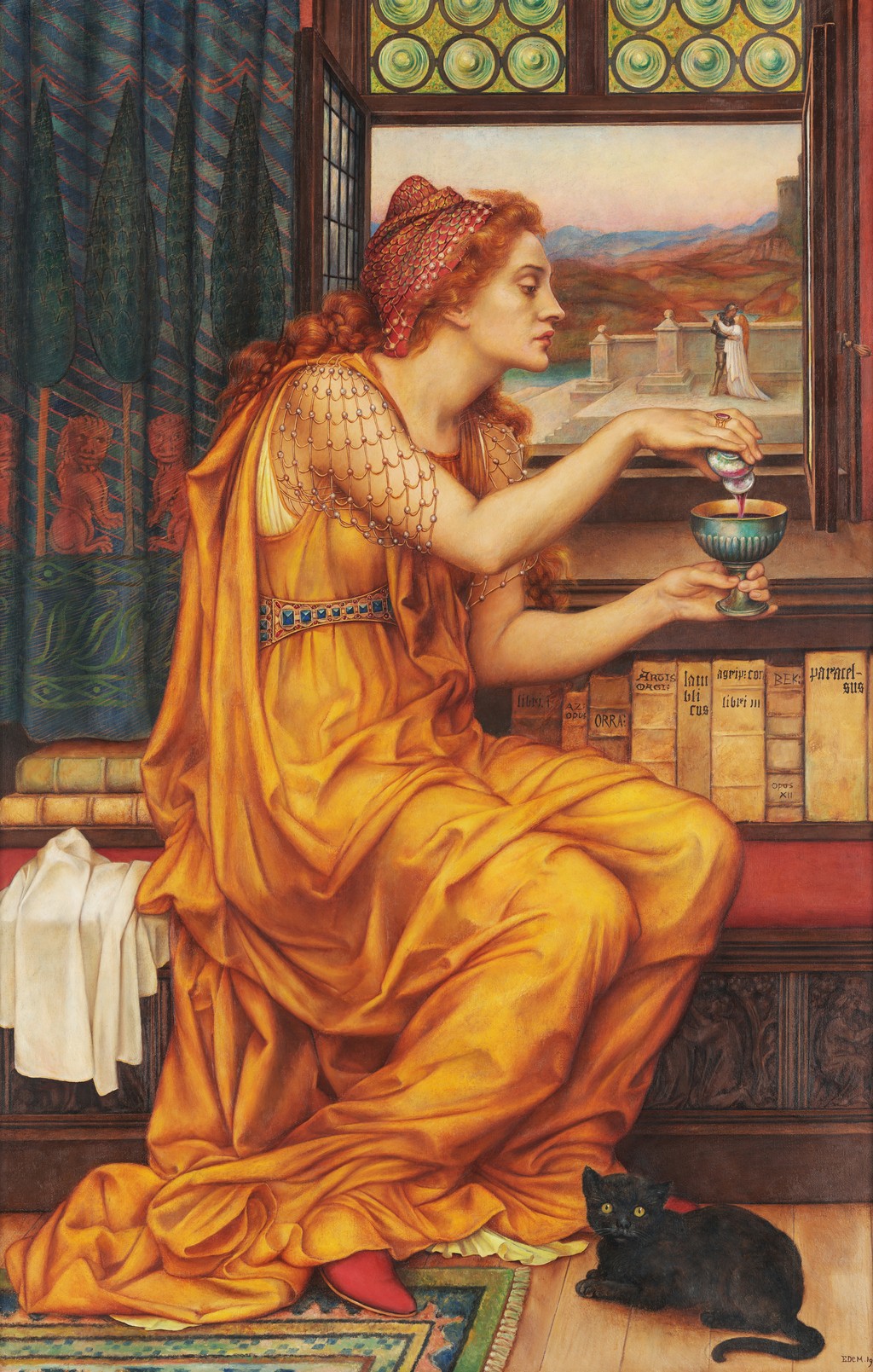
probably 1901–02The Love Potion
1903The Cadence of Autumn
1905Daughters of the Mist
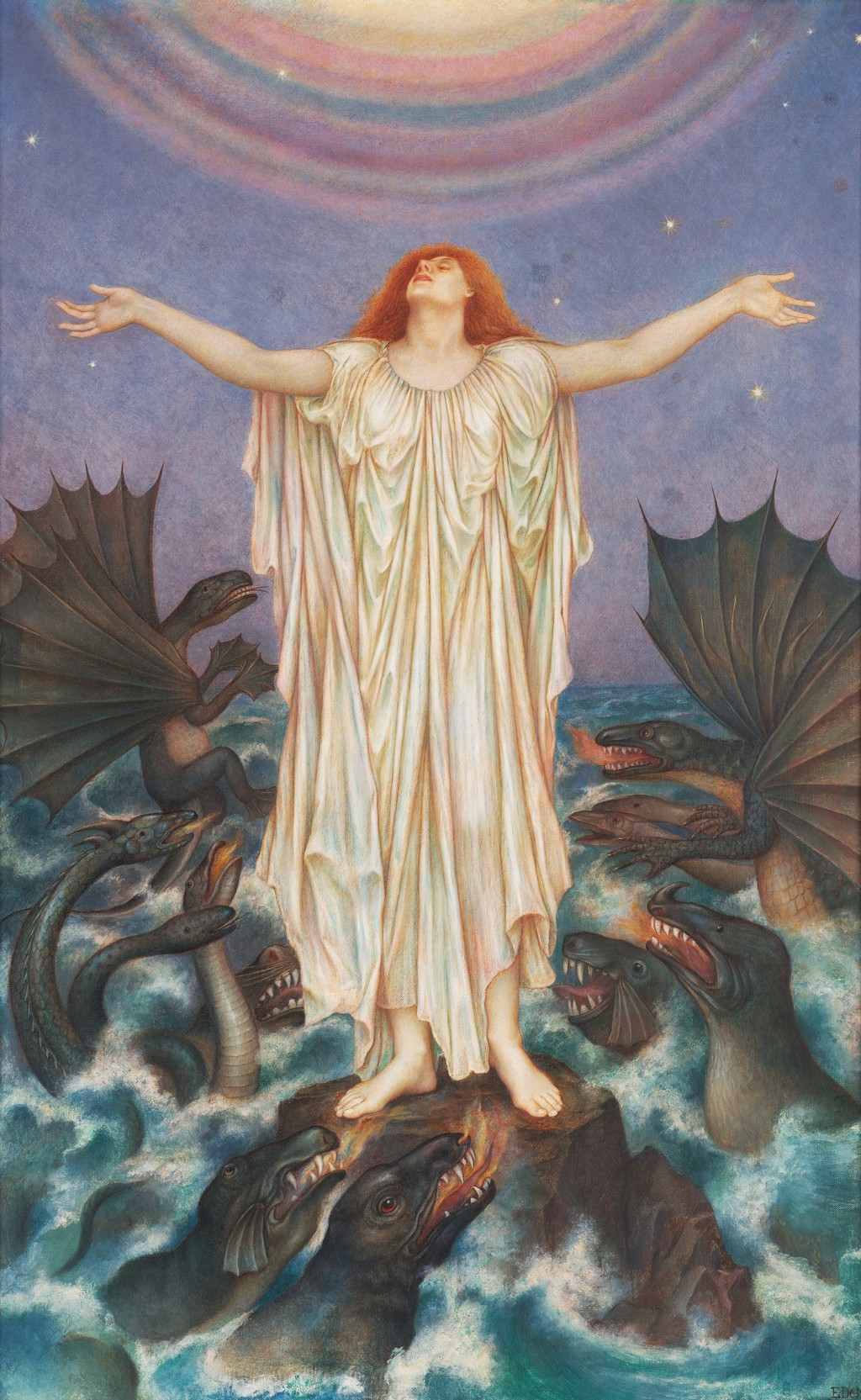
c. 1905–10S.O.S.
1914–16Contents
- What Is Happening in Night and Sleep?
- Two Figures Moving as One
- Drapery, Hair and the Direction of Flight
- Poppies and the Approach of Sleep
- From Pale Sky to Dark Cloak
- The Botticelli Comparison
- An Early Work, Not a Career in Miniature
- Looking Across De Morgan’s Paintings
What Is Happening in Night and Sleep?
De Morgan presents Night and Sleep as embodied forces rather than as an observed nocturnal scene. They float from right to left across the full width of the canvas. Night, at the rear, holds up a broad dark cloak that fills much of the upper field. Sleep lies across the foreground, carrying poppies and releasing them over the landscape below. The De Morgan Foundation describes both figures as relaxed, with closed eyes, already sharing the condition they bring to the world.[1]
There is no single dramatic incident. A hand loosens its hold on a flower, blossoms descend at different heights and the cloak covers the paler sky. Day does not end at a sharp boundary: darkness spreads, flowers fall and consciousness appears to soften.
The subject belongs to personification, in which an idea or natural force takes human form. This connects the work to De Morgan’s engagement with mythology and transformation, although the figures enact no long mythological story. Their identities are carried by their actions: Night covers, while Sleep distributes rest.
Two Figures Moving as One
The composition depends on the closeness of the pair. Their limbs overlap, their garments interlock and their bodies form a long horizontal shape. Sleep’s bent legs and Night’s sweeping arm create a sequence of diagonals, but the two figures remain contained within the same flowing silhouette. Neither appears to fly independently. Their physical entanglement makes Night and Sleep seem like related parts of one recurring process.
De Morgan balances movement with repose. Eyes are lowered or closed, heads incline and hands remain loose. Although drapery streams as if driven by air, the figures carry the bodily quiet associated with sleep.
The wide canvas strengthens the effect. A vertical arrangement would have suggested ascent or descent. Here the lateral format gives the pair room to pass across the viewer’s field of vision like weather moving over land. The emptiness below them also matters. Their scale and proximity make them feel immense, while the distant terrain reduces the human world to a narrow strip.
Drapery, Hair and the Direction of Flight
De Morgan uses cloth to make invisible movement visible. Night’s cloak stretches behind and above the figures, its folds rising, dipping and gathering around their feet. The edge behaves almost like a dark bank of cloud. Pink, red and rust-coloured garments flow in parallel bands, carrying the eye along the picture before the falling poppies interrupt that direction.
Strands, hems and folds bend at different rates, preventing the group from becoming a flat emblem. The bodies remain stable within this turbulence: Sleep’s arm rests across the poppies, while Night’s grip is firm but not strained.
This command of the figure followed her Slade training, where she won prizes for life drawing and composition. The Foundation records that she continued to draw from the figure throughout her career.[2] Although the exact preparatory sequence for Night and Sleep is not established here, the finished work coordinates anatomy and drapery into a single design.
Poppies and the Approach of Sleep
The poppies are the most concentrated points of colour. Sleep holds a dense armful against the body, while separate red flowers drop towards the land. Their staggered positions measure the space between the figures and the earth. They also turn an abstract force into a visible action: sleep is being scattered.
The Foundation connects the flowers with the sedative associations of the opium poppy and notes that Victorians used laudanum, made with tincture of opium, as a sleeping draught.[1] A separate Foundation essay advances a more pointed reading, proposing that the image addresses women’s dependence on laudanum.[3] That interpretation is useful, but it should not be mistaken for an uncontested statement of the artist’s intention. What the painting makes certain is the link between the blossoms and induced rest; the wider social meaning remains a reasoned institutional reading.
The flowers complicate the mood. Their red petals are vivid, yet associated with drowsiness and lost waking control. They descend gently rather than threateningly, allowing attraction and unease to coexist — a quality central to De Morgan’s symbolism and allegory.
From Pale Sky to Dark Cloak
The landscape is sparse: low hills, a thin band of earth and an open expanse of sky. Its restraint prevents it from competing with the figures, but it is not merely a backdrop. The pale atmosphere beneath the pair contrasts with the dark fabric above, so the whole image can be read as a transition in light. Night’s cloak does not simply signify darkness; it appears to produce it by covering what remains of the day.
Red and pink garments sit between those light and dark zones. Their warmth recalls the last colour of sunset, an association also made by the Foundation’s object account.[1] Muted greens and browns steady the brighter reds, while the scattered flowers carry the colour down into the landscape. The result is a controlled sequence rather than a naturalistic record of a particular sunset.
The wider account of De Morgan’s colour, gold and technique places this tonal design in context. Here colour has a structural role: it separates day from darkness and links the figures to the world below.
The Botticelli Comparison
The De Morgan Foundation identifies Sandro Botticelli’s The Birth of Venus as a compositional stimulus, specifically the intertwined figures of Zephyr and Chloris.[1] In Botticelli’s painting, the wind-borne pair at the left blow Venus towards shore while roses fall around them. De Morgan adopts the idea of two flying bodies acting as a coupled force, accompanied by descending flowers.
The comparison clarifies invention as well as influence. De Morgan does not copy the figures’ purpose. She changes the roses into poppies, substitutes the arrival of sleep for the arrival of Venus and makes the airborne pair the principal subject. Botticelli’s figures contribute to a larger narrative; De Morgan’s fill the canvas and embody the entire transition.
Travel to Italy and study of Old Masters sustained De Morgan’s familiarity with Renaissance painting. The Foundation places Botticelli’s influence within her early Aesthetic phase.[2] In the later Flora, that interest supports a more elaborate vision of spring and artistic identity.
An Early Work, Not a Career in Miniature
Painted in 1878, Night and Sleep belongs near the beginning of De Morgan’s professional life. After training at the Slade, she exhibited at the Dudley and Grosvenor galleries. Her early work drew on Neo-Classicism, Aestheticism and Renaissance art while giving narrative weight to decorative subjects.[2][3]
The picture anticipates later habits: personified ideas, expressive colour, carefully arranged figures and a passage between physical and immaterial states. It is tempting, however, to treat every one of those elements as proof of a fully formed later programme. The evidence does not require that. De Morgan’s spiritualism, social commitments and Symbolist language developed across decades; resemblance is not the same as identical meaning.
Two comparisons show the distance travelled. The Love Potion of 1903 gathers alchemical and spiritual signs around an interior figure. S.O.S. of 1914–1916 uses sea monsters and a rainbow to address war and hope. Night and Sleep is more concentrated: its meaning grows from covering and scattering.
Looking Across De Morgan’s Paintings
The work is best understood neither as a generic Pre-Raphaelite fantasy nor as an isolated exercise in beauty. Its precise figure drawing, rich surface and Renaissance reference place it near currents often associated with late Pre-Raphaelitism, yet De Morgan’s training, chronology and changing aims do not fit a simple movement label. The Foundation’s movement essay argues for a distinct visual language shaped by Neo-Classicism, Aestheticism, Symbolism and the artist’s own concerns.[3]
Within Evelyn De Morgan’s paintings, Night and Sleep offers an economical early solution to a recurring problem: how can a painted body make an invisible condition visible? Darkness becomes cloth, sleep a falling flower and time horizontal movement. Its clarity binds observation, classical form and allegory.
About this directory: These 72 entries form a reproducible researched online works census assembled from current public records. It is not a catalogue raisonné and does not claim absolute completeness.
Artworks directory
| Name | Date | Medium |
|---|---|---|
| A Soul in Hell | Date unknown | Painting |
| Ariadne in Naxos | 1877 | Painting |
| Aurora Triumphans | 1877 | Painting |
| Blindness and Cupidity Chasing Joy from the City | 1897 | Painting |
| Boreas and Oreithyia | 1896 | Painting |
| Boreas and the Fallen Leaves | 1910 | Painting |
| By the Waters of Babylon | 1882 | Painting |
| Cadmus and Harmonia | 1877 | Painting |
| Cassandra | 1898 | Painting |
| Clytie | 1886 | Painting |
| Daughters of the Mist | 1909 | Painting |
| Death of a Butterfly | 1910 | Painting |
| Death of the Dragon | 1916 | Painting |
| Deianira | 1878 | Painting |
| Demeter Mourning for Persephone | 1906 | Painting |
| Drapery study | 1890 | Drawing |
| Earthbound | 1897 | Painting |
| Eos | 1895 | Painting |
| Evening Star over the Sea | 1910 | Painting |
| Flora | 1894 | Painting |
| Helen of Troy | 1898 | Painting |
| In Memoriam | 1904 | Painting |
| Life and Thought Emerging from the Tomb | 1893 | Painting |
| Love's Passing | 1883 | Painting |
| Luna (Moon) | 1885 | Painting |
| Lux in Tenebris | 1895 | Painting |
| Medea | 1889 | Painting |
| Medusa | 1879 | Painting |
| Mercury | Date unknown | Painting |
| Moonbeams dipping into the Sea | 1918 | Painting |
| 'Music Sweet Music' (Saint Cecilia) | 1884 | Painting |
| Night and Dawn | 1910 | Painting |
| Night and Sleep | 1878 | Painting |
| Our Lady of Peace | 1907 | Painting |
| Phosphorus and Hesperus | 1881 | Painting |
| Port after Stormy Seas | 1905 | Painting |
| Portrait John Roddam Spencer Stanhope | 1880 | Painting |
| Queen Eleanor and the Fair Rosamund | Date unknown | Painting |
| S.O.S. | 1914–1916 | Painting |
| Sleep and Death: the Children of Night | 1883 | Painting |
| Study for 'Saint Christina' | 1904 | Painting |
| Study from the life | 1890 | Drawing |
| Study of Arms for "The Cadence of Autumn | 1905 | Drawing |
| Sunbeam and Summer Shower | 1910 | Painting |
| The Angel of Death I | 1880 | Painting |
| The Barred Gate | 1910 | Painting |
| The Cadence of Autumn | 1905 | Painting |
| The Captives | Date unknown | Painting |
| The Dryad | 1884 | Painting |
| The Garden of Opportunity | 1892 | Painting |
| The Gilded Cage | probably 1901–1902 | Painting |
| The Grey Sisters | 1880 | Painting |
| The Hourglass | 1904 | Painting |
| The Kingdom of Heaven Suffereth Violence and the Violent Take It by Force | 1878 | Painting |
| The Light Shineth in Darkness and the Darkness Comprehendeth It Not | 1906 | Painting |
| The Little Sea Maid | 1880 | Painting |
| The Love Potion | 1903 | Painting |
| The Martyr (Nazuraea) | 1880 | Painting |
| The Mourners | 1915 | Painting |
| The Passing of the Soul at Death | 1910 | Painting |
| The Poor Man Who Saved the City | 1901 | Painting |
| The Prisoner | 1907 | Painting |
| The Red Cross | 1915 | Painting |
| The Salutation | 1883 | Painting |
| The Sea Maidens | 1885 | Painting |
| The Soul's Prison House | 1880 | Painting |
| The Storm Spirits | 1900 | Painting |
| The Worship of Mammon | 1909 | Painting |
| Twilight | 1910 | Painting |
| Venus and Cupid | 1878 | Painting |
| William De Morgan | 1909 | Painting |
| William De Morgan (1839–1917) | 1893 | Painting |
Frequently Asked Questions
The painting personifies Night and Sleep as two intertwined figures crossing above a landscape. Night pulls a dark cloak over the sky while Sleep scatters poppies downwards, turning the onset of evening and rest into a single moving group.[1]
They are personifications: human forms used to embody Night and Sleep. The painting draws on classical visual language, but the Foundation account concentrates on what they do rather than identifying them as two specific named deities.[1]
The painting belongs to the De Morgan Collection and carries the identifier P_EDM_0001. The Foundation’s current object record associates it with Cannon Hall, but works may travel or rotate, so visitors should check the institution’s current display information.[1]
Discussion
What should readers notice when looking closely at Night and Sleep?
Reader Insights
Follow the falling poppies against the figures’ horizontal flight and the darkening land below.
Use the Botticelli comparison as a visual prompt, not as a substitute for looking at De Morgan’s design.
Does Sleep appear to follow Night, travel within Night, or transform the landscape with her?
Join the Conversation
Share your reading below, keeping observations specific and evidence clear.
References
- De Morgan Foundation, Night and Sleep, View source
- De Morgan Foundation, Evelyn De Morgan (1855–1919), View source
- De Morgan Foundation, Why Evelyn De Morgan is not a Pre-Raphaelite painter, View source