

 by Tom Gurney
Tom Gurney BSc (Hons) is an art history expert with over 20 years experience
/
Email: tomgurney1@gmail.com / Phone: +44 7429 011000
Evelyn De Morgan: Symbolism and Allegory: Introduction
Evelyn De Morgan made paintings that reward two kinds of attention at once. Their figures, fabrics, flowers and strange creatures create an immediately legible scene, yet their real drama often lies in relations between light and darkness, freedom and confinement, spirit and matter. A poppy is still a flower, a window remains part of a room and a dragon remains a creature of fantasy, but each can also help turn a scene into an ethical or spiritual argument.
That does not make every detail a code with one permanent answer. Her symbols change force according to their setting. Reading them well means beginning with what is visible, then testing interpretation against titles, object records and documented beliefs.
At a Glance
- PeriodSymbolic imagery runs through De Morgan’s career, from the 1870s to her First World War paintings.
- MethodRecognisable figures and objects carry abstract ideas through contrast, repetition and visual relationships.
- Recurring signsPoppies, thresholds, bonds, books, cages, sea creatures, rainbows and directed light.
- Major examplesNight and Sleep, The Love Potion, The Gilded Cage and S.O.S..
- BeliefsSpiritualism, pacifism and opposition to material constraint gave many images their moral pressure.
- Reading cautionInstitutional interpretations provide evidence, but symbols are not a fixed dictionary and visible ambiguity should remain visible.
Contents
- Allegory Is More Than Illustrated Story
- A Language That Changes Across the Career
- Night, Sleep and the Threshold of Evening
- Colour Becomes an Argument in The Love Potion
- Bonds, Cages and Divided Spaces
- Dragons, Sea, Rainbows and Light
- Why “Pre-Raphaelite” Is Not Enough
- Reading Symbols Without Forcing Them
Allegory Is More Than Illustrated Story
A narrative painting represents an event or situation: a viewer can ask what has happened, who acts and what may happen next. Allegory makes those elements serve a second structure. A figure may embody Sleep, Peace or material desire; a path may become a moral choice; a change from darkness to light may stage spiritual progress. The two modes frequently overlap. De Morgan could begin with a named myth or a recognisable domestic scene, then organise it so that the action becomes an argument about freedom, knowledge or the soul.
Her development was not a simple switch from storytelling to symbols. The De Morgan Foundation describes early works shaped by Renaissance art and the Aesthetic Movement, followed by a stronger turn towards spiritual allegory in the 1880s and an increasingly Symbolist use of colour around 1910.[1] Early paintings can therefore contain moral pressure beneath a beautiful historical surface, while late paintings may reduce narrative detail and ask colour, gesture or atmosphere to do more of the work.
An allegory is made by relationships, not merely unusual objects. A rainbow acquires meaning through the darkness it penetrates; a chain, through the body it restrains and the force that breaks it. De Morgan repeatedly composed such oppositions so that looking becomes an act of comparison.
A Language That Changes Across the Career
De Morgan’s early visual vocabulary came from several places: rigorous figure study, classical literature, Italian Renaissance painting and contemporary Aesthetic taste. Her pictures could resemble late Pre-Raphaelite art in their brilliant colour, elaborate drapery and idealised figures, but resemblance did not determine their purpose. The Foundation’s account stresses that she borrowed fashionable forms while redirecting them towards her own social and spiritual concerns.[1]
In the 1870s, mythological identities and personifications help make the symbolic action readable. Later, rooms, books, jewels and architectural divisions bring allegory into worldly settings. In her final phase, mist, radiance, storm and monsters become especially forceful. The contest between bodily danger and spiritual release remains, but grows less dependent on conventional story.
The linked themes of mythology and transformation and women, spiritualism and freedom reveal different sides of this change. Classical stories give De Morgan inherited plots to alter; female-centred allegories let her examine forms of constraint without claiming that every painted woman documents one real person’s experience.
Night, Sleep and the Threshold of Evening
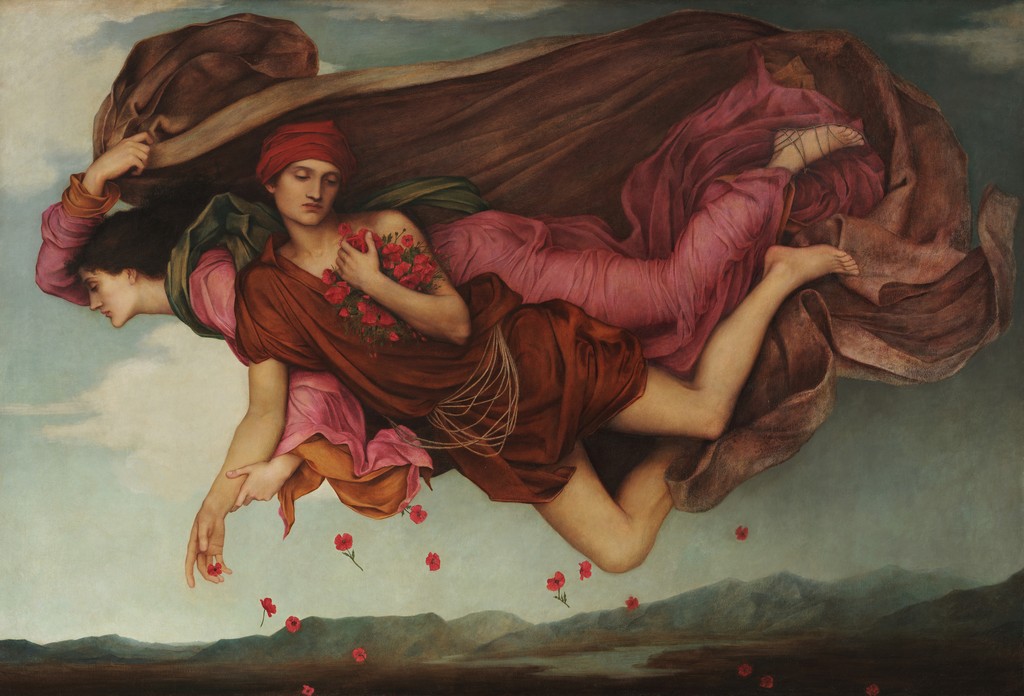
Night and Sleep is an early demonstration of how personification can be clear without becoming mechanical. Painted in 1878, it shows the two figures moving together through an evening sky. Night’s red drapery recalls the sunset, while the dark cloak trailing behind him appears to deepen the sky. Sleep scatters poppies towards the earth below.[3] The flowers carry an immediate association with sleep through the opium poppy, yet they are also part of the painting’s rhythm: small downward notes beneath bodies moving horizontally through air.
The Foundation identifies Botticelli’s intertwined Zephyr and Chloris in The Birth of Venus as a compositional stimulus.[3] That source clarifies the formal bond between the figures, but De Morgan changes its function. Instead of winds ushering in Venus, Night and Sleep become successive, inseparable conditions. Their linked bodies make transition visible: sunset does not stop so that darkness can begin, and wakefulness shades into sleep.
The painting is more than an illustration of two names. Closed eyes, suspended movement, falling poppies and the advancing cloak reinforce one process. A viewer may read gentle surrender, natural cycle or passage towards another state, but the object record does not require one exclusive answer.
Colour Becomes an Argument in The Love Potion
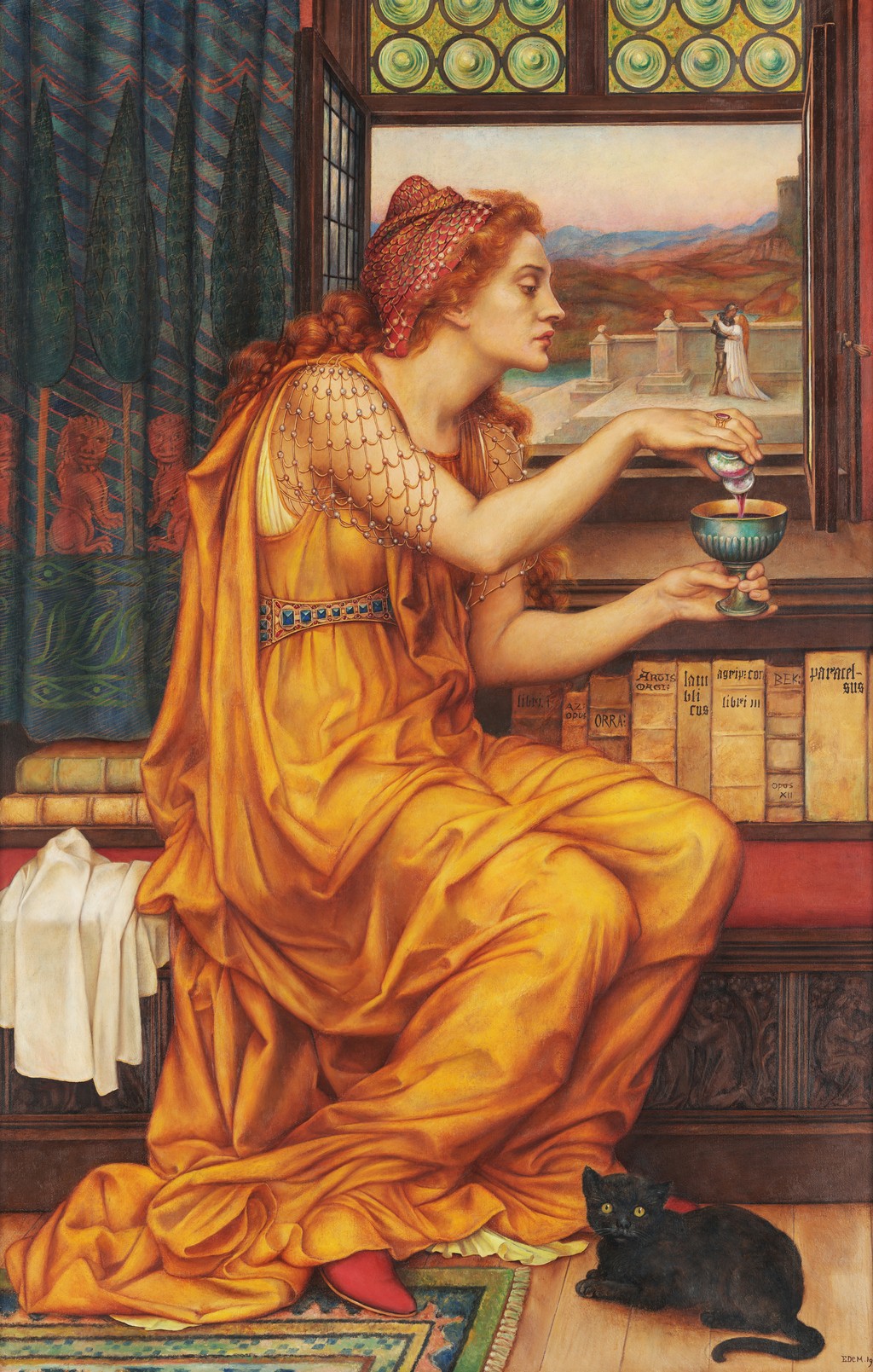
Colour does especially concentrated symbolic work in The Love Potion, painted in 1903. A seated woman handles a vessel in a richly furnished study; books, a black cat, a tapestry and the distant couple seen through the opening establish a field of possible clues. The familiar fairy-tale label “witch” is tempting, but the Foundation explicitly treats it as inadequate. Its interpretation presents her as a learned scholar surrounded by texts associated with philosophy, alchemy and spiritual knowledge.[4]
The same record relates the painting’s palette to a progression through black, white, red and yellow towards spiritual gold. Within that reading, the black cat evokes a material beginning, red lions in the tapestry suggest strength and wisdom, and the woman’s dominant yellow-gold clothing signals movement towards enlightenment.[4] Colour is not decorative icing here. It establishes stages and distinctions across the composition.
Even so, the sequence should not erase uncertainty. The woman’s expression, the distant pair and the liquid are not fully explained by identifying books or colours. The institutional interpretation offers a persuasive framework, not a complete plot. The broader role of pigment and surface is explored in colour, gold and technique.
Bonds, Cages and Divided Spaces
De Morgan often makes freedom or confinement spatial before it becomes verbal. Linked figures can signify harmony, as in Night and Sleep, but bonds can also restrain. Windows, doorways, terraces and strips of landscape divide one condition from another. The viewer sees an alternative state while a figure remains on the wrong side of its boundary.
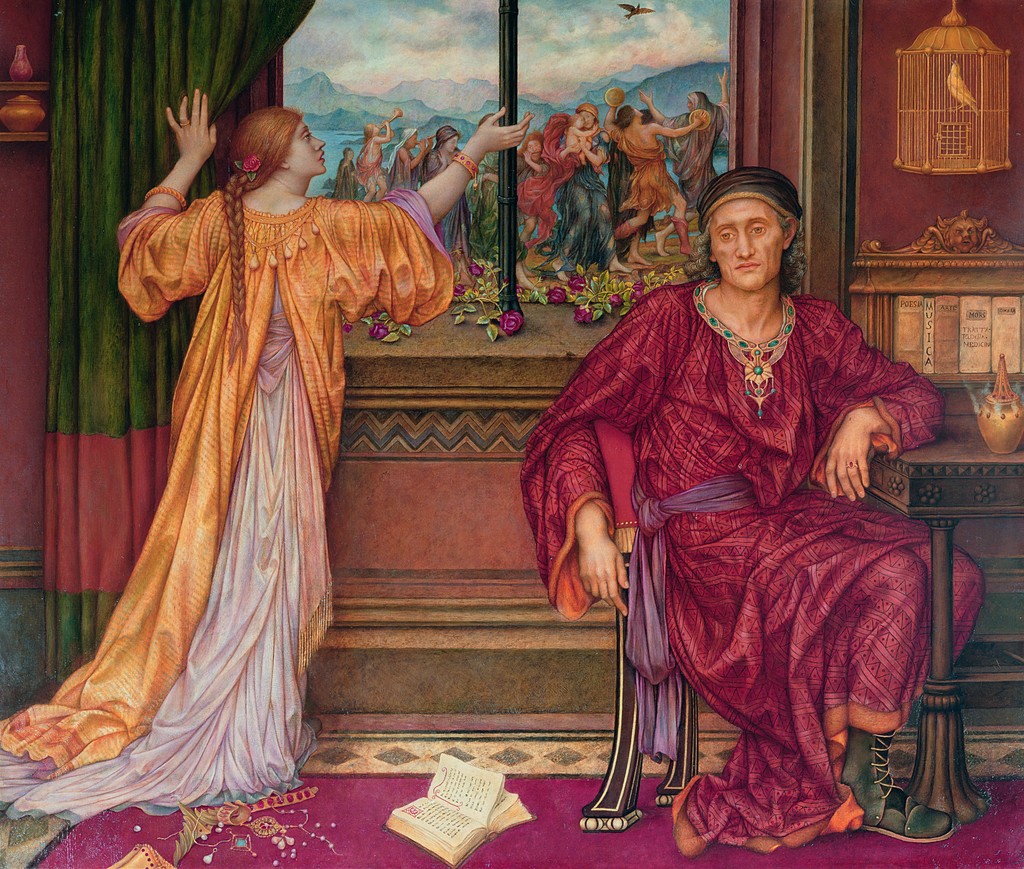
The Gilded Cage turns a domestic interior into precisely this kind of divided field. A woman looks towards music and movement outside while her richly appointed surroundings keep attention on comfort, possession and restriction. The title supplies the cage as a metaphor rather than showing a literal prison. Sarah Hardy’s Foundation essay reads De Morgan’s use of a late Pre-Raphaelite-looking interior as part of a critical engagement with patriarchal values, rather than evidence that she simply continued the Brotherhood’s programme.[2]
This warns against treating beauty as endorsement. Gold, textiles and ornament may describe luxury while making constraint seductive. Books or jewels can signal education and wealth without guaranteeing agency. An opening may offer hope without guaranteeing escape. De Morgan’s thresholds ask what prevents movement between two visible conditions.
Dragons, Sea, Rainbows and Light
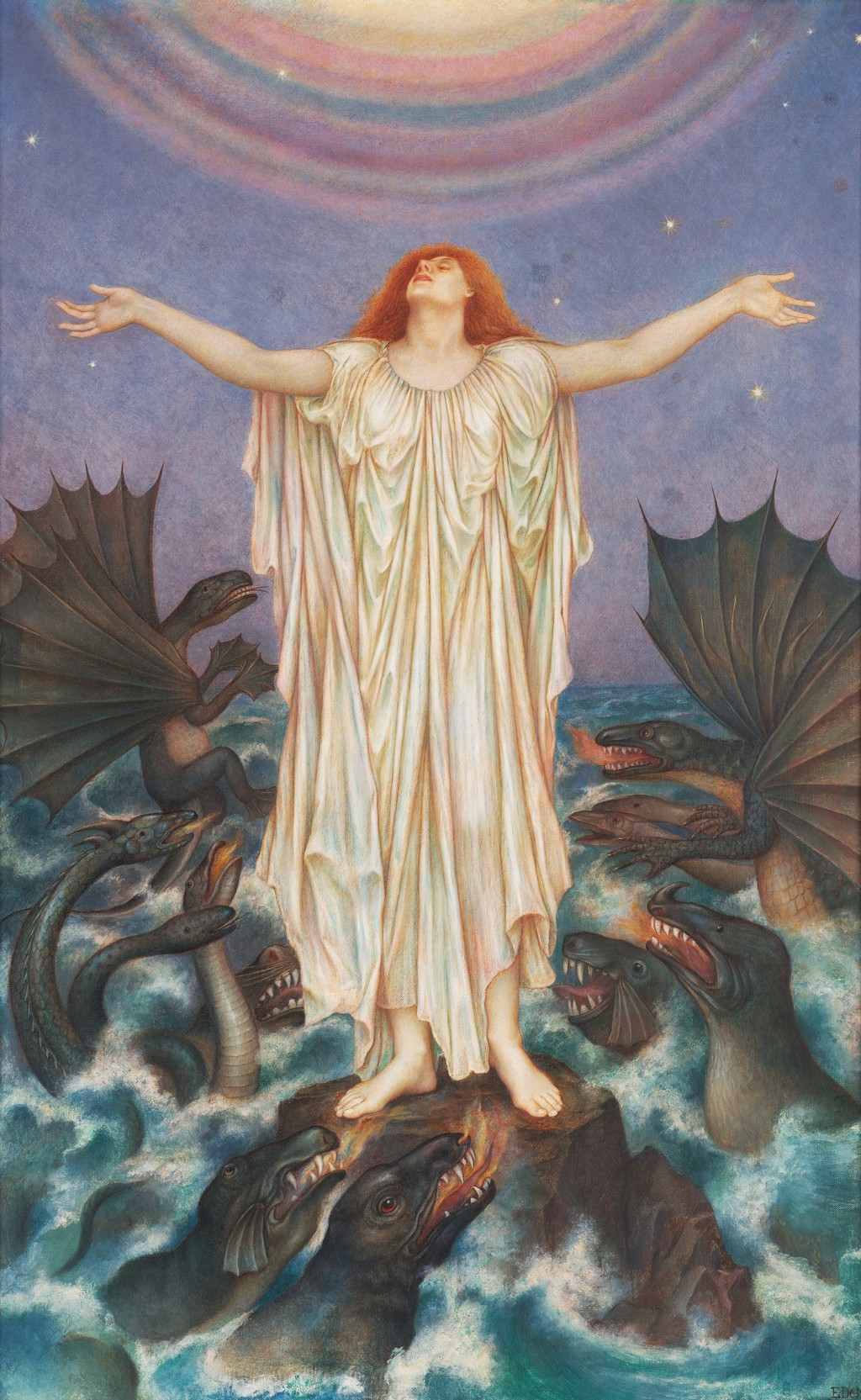
In De Morgan’s wartime imagery, abstract conflict becomes physically menacing. S.O.S., dated 1914–1916, places a white-robed woman on a solitary rock amid forceful water and encroaching sea serpents. She stretches upwards towards a rainbow. The Foundation reads the woman as the innocence of war’s victims, the creatures as evil and death, and the rainbow as a promise of salvation.[5] The title intensifies both kinds of danger: it invokes the modern Morse distress signal while also inviting the phrase “save our souls”.
This is not battlefield reportage. Sea, rock and monsters compress vulnerability into a single image. The creatures give threat shape; the foothold makes survival precarious; the woman’s upward gesture opposes the churning water. Its ethical position emerges from that structure, not martial action.
An Art UK essay traces the rainbow across De Morgan’s later work and connects it to biblical hope after the flood, peace after catastrophe and the imagined upward passage of the soul.[6] In S.O.S., the rainbow does not cancel the surrounding violence. Its narrow light remains distant from the body below, so hope is offered under pressure rather than as easy reassurance. De Morgan’s related war and pacifism paintings repeatedly oppose dragons, devastation and darkness with radiance, released bonds or rising movement.
Why “Pre-Raphaelite” Is Not Enough
The label “Pre-Raphaelite” can identify jewel-like colour, medievalising detail and kinship with artists De Morgan knew or studied. It misleads when stylistic resemblance replaces chronology and agency. De Morgan trained after the original Brotherhood’s formation and developed through Renaissance study, Neo-Classicism, Aesthetic painting and Symbolism.
Hardy argues that De Morgan used recognisably Pre-Raphaelite forms to challenge the gender values associated with them, particularly in works such as The Gilded Cage.[2] That is a named scholarly interpretation, not a neutral fact about every painting. Yet it identifies an important possibility: borrowing a visual language can be a way of revising or resisting it. De Morgan’s female scholars, prisoners, mythic subjects and agents of spiritual striving do not all perform the passive decorative role that a familiar surface might initially suggest.
“Symbolist” also needs care. It describes the increasing importance of suggestive colour, atmosphere and spiritual transition, especially in later work, but it should not make the paintings ahistorical puzzles. Their meanings remain connected to De Morgan’s training, professional circumstances, reform commitments and changing visual choices.
Reading Symbols Without Forcing Them
A disciplined reading starts with an inventory. What figures, objects, colours and divisions are actually present? Which details repeat, and which oppose one another? The title and current institutional record can then establish identities and documented interpretations. Only after that should biography or belief be used to test a wider claim.
This order guards against two common errors. The first is the fixed-code approach, in which gold, a bird or a flower must mean the same thing everywhere. The second is biographical overreach, in which every enclosed woman becomes direct evidence about De Morgan’s marriage or every radiant figure becomes a literal statement of doctrine. Symbols gain force from their local relationships. Even a recurring rainbow changes according to whether it surrounds a vision, spans a battlefield or barely reaches a figure in peril.
De Morgan’s allegories are most compelling when their tensions remain active. Material beauty can attract and warn. A bond can unite or imprison. Death can terrify the body while promising release to the spirit. Close reading should clarify how a painting constructs those choices without pretending that ambiguity is a defect.
About this directory: These 72 entries form a reproducible researched online works census assembled from current public records. It is not a catalogue raisonné and does not claim absolute completeness.
Artworks directory
| Name | Date | Medium |
|---|---|---|
| A Soul in Hell | Date unknown | Painting |
| Ariadne in Naxos | 1877 | Painting |
| Aurora Triumphans | 1877 | Painting |
| Blindness and Cupidity Chasing Joy from the City | 1897 | Painting |
| Boreas and Oreithyia | 1896 | Painting |
| Boreas and the Fallen Leaves | 1910 | Painting |
| By the Waters of Babylon | 1882 | Painting |
| Cadmus and Harmonia | 1877 | Painting |
| Cassandra | 1898 | Painting |
| Clytie | 1886 | Painting |
| Daughters of the Mist | 1909 | Painting |
| Death of a Butterfly | 1910 | Painting |
| Death of the Dragon | 1916 | Painting |
| Deianira | 1878 | Painting |
| Demeter Mourning for Persephone | 1906 | Painting |
| Drapery study | 1890 | Drawing |
| Earthbound | 1897 | Painting |
| Eos | 1895 | Painting |
| Evening Star over the Sea | 1910 | Painting |
| Flora | 1894 | Painting |
| Helen of Troy | 1898 | Painting |
| In Memoriam | 1904 | Painting |
| Life and Thought Emerging from the Tomb | 1893 | Painting |
| Love's Passing | 1883 | Painting |
| Luna (Moon) | 1885 | Painting |
| Lux in Tenebris | 1895 | Painting |
| Medea | 1889 | Painting |
| Medusa | 1879 | Painting |
| Mercury | Date unknown | Painting |
| Moonbeams dipping into the Sea | 1918 | Painting |
| 'Music Sweet Music' (Saint Cecilia) | 1884 | Painting |
| Night and Dawn | 1910 | Painting |
| Night and Sleep | 1878 | Painting |
| Our Lady of Peace | 1907 | Painting |
| Phosphorus and Hesperus | 1881 | Painting |
| Port after Stormy Seas | 1905 | Painting |
| Portrait John Roddam Spencer Stanhope | 1880 | Painting |
| Queen Eleanor and the Fair Rosamund | Date unknown | Painting |
| S.O.S. | 1914–1916 | Painting |
| Sleep and Death: the Children of Night | 1883 | Painting |
| Study for 'Saint Christina' | 1904 | Painting |
| Study from the life | 1890 | Drawing |
| Study of Arms for "The Cadence of Autumn | 1905 | Drawing |
| Sunbeam and Summer Shower | 1910 | Painting |
| The Angel of Death I | 1880 | Painting |
| The Barred Gate | 1910 | Painting |
| The Cadence of Autumn | 1905 | Painting |
| The Captives | Date unknown | Painting |
| The Dryad | 1884 | Painting |
| The Garden of Opportunity | 1892 | Painting |
| The Gilded Cage | probably 1901–1902 | Painting |
| The Grey Sisters | 1880 | Painting |
| The Hourglass | 1904 | Painting |
| The Kingdom of Heaven Suffereth Violence and the Violent Take It by Force | 1878 | Painting |
| The Light Shineth in Darkness and the Darkness Comprehendeth It Not | 1906 | Painting |
| The Little Sea Maid | 1880 | Painting |
| The Love Potion | 1903 | Painting |
| The Martyr (Nazuraea) | 1880 | Painting |
| The Mourners | 1915 | Painting |
| The Passing of the Soul at Death | 1910 | Painting |
| The Poor Man Who Saved the City | 1901 | Painting |
| The Prisoner | 1907 | Painting |
| The Red Cross | 1915 | Painting |
| The Salutation | 1883 | Painting |
| The Sea Maidens | 1885 | Painting |
| The Soul's Prison House | 1880 | Painting |
| The Storm Spirits | 1900 | Painting |
| The Worship of Mammon | 1909 | Painting |
| Twilight | 1910 | Painting |
| Venus and Cupid | 1878 | Painting |
| William De Morgan | 1909 | Painting |
| William De Morgan (1839–1917) | 1893 | Painting |
Frequently Asked Questions
It refers both to her use of images as carriers of abstract meaning and, more specifically, to a later manner in which colour, mist, light and expressive figures matter more than a fully specified story. The Foundation places this stronger Symbolist turn around 1910, while also showing that allegory had appeared much earlier in her career.[1]
Recurring motifs include flowers, books, jewels, windows, bonds, sea, dragons, rainbows and contrasting light and darkness. Their meanings depend on composition. Poppies support the movement towards sleep in Night and Sleep; threatening creatures and turbulent water intensify peril in S.O.S.
Institutional readings associate her rainbows with hope, peace, salvation and the soul’s passage beyond suffering. Art UK connects the motif to the biblical promise after the flood and shows how De Morgan adapted it in later spiritual and wartime images.[6]
No. Dragons and sea monsters often embody danger or evil in her later allegories, but an animal’s role must be read from its setting. The black cat in The Love Potion, for example, participates in an alchemical colour sequence and also toys with the stereotype of the witch’s familiar.[4]
No. Titles, object records and repeated motifs can support an interpretation, but they do not turn the paintings into substitution ciphers. The most reliable readings distinguish visible evidence from an institution’s account and from a viewer’s inference.
Discussion
What should readers notice when looking closely at Evelyn De Morgan: Symbolism and Allegory?
Reader Insights
Follow one sign—poppy, bond, animal, rainbow or light—across more than one painting.
Separate a symbol’s visible role from an institution’s interpretation and your own inference.
When does a recurring symbol clarify a painting, and when does it risk becoming a fixed code?
Join the Conversation
Share your reading below, keeping observations specific and evidence clear.
References
- De Morgan Foundation, Evelyn De Morgan (1855–1919), View source
- De Morgan Foundation, Why Evelyn De Morgan Is Not a Pre-Raphaelite Painter, View source
- De Morgan Foundation, Night and Sleep, View source
- De Morgan Foundation, The Love Potion, View source
- De Morgan Foundation, S.O.S., View source
- Art UK, The Rainbow as a Symbol of Hope in Evelyn De Morgan’s Paintings, View source