

 by Tom Gurney
Tom Gurney BSc (Hons) is an art history expert with over 20 years experience
/
Email: tomgurney1@gmail.com / Phone: +44 7429 011000
The Love Potion: Introduction
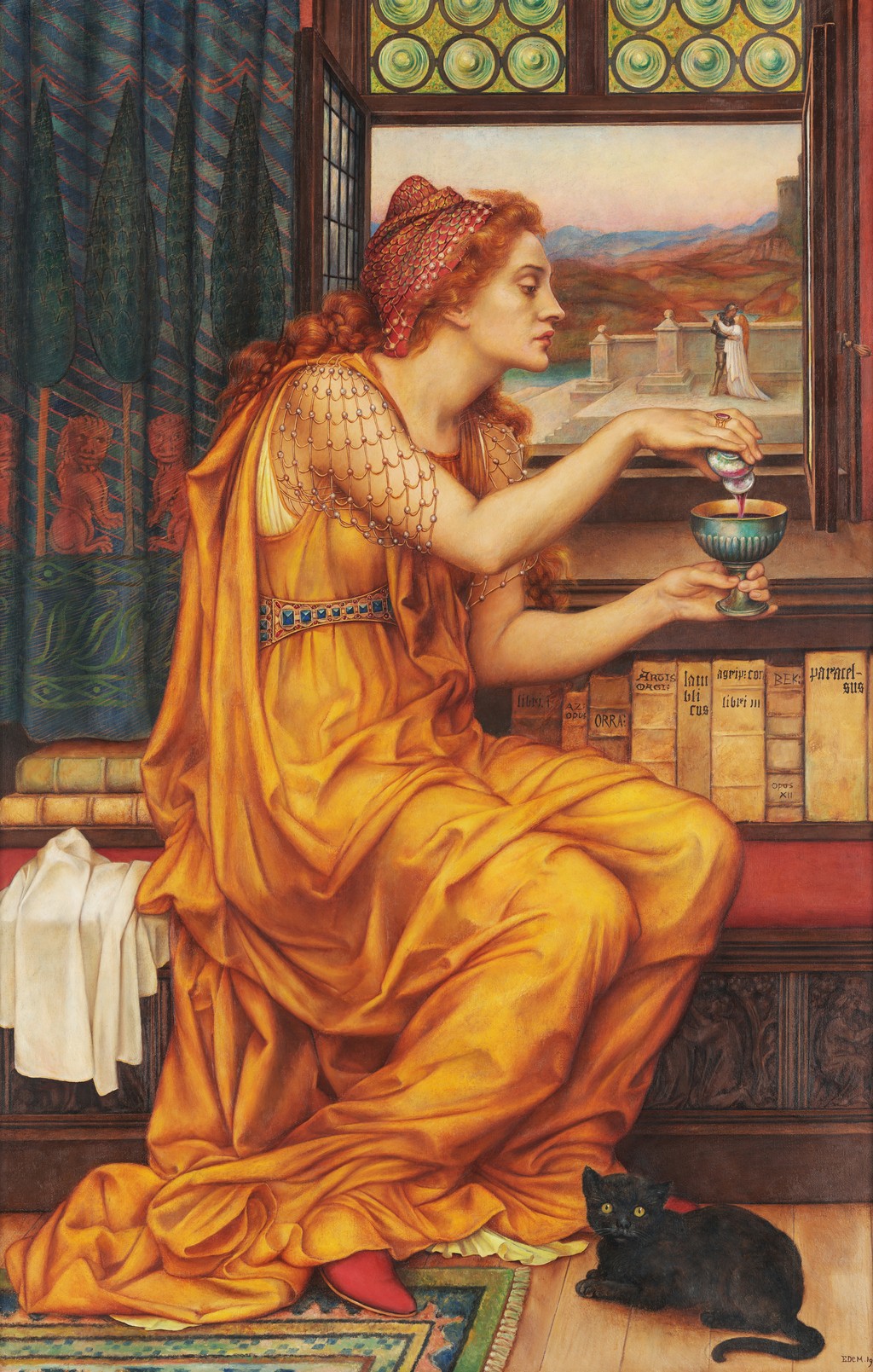
In The Love Potion (1903), Evelyn De Morgan makes a familiar fantasy difficult to trust. A richly dressed woman pours red liquid into a chalice while a black cat watches from the floor; beyond the open window, two lovers embrace on a terrace. Those details invite an instant tale of witchcraft and interference. The books, colour sequence and carefully divided space, however, suggest a more demanding possibility: the central figure may be a learned seeker of spiritual knowledge rather than a villain controlling someone else’s desire.
At a Glance
- ArtistEvelyn De Morgan
- Date1903
- MediumOil on canvas
- DimensionsFramed 1041.4 × 520.7 mm
- Identifier and collectionP_EDM_0035, De Morgan Collection
- Central questionWitch making a charm, or scholar pursuing alchemical and spiritual enlightenment?
Evelyn De Morgan in context
Cadmus and Harmonia
1877Night and Sleep
1878Flora
1894The Gilded Cage
probably 1901–02The Love Potion
1903The Cadence of Autumn
1905Daughters of the Mist
c. 1905–10S.O.S.
1914–16Contents
- What Can Be Seen
- The Window and Two Separate Worlds
- Why the Simple “Witch” Story Falls Short
- Books, Instruments and Learned Knowledge
- Reading Black, White, Red and Gold
- What Does the Black Cat Mean?
- Spiritualism, Knowledge and Female Agency
- Position in De Morgan’s Career
What Can Be Seen
The seated woman dominates the narrow upright composition. Her golden-yellow robe spreads across the bench and floor, its folds filling most of the lower half. Pearl-like strands cross her sleeves and headdress; a jewelled belt and red shoe sharpen the sense of material richness. She supports a green-blue chalice in one hand and tips a small glass vessel with the other. A narrow stream of red liquid connects them.
Around her, De Morgan assembles an interior of concentrated looking. Books fill the shelf directly beneath the window. A dark tapestry, patterned with red lions, hangs to the left. A white cloth lies over the bench, and a wide-eyed black cat occupies the foreground at the right. Coloured roundels across the top of the window cast the room as both luxurious and enclosed.
The embracing couple appears outside and at a much smaller scale. They are visible through the opening but do not share the woman’s physical space. This split between near and far is crucial. It encourages a narrative connection while withholding proof of one: the painting shows liquid being poured and lovers embracing, but it does not show the drink being given to either person.
The Window and Two Separate Worlds
The window acts like a picture within the picture. Its frame isolates the terrace, pale water, hills and warm sky from the dense interior. The lovers stand in the clearest patch of distance, their joined bodies reduced to a small vertical accent. Inside, the woman’s profile, forearms, vessel and cup form a second, much larger chain of attention.
It is easy to turn this arrangement into a sequence — potion, then altered love — because the title supplies a cause before the image does. Yet the spatial separation also makes that story uncertain. The woman looks towards her work, not straight out at the pair. No gesture crosses the sill, and no recipient waits for the chalice. The couple could be the desired outcome, a symbol, an object of contemplation or an unrelated scene placed in meaningful counterpoint.
The De Morgan Foundation interprets the lovers as a harmonious union of opposites within a spiritual allegory.[1] That reading fits the larger system it identifies, but the painting remains deliberately open at the level of action. De Morgan gives enough information to stimulate a story and too little to settle its mechanics.
Why the Simple “Witch” Story Falls Short
De Morgan’s sister, Wilhelmina Stirling, once described the figure as a cruel witch mixing a potion to upset the distant lovers. The Foundation reproduces that history in order to challenge it, arguing that the character has too often been miscategorised as a fairy-tale sorceress.[1] The cat, medieval-looking room and red liquid certainly activate that stereotype. They do not exhaust the evidence.
Nothing visible establishes malice. The woman’s concentrated profile need not be read as cruelty, and her controlled hands suggest trained activity rather than chaos. More importantly, the library places intellectual traditions beside the vessel. The Foundation therefore proposes that she belongs among De Morgan’s allegorical figures seeking enlightenment: a scholar equipped with texts and instruments.[1]
Replacing “witch” with “scholar” is not merely a kinder label. It changes the structure of the image. Under the first reading, knowledge is a threat and the couple are possible victims. Under the second, knowledge is disciplined work, the liquid belongs to transformation and the lovers signify achieved unity. The tension between those models makes the painting a particularly rich example of De Morgan’s symbolism and allegory.
Books, Instruments and Learned Knowledge
Several book spines carry names associated with philosophy, medicine, alchemy and ritual thought. The Foundation identifies references to Paracelsus, Agrippa von Nettesheim and Iamblichus, as well as an “A–Z Opus” connected in its interpretation with Azoth, the universal spirit.[1] These labels are not generic stage dressing. They position the figure within traditions of reading and experiment.
The distinction between scholarship and superstition is especially relevant to the Foundation’s account of Agrippa. It notes his effort to separate ancient or spiritual wisdom from dangerous and superstitious magical ritual.[1] The painting’s books similarly resist a neat division between modern science and occult belief. For a viewer in 1903, medicine, alchemy, philosophy and Spiritualist enquiry could appear in a contested intellectual field rather than in sealed categories.
It would still be unwise to claim that every title proves De Morgan’s personal agreement with its author. A represented library creates character and meaning; it is not an inventory of the painter’s convictions. What the books securely establish is the picture’s insistence on learning. The woman has access to textual knowledge, and the vessel she handles belongs in that studious environment.
Reading Black, White, Red and Gold
Colour supplies the Foundation’s strongest alternative to the witch narrative. Its object account, drawing on the scholarship of Elise Lawton Smith, describes an alchemical progression from black through white and red to yellow or gold. Black corresponds to a material state marked by guilt, sin and death; white to an early purification; red to a further stage; and gold to spiritual salvation.[1]
De Morgan distributes those colours across conspicuous objects. The cat is black. The folded cloth is white. Red appears in the liquid, shoe, jewels and lions on the tapestry. Yellow-gold floods the robe and reaches across most of the canvas. The sequence is not laid out as a diagram, but the dominant gold surrounds the person who performs the transformation.
Within that framework, the liquid is not necessarily a tool for manufacturing romantic obedience. It may visualise a stage of inner change, while the joined figures beyond offer an image of reconciliation. This remains an interpretive system, not a deciphered instruction supplied by De Morgan. Its value lies in accounting for many deliberately repeated colours at once. The cluster’s account of colour, gold and technique considers how hue carries structure elsewhere in her work.
What Does the Black Cat Mean?
The cat performs two jobs simultaneously. In popular imagery, a black cat suggests witchcraft and nocturnal mystery, so its position in the foreground steers the first glance towards sorcery. The Foundation regards that familiar association as an ironic lure: the stereotype draws viewers into an interpretation that the books and colour system then complicate.[1]
In the alchemical reading, black also signifies prime matter or the earliest material stage of transformation.[1] The animal can therefore belong to the sequence without functioning as evidence of evil. Its bright eyes and direct outward gaze create a further contrast. While the woman concentrates on cup and vessel, the cat faces the viewer, almost policing the boundary between our space and hers.
No single symbolic definition cancels the others. Cats retain their ordinary animal presence even when placed inside an allegory. De Morgan uses that recognisable body to hold superstition, colour symbolism and close observation together.
Spiritualism, Knowledge and Female Agency
The Foundation places The Love Potion within De Morgan’s increasingly explicit engagement with Spiritualism around the turn of the twentieth century.[2][3] Her pictures often imagine the soul moving from material confinement towards a freer spiritual condition. Here that progress is not represented by flight. It takes place through study, colour and a measured act of pouring.
This emphasis also changes how the female protagonist is understood. A stereotype of the dangerous witch turns a knowledgeable woman into a social threat. The Foundation instead describes her as intelligent, skilled and capable of pursuing enlightenment.[1] That argument connects naturally with De Morgan’s broader treatment of women, Spiritualism and freedom, but it should not be expanded into a specific political claim unsupported by the object record.
The painting’s closeness to late Pre-Raphaelite and Symbolist art concerns style and visual language, not simple membership of a movement. The Foundation stresses that De Morgan combined Renaissance sources, progressive training and spiritual or social concerns in an independent practice.[3] Rich medievalising detail creates the lure; allegorical revision changes what that detail does.
Position in De Morgan’s Career
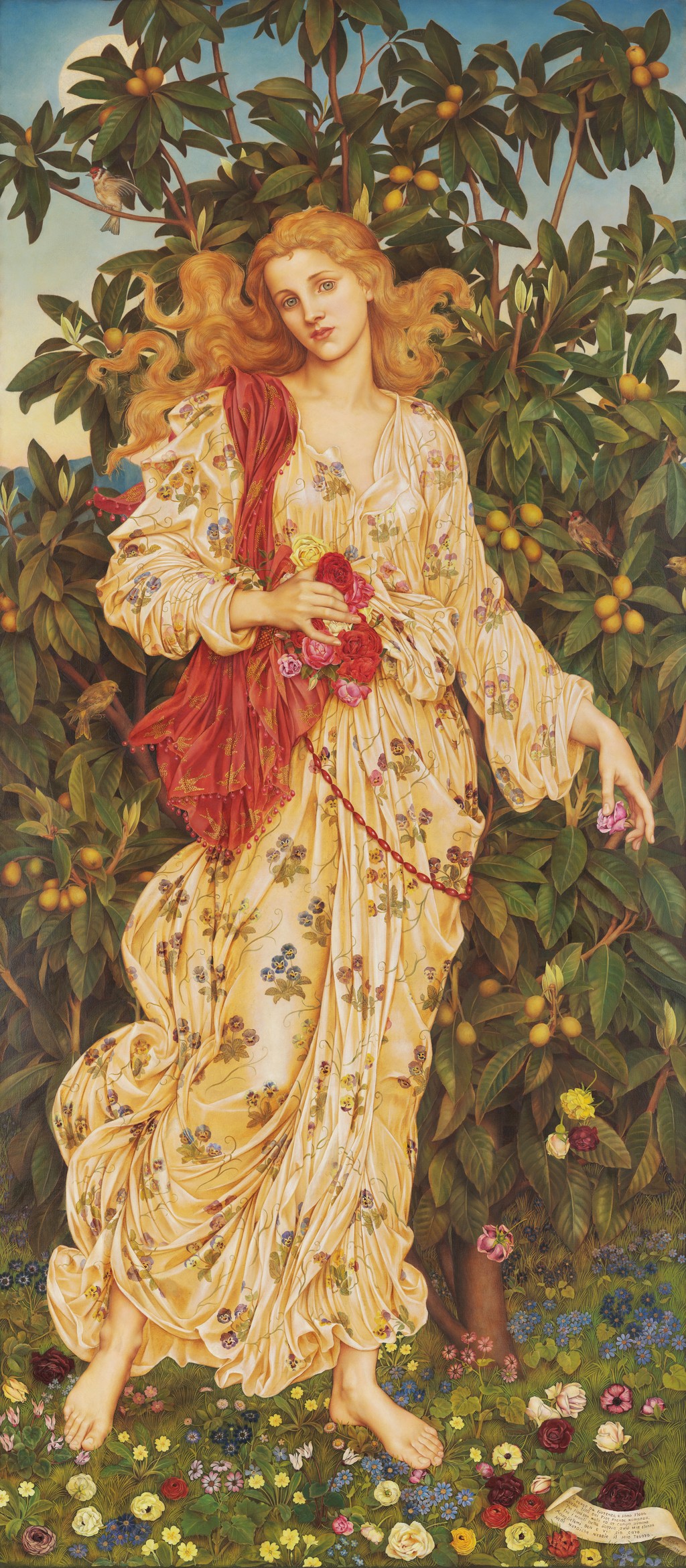
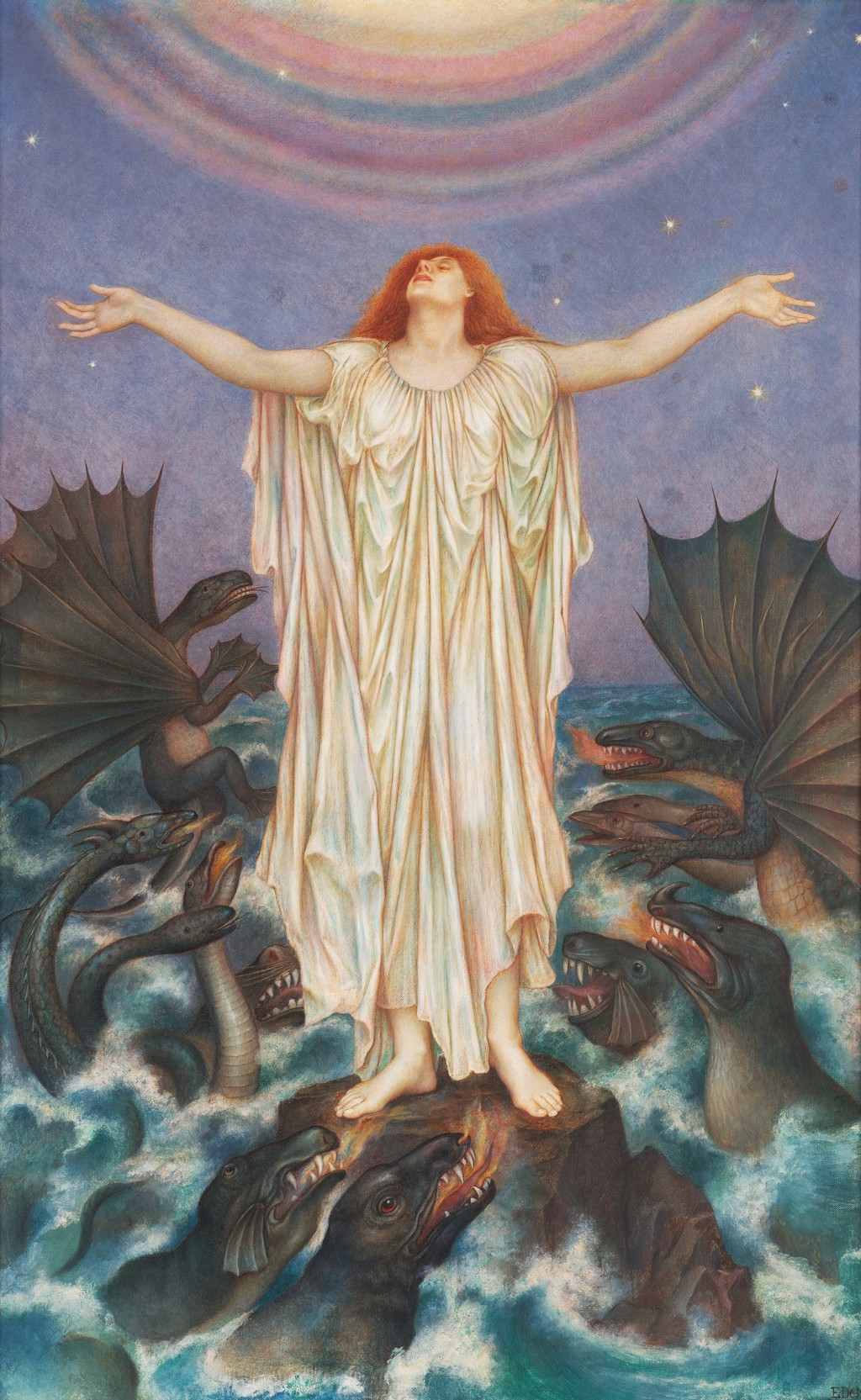
Among Evelyn De Morgan’s paintings, The Love Potion condenses a mature method into one interior. Compared with the abundant Florentine surface of Flora from 1894, its beauty is more enclosed and intellectually uneasy. Compared with S.O.S. of 1914–1916, its spiritual struggle remains private rather than shaped by the public catastrophe of war.
The work is signed and dated 1903, and its present record gives the framed dimensions as 1041.4 × 520.7 mm. It belongs to the De Morgan Collection as P_EDM_0035.[1] The same record notes that the painting was conserved in 2019, but does not detail the treatment there. That fact confirms recent institutional care; it does not by itself justify claims about altered colour or surface.
The picture endures because it makes interpretation part of its subject. Title, cat and vessel offer an easy category. Books, colour and spatial design resist it. De Morgan does not remove magic from the scene; she asks viewers to reconsider where power lies — in deception imposed on others, or in knowledge that transforms the self.
About this directory: These 72 entries form a reproducible researched online works census assembled from current public records. It is not a catalogue raisonné and does not claim absolute completeness.
Artworks directory
| Name | Date | Medium |
|---|---|---|
| A Soul in Hell | Date unknown | Painting |
| Ariadne in Naxos | 1877 | Painting |
| Aurora Triumphans | 1877 | Painting |
| Blindness and Cupidity Chasing Joy from the City | 1897 | Painting |
| Boreas and Oreithyia | 1896 | Painting |
| Boreas and the Fallen Leaves | 1910 | Painting |
| By the Waters of Babylon | 1882 | Painting |
| Cadmus and Harmonia | 1877 | Painting |
| Cassandra | 1898 | Painting |
| Clytie | 1886 | Painting |
| Daughters of the Mist | 1909 | Painting |
| Death of a Butterfly | 1910 | Painting |
| Death of the Dragon | 1916 | Painting |
| Deianira | 1878 | Painting |
| Demeter Mourning for Persephone | 1906 | Painting |
| Drapery study | 1890 | Drawing |
| Earthbound | 1897 | Painting |
| Eos | 1895 | Painting |
| Evening Star over the Sea | 1910 | Painting |
| Flora | 1894 | Painting |
| Helen of Troy | 1898 | Painting |
| In Memoriam | 1904 | Painting |
| Life and Thought Emerging from the Tomb | 1893 | Painting |
| Love's Passing | 1883 | Painting |
| Luna (Moon) | 1885 | Painting |
| Lux in Tenebris | 1895 | Painting |
| Medea | 1889 | Painting |
| Medusa | 1879 | Painting |
| Mercury | Date unknown | Painting |
| Moonbeams dipping into the Sea | 1918 | Painting |
| 'Music Sweet Music' (Saint Cecilia) | 1884 | Painting |
| Night and Dawn | 1910 | Painting |
| Night and Sleep | 1878 | Painting |
| Our Lady of Peace | 1907 | Painting |
| Phosphorus and Hesperus | 1881 | Painting |
| Port after Stormy Seas | 1905 | Painting |
| Portrait John Roddam Spencer Stanhope | 1880 | Painting |
| Queen Eleanor and the Fair Rosamund | Date unknown | Painting |
| S.O.S. | 1914–1916 | Painting |
| Sleep and Death: the Children of Night | 1883 | Painting |
| Study for 'Saint Christina' | 1904 | Painting |
| Study from the life | 1890 | Drawing |
| Study of Arms for "The Cadence of Autumn | 1905 | Drawing |
| Sunbeam and Summer Shower | 1910 | Painting |
| The Angel of Death I | 1880 | Painting |
| The Barred Gate | 1910 | Painting |
| The Cadence of Autumn | 1905 | Painting |
| The Captives | Date unknown | Painting |
| The Dryad | 1884 | Painting |
| The Garden of Opportunity | 1892 | Painting |
| The Gilded Cage | probably 1901–1902 | Painting |
| The Grey Sisters | 1880 | Painting |
| The Hourglass | 1904 | Painting |
| The Kingdom of Heaven Suffereth Violence and the Violent Take It by Force | 1878 | Painting |
| The Light Shineth in Darkness and the Darkness Comprehendeth It Not | 1906 | Painting |
| The Little Sea Maid | 1880 | Painting |
| The Love Potion | 1903 | Painting |
| The Martyr (Nazuraea) | 1880 | Painting |
| The Mourners | 1915 | Painting |
| The Passing of the Soul at Death | 1910 | Painting |
| The Poor Man Who Saved the City | 1901 | Painting |
| The Prisoner | 1907 | Painting |
| The Red Cross | 1915 | Painting |
| The Salutation | 1883 | Painting |
| The Sea Maidens | 1885 | Painting |
| The Soul's Prison House | 1880 | Painting |
| The Storm Spirits | 1900 | Painting |
| The Worship of Mammon | 1909 | Painting |
| Twilight | 1910 | Painting |
| Venus and Cupid | 1878 | Painting |
| William De Morgan | 1909 | Painting |
| William De Morgan (1839–1917) | 1893 | Painting |
Frequently Asked Questions
The painting deliberately evokes that stereotype, but the De Morgan Foundation rejects it as an adequate explanation. The books, instruments and alchemical colour sequence support its reading of the woman as a learned seeker of spiritual enlightenment.[1]
The source does not identify them as named people. In the Foundation’s interpretation, their embrace represents a harmonious union of opposites. The painting does not prove that they have received, or will receive, the red liquid.[1]
The cat recalls conventional images of witchcraft, helping to establish the misleading first impression. It also occupies the black stage of the alchemical colour sequence and is connected by the Foundation with prime matter.[1]
The institutional account reads black, white, red and yellow-gold as progressive alchemical stages moving from material limitation through purification towards spiritual salvation. This attributed interpretation explains the cat, cloth, liquid and dominant robe as a connected system.[1]
It is part of the De Morgan Collection, where it is recorded as P_EDM_0035. Since displays and loans may change, current viewing arrangements should be checked with the De Morgan Foundation.[1]
Discussion
What should readers notice when looking closely at The Love Potion?
Reader Insights
Track the route between book, vessel, pouring hand, distant lovers and the alert black cat.
Test the simple witch label against the Foundation’s learned and alchemical reading.
Does the figure control the lovers, observe them, or pursue knowledge whose effects remain uncertain?
Join the Conversation
Share your reading below, keeping observations specific and evidence clear.
References
- De Morgan Foundation, The Love Potion, View source
- De Morgan Foundation, Evelyn De Morgan (1855–1919), View source
- De Morgan Foundation, Why Evelyn De Morgan is not a Pre-Raphaelite painter, View source