

 by Tom Gurney
Tom Gurney BSc (Hons) is an art history expert with over 20 years experience
/
Email: tomgurney1@gmail.com / Phone: +44 7429 011000
Mythology and Transformation: Introduction
Evelyn De Morgan did not treat classical mythology as a store of fixed illustrations. She chose moments when a familiar story was changing direction: Ariadne after abandonment, Harmonia on the verge of sharing her husband’s metamorphosis, Demeter holding winter in her grief. Her paintings retain enough of each source to be recognisable, then alter emphasis through age, pose, setting and point of view.
The result is a mythology of inner states as well as supernatural events. Transformation may be bodily, seasonal, emotional or artistic. It can happen within the story, or in the painter’s decision to make a neglected figure command the picture.
At a Glance
- SourcesGreek and Roman myth, classical literature, Renaissance art and De Morgan’s own wide reading.
- Early phaseNeo-Classical subjects helped establish her professional career in the 1870s.
- Central figuresAriadne, Harmonia, Demeter and Flora receive sustained attention rather than serving as accessories to male heroes.
- Recurring transformationsAbandonment becomes reflection, a man becomes a serpent, grief governs the seasons and a Roman goddess becomes a Florentine image.
- Italian influenceBotticelli’s figures and compositions supplied forms that De Morgan studied, copied and decisively reworked.
- Key examplesAriadne in Naxos, Cadmus and Harmonia, Demeter Mourning for Persephone and Flora.
Contents
- Myth as Working Material, Not Decoration
- Ariadne After the Expected Drama
- Cadmus, Harmonia and a Changed Body
- Botticelli, Italy and the Art of Reuse
- Flora: Goddess, City and New Destination
- Demeter and the Seasonal Shape of Grief
- Four Transformations, Four Different Structures
- Female Viewpoint Without an Automatic Verdict
Myth as Working Material, Not Decoration
De Morgan encountered classical subjects through education and art, but unusually concrete evidence survives from the beginning of her career. A small sketchbook of about 1877 contains titles in her handwriting alongside designs for Cadmus and Harmonia, Ariadne in Naxos, Venus and Cupid and The Grey Sisters. Its reading list ranges beyond literature and Renaissance history to science, logic and social criticism.[4]
The find is important precisely because the adult written record is sparse. Emma Merkling describes the list as evidence of potential intellectual resources, not proof that every title was read or that a particular book explains a particular image.[4] That distinction models a sound approach to De Morgan’s myths: surviving notes establish curiosity and possible context, while the paintings themselves show how she turned knowledge into composition.
Classical imagery also belonged to the professional world she entered. Neo-Classical painting was prominent during her training, and mythological subjects could display command of anatomy, drapery and learned narrative. Yet recognisability did not require obedience. De Morgan could use a legible story to gain attention, then shift its emotional centre.
Ariadne After the Expected Drama
Ariadne in Naxos was painted in 1877, shortly after De Morgan left the Slade, and became her first exhibit at London’s Grosvenor Gallery. The oil on canvas, signed EP 1877, measures 598 × 1012 mm and is recorded as P_EDM_0003.[1] Its exhibition history places myth at the start of her public identity rather than at the margin of a later Symbolist career.
Ariadne has helped Theseus escape the Minotaur’s labyrinth and has then been deserted while asleep on Naxos. Artists could choose her discovery, rage, rescue by Bacchus or later triumph. De Morgan instead shows the aftermath of fury. According to the Foundation, Ariadne appears solitary and desolate, with a red robe that introduces an association with martyrdom; shells along the shore carry meanings of sexuality, fertility and love.[1]
That choice creates emotional duration where the plot might otherwise demand action. The departing hero need not occupy the canvas for his abandonment to govern it. Sea and empty shore extend Ariadne’s isolation, while her stillness asks viewers to remain with an experience that heroic narrative usually moves beyond.
This altered emphasis supports a reading concerned with female abandonment, but it should be named as a reading. The object record establishes De Morgan’s departure from the conventional image of frenzied rage; it does not preserve her own declaration that Ariadne represents all deserted women. Female interiority is produced by the selected moment and composition, not guaranteed merely by a female title.
Cadmus, Harmonia and a Changed Body
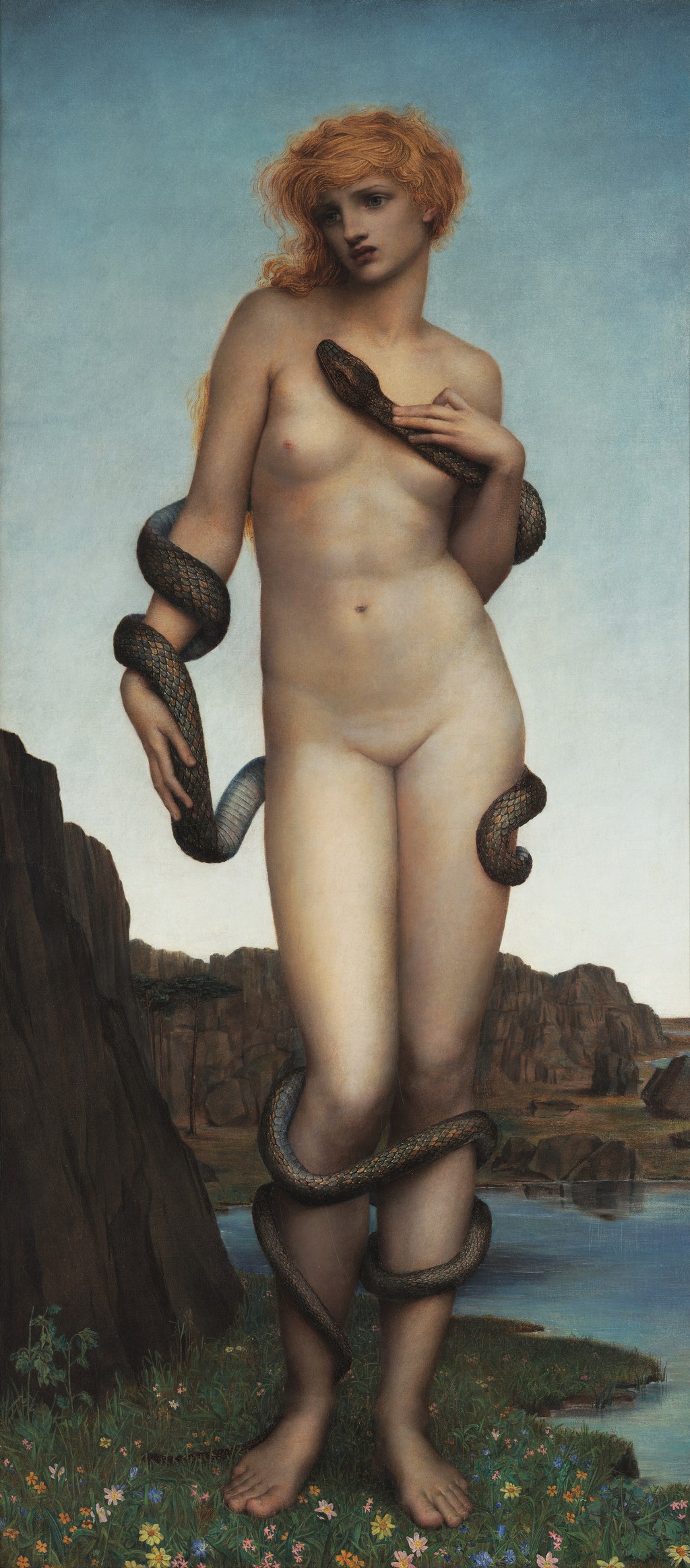
In Ovid’s Metamorphoses, Cadmus is changed into a serpent and Harmonia asks to share his fate. De Morgan’s Cadmus and Harmonia shows her embraced by the transformed husband before her own metamorphosis. Painted and signed in 1877, the work is an oil on canvas, now recorded as P_EDM_0041; its framed dimensions are 1485 × 895 × 104 mm.[2]
The Foundation identifies a decisive alteration. Ovid’s Harmonia is elderly when this episode occurs, whereas De Morgan makes her a statuesque young woman.[2] That change does more than adjust appearance. Youth removes the visible history of a marriage that has endured into old age and intensifies the contrast between smooth human flesh and the serpent’s coils. It also holds transformation in suspense: Cadmus has crossed the boundary between species, while Harmonia remains recognisably human at the instant represented.
The embrace can look protective, intimate and enclosing at once. No single adjective settles it. Harmonia’s wish in the literary source makes the serpent more than an attacker, but the coils still control the viewer’s experience of her body. This productive uncertainty is characteristic of De Morgan’s transformations: love and loss, union and extinction, can inhabit the same form.
Her reimagining does not simply modernise the tale. It selects a visual tension that paint can sustain more readily than a sequence of events—the charged interval between one metamorphosis and another.
Botticelli, Italy and the Art of Reuse
De Morgan painted Cadmus and Harmonia soon after returning from Italy. The Foundation compares Harmonia’s tall central presence with the figure in Botticelli’s Birth of Venus, a picture De Morgan had copied as a student.[2] The connection is formal rather than submissive. A pose learned from a Renaissance painting becomes the anchor of an Ovidian scene in which a serpent threads around the body.
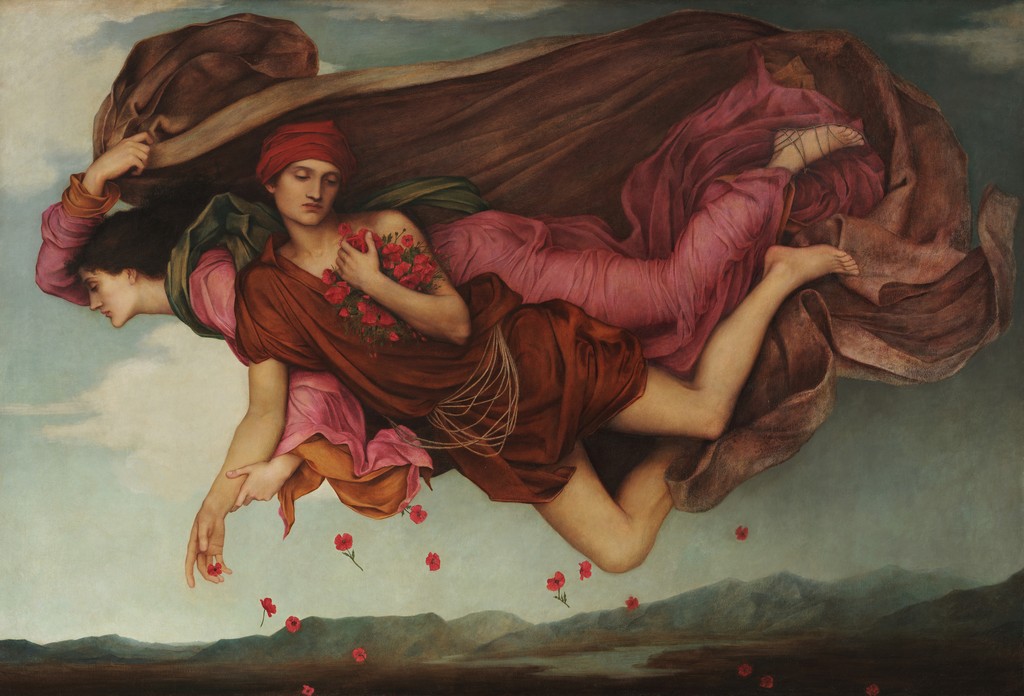
Botticelli remained useful because his art offered more than a repertoire of beautiful faces. Linear movement, flowing hair, patterned fabric and shallow, frieze-like arrangements could make a body seem both solid and rhythmic. De Morgan adapted those qualities to different narrative tasks. In Night and Sleep, intertwined airborne figures draw on the coupled winds in The Birth of Venus; in myth paintings, Renaissance grace can hold grief or metamorphosis rather than ideal arrival.
Calling these works simply Pre-Raphaelite obscures this longer exchange. De Morgan worked near late Pre-Raphaelite taste and shared its admiration for early Italian art, but her classical training, Neo-Classicism and direct study in Italy all matter. Influence is best understood as a method of selecting and transforming forms, not as membership of one stylistic camp.
Flora: Goddess, City and New Destination
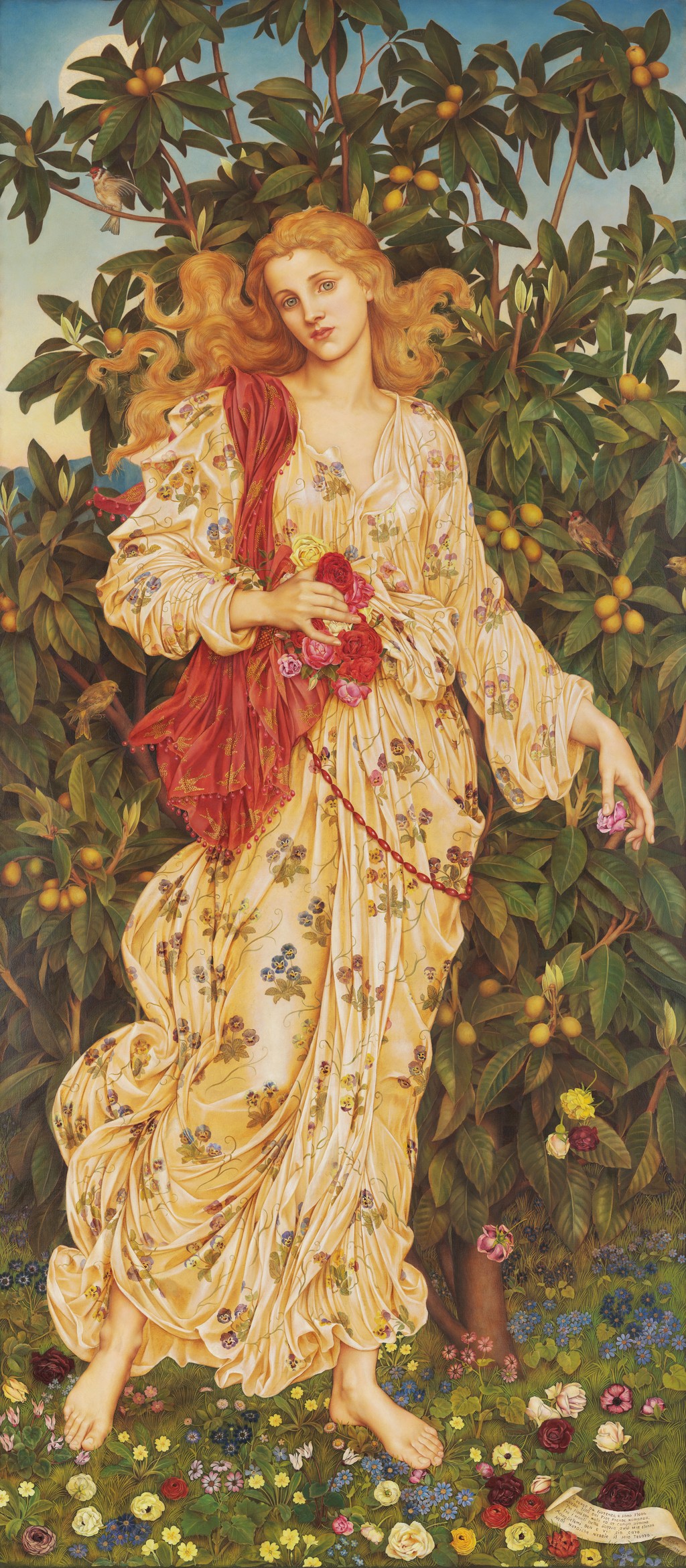
Flora is not a scene from an unfolding myth. It is a reinvention of the Roman goddess of flowers as the presiding spirit of Florence. Painted entirely in that city in 1894, the oil on canvas measures 1990 × 880 mm, is signed EDeM Maggio 1894 and bears the identifier P_EDM_0017.[5]
The Foundation connects the figure to Botticelli’s Primavera. Yet De Morgan builds a specific modern identity around her. Flora stands before a fruiting loquat tree; birds inhabit its branches; blossoms pattern her robe and fall from her hands. An Italian scroll has her announce that she comes from Florence and will make a new home in Scotland.[5] The destination refers to the painting’s purchaser, the Scottish shipowner William Imrie.
Several kinds of transformation meet here. A Roman deity becomes Florentine through the association between the city and flowers. Renaissance memory becomes a nineteenth-century commission. Spring growth passes into paint, textile pattern and gilded setting. Even geographical movement is folded into the fiction: Flora speaks as a traveller leaving Italy for a northern collection.
The work’s luminosity and intricate surface receive fuller attention in colour, gold and technique. Within the mythological sequence, its importance lies in invention. De Morgan does not illustrate a canonical exploit of Flora; she constructs a new encounter among goddess, place, patron and artistic ancestry.
Demeter and the Seasonal Shape of Grief
Demeter Mourning for Persephone returns to myth as an explanation of natural change. The 1906 oil on canvas, signed EDeM 1906, measures 512 × 458 mm and is catalogued as P_EDM_0033.[3] Its modest dimensions concentrate attention on a single grieving figure and the depleted land around her.
The myth links a mother’s loss to the seasons. Hades takes Persephone beneath the earth; Demeter withholds the earth’s fertility; divine negotiation secures the daughter’s return for part of each year because the pomegranate seeds she has eaten bind her to the underworld. The Foundation reads the barren landscape, ears of corn and falling poppies through that cycle of winter deprivation and renewed growth.[3]
De Morgan chooses waiting rather than reunion. Persephone is absent, so the landscape carries the consequence of separation. Corn recalls the harvest Demeter governs, while poppies can suggest sleep as growth moves towards winter. Return is structurally promised by the known myth, but it is not yet visible. Hope therefore depends on seasonal knowledge rather than a painted happy ending.
This differs from Ariadne’s abandonment. Ariadne’s future lies beyond the represented solitude; Demeter’s loss is recurrent, built into a cycle of departure and return. By focusing on the mother, De Morgan makes cosmic change answer to an intimate relation without reducing either scale.
Four Transformations, Four Different Structures
Placed together, these works resist the idea that mythology performed one function throughout De Morgan’s career. Ariadne in Naxos transforms narrative by moving beyond the expected outburst. Cadmus and Harmonia arrests a bodily metamorphosis halfway through. Flora remakes a deity through city, season and patronage. Demeter Mourning for Persephone turns recurring family separation into the rhythm of the year.
The differences are as important as the shared interest in change. Not every painting depicts magic. Not every heroine escapes. Some transformations happen to bodies, some to viewers’ sympathies and some to the cultural identity of an old figure. De Morgan’s symbolism and allegory grew from this capacity to make visible details operate on several levels at once.
Chronology also prevents a tidy story of progress from “illustration” to “meaning”. The 1877 paintings already revise emphasis, while the later Demeter remains grounded in a recognisable ancient account. De Morgan expanded the balance between story and symbol rather than abandoning one for the other.
Female Viewpoint Without an Automatic Verdict
These paintings repeatedly privilege women’s experience: Ariadne endures desertion, Harmonia faces a shared metamorphosis, Demeter’s mourning affects the world and Flora addresses the viewer in her own voice. That pattern makes comparison with women, spiritualism and freedom valuable. It does not make every classical picture a documented statement about suffrage.
A careful feminist reading asks specific questions. Which episode has De Morgan chosen? Who is absent? Whose body carries change? Has she altered age, emotion or outcome from the literary account? Does a woman act, wait, speak or command the space? These features offer evidence within the image. Claims about political intention require separate historical support.
Myth gave De Morgan inherited structures sturdy enough to withstand revision. Her originality lies neither in rejecting those structures nor in following them exactly. It lies in recognising where a change of moment, viewpoint or form could reveal an experience the conventional version left at its edge.
About this directory: These 72 entries form a reproducible researched online works census assembled from current public records. It is not a catalogue raisonné and does not claim absolute completeness.
Artworks directory
| Name | Date | Medium |
|---|---|---|
| A Soul in Hell | Date unknown | Painting |
| Ariadne in Naxos | 1877 | Painting |
| Aurora Triumphans | 1877 | Painting |
| Blindness and Cupidity Chasing Joy from the City | 1897 | Painting |
| Boreas and Oreithyia | 1896 | Painting |
| Boreas and the Fallen Leaves | 1910 | Painting |
| By the Waters of Babylon | 1882 | Painting |
| Cadmus and Harmonia | 1877 | Painting |
| Cassandra | 1898 | Painting |
| Clytie | 1886 | Painting |
| Daughters of the Mist | 1909 | Painting |
| Death of a Butterfly | 1910 | Painting |
| Death of the Dragon | 1916 | Painting |
| Deianira | 1878 | Painting |
| Demeter Mourning for Persephone | 1906 | Painting |
| Drapery study | 1890 | Drawing |
| Earthbound | 1897 | Painting |
| Eos | 1895 | Painting |
| Evening Star over the Sea | 1910 | Painting |
| Flora | 1894 | Painting |
| Helen of Troy | 1898 | Painting |
| In Memoriam | 1904 | Painting |
| Life and Thought Emerging from the Tomb | 1893 | Painting |
| Love's Passing | 1883 | Painting |
| Luna (Moon) | 1885 | Painting |
| Lux in Tenebris | 1895 | Painting |
| Medea | 1889 | Painting |
| Medusa | 1879 | Painting |
| Mercury | Date unknown | Painting |
| Moonbeams dipping into the Sea | 1918 | Painting |
| 'Music Sweet Music' (Saint Cecilia) | 1884 | Painting |
| Night and Dawn | 1910 | Painting |
| Night and Sleep | 1878 | Painting |
| Our Lady of Peace | 1907 | Painting |
| Phosphorus and Hesperus | 1881 | Painting |
| Port after Stormy Seas | 1905 | Painting |
| Portrait John Roddam Spencer Stanhope | 1880 | Painting |
| Queen Eleanor and the Fair Rosamund | Date unknown | Painting |
| S.O.S. | 1914–1916 | Painting |
| Sleep and Death: the Children of Night | 1883 | Painting |
| Study for 'Saint Christina' | 1904 | Painting |
| Study from the life | 1890 | Drawing |
| Study of Arms for "The Cadence of Autumn | 1905 | Drawing |
| Sunbeam and Summer Shower | 1910 | Painting |
| The Angel of Death I | 1880 | Painting |
| The Barred Gate | 1910 | Painting |
| The Cadence of Autumn | 1905 | Painting |
| The Captives | Date unknown | Painting |
| The Dryad | 1884 | Painting |
| The Garden of Opportunity | 1892 | Painting |
| The Gilded Cage | probably 1901–1902 | Painting |
| The Grey Sisters | 1880 | Painting |
| The Hourglass | 1904 | Painting |
| The Kingdom of Heaven Suffereth Violence and the Violent Take It by Force | 1878 | Painting |
| The Light Shineth in Darkness and the Darkness Comprehendeth It Not | 1906 | Painting |
| The Little Sea Maid | 1880 | Painting |
| The Love Potion | 1903 | Painting |
| The Martyr (Nazuraea) | 1880 | Painting |
| The Mourners | 1915 | Painting |
| The Passing of the Soul at Death | 1910 | Painting |
| The Poor Man Who Saved the City | 1901 | Painting |
| The Prisoner | 1907 | Painting |
| The Red Cross | 1915 | Painting |
| The Salutation | 1883 | Painting |
| The Sea Maidens | 1885 | Painting |
| The Soul's Prison House | 1880 | Painting |
| The Storm Spirits | 1900 | Painting |
| The Worship of Mammon | 1909 | Painting |
| Twilight | 1910 | Painting |
| Venus and Cupid | 1878 | Painting |
| William De Morgan | 1909 | Painting |
| William De Morgan (1839–1917) | 1893 | Painting |
Frequently Asked Questions
Her subjects included Ariadne, Cadmus and Harmonia, Demeter and Persephone, Flora, Venus and Cupid, the Grey Sisters, Helen of Troy and Cassandra. The surviving 1877 sketchbook links several early designs directly to her intellectual work at the start of her career.[4]
Myth offered recognisable stories, demanding figure subjects and a language for abandonment, metamorphosis, death, season and return. Because viewers knew the broad outlines, she could create meaning by changing the selected moment or the emphasis within it.
After Cadmus becomes a serpent, Harmonia asks to share his transformation. De Morgan shows the serpent embracing her before her own change and departs from Ovid by representing Harmonia as young rather than elderly.[2]
She may choose an overlooked aftermath, alter a figure’s age, remove a central actor, suspend the action before its conclusion or combine an ancient identity with a modern place and patron. The nature of each change must be established work by work.
Discussion
What should readers notice when looking closely at Mythology and Transformation?
Reader Insights
Compare De Morgan’s chosen moment with the better-known climax of each classical story.
Notice how Italian study affects pose, drapery and pattern without turning the paintings into copies.
What changes when Ariadne, Harmonia, Demeter or Flora becomes the centre of the story?
Join the Conversation
Share your reading below, keeping observations specific and evidence clear.
References
- De Morgan Foundation, Ariadne in Naxos, View source
- De Morgan Foundation, Cadmus and Harmonia, View source
- De Morgan Foundation, Demeter Mourning for Persephone, View source
- De Morgan Foundation, Evelyn De Morgan’s Reading Lists: A Discovery in the Archives, View source
- De Morgan Foundation, Flora, View source