by Tom Gurney
Tom Gurney BSc (Hons) is an art history expert with over 20 years experience
Email: tomgurney1@gmail.com / Phone: +44 7429 011000
Windsor Castle in Modern Times: Introduction
In Windsor Castle in Modern Times, Edwin Landseer makes a royal homecoming the centre of an elaborate household portrait. Prince Albert sits among dogs and the birds he has brought back from shooting, while Queen Victoria stands beside him with flowers. Their young daughter occupies the other end of the room, holding a small bird. The painting brings the activities of a family into a space whose furnishings, garden view and scale of display continually remind us that this is a royal household.[1][2]
The oil painting belongs to the Royal Collection, RCIN 406903. The Royal Collection dates it 1841–43, although the documented history of its making extends into 1845.[1][3] That extended development matters to the image's apparent ease. The encounter looks momentary, but the arrangement through which a sovereign becomes visible as wife and mother was developed over years. Its informality is an achievement of composition, rather than the absence of one.
At a Glance
This work across Edwin Landseer’s career
The Cat's Paw
c. 1824 [5]The Hunting of Chevy Chase
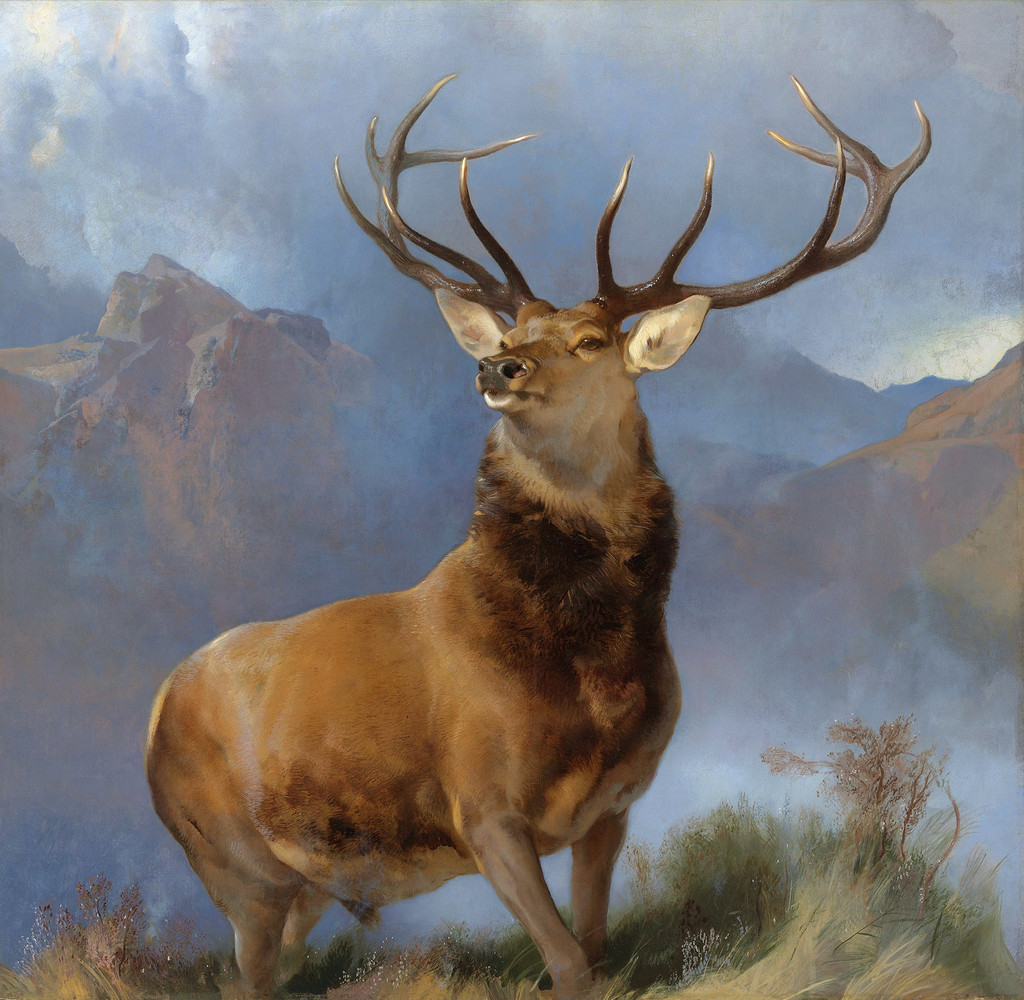
1825–26 [6]The Monarch of the Glen
about 1851 [11]Contents
- A greeting that holds the room together
- Four dogs with different places in the household
- The princess and the birds
- The Green Drawing Room and the view beyond
- An earlier arrangement of the royal couple
- A picture that took years to complete
- Wife, mother and sovereign
- From a royal room to printed images
A greeting that holds the room together
Albert sits near the centre, his body turned towards the standing queen. His bent legs extend into the foreground, with one boot reaching towards the lower edge and the other supported farther back. His clothes connect the seated figure with the outdoor activity represented by the game and shooting equipment. Yet the chair and the room contain that activity within a setting of comfort. Landseer presents the sportsman after exertion, when movement can give way to attention, touch and the claims of the household.[2]
Victoria's pale gown establishes the strongest upright shape on the right. Its broad skirt spreads below a fitted waist, while the lace at her shoulders breaks the bright surface into a more intricate edge. Against the dark green hanging, her figure remains clearly separated from the setting. Albert's darker clothes bring him nearer to the furniture and the dogs around him. The two figures belong together through their turned heads and adjacent hands, but Landseer makes them visible through very different kinds of contrast.[2]
The small flowers are important because they introduce another scale of exchange. Albert has brought into the room the results of shooting; Victoria holds a much more delicate offering near his upper body. The Royal Collection describes her as welcoming him with a nosegay.[1] The gesture gives the encounter a focus that is neither an affair of state nor a formal presentation of insignia. A handful of flowers can carry the connection between the figures precisely because the surrounding room supplies their status so abundantly.[2]
The queen does not need a throne or crown to remain the composition's most prominent standing figure. Her height, light dress and position near the open doorway distinguish her from everyone else. Albert is the point towards which much of the household's attention travels, but Victoria gives the group its highest human point. This balance makes the portrait more complicated than a simple division between an active husband and a passive wife. The picture can organise a domestic welcome while preserving the sovereign's visual authority.[2]
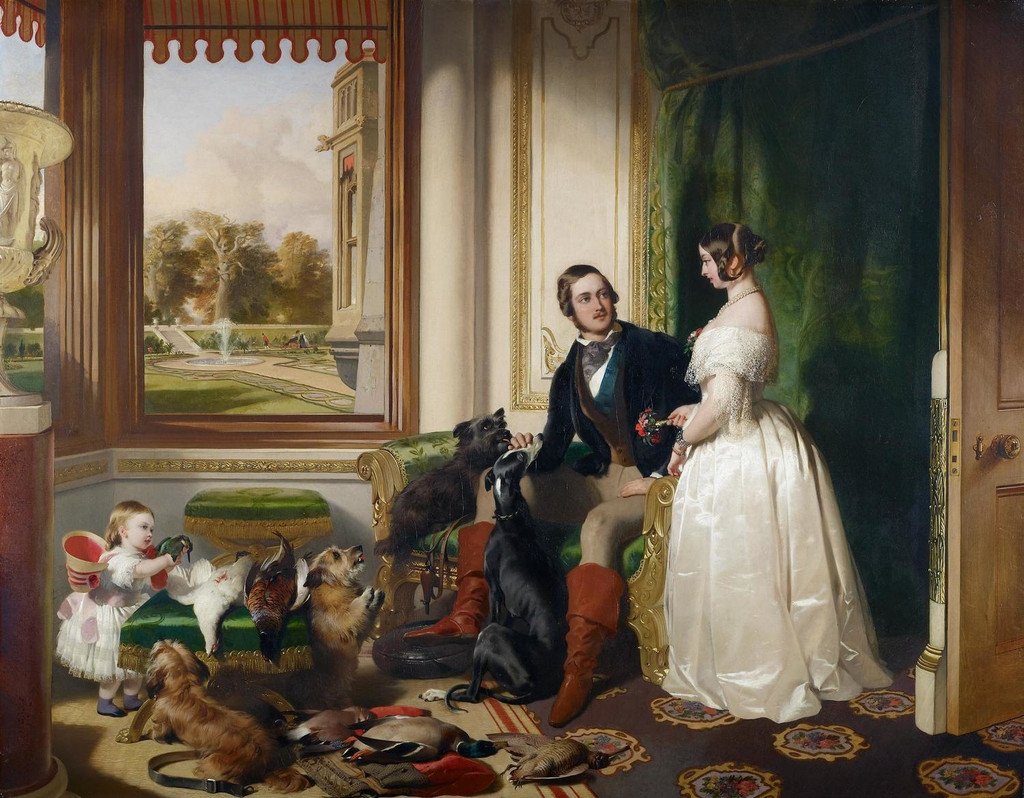
Windsor Castle in Modern Times: Queen Victoria, Prince Albert and Victoria, Princess Royal. Royal Collection. Image source. Public domain.
Four dogs with different places in the household
The dogs give the royal encounter several additional centres of attention. Ormond identifies the sleek black dog at Albert's knee as Eos, the dark terrier beside him on the sofa as Dandie, the upright begging dog as Islay and the brown dog farther left as Cairnach.[3] Their names identify particular animals within the household. Their pictured actions, however, are equally important: Landseer makes each one occupy a different level and participate in a different relation to the people, furniture and other creatures around it.[2]
Eos rises from the floor towards Albert's hand. The long muzzle points upwards, and the curve of the neck joins the seated man's arm to the lower part of the room. The smooth, dark coat creates a nearly continuous shape against his pale breeches and brown boots. The dog's position is close and physically specific: its body occupies the narrow interval before the seat, while its head reaches into the human exchange above. It links the sportsman's resting posture with the activity at his knee.[2]
Dandie occupies the sofa itself, beside Albert rather than below him. The shaggy head and raised forepart emerge against green upholstery, making a rougher outline than Eos's. The proximity of the two heads creates a small concentration of animal attention around Albert's hand. Their different coats and bodily forms keep them distinct even where their actions converge. Landseer does not arrange a row of pet portraits along the floor; he brings the animals into the furniture and gestures through which the family is represented.[2]
Islay sits upright nearer the middle of the room, with forepaws raised and head tilted towards the adults. The posture is immediately legible as begging, but its compositional effect is more extensive. It creates another vertical form between the princess and her parents, turning a patch of tan fur into a small upright presence beside the larger dark shapes. The raised paws also offer a gentler echo of the hands and flowers above. Across different scales, the picture repeatedly makes attention visible through an extended limb or an upward turn.[2]
Cairnach occupies the left foreground, facing towards the child and the stool. Its longer body runs across the rug rather than rising towards Albert. A broad collar and trailing strap give the animal a connection to the equipment scattered nearby, while its brown coat belongs to the warmer colours of the lower room. This different orientation prevents all four dogs from becoming variations on a single appeal to their owner. The household extends towards the princess as well as towards the seated prince.[2]
The four animals help distribute movement through an otherwise composed gathering. One stretches up, another presses into the sofa, a third balances upright, and a fourth remains close to the ground. Their actions make the room seem occupied rather than merely furnished. At the same time, their controlled placement makes that occupation easy to follow. Landseer combines the specificity of named companions with a design in which animal bodies carry the eye between the royal adults, the child and the objects of the day's sport.[2][3]
The princess and the birds
Victoria, Princess Royal, stands at the left in a pale dress, with her bonnet pushed behind her. Her position is far enough from her parents to give her an independent activity, yet close enough to remain part of their enclosed household. She holds a small bird in front of her face, while larger dead birds lie on the upholstered stool beside her. The contrast between the child's living attention and the still bodies of the game is one of the painting's most arresting features.[2]
The Royal Collection calls her bird a halcyon and interprets it as a symbol of peace; Ormond identifies it as a kingfisher.[1][3] This gives the small creature a significance different from that of the shooting trophies around it. The same image can bring sport into the royal home and attach an emblem of tranquillity to the child. The interpretation does not remove the bird's physical presence. Its compact form, held in small hands, remains part of the visible exchange between a young person and something that requires close inspection.[2]
The stool makes the birds unusually prominent. A pheasant hangs over one edge, while a pale game bird spreads across the green surface; more birds lie on the floor beside the shooting bag.[2][3] Their placement raises some of the game towards the child's level and brings the rest near the spectator. The objects are not confined to a distant corner as evidence of an activity completed elsewhere. They occupy the same immediate space as the dogs, boots, rug and furniture, making the day's shooting a material part of the family scene.
Their stillness also changes the rhythm of the lower foreground. Feathers and wings spread into irregular shapes, unlike the smoother curves of Eos or the compact uprightness of Islay. Bright patches on the birds punctuate the patterned floor, while their overlapping bodies give this part of the picture a density quite different from the queen's clear white silhouette. Landseer makes the spectator move between forms that are animated by gesture and forms whose movement has ended. The domestic portrait contains that difference without turning it into a separate dramatic episode.[2]
The painting therefore resists an entirely uncomplicated account of contented family life. Its welcome and its sense of companionship coexist with the dead creatures that establish Albert's sporting role. The child does not have to be assigned a precise emotional response for that juxtaposition to matter. Her small scale and absorbed activity bring the birds close to the everyday life of the household. What might seem an exceptional intrusion to another viewer is presented here as part of the arranged world in which the royal family appears at ease.[2]
The Green Drawing Room and the view beyond
The room is identified by the Royal Collection's account of the East Terrace Garden as the Green Drawing Room at Windsor Castle.[1] Its rich surfaces establish a particular kind of interior. Gilt edges define the seat and wall panels; green upholstery and hanging cloth surround the adults; the patterned carpet meets a smaller rug beneath the game. The surfaces do not form a neutral background. Their colour, sheen and repeated borders help separate bodies and objects while binding them within a single furnished environment.[2]
The large window opens a second kind of space at the left. Outside, the garden is organised through paths, planted shapes and the central fountain, with trees providing a deeper boundary. The visible terrace and castle wall give the view an architectural edge. It is an outdoor world that has already been shaped for looking and movement. Albert's return from shooting is thus placed between two cultivated settings: the palace room in which he rests and the formal ground visible beyond it.[1][2]
Within that distant view, the Duchess of Kent appears in a bath chair, accompanied around the terrace.[1] The small group extends the family beyond the three principal figures without crowding their immediate encounter. Victoria's mother occupies another generation and another part of the household's daily space. The scale is radically different from that of the daughter near the foreground, but the two presences help frame the royal couple within a family that reaches both backwards and forwards in age.[2]
The window also balances the queen's brightness. Her gown dominates the right, while pale sky and garden light open the left. Between these areas, Albert's darker body and the green furniture become the centre through which the spectator passes. The composition is not simply a group placed beside a convenient view. Its interior and exterior are mutually organised, with the dark hanging containing one side and the open window relieving the other. The result gives a crowded room a sense of breadth without dissolving its enclosure.[2]
John Morrison has contrasted this controlled Windsor setting with Landseer's later image of the royal couple at Loch Muick. In his reading, the formal garden and furnished interior help establish an ordered domestic world, whereas the Highland subject offers the royal pair a different relation to outdoor life.[14] That comparison clarifies something particular to the Windsor canvas. Nature is present through flowers, dogs, game and the garden, but each has been brought into a carefully managed relationship with the home. The picture's ease depends on that organisation.[2]
An earlier arrangement of the royal couple
A surviving study shows that the final grouping was not the only way Landseer considered presenting Victoria and Albert. The Royal Collection dates the sketch tentatively to June 1841. In it Albert stands beside the queen in ordinary clothes, and the pair seem to attend to a lightly indicated parrot at the left.[15] The difference is substantial. The man who occupies the centre of the finished painting as a seated sportsman first appeared as another upright figure, sharing a more compact action with his wife.
The queen's figure remained closer to the eventual design, while Albert's height and orientation changed. In the study, the two standing bodies form a narrow group, with his dark shape leaning towards her. In the finished picture, seating him opens the composition across the room and creates places for the dogs, shooting equipment and child to participate.[2][15] The change makes domestic life visible through a broader range of relationships. The image no longer depends chiefly on what two adults are looking at together.
The study's unfinished condition is useful because it makes the difference between an idea and a completed arrangement so evident. Albert's features are scarcely developed, and large passages remain loosely indicated. Victoria's dress and posture have received more definition. The contrast shows the unequal development of different parts of a design without proving the precise sequence in which Landseer worked on the final canvas. What the study securely offers is an alternative conception of the couple, one whose relations can be compared with the finished picture.[15][16]
Ann Poulson has discussed this change alongside the competing demands of Victoria's position as wife and sovereign. Her account brings together differing scholarly readings of the final image rather than reducing the alteration to one certain cause.[16] The comparison is valuable even when motive remains open. Placing Albert lower allows Victoria to stand above him, while his central position and the attention directed towards him preserve his importance. A change in pose can redistribute authority without producing a simple reversal of the couple's roles.[2]
A picture that took years to complete
Victoria commissioned the painting, and Ormond traces its development through her journal. An agreement and sittings are recorded in June 1841; the large canvas was brought to Windsor that August. Further sittings followed in 1842 and 1843, with additional work in March 1845 and a journal notice of its hanging on 2 October 1845.[3] This chronology explains why the present 1841–43 catalogue range cannot tell the whole story of the object's making. The image's development continued beyond the period attached to its familiar label.
An older scholarly record also reports an inscription on the reverse naming an 1840 beginning and an 1843 finish.[17] That information introduces another dating layer, but does not make the later journal account disappear. The different dates refer to the work through inscriptions, cataloguing and the sequence of sittings and delivery. It is more revealing to keep those kinds of evidence distinct than to turn them into an apparently exact account of uninterrupted work. A portrait can have a recorded early state and still require later attention before its owner hangs it.
There is a contemporary glimpse of Landseer's royal domestic work in Macready's diary. On 4 April 1843, during visits to artists' studios, he recorded seeing a domestic subject of the queen and Prince Albert at the Landseers.[18] He did not give a title or describe a finished state. The entry nevertheless provides a useful contrast with the final painting's poised encounter. Royal family imagery was something visitors could see taking shape in an artist's working environment, before it became a composed image on a palace wall.
Wife, mother and sovereign
The portrait's domestic roles are clear enough to be recognisable: the sportsman returns, his wife greets him, their daughter occupies herself nearby. Yet their political identities remain inseparable from the scene. The room's splendour supplies a royal setting even where the figures do not display crowns or state robes. Victoria's white dress and standing position distinguish her from the seated Albert, while his centrality and the attention of the dogs make him a compelling focus. The household arrangement contains several kinds of prominence rather than a single hierarchy.[2]
Poulson's discussion shows how differently this balance has been understood. Some readings emphasise the queen's affectionate domestic deference; others stress the sovereignty maintained by her upright, conspicuous figure. Poulson treats those disagreements as evidence of the difficulty of combining Victoria's roles in one image.[16] The painting sustains that difficulty because its devices work in more than one direction. The very pose that can suggest a welcoming wife can also make her the figure who rises above the room's principal seated occupant.
The dogs reinforce this complexity rather than resolving it. Their attentions gather around Albert, giving his presence a bodily immediacy that no formal emblem could supply. The princess and Cairnach extend the action leftwards, while the queen's figure closes the group on the right. Landseer distributes relations through looking, touching, waiting and holding. The result makes family life appear as a set of connections between particular beings, even while the larger design offers those connections as an image of monarchy.[2]
The title's emphasis on modern times is important in this respect. The painting is not a royal history scene in which costume carries the viewer into a distant reign. It presents contemporary clothes, companions and family activities inside an old royal residence. The castle's continuity is expressed through a household imagined in the present. That combination allows the portrait to make a claim about ordinary relationships without abandoning the special setting that makes these relationships publicly significant.[1][2]
From a royal room to printed images
The painting's later circulation brought that carefully composed household to viewers beyond the palace. A print in the National Portrait Gallery, titled Windsor Castle in the Present Time, is catalogued as a mixed-method engraving by Thomas Lewis Atkinson and Frederick Stacpoole, printed by Dixon & Ross and published by Henry Graves & Co on 17 November 1851.[19] Those distinct roles matter. The painted image reached another medium through work shared among engravers, printer and publisher, rather than through an anonymous reproduction that can simply be treated as Landseer's own hand.
The date belongs to that documented impression. Earlier and later catalogues do not give an entirely uniform print chronology: Graves's 1874 list assigns the Atkinson engraving to 1851, while Ormond lists 1850.[3][20] The surviving record is sufficient to establish a dated public form without inventing an exact first appearance. Its changed title also shifts the emphasis slightly. The modern royal household becomes a present-time view of Windsor, attaching the residence's name to the family arrangement that made its interior visible.
An Atkinson engraving after the same painting survives at Dunham Massey, where the National Trust records it in an ornate gilt frame.[21] Its presence demonstrates one concrete afterlife of the image in another collection. It does not require a claim that every household owned a copy or that all spectators accepted its view of family life. A royal domestic portrait could travel into a different interior, where its dogs, child and welcoming couple remained recognisable even when the original room was far away.
Landseer's achievement rests on the relationship between that wider visibility and the scene's apparent privacy. The flowers are small, the dogs have individual places, and the child has her own absorbing activity, yet none of these details has escaped the ordering of the whole. The garden and the drawing room, the living companions and the dead game, the standing queen and the seated consort form an image whose ease is inseparable from its construction. The royal home is made convincing through particular presences, then made available as something to be seen.[2]
Artworks directory
This directory gathers works discussed in the articles, including drawings, original etchings and prints after Landseer. It is not a complete catalogue of every drawing, version, plate or impression. Distinct media are kept separate; uncertain dates are left blank. Linked titles open individual articles.
| Name | Date | Medium |
|---|---|---|
| A Bellowing Stag | Drawing | |
| A Deerhound | 1826 | Painting |
| A Distinguished Member of the Humane Society | 1838 | Painting |
| A Highland Breakfast | 1834 | Painting |
| A Highland Landscape | c. 1830 | Painting |
| A Highland Shepherd's Home | Painting | |
| A Horse, Goat and Bull | 1811 | |
| A Hunting Horse | Drawing | |
| A Jack in Office | Painting | |
| A Lion Disturbed at His Repast | Painting | |
| A Random Shot | Painting | |
| A Scene at Abbotsford | Painting | |
| Adversity | Painting | |
| Alexander and Diogenes | exhibited 1848 | Painting |
| Alpine Mastiffs Reanimating a Distressed Traveler | 1820 | Painting |
| Contending Group after Nature | Drawing | |
| Copy after Rubens's Wolf and Fox Hunt | c. 1824–26 | Painting |
| Dash | Painting | |
| Deer and Deer Hounds in a Mountain Torrent ('The Hunted Stag') | c. 1832 / exhibited 1833 | Painting |
| Deer Family | ||
| Dignity and Impudence | 1839 | Painting |
| Dog Resting Upon a Couch | Drawing | |
| Eos | 1841 | Painting |
| Favourites, the Property of H.R.H. Prince George of Cambridge | 1834–35 | Painting |
| Her Majesty Sketching at Loch Laggan | ||
| High Life | 1829 / exhibited 1831 | Painting |
| Highland Lassie | Drawing | |
| Isaac van Amburgh and his Animals | 1839 | Painting |
| Lady Godiva's Prayer | Painting | |
| Laying Down the Law | 1840 | Painting |
| Lion Defending Its Prey | c. 1840 | Painting |
| Lioness | Drawing | |
| Little Strollers | ||
| Low Life | 1829 / exhibited 1831 | Painting |
| Man Proposes, God Disposes | 1864 | Painting |
| Nell Gwynne / Diana Vernon | Painting | |
| Neptune | ||
| No Hunting Till the Weather Breaks | Painting | |
| Otterhounds | Drawing | |
| Peace | Painting | |
| Pensioners | Painting | |
| Portrait of a Mule | Painting | |
| Portrait of Mr Van Amburgh, as He Appeared with His Animals at the London Theatres | 1846–47 | Painting |
| Portraits of a Pointer Bitch and Puppy | Painting | |
| Pray Let Me Out | ||
| Prosperity | Painting | |
| Ptarmigan in a Landscape | by 1833 | Painting |
| Queen Victoria and Prince Albert at the Bal Costumé of 12 May 1842 | 1842–46 | Painting |
| Queen Victoria at Loch Laggan | Painting | |
| Queen Victoria at Osborne | 1865–67 | Painting |
| Queen Victoria landing at Loch Muick | Painting | |
| Rat-catching | 1823 | |
| Reclining Lion | Drawing | |
| Reclining Lion, From Back | Drawing | |
| Rent-day in the Wilderness | 1855–68 | Painting |
| Return from Deer Stalking | 1839 | |
| Royal Sports on Hill and Loch | Painting | |
| Sam Lovill, Porter at the Royal Academy | Drawing | |
| Scene from A Midsummer Night's Dream | 1848–51 | Painting |
| Scene in the Highlands, with portraits of the Duchess of Bedford, the Duke of Gordon and Lord Alexander Russell | Painting | |
| Scottish Highlands, Lochs and Figures | Drawing | |
| Shoeing | exhibited 1844 | Painting |
| Sleeping Bloodhound | exhibited 1835 | Painting |
| Spaniel and Rabbit | Painting | |
| Stag at Bay | 1866 | Sculpture |
| Stag at Bay | 1846 | Painting |
| Studies of a staghound and the head of a stag for painting ‘The Hunting of Chevy Chase’ | Drawing | |
| Study for Alpine Mastiffs Reanimating a Distressed Traveler | Drawing | |
| Study for the Monkey in The Cat's Paw | Drawing | |
| Study of a Dog | Drawing | |
| Study of a herding dog facing right | Drawing | |
| Study of the horse of Selene, from the East pediment of the Parthenon | Drawing | |
| Suspense | Painting | |
| Taking a Buck | ||
| The Arab Tent | c. 1865–66 | Painting |
| The Barn | Drawing | |
| The Best Run of the Season | ||
| The Cat's Paw | c. 1824 | Painting |
| The Cavalier’s Pets | ||
| The Challenge | Painting | |
| The Chase | Drawing | |
| The Connoisseurs: Portrait of the Artist with Two Dogs | 1865 | Painting |
| The Death of a Stag in Glen Tilt | Painting | |
| The Drive—Shooting Deer in the Pass | Painting | |
| The Drover's Departure | Painting | |
| The Highland Shepherd’s Dog | 1824; portfolio issue 1848 | |
| The Honourable Mrs Norton | Painting | |
| The Hunting of Chevy Chase | 1825–26 | Painting |
| The Illicit Highland Whisky Still | Painting | |
| The Keeper John Crerar with his Pony | Painting | |
| The Larder Invaded | ||
| The Lion-Dog of Malta | ||
| The Lions at the Base of Nelson's Column | 1867 | Sculpture |
| The Monarch of the Glen | about 1851 | Painting |
| The Mountain Torrent | ||
| The Old Shepherd's Chief Mourner | 1837 | Painting |
| The Sanctuary | 1842 | Painting |
| The Stricken Deer | Painting | |
| The Twa Dogs | Painting | |
| Time of Peace | ||
| Two stags running | Drawing | |
| Victoria, Princess Royal, with Eos | Painting | |
| View of Glenfeshie | Painting | |
| War | Painting | |
| White Horse in a Stable | Painting | |
| Windsor Castle in Modern Times | 1841–43 | Painting |
| Woburn Abbey Game Card | 1825; portfolio issue 1848 |
Discussion
Use the article’s images and evidence to develop your own reading of Windsor Castle in Modern Times.
Reader Insights
Which detail is most revealing when you consider “A greeting that holds the room together”?
How does the evidence in “Four dogs with different places in the household” affect your reading of Windsor Castle in Modern Times?
What further question would you bring to “From a royal room to printed images”?
Join the Conversation
Share a detail, comparison or question about Windsor Castle in Modern Times below.
References
- Royal Collection Trust, Windsor Castle in modern times; Queen Victoria, Prince Albert and Victoria, Princess Royal, RCIN 406903; Castle and Terrace Garden, RCIN 817132.w. Accessed 31 October 2026. View source 1. View source 2.
- Royal Collection Trust, colour photograph of Windsor Castle in Modern Times, accompanying the Royal Gardens account. Accessed 31 October 2026. View source.
- Richard Ormond, Sir Edwin Landseer, Philadelphia Museum of Art and Tate Gallery, 1981, entry 105, pp. 150–152. Includes accounts of Queen Victoria's journal entries from June 1841 to October 1845. Accessed 31 October 2026. View source.
- National Gallery of Art, Alpine Mastiffs Reanimating a Distressed Traveler. View source.
- Minneapolis Institute of Art, The Cat's Paw. View source.
- Birmingham Museums Trust, The Hunting of Chevy Chase. View source.
- Victoria and Albert Museum, The Old Shepherd's Chief Mourner. View source.
- Tate, Dignity and Impudence. View source.
- Royal Collection, Eos. View source.
- Royal Collection, Windsor Castle in Modern Times. View source.
- National Galleries of Scotland, The Monarch of the Glen. View source.
- Royal Holloway, University of London, Man Proposes, God Disposes. View source.
- Trafalgar Square / Greater London Authority, The Lions at the Base of Nelson's Column. View source.
- John Morrison, “‘The whole is quite consonant with the truth’: Queen Victoria and the myth of the Highlands”, in Victoria & Albert: Art & Love, edited by Susanna Avery-Quash, Royal Collection Trust, 2012, pp. 3–4. Accessed 31 October 2026. View source.
- Royal Collection Trust, Queen Victoria and Prince Albert: Study for “Windsor Castle in Modern Times”, RCIN 404049, tentatively dated June 1841. Accessed 31 October 2026. View source.
- Ann Poulson, The Public Image of Queen Victoria 1837–1861: Wife, Mother, and Queen Regnant, PhD thesis, King's College London, 2015, pp. 140–143 and fig. 115, p. 430. Accessed 31 October 2026. View source.
- University of Virginia, Rossetti Archive, Windsor Castle in Modern Times: Queen Victoria, Prince Albert and Victoria, Princess Royal, electronic archive edition 1, op129.rap.xml. Accessed 31 October 2026. View source.
- William Charles Macready, The Diaries of William Charles Macready, 1833–1851, edited by William Toynbee, volume II, New York: G. P. Putnam's Sons, 1912, p. 201, entry 4 April 1843. Accessed 31 October 2026. View source.
- National Portrait Gallery, Windsor Castle in the Present Time, NPG D50323, mixed-method engraving after Landseer, published 17 November 1851. Accessed 31 October 2026. View source.
- Algernon Graves, Catalogue of an Exhibition of the Engraved Works of the Late Sir Edwin Landseer, R.A., revised edition, London: Henry Graves & Co., 1874, p. 38, no. 514. Accessed 31 October 2026. View source.
- National Trust, Windsor Castle in Modern Times, NT 930300, engraving by Thomas Lewis Atkinson after Landseer, Dunham Massey. Accessed 31 October 2026. View source.
- Splash image, Windsor Castle in Modern Times: Queen Victoria, Prince Albert and Victoria, Princess Royal. Royal Collection. Image source. Public domain.
- Navigation image, One of the bronze lions at Nelson’s Column: modelled by Edwin Landseer and cast by Carlo Marochetti. Photograph by Amanda Slater. CC BY-SA 2.0. Image source. CC BY-SA 2.0. Resized.