by Tom Gurney
Tom Gurney BSc (Hons) is an art history expert with over 20 years experience
Email: tomgurney1@gmail.com / Phone: +44 7429 011000
A painting of beauty and damage
Sir Edwin Landseer's Ptarmigan in a Landscape turns a difficult visual problem into an unsettling encounter. Two nearly white birds lie on snow and pale rock. Their bodies might have disappeared into that ground, but dark tail feathers, grey shadows and small red wounds make them impossible to overlook. Four more ptarmigan fly across a distant mountain. No sportsman, gun or dog appears. The human action has already happened; the picture gives its consequences almost the whole foreground.
The Philadelphia Museum of Art dates the work “By 1833”, records it as oil on panel and gives its size as 19½ by 25¾ inches, or 49.5 by 65.4 centimetres. The museum holds it as object 82728, accession `1986-26-280`, credited to the Henry P. McIlhenny Collection in memory of Frances P. McIlhenny.[1] Those particulars matter because older accounts vary in title, dimensions and proposed place of execution. They also give firm limits to a picture that readily invites a story.
Philadelphia's interpretation identifies the larger, left-hand bird as a dying male and the other as his wounded mate, still guarding their nest. It reads their attachment as an image of love, violence and family duty.[1] That is a compelling history of interpretation, but it is not identical with everything visible on the panel. Blood and injury are clear; the birds' sexes and an actual nest are not independently certain. Modern ornithology also complicates the familiar claim that ptarmigan pair for life. The distinction does not strip the scene of feeling. It shows how Landseer's image, a museum label and knowledge of the living species each contribute something different.
The painting earned two strikingly different responses at its first known exhibition. One critic praised the technical feat of distinguishing white birds from snow. Another dwelt on their pain and challenged the pleasure of shooting. Both responses appeared in February 1833.[2][3] Technique and moral force were therefore joined from the start. Landseer made the birds visible; once seen, their beauty and damage could not easily be separated.
At a Glance
- ArtistEdwin Landseer [1]
- Dateby 1833 [1]
- Collection or sitePhiladelphia Museum of Art [1]
- Object1986-26-280 / object 82728 [1]
This work across Edwin Landseer’s career
The Cat's Paw
c. 1824 [5]The Hunting of Chevy Chase
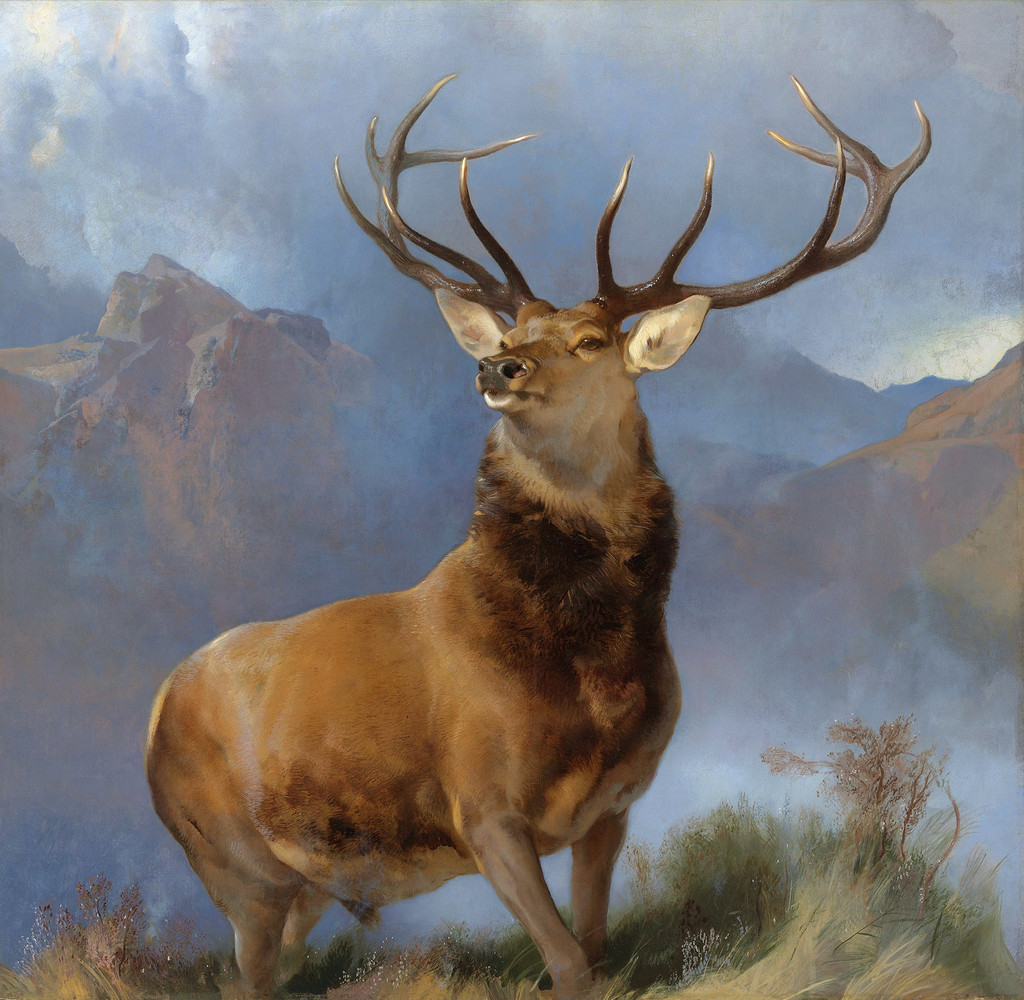
1825–26 [6]The Monarch of the Glen
about 1851 [11]Contents
- A painting of beauty and damage
- The object and its changing names
- Why the date stops at “By 1833”
- Two wounded birds and an absent hunter
- Solving white against white
- Blood, black feathers and the picture's accents
- Rocks, snow and a severe mountain wall
- Four distant birds and two kinds of time
- What kind of bird is a ptarmigan?
- Can the mate-and-nest story be seen?
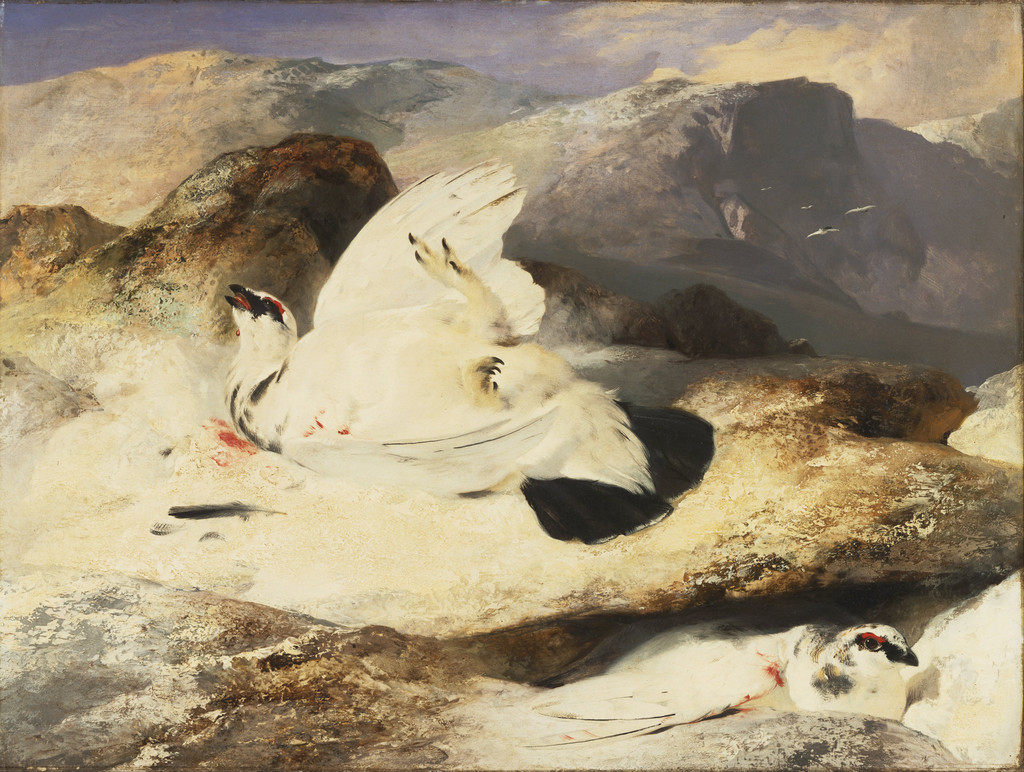
Ptarmigan in a Landscape. Philadelphia Museum of Art. Image source. Public domain.
The object and its changing names
The museum's current title is Ptarmigan in a Landscape. Its wording balances species and setting: the birds are not isolated specimens, while the mountains are not neutral scenery. Philadelphia's structured record names Sir Edwin Landseer, an English artist born in 1802 and dead in 1873, and classifies the work among paintings. It also assigns “Made in England” as its geography and marks the image record Public Domain.[1] The latter status is useful for access, although it says nothing by itself about the panel's manufacture or condition.
Richard Ormond's catalogue for the major 1981–82 Landseer exhibition reproduces this object as no. 37 under the shorter name Ptarmigan. He records the same medium but gives the dimensions as 19¾ by 26 inches, or 50.2 by 66 centimetres.[14] That quarter-inch difference in each direction has no explanation in the checked records. Philadelphia's present figures should take precedence for the current object, while Ormond's remain a valid record of how it was measured or catalogued in 1981. The discrepancy cannot responsibly be converted into a tale of trimming, reframing or restoration.
Titles changed more conspicuously. The British Institution showed the work as Ptarmigan, no. 129, in 1833. Ormond lists it in a London exhibition of 1874 as Blackcock, no. 352, before recording later appearances in London in 1890 and 1961 and Detroit in 1968.[14] “Blackcock” did not endure. The nineteenth-century exhibition title Ptarmigan, the present museum identification and the birds' white plumage, black tails and mountain habitat all support the modern name. The 1874 label is valuable not because it settles the species, but because it reveals how catalogue identities can wander while the painted object remains.
No checked source identifies a signature or dated inscription. Nor does the museum specify the panel's wood, thickness, joins, preparation or conservation history. Oil on panel is the complete secure material description.[1] Calling it canvas would be an error; naming oak, mahogany or another timber would exchange one unsupported certainty for another.
Why the date stops at “By 1833”
“By 1833” is unusually informative when read beside the exhibition press. The Spectator discussed Ptarmigan no. 129 on 16 February 1833, and The Examiner reviewed the same number eight days later.[2][3] The panel was therefore complete enough to hang at the British Institution and attract detailed notice by the middle of February. This is a secure latest date, not proof that Landseer applied his final stroke in 1833.
Ormond goes further. He proposes that the painting was almost certainly made in the hills above Glenfeshie, probably in autumn 1832.[14] His wording belongs to connoisseurial reconstruction: informed, specific and still probabilistic. No letter, dated sketch, inscription or documented expedition cited in the exact entry fixes the panel to that season. Philadelphia's separate “Made in England” field points in another direction.[1] The two statements cannot be harmonised by inventing a Scottish beginning and English completion. They should remain an open catalogue disagreement.
Season presents a second caution. The foreground birds are predominantly white and lie amid snow. In broad terms, that is cold-season plumage. Yet ptarmigan do not exchange one uniform for another on a single calendar date. Both sexes become white in winter, and males can retain conspicuous white plumage into the breeding period.[15][16] A white bird on snow cannot date the act of painting. Landseer might also have worked from dead specimens, earlier observation, drawings or memory, but no evidence attached to this object identifies his procedure.
Ormond quotes an account by the actor Charles James Mathews of a demanding journey from the Doune to the Glenfeshie huts in September 1833. The party rode over mountain tops and dispersed in search of game on the ptarmigan hills.[14] It offers vivid evidence of the sporting world Landseer knew. Chronology prevents it from becoming this picture's origin story: the panel had already been reviewed in London seven months earlier. The episode illuminates a recurrent practice, not the creation of no. 129.
Two wounded birds and an absent hunter
The larger bird lies across the left and centre of the foreground. Its head turns upwards from the snow, the beak opens and a red drop hangs below it. One wing rises into a pale fan; a dark-clawed foot lifts against the mass of white feathers. Red marks gather under the breast and recur along the lower plumage. The position is unstable enough to resist the neatness of a displayed trophy. The Examiner described a wounded bird lying in pain, and Philadelphia calls the male dying.[1][2] “Wounded”, “dying” or “in extremis” fits the evidence better than declaring a precise moment of death.
The second ptarmigan lies along the lower-right edge, partially separated from the first by a diagonal shelf of rock and snow. Its head remains visible, with a short black bill, dark eye, black facial marks and a red comb. Blood crosses its neck and breast. Philadelphia calls this bird the wounded mate; Ormond uses similar language, though he says “apparently” wounded.[1][14] The red marks support injury, but the picture does not supply a reliable test of sex. Winter whiteness belongs to males and females, and painted facial features cannot resolve the question alone.[15][16]
Everything human is offstage. No hand holds a gun, no hound retrieves the quarry and no figure claims possession. The viewer must work backwards from blood and collapsed bodies to a shooting. This displacement changes the usual hierarchy of a sporting scene. The sportsman's skill, equipment and excitement receive no visual space. His impact fills it.
Absence does not automatically make the painting a denunciation of all field sport. Landseer knew sporting patrons and expeditions, and the first documented owner was himself a notable sportsman.[14] What the composition does is narrower and more exact: it withholds the agent while bringing the vulnerable results near. The person who looks at the panel occupies the position from which the unseen hunter might otherwise have dominated. That uncomfortable proximity helps explain why an 1833 critic could move from admiration of painting to a question about causing pain for amusement.[2]
Solving white against white
The central technical feat is easy to state and hard to achieve. White feathers rest on white snow, but neither bird dissolves. Landseer does not rely on a heavy contour around every form. He differentiates neighbouring pale areas through temperature, tone, edge and direction. Cream and faint gold warm some feathers; cool grey turns others away from the light. Thin brown-grey marks pick out quills. Soft transitions build the breast, while sharper accents define the wing tips and claws.[17]
Snow is equally varied. It carries buff reflected colour near rocks, grey in shallow depressions and brighter passages around the birds. Exposed stone interrupts the pale field with ochre, umber and blue-grey. These shifts let the eye distinguish feather from ground even where both approach the same brightness. They also make the apparent camouflage unstable: the birds belong to the terrain, yet injury exposes them within it.
The black tail of the left bird provides the strongest anchor. Two dense dark shapes project beneath the white body near the centre-right, preventing the folded plumage from becoming a shapeless light patch. Smaller black notes—the bill, eye line, neck markings, claws and several feather tips—carry that structure through the bird. The lower-right ptarmigan repeats the dark face and bill on a smaller scale. Its body, however, runs almost horizontally into the pale edge, as though disappearance remains possible.
This was not merely a modern response to a high-resolution image. Reviewing the British Institution in February 1833, The Spectator called the painting “a triumph of art” and singled out the skill with which the birds' white was relieved and contrasted by snow.[3] The critic recognised that snow is not a blank background. It is an active comparator: similar enough to threaten visibility, different enough under Landseer's handling to disclose volume, species and wound.
Ormond later called the panel a “brilliant study in whites” and emphasised the tactile finish of the feathers.[14] The digital image supports close description of broad and fine marks, but it does not reveal pigments, underdrawing, glazing sequence or later restoration. The achievement can be understood without pretending to possess a conservation report.
Blood, black feathers and the picture's accents
Red occupies very little of the surface. That scarcity gives it force. Beneath the left bird, blood interrupts the cream snow in short, irregular patches. A drop near the open beak creates a finer vertical accent. Streaks appear again on the lower-right bird, so that the eye discovers injury twice rather than exhausting it in one dramatic centre.[17]
The red combs above the birds' eyes complicate the reading. They are features of the animal as well as colour echoes of its wounds. A mark can therefore belong to healthy anatomy in one place and violence in another. Landseer uses that ambiguity to bind close observation to pathos. The scene is not persuasive because every red note means blood; it is persuasive because the normal brilliance of the bird and the evidence of damage share a narrow range of colour.
Black carries a different burden. Tail and facial feathers help identify a winter ptarmigan, since the species remains dark in those areas when most plumage turns white.[15][16] In the painting, the same marks also control composition. The left tail weighs down the raised wing; the lower bird's bill and eye pull attention towards the margin; the dark claws interrupt the central whiteness at its most exposed point. Natural-history accuracy and pictorial design need not be opposing explanations. An observed feature can become an organising device.
The physical cause remains withheld. Nothing permits a reconstruction of shot direction, weapon, range or sequence. Even the exact division between blood, red comb and warm reflected paint should be described visually rather than forensically. Yet the wounds are unequivocal enough for the 1833 Examiner to notice white plumage stained by blood.[2] Its critic did not need to see the gun. Landseer's colour had made the cost legible.
The combination of delicate plumage and injury also prevents neutral admiration. Close looking rewards the viewer with changing whites, fine edges and anatomical structure, then makes that attention dwell on an open beak and bloodied breast. Beauty is not placed before the violence as consolation. It intensifies what has been harmed.
Rocks, snow and a severe mountain wall
The birds occupy a landscape made from interlocking diagonals. A dark ledge runs across the foreground and separates the lower-right ptarmigan from the larger body. Behind the raised wing, warm brown-grey rocks climb towards the centre. Snow drapes and breaks around them rather than forming a flat sheet. Ormond observed that these snowy rocks both set off the birds and define strong diagonal lines.[14] The high-resolution image confirms how thoroughly setting and arrangement coincide.[17]
Beyond the foreground, the land recedes in broad, compressed bands. Pale slopes rise at the left. Blue-grey and muted green passages create a middle distance behind the birds. At the upper right, a steep dark mountain face occupies much of the background, relieved by a lighter peak or snowfield beyond it. The horizon sits high enough that the animals seem enclosed by ground and rock rather than displayed beneath an expansive sky.
The sky itself is narrow. Cool lilac-grey enters at the upper left; paler cream-grey appears towards the right. No sun, storm front or exact hour can be securely named. Its restricted strip matters compositionally because it leaves the four flying birds mostly silhouetted against mountain, where their white wings are easier to follow.
This is convincing ptarmigan country in general terms. RSPB locates Britain's birds on the highest mountains of the Scottish Highlands, in terrain it likens to an Arctic landscape; BTO likewise associates them with sparsely vegetated high tops.[15][18] Those sources support mountain altitude and habitat, not an exact topographic identification. No peak, corrie or viewpoint in the painting is named by Philadelphia. Even Ormond's Glenfeshie proposal concerns where the panel may have been made, not a demonstrated map location for every ridge.[1][14]
The setting is therefore specific in ecology and unspecific in cartography. Snow, exposed rock, sparse vegetation and severe slopes make the species at home. The absence of a named summit keeps the viewer's attention on relations—pale body to pale ground, fragile foreground to massive distance—rather than converting the picture into a travel record.
Four distant birds and two kinds of time
Four small ptarmigan fly across the dark upper-right mountain. Their number and position are clearest in Philadelphia's 5,448-by-4,086 image service.[17] They are not decorative flecks. Each pale body is separated by a short interval, and their wing positions vary. Together they carry a broken rhythm from left to right through the otherwise heavy mountain wall.
The foreground and background stage opposite conditions of the same species. Two birds are grounded, wounded and enlarged. Four remain airborne, remote and apparently uninjured. The contrast creates depth, but it also creates time. The lifted wing and open beak of the central bird make suffering feel immediate. The distant flock proceeds through a space too large to be arrested by that single event.
Ormond compared the flying birds to a Greek chorus and called them harbingers of tragedy.[14] It is a vivid critical analogy, not a literal account of avian awareness. Nothing proves that the distant birds see the casualties, understand shooting or fly towards them. The analogy is useful because it describes their pictorial role: they enlarge an intimate scene into something witnessed, echoed or continued beyond the foreground.
Their visibility also repeats the painting's white-on-white experiment in reverse. The wounded birds are pale against pale snow, so Landseer must find small differences to reveal them. The living birds cross a dark mountain and appear almost at once. Nearness brings detail but threatens camouflage; distance removes detail but supplies contrast. The same species is presented under two visual conditions.
That arrangement keeps the work between still life and narrative. The foreground plumage invites the exact scrutiny of laid-out game. The flock introduces before and after, freedom and consequence, continuation and loss. Neither category fully contains the panel. It is a study of dead or dying quarry that refuses to keep life outside the frame.
What kind of bird is a ptarmigan?
The ptarmigan is Lagopus muta, a member of the grouse family adapted to cold, open mountain and tundra conditions.[15][18] In Britain its stronghold is the highest ground of the Scottish Highlands. Feathered feet help it move on snow, while seasonal plumage changes alter the bird's relation to its surroundings.[18]
RSPB describes summer upperparts as a mixture of grey, brown and black, with white wings and belly. In winter the bird becomes largely white, except for the black tail and eye patch.[15] BTO refines the summer difference: females are mottled brown above, while males are greyer.[18] Cornell notes that both sexes are white in winter and that males generally have a more pronounced red comb and black line before the eye.[16]
These features clarify Landseer's choices without turning the panel into a scientific plate. The black tails, dark facial marks and red combs belong to recognisable ptarmigan morphology. The white bodies fit a snowy or transitional seasonal appearance. The mountain rocks and sparse ground fit the species' habitat. Yet a painting can intensify a comb, expose a tail or arrange a wing for pictorial reasons. The exact sex of either wounded bird cannot be certified by comparing a nineteenth-century image with a field guide.
Season is equally resistant to precision. Winter whiteness is a real adaptation, but males can remain white well into courtship, later changing towards brown. Snow can persist on high ground when lower country has moved into another season.[15][16] The image supports “winter plumage”, “white seasonal plumage” or “cold mountain setting”; it does not support a particular month.
The species knowledge deepens the painting's visual premise. Camouflage should reduce visibility. Landseer reverses that protective relation without abandoning it: the birds nearly share the colour of their environment, but blood, shadow and black plumage disclose them. The very adaptation that helps a living ptarmigan disappear becomes the painter's means of making injured quarry newly present.
Can the mate-and-nest story be seen?
Philadelphia's label offers a complete drama. Two favourite birds of Scottish sport have been shot; the male dies; his wounded mate remains to guard the nest. Landseer, the label argues, uses the pair to address love and family under violence.[1] Ormond's catalogue anticipates much of that reading. He describes the left bird as a wounded hero and the apparently wounded mate as continuing to guard the nest, then connects the scene to heroic widowhood.[14]
Several parts have firm visual support. There are two large ptarmigan. Both carry red wound marks. The larger bird's contorted pose suggests acute suffering, while the lower-right bird appears more watchful. Their proximity encourages a relationship, and the rocky ground is suitable for a species that nests in exposed, stony places. Cornell describes the nest as a shallow scrape, often beside rocks, selected and lined by the female.[16]
Other parts depend on interpretation. No egg is visible. No ring of vegetation, lining or hollow can be identified so securely that it must be a nest. The second bird's sex is not demonstrated by its white plumage. “Mate” is plausible within the established reading, but it is not equivalent to a marked pair in an ornithological study.
Keeping those levels distinct strengthens rather than weakens the account. A viewer can see the second bird's persistence beside the larger casualty and understand why museum and catalogue writers have framed it as fidelity. The absence of a plainly depicted nest also keeps the image from behaving like an illustration with labelled parts. Its emotional narrative arises from pose, proximity, wounds and the contrast with flight.
The human analogy therefore belongs to reception. It describes what viewers have made of the arrangement, not an anatomical fact hidden in the feathers. Landseer supplies unusually potent cues; later interpreters complete them as a story of spouses, home and bereavement.
Did ptarmigan mate for life?
The claim that ptarmigan mate for life gives the museum's family reading an appealing simplicity, but current ornithology requires more careful language. Cornell reports that males and females form courtship pairs and that monogamous pairs remain close during courtship. The male guards the female during incubation. It also notes that many males—up to a third in some studies—are polygynous, with two female partners on a territory.[16]
Only the female incubates. Shortly before the eggs hatch, males leave their territories and gather into small flocks, while females tend the young.[16] BTO likewise identifies female incubation.[18] These behaviours describe seasonal pairing, guarding, polygyny and divided parental roles. They do not justify a universal lifetime bond.
This correction need not flatten the painting into a lesson in bird behaviour. Art often works through analogies that exceed zoological description. The two wounded bodies can evoke attachment even if the species does not conform to a single human model of marriage. What changes is the phrasing: the panel has been interpreted as a tragedy of mates and family, rather than proving that a lifelong natural pair has been broken.
The distinction also helps identify where anthropomorphism enters. Landseer's close observation gives viewers believable bodies, species markings and habitat. Pose and arrangement then encourage motives—loyalty, guardianship, grief—that cannot be measured in the paint. Philadelphia makes that emotional translation explicit.[1] Ormond heightens it through heroic and classical comparisons.[14] Modern biology sets a boundary without cancelling the imaginative response.
The most responsible reading can therefore hold three propositions together. The birds are recognisable ptarmigan. A mate-and-nest narrative has strong institutional and scholarly precedent. Lifelong monogamy is not a secure fact about the species. Feeling does not require factual overstatement.
What the first reviewers saw in 1833
The two February reviews reveal how quickly the panel generated different kinds of attention. The Spectator approached it through accomplishment. Amid a critical survey of the British Institution, it praised Landseer's dogs and game for natural observation and animal character, then isolated no. 129 as an exceptional technical success. White birds, it noted, had been made distinct from white snow.[3]
The Examiner approached the same work through injury. Its review grouped Landseer's bird pictures among faithful representations that might first appeal to sportsmen. Ptarmigan then disrupted that pleasure. The critic saw the wounded bird, pain and blood-stained white feathers and asked whether inflicting such suffering merely for amusement could be justified. Even a hardened sportsman, it suggested, might be moved to “break his fowling-piece”.[2]
The exact issue is no. 1308, dated 24 February 1833, on printed page 117.[2] Ormond's catalogue cites no. 1307, but the surviving issue resolves the bibliographic point.[14] More important is the review's timing. Ethical discomfort was not added after modern attitudes changed; it was available while the picture was new and displayed within a culture of sporting patronage.
Neither critic supplies Landseer's private intention. The Spectator cannot prove that he cared only about formal skill, and The Examiner cannot make him an opponent of every hunt. Their value lies in reception. The panel could reward a painter's eye and trouble a sportsman's conscience at the same moment.
That conjunction remains its strongest historical claim. The whites are not virtuosity placed beside a separate moral message. They are the means by which wounded bodies become visible. The blood is not a caption telling viewers what to think. It is a small chromatic event whose force depends on the field of feathers and snow around it. The early reviews name the two halves of one pictorial operation.
Glenfeshie, England and an unresolved place
Ormond's proposed location is precise enough to be tempting. He places the panel in the hills above Glenfeshie and probably in autumn 1832. He situates it among works of dead game associated with William Wells and within Landseer's first decade of sustained Scottish experience.[14] The mountain severity and ptarmigan habitat make the proposal visually plausible.
Philadelphia, however, catalogues the geography as “Made in England”.[1] That phrase concerns production, not depicted terrain. It does not turn snow mountains into an English species site, nor does it explain whether the field represents a studio location, a final working place or a broad cataloguing convention. No technical examination or documentary note on the object page resolves the basis.
The safest account preserves both records. Ormond thought Glenfeshie highly likely; the current museum assigns England. They cannot be merged into a confident sequence in which Landseer observed the birds in Scotland, began the panel there and completed it in London. That might be possible, but possibility is not evidence.
Even the Mathews journey cannot bridge the gap. His lively description of a September expedition to the ptarmigan hills shows Landseer moving through this sporting geography, yet its 1833 date follows the work's London exhibition.[14] It demonstrates familiarity, not origin.
What remains secure is regional rather than cartographic. The subject belongs to Scottish high-mountain ecology; the picture's snow, rock and sparse vegetation are coherent with that world.[15][18] Its exact peak and viewpoint remain unnamed. This is one of the panel's useful tensions: it conveys a highly specialised habitat without becoming a labelled topographical view.
William Wells and the picture's first life
The earliest documented owner was William Wells of Redleaf. Ormond describes Wells as a sportsman and collector, and Redleaf as one of Landseer's favourite haunts from the early 1830s. The artist painted many animal studies for him, treated the house almost as a second home and was represented in the collection by more than twenty works.[14]
Ormond places Ptarmigan among at least seven pictures of mostly dead game birds made for Wells around this period, alongside studies of pheasant, grouse, woodcock, partridge and wild duck.[14] That setting discourages a simple opposition between sporting culture and sympathy for animals. The same circle could value quarry, close observation, painterly beauty and the pathos of death. The Examiner even imagined a sportsman as the viewer most powerfully challenged.[2]
No surviving statement in the checked evidence records Wells's response. It is not known whether he proposed the subject, commissioned the panel on fixed terms, bought it after exhibition or chose where it first hung. Calling him a hypocrite would be as speculative as making him the remorseful sportsman of the review. His ownership matters because it places the picture inside, not outside, the world whose pleasures it could complicate.
The panel remained with Wells until his sale at Christie’s on 10 May 1890. It was lot 34 and was bought by Agnew. Ormond next records Mrs Robert Frank of London, from whom Henry P. McIlhenny acquired it.[14] Dates and prices for those intermediate transfers are not supplied. The provenance is a strong sequence with gaps, not a complete ledger of transactions.
Its exhibition history followed a similarly uneven path. After the British Institution in 1833 came the 1874 appearance as Blackcock, then London exhibitions in 1890 and 1961 and Detroit in 1968.[14] The succession shows that the painting remained visible enough to be renamed, recatalogued and reconsidered long before it entered Philadelphia.
Henry P. McIlhenny and Philadelphia
The present accession belongs to a much larger act of collecting. Philadelphia describes Henry P. McIlhenny's bequest—approximately 450 objects—as a gift that transformed the museum. He served the institution for fifty years, first as Curator of Decorative Arts and later as chair of its board.[19] The current credit dates the Landseer accession to 1986 and names the Henry P. McIlhenny Collection in memory of Frances P. McIlhenny.[1]
McIlhenny's interest in Landseer developed within a particular setting. After buying a nineteenth-century castle in Ireland, he assembled a large group of the artist's paintings and drawings for what the museum calls an intensely Romantic environment. Philadelphia judged it the most comprehensive Landseer collection then in American hands.[19] Ptarmigan in a Landscape, with its mountain isolation, game birds and tragic charge, fitted that Victorian ensemble, although the checked sources do not identify its exact room or purchase date.
Ormond's 1981 catalogue already gives McIlhenny as owner and states that he acquired the panel from Mrs Robert Frank.[14] The museum's 1986 credit then records its institutional destination. Neither source explains who Frances P. McIlhenny was in relation to the bequest, and the dedication should be repeated without embellishment.
Philadelphia's structured image record marks the work Public Domain, and its IIIF service supplies a large, exact view.[1][17] That access makes details such as the four distant birds, the blood under the breast and the lower bird's facial markings available beyond the gallery. Current display information is less durable; the museum holds the painting whether or not it occupies a particular room on a given day.
The collection history also changes the picture's audience. A panel once owned by a British sportsman and passed through London dealers became part of an American museum through a collector deeply involved in that institution. Yet the encounter remains direct. Two wounded birds dominate; four others cross the mountain; the person who fired is nowhere to be seen.
Why the painting still holds attention
Ptarmigan in a Landscape is not powerful because every part of its story can be settled. Its date stops at “By 1833”. Current and older dimensions differ slightly. Ormond proposes Glenfeshie while Philadelphia records England. The museum and catalogue identify a male and his nest-guarding mate, though neither sex nor nest is optically certain. The familiar lifetime-pair claim gives way to more variable bird behaviour.[1][14][16]
What is secure is unusually rich. The panel presents two blood-marked foreground ptarmigan and four birds in distant flight. It makes pale plumage distinct from snow through minute tonal changes, black tails, facial marks, warm rock and red wounds.[17] A contemporary critic praised that visual solution, while another used the suffering it disclosed to question shooting for amusement.[2][3] The painting's formal intelligence and ethical pressure have been intertwined since its first exhibition.
The absent hunter is crucial. Had Landseer shown a sportsman, viewers might have followed his aim, skill, dress or triumph. Instead they face bodies whose camouflage no longer protects them. The larger bird rises into one last unstable fan of feathers; the other lies at the margin; the flock continues across a mountain too distant to share their scale.
Landseer neither removes beauty from sport nor lets beauty conceal its cost. The feathers are handled with care because the birds matter as forms, animals and objects of attention. Blood matters because that care has made the damage visible. Between the white foreground and dark mountain, the picture asks viewers to look closely enough for admiration to become morally complicated.
Artworks directory
This directory gathers works discussed in the articles, including drawings, original etchings and prints after Landseer. It is not a complete catalogue of every drawing, version, plate or impression. Distinct media are kept separate; uncertain dates are left blank. Linked titles open individual articles.
| Name | Date | Medium |
|---|---|---|
| A Bellowing Stag | Drawing | |
| A Deerhound | 1826 | Painting |
| A Distinguished Member of the Humane Society | 1838 | Painting |
| A Highland Breakfast | 1834 | Painting |
| A Highland Landscape | c. 1830 | Painting |
| A Highland Shepherd's Home | Painting | |
| A Horse, Goat and Bull | 1811 | |
| A Hunting Horse | Drawing | |
| A Jack in Office | Painting | |
| A Lion Disturbed at His Repast | Painting | |
| A Random Shot | Painting | |
| A Scene at Abbotsford | Painting | |
| Adversity | Painting | |
| Alexander and Diogenes | exhibited 1848 | Painting |
| Alpine Mastiffs Reanimating a Distressed Traveler | 1820 | Painting |
| Contending Group after Nature | Drawing | |
| Copy after Rubens's Wolf and Fox Hunt | c. 1824–26 | Painting |
| Dash | Painting | |
| Deer and Deer Hounds in a Mountain Torrent ('The Hunted Stag') | c. 1832 / exhibited 1833 | Painting |
| Deer Family | ||
| Dignity and Impudence | 1839 | Painting |
| Dog Resting Upon a Couch | Drawing | |
| Eos | 1841 | Painting |
| Favourites, the Property of H.R.H. Prince George of Cambridge | 1834–35 | Painting |
| Her Majesty Sketching at Loch Laggan | ||
| High Life | 1829 / exhibited 1831 | Painting |
| Highland Lassie | Drawing | |
| Isaac van Amburgh and his Animals | 1839 | Painting |
| Lady Godiva's Prayer | Painting | |
| Laying Down the Law | 1840 | Painting |
| Lion Defending Its Prey | c. 1840 | Painting |
| Lioness | Drawing | |
| Little Strollers | ||
| Low Life | 1829 / exhibited 1831 | Painting |
| Man Proposes, God Disposes | 1864 | Painting |
| Nell Gwynne / Diana Vernon | Painting | |
| Neptune | ||
| No Hunting Till the Weather Breaks | Painting | |
| Otterhounds | Drawing | |
| Peace | Painting | |
| Pensioners | Painting | |
| Portrait of a Mule | Painting | |
| Portrait of Mr Van Amburgh, as He Appeared with His Animals at the London Theatres | 1846–47 | Painting |
| Portraits of a Pointer Bitch and Puppy | Painting | |
| Pray Let Me Out | ||
| Prosperity | Painting | |
| Ptarmigan in a Landscape | by 1833 | Painting |
| Queen Victoria and Prince Albert at the Bal Costumé of 12 May 1842 | 1842–46 | Painting |
| Queen Victoria at Loch Laggan | Painting | |
| Queen Victoria at Osborne | 1865–67 | Painting |
| Queen Victoria landing at Loch Muick | Painting | |
| Rat-catching | 1823 | |
| Reclining Lion | Drawing | |
| Reclining Lion, From Back | Drawing | |
| Rent-day in the Wilderness | 1855–68 | Painting |
| Return from Deer Stalking | 1839 | |
| Royal Sports on Hill and Loch | Painting | |
| Sam Lovill, Porter at the Royal Academy | Drawing | |
| Scene from A Midsummer Night's Dream | 1848–51 | Painting |
| Scene in the Highlands, with portraits of the Duchess of Bedford, the Duke of Gordon and Lord Alexander Russell | Painting | |
| Scottish Highlands, Lochs and Figures | Drawing | |
| Shoeing | exhibited 1844 | Painting |
| Sleeping Bloodhound | exhibited 1835 | Painting |
| Spaniel and Rabbit | Painting | |
| Stag at Bay | 1866 | Sculpture |
| Stag at Bay | 1846 | Painting |
| Studies of a staghound and the head of a stag for painting ‘The Hunting of Chevy Chase’ | Drawing | |
| Study for Alpine Mastiffs Reanimating a Distressed Traveler | Drawing | |
| Study for the Monkey in The Cat's Paw | Drawing | |
| Study of a Dog | Drawing | |
| Study of a herding dog facing right | Drawing | |
| Study of the horse of Selene, from the East pediment of the Parthenon | Drawing | |
| Suspense | Painting | |
| Taking a Buck | ||
| The Arab Tent | c. 1865–66 | Painting |
| The Barn | Drawing | |
| The Best Run of the Season | ||
| The Cat's Paw | c. 1824 | Painting |
| The Cavalier’s Pets | ||
| The Challenge | Painting | |
| The Chase | Drawing | |
| The Connoisseurs: Portrait of the Artist with Two Dogs | 1865 | Painting |
| The Death of a Stag in Glen Tilt | Painting | |
| The Drive—Shooting Deer in the Pass | Painting | |
| The Drover's Departure | Painting | |
| The Highland Shepherd’s Dog | 1824; portfolio issue 1848 | |
| The Honourable Mrs Norton | Painting | |
| The Hunting of Chevy Chase | 1825–26 | Painting |
| The Illicit Highland Whisky Still | Painting | |
| The Keeper John Crerar with his Pony | Painting | |
| The Larder Invaded | ||
| The Lion-Dog of Malta | ||
| The Lions at the Base of Nelson's Column | 1867 | Sculpture |
| The Monarch of the Glen | about 1851 | Painting |
| The Mountain Torrent | ||
| The Old Shepherd's Chief Mourner | 1837 | Painting |
| The Sanctuary | 1842 | Painting |
| The Stricken Deer | Painting | |
| The Twa Dogs | Painting | |
| Time of Peace | ||
| Two stags running | Drawing | |
| Victoria, Princess Royal, with Eos | Painting | |
| View of Glenfeshie | Painting | |
| War | Painting | |
| White Horse in a Stable | Painting | |
| Windsor Castle in Modern Times | 1841–43 | Painting |
| Woburn Abbey Game Card | 1825; portfolio issue 1848 |
Discussion
Use the article’s images and evidence to develop your own reading of Ptarmigan in a Landscape.
Reader Insights
Which detail is most revealing when you consider “A painting of beauty and damage”?
How does the evidence in “The object and its changing names” affect your reading of Ptarmigan in a Landscape?
What further question would you bring to “Why the painting still holds attention”?
Join the Conversation
Share a detail, comparison or question about Ptarmigan in a Landscape below.
References
- Philadelphia Museum of Art, “Ptarmigan in a Landscape”, object 82728, accession 1986-26-280. View source.
- The Examiner, no. 1308, 24 February 1833, p. 117, “Fine Arts: British Institution”. View source.
- The Spectator, 16 February 1833, p. 19, “Pictures and Artists: Modern Painting—3 at the British Institution”. View source.
- National Gallery of Art, Alpine Mastiffs Reanimating a Distressed Traveler. View source.
- Minneapolis Institute of Art, The Cat's Paw. View source.
- Birmingham Museums Trust, The Hunting of Chevy Chase. View source.
- Philadelphia Museum of Art, Ptarmigan in a Landscape. View source.
- Victoria and Albert Museum, The Old Shepherd's Chief Mourner. View source.
- Tate, Dignity and Impudence. View source.
- Royal Collection, Eos. View source.
- National Galleries of Scotland, The Monarch of the Glen. View source.
- Royal Holloway, University of London, Man Proposes, God Disposes. View source.
- Trafalgar Square / Greater London Authority, The Lions at the Base of Nelson's Column. View source.
- Richard Ormond, Sir Edwin Landseer (Philadelphia Museum of Art and Tate Gallery, 1981), pp. 9, 79–80, no. 37. View source.
- RSPB, “Ptarmigan”. View source.
- Cornell Lab of Ornithology, “Rock Ptarmigan Life History” and “Rock Ptarmigan Identification”. View source 1. View source 2.
- Philadelphia Museum of Art / Micrio, IIIF ImageService3 record for `1986-26-280.jpg`, service `YYNHF`. View source.
- British Trust for Ornithology, “Ptarmigan”, BirdFacts. View source.
- Philadelphia Museum of Art, “The Henry P. McIlhenny Collection”, exhibition 22 November 1987–17 January 1988. View source.
- Splash image, Ptarmigan in a Landscape. Philadelphia Museum of Art. Image source. Public domain.
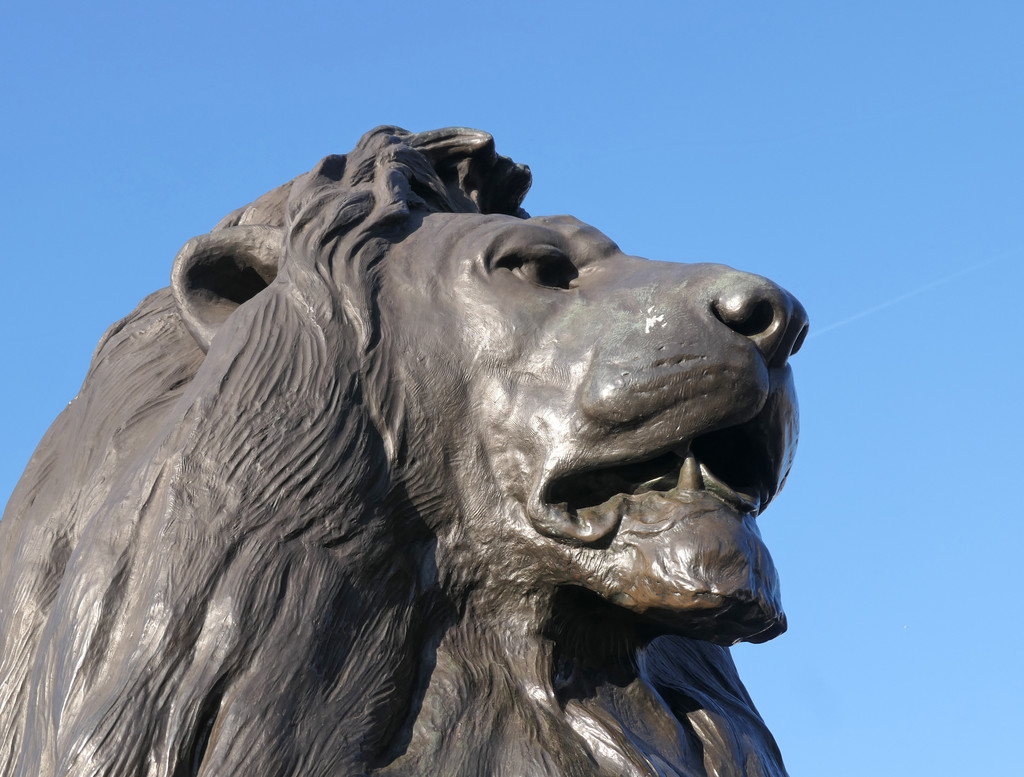
- Navigation image, One of the bronze lions at Nelson’s Column: modelled by Edwin Landseer and cast by Carlo Marochetti. Photograph by Amanda Slater. CC BY-SA 2.0. Image source. CC BY-SA 2.0. Resized.