by Tom Gurney
Tom Gurney BSc (Hons) is an art history expert with over 20 years experience
Email: tomgurney1@gmail.com / Phone: +44 7429 011000
Isaac van Amburgh and his Animals: Introduction
Edwin Landseer's Isaac van Amburgh and his Animals turns a theatrical attraction into an unusually intimate encounter with captive predators. The American performer reclines among five large cats, holding a lamb close to his body. Behind the bars, a crowd watches. The painting belongs to the Royal Collection, where it is catalogued as an oil on canvas inscribed 1839, measuring 113.7 × 174.8 cm, under the number RCIN 406346. Queen Victoria commissioned it during Van Amburgh's London success. [1]
Its extraordinary effect comes from the difference between the man's posture and the animals' mouths. He seems to have made himself comfortable in a place where comfort should be impossible. The tiger exposes its teeth beneath his outstretched arm; a lioness turns towards the group; a leopard stretches across the front of the platform. The little lamb supplies the act with its most vulnerable participant. Each creature remains recognisably separate, yet all have been brought within the reach of a single reclining figure. Landseer makes their proximity both impressive and difficult to accept as an uncomplicated scene of peace. [2]
The cage is also a theatre of looking. Its human audience occupies only a narrow part of the painting, while the animals spread across almost its entire width. We see more than those spectators can see, from a position they do not occupy. That reversal gives the picture its particular force: a performance designed to display mastery becomes an invitation to consider how mastery is staged, witnessed and believed. [2]
At a Glance
This work across Edwin Landseer’s career
The Cat's Paw
c. 1824 [4]The Hunting of Chevy Chase
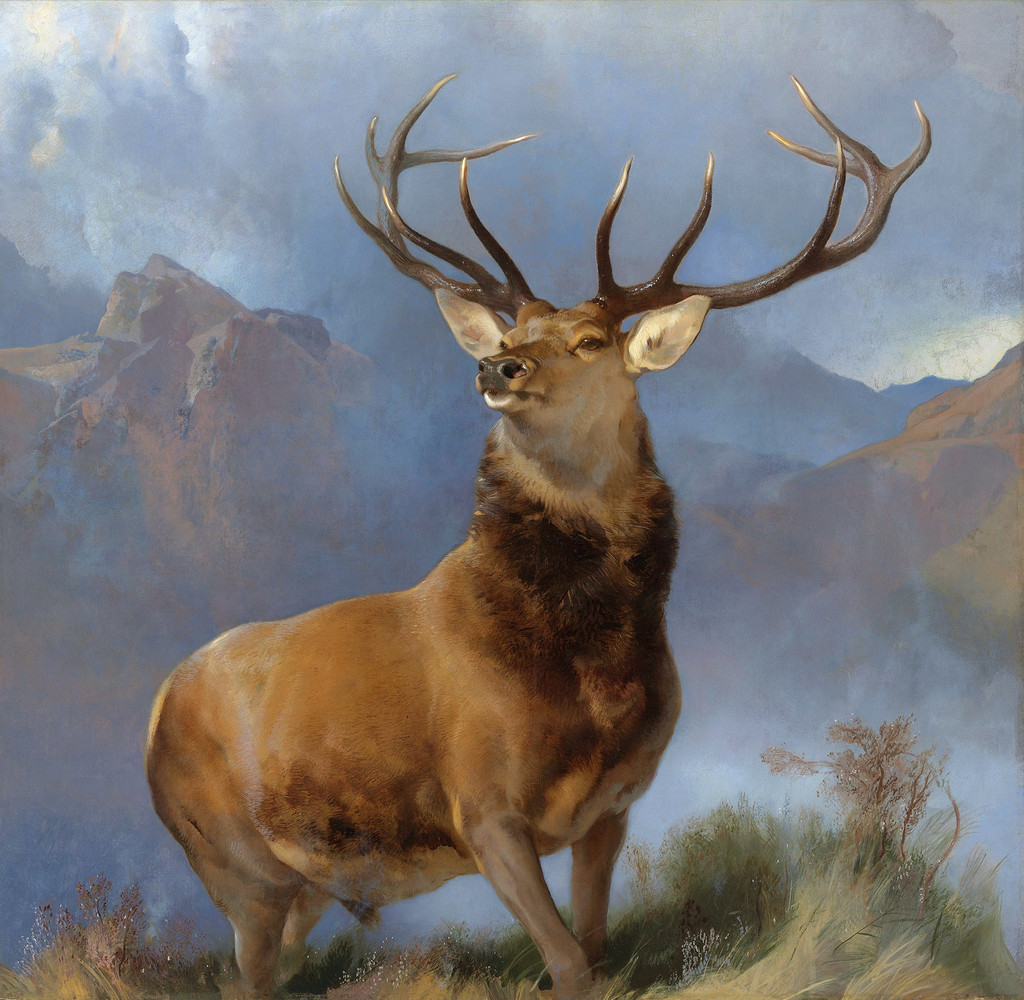
1825–26 [5]The Monarch of the Glen
about 1851 [10]Contents
- Looking from the animals' side
- Five cats, five kinds of attention
- The performer's carefully displayed ease
- The lamb and the promise of peace
- An American attraction on the London stage
- What happened during the royal feeding visit
- From royal enthusiasm to a painted commission
- The money behind the spectacle
- Control, coercion and the limits of the image
- Imported animals and the display of authority
Looking from the animals' side
The bars run down the left of the composition, dividing the spectators' relatively bright surroundings from the darker enclosure. Several faces press towards the spectacle. Their bodies are largely hidden, so attention gathers in the heads and eyes between the vertical lines. Some look directly into the den, while others turn slightly towards a neighbour. Landseer has made an audience out of individual acts of looking without giving those people enough prominence to compete with the animals. They are evidence that this grouping is being presented to somebody, rather than a gathering discovered by chance. [2]
The relationship between enclosure and picture is more complicated than a simple division of safety from danger. The spectators stand beyond the bars, but the painting's own foreground opens towards us. No corresponding row of iron uprights crosses our view of the leopard, the trainer or the lamb. We therefore receive the privileged, unobstructed position usually reserved for an ideal spectator, while apparently occupying the same side of the barrier as the cats. This is a pictorial arrangement, not proof that Landseer himself sat unprotected inside a working cage. Its achievement is to combine the clarity of a staged tableau with the suggestion of physical exposure. [2]
The wooden floor helps establish that exposure. Broad boards continue beneath paws, bare limbs and costume, joining bodies that differ greatly in size and kind. The foreground leopard lies close to the lower edge, with little empty space separating its flank from the viewer. Beyond it, the tiger's striped body crosses the platform towards the lioness. The man's extended legs belong to this same low horizontal zone. Instead of standing securely above the animals, he has lowered himself into their level. The floor becomes a common surface on which human confidence and animal strength have to coexist. [2]
On the right, darkness closes the scene behind the large lion. A hanging drapery and a round shield interrupt the background without opening a deep landscape beyond it. The enclosure is furnished as a place of performance. Its distant light and visible crowd do not turn it into open country, and the animals' closeness cannot be mistaken for a natural habitat. The composition keeps reminding us that these bodies have been assembled and contained. The bars are only the most explicit sign of a situation created for display. [2]
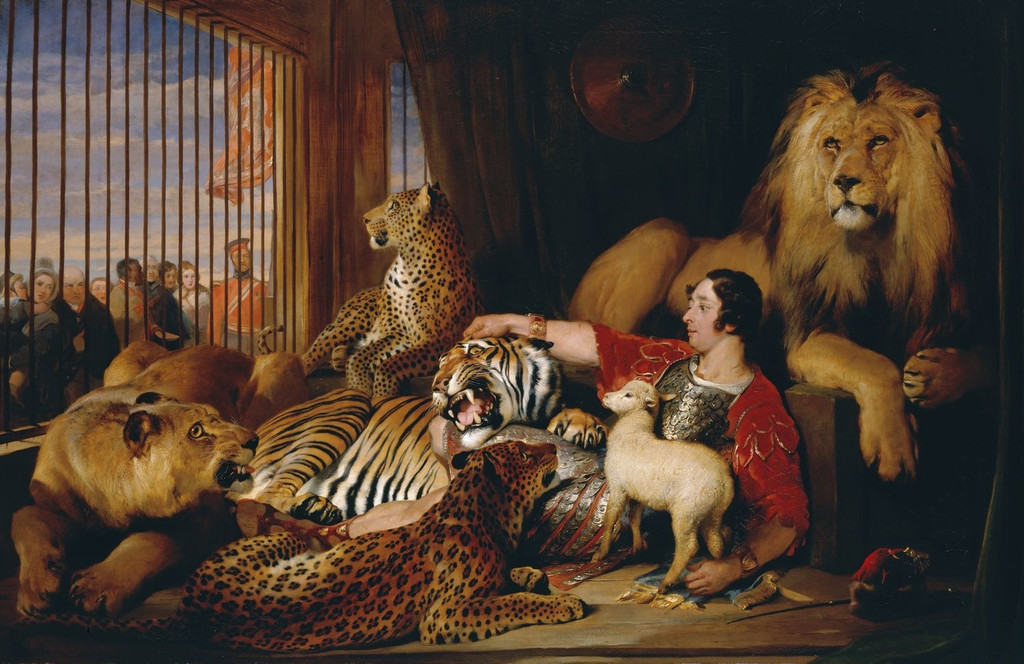
Isaac van Amburgh and his Animals. Royal Collection. Image source. Public domain.
Five cats, five kinds of attention
The lion occupies the highest and most imposing position. Its mane spreads around a broad face above Van Amburgh's head, while a large foreleg hangs down beside him. The paw is relaxed in its position but substantial in scale. Seen against the man's relatively small head, the lion's body establishes how much physical power the performance claims to have made manageable. Its upright bearing differs from the trainer's repose. It can preside over the group without participating in the same manner of rest. [2]
The lioness on the left provides a different kind of presence. Her head projects towards the centre, her mouth is partly open, and the pale whiskers and teeth interrupt the warm colour of her face. Her forepaws extend towards the near edge. Although she lies low, her attention appears directed across the platform, towards the cluster containing the tiger and lamb. The picture does not give her a human moral role. It gives her a posture and a direction of interest that complicate the claim that everything in the enclosure has settled into easy companionship. [2]
The tiger is the most conspicuously demonstrative animal. Its open jaws reveal the pink tongue and pale teeth beneath Van Amburgh's extended forearm. The striped head sits close to his exposed flesh; a paw rests beside his torso. That arrangement gives the human gesture two possible appearances. It resembles a familiar touch across an animal's head, yet it also looks like an act that holds the head in a particular position. The painting does not resolve the mechanics for us. What matters visually is that the forearm, mouth and paw establish a concentration of contact within the wider group. [2]
The two spotted cats distribute attention elsewhere. One sits upright near the bars, lifting its head towards the brighter left side. Its body connects the distant spectators with the den's central mass. The other stretches along the foreground, turning its head back towards the trainer and lamb. Its long flank supplies a richly patterned screen across the lowest part of the picture, while the turned head redirects the eye into the scene. These are not simply matching decorative animals placed on either side of a portrait. Their contrasting positions give the enclosure several simultaneous lines of interest. [2]
The differences in coats also do compositional work. A broad tawny surface, a mane, closely repeated stripes and broken spots remain distinct even where the bodies overlap. Light catches these surfaces unevenly, allowing a viewer to separate animals whose limbs and backs are pressed together. The lamb's pale fleece makes a further contrast, both in texture and in the smallness of the body it covers. Landseer's descriptive skill sustains the drama because the creatures do not dissolve into a general mass of exotic fur. The act depends on the presence of different animals; the painting makes their differences legible. [2]
The performer's carefully displayed ease
Van Amburgh's body stretches diagonally through the centre, but his head remains upright and turned towards the left. He does not meet the viewer's eyes. His attention seems to belong to the performance and its surrounding audience rather than to a formal portrait sitting. The arrangement lets us observe him while preserving the appearance that he is occupied elsewhere. His ease is therefore something displayed for inspection: the outward sign by which extraordinary control is supposed to become visible. [2]
His clothing makes the scene unmistakably theatrical. Red fabric spreads around his shoulders, while overlapping metallic-looking pieces cover the torso and fall towards his thighs. Bare arms and lower legs remain exposed. A shield hangs behind him and other props lie on the platform. These elements supply a martial setting without making the painting an archaeological reconstruction. The costume gives the performer the bearing of a figure from an imagined heroic past, while the visible audience and cage locate that figure within a modern entertainment. The distance between the two belongs to the attraction. [2]
The exposed limbs are especially important. A spectator can see the contact between human skin and animal bodies without having to imagine what is concealed beneath clothing. Van Amburgh's arm rests over the tiger's head; his hand supports the lamb near its feet. One gesture concerns a large carnivore, the other a small domestic animal. Both converge on the same torso. The composition gives him a mediating position, but it also shows how much of that position depends on the continued arrangement of living bodies around him. A sudden movement by one participant would alter the whole. [2]
Nor does the face receive the visual independence expected of a conventional portrait. The lion's mane rises behind it, the tiger's mouth occupies the space below the extended arm, and the lamb presses against the costume. Van Amburgh's likeness is inseparable from the circumstances that made him worth portraying. Remove the animals and the scene loses its central claim. Remove the man and the cats become an improbable collection without an organising performer. Landseer constructs celebrity as a relationship between a recognisable person, a repeatable action and an audience prepared to watch. [2]
The lamb and the promise of peace
The lamb stands close against Van Amburgh rather than lying asleep at a safe distance. Its pale body is small enough to be enclosed by the larger shapes around it. The man's supporting hand and the nearby tiger's paw are visible in the same confined area. The animal's position turns a broad spectacle of courage into a more exact question: can a vulnerable creature remain unharmed among predators? That question is different from whether an experienced human performer can protect himself. The lamb makes the demonstration's claim to harmony harder to dismiss as a personal feat alone. [2]
The biblical language behind such a grouping deserves precision. Isaiah 11:6 in the King James Version joins a wolf with a lamb and a leopard with a kid, then brings a calf and young lion together under a child's leadership. The following verse imagines a lion eating straw like an ox. Verse nine promises an end to hurting and destroying. The familiar pairing of lion and lamb condenses this larger vision of transformed relationships among creatures. Landseer's picture can evoke that tradition without being a literal illustration of every animal named in the passage. [13]
The distinction matters because the biblical vision concerns more than temporary restraint. Predators and potential prey inhabit a world in which the ordinary expectation of injury has changed. On Landseer's platform, however, the tiger still displays its teeth and the cats retain their different directions of attention. The painted arrangement does not remove their capacities. It places the lamb within reach of them. The resulting peace is conditional in a way that Isaiah's promised order is not. We can see why the tableau would be impressive precisely because it does not look self-sustaining. [2] [13]
This gives the lamb a pictorial function beyond innocence as a general symbol. Its presence changes the meaning of every surrounding mouth and paw. A carnivore resting near a man may indicate training, familiarity or the successful completion of a stunt. The same carnivore close to a lamb introduces the possibility that its attention could turn towards another kind of object altogether. The lamb is the element that makes the gathering appear to contradict the usual relation between these animals. It also allows the contradiction to remain visible, rather than disappearing into a sentimental picture of affectionate companions. [2]
The performer seems to offer a local answer to that contradiction: he will keep the participants together. The artist's answer is more complex. He can hold their positions indefinitely on canvas, but he also preserves the signs that make us doubt the arrangement's durability. The tableau promises stillness while displaying bodies capable of movement. Its religious associations amplify this tension, because the apparent fulfilment of a prophecy remains dependent on the practices of a commercial show. [2] [13]
An American attraction on the London stage
Matthew Wittmann places Van Amburgh within the movement of American entertainment across the Atlantic. A menagerie managed by Lewis B. Titus travelled from New York in 1838 under the name Mammoth American Menagerie. Its star performed at Astley's Amphitheatre before appearing in dramatic entertainments at Drury Lane. Wittmann's account describes routines involving lions, tigers and leopards, including close bodily contact and a concluding repose with a lamb. This was an exportable performance, supported by animals, management, venues and publicity, rather than an isolated encounter between a fearless individual and a wild beast. [14]
That context helps explain the painting's combination of intimacy and apparatus. The cats have individual bodies, but their conjunction is itself an attraction. Van Amburgh's reclining pose was intelligible as one part of an act that could include quite different gestures. A picture of that pose cannot stand for the entire sequence, still less for every hour of the animals' lives. Landseer selects a moment in which the exertion involved in presenting the animals seems to have culminated in rest. The earlier actions that produced this result remain outside the frame. [2] [14]
Alfred Bunn, who managed Drury Lane, provides a contemporary account of the setting in which such acts became profitable. In his 1840 memoir, he places Van Amburgh and the animals within Charlemagne, a spectacle associated with Andrew Ducrow. Bunn defends combining these attractions with musical and dramatic entertainments. His discussion is combative: objections to the animals become, in his telling, evidence of his opponents' pretensions and ignorance of theatrical realities. He writes as the manager who had to fill a house, defend his choices and explain his receipts. [15]
The painting does not reproduce a complete theatre interior or the other performers in an evening's programme. Instead, it concentrates the attraction in a single enclosure. Yet its costume, props and watching faces keep the connection with theatre visible. The setting asks the audience to recognise both the actual animals and the fictional elevation of the man among them. A heroic character and a working entertainer occupy the same body. That double identity helps explain why this particular scene could pass from a mixed public programme into a royal painting. [2] [15]
What happened during the royal feeding visit
Bunn's account becomes unusually specific when he describes Victoria's visits in January 1839. He gives 10, 17 and 24 January as successive occasions on which she attended Drury Lane. On the third of those evenings, she crossed the stage after the general audience had left to watch the animals being fed. Curtains enclosed the entrances and a carpet covered the stairs. Bunn explains these arrangements as protection from draughts and from the gaze of people who lingered in the hope of seeing the royal party. The performance had two audiences: those admitted to the ordinary show and those granted a further, carefully managed encounter. [15]
The details change our understanding of spectatorship in the painting. The faces behind Landseer's bars share a common view, but the real theatre could redistribute access according to rank. The sovereign's private viewing was not simply another seat in the same audience. It involved movement across the stage, the departure of other spectators and changes to the surrounding space. Bunn makes the royal visitor's comfort and privacy part of his narrative because these were themselves signs that his theatre could accommodate an exceptional patron. [2] [15]
His description also contains evidence that sits uneasily beside its celebration. Bunn states that the animals had deliberately gone without food for thirty-six hours. During the preceding performance, he says, a lion and a panther attacked the lamb when it entered their den. He then describes Van Amburgh lashing them into submission. These are the manager's words about a particular occasion; they do not establish an identical feeding practice before every show. Nevertheless, the source is especially revealing because Bunn supplies these details while defending the attraction and praising the trainer. He did not need to be an opponent of the act to record the use of hunger and physical force. [15]
The feeding that followed becomes, in his telling, a demonstration of the animals' power when the man no longer restrained their competition for meat. Bunn describes a lion taking food from the tiger and a violent impact against the den. He contrasts attendants who stepped back with the queen's continued attention. The passage is written to enhance both the spectacle and the young sovereign's composure. It cannot be treated as a disinterested measurement of her emotions, but it shows what the manager considered worth emphasising: intensity in the animals, courage in the visitor, and the exceptional character of the event. [15]
Landseer's picture offers no equivalent heap of meat or feeding struggle. The lamb remains whole and upright, and the trainer's pose binds the cats into a composition. Reading the painting beside Bunn's account does not turn it into a secret illustration of that incident. It restores an important distinction between the controlled image and the variable circumstances of performance. The picture can preserve the appearance of a successful arrangement even when a participant's account reveals how precarious such arrangements could be. [2] [15]
From royal enthusiasm to a painted commission
The Royal Collection quotes Victoria's journal for 23 February 1839, when she saw the picture and admired the reclining performer as being “just as exactly as I saw him”. Her response survives here through the collection's published account, rather than as a neutral description of every feature. Its emphasis is revealing: she valued the painting's correspondence with a remembered experience. [1]
That judgement concerns something more specific than the number of animals or the accuracy of a face. The painted body reproduces a recognisable manner of occupying the den. Van Amburgh's ease, the surrounding cats and the lamb make a situation that a spectator could remember. For the queen, according to the quoted entry, resemblance included the event's arrangement. The picture's plausibility therefore depended on its ability to bring an exceptional experience back into view. It gave an owner time to revisit relationships that had originally unfolded during a performance. [1] [2]
Bunn's memoir independently connects royal favour with the picture. On his page devoted to the command performance of 29 January, he states that Landseer's painting was expressly ordered and had been exhibited in Trafalgar Square the previous year. He also says that facilities were provided to assist the artist. His extravagant praise of Landseer belongs to the same promotional voice that celebrates the theatre. The passage is useful evidence of a royal order associated with this attraction; it does not reveal a complete sequence of sittings, a precise commissioning day or the time spent executing every part of the canvas. [15] The painting appeared at the Royal Academy in 1839 as catalogue number 351: a public exhibition alongside its private royal ownership. [16]
The Royal Collection records payment of £315 on 11 September 1840, citing QV Ledgers 1840/6. That financial date follows the painting's inscription and Victoria's February 1839 response. It records payment, not a redating of the picture. The collection describes the work as one of her first commissions to Landseer. [1]
The sequence is more informative than a general story of royal approval. A performance attracted repeated attention; an image translated a remembered pose into an enduring object; payment entered a different documentary record. These stages belong together, but they are not interchangeable. The painted cats were not the queen's household pets, and the canvas was not merely a souvenir detached from its setting. It carried the theatre's extraordinary arrangement into a form that could be owned, displayed and considered at leisure. [2] [15]
The money behind the spectacle
Bunn understood the animals through the economics of a large theatre. He compares the first five performances of Rossini's La gazza ladra with the next five, when Charlemagne supported the programme. His stated net receipts rise from £530 for the earlier group to £1,371 for the later one. In his explanation, an unsuccessful financial pattern became a profitable one when the spectacle was added. These are figures he selected and published in defence of his management, not an independent balance sheet for the animal act alone. They nevertheless show why he resisted a rigid division between respectable music and profitable spectacle. [15]
His argument draws on precedent as well as money. Bunn recalls earlier theatrical programmes that combined eminent actors with horses or a performing dog. He asks why a manager should be condemned for adding attractions when serious drama could fail to pay its way. The position is interested, but it is not trivial. The animals' appearance in a major London theatre raised questions about what belonged there, who could decide and how artistic prestige was supposed to survive commercial losses. The objectionable novelty, from his perspective, was part of a longer practical history of keeping theatres open. [15]
For 29 January 1839, Bunn prints a detailed account of receipts from the command night, including boxes, pit, galleries, tickets and stalls. The total is £712 7s. 6d. He deploys this sum against suggestions that Victoria's popularity had declined. The figure should not be confused with Landseer's fee or with a salary paid to Van Amburgh. Its purpose in the memoir is to turn the attendance of a sovereign into a visible financial answer to critics. Royal presence made a performance an event, and the manager wanted that event to demonstrate the strength of his establishment. [15]
The picture performs another conversion. A subject whose appeal was expressed in nightly attendance became an artwork with a distinct patron and price. Landseer does not include a ticket office or an account book; those belong to the conditions around the scene. But the watching crowd keeps the act's dependence on spectators within the picture itself. Van Amburgh's apparent independence among the cats was supported by a complex human arrangement beyond the enclosure. Bunn's figures make that arrangement more tangible without reducing the painting to a statement about revenue. [2] [15]
Control, coercion and the limits of the image
It would be misleading to interpret the animals' proximity as proof that they had become harmless. The painting represents a successful grouping, but it gives no continuous account of its maintenance. Nor can a relaxed paw or open mouth, by itself, establish an animal's welfare or reveal the entirety of its training. What can be said securely is that the performance's appearance of ease coexisted with testimony about intervention and force. Bunn's description of the lamb incident is particularly valuable because it identifies an action, an occasion and an observer's interested account. [2] [15]
Peta Tait's study of menagerie performance distinguishes the rhetoric of an almost mysterious human influence from accounts of bodily handling. She traces how claims about Van Amburgh's commanding presence could coexist with descriptions of striking animals. Her discussion also warns that later allegations and promotional exaggeration are difficult to disentangle. This offers a useful distinction for the painting: the appearance of command was part of what audiences consumed, while the means of securing that appearance require separate evidence. It does not license the transfer of every later story about a tamer into this particular den. [17]
The contrast between the man's two hands becomes more suggestive in that light. One supports a creature that looks vulnerable; the other extends over the tiger's head. The picture can accommodate care and control within the same figure without telling us that they were equivalent experiences for the animals. Neither gesture settles the question of what happened before or after the represented moment. Landseer's composition gives these relationships a concentrated visibility, while the historical accounts remind us that the performers could not actually remain fixed in such positions. [2] [15]
Helen Cowie identifies another contemporary response in an 1838 Examiner notice. As she reports it, a critic objected to putting a head inside a lion's jaws as offensive towards the animal, unpleasant for spectators and hazardous to the performer. The original notice is encountered here through Cowie's historical account. Its objection reaches across several relationships in the show, rather than addressing human courage alone. It also demonstrates that an audience's possible discomfort formed part of the attraction's reception. [18]
It is equally important to distinguish kinds of objection. Dislike of danger to a human performer, disgust at feeding carnivores in public, defence of legitimate drama and concern for an animal subjected to force could lead to different criticisms. They need not express a single shared principle. Bunn's defence reveals controversy even as it tries to dismiss it. The evidence supports a contested entertainment whose supporters and detractors could attend to different parts of the same event. A blanket account of an age either indifferent to animals or united against cruelty would conceal those differences. [15] [18]
Imported animals and the display of authority
The gathering in the cage brings different species under one person's apparent command. This is the feature that makes a connection with wider cultures of authority plausible. Tait situates menagerie entertainments within systems that moved animals through trade and empire and used them in narratives of conquest and confrontation. Such a framework helps explain why mastery over large cats could carry meanings beyond a practical demonstration of handling. Yet the painting does not provide the capture history of these individual animals, and their bodies cannot simply be assigned to particular colonies. [17]
The American origin of the attraction also complicates an exclusively British story. Wittmann's transatlantic account shows a performance moving into British venues and receiving royal recognition. The spectacle's success depended on circulation between countries, rather than on a single nation producing every part of it. The painted red costume and shield supply the performer with a theatrical past, while the visible audience supplies a contemporary public. The resulting authority is assembled from bodily skill, exotic animals, fictional dress and social recognition. It is displayed in London, but its components cannot be contained within London alone. [2] [14]
The watching faces give authority a social dimension within the picture itself. People beyond the bars attend to a man whose exceptional status is established through his relation to captive animals. Their concentrated attention helps distinguish him from an ordinary occupant of the enclosure. The scene makes a hierarchy visible while also making it depend on continued performance: the audience must recognise his command, and the animals must continue to give that command an impressive outward form. [2]
Celebrity beyond the royal canvas
Other objects show how Van Amburgh's name circulated through different kinds of image. London Museum preserves an engraved theatrical sheet published by A. Park on 16 May 1839, titled Van Amburgh the Brute Tamer — Van Amburgh the Conqueror. Its two scenes place the performer among animals. The record identifies a separate work on paper, rather than an engraving documented as copying Landseer's canvas. Its titles announce the public language of mastery in which the entertainer was promoted. [19]
A political print had already borrowed the name. The National Portrait Gallery's Van Amburgh Outdone!, published on 3 December 1838, is a lithograph by John Doyle, printed by Alfred Ducôte and issued by Thomas McLean. The gallery identifies political figures including Melbourne, Palmerston and Daniel O'Connell. Even without treating it as a comment on Landseer's later picture, its title demonstrates that the performer's name could serve an analogy outside the theatre. [20]
These objects help place the royal painting without making it responsible for all subsequent celebrity. Park's titles sell a conqueror; Doyle's title assumes that somebody might surpass the famous act; Landseer gives the performance a bodily and spatial complexity that can sustain prolonged looking. Their differences matter as much as their shared subject. The canvas does not merely preserve a public label. It allows us to inspect the particular grouping through which that label became persuasive, including the bodies whose continued cooperation the spectacle required. [2] [19] [20]
A royal success and a later critical reservation
The painting should be distinguished from Landseer's later Van Amburgh composition, associated historically with the Duke of Wellington. Writing in 1880, Frederick G. Stephens explicitly separated the picture of 1839 from the work exhibited in 1847. His judgement was qualified: he found the later picture less satisfactory, but placed neither on the level of Landseer's earlier lion paintings. This is a retrospective critical preference, rather than evidence that the royal commission had been unanimously rejected in its own year. [21]
Stephens's reservation is useful because it prevents Victoria's pleasure from becoming a universal verdict. A patron could value the exact recollection of an extraordinary performance, while a later critic preferred animal subjects that seemed to offer different pictorial qualities. Their judgements begin from different questions. The queen's quoted response concerns recognition; Stephens's comparison concerns Landseer's achievement across a group of lion pictures. Neither response exhausts the object, and neither should be enlarged into an opinion held by every contemporary spectator. [1] [21]
The Royal Collection now presents the painting among the highlights of the Picture Gallery at St James's Palace. That institutional setting adds another audience to its history, although it does not establish an uninterrupted location or guarantee access on any particular visit. A performance once attended in a theatre can be approached through an object that has remained within the royal collection. [22]
A pause that has to be made
The most consequential feature of Landseer's picture is the way its apparent rest remains visibly organised. The platform gives the bodies a shared surface; the man's gestures bring the tiger and lamb into contact with him; the upright lion crowns the grouping; the spectators confirm its purpose as a spectacle. None of these elements works alone. Their conjunction lets the performer appear at ease while allowing the viewer to recognise how extraordinary that ease is supposed to be. [2]
Bunn's account makes the distinction between appearance and circumstance especially clear. His theatrical arrangements, receipts, withheld food and description of lashing belong to a world of preparation, pressure and intervention. Landseer offers a single moment that can be held before the eye. The canvas cannot reproduce the noise or duration of the act, but it can make us study the distribution of attention within it. The open mouths, different gazes and small lamb prevent repose from becoming an entirely settled condition. [2] [15]
The result is a portrait whose subject exceeds the celebrated individual. It includes the audience that makes his action meaningful and the animals that make his claim possible. The lamb brings the grand promise of peace down to the scale of a body standing within reach of teeth. Van Amburgh's confidence, Victoria's admiration and Bunn's defence all belong to the painting's history, but the picture gives us something more exact to contemplate: a moment of concord that has been carefully brought into being, and that its living participants could not be expected to preserve indefinitely. [2] [15] [13]
Artworks directory
This directory gathers works discussed in the articles, including drawings, original etchings and prints after Landseer. It is not a complete catalogue of every drawing, version, plate or impression. Distinct media are kept separate; uncertain dates are left blank. Linked titles open individual articles.
| Name | Date | Medium |
|---|---|---|
| A Bellowing Stag | Drawing | |
| A Deerhound | 1826 | Painting |
| A Distinguished Member of the Humane Society | 1838 | Painting |
| A Highland Breakfast | 1834 | Painting |
| A Highland Landscape | c. 1830 | Painting |
| A Highland Shepherd's Home | Painting | |
| A Horse, Goat and Bull | 1811 | |
| A Hunting Horse | Drawing | |
| A Jack in Office | Painting | |
| A Lion Disturbed at His Repast | Painting | |
| A Random Shot | Painting | |
| A Scene at Abbotsford | Painting | |
| Adversity | Painting | |
| Alexander and Diogenes | exhibited 1848 | Painting |
| Alpine Mastiffs Reanimating a Distressed Traveler | 1820 | Painting |
| Contending Group after Nature | Drawing | |
| Copy after Rubens's Wolf and Fox Hunt | c. 1824–26 | Painting |
| Dash | Painting | |
| Deer and Deer Hounds in a Mountain Torrent ('The Hunted Stag') | c. 1832 / exhibited 1833 | Painting |
| Deer Family | ||
| Dignity and Impudence | 1839 | Painting |
| Dog Resting Upon a Couch | Drawing | |
| Eos | 1841 | Painting |
| Favourites, the Property of H.R.H. Prince George of Cambridge | 1834–35 | Painting |
| Her Majesty Sketching at Loch Laggan | ||
| High Life | 1829 / exhibited 1831 | Painting |
| Highland Lassie | Drawing | |
| Isaac van Amburgh and his Animals | 1839 | Painting |
| Lady Godiva's Prayer | Painting | |
| Laying Down the Law | 1840 | Painting |
| Lion Defending Its Prey | c. 1840 | Painting |
| Lioness | Drawing | |
| Little Strollers | ||
| Low Life | 1829 / exhibited 1831 | Painting |
| Man Proposes, God Disposes | 1864 | Painting |
| Nell Gwynne / Diana Vernon | Painting | |
| Neptune | ||
| No Hunting Till the Weather Breaks | Painting | |
| Otterhounds | Drawing | |
| Peace | Painting | |
| Pensioners | Painting | |
| Portrait of a Mule | Painting | |
| Portrait of Mr Van Amburgh, as He Appeared with His Animals at the London Theatres | 1846–47 | Painting |
| Portraits of a Pointer Bitch and Puppy | Painting | |
| Pray Let Me Out | ||
| Prosperity | Painting | |
| Ptarmigan in a Landscape | by 1833 | Painting |
| Queen Victoria and Prince Albert at the Bal Costumé of 12 May 1842 | 1842–46 | Painting |
| Queen Victoria at Loch Laggan | Painting | |
| Queen Victoria at Osborne | 1865–67 | Painting |
| Queen Victoria landing at Loch Muick | Painting | |
| Rat-catching | 1823 | |
| Reclining Lion | Drawing | |
| Reclining Lion, From Back | Drawing | |
| Rent-day in the Wilderness | 1855–68 | Painting |
| Return from Deer Stalking | 1839 | |
| Royal Sports on Hill and Loch | Painting | |
| Sam Lovill, Porter at the Royal Academy | Drawing | |
| Scene from A Midsummer Night's Dream | 1848–51 | Painting |
| Scene in the Highlands, with portraits of the Duchess of Bedford, the Duke of Gordon and Lord Alexander Russell | Painting | |
| Scottish Highlands, Lochs and Figures | Drawing | |
| Shoeing | exhibited 1844 | Painting |
| Sleeping Bloodhound | exhibited 1835 | Painting |
| Spaniel and Rabbit | Painting | |
| Stag at Bay | 1866 | Sculpture |
| Stag at Bay | 1846 | Painting |
| Studies of a staghound and the head of a stag for painting ‘The Hunting of Chevy Chase’ | Drawing | |
| Study for Alpine Mastiffs Reanimating a Distressed Traveler | Drawing | |
| Study for the Monkey in The Cat's Paw | Drawing | |
| Study of a Dog | Drawing | |
| Study of a herding dog facing right | Drawing | |
| Study of the horse of Selene, from the East pediment of the Parthenon | Drawing | |
| Suspense | Painting | |
| Taking a Buck | ||
| The Arab Tent | c. 1865–66 | Painting |
| The Barn | Drawing | |
| The Best Run of the Season | ||
| The Cat's Paw | c. 1824 | Painting |
| The Cavalier’s Pets | ||
| The Challenge | Painting | |
| The Chase | Drawing | |
| The Connoisseurs: Portrait of the Artist with Two Dogs | 1865 | Painting |
| The Death of a Stag in Glen Tilt | Painting | |
| The Drive—Shooting Deer in the Pass | Painting | |
| The Drover's Departure | Painting | |
| The Highland Shepherd’s Dog | 1824; portfolio issue 1848 | |
| The Honourable Mrs Norton | Painting | |
| The Hunting of Chevy Chase | 1825–26 | Painting |
| The Illicit Highland Whisky Still | Painting | |
| The Keeper John Crerar with his Pony | Painting | |
| The Larder Invaded | ||
| The Lion-Dog of Malta | ||
| The Lions at the Base of Nelson's Column | 1867 | Sculpture |
| The Monarch of the Glen | about 1851 | Painting |
| The Mountain Torrent | ||
| The Old Shepherd's Chief Mourner | 1837 | Painting |
| The Sanctuary | 1842 | Painting |
| The Stricken Deer | Painting | |
| The Twa Dogs | Painting | |
| Time of Peace | ||
| Two stags running | Drawing | |
| Victoria, Princess Royal, with Eos | Painting | |
| View of Glenfeshie | Painting | |
| War | Painting | |
| White Horse in a Stable | Painting | |
| Windsor Castle in Modern Times | 1841–43 | Painting |
| Woburn Abbey Game Card | 1825; portfolio issue 1848 |
Discussion
Use the article’s images and evidence to develop your own reading of Isaac van Amburgh and his Animals.
Reader Insights
Which detail is most revealing when you consider “Looking from the animals' side”?
How does the evidence in “Five cats, five kinds of attention” affect your reading of Isaac van Amburgh and his Animals?
What further question would you bring to “A pause that has to be made”?
Join the Conversation
Share a detail, comparison or question about Isaac van Amburgh and his Animals below.
References
- Royal Collection Trust, Isaac van Amburgh and his Animals, inscribed 1839, RCIN 406346; catalogue text adapted from Victoria and Albert: Art & Love (2010), with provenance citing QV Ledgers 1840/6 and quotations from Victoria's journals. Collection record. Accessed 31 October 2026. View source.
- Edwin Landseer, Isaac van Amburgh and his Animals, 1839, Royal Collection, RCIN 406346. Full colour photograph, 1,500 × 973 pixels, from Royal Collection Trust, preserved with its institutional source in the Wikimedia Commons file record. Accessed 31 October 2026. View source.
- National Gallery of Art, Alpine Mastiffs Reanimating a Distressed Traveler. View source.
- Minneapolis Institute of Art, The Cat's Paw. View source.
- Birmingham Museums Trust, The Hunting of Chevy Chase. View source.
- Victoria and Albert Museum, The Old Shepherd's Chief Mourner. View source.
- Tate, Dignity and Impudence. View source.
- Royal Collection, Isaac van Amburgh and his Animals. View source.
- Royal Collection, Eos. View source.
- National Galleries of Scotland, The Monarch of the Glen. View source.
- Royal Holloway, University of London, Man Proposes, God Disposes. View source.
- Trafalgar Square / Greater London Authority, The Lions at the Base of Nelson's Column. View source.
- The Holy Bible, King James Version, Isaiah 11, especially verses 6–9. Complete chapter, Bible Gateway. Accessed 31 October 2026. View source.
- Matthew Wittmann, ‘The Transnational History of the Early American Circus’, in Susan Weber, Kenneth L. Ames and Matthew Wittmann, eds, The American Circus (New Haven and London: Yale University Press, 2012), pp. 55–86, particularly the Van Amburgh passage and notes 47–52; Bard Graduate Center republication. Accessed 31 October 2026. View source.
- Alfred Bunn, The Stage: Both Before and Behind the Curtain, from “Observations Taken on the Spot”, vol. III (London: Richard Bentley, 1840), pp. 98–100, 117–123. Original scanned volume, Internet Archive. Accessed 31 October 2026. View source.
- Richard Ormond, Sir Edwin Landseer, exhibition catalogue, Philadelphia Museum of Art and Tate Gallery, 1981, p. 205, giving the Royal Academy exhibition references for the two Van Amburgh paintings. Digitised catalogue. Accessed 31 October 2026. View source.
- Peta Tait, Fighting Nature: Travelling Menageries, Animal Acts and War Shows (Sydney: Sydney University Press, 2016), introduction and chapter 1, particularly pp. 13–22 and their notes. Publisher's open edition. Accessed 31 October 2026. View source.
- Helen Cowie, ‘A brief history of lion taming’, The Conversation, 11 May 2018; author-attributed republication at Phys.org. Accessed 31 October 2026. View source.
- London Museum, Van Amburgh the Brute Tamer — Van Amburgh the Conqueror, A. Park, 16 May 1839, paper and ink, object 99.132/394a. Collection record. Accessed 31 October 2026. View source.
- National Portrait Gallery, Van Amburgh Outdone!, John Doyle, printed by Alfred Ducôte, published by Thomas McLean, 3 December 1838, lithograph, NPG D41495. Collection record. Accessed 31 October 2026. View source.
- Frederick G. Stephens, Sir Edwin Landseer (London: Sampson Low, Marston, Searle & Rivington, 1880), pp. 80–81. Project Gutenberg transcription. Accessed 31 October 2026. View source.
- Royal Collection Trust, ‘Highlights of St James's Palace’, Picture Gallery subsection. Palace highlights. Accessed 31 October 2026. View source.
- Splash image, Isaac van Amburgh and his Animals. Royal Collection. Image source. Public domain.
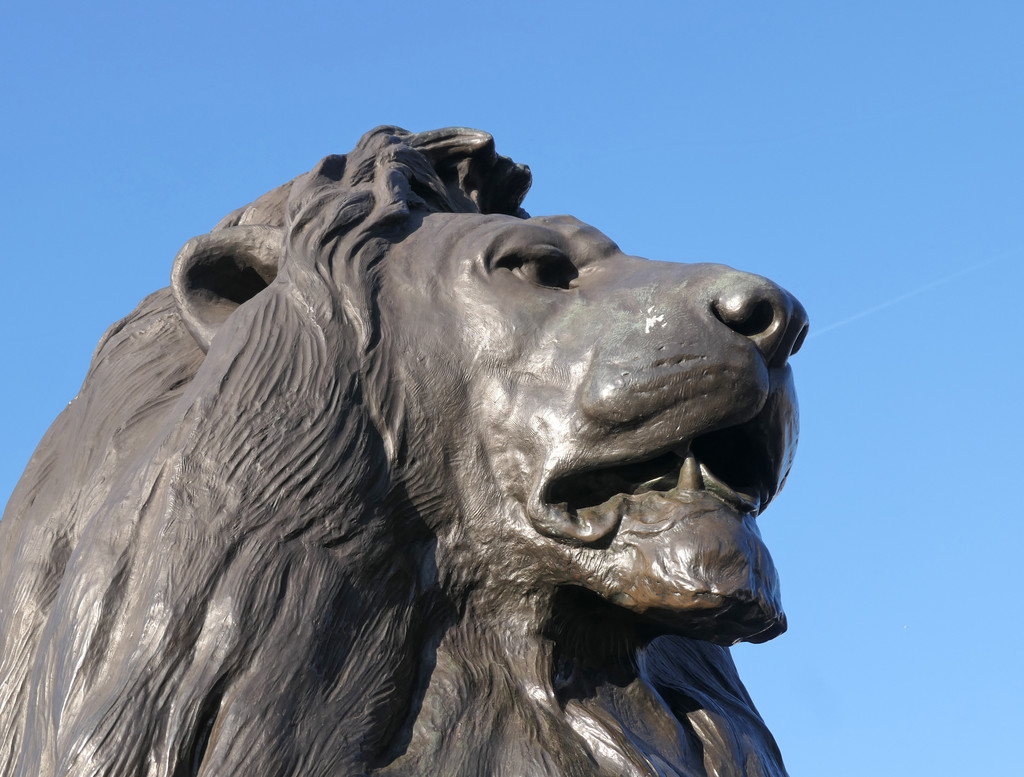
- Navigation image, One of the bronze lions at Nelson’s Column: modelled by Edwin Landseer and cast by Carlo Marochetti. Photograph by Amanda Slater. CC BY-SA 2.0. Image source. CC BY-SA 2.0. Resized.