 by Tom Gurney
Tom Gurney BSc (Hons) is an art history expert with over 20 years experience
Email: tomgurney1@gmail.com / Phone: +44 7429 011000
Drawings: Introduction
Edwin Landseer is most familiar through large oil paintings in which an animal occupies the place traditionally given to a human protagonist. His drawings show how incomplete that familiar picture is. On paper he examined the muscles beneath an animal’s skin, watched a dog settle into a sofa, held the turn of a stag in motion, portrayed people around the Royal Academy, recorded Highland scenery, copied antique sculpture and worked out groups destined for another medium. He also drew in albums shared with friends. Some sheets can be connected to paintings or prints; others have no documented destination beyond themselves.[1][2]
That variety matters because “drawing” names neither one material nor one stage of production. Landseer used graphite, chalk, charcoal, pen, ink, wash, transparent watercolour, opaque watercolour and gouache in different combinations. A work might occupy both sides of one leaf, extend across joined pieces of paper or be pasted into an album. It might be mounted later, removed from a sketchbook or known only through a copy by somebody else. Format and physical history shape what can now be understood just as much as the image on the surface.[2][3][4]
The drawings also ask for a slower kind of certainty. A quick-looking line need not have been careless, and a coloured sheet need not have been made for exhibition. An old inscription may preserve valuable information without settling authorship. A work acquired from Landseer’s studio may have belonged to him rather than been made by him. Looking at this part of his practice means attending not only to skill but to catalogue language: who is named as artist, how wide the date is, which materials are recorded, whether the sheet is a recto or verso, and how it reached its present collection.
At a Glance
- MediaGraphite, chalk, ink, wash and watercolour [2][3]
- FormatsSheets, sketchbooks and albums [2]
- CorpusNo secure total of autograph drawings [2][4]
Contents
- What survives under the word drawing
- An early practice, not a childhood myth
- Drawing beneath the skin
- Rest, attention and movement
- Drawing people
- Landscape, colour and place
- Looking at other art
- From a sheet to another work
- When a drawing stands on its own
- Albums, sketchbooks and loose leaves
Explore a drawing
What survives under the word drawing
There is no secure total for Landseer’s drawings. They are dispersed among public collections, albums and private ownership, and the boundaries of the category vary. The British Museum’s artist page, for example, currently connects him with 1,062 objects. That figure is not a census of drawings: the results include prints by him, impressions made after his designs, albums and other associated material. A large digital result set can reveal the reach of a name while saying little about how many sheets came from the artist’s hand.[4]
Richard Ormond’s study of Landseer’s private drawings supplies the most sustained account of the field. Its importance lies less in offering a number than in restoring diversity to a career often represented by a short line of famous paintings. Drawings survive from different moments, in different conditions and with unequal histories. Some carry dates or inscriptions; others have ranges as broad as Landseer’s working life. Some stayed in bound volumes, while others acquired individual mounts and titles only after leaving their original setting.[2]
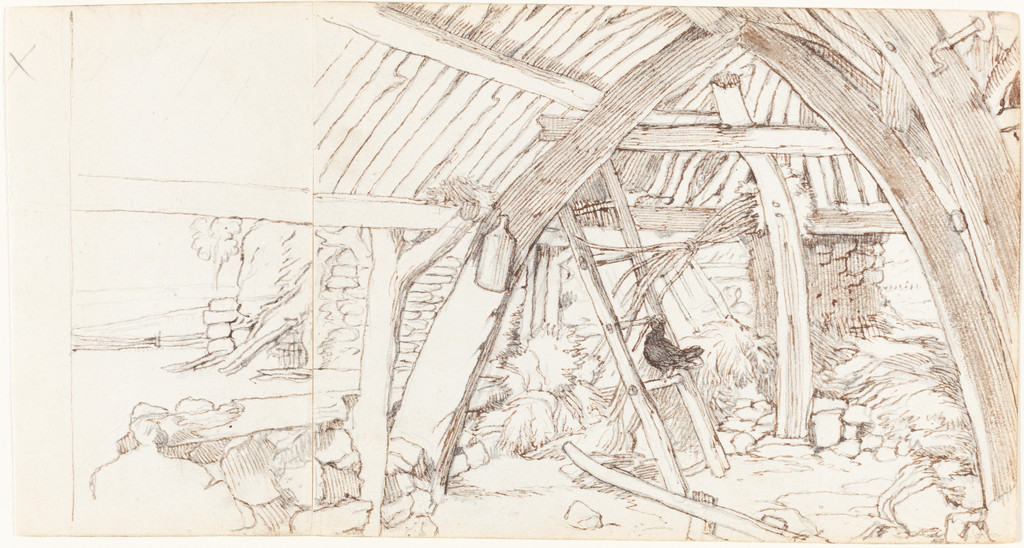
The physical descriptions in modern records are therefore part of the evidence. The National Gallery of Art’s The Barn is pen and brown ink over graphite on two joined sheets of wove paper. The join tells us that the image’s width was constructed rather than supplied by one ready-made leaf. Its Contending Group after Nature is on laid paper and mounted. Mounting affects how a sheet is handled and framed, but the current record does not say that Landseer chose that presentation. The double-sided study for Alpine Mastiffs Reanimating a Distressed Traveler is one sheet catalogued through two faces, not two unrelated drawings.[3]
Titles require equal care. “Study” may identify a preparatory relation, but it can also be a later descriptive convenience. “Sketch” may refer to economy or to membership of a sketchbook, without proving haste. “After Nature”, embedded in the title of a fight among a lion, tiger and leopard, cannot make that extraordinary encounter a documentary event. A catalogue title helps locate an object; unless an inscription proves otherwise, it is not automatically Landseer’s own account of what the work meant.
These cautions do not diminish the drawings. They make their differences visible. Instead of arranging every sheet on a ladder that rises towards oil painting, it is more useful to ask what problem each object addresses. Does it measure a body, preserve an attitude, test an arrangement, translate another artwork, hold a colour effect, entertain a room or record a place? Often more than one answer is possible.
An early practice, not a childhood myth
Landseer entered the Royal Academy Schools on 9 August 1816, having already exhibited at the Academy in 1815. Formal training therefore joined a practice encouraged within his artistic family rather than beginning it. His father John was an engraver; his brothers Thomas and Charles also worked as artists. Line, reproduction and comparison belonged to the household in which Edwin learned, while the Academy added casts, institutional routines and encounters with people whose labour sustained the school.[1][5]
The Metropolitan Museum dates Study of a herding dog facing right to 1810. It is a small graphite sheet, 13.5 by 18.4 centimetres, in which the animal’s body is set side-on while its head turns away from the direction of its stance. The date, if accepted, places the drawing remarkably early. Yet the object should not be made to prove every story told about an eight-year-old prodigy. A current museum date is strong object information; it is not a full diary of the circumstances in which the marks were made.[6]
A more firmly anchored early work is RISD Museum’s Dog Resting Upon a Couch. The pencil drawing is initialled and dated 1817 on the arm of the couch. The furniture matters. It supports and partially contains the animal, giving Landseer a chance to observe how a relaxed body spreads its weight against a human-made surface. The dog does not perform a moral drama or heroic rescue. Its resting posture is enough. Changes of pressure and density describe the body without requiring colour, while the couch locates the study in a domestic interior.[7]
An early human portrait at the Metropolitan Museum broadens the record again. Sam Lovill, Porter at the Royal Academy, dated about 1817–20, is worked in black chalk heightened with white over graphite. Lovill’s name and employment form part of the present title. The sheet gives sustained attention to a worker within the institution rather than to an Academy president, royal patron or celebrated sitter. White heightening and dark chalk build a presence different from the more linear couch study, even though the works are close in date.[6]
Taken together, these sheets show development without offering a neat sequence from outline to mastery. The 1810 date is a current attribution of time, the 1817 dog carries its own inscription, and the Lovill portrait has a short estimated range. Each kind of dating has a different basis. It is better to preserve those distinctions than to smooth them into a legend in which every early mark inevitably predicts the famous mature painter.
Drawing beneath the skin
Among Landseer’s most startling works on paper are eleven écorché sheets of dogs and cats acquired by the Victoria and Albert Museum. Made between about 1817 and 1821, they expose musculature and parts of the skeleton ordinarily concealed beneath the animals’ skin. Susan Owens’s specialist study established the group as a serious part of the young artist’s anatomical education. The museum’s acquisition report likewise describes them as records of investigation undertaken while he was still in his teens.[8][9]
These are drawings of an animal body under exceptional conditions, not transparent keys to every later painting. They isolate structures normally hidden by skin and fur. That knowledge could inform the placing of joints, the bearing of weight and the limits of a movement, but it did not dictate expression or narrative. A finished dog could conceal nearly everything made explicit in an écorché sheet while remaining more convincing because the painter understood what lay beneath its surface.
Anatomical drawings also expose a problem of names. Edwin and Charles Landseer worked in closely related conditions; on some occasions they sat together and chose identical combinations of black, red and white chalk on comparable wrapping paper. The Metropolitan Museum’s life-size écorché hound of 1821 is now assigned to Charles, although its earlier history connected it with Edwin. Comparative judgement, not the fame of one brother or an inscription alone, controls the present attribution.[10]
The distinction is important. Shared materials can demonstrate shared training just as readily as individual authorship. A drawing does not become Edwin’s simply because it looks like the kind of anatomical work associated with him. The V&A group remains powerful evidence of his own sustained study, while the Charles hound warns that related family sheets must be examined one at a time.[8][10]
Rest, attention and movement
Once skin and muscle are reunited in a living animal, the draughtsman faces a different difficulty: the subject moves. The Met’s Study of a Dog, broadly dated 1820–73, shows how an apparently private encounter could depend on practical assistance. Landseer used black chalk heightened with white and red to concentrate on the shape of the head and the animal’s alert expression. At the edge, a lightly indicated human hand holds a cloth. The museum interprets it as the means by which the dog’s attention was held.[6]
That small hand changes the scene. The animal is not an inert object waiting to be copied. A person supplies a stimulus; the dog responds; the artist selects an interval in which ears, eyes and muscles briefly align. The most abbreviated element in the drawing may explain the conditions under which its most concentrated passages became possible. Observation was direct, but it was also arranged.
RISD’s couch dog presents almost the opposite temporal problem. Rest gives the body a stable relation to upholstery, allowing pencil to follow the downward spread of weight. The Met study fixes heightened attention through three colours of chalk. Neither object defines how Landseer always drew dogs. One records settling, the other arousal, and their materials answer those different conditions in distinct ways.[6][7]
Movement can require greater abbreviation. The Met’s Two stags running, dated across the wide span 1820–73, is only 10.7 by 13.8 centimetres. Brown wash brushed over graphite joins the animals into a compact surge. Wash can establish mass and direction more rapidly than a fully articulated contour, while the graphite beneath provides a structure that the darker passages need not repeat. The broad date should remain broad: nothing in the current record licenses its placement beside one particular Highland painting.[6]
The Frick Collection’s Otterhounds, made about 1838–44, demonstrates another response to collective motion. It is watercolour and gouache on wove paper, bounded by graphite framing lines. Numerous hounds press together beside a riverbank, yet fine strokes keep heads, coats and turns of body distinct. The museum emphasises both individual movement and the visual harmony of the pack. Opaque colour, transparent passages and a deliberately contained field make this an accomplished image, not merely a note waiting to become something else.[11]
Across these examples, drawing does not freeze animal life in one way. It can prolong a resting form, concentrate a provoked look, compress running bodies or organise a pack whose members overlap. The marks are selective because living behaviour is excessive: more changes than any one sheet can hold. Landseer’s decisions about what to leave open are as important as the parts he resolves.
Drawing people
The paintings that made Landseer famous often place human feeling onto animals. His works on paper remind us that he also observed people directly and across a wider social field than court portraiture suggests. Sam Lovill gives individual weight to the Royal Academy’s porter. The black chalk creates density; white heightening lifts selected forms from the paper; graphite remains part of the construction beneath. The sitter’s institutional role belongs to the title, but his expression should not be converted into a story that the sheet does not supply.[6]
Cleveland Museum of Art’s Highland Lassie is a useful case precisely because its information is limited. Made in graphite, charcoal and white chalk, it is dated only to about 1824–73. The current title identifies a Highland female figure, not a named sitter. Her presence shows that Landseer’s Scottish drawing extended beyond mountains, deer and sporting parties. The broad range, however, cannot be narrowed merely by matching costume or mood to a known journey.[12]
The richest human world appears in the British Museum’s Redleaf “Scribblers’ Book”. This album contains 66 leaves and 163 drawings, some on sheets laid down and some made directly on album pages. Portraits and figure studies sit among dogs, game, sportsmen, working people, artists at easels, interiors, travel scenes, boats and landscapes. Pen and ink, wash, chalk, graphite, watercolour, charcoal, bodycolour and different coloured papers coexist within the volume.[4]
Those 163 drawings are not 163 works by Edwin Landseer. The album is multi-hand. The museum identifies contributions by Edwin and Charles Landseer, Frederick Richard Lee, William Mulready, Thomas Clark, Edward William Cooke, Frederick Goodall, John Phillip, William Collins, Richard Redgrave, William Wells of Redleaf and others. Individual attributions vary in certainty. The album’s value lies partly in keeping different makers and occasions in material proximity, not in turning their marks into one artist’s output.[4]
Within such a book, portraiture could be remembrance, observation, amusement or social exchange. A recognisable face might be drawn for companions already familiar with the sitter. A caricatural compression could depend on shared knowledge unavailable to a modern viewer. Informality does not mean insignificance, and rapid execution does not erase attention. The album places drawing inside a room of relationships: one person makes a mark, another watches, a host preserves it, later descendants keep the volume, and a museum eventually catalogues the assembly.
Landseer’s human sheets therefore resist two reductions. They are neither an appendix to his animal work nor a minor version of his painted aristocratic portraits. They include an Academy employee, an unidentified Highland woman and many socially situated figures whose exact occasions may remain obscure. Together they show a draughtsman testing character without always requiring the apparatus of a commission.
Landscape, colour and place
Landseer’s Scottish works on paper can carry topographical information, but they are not neutral surveys. The Morgan Library & Museum’s Scottish Highlands, Lochs and Figures is signed and dated 1824. An inscription on its reverse says that it was drawn for Sir Walter Scott during Landseer’s visit that year. At 313 by 472 millimetres, it is a substantial sheet, using transparent and opaque watercolour with selective gum-arabic glazing. Both faces belong to its record.[13]
The mixture of transparent and opaque colour changes the status of the surface. Light can appear to pass through some passages while others sit more densely on the paper; gum arabic deepens selected areas with local sheen. Such material variety makes the work more than a colourless memory aid. Yet its travel connection does not prove that every touch was completed outdoors at a single sitting. A dated encounter, a presentation to Scott and possible later adjustment can all belong to the same object.[13]
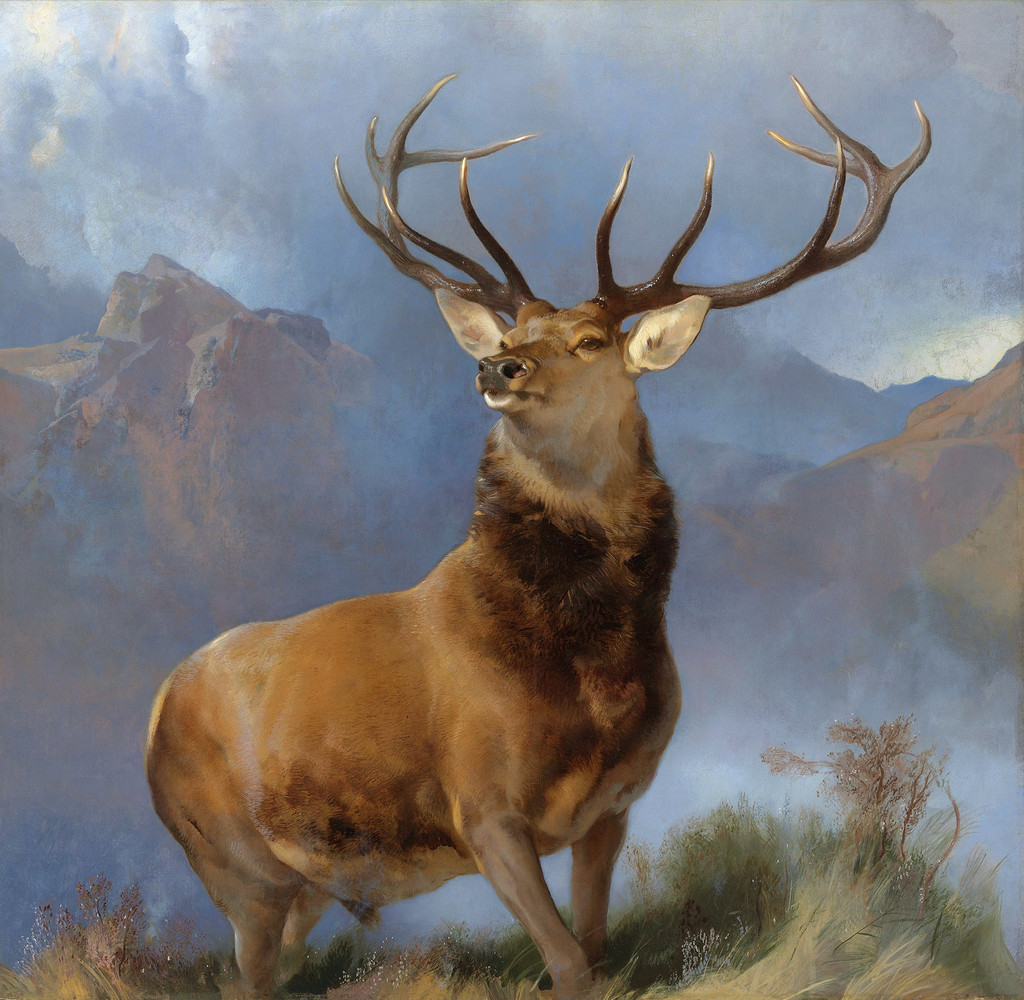
At the National Gallery of Art, A Bellowing Stag is catalogued “probably 1840/1850”. Pen and brown ink over graphite establish the animal and surrounding space without the coloured atmosphere of the Morgan sheet. The uncertain date is meaningful. It shows what the current evidence can support and no more. The drawing need not be forced into a preparation for The Monarch of the Glen or any other famous canvas simply because a stag raises its head in a landscape.[3]
The Barn, also at the NGA, makes the absence of a prominent animal productive. Pen and brown ink over graphite describe a rustic interior across two joined sheets. Beams, roof, tools, stacked matter, openings and glimpses of exterior space generate the subject. The join helped create a wide field in which the eye can travel through construction and clutter. No named location or finished painting is attached to the current record, so the sheet can be encountered as a sustained architectural observation in its own right.[3]
Together, these works complicate the category of landscape. The Morgan watercolour connects place, travel, colour and a named recipient. The bellowing stag joins animal action to an uncertain setting and date. The Barn turns built rural space into a complex graphic field. Landseer did not have to choose between figure, animal and landscape as sealed genres; paper allowed their proportions to change from one encounter to another.
This range should not be inflated into a claim that landscape was his hidden principal speciality. The surviving sheets give selected views of what he did, filtered by preservation and collection. Their real value is more precise: they demonstrate that attention to place could be independent, could support animal presence or could travel as a worked watercolour between artist and recipient.
Looking at other art
Drawing from another artwork was a central kind of looking. The British Museum’s graphite study of the horse of Selene records the famous head from the east pediment of the Parthenon, probably through a cast. The museum dates it tentatively to 1820–40 and associates it with Landseer’s youth. Sculpture had already compressed the horse into monumental form; drawing translated that three-dimensional interpretation into line and tone on a small sheet.[4]
The object also carries a later physical story. It was removed from a sketchbook sold in 1967 and subsequently dispersed. Seen alone, the horse still records an encounter with antique form, but its former neighbours and position in the book can no longer be read directly. The loss does not make the leaf meaningless. It changes the questions that can be answered: individual image survives, sequence does not.[4]
Landseer’s looking at drawings continued beyond formal education. He later owned anatomical drawings of the horse by George Stubbs. The National Gallery’s account of those works establishes possession, not a specific moment of copying or a direct loan into one Landseer composition. Still, a collection can function as a visual library. The work of an earlier British animal painter remained available for close comparison in the later artist’s own environment.[14]
Copying and collecting unsettle the idea that originality requires isolation. The Selene horse offered an ancient model interpreted through sculpture; the Stubbs sheets offered anatomical thought translated by another draughtsman. Landseer could learn how forms had already been selected and organised without surrendering his own choices. Paper made looking analytical: to redraw something is to decide which structures deserve another mark.
From a sheet to another work
Some relations between drawing and painting are unusually direct. The NGA’s double-sided Study for Alpine Mastiffs Reanimating a Distressed Traveler is dated 1820 and connected by its current title and scholarship to the painting of that year. On the recto, graphite is reinforced with pen and brown ink; on the verso, graphite explores the subject again. The two faces preserve alternatives on one physical support.[3]
This sheet makes preparation visible without turning preparation into a universal law. Landseer could reconsider positions, emphasis and group relations before committing them to a large canvas. Turning the paper over extended the available field while keeping the studies together. The finished painting gives the experiment a known destination, but the drawing remains evidence of decisions that the later surface resolves or conceals.[1][3]
Contending Group after Nature [A Lion Fighting a Tiger and a Leopard] connects paper to print rather than to a documented painting. Made in 1822, it layers pen and black and brown ink with grey and brown wash over graphite on laid paper. The different materials suggest planning, revision and tonal separation within the violent knot of animals. An NGA exhibition label identifies it as a model for an etching by Landseer’s brother Thomas.[3][15]
That relation involves translation rather than mechanical duplication. Edwin’s drawing supplies a design; Thomas’s etching reverses and reformulates marks through a plate, ink and impression. The drawing has its own scale, layered surface and provenance, while the print enters a potentially multiple edition. Recognising the connection clarifies the labour of both brothers. It does not make the paper object merely a disposable intermediate.[15]
Nor should “After Nature” make the animal fight literal reportage. A lion, tiger and leopard are arranged in an intensely compressed collision. Anatomical study could make individual bodies plausible while composition created an encounter unlikely to have been observed as a whole. The title’s appeal to nature and the drawing’s artifice coexist.
These two sheets establish opposite lessons that belong together. The Alpine study proves that a drawing may lead towards a painting. Contending Group shows that a sheet can become a design for another maker’s print. Neither relation explains The Barn, the Scott watercolour or every album portrait. Destination is an object-by-object fact, not an essence of the medium.
When a drawing stands on its own
An independent drawing need not be without purpose. It may test, remember, entertain, present or collect visual information while remaining the principal surviving object. The phrase is most useful as a refusal to invent a lost painting whenever no further work is documented. Landseer’s corpus includes sheets whose visual organisation is complete enough to reward attention without a known sequel.[2]
Otterhounds makes this clear through colour and containment. Graphite framing lines define the field; watercolour and gouache distinguish coats, bodies, riverbank and light. The repeated heads form a pack without dissolving into pattern. It is possible that ideas within the sheet informed other work, but no such hypothetical destination is needed to explain the object’s present coherence.[11]
The Morgan landscape achieves independence differently. Its inscription to Sir Walter Scott makes exchange part of the work’s identity. Transparent and opaque colour, selective glazing, large size and information on both sides give it a material density unlike a casual memorandum. A gift can still be investigative; a travel record can still be composed. Social destination does not cancel visual inquiry.[13]
Even The Barn, without colour, date or named site, holds attention through construction. Its two joined sheets are not evidence of incompleteness but of extension. The repeated timbers direct the eye, small objects vary the interior, and openings interrupt the built enclosure. Calling the work independent does not claim that Landseer meant it for a gallery. It acknowledges that the object is not currently subordinate to a proved larger project.[3]
The language of finish is especially misleading here. A watercolour may contain open paper; an ink interior may be densely worked; a graphite portrait may focus on a face and leave its surroundings slight. Resolution can vary within a single sheet. What matters is how that variation organises attention, not whether paper imitates the uniform coverage expected of a polished oil painting.
Albums, sketchbooks and loose leaves
An album is more than storage. Its binding puts images into sequence, protects some surfaces, exposes others to handling and creates opportunities for additions over time. The Redleaf “Scribblers’ Book” contains drawings made directly on leaves as well as separate sheets laid down. Rectos and occasional versos, different papers and a wide range of materials produce a physical history that cannot be reduced to a folder of interchangeable images.[4]
Its chronology is equally layered. The museum describes a central span around 1819–42 while allowing possible later hands to 1885. That breadth matters when interpreting proximity. Two drawings facing one another now need not have been made at the same gathering, and a later mounting may have created the surviving order. The volume preserves associations while also requiring caution about how those associations formed.[4]
The name “Scribblers’ Book” encourages thoughts of spontaneity, but “scribble” should not become a judgement that its contents are trivial. The album contains named portraits, hunting material, ordinary work, travel, performance and scenes of artists themselves. Its informal setting allowed subjects that might never have become Academy pictures. Quick marks could depend on long familiarity with a face or gesture; a carefully worked contribution could still be sociable.
The horse of Selene represents the reverse condition. Its old mount records removal from a sketchbook sold in June 1967. Extraction gave the sheet an individual market and museum life, but the act separated it from pages that could have clarified chronology, repeated motifs or a visit to a cast collection. The leaf carries evidence of absence: we know that a context existed, while no longer being able to inspect it as a bound whole.[4]
These cases show why the common claim that Landseer’s drawings were simply scattered cannot stand without qualification. One major album survived assembled; one documented leaf was detached; other works passed independently through sales and collections. Dispersal happened in particular ways at particular times. It should be reconstructed from bindings, mounts, inscriptions, sale records and ownership histories, rather than treated as a romantic fate shared by every sheet.
Format also changes counting. A Redleaf album leaf may carry more than one drawing or have material on both sides. A separate sheet may be laid onto a bound page. The Alpine study has recto and verso accession suffixes but remains one sheet. The Barn uses two joined pieces to form one work. A numerical list that ignores these distinctions may look exact while confusing images, faces, leaves and objects.
For viewers, the practical lesson is simple: look at the edges as well as the centre. A join, hinge, mount line, framing rule, inscription on the reverse or change of paper may explain how the image was made and preserved. Digital presentation often gives a clean rectangle. The physical record tells a more complicated story.
How drawings travelled
The ownership history of Contending Group is unusually revealing. It remained in Landseer’s collection and appeared in his studio sale at Christie’s on 8 May 1874 as part of a larger lot. It then belonged to his sister, Mrs Mackenzie, and reappeared in her 1895 sale. Agnew held it, followed by private ownership and Guy Peppiatt; the National Gallery of Art acquired it in 2021.[3]
This chain does not disclose why every person kept or sold the drawing. It does show how the object’s status changed. In the artist’s possession it could remain near related work; in a family collection it carried personal as well as artistic association; through dealers and auctions it became an individually valued commodity; in a public museum it received a stable accession, conservation care, digital record and open image.[3]
The Alpine sheet may also have appeared in the 1874 sale, but its record marks that step as possible. That qualifier should not disappear. Provenance is strongest when each transfer is documented; a plausible identification with a broad sale description remains different from a named, certain transaction.[3]
Ownership after Landseer’s death has affected what can be compared. Studio lots sometimes grouped several sheets. Family descent could preserve associations, while market division could separate them. A new mount might make a drawing easier to display and obscure its former edges. Museum acquisition can restore public access without recreating an original studio order. The history of a drawing is therefore not finished when the artist stops marking it.
Attribution is an argument
Attribution means weighing evidence, not reading a celebrated name off an old label. The Charles Landseer écorché hound shows the difficulty within a family workshop. The brothers shared teachers, subjects, chalk colours and papers; they sometimes drew side by side and did not consistently sign. A sheet could resemble Edwin’s anatomical work because Charles underwent closely related training. The Met’s present assignment to Charles follows comparison rather than inherited expectation.[10]
An even more dramatic case concerns twenty-five landscape drawings in the Royal Collection. Queen Victoria acquired them from Edwin Landseer’s studio in 1874, and they were bound in a blue album lettered Sketches by Sir E. Landseer. Their location and binding encouraged belief in his authorship. By 1995, however, they were catalogued more cautiously as circle of Thomas Gainsborough or the Norwich School.[16]
In 2013, Lindsay Stainton recognised one sheet as a squared study for Gainsborough’s Cornard Wood. Another related to his Autumn Landscape. Comparisons of style, paper and watermarks supported the reassignment of the whole group to the young Gainsborough, about 1746–50. Some sheets record nature directly, some are squared for transfer and others are more invented landscape compositions. The group’s internal material consistency, including shared paper types and oil stains, helped preserve its collective identity even while the artist’s name changed.[16]
Nothing in that correction implies fraud by Landseer. Artists collect the work of others, and Royal Collection Trust states that it is unclear how he obtained these drawings. Possession in his studio is a fact; manufacture by his hand is not. The album title records an earlier belief, not a signature distributed across every page.[16]
The Gainsborough group demonstrates why several forms of evidence must meet. A preparatory relation to a known painting can connect one sheet to an artist. Watermarks help date and group papers. Repeated materials, dimensions and stains can indicate that sheets travelled together. Style becomes more persuasive when it agrees with those physical and compositional links. Provenance explains custody but does not decide authorship alone.
Current catalogues remain open to revision. “By”, “attributed to”, “circle of”, “after” and “formerly attributed to” describe different levels or kinds of relation. Those words should not be discarded when an image is reproduced. They are compact histories of judgement, and they protect both the artist who did not make an object and the one whose work has been recovered.
For Landseer, this caution enriches rather than empties the corpus. Secure sheets become clearer when doubtful ones are not forced into it. Related works by Charles illuminate shared education. The Gainsborough album reveals Landseer as an owner of earlier drawings, even though it no longer enlarges his output. Attribution can change the question from “Did he draw this?” to “Why was this drawing in his studio, and what might he have seen in it?”
Surviving through another hand
Sometimes the object that preserves a design is not by the designer. On 5 September 1847, Queen Victoria made a pencil drawing titled Copied from Landseer’s drawing on the Dining room at Ardverikie. Landseer had designed murals for the Scottish lodge; Victoria recorded in her diary that she tried to copy his wall drawings and was pleased with her stag. Ardverikie House was destroyed by fire in 1873, leaving her sheet among the few records of the lost decoration.[17]
Authorship here has two layers that must remain separate. Victoria drew the surviving work on paper. Landseer devised the wall image she copied. Her sheet cannot be added to a list of drawings by him, yet it carries evidence of a Landseer design no longer available for direct inspection. Copying preserved something while inevitably translating it through another hand, scale and medium.[17]
The case expands the meaning of survival. A drawing may endure as its original sheet, as one face of a leaf, inside an album, after removal from a book or through a copy made by somebody else. Each condition gives access and imposes limits. Victoria’s pencil marks cannot recover the full colour, surface or room-scale effect of the mural, but without them the visual record would be poorer.
How to look at a Landseer drawing
Begin with the catalogue line before deciding what the image proves. Read the artist field closely. A drawing “by Edwin Landseer” is not the same as one by Charles, one after Edwin, or an album formerly assigned to him. Keep the date exactly as given: a single year, “about”, “probably” and a range express different degrees of knowledge. Note the medium and support rather than relying on appearance in a screen image.[6][10][16]
Next, identify the physical unit. Is it one sheet, two joined sheets or a leaf with work on both sides? Has it been mounted, laid into an album or extracted from a sketchbook? Check dimensions. The tiny Two stags running and the substantial Morgan watercolour ask the hand and eye to operate at different scales even when reproduced at similar widths online.[6][13]
Then separate subject from function. A dog may be an anatomical specimen, a resting household animal, an alert head or one member of a moving pack. A landscape may record travel, hold an animal action or investigate a barn interior. The current title may announce a study for a painting, as with Alpine Mastiffs, but no later work should be invented for a sheet whose record supplies none.[9][7][3][11]
Look for layers. Graphite beneath ink can preserve a first arrangement under stronger decisions. White or red heightening may select light, structure or emphasis from darker chalk. Transparent and opaque watercolour behave differently on the same sheet. Framing lines can establish a chosen field. Repetition on a verso may show another attempt rather than the back of an unrelated object. None of these features creates a universal order in which Landseer always proceeded from one material to the next.
Attend to omission. In the Met dog, the slight hand with a cloth explains the animal’s concentrated gaze. In The Barn, the lack of a famous animal permits beams, tools and intervals of light to organise the experience. In an album portrait, abbreviated surroundings may make a face legible to people who already knew the sitter. Open paper is not necessarily an unfinished failure; it can keep the viewer’s attention where the draughtsman wanted it.[6][3][4]
A useful boundary case is The Honourable Mrs Norton. Current collection information describes the 1837 portrait as oil, charcoal and crayon on canvas. Charcoal and crayon are drawing materials, but their presence does not cancel the object’s canvas support and oil medium or turn it into a work on paper. Material categories overlap. The safest practice is to preserve the full current description rather than choose the one word that best fits a preconceived section of an artist’s career.[18]
Finally, follow the object beyond Landseer’s hand. An inscription may date or dedicate it. A binding may preserve company. A sale may split a group. A dealer or collector may add a mount. A museum may revise an attribution when another painting, watermark or comparable sheet supplies better evidence. These events do not sit outside the drawing’s meaning; they determine the form in which it can now be studied.[3][4][16]
Landseer’s drawings reward this attention because they keep categories mobile. Animal and human, observation and invention, private amusement and serious study, preparation and independence all meet on paper without becoming identical. The most revealing sheet is not always the most polished or the one closest to a famous painting. It may be the object that shows a handler’s hand, retains a join, carries two attempts, survives in a shared album or loses a confident attribution. Through such details, drawing emerges as a major arena of Landseer’s art: not merely the route to the image for which he became known, but a varied practice of seeing, testing, remembering and exchange.[1][2]
Read the exhibition evidence
The original 2023 National Gallery of Art exhibition labels survive in an archived copy. The Lion Defending its Prey label appears on PDF page 49, numbered 41 in the exhibition.
Drawing in Britain, 1700–1900: exhibition labels. National Gallery of Art, Washington, 2023. Archived 2 July 2024.
Compare the exhibition’s circa-1820 label with the current circa-1840 catalogue date discussed in the article. Read the archived labels (PDF).
Artworks directory
This directory gathers works discussed in the articles, including drawings, original etchings and prints after Landseer. It is not a complete catalogue of every drawing, version, plate or impression. Distinct media are kept separate; uncertain dates are left blank. Linked titles open individual articles.
| Name | Date | Medium |
|---|---|---|
| A Bellowing Stag | Drawing | |
| A Deerhound | 1826 | Painting |
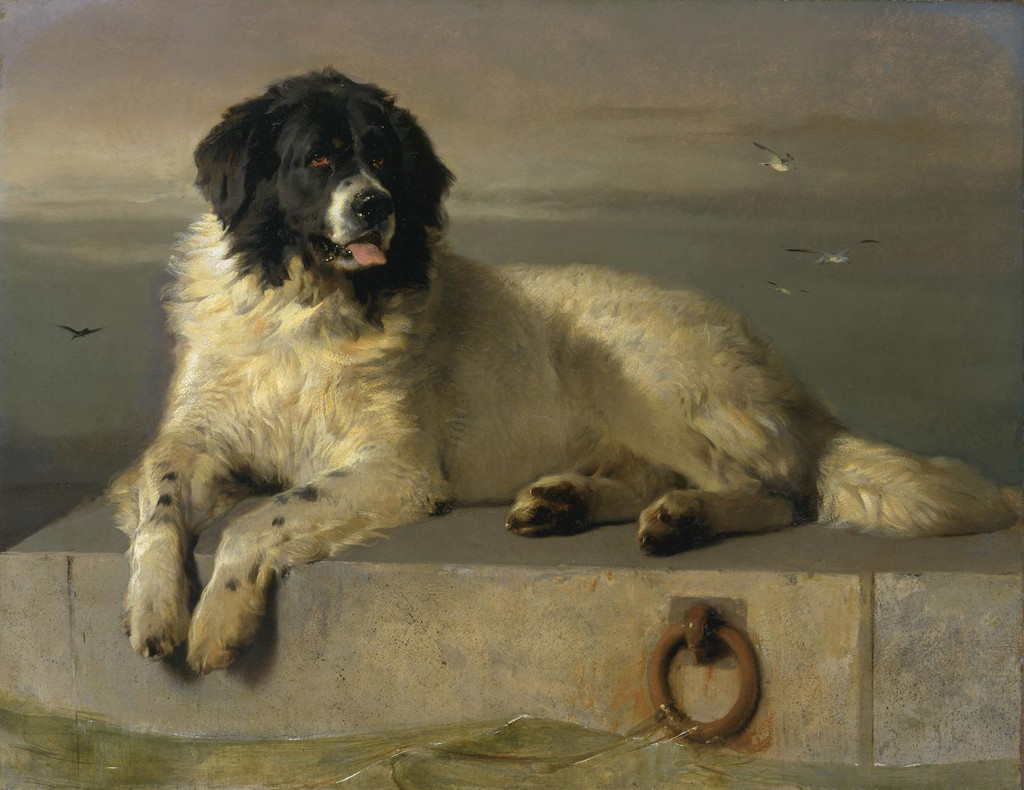
| A Distinguished Member of the Humane Society | 1838 | Painting |
| A Highland Breakfast | 1834 | Painting |
| A Highland Landscape | c. 1830 | Painting |
| A Highland Shepherd's Home | Painting | |
| A Horse, Goat and Bull | 1811 | |
| A Hunting Horse | Drawing | |
| A Jack in Office | Painting | |
| A Lion Disturbed at His Repast | Painting | |
| A Random Shot | Painting | |
| A Scene at Abbotsford | Painting | |
| Adversity | Painting | |
| Alexander and Diogenes | exhibited 1848 | Painting |
| Alpine Mastiffs Reanimating a Distressed Traveler | 1820 | Painting |
| Contending Group after Nature | Drawing | |
| Copy after Rubens's Wolf and Fox Hunt | c. 1824–26 | Painting |
| Dash | Painting | |
| Deer and Deer Hounds in a Mountain Torrent ('The Hunted Stag') | c. 1832 / exhibited 1833 | Painting |
| Deer Family | ||
| Dignity and Impudence | 1839 | Painting |
| Dog Resting Upon a Couch | Drawing | |
| Eos | 1841 | Painting |
| Favourites, the Property of H.R.H. Prince George of Cambridge | 1834–35 | Painting |
| Her Majesty Sketching at Loch Laggan | ||
| High Life | 1829 / exhibited 1831 | Painting |
| Highland Lassie | Drawing | |
| Isaac van Amburgh and his Animals | 1839 | Painting |
| Lady Godiva's Prayer | Painting | |
| Laying Down the Law | 1840 | Painting |
| Lion Defending Its Prey | c. 1840 | Painting |
| Lioness | Drawing | |
| Little Strollers | ||
| Low Life | 1829 / exhibited 1831 | Painting |
| Man Proposes, God Disposes | 1864 | Painting |
| Nell Gwynne / Diana Vernon | Painting | |
| Neptune | ||
| No Hunting Till the Weather Breaks | Painting | |
| Otterhounds | Drawing | |
| Peace | Painting | |
| Pensioners | Painting | |
| Portrait of a Mule | Painting | |
| Portrait of Mr Van Amburgh, as He Appeared with His Animals at the London Theatres | 1846–47 | Painting |
| Portraits of a Pointer Bitch and Puppy | Painting | |
| Pray Let Me Out | ||
| Prosperity | Painting | |
| Ptarmigan in a Landscape | by 1833 | Painting |
| Queen Victoria and Prince Albert at the Bal Costumé of 12 May 1842 | 1842–46 | Painting |
| Queen Victoria at Loch Laggan | Painting | |
| Queen Victoria at Osborne | 1865–67 | Painting |
| Queen Victoria landing at Loch Muick | Painting | |
| Rat-catching | 1823 | |
| Reclining Lion | Drawing | |
| Reclining Lion, From Back | Drawing | |
| Rent-day in the Wilderness | 1855–68 | Painting |
| Return from Deer Stalking | 1839 | |
| Royal Sports on Hill and Loch | Painting | |
| Sam Lovill, Porter at the Royal Academy | Drawing | |
| Scene from A Midsummer Night's Dream | 1848–51 | Painting |
| Scene in the Highlands, with portraits of the Duchess of Bedford, the Duke of Gordon and Lord Alexander Russell | Painting | |
| Scottish Highlands, Lochs and Figures | Drawing | |
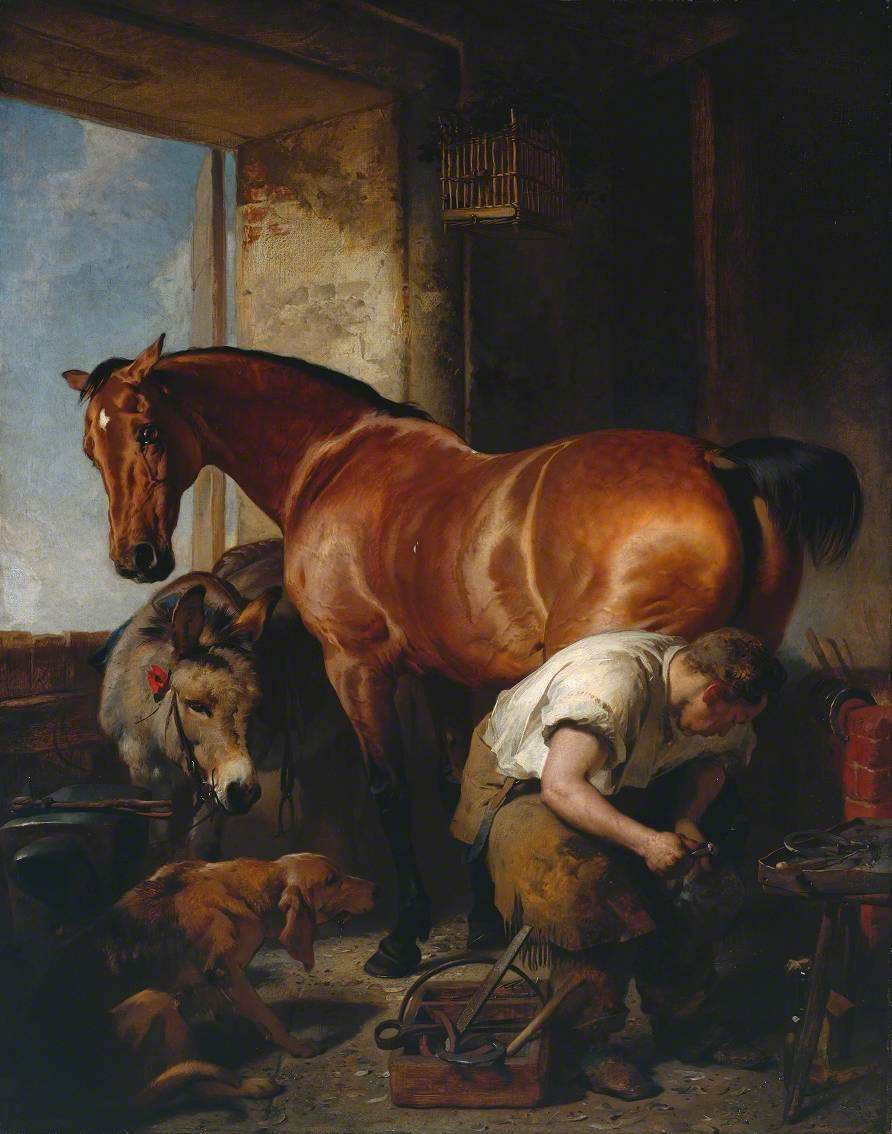
| Shoeing | exhibited 1844 | Painting |
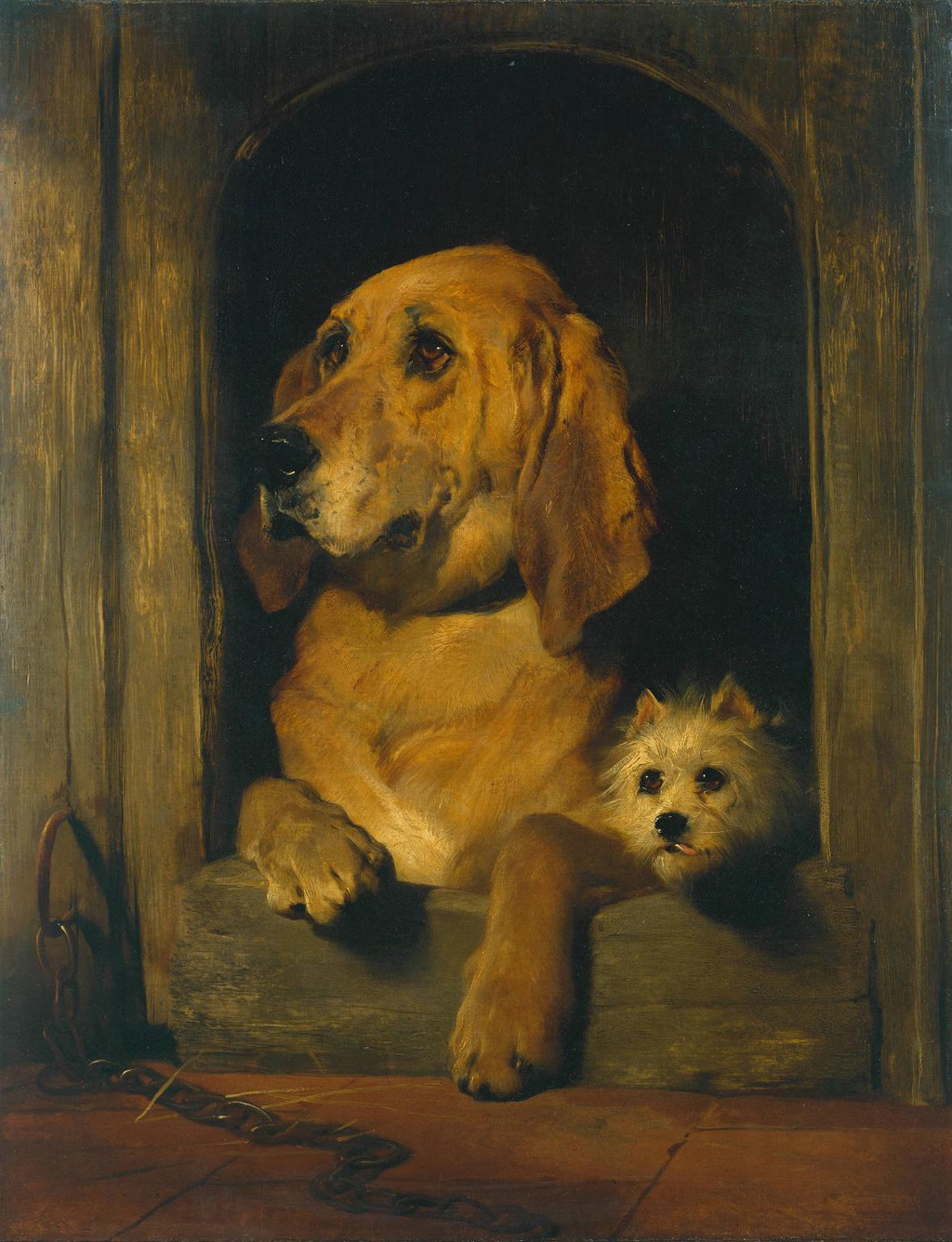
| Sleeping Bloodhound | exhibited 1835 | Painting |
| Spaniel and Rabbit | Painting | |
| Stag at Bay | 1866 | Sculpture |
| Stag at Bay | 1846 | Painting |
| Studies of a staghound and the head of a stag for painting ‘The Hunting of Chevy Chase’ | Drawing | |
| Study for Alpine Mastiffs Reanimating a Distressed Traveler | Drawing | |
| Study for the Monkey in The Cat's Paw | Drawing | |
| Study of a Dog | Drawing | |
| Study of a herding dog facing right | Drawing | |
| Study of the horse of Selene, from the East pediment of the Parthenon | Drawing | |
| Suspense | Painting | |
| Taking a Buck | ||
| The Arab Tent | c. 1865–66 | Painting |
| The Barn | Drawing | |
| The Best Run of the Season | ||
| The Cat's Paw | c. 1824 | Painting |
| The Cavalier’s Pets | ||
| The Challenge | Painting | |
| The Chase | Drawing | |
| The Connoisseurs: Portrait of the Artist with Two Dogs | 1865 | Painting |
| The Death of a Stag in Glen Tilt | Painting | |
| The Drive—Shooting Deer in the Pass | Painting | |
| The Drover's Departure | Painting | |
| The Highland Shepherd’s Dog | 1824; portfolio issue 1848 | |
| The Honourable Mrs Norton | Painting | |
| The Hunting of Chevy Chase | 1825–26 | Painting |
| The Illicit Highland Whisky Still | Painting | |
| The Keeper John Crerar with his Pony | Painting | |
| The Larder Invaded | ||
| The Lion-Dog of Malta | ||
| The Lions at the Base of Nelson's Column | 1867 | Sculpture |
| The Monarch of the Glen | about 1851 | Painting |
| The Mountain Torrent | ||
| The Old Shepherd's Chief Mourner | 1837 | Painting |
| The Sanctuary | 1842 | Painting |
| The Stricken Deer | Painting | |
| The Twa Dogs | Painting | |
| Time of Peace | ||
| Two stags running | Drawing | |
| Victoria, Princess Royal, with Eos | Painting | |
| View of Glenfeshie | Painting | |
| War | Painting | |
| White Horse in a Stable | Painting | |
| Windsor Castle in Modern Times | 1841–43 | Painting |
| Woburn Abbey Game Card | 1825; portfolio issue 1848 |
Discussion
Use the article’s images and evidence to develop your own reading of Drawings.
Reader Insights
Which detail is most revealing when you consider “What survives under the word drawing”?
How does the evidence in “An early practice, not a childhood myth” affect your reading of Drawings?
What further question would you bring to “How to look at a Landseer drawing”?
Join the Conversation
Share a detail, comparison or question about Drawings below.
References
- Richard Ormond, with Joseph Rishel and Robin Hamlyn, Sir Edwin Landseer, Philadelphia Museum of Art / Tate Gallery / Rizzoli, 1981, ISBN 0-87633-044-8.
- Richard Ormond, Edwin Landseer: The Private Drawings, Norwich, 2009.
- National Gallery of Art, “Study for Alpine Mastiffs Reanimating a Distressed Traveler”; “Contending Group after Nature”; “A Bellowing Stag”; “The Barn”; “Sir Edwin Landseer”. View source 1. View source 2. View source 3. View source 4. View source 5.
- British Museum, “Edwin Landseer”; “Study of the horse of Selene”; “Scribblers’ Book”; British Drawings with Uncertain or Incomplete Provenance, 1933–45. View source 1. View source 2. View source 3. View source 4.
- Royal Academy of Arts, “Edwin Landseer RA”. View source.
- Metropolitan Museum of Art, “Study of a herding dog facing right”; “Study of a Dog”; “Two stags running”; “Sam Lovill, Porter at the Royal Academy”. View source 1. View source 2. View source 3. View source 4.
- RISD Museum, “Dog Resting Upon a Couch”. View source.
- Susan Owens, “Écorché drawings by Edwin Landseer”, The Burlington Magazine, vol. 154, no. 1310, May 2012, pp. 337–44. View source.
- Victoria and Albert Museum, Annual Report and Accounts 2010–11. View source.
- Metropolitan Museum of Art, Charles Landseer, “A Full Size Écorché Study of a Hound”. View source.
- Frick Collection, “Otterhounds”. View source.
- Cleveland Museum of Art, “Highland Lassie”. View source.
- Morgan Library & Museum, “Scottish Highlands, Lochs and Figures”. View source.
- National Gallery, Annual Review 2018–19. View source.
- National Gallery of Art, Drawing in Britain, 1700–1900 wall text and exhibition record. View source 1. View source 2.
- Royal Collection Trust, “Study for ‘Cornard Wood’”; “Trees beside a pond”; “Drawings by young Gainsborough will go on display for the first time”. View source 1. View source 2. View source 3.
- Royal Collection Trust, “Copied from Landseer’s drawing on the Dining room at Ardverikie”. View source.
- Art UK / Nottingham City Museums & Galleries, “The Honourable Mrs Norton”. View source.
- Splash image, Edwin Landseer, The Barn. National Gallery of Art, Washington. Image source. CC0 / Public domain.
- Navigation image, One of the bronze lions at Nelson’s Column: modelled by Edwin Landseer and cast by Carlo Marochetti. Photograph by Amanda Slater. CC BY-SA 2.0. Image source. CC BY-SA 2.0. Resized.