 by Tom Gurney
Tom Gurney BSc (Hons) is an art history expert with over 20 years experience
Email: tomgurney1@gmail.com / Phone: +44 7429 011000
Shoeing: Introduction
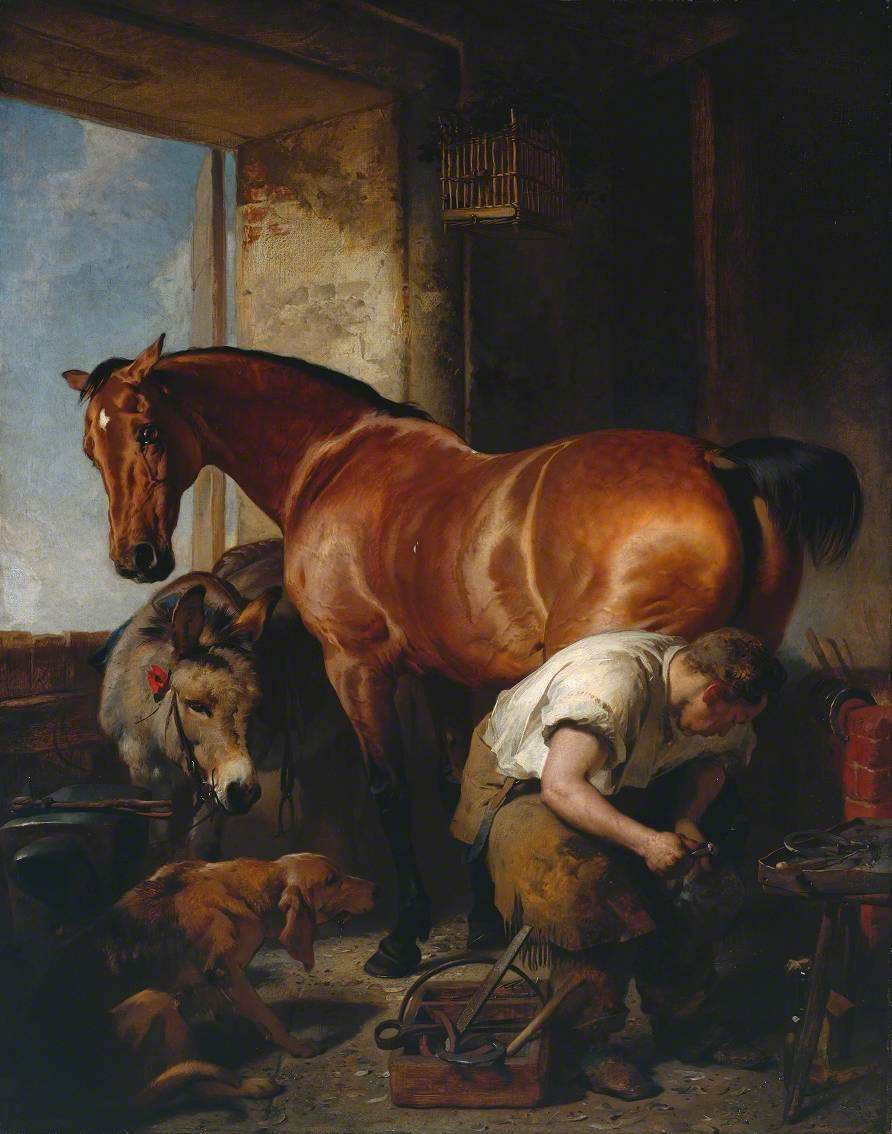
Edwin Landseer's Shoeing gives a routine operation the scale and concentration of a substantial animal portrait. A bay mare fills the centre of a forge while a farrier bends over one raised hind hoof; a donkey and a bloodhound occupy the space beside and below her. Exhibited in 1844, the oil painting belongs to Tate as N00606. Its upright canvas measures approximately 142 × 112 cm.[1] The horse's illuminated body commands attention, but the work being performed at its edge determines how the whole company has been brought together.
Light entering from the left passes over the mare's neck, shoulder and flank, then catches the farrier's pale shirt. These bright surfaces connect animal and worker across the darker interior. The man's lowered head and extended arm lead towards the hoof, while the animals' differently inclined faces bring several kinds of attention into the same confined space. The painting holds a practical task in suspense long enough for its participants, equipment and surroundings to become individually visible.[2]
The mare was Old Betty, owned by Landseer's patron Jacob Bell; the bloodhound was Laura. Algernon Graves later recounted that the commission had begun as a proposed portrait of mare and foal, before delay changed its subject.[3] The finished painting preserves the individuality of a valued horse while placing her within an occupation. That combination gives the scene its particular character: a portrait has become an encounter between an animal's physical presence and the human work required to maintain it.
At a Glance
This work across Edwin Landseer’s career
The Cat's Paw
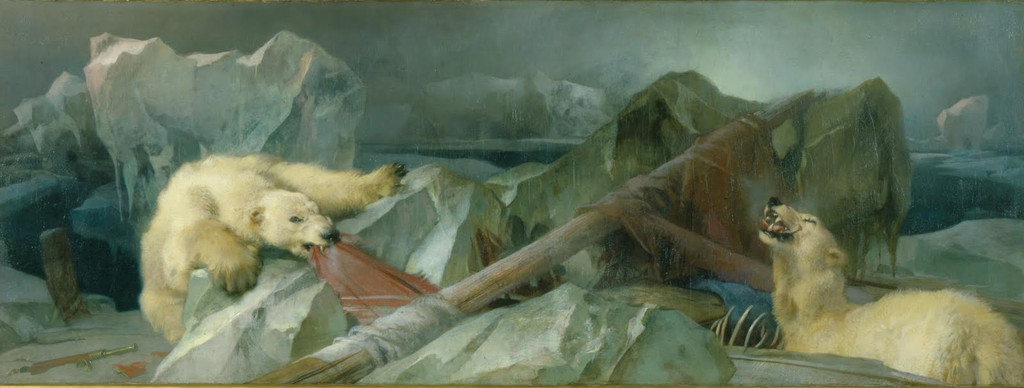
c. 1824 [5]The Hunting of Chevy Chase
1825–26 [6]Shoeing (current article)
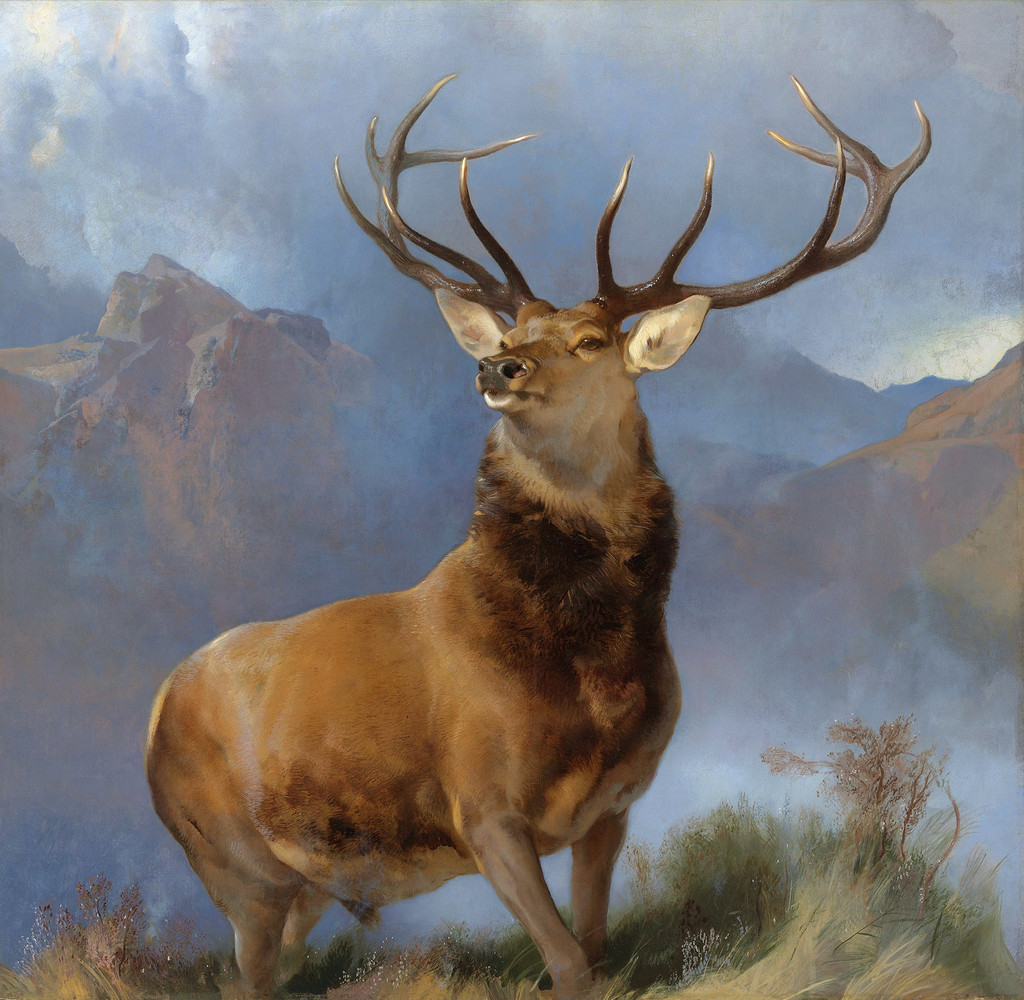
exhibited 1844 [10]The Monarch of the Glen
about 1851 [11]Contents
- The mare's substantial presence
- The farrier's bent figure
- The other animals in the forge
- A portrait that outgrew its first plan
- Handling and the constructed scene
- The value of a glossy hide
- Private ownership and public painting
- Harmony as a pictorial proposition
- Engravings, a newspaper sheet and a painted copy
- A task held in suspension
The mare's substantial presence
Old Betty stretches across much of the canvas, yet her position is governed by the upright frame. The high doorway, wall and ceiling establish a tall enclosure around the broad horizontal mass of her body. Her neck bends down towards the opening, and her hindquarters approach the opposite edge. Landseer gives the viewer a nearly complete animal without isolating her against a neutral background. The mare's size is felt through the amount of working space she occupies and the narrow intervals left for the other figures.[2]
Her bay colouring supplies the richest range of tones in the picture. Deep brown passes into warmer copper and gold along the areas receiving light; the black mane, tail and lower legs provide firmer dark accents. The highlights describe the shoulder and barrel through broad curves rather than through an even covering of brightness. They make the surface seem polished while also helping the viewer follow the body's changing direction. The visible coat is inseparable from the large forms it covers.[2]
The head introduces a quieter concentration of detail. A small pale marking stands out on the forehead, and the eye is set within a network of dark lines and warm brown planes. The muzzle hangs well below the ears, bringing the face close to the donkey beneath it. This lowered position gives the mare a different bearing from the elevated heads of ceremonial horse portraits. Her prominence comes from bodily scale and illumination while her head remains part of the forge's close, downward-looking activity.[2]
The contrast between a large body and a relatively subdued face is essential to the painting's calm. The mare does not need an emphatic gesture to retain her place at its centre. Her stance supplies the stable mass around which the farrier can bend and the other animals can gather. At the same time, one lifted hoof interrupts the completeness of an ordinary standing pose. Landseer makes the animal's apparent repose depend on a moment in which her body is being handled.[2]
The farrier's bent figure
The man occupies the lower right of the composition, where his white shirt provides the strongest light after the horse's flank. His back bends beneath that flank, his head inclines towards his hands, and his exposed forearm crosses the brown apron. The pose makes work visible through a continuous curve of body and arm. His face is present but partly turned away, so the spectator recognises his concentration chiefly through the relation between posture, hands and the small area on which he is engaged.[2]
This distribution of attention differs from the mare's broad exposure. Her body can be surveyed at a glance; his task requires the viewer to look into a compact, shadowed meeting of hand and hoof. The painting gives much more space to the animal than to the operation, although the operation explains her raised leg and the worker's position. A modest action can consequently organise a large composition. Its importance is measured by the relationships it creates rather than by the amount of canvas assigned to it.[2]
The implements extend that relationship towards the spectator. Long handles and curved metal forms rise from a low basket in the foreground, while more equipment lies on or leans against the support at the right. These objects occupy the passage between the viewer and the figures. Their angles interrupt the softer curves of horse, dog and clothing, and they establish the forge as a place fitted for a particular kind of labour. Landseer lets the equipment retain its awkward, varied shapes instead of arranging it as an ornamental accessory.[2]
The man's occupation gives him a necessary place beside the mare, but the painting does not provide his name. His individuality lies in the turned head, uncovered arms, substantial apron and practised-looking bend. The closeness of his body to the horse makes the difference in their scale especially clear. He works within the space allowed by a much larger creature, and the composition asks the viewer to attend to the precision of that relationship without supplying a story about his life beyond the depicted task.[2]
The other animals in the forge
The donkey stands beneath the mare's neck, partly sheltered by the broad body behind it. Its lighter, rougher coat breaks into small irregular changes that contrast with the long illuminated curves of the horse. A bridle follows the narrower face, and a bright red ornament introduces a small, unexpected concentration of colour near the ear. The donkey's presence creates another register of animal appearance within the portrait: its compact head and uneven surface make the mare's height and sheen more conspicuous.[2]
Laura occupies a different level again. The bloodhound is low in the foreground, with long ears hanging beside the head and a warm, broken coat against the darker floor. Graves identifies her alongside Old Betty in his account of the painting.[3] Her face turns towards the worker's side of the scene, bringing the foreground into contact with the action farther back. The dog is sufficiently close for her contour to overlap the space of the tools, but she does not obstruct the farrier's hands.[2]
The animals' heads form a progression through the interior. The mare looks down from above, the donkey's face appears below and slightly farther forward, and the dog turns at floor level. These positions give the spectator a route among creatures of markedly different size. Their attention can seem to converge on the shoeing, but their bodies remain distinct. Landseer does not furnish them with a single exaggerated expression or a common human gesture; the sense of company develops through their placement around the task.[2]
High above this group hangs a birdcage. Its narrow bars and small suspended form are easy to overlook beside the mare's illuminated bulk. The cage nevertheless adds another scale of habitation to the forge, extending its occupied space towards the ceiling. In the 1844 review, the bird was identified as a blackbird whose imagined song joined the sounds of work.[14] In the painting itself, the cage remains silent: the viewer's sense of a populated interior is carried by visible positions and objects.[2]
A portrait that outgrew its first plan
Graves's 1874 catalogue gives the commission a history of repeated postponement. Bell had wanted his mare painted with a foal and bred her with that picture in mind. According to this later account, one foal grew beyond infancy and outgrew its mother; a second followed, with the same result. The proposed pairing was eventually abandoned. Landseer then resolved to paint Old Betty, and the shoeing subject was chosen for the work that reached the Royal Academy in 1844.[3]
The story explains a change in the kind of relationship the painting depicts. A mare-and-foal portrait would have organised its subject around maternity, resemblance and differences of age. Shoeing places the mare among other animals and a worker, with an operation linking them. Old Betty remains the reason for the commission, but her appearance now belongs to a more varied arrangement. The work acquires several objects of attention without allowing the additional figures to rival her physical prominence.[2][3]
The donkey is especially consequential in this respect. It cannot occupy the foal's place as offspring, and its visibly different kind of coat prevents it from becoming a smaller equivalent of the mare. Instead, it introduces contrast within companionship. The animal shares the enclosure and the moment while retaining another bodily character. What the delayed commission lost as a family grouping, the finished composition replaces with a gathering whose coherence depends on proximity and activity.[2]
Graves's narrative is valuable as a later account of the picture's development, rather than as a surviving record of every stage in the negotiations. Its central point is visible in the finished work: Landseer solved the commission through a scene, rather than by presenting the mare alone. The shoeing provides an occasion for showing her body, but it also exposes that body to another person's skilled attention. Portraiture and the representation of work become mutually supporting parts of the image.[2][3]
Handling and the constructed scene
Robin Hamlyn reproduces Bell's explanation that the mare and donkey first became acquainted in the studio, challenging a story that Betty required the donkey's presence before she would be shod. His account also described as a rumour the story that the composition had been discovered in a country forge. He explained that the absence of a halter reflected the mare's habits: she would stand without fastening but resisted being tied, sometimes jerking back hard enough to break a bridle.[15] The account describes a particular animal rather than a general rule for handling horses.
That testimony changes the status of the painting's apparent ease. The figures can look as though they have gathered naturally around a familiar operation, yet their conjunction was composed. The donkey's useful position, the mare's lowered head and the farrier's bend belong to an arrangement made persuasive on canvas. The scene's credibility does not require it to reproduce a single event witnessed in exactly this form. Landseer has made separate observations support the appearance of one continuous moment.[2][15]
Bell addressed another objection concerning the mare's stance. Viewers thought the position of a forefoot made her appear to rest on only two legs. In the account transmitted by Hamlyn, the animal was repeatedly placed in position before the painting was finished, and each time adopted the stance represented.[15] This defence appealed to the behaviour of the individual sitter. It made close observation, rather than an ideal standing formula, the justification for a pose that some spectators found doubtful.
The painting therefore holds together two kinds of claim. Its arrangement is openly constructed, while details of the mare's behaviour are defended as particular and accurate. Neither claim cancels the other. The worker's posture, the animals' relative heights and the distribution of light make a coherent picture; the named horse's habits give that picture a more specific basis. The effect is one of observed familiarity shaped into a public exhibition work, with the evidence of work and the pleasures of finish sharing the same interior.[2][15]
The value of a glossy hide
The Athenaeum reviewed Shoeing on 11 May 1844, identifying it as Royal Academy exhibit 332. Its response joined an inherited hierarchy of subjects to admiration for Landseer's power of imitation. A stable interior could belong to a comparatively low order of art, the reviewer suggested, yet the picture's convincing material presence made such criticism difficult to sustain. The attraction of what seemed positive and tangible was acknowledged even while the subject's artistic rank remained in question.[14]
This was a judgement about the purposes of painting as well as its execution. A familiar operation could be rendered with extraordinary persuasiveness and still leave a critic asking whether the achievement served a sufficiently elevated end. The mare's coat was an obvious focus for that dispute because it made the painter's dexterity so conspicuous. Its sheen could be enjoyed as a difficult visual success, or regarded as an accomplishment that attracted too much attention to the surface of things.[2][14]
Ruskin sharpened the objection in the second volume of Modern Painters, first published in 1846. In a discussion of the relation between texture and larger pictorial truths, he contrasted Landseer's attention to curls and gloss with Veronese's treatment of an animal through form, colour and light. His note singled out Shoeing as an expenditure of energy on surface at the expense of colour, expression and action.[16] The complaint was specific: it concerned the balance among pictorial qualities, rather than the mere presence of a horse in art.
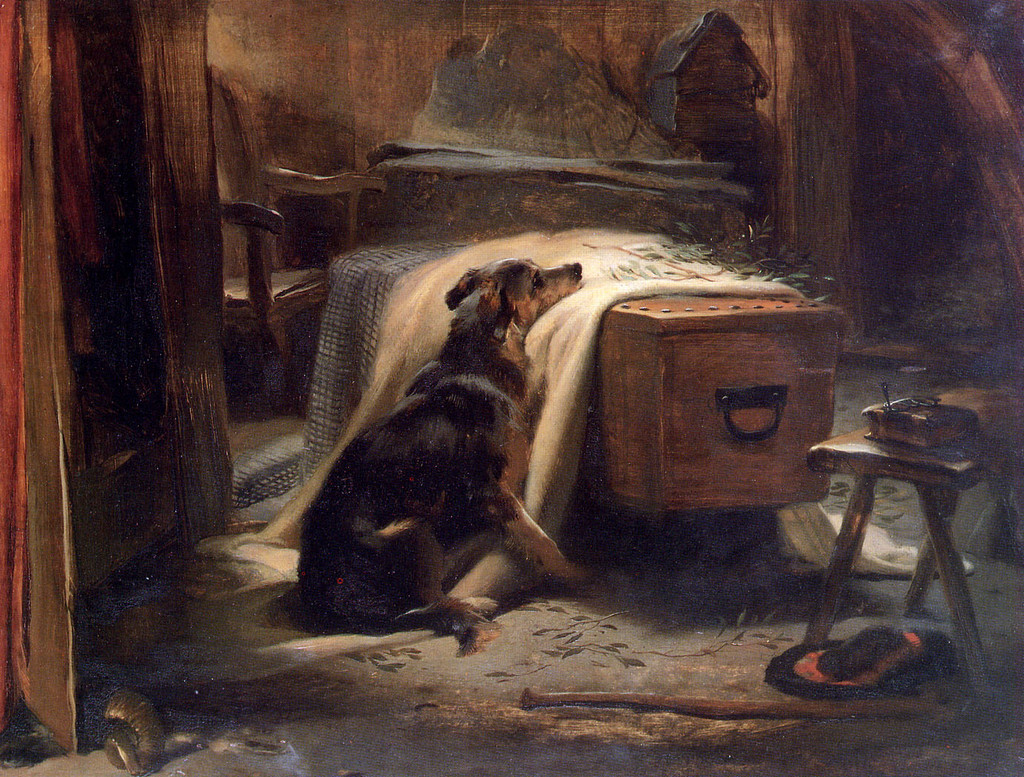
Ruskin also expressly retained his praise for works that developed the character and inner life of animals, including The Old Shepherd's Chief Mourner.[16] His reservation about Shoeing thus helps distinguish different expectations placed on Landseer's pictures. Fidelity to appearance could impress one viewer while leaving another unsatisfied about meaning or imaginative force. The same polished flank that establishes the mare's substantial presence becomes the point at which technical admiration and critical resistance meet.[2][16]
Writing in 1873, James Dafforne returned to the beauty of the horse's painted surface and to the individuality of the sitters. He described the farrier, donkey and bloodhound as portraits as well as identifying Old Betty.[17] His appreciation brings the argument back to the people and animals represented. The subject's ordinariness could be understood as a limit, but it also allowed the painter to confer sustained attention on a particular mare and the company assembled around her care.
Private ownership and public painting
Bell bequeathed Shoeing to the nation in 1859, and it entered the National Gallery before its transfer to Tate in 1912.[1][3][15] The object now belonged to a public collection, while retaining a subject derived from a private owner's interest in his animal. Its earlier exhibition and reproductive life helped make that transition intelligible. Viewers did not need to know Old Betty personally to recognise the bodily care, close looking and ordinary occupation around which her portrait had been organised.[2]
Alison Elizabeth Wright places Bell's animal pictures within a collecting practice that had public ambitions. His lending and bequest made individual animal portraits available beyond their owner's circle, and she treats Shoeing as a work that combines a working horse's identity with some of the emotional investment of a pet portrait.[18] This reading helps explain why the painting could retain its specificity in a national collection: an animal valued by one owner becomes available to other viewers as a substantial subject of attention.
The mare's appearance supports that possibility without requiring the spectator to adopt Bell's attachment in advance. Her size, the careful distribution of light and the visible relation between body and task give her a presence that can be examined independently of the commission story. The painting lets knowledge accumulate around a named animal rather than reducing her to a generic example of equine beauty. Ownership explains why the portrait was wanted; the composition determines what a wider audience can find within it.[2]
Harmony as a pictorial proposition
Wright proposes a further reading of the composition through its resemblance to religious arrangements. The barn-like enclosure, central illumination, watching animals and bent man suggest to her a nativity-like structure, with the tool basket occupying the foreground. She also reads the gathering as an image of peaceable relations across species.[18] These are interpretations of the painting's organisation, rather than evidence that Landseer intended a religious allegory or that the depicted animals shared a conscious understanding of the event.
The comparison is most useful when it directs attention back to the arrangement. The basket is conspicuously close to the viewer, the man's lowered body draws the eye inward, and the animals attend from different heights. These relationships can make an everyday action appear unusually concentrated. The painting gives its figures a common space while keeping their bodies, functions and kinds of attention separate. Its stillness is an achieved pictorial effect, sustained by the careful distribution of activity around a small operation.[2]
That effect also establishes the limits of any claim about harmony. The horse is being worked upon, the donkey is bridled, the bird is caged, and the man is occupied with equipment. Their proximity belongs to a human working environment. Landseer represents that environment as composed and apparently manageable, but its tranquillity remains something the picture asks us to see. The visible relations invite consideration of dependence and care without proving what any participant feels beyond the moment represented.[2]
Engravings, a newspaper sheet and a painted copy
Graves recorded a substantial reproductive history for Shoeing. His 1874 catalogue lists a large engraving by C. G. Lewis dated 1848, a small version dated 1851 and a middle-sized version dated 1860.[3] These entries distinguish engraved adaptations in different sizes. They show that the composition could be offered in more than one format, rather than proving a particular number of impressions or purchasers. The original oil and the later plates belong to related but separate histories of making and circulation.
An exact later example survives in the Wellcome Collection. Its lithograph, catalogued as 40131i, is lettered Shoeing the Bay Mare and carries the header of a supplement to the Glasgow Weekly Herald dated 18 April 1891. The lower imprint names Maclure, Macdonald & Co., lithographers in Glasgow.[19] This sheet supplies a concrete newspaper setting for the picture's afterlife, almost half a century after its first exhibition. It is a lithographic reproduction, distinct from both Landseer's canvas and Lewis's engravings.
The monochrome sheet preserves the crowded upright arrangement, including the cage above and the implements below. Its light mare and pale shirt remain prominent, but the copper and gold of the horse's coat must be conveyed through differences of tone. A viewer can still follow the relations among bodies, tools and doorway, while encountering a surface made through another medium. The newspaper heading and printed title also frame the picture as something to be issued and read, giving the forge scene a new material setting.[2][19]
Painted copying offered another route. Glanmore National Historic Site in Belleville, Ontario, catalogues an oil copy dated about 1861–70 by Bertram Couldery in its Couldery Collection.[20] That particular object is evidence of the composition's transmission beyond the original and its reproductive plates. Together, the dated engravings, the newspaper supplement and the museum's copy record give the work a demonstrable afterlife without requiring a general claim that reproductions appeared everywhere or that every later version had the same purpose.
A task held in suspension
The operation in Shoeing is small in relation to the animal whose body makes it necessary. Landseer builds the picture around that disparity. The farrier bends into a narrow area beneath the mare's flank, while light carries the viewer across a much larger expanse of coat. The donkey, dog and caged bird extend the scene's inhabited space, and the equipment brings the activity almost to the spectator's feet. Every figure and object helps make the task both particular and legible.[2]
The result preserves the mare's identity while allowing her portrait to become an image of work. Its finish can be admired or questioned, as the early critics demonstrate, but the glossy surface does not stand alone. It belongs to a body supported, handled and attended within an organised interior. The painting's quiet depends on the continuation of that relationship: the animal holds her place, the worker remains bent to his task, and an ordinary act receives the prolonged attention of a substantial canvas.[2]
Artworks directory
This directory gathers works discussed in the articles, including drawings, original etchings and prints after Landseer. It is not a complete catalogue of every drawing, version, plate or impression. Distinct media are kept separate; uncertain dates are left blank. Linked titles open individual articles.
| Name | Date | Medium |
|---|---|---|
| A Bellowing Stag | Drawing | |
| A Deerhound | 1826 | Painting |
| A Distinguished Member of the Humane Society | 1838 | Painting |
| A Highland Breakfast | 1834 | Painting |
| A Highland Landscape | c. 1830 | Painting |
| A Highland Shepherd's Home | Painting | |
| A Horse, Goat and Bull | 1811 | |
| A Hunting Horse | Drawing | |
| A Jack in Office | Painting | |
| A Lion Disturbed at His Repast | Painting | |
| A Random Shot | Painting | |
| A Scene at Abbotsford | Painting | |
| Adversity | Painting | |
| Alexander and Diogenes | exhibited 1848 | Painting |
| Alpine Mastiffs Reanimating a Distressed Traveler | 1820 | Painting |
| Contending Group after Nature | Drawing | |
| Copy after Rubens's Wolf and Fox Hunt | c. 1824–26 | Painting |
| Dash | Painting | |
| Deer and Deer Hounds in a Mountain Torrent ('The Hunted Stag') | c. 1832 / exhibited 1833 | Painting |
| Deer Family | ||
| Dignity and Impudence | 1839 | Painting |
| Dog Resting Upon a Couch | Drawing | |
| Eos | 1841 | Painting |
| Favourites, the Property of H.R.H. Prince George of Cambridge | 1834–35 | Painting |
| Her Majesty Sketching at Loch Laggan | ||
| High Life | 1829 / exhibited 1831 | Painting |
| Highland Lassie | Drawing | |
| Isaac van Amburgh and his Animals | 1839 | Painting |
| Lady Godiva's Prayer | Painting | |
| Laying Down the Law | 1840 | Painting |
| Lion Defending Its Prey | c. 1840 | Painting |
| Lioness | Drawing | |
| Little Strollers | ||
| Low Life | 1829 / exhibited 1831 | Painting |
| Man Proposes, God Disposes | 1864 | Painting |
| Nell Gwynne / Diana Vernon | Painting | |
| Neptune | ||
| No Hunting Till the Weather Breaks | Painting | |
| Otterhounds | Drawing | |
| Peace | Painting | |
| Pensioners | Painting | |
| Portrait of a Mule | Painting | |
| Portrait of Mr Van Amburgh, as He Appeared with His Animals at the London Theatres | 1846–47 | Painting |
| Portraits of a Pointer Bitch and Puppy | Painting | |
| Pray Let Me Out | ||
| Prosperity | Painting | |
| Ptarmigan in a Landscape | by 1833 | Painting |
| Queen Victoria and Prince Albert at the Bal Costumé of 12 May 1842 | 1842–46 | Painting |
| Queen Victoria at Loch Laggan | Painting | |
| Queen Victoria at Osborne | 1865–67 | Painting |
| Queen Victoria landing at Loch Muick | Painting | |
| Rat-catching | 1823 | |
| Reclining Lion | Drawing | |
| Reclining Lion, From Back | Drawing | |
| Rent-day in the Wilderness | 1855–68 | Painting |
| Return from Deer Stalking | 1839 | |
| Royal Sports on Hill and Loch | Painting | |
| Sam Lovill, Porter at the Royal Academy | Drawing | |
| Scene from A Midsummer Night's Dream | 1848–51 | Painting |
| Scene in the Highlands, with portraits of the Duchess of Bedford, the Duke of Gordon and Lord Alexander Russell | Painting | |
| Scottish Highlands, Lochs and Figures | Drawing | |
| Shoeing | exhibited 1844 | Painting |
| Sleeping Bloodhound | exhibited 1835 | Painting |
| Spaniel and Rabbit | Painting | |
| Stag at Bay | 1866 | Sculpture |
| Stag at Bay | 1846 | Painting |
| Studies of a staghound and the head of a stag for painting ‘The Hunting of Chevy Chase’ | Drawing | |
| Study for Alpine Mastiffs Reanimating a Distressed Traveler | Drawing | |
| Study for the Monkey in The Cat's Paw | Drawing | |
| Study of a Dog | Drawing | |
| Study of a herding dog facing right | Drawing | |
| Study of the horse of Selene, from the East pediment of the Parthenon | Drawing | |
| Suspense | Painting | |
| Taking a Buck | ||
| The Arab Tent | c. 1865–66 | Painting |
| The Barn | Drawing | |
| The Best Run of the Season | ||
| The Cat's Paw | c. 1824 | Painting |
| The Cavalier’s Pets | ||
| The Challenge | Painting | |
| The Chase | Drawing | |
| The Connoisseurs: Portrait of the Artist with Two Dogs | 1865 | Painting |
| The Death of a Stag in Glen Tilt | Painting | |
| The Drive—Shooting Deer in the Pass | Painting | |
| The Drover's Departure | Painting | |
| The Highland Shepherd’s Dog | 1824; portfolio issue 1848 | |
| The Honourable Mrs Norton | Painting | |
| The Hunting of Chevy Chase | 1825–26 | Painting |
| The Illicit Highland Whisky Still | Painting | |
| The Keeper John Crerar with his Pony | Painting | |
| The Larder Invaded | ||
| The Lion-Dog of Malta | ||
| The Lions at the Base of Nelson's Column | 1867 | Sculpture |
| The Monarch of the Glen | about 1851 | Painting |
| The Mountain Torrent | ||
| The Old Shepherd's Chief Mourner | 1837 | Painting |
| The Sanctuary | 1842 | Painting |
| The Stricken Deer | Painting | |
| The Twa Dogs | Painting | |
| Time of Peace | ||
| Two stags running | Drawing | |
| Victoria, Princess Royal, with Eos | Painting | |
| View of Glenfeshie | Painting | |
| War | Painting | |
| White Horse in a Stable | Painting | |
| Windsor Castle in Modern Times | 1841–43 | Painting |
| Woburn Abbey Game Card | 1825; portfolio issue 1848 |
Discussion
Use the article’s images and evidence to develop your own reading of Shoeing.
Reader Insights
Which detail is most revealing when you consider “The mare's substantial presence”?
How does the evidence in “The farrier's bent figure” affect your reading of Shoeing?
What further question would you bring to “A task held in suspension”?
Join the Conversation
Share a detail, comparison or question about Shoeing below.
References
- Tate, Shoeing, N00606, collection record; published open collection data, exact object JSON; current Tate institutional artwork text. Native collection page returned an access error; published data and current institutional text consulted. Accessed 31 October 2026. View source 1. View source 2. View source 3.
- Art UK, colour image of Shoeing, N00606, preserved on Wikimedia Commons, compared with the Tate image. Accessed 31 October 2026. View source 1. View source 2.
- Algernon Graves, Catalogue of an Exhibition of the Engraved Works of the Late Sir Edwin Landseer, R.A., revised edition, London: Henry Graves & Co., 1874, p. 18, no. 331; p. 36, nos. 420–422. Accessed 31 October 2026. View source.
- National Gallery of Art, Alpine Mastiffs Reanimating a Distressed Traveler. View source.
- Minneapolis Institute of Art, The Cat's Paw. View source.
- Birmingham Museums Trust, The Hunting of Chevy Chase. View source.
- Victoria and Albert Museum, The Old Shepherd's Chief Mourner. View source.
- Tate, Dignity and Impudence. View source.
- Royal Collection, Eos. View source.
- Tate, Shoeing. View source.
- National Galleries of Scotland, The Monarch of the Glen. View source.
- Royal Holloway, University of London, Man Proposes, God Disposes. View source.
- Trafalgar Square / Greater London Authority, The Lions at the Base of Nelson's Column. View source.
- Royal Academy exhibition review, The Athenaeum, no. 863, 11 May 1844, p. 433. Accessed 31 October 2026. View source.
- Robin Hamlyn, “Shoeing”, entry 134, in Richard Ormond, Sir Edwin Landseer, Philadelphia Museum of Art and Tate Gallery, 1981, pp. 183–184. Includes Jacob Bell's account of the composition and mare's habits. Accessed 31 October 2026. View source.
- John Ruskin, Modern Painters, volume II, part III, section II, chapter IV, §11 and note 71; first published 1846. Consulted later Library Edition, National Library Association, New York and Chicago, transcribed by Project Gutenberg; original 1846 facsimile not inspected. Accessed 31 October 2026. View source.
- James Dafforne, Pictures by Sir Edwin Landseer, Royal Academician: With Descriptions and a Biographical Sketch of the Painter, London: Virtue & Co., 1873, p. 27. Accessed 31 October 2026. View source.
- Alison Elizabeth Wright, Animal and sporting painting in Britain, 1760–c.1850: its artistic practices, patronage and public display, PhD thesis, University of East Anglia, November 2018, pp. 179–180, 186–188; fig. 65, p. 267. Accessed 31 October 2026. View source.
- Wellcome Collection, A mare is shod by a farrier in the company of a donkey and a dog, lithograph after Landseer, 40131i, catalogue API record, and actual dated sheet, image V0020861, supplement to the Glasgow Weekly Herald, 18 April 1891. Accessed 31 October 2026. View source 1. View source 2. View source 3.
- Glanmore National Historic Site of Canada, “The Art of Copying”, record for Bertram Couldery's Copy of Shoeing, about 1861–70, Couldery Collection, Belleville, Ontario. Accessed 31 October 2026. View source.
- Splash image, Shoeing. Tate. Image source. Public domain.
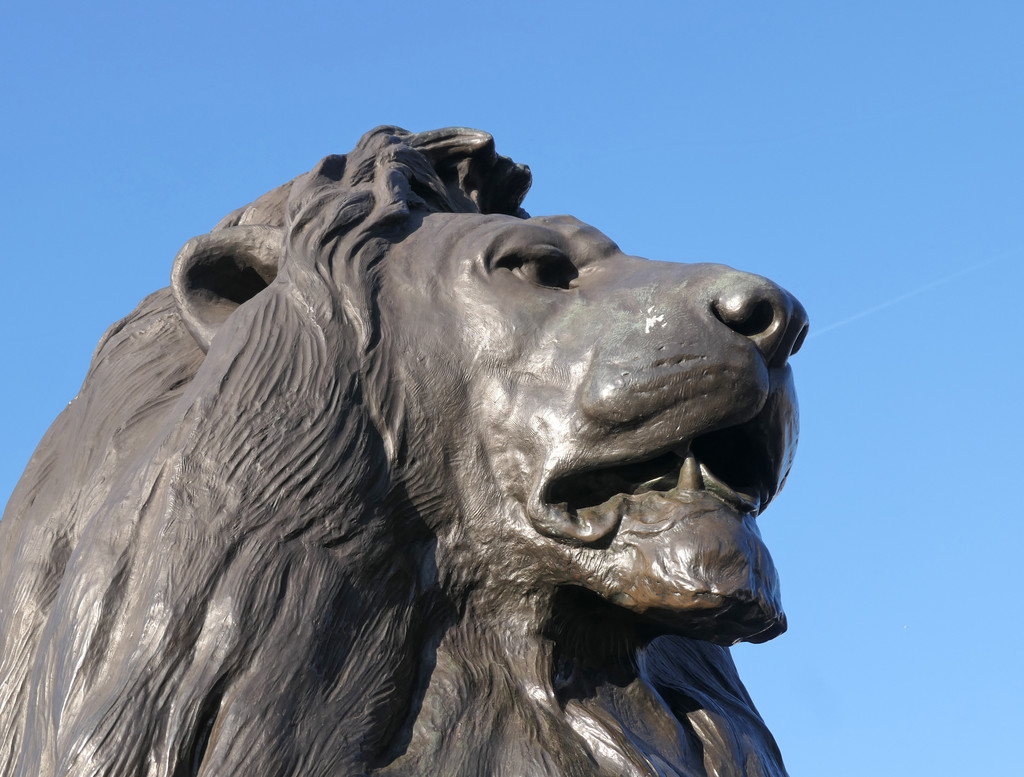
- Navigation image, One of the bronze lions at Nelson’s Column: modelled by Edwin Landseer and cast by Carlo Marochetti. Photograph by Amanda Slater. CC BY-SA 2.0. Image source. CC BY-SA 2.0. Resized.