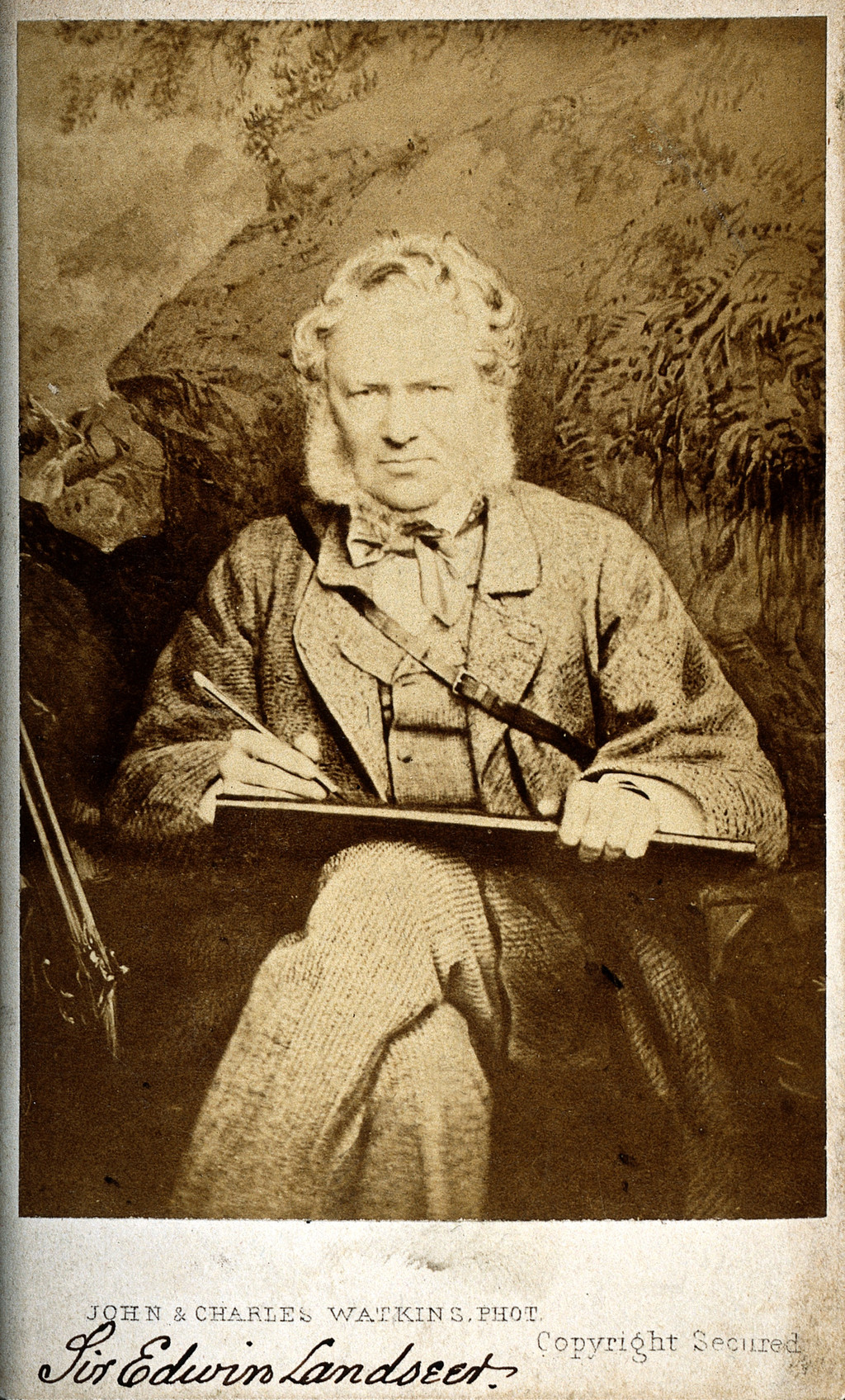
 by Tom Gurney
Tom Gurney BSc (Hons) is an art history expert with over 20 years experience
Email: tomgurney1@gmail.com / Phone: +44 7429 011000
Biography: Introduction
Sir Edwin Henry Landseer lived from 7 March 1802 to 1 October 1873. Between those dates he moved from a London household centred on drawing and engraving to a commanding position in British exhibition culture. He entered the Royal Academy Schools at fourteen, became an Associate of the Academy at twenty-four and a full Academician at twenty-eight. In 1866 his fellow Academicians elected him President, although illness led him to refuse the office.[1] These milestones make a remarkable sequence, but they can also distort the life. Precocity becomes a legend of effortless talent; royal favour becomes permanent intimacy; illness becomes an invitation to diagnose a man who cannot answer back.
The surviving record supports a more exact and more interesting account. Landseer learned through several channels rather than one formal apprenticeship. His father's profession brought him close to the making and circulation of images. Benjamin Robert Haydon encouraged anatomical inquiry. The Royal Academy supplied institutional training, exhibition and professional recognition. Scottish travel extended his subjects and social connections. Patrons, publishers, engravers and fellow artists helped his pictures reach different audiences. Victoria and Albert engaged him as painter, portraitist and instructor, but their patronage involved deadlines, corrections, payments and unfinished commissions as well as admiration.[2][3][4]
Landseer's career was unusually public. Paintings appeared at the Royal Academy and the British Institution; engraved versions entered homes that could never acquire the oils; portraits and caricatures circulated through private networks; royal pictures acquired dynastic meanings; and four bronze lions eventually fixed his animal imagery into the fabric of Trafalgar Square. Yet his working life was also vulnerable. A serious illness interrupted it in 1840. Later letters describe weakness, sleeplessness, poor appetite, faintness, fatigue and difficulty drawing. Such testimony records suffering and reduced capacity. It does not authorise a modern clinical label, still less a single dramatic cause.[5][6]
A reliable biography therefore has to keep different kinds of evidence apart. An original exhibition catalogue can settle when a work was shown. A museum record can identify a present object. A visitor-book leaf can prove a visit without disclosing everything that happened during it. A private letter can describe one day's condition but cannot explain an entire life. Early biographies remain valuable because they preserve documents and recollections; their moral judgements and psychological stories require caution. Read in this way, Landseer's life is neither a smooth ascent nor a tragedy foretold by late pictures. It is the history of a gifted, ambitious and widely connected maker whose circumstances repeatedly changed what he could do.
At a Glance
- Life1802–1873 [1][3]
- TrainingRoyal Academy Schools from 1816 [1]
- RecognitionRoyal Academician, 1831; knighted, 1850 [1]
Edwin Landseer in context
J. M. W. Turner
1775–1851 Lifespan; overlapping dates indicate contemporaneity, not a documented personal influence. [9]John Constable
1776–1837 Lifespan; overlapping dates indicate contemporaneity, not a documented personal influence. [10]David Wilkie
1785–1841 Lifespan; overlapping dates indicate contemporaneity, not a documented personal influence. [11]Edwin Landseer
1802–1873 Lifespan; overlapping dates indicate contemporaneity, not a documented personal influence. [12]The Cat's Paw
c. 1824 [14]The Hunting of Chevy Chase
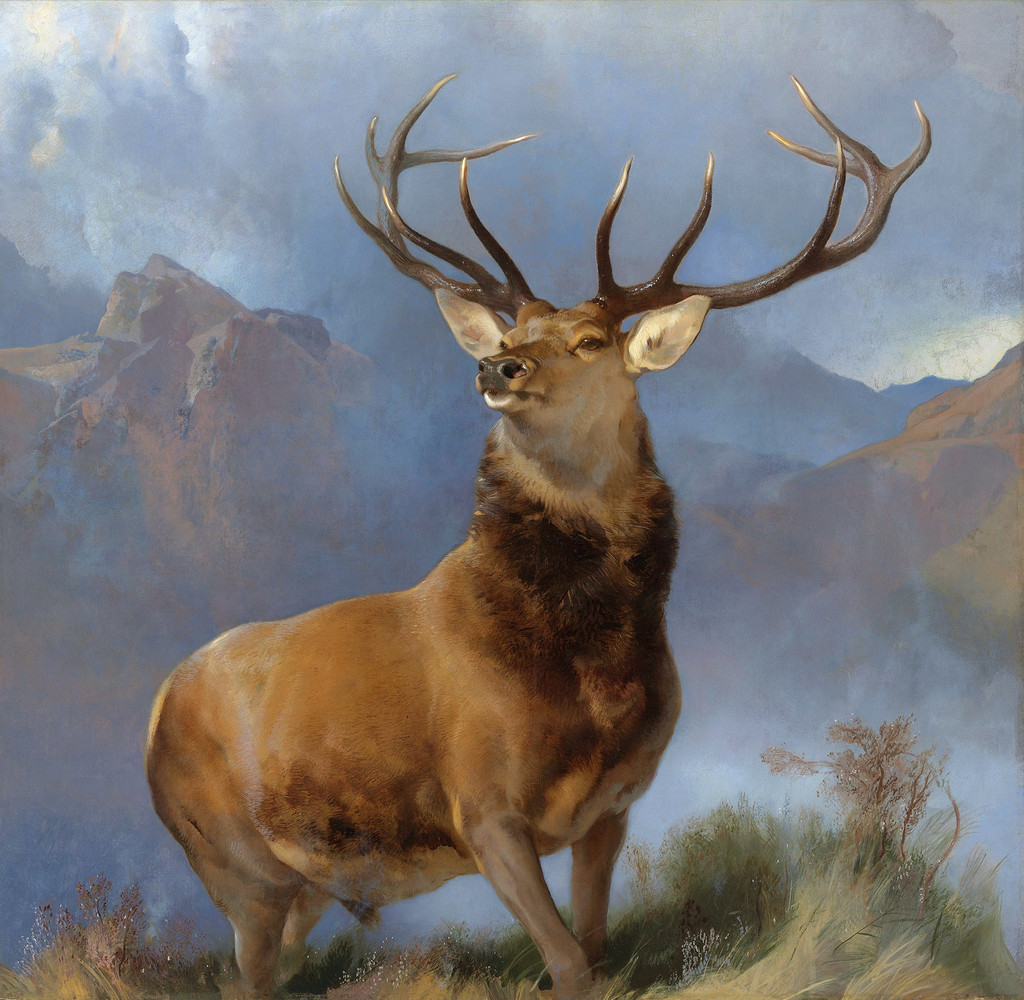
1825–26 [15]The Monarch of the Glen
about 1851 [19]Four stages of Edwin Landseer’s career
These four overlapping periods are a reading aid, not fixed stylistic boundaries. Painting, drawing, printmaking and travel continued across them.
Family, anatomy and early exhibitions
Family instruction and anatomical study accompanied early exhibition. Landseer entered the Royal Academy Schools in 1816, while Alpine Mastiffs showed his narrative ambition by 1820. [12]
Scotland and narrative painting
The first documented Scottish visit in 1824 enlarged Landseer’s subjects and connections. Historical hunts, domestic animals and Highland life developed alongside one another. [22]
Royal commissions and wider audiences
Victoria and Albert’s commissions, purchases and drawing lessons made royal patronage a continuing working relationship. Painting and reproduction brought his animals to different audiences. [23]
Monuments and difficult histories
Large projects continued beside recurrent ill health. The Nelson lions, installed in 1867, joined his animal designs to a public monument through Carlo Marochetti’s bronze casting. [24]
Contents
- A family of makers in London, 1802–1814
- Exhibiting before entering the Schools, 1814–1816
- From student to independent painter, 1816–1823
- Scotland, Walter Scott and a larger field, 1824–1826
- Academician and metropolitan professional, 1827–1836
- Victoria, Albert and the work of patronage, 1836–1840
- Illness, return and a changing practice, 1840–1849
- Honour and international visibility, 1850–1857
- Public lions and private strain, 1858–1866
- What the late letters document, 1867–1873
A family of makers in London, 1802–1814
Landseer was born in London to John George Landseer and Jane Landseer, née Potts. John was an engraver, painter and writer who argued publicly for the status of engraving. The distinction matters because engraving was not merely a household trade in the background of Edwin's later fame. It was a means by which an image could be interpreted, multiplied, published and sold. Growing up near that activity made the movement between an original design and its reproductive life part of Edwin's earliest environment.[4][25]
The family was not a one-artist origin story. Thomas Landseer became an engraver whose reproductive work would be closely associated with Edwin's paintings. Charles Landseer pursued painting and later became Keeper of the Royal Academy. Jessica Landseer worked as a painter and miniaturist, while Emma also drew and painted. Their careers and roles were not interchangeable, and the documentary record is fuller for some than for others. Naming them restores a household of makers in place of the familiar picture of a solitary boy discovered by an unusually farsighted father.[3][4][25][26]
Jane's presence also needs to be kept independent of later stories about her son. Portrait records identify her and preserve her dates, while early accounts place her within the large family household.[25] Much later writing used her death in 1840 as a ready explanation for Edwin's illness in the same year. Coincidence in a chronology is not proof of cause. She belongs in his early biography as his mother and as part of the domestic world in which the children grew, not merely as a device in a medical narrative.
Accounts written after Landseer's fame was secure delighted in pushing his gift ever further into childhood. Drawings were assigned strikingly young ages; walks through fields became scenes of instant mastery; every animal seemed to offer itself to the future painter. Some early sheets do carry retrospective labels, and a family trained in visual work clearly encouraged looking and drawing. The cautious conclusion is substantial enough: animals formed an early and sustained subject, and instruction began before Academy enrolment. Exact anecdotes about what he drew at five or how a particular adult reacted cannot all bear the same evidential weight.[5][26]
Historical records report recognition from the Society of Arts before his public Academy career. They distinguish a silver palette associated with 1813 from the Isis Medal awarded in 1814 for a drawing described as A Hunting Horse. These prizes belong to a culture that rewarded youthful accomplishment and presented drawing as demonstrable skill.[5] They should not be fused into one triumph or treated as proof that development was complete. What they show is that the family's training had already placed Edwin's work before organised judges.
John's profession offered one kind of education. Drawing from animals and prints offered others. Thomas's activity made the interpretive labour of an engraver visible at close range. A print after a painting had to translate colour, surface and scale into another system of marks, while keeping the subject legible to a purchaser who might never see the original. Edwin would later benefit enormously from reproductive circulation. His childhood did not predetermine that success, but it gave him an unusually practical acquaintance with how images travelled.[4][26]
The London setting is equally important. Landseer did not emerge at a distance from institutions and then arrive fully formed. Artists, print sellers, exhibitions, patrons and schools were accessible within the city. In 1815 the Royal Academy catalogue placed “Master E. Landseer” at 33 Foley Street, a public address that also locates the youthful exhibitor within the family base.[2] His development joined domestic instruction to a metropolitan art world. The next decisive step came before he was formally an Academy student.
Exhibiting before entering the Schools, 1814–1816
Landseer's first Royal Academy exhibition was in 1815, not 1816. The original catalogue for the forty-seventh annual exhibition lists two works under “Master E. Landseer”: no. 443, Portrait of a Mule, and no. 584, Portraits of a Pointer Bitch and Puppy.[2] The evidence is modest and conclusive. It supplies titles, numbers, address and public occasion. Later summaries that place his debut in 1816 have probably allowed the date of his admission to the Schools to absorb the preceding exhibition.
Separating those events changes the story. Landseer first submitted work to the Academy's public exhibition and only afterwards became a student there. He was thirteen when the 1815 exhibition opened and fourteen when admitted to the Schools on 9 August 1816.[1][2] “Child prodigy” may describe how contemporaries and later writers received such an appearance, but it is not an explanation of the paintings. The catalogue identifies animal portraiture already framed for a public audience: one individual mule, then a bitch and puppy whose relationship was part of the subject.
Benjamin Robert Haydon contributed another strand of instruction. Early biographies connect Landseer with Haydon's insistence on anatomical study and with access to drawings made from dissected lions. The relationship is better understood as advice, encouragement and exposure than as an exclusive conventional apprenticeship.[5][26] Haydon's influence did not replace John's teaching or the Academy. It pressed the young artist to look beneath coat and skin, treating an animal body as a structure capable of weight, tension and movement.
That emphasis helps explain why the best early evidence is not a charming canine sketch but a demanding programme of bodily inquiry. Eleven surviving écorché drawings of dogs and cats, dated approximately 1817–21, study musculature with the skin removed or conceptually stripped away. Their entry into the Victoria and Albert Museum made a concentrated group available for modern study.[27] These sheets belong just after the 1815 debut and Academy admission, but the intellectual direction was already being established: observed appearance had to be tested against underlying construction.
The Academy Schools added a formal environment in which drawing, comparison and exposure to older art could operate together. Their exact curriculum should not be imagined from a single line in the membership record, and enrolment did not transform Landseer overnight. It gave institutional form to work already under way. Academy membership would later determine exhibitions, honours and obligations across the rest of his life, yet in 1816 he entered as a student who had already negotiated the threshold between family production and public display.[1]
The timing also guards against a common compression. A reported prize at twelve, an Academy appearance at thirteen and Schools admission at fourteen describe different tests of ability. When retold as one moment of discovery, they create the illusion of instantaneous success. In practice, each required a different object, audience and decision. Drawings were submitted to one organisation, oils to another exhibition, and the student himself to an institutional course. The sequence is evidence of sustained work and family support as much as native facility.
No contemporary judgement quoted without a traceable source is needed to make the point. The titles in the 1815 catalogue already show a young painter handling differences of species, age and relation. The Academy date demonstrates access to advanced instruction. Haydon's role directs attention to anatomy. Together these facts replace decorative legend with a demanding beginning: by his mid-teens, Landseer was learning to convert close animal study into pictures capable of surviving professional selection.
From student to independent painter, 1816–1823
The years after Academy admission joined study to increasingly ambitious public work. Landseer continued to draw, and anatomical inquiry helped him understand how bodies bore weight or acted against one another. The écorché sheets are not recipes for finished paintings. They investigate the mechanics beneath a visible coat, whereas an exhibited oil also requires setting, light, narrative timing and an intelligible relation among figures.[27] Their importance lies in proving that apparent ease rested on disciplined analysis.
He also learned by looking at art and by working across formats. The British Museum records his activity as draughtsman, etcher, lithographer, illustrator, painter and occasional sculptor over the career.[4] Not all those practices were equally developed during his student years, but the range warns against imagining that early animal painting was insulated from print or from the study of other artists. In a family where engraving mattered, a line could be both a record of seeing and the beginning of an image intended to circulate.
Public scale arrived early. Alpine Mastiffs Reanimating a Distressed Traveler, painted in 1820 when Landseer was eighteen, is a large narrative canvas rather than a private exercise. Two dogs attend a man overcome in snow while distant human rescuers approach. The present holder's record documents the work's emergence at the British Institution and its later history.[28] Its ambition is clear without attaching the rescue-barrel folklore that accumulated around the St Bernard. Bodies, weather, distance and contrasting actions organise a scene designed to arrest an exhibition visitor.
The painting reveals how quickly anatomical credibility became one component of storytelling. One dog attempts contact with the traveller; the other directs attention outward. The man's exposed body and the far-off building establish danger and delayed assistance. No single observed animal could supply that structure. Landseer had to coordinate poses into a readable event. His later reputation for making animals appear to think began in such acts of arrangement, not in an ability to copy fur alone.
Historical catalogues and the near-contemporary register compiled by Algernon Graves record a growing density of exhibited subjects during these years.[29] They are useful for mapping public appearances, although current collections take precedence when titles or dates conflict. The register also makes plain how quickly a career can become difficult to reconstruct: similar subjects recur, titles alter, originals disappear, and engraved versions develop lives of their own. Landseer was gaining visibility inside a system that multiplied both his audience and the chances of later confusion.
Portraiture remained part of the work. “Animal painter” was not then a narrow retreat from portrait practice; owners commissioned likenesses of valued animals, and a picture could join individual observation to codes of status, sport or affection. The mule, pointer and puppy of 1815 already occupied that territory.[2] During the early 1820s, larger narrative and sporting subjects expanded it. Animals could be recognisable individuals and actors within constructed situations.
Independence did not mean separation from the family. Thomas's engraving career would become crucial to the reproductive afterlife of Edwin's designs, and John continued to write and make prints.[4] Nor did professional advance mean that every surviving object can be assigned cleanly among relatives. Shared surnames, related subject matter and later cataloguing sometimes obscure authorship. A responsible life history names the network without treating every plate after a Landseer design as Edwin's handiwork.
By 1823, the foundations of the mature career were visible. Landseer had Academy training, exposure at two major London exhibition institutions, experience of large narrative composition and a discipline of anatomical drawing. He had not yet become the painter of Highland culture or the sustained recipient of royal patronage. Those identities grew from later journeys and relationships. The distinction prevents early promise from being read backwards as a miniature version of everything that followed.
Scotland, Walter Scott and a larger field, 1824–1826
Landseer first visited Scotland in 1824. That date is supported by more than later reminiscence. A leaf from the Abbotsford visitor book bears his signature, and Walter Scott's letter of 18 May asks for a promised sketch of Abbotsford. The National Portrait Gallery's record for Landseer's portrait of Scott also places repeated contact from 1824 within a relationship whose individual objects are not always dated with certainty.[30] The combination provides a firm beginning while leaving room for doubt about particular episodes.
Scott mattered as host, sitter and celebrated author, but he did not single-handedly invent Landseer's Highland imagination. The journey opened several connected fields: landscape, deer and other animals, sporting practice, estate life, patronage and a literary culture through which Scotland was already being pictured for British audiences. Repeated visits allowed those subjects to develop over time.[30][31] The artist's own participation in sketching and hunting complicated his viewpoint; he observed animals within systems of pursuit as well as in the terrain.
Abbotsford offered a particularly dense social and imaginative setting. Scott's house gathered objects, stories, guests and an architectural performance of history. A requested sketch records work exchanged within hospitality, while a painted portrait converted personal access into a public object.[30] Yet the evidence should not be expanded into an uninterrupted account of every conversation. A signature proves presence. A letter proves an expectation. A portrait record establishes a work and acknowledges uncertainty over date. Their restraint is part of their value.
The Scottish journeys also altered Landseer's professional network. Country-house visits brought him into contact with patrons who valued sporting subjects and animal likenesses. The landscapes and pursuits he encountered could be reworked for metropolitan exhibitions, where viewers brought their own ideas of the Highlands. Local observation and London display were thus not opposites. The career depended upon their movement into one another.[26][31]
In 1826 Landseer exhibited The Hunting of Chevy Chase, a historical subject on a scale that signalled widened ambition.[5][29] The same year, on 6 November, the Royal Academy elected him an Associate.[1] Election acknowledged professional standing rather than awarding a final verdict on the work. It also increased his obligations within the institution that had accepted him as a student ten years earlier.
At twenty-four, Landseer could now be recognised through several overlapping identities: the precocious London exhibitor, the anatomically trained animal painter, the maker of ambitious narratives and the visitor whose Scottish subjects promised a major new direction. None had displaced the others. The Highland career grew through repetition, new patrons and later pictures rather than springing complete from the first encounter with Scott.
The documentary precision of 1824–26 matters because later fame tempted biographers to build turning points around personalities. A romantic version needs a great writer to recognise a great painter and unlock his destiny. The surviving documents suggest something more workmanlike. Landseer travelled, signed a book, promised a drawing, made portraits, returned, cultivated relationships and submitted major pictures. Opportunity became a career through repeated labour.
Academician and metropolitan professional, 1827–1836
Associate status placed Landseer within the Academy while he continued to build audiences elsewhere. During the later 1820s he developed a metropolitan practice that combined exhibited oils, portraits, sporting scenes, private drawings and designs carried through print. Patronage operated through introductions and repeat relationships rather than through one official appointment. Country houses and London interiors, Academy galleries and print shops were connected parts of the same professional economy.[26][29]
Two small paintings now at Tate show how varied that economy could be. High Life and Low Life date from 1829 and appeared at the British Institution in 1831. Each places a dog within an imagined social environment, setting an elegant deerhound against a compact terrier world.[32] The pair belongs to the moment of Landseer's advance to full Academicianship, but its humour is not a minor diversion from serious ambition. The pictures demonstrate how breed, posture, possessions and interior space could make class legible without a conventional human portrait.
On 10 February 1831, the Royal Academy elected Landseer a full member.[1] He was twenty-eight, and the promotion completed an institutional progression that had begun with the Schools fifteen years earlier. The title RA increased prestige, yet it also tied his public identity more closely to annual exhibition and to the governance of the Academy. Institutional success should not be confused with a settled style. In these years he moved among comic, sporting, historical and portrait subjects while Scottish material continued to grow.
Private caricatures from approximately 1830–40 disclose another side of the same network. Drawn informally, they identify figures including the Duke of Devonshire, Count d'Orsay, Samuel Rogers and Sydney Smith.[33] Such sheets cannot prove every story about fashionable society, but they show Landseer observing human gesture and character among people he knew. The animal satires did not arise from a painter uninterested in human behaviour. Social looking extended from drawing rooms into compositions where dogs carried the visible action.
Reproduction made professional relationships still more complex. An engraving after a Landseer might be cut by Thomas Landseer or another specialist, published by a commercial firm and sold to a public far larger than the audience for the oil.[4][29] Edwin supplied the originating design, but the resulting plate embodied another maker's decisions. Prints extended reputation, generated income and stabilised certain compositions in memory. They could also encourage the misleading habit of crediting every visible mark to the painter whose name sold the subject.
Landseer's working life therefore cannot be represented by an isolated easel. It involved negotiations over access to animals, sittings, delivery, exhibition, reproduction and ownership. A patron might want a likeness, a sporting memory or an image suited to a particular room. A publisher needed a composition that could survive translation. An institution set deadlines and categories. The artist's fluency made the results look direct, but professional smoothness was something produced through planning and revision.
The exhibition calendar imposed its own rhythm. An Academy picture had to be conceived and brought to a finish in time for selection, then encountered beside works competing for attention in crowded rooms. A smaller oil intended for the British Institution entered a different display but still depended on catalogue title, placement and press discussion.[26][29][32] Landseer learned to make action and relation legible at first encounter. That clarity later encouraged the belief that his pictures were effortless, when it was also a solution to the practical conditions of exhibition.
Commissioned animal portraiture required another form of preparation. Access to a valuable horse, deerhound or pet might be limited by the owner's household and by the animal's own behaviour. Studies could preserve separate turns of the head, positions of the limbs or textures of coat before a finished composition brought those observations together.[26][27] A convincing whole need not describe one uninterrupted sitting. The result could feel immediate precisely because selection had removed hesitation and combined information gathered at different moments.
Patron lists can make this phase look like a procession of famous names. The more useful pattern is repeat contact. A country-house invitation might lead to drawings, portraits, acquaintance with another collector and subjects later shown in London. Private caricature records conversation and familiarity without converting every host into a commissioner.[33] Professional friendship, hospitality and paid work overlapped, but they were not identical. Landseer navigated the distinctions with enough success to remain welcome in settings where access itself had economic value.
That access also carried risk. A picture promised within a social relationship could be harder to manage than an impersonal sale, since delay touched friendship and status as well as money. Later royal records expose this tension especially clearly, but it did not begin at court.[26][34] The polished public image of the quick, sociable painter concealed an occupation dependent upon many other people's time, animals, approval and willingness to wait.
The Scottish and metropolitan strands reinforced each other. Estate visits provided scenes and contacts; London exhibitions conferred visibility; engraved versions carried the pictures to new purchasers. Meanwhile, the Academy supplied status that could reassure private patrons. Landseer's rise was not a simple passage from local study to national fame. It was an expanding circuit in which place, institution, patron and medium continually altered one another.
By 1836, he had both the credentials and the social reach to attract the attention of the royal household. The entry did not begin with a state portrait or an abstract appointment. It began with the portrait of a much-loved dog, commissioned as a personal birthday present. That specificity is the best protection against a later story in which the artist seems simply to have become a permanent court favourite.
Victoria, Albert and the work of patronage, 1836–1840
The first painting Landseer produced for the future Queen Victoria was Dash. Her mother, the Duchess of Kent, commissioned it as a birthday gift in 1836. The Royal Collection's record identifies both the animal and the occasion.[35] Victoria was still a princess. The commission preceded her accession and corrects the often repeated claim that Landseer's royal work began with a portrait in 1839.
Dash demonstrates why court patronage needs to be described through objects and transactions. The subject was a named companion, not a generic emblem. The picture moved between maker, commissioning mother and recipient daughter. Affection helped determine its meaning, while the quality and status of the painting made that affection suitable for dynastic exchange.[35][36] A relationship founded on such work could become personally warm without ceasing to be professional.
After Victoria became queen in 1837 and married Prince Albert in 1840, Landseer's royal work widened. He painted pets, portraits, family groups and scenes associated with royal residences and Scottish life.[34][36] Access created opportunities unavailable to most artists, and royal ownership greatly enhanced his visibility. It did not mean that he lived in constant attendance or that every commission proceeded without difficulty. Royal Collection scholarship preserves a record of admiration entangled with sittings, revisions, delay, accounts and pictures that remained unfinished.[34]
The distinction between favour and employment is important. Landseer did not hold a simple post that explains all work from the late 1830s onward. Commissions arose separately, sometimes as gifts and sometimes through extended planning. Household intermediaries and other artists could become involved. A royal sitter's wishes carried unusual weight, but the familiar problems of portrait practice remained: finding time, settling pose and setting, revising likeness, negotiating scale, finishing and payment.[34]
Court access also joined rather than replaced Landseer's other networks. He continued exhibiting and working for non-royal patrons. Scottish travel had preceded royal enthusiasm for the Highlands. Print circulation brought images to viewers with no direct connection to the palace. The royal relationship amplified a career already established through Academy and British Institution display; it did not create the animal painter from nothing.
Landseer's presence near Victoria and Albert is sometimes used to infer political motives for every Scottish subject or flattering intention in every animal portrait. The evidence supports shared interest, commissions and personal regard, not a comprehensive programme. A royal pet could hold private emotional value and public representational force at once. A Highland scene could suit court taste while also belonging to estate culture and an exhibition market. Biography gains clarity when those possibilities remain distinguishable.
The endpoint of this phase was not an uninterrupted triumph. In 1840 Landseer experienced a serious illness that stopped or sharply disrupted work.[5][26] The same year included his mother's death, but the chronological conjunction does not demonstrate causation. Nor does the existence of difficult royal work explain the event. The reliable statement is limited: illness intervened, friends assisted, and a journey on the Continent followed. What came next was a return to activity under altered conditions, not evidence that vulnerability had vanished.
Illness, return and a changing practice, 1840–1849
Jacob Bell accompanied Landseer on continental travel after the illness of 1840. Bell was a friend, patron and pharmacist, and early biographical evidence treats the journey as part of convalescence.[5][26] Its precise therapeutic effect cannot be recovered. It marks an interruption and a supported attempt to resume ordinary life. The episode is best understood through what can be dated rather than through later claims about one emotional shock or one hidden disease.
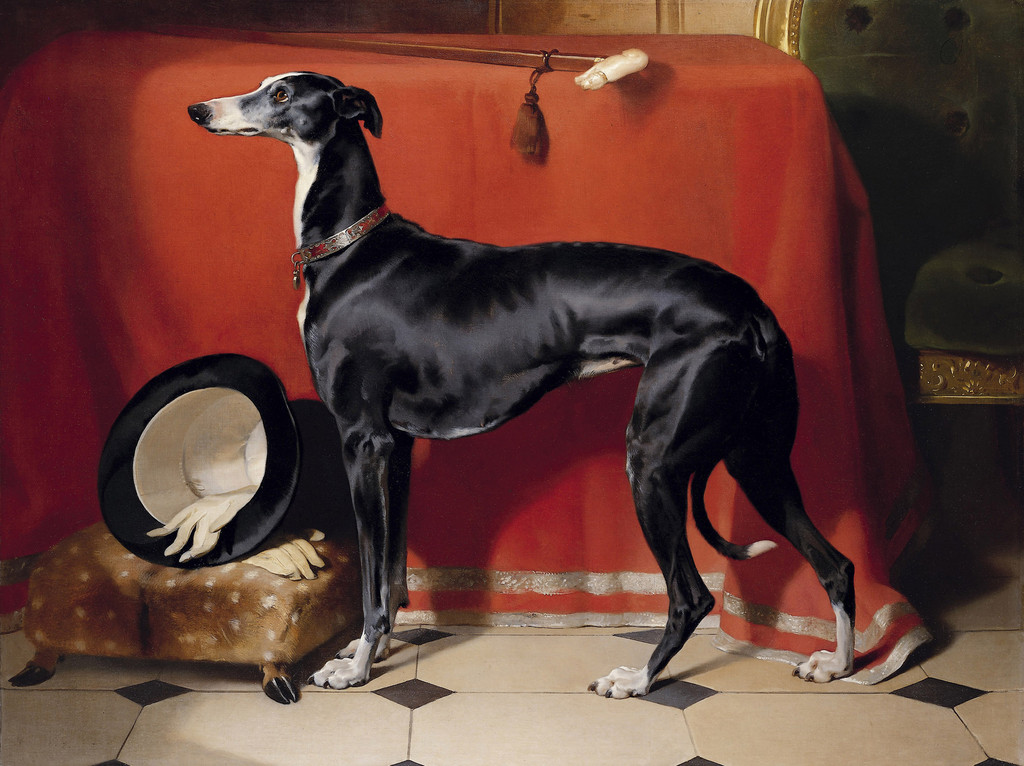
Landseer returned to an active and increasingly varied practice. In 1841 Victoria commissioned the life-size portrait of Prince Albert's greyhound Eos as a Christmas present. The picture was intended for Albert's dressing room at Buckingham Palace.[37] Like Dash, it binds a particular animal to a relationship, occasion and setting. It also shows that the royal connection remained productive after the 1840 interruption.
From 1842 Landseer instructed Victoria and Albert in etching. Royal Collection records attribute ninety-three plates to the couple during the 1840s and identify cases in which they copied his drawings.[38] The activity changes the image of patronage. Landseer was not simply delivering finished pictures to passive owners; he also explained a process, supplied designs and helped royal amateurs make impressions. In turn, their printmaking brought his linear inventions into an unusually private workshop of status and publicity.
Teaching etching drew upon the reproductive culture of his family without making the royal plates commercial equivalents of Thomas Landseer's engravings. The intimacy of instruction, the pleasure of copying and the circulation of impressions within court networks had their own purposes.[4][38] Still, the episode demonstrates continuity: the movement from a drawn design into another medium remained part of Landseer's professional identity long after oil painting had made him famous.
The 1840s also resisted confinement to royal pets. The Sanctuary, dated 1842, belongs to the return to exhibited animal narrative, while Scottish visits continued to supply work and contacts.[26] At Ardverikie in 1847, Victoria copied a drawing that Landseer had made on a dining-room wall.[36] That surviving copy records a small reciprocal act: an artist's informal image became a royal exercise. It does not prove a seamless friendship, but it makes the shared practice of looking more concrete than general praise.
An ambitious literary commission broadened the decade further. Isambard Kingdom Brunel planned a Shakespeare room and commissioned Scene from A Midsummer Night's Dream. Titania and Bottom. Landseer worked on the canvas from 1848 to 1851, and it appeared at the Royal Academy in 1851.[39] Its transformed Bottom, fairy court, luxurious colour and human figures disrupt any biography built only from dogs, deer and royal domesticity. Animal expertise could serve fantastic metamorphosis as well as portrait observation.
This diversity is important when interpreting illness. A return to work does not show that the 1840 crisis was trivial, and a later interruption does not prove that every intervening picture concealed decline. Surviving objects document activity, not an internal state. They reveal that Landseer could again fulfil demanding commissions, teach, travel and exhibit. They do not create a clinical chart.
Professional pressure accompanied opportunity. Royal projects could be extended by changes and delay; exhibition created annual deadlines; large paintings demanded sustained labour; travel and social obligations occupied time.[26][34] These conditions form part of the career without becoming a speculative cause of illness. The evidential discipline is the same as elsewhere: document demands where records show them, document symptoms when Landseer or his contemporaries recorded them, and leave diagnosis to the limits of the historical archive.
By the end of the 1840s, Landseer had re-established public momentum. The decade had carried him from serious interruption through royal instruction and major imaginative painting towards formal honour. Yet the pattern was not a neat recovery narrative. Periods of high activity and recurrent illness could coexist. The next decade enlarged his international visibility while also creating some of the unfinished and delayed obligations that complicated his later years.
Honour and international visibility, 1850–1857
Landseer was knighted in 1850.[31] The honour registered his public standing and close association with elite patrons; it did not make a judgement on every work or convert him into a royal office-holder. “Sir Edwin” became part of his public identity at a moment when exhibition, print and court activity had already made his name widely recognisable.
Around the same period, several large commissions pushed familiar categories in different directions. Scene from A Midsummer Night's Dream reached the Academy in 1851 after its unusual private commission.[39] The Monarch of the Glen, made about 1851, turned the mature stag into an image whose later reproductive and commercial life would far outgrow its original circumstances.[31] The works are not stylistic twins. One converts Shakespearean metamorphosis into a crowded fantasy; the other gives concentrated authority to a solitary Highland animal. Together they show why a biography should use representative objects to register range rather than force the career into one ascending sequence.
International recognition followed. At the Paris Exposition Universelle of 1855, Landseer received the great medal of honour. An official French Salon catalogue published in 1864 records him as the sole English recipient in that award category.[40] This formulation is narrower and more secure than the claim that he was the first English artist ever to win a Paris gold medal. The award placed his work inside an international exhibition system whose classifications and national comparisons helped manufacture reputation.
Prints amplified that visibility beyond people who attended exhibitions in London or Paris. Catalogues of Landseer's exhibited work and the activities of reproductive engravers show the same compositions moving through different titles, scales and formats.[4][29] Reproduction could stabilise a memorable subject while changing tone and surface. It also distributed credit unevenly: the painter's name often remained the selling point, even when an engraver's interpretation made the printed image possible.
Royal favour continued, but Royal Collection research complicates the appearance of effortless access.[34] Commissions could be desired and delayed at the same time. Personal affection did not cancel the authority of the patron, and public honour did not remove practical difficulty. This tension is especially useful in a life too often narrated as uninterrupted popularity before sudden collapse. The record shows prestige and friction operating together.
Landseer's reputation at mid-century rested on several infrastructures: Academy membership, major public display, aristocratic collections, royal ownership, publishing and international awards. No one picture or patron produced the whole. That distributed support helps explain why his imagery became so familiar. It also created obligations across institutions and households, some of which remained unresolved for years.
The decade's honours can therefore be treated as evidence of reach rather than as a ranking. Knighthood and the Paris medal reveal how Landseer was positioned by monarchy and exhibition administration. They say little by themselves about how a drawing was made or why a picture persuades. Their biographical force lies in showing the scale of expectation attached to him before the most difficult public commission of his late career.
Public lions and private strain, 1858–1866
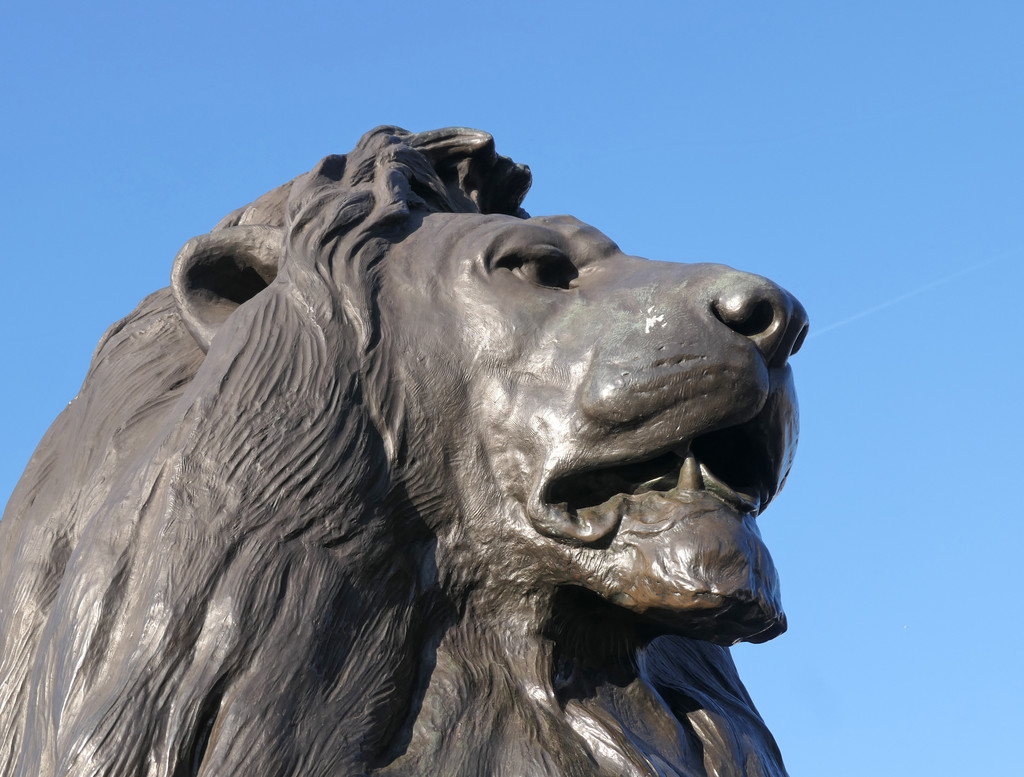
In the late 1850s the government turned to Landseer for the four lions intended for the base of Nelson's Column. The choice translated his authority as an animal painter into a sculptural and civic problem. Landseer designed and modelled the animals; Baron Carlo Marochetti was responsible for casting them in bronze. Work extended across years, drew parliamentary attention and was repeatedly associated with Landseer's ill health and delay.[41]
John Ballantyne's portrait of Landseer at work in Marochetti's studio presents the artist modelling, surrounded by the material setting of the commission.[41] It is a valuable corrective to the assumption that a painter simply supplied four drawings to a foundry. At the same time, the portrait cannot stand as a complete production history. Modelling, enlargement, foundry practice, transport and installation involved divided expertise. Credit has to recognise Landseer's design without erasing Marochetti's casting role.
The commission placed private capacity under public scrutiny. Questions in Parliament concerned progress and responsibility, turning delay into a matter of state expenditure and monumental completion.[41] Landseer was accustomed to deadlines and demanding patrons, but the lions required sustained work in another medium and at an unprecedented civic scale. They also carried symbolic weight: animal bodies were expected to support the commemoration of naval victory beneath Nelson's figure.
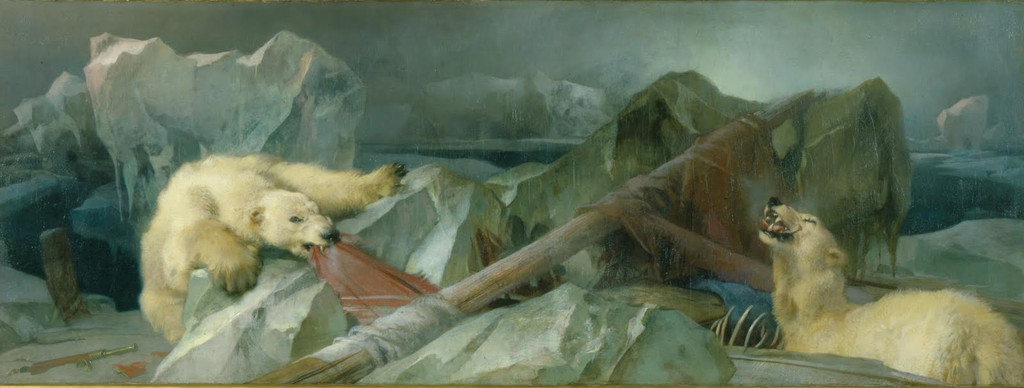
Late painting meanwhile remained varied. Man Proposes, God Disposes appeared in 1864, imagining polar bears among remains associated with Sir John Franklin's lost Arctic expedition.[42] It is severe, historical and concerned with the collapse of human intention. In 1865 The Connoisseurs placed Landseer himself at a drawing board while two dogs inspect his activity.[42] Its reflexive comedy makes a startling neighbour to the Arctic picture. Neither should be converted into a symptom of illness; together they demonstrate continuing invention across radically different tones.
Charles Eastlake, President of the Royal Academy, died in December 1865. On 24 January 1866 the Academy elected Landseer to succeed him.[1] The date matters because shorthand accounts often call it an election of 1865. Landseer declined on grounds of ill health. Refusal did not cancel the institutional meaning of the vote: after half a century connected with the Academy, his peers regarded him as eligible for its highest office. Nor did election prove that he possessed the capacity to bear its administrative load.
These years resist a simple division between public achievement and private failure. The lion models advanced, important paintings reached viewers, and the Academy offered its presidency. At the same time, documented illness limited what Landseer could accept and contributed to delay.[1][26][41] Each fact must remain true without being used to negate the others. Productivity is not evidence of good health, and illness does not make late work negligible.
The temptation to turn the lions into a recovery symbol is especially misleading. Their prolonged making crossed fluctuating periods of capacity. The finished bronzes cannot retrospectively smooth that history into triumph, just as delay cannot prove that Landseer alone failed. A government commission of this scale was collaborative, technically demanding and politically visible. Biography should mark its pressure while leaving the full administrative and material story to the monument's own history.
By the end of 1866, Landseer had refused the Academy presidency and the lions still awaited public installation. The late letters that survive from the next years offer unusually direct, if fragmentary, evidence of his physical condition. They need to be read as dated communications shaped by a recipient and immediate obligation, not as entries in a diagnostic file.
What the late letters document, 1867–1873
A letter of 15 May 1867 to National Gallery director William Boxall explained that Landseer had been unwell.[6] In June, writing from Balmoral, he described weakness, little appetite, sleeplessness, cramp, episodes of faintness and trouble drawing.[5] These are concrete symptoms reported at a particular time. They establish significant impairment more securely than later anecdotes, but they do not identify a modern condition.
The four Trafalgar Square lions were installed in 1867.[41] Their arrival created the permanent public landmark now most closely attached to Landseer's name. Installation coincided with evidence of ill health rather than closing it. The visible stability of bronze can obscure the unstable circumstances under which the design was completed. Monument and letters have to be held together without allowing either one to explain the other away.
Further correspondence shows that difficulty continued. A letter from Balmoral to John Forster on 10 June 1869 apologised for poor health and reduced activity. Related letters preserve fatigue, trouble meeting expectations and the pressure of obligations.[6] Because such communications often accompanied an apology or request, their immediate purpose matters. Landseer was telling particular people what he could not do, not composing a comprehensive medical history.
Early biographers also preserved reports of care by family, friends and medical attendants during the final years.[5][26] Those accounts show dependence and concern, although their interpretations often reflect nineteenth-century assumptions about mind, morality and genius. When a writer moves from witnessed behaviour to a sweeping explanation, the evidence changes category. A symptom recalled by an observer is not the same as a diagnosis, and neither is automatically reliable because it appears in an old book.
The historical death certificate used the terms “cerebral disease” and “cerebral effusion”.[5] They may be recorded as the language of the certificate, but translating them into a present-day psychiatric or neurological label would exceed what the document can support. Medical vocabulary, diagnostic practice and standards of evidence have changed. The responsible conclusion is that Landseer experienced severe recurrent illness with physical and cognitive or behavioural effects reported by contemporaries; its precise modern classification remains unresolved.
Several popular causal stories must therefore be set aside. The timing of Jane Landseer's death does not establish that bereavement produced the illness of 1840. A difficult commission cannot by itself explain later incapacity. Claims about alcohol, drugs, romantic disappointment, an accident or fashionable exhaustion have often been repeated without a chain of evidence strong enough to bear the conclusion. Combining them into a dramatic decline only multiplies uncertainty.
Late pictures cannot solve the medical question. The violence of Man Proposes, God Disposes does not prove a disturbed mind, and the humour of The Connoisseurs does not demonstrate recovery.[42] Artists make works for patrons, exhibitions and imagined viewers; subject matter is mediated by convention, source, composition and professional choice. Reading imagery as an involuntary symptom removes precisely the artistic decisions that need explanation.
Nor should limited capacity be converted into inactivity. Landseer continued to face requests and to work when able, even as letters document shrinking energy.[6] The record is uneven because correspondence survives selectively and because finished objects conceal abandoned attempts. A careful late chronology can say when a letter was sent, when a monument appeared and when a work was exhibited. It cannot reconstruct every interval between them.
The last years are thus best described without a melodramatic arc. Landseer was cared for, remained a figure of public interest and encountered serious limitations that he himself sometimes named. His fame did not protect him from illness; illness did not erase the career. On 1 October 1873, he died in London, aged seventy-one. The funeral moved his private death into a national and institutional setting that had shaped him since youth.
Death, burial and the biographies that followed
Landseer was buried in St Paul's Cathedral on 11 October 1873. Cathedral histories, the surviving monument inscription and a sermon delivered the following day independently fix the sequence.[43] Burial near other publicly commemorated figures gave architectural form to his status. It was not merely a family decision about a grave; it placed an artist known for animals within a pantheon of national memory.
The memorial records his birth on 7 March 1802 and death on 1 October 1873.[43] Those dates correct the erroneous 1878 death year still found in inherited summaries. Exact chronology matters especially at the end of a life because posthumous events can otherwise slide into the artist's own activity. Exhibitions, engravings and the completion of unfinished pictures continued, but Landseer did not live to direct them.
One unfinished equestrian canvas provides a documented example. John Everett Millais later completed it, and it became known as Nell Gwynne or Diana Vernon; the work was finished in 1882.[44] This is a case of divided authorship and posthumous intervention, not licence to claim that Millais completed every unfinished object associated with Landseer's studio. Each canvas requires its own evidence about what Landseer left and what another artist added.
The Royal Academy mounted a large memorial exhibition in 1874.[45] Its timing connected commemoration to the institution where Landseer had first exhibited as a boy, studied, advanced through membership and declined the presidency. A memorial display can consolidate a reputation, but it also selects and arranges. Works separated across collections were made to tell a posthumous story under Academy authority.
Early biographies performed a similar operation in prose. They preserved letters, family recollections, exhibition history and vivid observations. They also converted uncertainty into character, attached moral meanings to illness and repeated entertaining childhood stories.[5] Their closeness to the nineteenth century is valuable; it does not make every interpretation primary evidence. Later writers inherit both the documents they saved and the need to test the narratives built around them.
Landseer's images continued to circulate through prints and popular reproduction. That survival could flatten difference. Comic dogs, royal pets, Highland stags and rescue scenes were readily gathered under a single label of sentiment, while the Arctic picture, anatomical studies, literary fantasy and difficult commission histories sat less comfortably within it.[4][26] Familiarity kept the name alive but narrowed the artist whom viewers expected to find.
The major retrospective shown in Philadelphia and at Tate in 1981–82 created a new occasion to examine the career across objects and media. Richard Ormond's accompanying study remains the modern scholarly foundation for its chronology and range.[26][45] This was not a discovery of somebody entirely forgotten. The lions and popular images had never disappeared. Its achievement was to place fame itself under examination and to reconnect icons with less familiar work.
Current museums have extended that process through object records, conservation, digitised catalogues and new interpretation. The original 1815 Academy catalogue can now correct a repeated debut date.[2] Royal records can separate Dash from later court commissions.[35] A visitor-book leaf and a dated Scott letter can discipline romantic accounts of Scotland.[30] Late correspondence can be read beside, rather than beneath, speculative biography.[6] The result is not a final life immune to revision. It is a hierarchy in which claims remain answerable to the strongest available witness.
Different witnesses also answer different questions. Graves helps establish what titles entered exhibition records, but it cannot always identify a present canvas.[29] A current museum catalogue can describe an object in detail while remaining brief about the artist's household. Manson may preserve a letter unavailable elsewhere and then surround it with an interpretation that no longer persuades.[5] Ormond's retrospective synthesis gives the career shape, while newer institutional work can correct an isolated date or recover the transaction behind a particular commission.[26][35][34] Biography becomes stronger by coordinating these functions, not by choosing one source to govern everything.
Popular survival has its own uneven archive. A composition reproduced in large numbers leaves many impressions and references; an unengraved study may remain nearly invisible. Royal ownership produces inventories, bills and correspondence that an ordinary commission may lack. Public controversy records the delayed lions more readily than routine studio labour.[34][41] The density of surviving evidence therefore reflects power and circulation as well as Landseer's daily priorities. Silence around an activity should not automatically be treated as absence, while a rich file should not make one patron or monument stand for the whole career.
This imbalance explains why revision remains necessary. Each newly catalogued drawing, resolved print state or identified letter can adjust a local part of the chronology without overturning the life. The central sequence is secure: London birth and family training, early exhibition, Academy formation, Scottish expansion, royal and wider patronage, public honour, recurrent illness, death and commemoration. Around it, attribution and object history remain active fields rather than decorative footnotes.
Commemoration also changed Landseer's physical presence in London. The St Paul's burial and memorial made him part of cathedral history, while the Trafalgar Square lions gave millions of passers-by an encounter with his design without requiring knowledge of his name.[41][43] These forms of survival are powerful and partial. Stone and bronze encourage permanence; biography has to recover time, collaboration, uncertainty and change.
How to read the life through the work
Landseer's chronology explains conditions of making, not the value of every object. Family engraving culture clarifies why reproduction mattered. Academy training and anatomical drawings illuminate the discipline behind bodily description. The 1824 Scottish visit begins a durable field of travel, patrons and subjects. Royal commissions reveal both privileged access and professional negotiation. Illness establishes limits on capacity without assigning hidden meanings to paint. These contexts sharpen looking when they remain attached to evidence.[4][27][30][34]
Representative works can mark those changes without becoming illustrations of a predetermined destiny. The 1815 animal portraits show public presentation before formal Academy study.[2] Alpine Mastiffs demonstrates large narrative ambition at eighteen.[28] High Life and Low Life join canine observation to metropolitan class comedy at the threshold of full Academicianship.[32] Dash and Eos reveal royal patronage through particular animals and occasions.[35][37] The Shakespearean canvas makes literary fantasy visible within the mid-career range.[39]
Late objects complicate rather than complete the line. The Nelson lions turn animal design into collaborative public sculpture.[41] Man Proposes, God Disposes opposes human plans with an imagined Arctic aftermath, while The Connoisseurs stages the artist and two dogs as fellow lookers.[42] No one is the inevitable product of childhood gifts, Highland travel or illness. Each arose from a commission, exhibition prospect, medium and moment that deserve separate study.
Institutions repeatedly altered the opportunities available to Landseer. The Society of Arts reportedly rewarded youthful drawings; the Academy admitted, exhibited, elected and commemorated him; the British Institution displayed important paintings; royal households commissioned and copied; French exhibition officials awarded an international medal; Parliament examined a delayed monument.[1][2][40][41][45] His life was made through these structures as surely as through private talent. They conferred access and pressure together.
People also mattered without becoming a chain of heroic encounters. John and the wider Landseer family taught and collaborated. Haydon directed attention towards anatomy. Scott was host, correspondent and sitter within a Scottish network. Bell accompanied convalescent travel. Victoria and Albert were patrons and pupils. Marochetti translated models into monumental bronze. Millais completed one unresolved canvas after Landseer's death.[3][5][30][38][41][44] Their roles differ; biography should not reduce them to supporting characters in one man's genius.
The same discipline applies to suffering. Dated letters deserve serious attention because they record what Landseer could tell recipients about weakness and diminished work.[6] They do not license a personality assembled from symptoms. Historical certificate language can be preserved without pretending it maps cleanly onto modern medicine.[5] Refusing diagnosis is not evasive. It is a recognition that precision includes knowing what the evidence cannot settle.
Landseer's public success was real, but it was never self-explanatory. Academy status, a knighthood, royal favour, engraved circulation, Paris recognition, cathedral burial and a memorial exhibition all testify to reach.[1][31][40][43][45] They do not require every viewer to admire every painting. They help explain how certain images became authoritative and why later criticism sometimes reacted against that authority.
Read whole, the life changes familiar labels. “Animal painter” expands to include anatomy, portraiture, narrative, satire, print culture and sculpture. “Court favourite” becomes a relationship of particular gifts, lessons, negotiations and incomplete obligations. “Highland artist” begins with documented journeys but extends into the metropolitan making of Scotland. “Victorian celebrity” becomes the outcome of institutions, patrons and reproduction. Even the four calm lions acquire a history of delay, collaboration and compromised health.
The most credible Landseer is therefore neither the effortless prodigy nor the broken genius of retrospective legend. He was a maker formed in a family workshop, tested early in public, sustained by observation, exceptionally adept at relationships between animals and human worlds, and dependent on complex systems that could support and burden him. His biography gives those systems dates and names. The works remain more than evidence of a life, but the life teaches us to see how much labour, mediation and uncertainty their apparent immediacy contains.
Artworks directory
This directory gathers works discussed in the articles, including drawings, original etchings and prints after Landseer. It is not a complete catalogue of every drawing, version, plate or impression. Distinct media are kept separate; uncertain dates are left blank. Linked titles open individual articles.
| Name | Date | Medium |
|---|---|---|
| A Bellowing Stag | Drawing | |
| A Deerhound | 1826 | Painting |
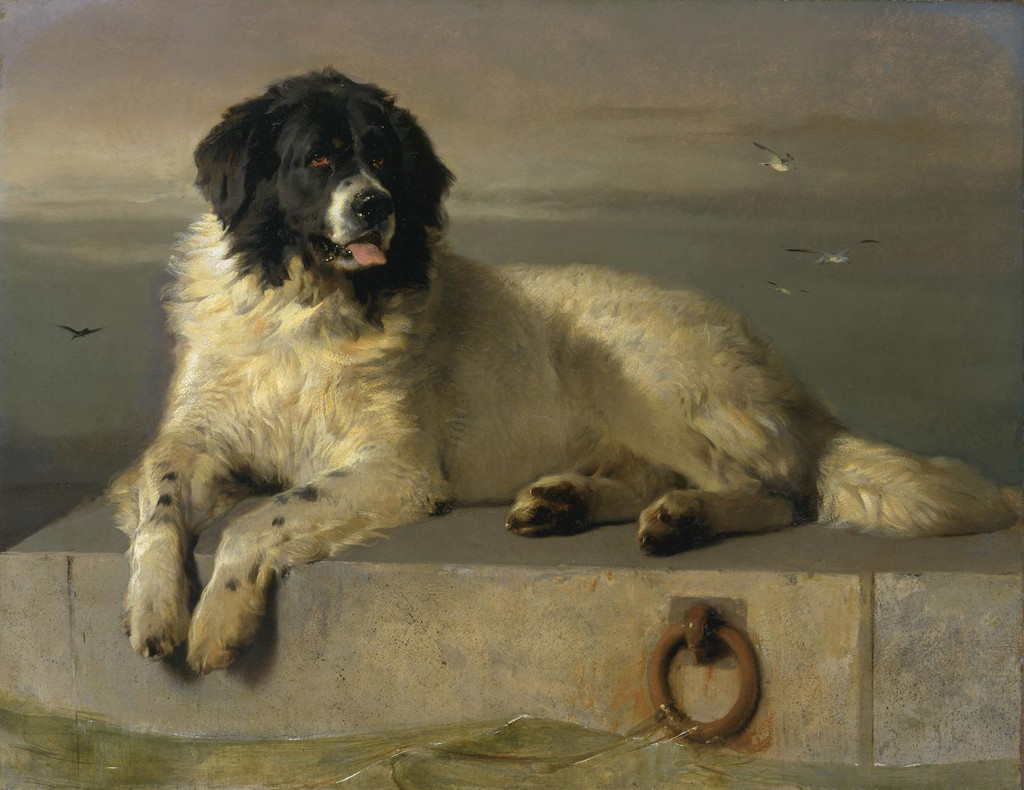
| A Distinguished Member of the Humane Society | 1838 | Painting |
| A Highland Breakfast | 1834 | Painting |
| A Highland Landscape | c. 1830 | Painting |
| A Highland Shepherd's Home | Painting | |
| A Horse, Goat and Bull | 1811 | |
| A Hunting Horse | Drawing | |
| A Jack in Office | Painting | |
| A Lion Disturbed at His Repast | Painting | |
| A Random Shot | Painting | |
| A Scene at Abbotsford | Painting | |
| Adversity | Painting | |
| Alexander and Diogenes | exhibited 1848 | Painting |
| Alpine Mastiffs Reanimating a Distressed Traveler | 1820 | Painting |
| Contending Group after Nature | Drawing | |
| Copy after Rubens's Wolf and Fox Hunt | c. 1824–26 | Painting |
| Dash | Painting | |
| Deer and Deer Hounds in a Mountain Torrent ('The Hunted Stag') | c. 1832 / exhibited 1833 | Painting |
| Deer Family | ||
| Dignity and Impudence | 1839 | Painting |
| Dog Resting Upon a Couch | Drawing | |
| Eos | 1841 | Painting |
| Favourites, the Property of H.R.H. Prince George of Cambridge | 1834–35 | Painting |
| Her Majesty Sketching at Loch Laggan | ||
| High Life | 1829 / exhibited 1831 | Painting |
| Highland Lassie | Drawing | |
| Isaac van Amburgh and his Animals | 1839 | Painting |
| Lady Godiva's Prayer | Painting | |
| Laying Down the Law | 1840 | Painting |
| Lion Defending Its Prey | c. 1840 | Painting |
| Lioness | Drawing | |
| Little Strollers | ||
| Low Life | 1829 / exhibited 1831 | Painting |
| Man Proposes, God Disposes | 1864 | Painting |
| Nell Gwynne / Diana Vernon | Painting | |
| Neptune | ||
| No Hunting Till the Weather Breaks | Painting | |
| Otterhounds | Drawing | |
| Peace | Painting | |
| Pensioners | Painting | |
| Portrait of a Mule | Painting | |
| Portrait of Mr Van Amburgh, as He Appeared with His Animals at the London Theatres | 1846–47 | Painting |
| Portraits of a Pointer Bitch and Puppy | Painting | |
| Pray Let Me Out | ||
| Prosperity | Painting | |
| Ptarmigan in a Landscape | by 1833 | Painting |
| Queen Victoria and Prince Albert at the Bal Costumé of 12 May 1842 | 1842–46 | Painting |
| Queen Victoria at Loch Laggan | Painting | |
| Queen Victoria at Osborne | 1865–67 | Painting |
| Queen Victoria landing at Loch Muick | Painting | |
| Rat-catching | 1823 | |
| Reclining Lion | Drawing | |
| Reclining Lion, From Back | Drawing | |
| Rent-day in the Wilderness | 1855–68 | Painting |
| Return from Deer Stalking | 1839 | |
| Royal Sports on Hill and Loch | Painting | |
| Sam Lovill, Porter at the Royal Academy | Drawing | |
| Scene from A Midsummer Night's Dream | 1848–51 | Painting |
| Scene in the Highlands, with portraits of the Duchess of Bedford, the Duke of Gordon and Lord Alexander Russell | Painting | |
| Scottish Highlands, Lochs and Figures | Drawing | |
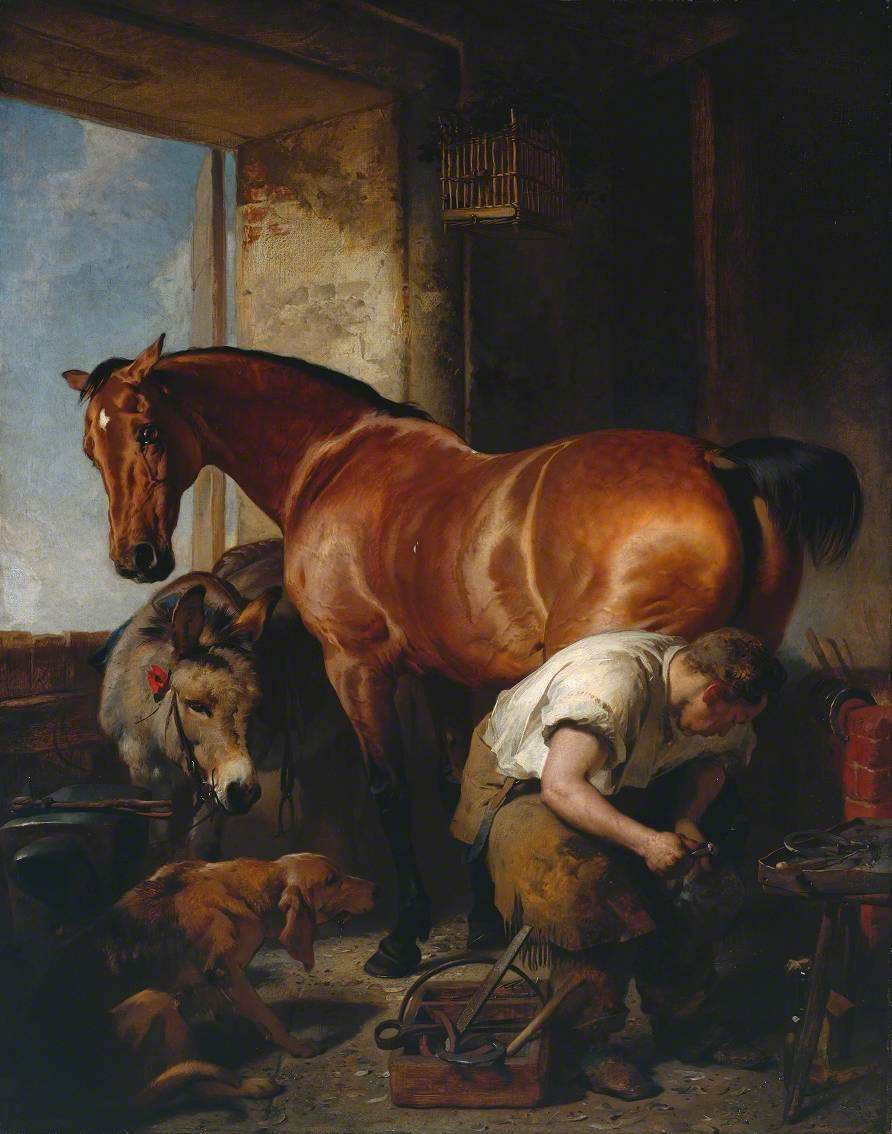
| Shoeing | exhibited 1844 | Painting |
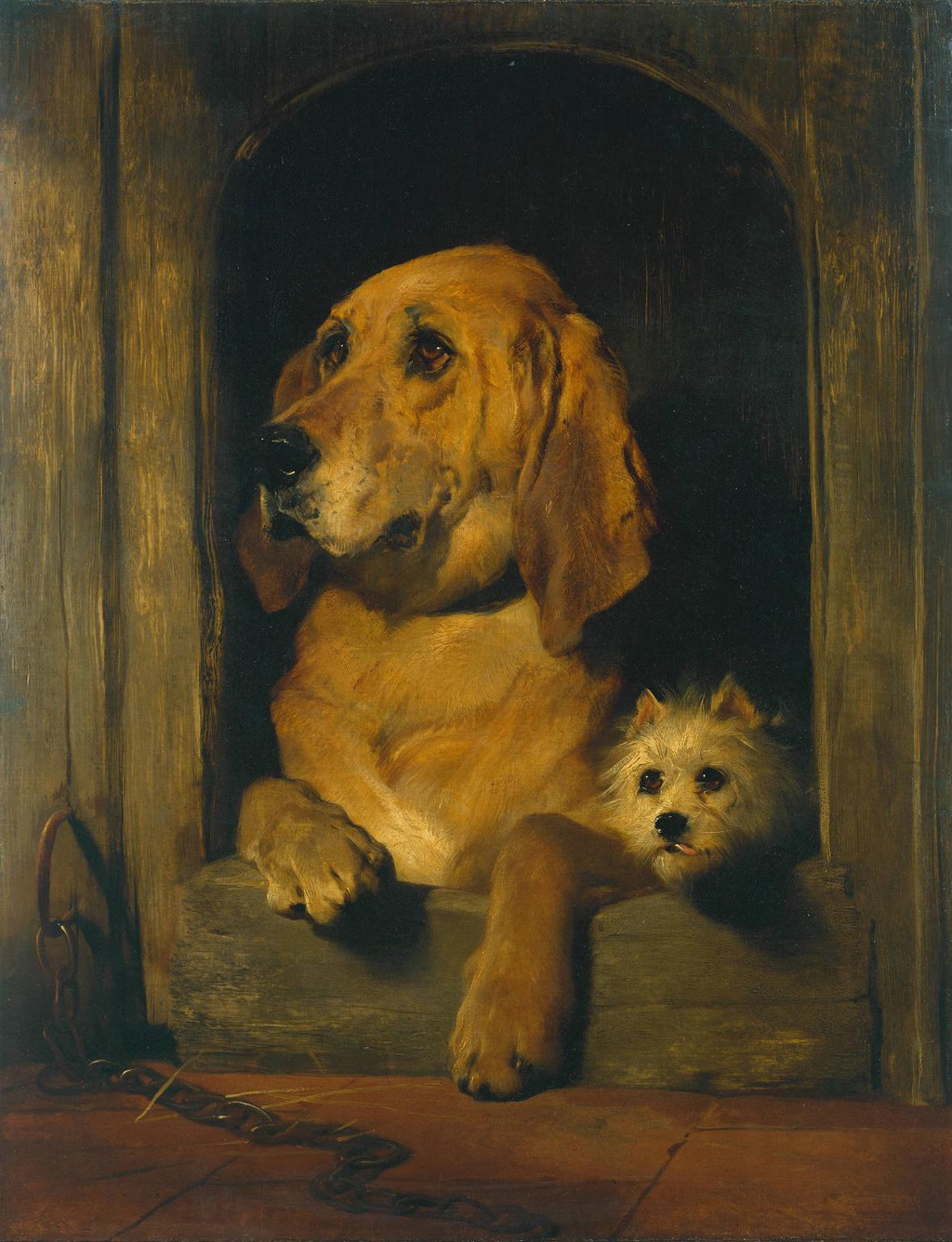
| Sleeping Bloodhound | exhibited 1835 | Painting |
| Spaniel and Rabbit | Painting | |
| Stag at Bay | 1866 | Sculpture |
| Stag at Bay | 1846 | Painting |
| Studies of a staghound and the head of a stag for painting ‘The Hunting of Chevy Chase’ | Drawing | |
| Study for Alpine Mastiffs Reanimating a Distressed Traveler | Drawing | |
| Study for the Monkey in The Cat's Paw | Drawing | |
| Study of a Dog | Drawing | |
| Study of a herding dog facing right | Drawing | |
| Study of the horse of Selene, from the East pediment of the Parthenon | Drawing | |
| Suspense | Painting | |
| Taking a Buck | ||
| The Arab Tent | c. 1865–66 | Painting |
| The Barn | Drawing | |
| The Best Run of the Season | ||
| The Cat's Paw | c. 1824 | Painting |
| The Cavalier’s Pets | ||
| The Challenge | Painting | |
| The Chase | Drawing | |
| The Connoisseurs: Portrait of the Artist with Two Dogs | 1865 | Painting |
| The Death of a Stag in Glen Tilt | Painting | |
| The Drive—Shooting Deer in the Pass | Painting | |
| The Drover's Departure | Painting | |
| The Highland Shepherd’s Dog | 1824; portfolio issue 1848 | |
| The Honourable Mrs Norton | Painting | |
| The Hunting of Chevy Chase | 1825–26 | Painting |
| The Illicit Highland Whisky Still | Painting | |
| The Keeper John Crerar with his Pony | Painting | |
| The Larder Invaded | ||
| The Lion-Dog of Malta | ||
| The Lions at the Base of Nelson's Column | 1867 | Sculpture |
| The Monarch of the Glen | about 1851 | Painting |
| The Mountain Torrent | ||
| The Old Shepherd's Chief Mourner | 1837 | Painting |
| The Sanctuary | 1842 | Painting |
| The Stricken Deer | Painting | |
| The Twa Dogs | Painting | |
| Time of Peace | ||
| Two stags running | Drawing | |
| Victoria, Princess Royal, with Eos | Painting | |
| View of Glenfeshie | Painting | |
| War | Painting | |
| White Horse in a Stable | Painting | |
| Windsor Castle in Modern Times | 1841–43 | Painting |
| Woburn Abbey Game Card | 1825; portfolio issue 1848 |
Discussion
Use the article’s images and evidence to develop your own reading of Biography.
Reader Insights
Which detail is most revealing when you consider “A family of makers in London, 1802–1814”?
How does the evidence in “Exhibiting before entering the Schools, 1814–1816” affect your reading of Biography?
What further question would you bring to “How to read the life through the work”?
Join the Conversation
Share a detail, comparison or question about Biography below.
References
- Royal Academy of Arts, “Edwin Landseer RA”, artist and collection record. View source.
- Royal Academy of Arts, The Exhibition of the Royal Academy, 1815, nos. 443 and 584. View source.
- National Portrait Gallery, “Sir Edwin Henry Landseer”, person record. View source.
- British Museum, John, Edwin and Thomas Landseer authority and collection records. and and View source 1. View source 2. View source 3.
- James A. Manson, Sir Edwin Landseer, R.A., 1902, used for preserved chronology, letters and contemporary records with later speculation excluded. View source.
- National Gallery archive, Christie’s and Morgan Library late-letter records, as listed in reference 6. and and View source 1. View source 2. View source 3.
- Kathryn Calley Galitz, Romanticism, Metropolitan Museum of Art, 2004. View source.
- Ross Finocchio, Nineteenth-Century French Realism, Metropolitan Museum of Art, 2004. View source.
- National Gallery, London, J. M. W. Turner. View source.
- National Gallery, London, John Constable. View source.
- National Gallery, London, Sir David Wilkie. View source.
- Royal Academy of Arts, Sir Edwin Landseer RA. View source.
- National Gallery of Art, Alpine Mastiffs Reanimating a Distressed Traveler. View source.
- Minneapolis Institute of Art, The Cat's Paw. View source.
- Birmingham Museums Trust, The Hunting of Chevy Chase. View source.
- Victoria and Albert Museum, The Old Shepherd's Chief Mourner. View source.
- Tate, Dignity and Impudence. View source.
- Royal Collection, Eos. View source.
- National Galleries of Scotland, The Monarch of the Glen. View source.
- Royal Holloway, University of London, Man Proposes, God Disposes. View source.
- Trafalgar Square / Greater London Authority, The Lions at the Base of Nelson's Column. View source.
- James A. Manson, Sir Edwin Landseer, R.A., 1902. View source.
- Vanessa Remington, Queen Victoria, Prince Albert and their relations with artists, Royal Collection Trust, 2010. View source.
- Greater London Authority, Trafalgar Square. View source.
- National Portrait Gallery, John George Landseer and Jane Landseer portrait records and Landseer family people records. and and View source 1. View source 2. View source 3.
- Richard Ormond, with Joseph Rishel and Robin Hamlyn, Sir Edwin Landseer, Philadelphia Museum of Art / Tate Gallery / Rizzoli, 1981, ISBN 0-87633-044-8.
- Susan Owens, “Écorché drawings by Edwin Landseer”, The Burlington Magazine, May 2012, pp. 341–45; Victoria and Albert Museum, Annual Report and Accounts 2010–11.
- National Gallery of Art, Washington, Sir Edwin Landseer, Alpine Mastiffs Reanimating a Distressed Traveler, 1820. View source.
- Algernon Graves, Catalogue of the Works of the Late Sir Edwin Landseer, R.A. View source.
- Morgan Library, Edwin Landseer signature in the Abbotsford visitors’ book, 1824; Walter Scott correspondence, 18 May 1824; National Portrait Gallery, Landseer’s portrait of Scott. and and View source 1. View source 2. View source 3.
- National Galleries of Scotland, “Sir Edwin Landseer”, artist record. View source.
- Tate, Sir Edwin Landseer, High Life and Low Life, both 1829. and View source 1. View source 2.
- National Portrait Gallery, Landseer private caricature set, circa 1830–40. View source.
- Vanessa Remington, “Queen Victoria, Prince Albert and their relations with artists”, Royal Collection Trust, Victoria & Albert: Art & Love, 2010. View source.
- Royal Collection Trust, Sir Edwin Landseer, Dash, 1836. View source.
- Royal Collection Trust, paintings overview, royal-pets survey and Victoria’s Ardverikie copy after Landseer. and and View source 1. View source 2. View source 3.
- Royal Collection Trust, Sir Edwin Landseer, Eos, 1841. View source.
- Royal Collection Trust, “Queen Victoria”; Two peasant women, royal etching record. and View source 1. View source 2.
- National Gallery of Victoria, “Away with the fairies: Edwin Landseer’s A Midsummer Night’s Dream. Titania and Bottom, 1848–1851”. View source.
- Explication des ouvrages de peinture, sculpture, architecture, gravure et lithographie des artistes vivants, 1864, official retrospective list of the 1855 awards. View source.
- National Portrait Gallery, John Ballantyne, Sir Edwin Landseer, circa 1865; Greater London Authority, “Trafalgar Square”; Hansard, House of Commons debate, 6 June 1864. and and View source 1. View source 2. View source 3.
- Royal Holloway, University of London, Sir Edwin Landseer, Man Proposes, God Disposes, 1864; Royal Collection Trust, The Connoisseurs: Portrait of the Artist with Two Dogs, 1865. and View source 1. View source 2.
- William Macdonald Sinclair, Memorials of St Paul’s Cathedral; University of York, “Sir Edwin Landseer” monument record; James Augustus Hessey, The Artist a Great Moral Teacher, 1873. and and View source 1. View source 2. View source 3.
- John Guille Millais, The Life and Letters of Sir John Everett Millais. View source.
- Royal Academy of Arts, 1874 Sir Edwin Landseer, R.A. memorial exhibition catalogue; Tate Archive, “Sir Edwin Landseer: A Retrospective Exhibition”, TG 92/403. and View source 1. View source 2.
- Splash image, Sir Edwin Landseer, photographed by John & Charles Watkins. Wellcome Collection, V0028607. Image source. CC BY 4.0. Resized.
- Navigation image, One of the bronze lions at Nelson’s Column: modelled by Edwin Landseer and cast by Carlo Marochetti. Photograph by Amanda Slater. CC BY-SA 2.0. Image source. CC BY-SA 2.0. Resized.