by Tom Gurney
Tom Gurney BSc (Hons) is an art history expert with over 20 years experience
Email: tomgurney1@gmail.com / Phone: +44 7429 011000
What is Sleeping Bloodhound?
Sleeping Bloodhound is not a record of a living dog disturbed in her rest. It is a posthumous portrait of Countess, a bloodhound belonging to Jacob Bell. She had died after an accidental fall before Edwin Landseer made the painting. He arranged her great body as if sleep, rather than death, had brought it to stillness.
Tate identifies the work as an oil painting on canvas, exhibited in 1835. The support measures 101.6 by 127 centimetres, the accession number is N00603, and the acquisition credit reads “Bequeathed by Jacob Bell 1859”.[1] These details distinguish the physical object from the stories and prints that accumulated around it. They also correct two easy errors: the holder is Tate, not “Tate Modern”, and a present display location should not be made permanent in an account of the painting.
The composition is horizontal and close to life size. Countess lies across a pale fleece or rug spread over a reddish floor covering. Her forelegs reach towards the lower left; her head bends down beside them; folded hindquarters and a curving tail complete the body at the right. A dark helmet with a red plume stands at the upper left. Behind her are shadowed furnishing, a deep recess and green cloth in an interior that Tate deliberately leaves nonspecific.[1]
Nothing in this inventory depicts the accident. There is no balcony, vehicle, wound, blood or anxious owner. Nor is there evidence of a kennel, stable, straw or hay. The historical event is outside the frame, while the title instructs viewers to see its consequence as ordinary sleep. Landseer's central transformation is therefore at once simple and unsettling: a dead animal is rendered with enough bodily presence to make renewed movement seem possible.
That distinction gives the painting a different character from an anecdotal picture in which an animal acts out a human virtue. Countess does not rescue, guard, plead or mourn. She is not shown doing anything. The narrative lies in the gap between what the title says, what the body appears to do and what the owner-derived history reveals had already happened.
At a Glance
This work across Edwin Landseer’s career
The Cat's Paw
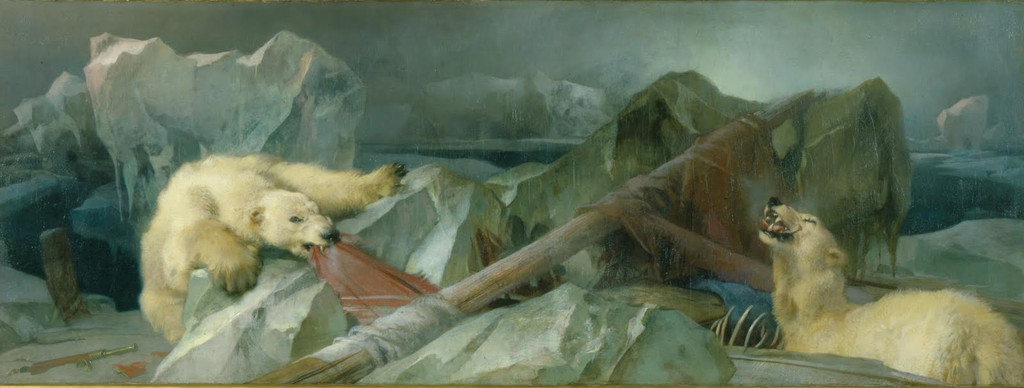
c. 1824 [3]The Hunting of Chevy Chase
1825–26 [4]Sleeping Bloodhound (current article)
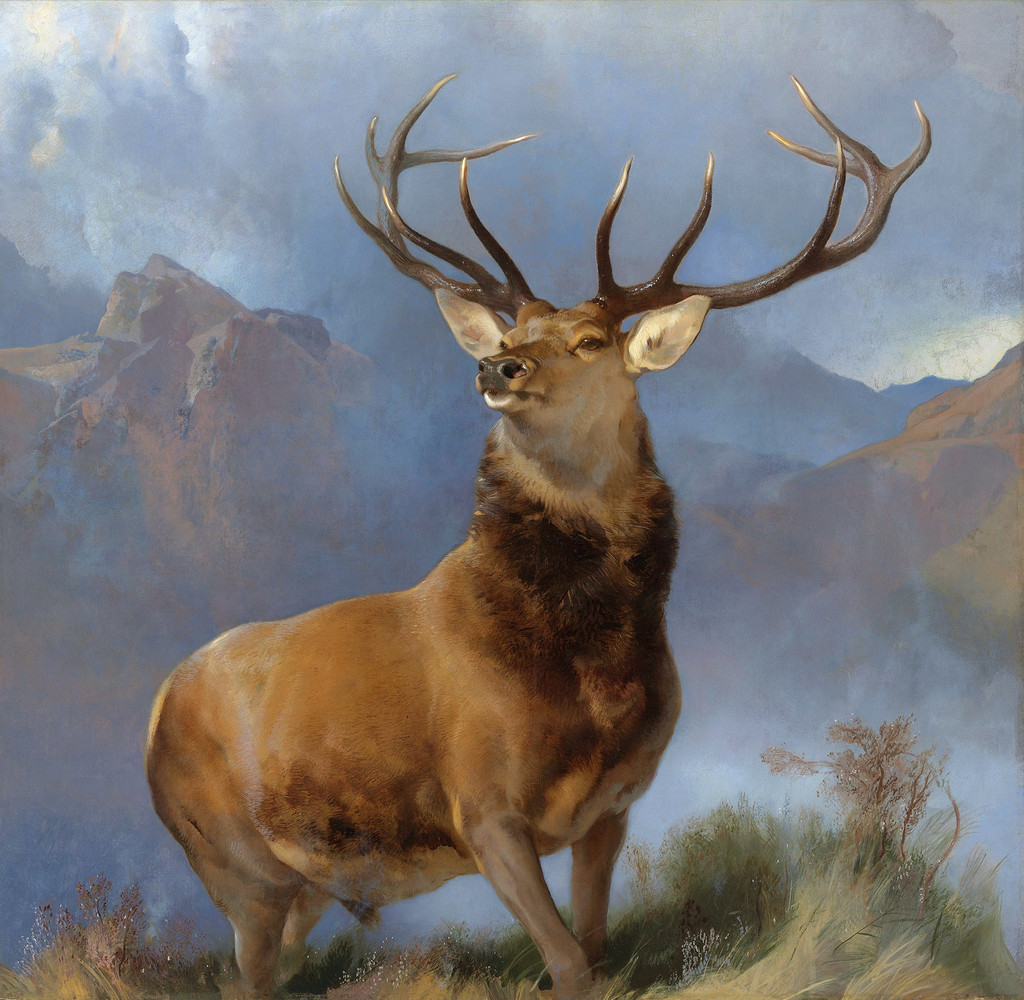
exhibited 1835 [5]The Monarch of the Glen
about 1851 [9]Contents
- What is Sleeping Bloodhound?
- Countess, not an anonymous sleeping dog
- A body arranged across the canvas
- Head, ears, legs and tail
- Fleece, drugget and the dark interior
- The helmet and an absent household
- A posthumous portrait made to look asleep
- What Bell's recorded account says
- Why the accident stories do not combine
- Number 73 at the British Institution
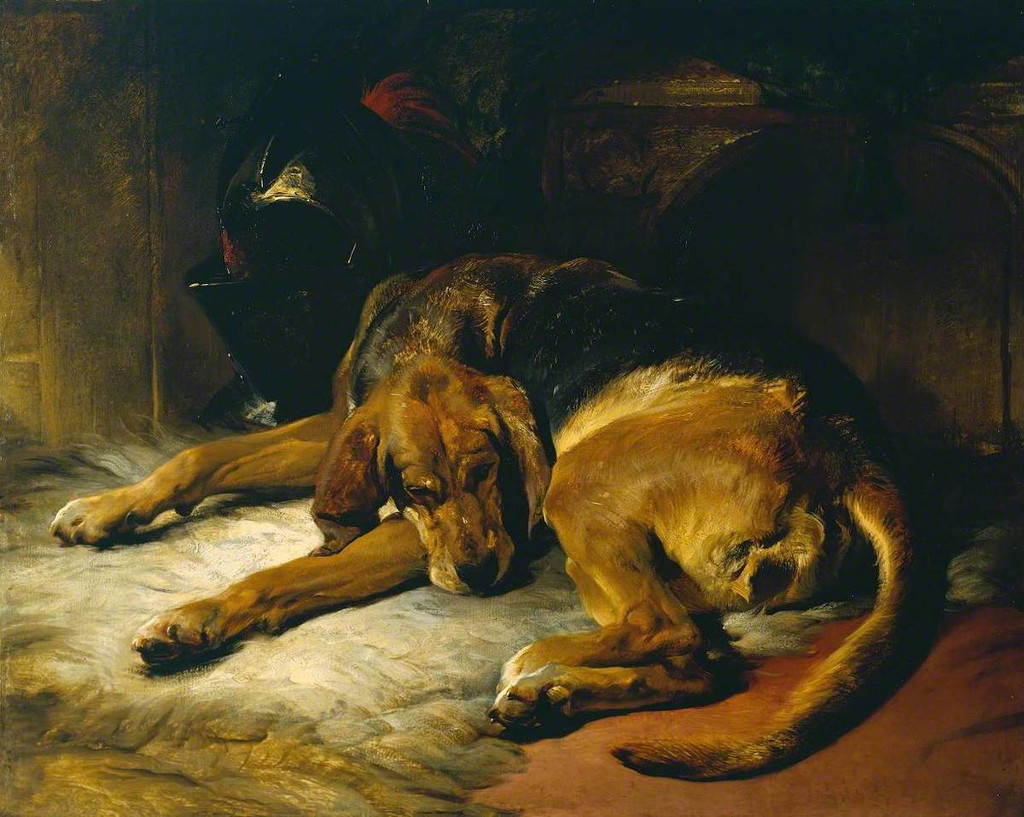
Sleeping Bloodhound. Tate. Image source. Public domain.
Countess, not an anonymous sleeping dog
The sitter's name matters because Sleeping Bloodhound is a portrait, not merely an ideal example of a breed. The account published in The Portfolio in 1875 identifies the dog as Countess and Jacob Bell as both her owner and the original owner of the picture.[12] James Dafforne had printed a closely related version two years earlier, adding a footnote that the anecdote had been recorded by Bell.[13] Modern scholarship likewise places the work among Landseer's portraits of Bell's own animals.[14]
Countess was female. That elementary fact is easily lost when an inherited description repeatedly calls the dog “he” and builds a masculine fiction of work, strength and vigilance around her. Restoring her name and sex does not produce a complete biography. The checked records do not establish her age, formal pedigree, breeder, training or exact date and hour of death. They establish an owned individual whose appearance Bell wanted preserved.
The word “bloodhound” is secure in the historical exhibition title, Bell-derived accounts and Tate's current subject record.[1][15][12] A present-day show standard can help identify visible features: a long head and foreface, relatively loose skin, low-set ears falling in folds, substantial limbs and a long tapering tail.[16] It cannot retrospectively certify Countess's pedigree or temperament. Nor can general bloodhound character be used to explain her pose. The painting supplies an individual body, not a behavioural profile.
Bell's wish for remembrance is central to the making story. In the 1875 account, he took Countess to Landseer hoping that the artist might make a sketch of an old favourite.[12] The resulting canvas is much more ambitious than an informal token, but that reported motive keeps its origin within private attachment. Before the British Institution made Countess a public spectacle, she was a particular animal whose loss belonged to a household.
A body arranged across the canvas
Landseer makes Countess's physical scale the painting's first argument. Her body occupies most of the width and much of the lower half of the canvas. The long back rises through the centre, then turns down into the folded rear legs. The forequarters extend in the opposite direction. Little empty floor remains around her, so the interior appears organised to contain the dog rather than the dog placed decoratively within a room.[1]
The dark saddle across the back holds the torso together as a broad mass. Brown and tan move through the head, legs and flanks; paler passages emerge at the underbody, paws and rear. These changes prevent the reclining form from becoming a single silhouette. They also lead the eye slowly along the animal, from the concentrated head and forelegs to the rounded hindquarters and tail.
Weight is communicated through contact. Countess does not float on an indistinct bed of colour. Her side presses into the light fleece, the head settles low, and the front limbs extend at slightly different lengths. The soft support bunches beneath a body whose muscular structure remains legible. Fleece and fur are adjacent but not confused: one receives the body's weight, while the other describes its surface.
The pose has the broad coherence of sleep, yet it contains small irregularities. The farther foreleg projects beyond the nearer one. The tail bends in an awkward fleshy curve rather than completing a graceful ornamental arc. The hind legs are gathered compactly, while the upper back remains expansive. Alison Elizabeth Wright has argued that these minute discrepancies make the body's solidity unusually tactile and leave the viewer with the impression that a paw or muscle might move again.[14]
That impression should remain an impression. A still image cannot tell us that Countess is breathing, twitching or dreaming. It can show how Landseer made different parts of a large body cohere without smoothing them into lifeless symmetry. The poignancy arrives later, when knowledge of the sitter's death makes every suggestion of possible movement impossible.
The horizontal format supports this suspended state. A standing bloodhound would turn the canvas into a demonstration of height and bearing. Here length matters more. Countess is spread across the viewer's field at nearly bodily scale, encountered less as a distant type than as a presence sharing the room. Landseer asks the spectator to look along her, not merely at her face.
Head, ears, legs and tail
Countess's head is lowered towards the foreground. The long muzzle ends in a black nose; loose skin and jowl gather beneath it. One ear lies in a dark fold beside the head, while the other merges with adjacent shadow and fur. The eyelids are lowered, and the face turns inward and down rather than lifting to meet the spectator.[1]
This orientation corrects the tempting claim that she is watching the painter. No reciprocal look is securely visible. The head offers no direct address, and the viewer receives no sign of recognition. Even if a narrow dark line at an eyelid can be read differently at different reproductions or magnifications, it cannot support a story of irritation, wakefulness or anxiety. Direction matters more than a disputed sliver: Countess does not turn outward to engage us.
Her long ears are equally easy to animate. Later critics imagined them listening for a familiar step, but paint cannot identify a sound. In the picture they are folded forms that enlarge the head, connect it to the ground and soften the transition from muzzle to foreleg. Their downward pull reinforces stillness. The modern bloodhound standard's description of thin, long, low-set ears helps name the anatomy, not the animal's attention.[16]
The forelegs introduce a different kind of extension. They travel diagonally towards the lower left, bringing the body close to the picture's front edge. Their unequal placement avoids the stiffness of a formal display and creates a pathway from shoulder to paw. Small pale markings catch against the warmer legs and reddish floor. No injury is visible in them, and their position cannot be used to reconstruct the fall.
At the opposite end, the hindquarters turn the body back upon itself. The rear legs fold beneath or beside the rounded flank; the tail runs along the lower right before curling towards the torso. Wright singles out the tail's awkward curve as one of the details that resists idealisation.[14] It is a useful observation because it locates feeling in form. Countess does not need a human expression. The peculiar placement of her own body is enough to make the likeness individual.
The head, forelegs and tail also distribute three different kinds of line. The muzzle and ears descend; the forelegs reach; the tail returns. Together they keep the resting animal from reading as inert geometry. Yet none of those lines becomes action. The painting remains poised between the visual grammar of sleep and the historical fact of death.
Fleece, drugget and the dark interior
The surfaces beneath Countess are important precisely because the inherited kennel story misidentifies them. The pale material is a fleece or rug, not straw, hay or a feather bed. Around it lies a reddish floor covering. The 1875 account calls the pale support a whitish skin and the red one a drugget, a coarse woven floor cloth.[12] Those words correspond closely with the image while preserving a distinction between animal hide and manufactured textile.
The fleece increases tactility. Its irregular pale edge breaks against the red, while Countess's darker fur remains legible above it. The relation could have become confusing—a dead animal resting on another animal's skin—but Landseer uses contrasts of colour and texture to separate sitter from support. Countess's body is specific and articulated; the fleece is a yielding field beneath her.
Behind the dog, the space closes quickly. Dark furnishing or carved structure rises at the centre and right. A recess forms a black interval behind the torso. Green cloth hangs above, and warm light reaches the foreground from a source outside the picture. Wright reads the setting as a fleece at the foot of a desk and attributes the deep shadows to an unseen fire.[14] These are informed visual interpretations, not labels supplied by Tate. “Nonspecific interior” remains the safer description when the exact furniture and light source cannot be proved.[1]
The darkness has a compositional effect even without a named object. It presses the body forward. Tan legs, pale fleece and the red plume become more intense against it, while the dark saddle almost disappears into the background before re-emerging at the flank. Countess is both integrated with the room and isolated from it.
No visible household activity competes with her. There is no chair occupied by Bell, no servant, no artist at work and no implement belonging to a kennel. The interior has been stripped to supports and suggestive accessories. It resembles a setting prepared for remembrance rather than the site of an ordinary nap.
The helmet and an absent household
The helmet at the upper left is the composition's most assertive object. Its dark metal catches limited light, and the red plume rises above the otherwise low horizontal body. The accessory balances Countess without explaining her. It belongs to the imagery of chivalry, but no knight appears to wear it and no event links it to the dog.[1]
The earliest checked critic noticed this ambiguity. Reviewing the work at the British Institution in February 1835, The Literary Gazette praised the helmet and other accessories as appropriate to the chivalric character of the “olden time”.[15] The object therefore helped contemporary viewers move from a named breed to an imagined historic household. Countess could look like the great retainer of an absent warrior, even though nothing establishes that role as her own biography.
The red plume also supplies an upright accent that the recumbent dog cannot. It marks the left edge, lifts the eye and then sends it back down through the helmet towards the extended forelegs. Its colour relates to the reddish drugget below. Formally, the old armour is a counterweight. Narratively, it is an invitation.
That invitation has limits. The helmet is not proof that Countess guarded armour, waited for a master or belonged to an ancestral hall. The critic's chivalric response records what the accessory could suggest in 1835. It does not identify an exact period, owner or room. Landseer gives the dog a noble surrounding while leaving the human society that would make nobility meaningful entirely absent.
A posthumous portrait made to look asleep
The title's gentleness can conceal how radical the image is. Sleeping Bloodhound turns the fact of death into a reversible condition. Sleep ordinarily promises waking; death does not. Landseer does not illustrate that difference with allegorical symbols. He allows the same body to support both meanings, and lets historical knowledge change the viewer's understanding of what stillness means.
The 1875 article states the matter without euphemism: the picture represents a dead bloodhound, despite its title.[12] Wright accordingly treats it as a posthumous portrait. In her reading, life-size scale, deep shadow, the tactile fleece and minute anatomical observations make Countess seem physically present; the impression that she might move gives the work its pathos because the viewer knows that she cannot.[14]
The result is not simply deception. Landseer does not hide a death certificate inside the frame, but neither does he paint a generalized sleeping animal unrelated to loss. Countess's individual body carries the memorial. The uneven limbs, folded ears, slack jowl and tail preserve enough particularity to make the fiction of sleep convincing as likeness.
Nor is the fiction necessarily consoling. To see the picture as sleep is to imagine a future moment of waking. The owner-derived account denies that future. A viewer can move repeatedly between the two conditions: first encountering a resting dog, then recalling death, then noticing again how persuasively the body appears capable of life. The image does not resolve grief; it gives grief a visual rhythm.
This also distinguishes the work from a scene of canine emotion directed towards a human. Countess does not visibly mourn Bell, appeal to him or perform loyalty. The absent owner is the mourner, and the painting is one means by which his attachment becomes durable. The dog's inward pose allows her to remain the object of that feeling without acting it out for us.
Calling the work a memorial portrait therefore requires no claim that every dark passage symbolises death. The evidence is simpler. Bell lost Countess, took her to an artist, retained the resulting picture and later bequeathed it with his collection. Landseer made fatal stillness look close enough to sleep for the lost animal to remain imaginatively present.[1][12]
What Bell's recorded account says
The fullest controlled narrative appeared four decades after the painting. The Portfolio said that the original owner had left his own account of the catastrophe. Countess was sleeping on top of a balustrade at Wandsworth on a Sunday evening. Startled by the arrival of her master's vehicle, she lost her balance, fell 23 feet and died that evening. On Monday she was carried by cab to Landseer's home in St John's Wood because Bell hoped for a remembrance sketch.[12]
Landseer reportedly recognised an “opportunity not to be lost” and told Bell to return on Thursday at two. At that time the life-size painting was finished.[12] Dafforne prints nearly the same sequence from the collection catalogue and explicitly notes that Bell recorded the anecdote.[13] These sources make the owner's path visible even though their publication dates remain long after 1835.
Several elements deserve separation. Wandsworth is the place of the accident, not a location depicted in the painting. The balustrade belongs to Countess's life, not to the dark furnishing behind her. Bell's hope for a sketch explains why the body reached Landseer, but it does not survive as a contract specifying the final canvas. The instruction to return on Thursday reports astonishing speed, not a complete description of method.
The schedule is less exact than it first appears. “Monday” to “Thursday at two” supplies endpoints, while the 1835 critic's “two days” supplies a different summary.[15][12] Neither tells us when preparatory thought began, whether assistants handled materials, how long each painting session lasted or what changes occurred before Bell returned. A rapid result is secure; a stopwatch account is not.
The story also does not establish a fee. Bell was Landseer's friend, business adviser and patron, and the picture remained in his possession.[17][14] Those relationships make an owner-directed portrait plausible, but no checked letter, receipt or formal commission terms have emerged for N00603. It is more accurate to call it Bell's portrait of Countess than to invent the economics of its making.
Why the accident stories do not combine
The contemporary and later accounts agree on a fatal fall and rapid painting, but they do not form one seamless narrative. The Literary Gazette in 1835 says only—under the warning “if we have not been misinformed”—that the dog was not sent to Landseer until dead and that the picture was executed in two days.[15] It does not name Countess, Bell or Wandsworth. Its value is immediacy; its limitation is acknowledged hearsay.
Bell's recorded version supplies identity, place, a 23-foot fall, death on Sunday evening, transport on Monday and completion by Thursday.[12][13] Frederic George Stephens's 1880 biography gives a related account: Countess fell from a parapet at Clock House, West Hill, Wandsworth, died during the night and reached St John's Wood the following Monday. He reports that the sight of her changed Landseer's initial vexation at being interrupted into sympathy, and places the work between about midday Monday and Thursday at two.[17]
Stephens then preserves another authority's very different story. In that version, Countess was anxiously watching for Bell on a dark night. Hearing his gig and voice, she leapt from a balcony, missed her footing and fell nearly dead at his feet. Bell put her in the gig, returned to London, woke Landseer and had the dying animal sketched immediately.[17]
The differences are structural, not decorative. Countess cannot simultaneously be asleep and watching for Bell. She cannot die at Wandsworth before Monday transport and remain alive for a nocturnal studio visit. Bell cannot both wait until morning and drive directly back to London. An immediate sketch of a dying animal cannot be treated as proven merely because it makes the story more dramatic.
The responsible account therefore preserves a stable core. Countess suffered a fatal domestic fall; Bell brought her to Landseer in hope of a remembrance; the artist produced a large finished picture with extraordinary speed; and the title converted death into sleep. The precise trigger, moment of death and studio sequence remain variant.
This uncertainty does not weaken the painting's history. It reveals how a compelling image attracts anecdotes that imitate its own operation. Just as Landseer makes a dead body look capable of waking, later storytellers make an already fatal accident feel immediate, audible and active. Wheels arrive, a voice calls, the dog leaps, the artist rises from bed. The narrative wakes Countess in order to explain a painting that refuses to do so openly.
Number 73 at the British Institution
The British Institution exhibition of works by living British artists opened on Monday 9 February 1835. The date is fixed by The Literary Gazette issue of Saturday 14 February, which says the gallery had opened “on Monday last”. In its review, Landseer's picture appears as no. 73, The Sleeping Blood-hound.[15]
The critic called the subject a “magnificent animal”.[15] That short response is important because it directs praise towards Countess's represented body before elaborating the anecdote. Scale, modelling and presence evidently carried force even for a writer who understood the sitter to have been dead.
The same notice reports two kinds of transformation. Landseer had supposedly turned a dead dog into a finished picture within two days, and the helmet had turned a private portrait into something associated with chivalric old time. Both claims emphasise imaginative speed: physical loss becomes pictorial presence, while a household animal becomes a historic retainer.[15]
The notice remains one review. It establishes neither universal acclaim nor a prize, exhibition sale or complete critical consensus. Its death story is explicitly qualified, and its interpretation of the accessories belongs to reception. What it securely demonstrates is that the key elements of the painting's later reputation were already joined at first exhibition: a remarkable animal, a rapid posthumous making story and a setting that elevated the dog beyond ordinary domestic portraiture.
The current title drops the initial article and historical hyphen. Tate's Sleeping Bloodhound should govern modern identification, while The Sleeping Blood-hound belongs to the 1835 review and exhibition context.[1][15] Keeping those forms distinct prevents a minor historical label from silently replacing the holder's current record.
How later critics tried to wake Countess
The most revealing later description is Dafforne's in 1873. He first records that Countess died, was taken to Landseer and became the finished painting. He then resists the consequence of his own evidence. This cannot be a poor lifeless animal or merely a post-mortem study, he argues; it must be an animated retainer in an old mansion, keeping “watch and ward”. He imagines an eye open and ears listening for a familiar footstep.[13]
That passage tells us less about the eyelids than about expectations surrounding Landseer. A celebrated animal painter was supposed to reveal living character. Faced with a portrait whose model was dead, Dafforne supplied vigilance, hearing and social role. He transformed the title's sleep into alert restraint, as though complete repose would betray the artist's gift.
The inherited description repeats a similar act without acknowledging it as criticism. It says Countess's eyes are open, has her gaze directed towards the painter, calls her troubled and weary, and imagines that she may be asked to rise and work. None of those claims is needed to describe the picture. They convert a difficult memorial into a conventional story of canine psychology.
Wright's modern reading moves in the opposite direction. Countess's apparent potential for movement matters because the sitter is dead, not because she is secretly awake. Her head turns towards her own body rather than the human spectator; there is little sense of a working or guard role.[14] The painting's inwardness is thus not an expressive deficit. It is what allows the individual animal's physical presence to carry meaning without performing for us.
The comparison provides a useful historical lesson. Close description is never independent of expectation. Dafforne looks for Landseer's animated character and finds a listening retainer. A memorial reading looks for the tension between likeness and loss and finds an inaccessible, self-contained body. The current digital image cannot abolish interpretation, but it can discipline it: lowered head, folded ears and lack of returned gaze must come before an invented footstep.
A portrait turned inward
Countess's inward orientation changes the relation between animal and spectator. Many portraits use the face to establish exchange. A direct eye can seem to acknowledge the viewer and make the sitter socially present. Here the head is lowered into the space of the body. We look closely, but Countess does not appear to look back.[1][14]
This asymmetry is especially powerful in a near-life-size work. Physical proximity ordinarily increases the chance of encounter. Countess fills the canvas, yet her attention is unavailable. The spectator can study muzzle, jowl, ears and paws without receiving an answering expression. Bodily presence and social absence coexist.
The title softens that absence by naming sleep. A sleeping animal is temporarily withdrawn and may soon rejoin the household. The owner-derived story makes the withdrawal permanent. The painting lets the first idea protect the second without cancelling it. Countess is at once close enough to touch and beyond response.
Wright places this quality within Bell's group of pet portraits, arguing that the animal's physical specificity has value in itself rather than serving an obvious moral lesson.[14] That is an important boundary. Countess need not stand for loyalty, nobility or obedience. The helmet may invite chivalric association, but the dog's inward body remains stubbornly individual.
An elegiac reading follows from that individuality. The work does not illustrate mourning; it gives an absent owner a sustained object of attention. Every observed feature can be revisited, and every revisit repeats the impossible hope embedded in the title. Sleep promises response later. The portrait preserves the promise while history withholds fulfilment.
Jacob Bell and the 1859 bequest
Jacob Bell links Countess's private life to the painting's public afterlife. Stephens calls him Landseer's constant friend and energetic man of business.[17] Wright identifies him as friend, business adviser and patron, and shows how strongly animal painting shaped his collection. Of the 19 pictures he left to the National Gallery, 12 involved animals to some degree, including portraits of his own pets by Edwin and Charles Landseer.[14]
Sleeping Bloodhound therefore belonged to more than one isolated act of remembrance. Bell valued representations of animals, owned several major Landseers and eventually placed those interests within a national gift. Countess entered public culture first at the British Institution, then more permanently through her owner's bequest.
Tate's current credit—“Bequeathed by Jacob Bell 1859”—is the proper endpoint for the acquisition statement.[1] It does not require an invented sequence of executors, transfers and gallery rooms. The essential movement is clear: a household loss produced a privately owned portrait; exhibition and print made it familiar; the bequest transferred the oil into the national collection.
That movement also changes the audience. Bell could recognise Countess and remember the accident. Later viewers usually encounter a titled bloodhound, a helmet and an anecdote. The painting preserves the individual animal while continually exposing her to more general stories about chivalry, artistic speed and canine character.
Thomas Landseer's 1837 print
Thomas Landseer helped detach Countess's image from the unique oil. Rijksmuseum records his 1837 print after Edwin as a combination of etching, engraving and aquatint on paper. Its plate measures 45.6 by 55.4 centimetres; Francis Graham Moon, Ackermann & Co. and Wyatt & Son are named as publishers in London and Oxford. The object number is RP-P-OB-33.748.[18]
The print is not merely the painting at a smaller size. Oil colour, canvas texture and near-life-size encounter are translated into ink, tone and line. Countess's broad dark back, pale supports, low head and helmet remain recognisable, but the material conditions of viewing change. A paper impression can circulate through collections and homes in ways the large canvas cannot.
The Rijksmuseum's current description suggests that the printed dog may be a French braque. That catalogue opinion does not displace the bloodhound identity established by the 1835 title, Tate's object record and Bell's account.[1][15][12][18] It is a reminder that derivative objects develop their own cataloguing histories, sometimes at odds with the source work.
Other reproductive versions followed. The 1875 Portfolio article announces an etching by W. Wise, while Dafforne introduced an engraving with his discussion.[12][13] These examples show continued circulation without supplying a complete print census. Edition sizes, prices, total sales and the full sequence of makers remain unestablished.
The distinction between objects is also a rights distinction. The Rijksmuseum's public-domain status applies to its recorded print. It does not automatically license a Tate or Art UK photograph of the oil. Maker, medium, source file and provider terms have to remain attached to the particular reproduction being used.
What the technical record can and cannot establish
Tate's public record gives a firm material base: oil paint on canvas, support 101.6 by 127 centimetres, with a frame measuring 136.4 by 161.8 by 9 centimetres.[1] These are current catalogue measurements. They do not prove that the frame is original, identify its maker or describe the painting's condition.
For N00603, the public data provides no physical-description text, conservation resource, technical essay or treatment history.[1] No responsible account can therefore claim that the canvas is lined or unlined, identify its weave or ground, name pigments, reconstruct underdrawing, distinguish glaze layers, date varnish, or state where cracking, abrasion and retouching occur. A high-resolution digital image is not a condition report.
This limit matters because rapid-execution stories encourage technical invention. A critic's “two days” and Bell's Monday-to-Thursday schedule do not reveal brush sequence, drying times, assistants or revisions.[15][12] Visible breadth or freshness cannot be converted into a timed demonstration of method. The photograph records a present digital appearance, not every stage of manufacture.
The same caution applies to digital reproductions. Tate's data marks its master image `CLEARED`, but the Creative Commons field is empty.[1] That workflow label supports access for study; it is not an open licence. Neither the age of the painting nor a third party's public-domain label automatically settles the provider and reproduction rights of a particular photograph.
What can be said is still substantial. The current support and frame dimensions are exact. Oil and canvas distinguish the unique painted object from paper prints. The digital master securely supports composition-level looking. What cannot be said—condition, treatment, layer structure and reuse permission—should remain explicit absence rather than speculative expertise.
How to look at Sleeping Bloodhound now
Begin with Countess's name and then postpone the accident. Follow the body from the forelegs to the dark back, folded hindquarters and returning tail. Notice how the pale fleece takes the weight and how the reddish drugget surrounds it. Let the head remain lowered. Do not force the eyelids into a gaze or the ears into a response.[1]
Move next to the room. The dark furnishing and green cloth do not make a kennel. The warm light does not reveal its source. The helmet and plume raise a chivalric possibility without placing a knight beside the dog. Countess dominates a household from which every human has been removed.
Now restore Bell's recorded history. The resting body becomes the body of an old favourite carried to Landseer after a fatal fall. The title becomes an act of conversion: final stillness is made to resemble a temporary withdrawal. The visual promise of waking survives even though the owner knew it could not be fulfilled.[12][13]
Finally, place the stories beside one another rather than blending them. The 1835 critic heard that a dead dog had been painted in two days. Bell's record runs from Monday to Thursday. A later oral version sends a dying Countess through the night to Landseer's studio.[15][12][17] Their disagreement is part of the work's history. Each tries to account for how rapidly loss became presence.
Later viewers performed the same conversion in interpretation. Dafforne opened an eye and set the ears listening; Wright finds pathos in a body that seems almost capable of movement yet turns away from us.[13][14] The second reading better preserves the paradox visible in the canvas. Countess appears vividly there without being required to act alive for the spectator.
Sleeping Bloodhound endures because it is both exact and withholding. It gives us the scale, colour, weight and peculiar arrangement of one animal, but no reciprocal look and no depicted event. Landseer made remembrance from that imbalance. Countess remains physically near, socially absent and suspended beneath a title that offers sleep where history records death.
Artworks directory
This directory gathers works discussed in the articles, including drawings, original etchings and prints after Landseer. It is not a complete catalogue of every drawing, version, plate or impression. Distinct media are kept separate; uncertain dates are left blank. Linked titles open individual articles.
| Name | Date | Medium |
|---|---|---|
| A Bellowing Stag | Drawing | |
| A Deerhound | 1826 | Painting |
| A Distinguished Member of the Humane Society | 1838 | Painting |
| A Highland Breakfast | 1834 | Painting |
| A Highland Landscape | c. 1830 | Painting |
| A Highland Shepherd's Home | Painting | |
| A Horse, Goat and Bull | 1811 | |
| A Hunting Horse | Drawing | |
| A Jack in Office | Painting | |
| A Lion Disturbed at His Repast | Painting | |
| A Random Shot | Painting | |
| A Scene at Abbotsford | Painting | |
| Adversity | Painting | |
| Alexander and Diogenes | exhibited 1848 | Painting |
| Alpine Mastiffs Reanimating a Distressed Traveler | 1820 | Painting |
| Contending Group after Nature | Drawing | |
| Copy after Rubens's Wolf and Fox Hunt | c. 1824–26 | Painting |
| Dash | Painting | |
| Deer and Deer Hounds in a Mountain Torrent ('The Hunted Stag') | c. 1832 / exhibited 1833 | Painting |
| Deer Family | ||
| Dignity and Impudence | 1839 | Painting |
| Dog Resting Upon a Couch | Drawing | |
| Eos | 1841 | Painting |
| Favourites, the Property of H.R.H. Prince George of Cambridge | 1834–35 | Painting |
| Her Majesty Sketching at Loch Laggan | ||
| High Life | 1829 / exhibited 1831 | Painting |
| Highland Lassie | Drawing | |
| Isaac van Amburgh and his Animals | 1839 | Painting |
| Lady Godiva's Prayer | Painting | |
| Laying Down the Law | 1840 | Painting |
| Lion Defending Its Prey | c. 1840 | Painting |
| Lioness | Drawing | |
| Little Strollers | ||
| Low Life | 1829 / exhibited 1831 | Painting |
| Man Proposes, God Disposes | 1864 | Painting |
| Nell Gwynne / Diana Vernon | Painting | |
| Neptune | ||
| No Hunting Till the Weather Breaks | Painting | |
| Otterhounds | Drawing | |
| Peace | Painting | |
| Pensioners | Painting | |
| Portrait of a Mule | Painting | |
| Portrait of Mr Van Amburgh, as He Appeared with His Animals at the London Theatres | 1846–47 | Painting |
| Portraits of a Pointer Bitch and Puppy | Painting | |
| Pray Let Me Out | ||
| Prosperity | Painting | |
| Ptarmigan in a Landscape | by 1833 | Painting |
| Queen Victoria and Prince Albert at the Bal Costumé of 12 May 1842 | 1842–46 | Painting |
| Queen Victoria at Loch Laggan | Painting | |
| Queen Victoria at Osborne | 1865–67 | Painting |
| Queen Victoria landing at Loch Muick | Painting | |
| Rat-catching | 1823 | |
| Reclining Lion | Drawing | |
| Reclining Lion, From Back | Drawing | |
| Rent-day in the Wilderness | 1855–68 | Painting |
| Return from Deer Stalking | 1839 | |
| Royal Sports on Hill and Loch | Painting | |
| Sam Lovill, Porter at the Royal Academy | Drawing | |
| Scene from A Midsummer Night's Dream | 1848–51 | Painting |
| Scene in the Highlands, with portraits of the Duchess of Bedford, the Duke of Gordon and Lord Alexander Russell | Painting | |
| Scottish Highlands, Lochs and Figures | Drawing | |
| Shoeing | exhibited 1844 | Painting |
| Sleeping Bloodhound | exhibited 1835 | Painting |
| Spaniel and Rabbit | Painting | |
| Stag at Bay | 1866 | Sculpture |
| Stag at Bay | 1846 | Painting |
| Studies of a staghound and the head of a stag for painting ‘The Hunting of Chevy Chase’ | Drawing | |
| Study for Alpine Mastiffs Reanimating a Distressed Traveler | Drawing | |
| Study for the Monkey in The Cat's Paw | Drawing | |
| Study of a Dog | Drawing | |
| Study of a herding dog facing right | Drawing | |
| Study of the horse of Selene, from the East pediment of the Parthenon | Drawing | |
| Suspense | Painting | |
| Taking a Buck | ||
| The Arab Tent | c. 1865–66 | Painting |
| The Barn | Drawing | |
| The Best Run of the Season | ||
| The Cat's Paw | c. 1824 | Painting |
| The Cavalier’s Pets | ||
| The Challenge | Painting | |
| The Chase | Drawing | |
| The Connoisseurs: Portrait of the Artist with Two Dogs | 1865 | Painting |
| The Death of a Stag in Glen Tilt | Painting | |
| The Drive—Shooting Deer in the Pass | Painting | |
| The Drover's Departure | Painting | |
| The Highland Shepherd’s Dog | 1824; portfolio issue 1848 | |
| The Honourable Mrs Norton | Painting | |
| The Hunting of Chevy Chase | 1825–26 | Painting |
| The Illicit Highland Whisky Still | Painting | |
| The Keeper John Crerar with his Pony | Painting | |
| The Larder Invaded | ||
| The Lion-Dog of Malta | ||
| The Lions at the Base of Nelson's Column | 1867 | Sculpture |
| The Monarch of the Glen | about 1851 | Painting |
| The Mountain Torrent | ||
| The Old Shepherd's Chief Mourner | 1837 | Painting |
| The Sanctuary | 1842 | Painting |
| The Stricken Deer | Painting | |
| The Twa Dogs | Painting | |
| Time of Peace | ||
| Two stags running | Drawing | |
| Victoria, Princess Royal, with Eos | Painting | |
| View of Glenfeshie | Painting | |
| War | Painting | |
| White Horse in a Stable | Painting | |
| Windsor Castle in Modern Times | 1841–43 | Painting |
| Woburn Abbey Game Card | 1825; portfolio issue 1848 |
Discussion
Use the article’s images and evidence to develop your own reading of Sleeping Bloodhound.
Reader Insights
Which detail is most revealing when you consider “What is Sleeping Bloodhound?”?
How does the evidence in “Countess, not an anonymous sleeping dog” affect your reading of Sleeping Bloodhound?
What further question would you bring to “How to look at Sleeping Bloodhound now”?
Join the Conversation
Share a detail, comparison or question about Sleeping Bloodhound below.
References
- Tate, Sir Edwin Henry Landseer, Sleeping Bloodhound, exhibited 1835, oil paint on canvas, N00603, current object record, API data and principal digital image: and and View source 1. View source 2. View source 3.
- National Gallery of Art, Alpine Mastiffs Reanimating a Distressed Traveler. View source.
- Minneapolis Institute of Art, The Cat's Paw. View source.
- Birmingham Museums Trust, The Hunting of Chevy Chase. View source.
- Tate, Sleeping Bloodhound. View source.
- Victoria and Albert Museum, The Old Shepherd's Chief Mourner. View source.
- Tate, Dignity and Impudence. View source.
- Royal Collection, Eos. View source.
- National Galleries of Scotland, The Monarch of the Glen. View source.
- Royal Holloway, University of London, Man Proposes, God Disposes. View source.
- Trafalgar Square / Greater London Authority, The Lions at the Base of Nelson's Column. View source.
- The Portfolio: An Artistic Periodical, vol. 6, 1875, “The National Gallery. XVII.—Sir Edwin Landseer. The Sleeping Bloodhound”, printed pp. 65–66: and View source 1. View source 2.
- James Dafforne, Pictures by Sir Edwin Landseer, Royal Academician, with Descriptions and a Biographical Sketch of the Painter, 1873, pp. 42–43: View source.
- Alison Elizabeth Wright, Animal and sporting painting in Britain, 1760–c.1850: its artistic practices, patronage and public display, PhD thesis, University of East Anglia, 2018, pp. 179 and 186: and View source 1. View source 2.
- The Literary Gazette, issue 943, 14 February 1835, “British Institution”, no. 73, printed pp. 106–07: and View source 1. View source 2.
- Royal Kennel Club, current Bloodhound breed standard, last updated 1 April 2025: View source.
- Frederic George Stephens, Sir Edwin Landseer, 1880, pp. 75–76: View source.
- Rijksmuseum, Thomas Landseer after Edwin Henry Landseer, The Sleeping Bloodhound, 1837, etching, engraving and aquatint, RP-P-OB-33.748: and View source 1. View source 2.
- Splash image, Sleeping Bloodhound. Tate. Image source. Public domain.
- Navigation image, One of the bronze lions at Nelson’s Column: modelled by Edwin Landseer and cast by Carlo Marochetti. Photograph by Amanda Slater. CC BY-SA 2.0. Image source. CC BY-SA 2.0. Resized.