by Tom Gurney
Tom Gurney BSc (Hons) is an art history expert with over 20 years experience
Email: tomgurney1@gmail.com / Phone: +44 7429 011000
The Arab Tent: Introduction
Edwin Henry Landseer's The Arab Tent gathers a mare, her foal and a small company of other animals into a shelter crowded with fabrics and foliage. The pale horse occupies most of the foreground, yet the picture's intimacy comes from the smaller chestnut body lying close beside her. Landseer makes their shared resting place elaborate without allowing its patterned furnishings to overwhelm the two animals. Painted about 1865–66, this large oil on canvas measures 153.6 × 226.4 cm and belongs to the Wallace Collection, London, as P376.[1][2]
Its history complicates the apparently straightforward title. Exhibited in 1866 with an Indian tent in its name, it was publicly called The Arab Tent by 1873, when the Prince of Wales lent it to the Vienna Universal Exhibition. These changing descriptions belong to the picture's reception; they do not supply a reliable map of the place represented. The painting combines a closely observed relationship between horses with an inviting, carefully arranged setting whose cultural identity has always depended partly on words.[3][4]
At a Glance
This work across Edwin Landseer’s career
The Cat's Paw
c. 1824 [6]The Hunting of Chevy Chase
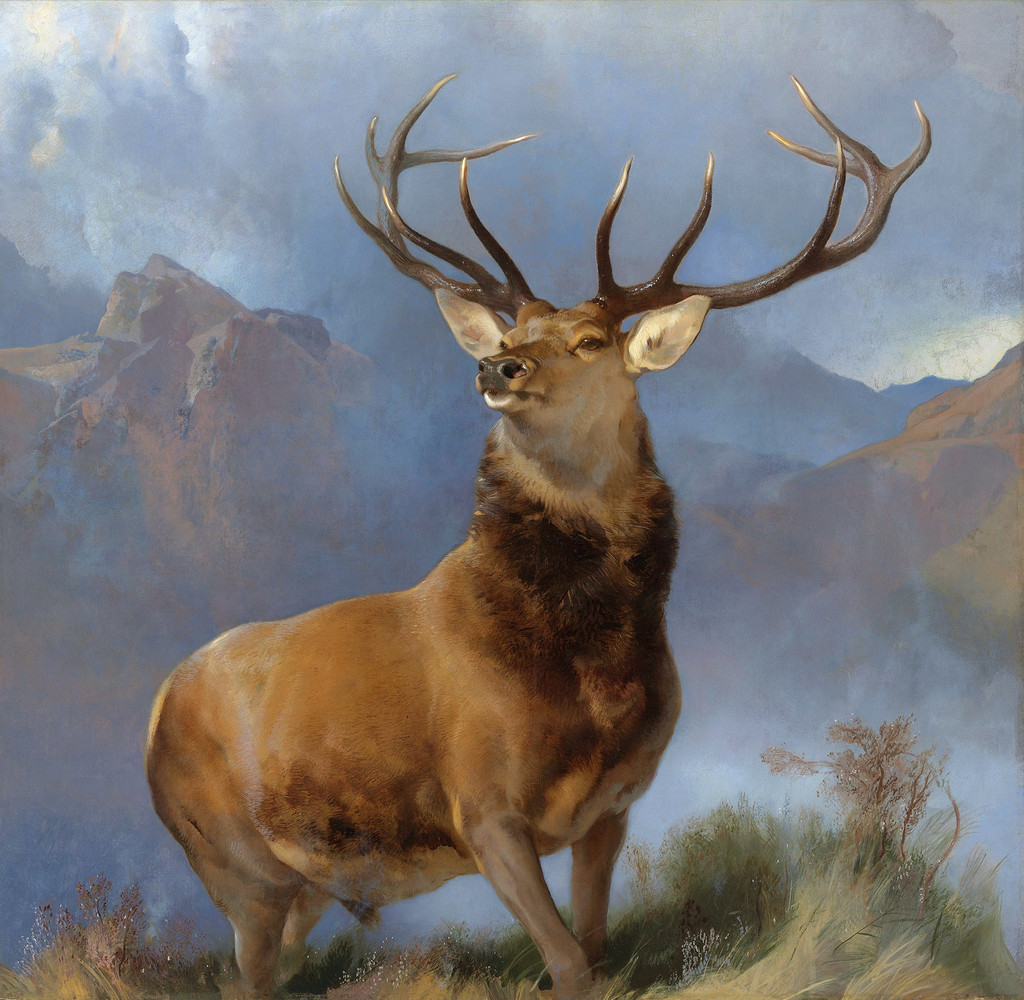
1825–26 [7]The Monarch of the Glen
about 1851 [11]The Arab Tent (current article)
c. 1865–66 [13]Contents
- A mare and foal at rest
- Fabrics, fur and a low roof
- From an Indian tent to an Arab title
- The painting at the 1866 exhibition
- Grace, character and early criticism
- Horses in Landseer's later work
- From the Prince of Wales to Richard Wallace
- Conservation and the visible painting
A mare and foal at rest
The mare's body describes a broad turn across the lower part of the canvas. Her hindquarters are nearest the spectator, her neck curves back towards the left, and her head rises above the foal. This arrangement gives an unusually substantial view of a resting horse: the animal is a weight resting on the ground, with a flank, folded limbs and long tail occupying real space. At the same time, the turning neck prevents the body from becoming an inert white mass. The head leads the eye back towards the smaller animal and makes the group feel gathered together.[2]
The foal's darker coat sets it apart from the mare before the differences in scale become clear. Its slim legs extend towards the left, while its neck lifts into the pale curve behind it. Landseer places the young animal within the larger horse's surrounding forms, using the difference between their colours to keep both bodies legible. The foal is neither a miniature duplicate of the adult nor an ornamental addition to her silhouette. Its narrower build, smaller head and more angular arrangement of limbs make youth visible through shape. The composition allows the two horses to share a space without merging their identities.[2]
Both heads turn towards the same side of the picture. The mare's longer face appears above and slightly behind the foal's, creating a rhythm of muzzle, eye and upright ear across two different scales. Their alignment gives the scene a common direction of attention. It also leaves the viewer outside that exchange: the animals do not look out to acknowledge an audience, and the picture offers no obvious human action to explain their orientation. Their posture is enough to organise the scene. A story about precisely what they hear or whom they await would close an ambiguity that Landseer leaves open.[2]
The light coat is particularly important to this balance. Grey and warmer shadows model the mare's broad body, while the brighter passages separate her from the dark opening behind. Her pale tail spreads across the lower foreground, bringing the largest animal into contact with the carpet's intricate surface. The foal supplies a warmer concentration of colour near the head and neck. The visual relationship is therefore more than a contrast between white and brown: one animal gives breadth and luminosity to the design, the other a smaller, warmer focus within it.[2]
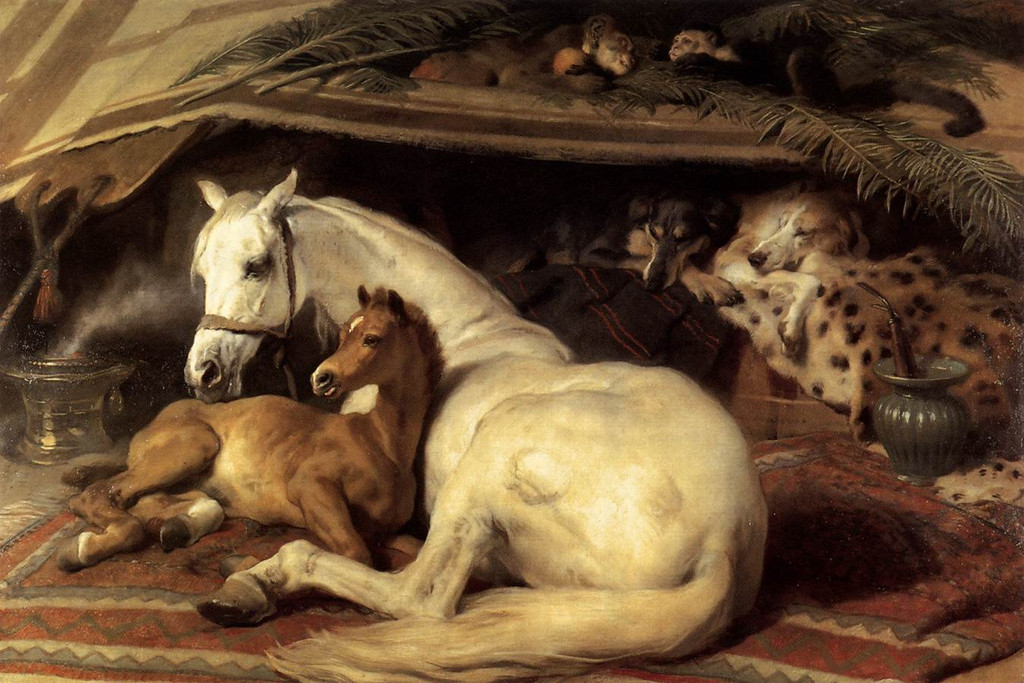
The Arab Tent. Wallace Collection. Image source. Public domain.
Fabrics, fur and a low roof
The tent does more than identify a setting. Its low roof presses the animals into a shallow, protected space, while its sloping edges frame the mare's head and back. Across the top, branches lie over the covering and extend towards the right, making a rough fringe above the smooth animal bodies. Beneath them, the dark recess provides a continuous background against which pale heads and patches of fur emerge. The shelter functions almost as a second frame inside the canvas, narrowing attention to the occupants and their furnishings.[2]
At ground level, a broad patterned carpet reaches the lower edge. Its repeated shapes and borders make a surface that the eye can follow beneath the horses. The mare's rounded body interrupts that ordered pattern; her tail stretches across it in softer, irregular strands. The contrast helps the floor seem flat and the animal substantial. Landseer keeps the carpet visually active without giving it equal importance everywhere. It is clearest around the group's edges, where it establishes the space the horses occupy, rather than competing with their heads for the centre of attention.[2]
Another kind of pattern appears behind them. The two hounds rest upon a spotted skin, with their heads close to the upper edge of the mare's back. One dark head and one much lighter head make this rear group visible in the shadow. The Wallace Collection identifies the dogs as Persian greyhounds.[1] Their long faces echo the directional emphasis of the horses without repeating the same bodily scale. Although the dogs lie farther back, their raised resting place brings their heads towards the viewer and prevents them from disappearing into the interior.[2]
The spotted skin folds over that support, changing from an apparently soft horizontal bed into a hanging surface. Its markings offer a strong counterpoint to the carpet's geometry. The anonymous Examiner reviewer in 1866 identified it as leopard skin.[15] In the composition, its significance begins with this change of texture and position. The still covering beneath the living dogs is visibly different from their own fur, and its decorative use brings another animal presence into the shelter. No hunt or killing is shown; the picture presents the skin as part of an already furnished interior.[2]
Two monkeys occupy the highest level, among the branches above the roof. Their small forms are easy to overlook at first, but finding them changes the apparent extent of the group. The tent's inhabitants are arranged vertically as well as in depth: horses fill the foreground, hounds look out from the recess, and monkeys rest overhead. The levels let Landseer include several species without gathering them into a single confused knot. They also offer different routes through the picture, from the large pale body below to the darker, smaller forms near its upper boundary.[2]
Two vessels provide a further balance across the foreground. At the left, a metal container releases a faint plume of smoke beside the foal. At the right, a green jar makes a compact patch of saturated colour against the spotted skin and red fabric. Its rounded shape answers the curves of the mare's body on a much smaller scale, while its more concentrated colour holds the edge of the composition. The smoking vessel introduces the suggestion of movement into an otherwise still arrangement; the jar supplies a firm visual stop.[2]
The museum identifies two pipes in the jar.[1] These possessions make an unseen human presence plausible, although no owner enters the scene. The carpet, hanging fabrics and laid branches similarly suggest a place prepared for occupation. Landseer gives the animals access to a furnished shelter while leaving the person who might use its objects outside the frame. This absence is structurally useful: every visible face belongs to an animal, and the mare and foal retain the prominence that a standing or seated figure could easily have taken from them.[2]
From an Indian tent to an Arab title
The relationship between the painting's names can be traced without treating either as a precise geographical identification. James Dafforne's exhibition list, published in 1873, records Landseer's Royal Academy contribution of 1866 as no. 92, Mare and Foal—Indian Tent, &c..[3] This title starts with the principal animals and moves towards their surroundings. Its final abbreviation leaves the additional creatures and furnishings open-ended, much as a viewer discovers them after first noticing the horses. The animal group and the setting were both present in the early name; the familiar modern title reverses their emphasis.
The 1866 Examiner account also calls the shelter Indian, while describing the carpet as a Turkey carpet.[15] Those terms reveal how a contemporary British critic named the picture's accessories. They should not be converted into a certificate of manufacture for the textile or evidence of the artist's presence in a particular country. The pattern can be described, and the critic's terminology can be reported, without assigning the carpet to a specific workshop. The same distinction applies to the tent: a painted assemblage and its historical label are related evidence, but neither establishes the history of every object represented.
The Indian title remained in public use after the Royal Academy exhibition. At Leeds in 1868, the official catalogue listed The Indian Tent under Landseer's name in the section for living British painters in oil. The work was no. 1341 in Gallery E, contributed by the Prince of Wales.[16] This is a useful intermediate point. The picture had entered royal ownership and was being lent for exhibition, yet the name still referred to India. There is no need to suppose that the current title accompanied the painting throughout its earliest public life.
By 1873 the Vienna catalogue gives the other name: The Arab Tent, no. 37, lent by the Prince of Wales.[4] Thus the Arab title predates Sir Richard Wallace's acquisition. The two exhibition records establish a change in public wording between the Leeds and Vienna listings, though they do not identify who proposed it or when it was first adopted. The alteration may seem small to a viewer concerned chiefly with the horses. Historically, however, it changes the region through which the scene is approached and makes the shelter itself the principal subject in the title.
The present Wallace record regards the tent as apparently Arab rather than Indian and describes the work as an unusual response by Landseer to Orientalist themes.[1] Here Orientalism concerns the British painter's presentation of a setting associated with the East. The image offers patterned textiles, branches, pipes and animals as a coherent, attractive environment. Its changing names are a reminder that this coherence is pictorial: it can make a setting convincing to the eye while leaving its exact location indeterminate. The strongest account of the work keeps that distinction alongside the clarity with which the horses themselves are represented.[2][3][16][4]
The painting at the 1866 exhibition
An early response gives the picture a more prominent position than its brief later mentions might suggest. On 5 May 1866, The Examiner singled out the mare-and-foal composition as the most important of Landseer's paintings in that year's Royal Academy exhibition. The review emphasised the large scale and the horses resting beneath the low tent, then named the carpet, skin, dogs and monkeys among palm branches. Its short account already contains much of the ensemble that still structures a viewer's first encounter.[15]
The order of this description matters. The reviewer did not begin with an exotic anecdote, a named owner inside the scene or a journey undertaken by the painter. The horses came first, followed by their elaborate surroundings. The setting expanded the subject rather than supplying a separate story that had to be known in advance. This early account supports an understanding of the picture as a major animal composition presented through a richly furnished shelter. It also shows that the peripheral creatures and materials were visible parts of its public identity from the beginning.[15]
The review placed the painting alongside other Landseer exhibits, including Lady Godiva's Prayer, and noticed work by several other painters. Its declaration of importance was a judgement within that particular exhibition, not a universal ranking of Landseer's career.[15] That distinction helps preserve the value of the testimony. It records a response close to the painting's first showing, before later biographers arranged his works into a continuous story of development or decline. The large mare-and-foal picture could command attention in its immediate setting without becoming the work through which every later critic chose to explain the artist.
Grace, character and early criticism
The early retrospective accounts do not repeat a single verdict. Dafforne's 1873 narrative lists the 1866 exhibits but gives extended attention to Lady Godiva's Prayer, which he criticises. He passes over the mare-and-foal picture with comparatively little discussion.[3] His brevity should not be enlarged into a detailed negative judgement that he never supplied. It demonstrates instead how different an author's priorities could be from those of the Examiner reviewer. One writer singled the tent picture out; another found more to discuss in the risks of Landseer's treatment of a human legend.
F. G. Stephens, writing in 1880, was more directly appreciative of the horse group. He briefly commended the painting of the white mare and foal, naming their Indian setting while surveying the artist's work of 1866.[17] The account is short, but it offers positive testimony about the execution of the principal animals. Stephens's surrounding discussion also attends to horse subjects in which beauty, labour and suffering carry different meanings. His approval of this particular group belongs to a critical view capable of distinguishing among Landseer's equine pictures rather than treating them as interchangeable illustrations of affection.
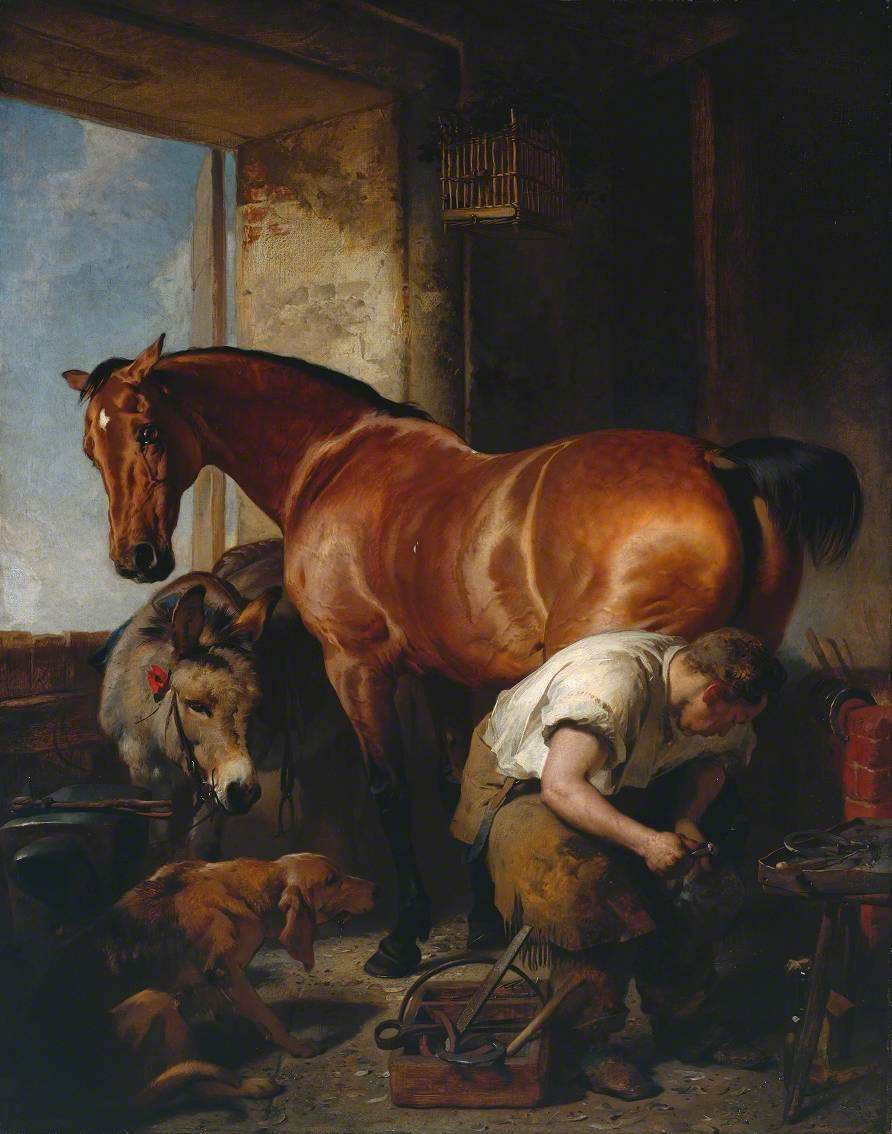
W. Cosmo Monkhouse raised a more searching objection in The Studies of Sir Edwin Landseer. He acknowledged the graceful curves in Indian Tent, Mare and Foal, but thought that in this picture, as in Shoeing, the artist cared more for the beauty of a horse's skin and its place in the design than for its essential life and character.[18] This was an aesthetic judgement about what animal painting ought to accomplish. It did not deny the painter's ability to draw a horse; it questioned whether elegant representation was sufficient. The criticism draws attention to a tension that remains productive when looking at the canvas.
The mare's great pale flank can indeed be enjoyed as a sequence of curves and tonal changes. Its brightness sets off the foal, the hounds and the patterned fabrics. Yet its scale and folded posture also insist on the presence of a large resting body. To accept every element merely as decoration would overlook the difference between the mare's weight and the foal's narrower, more angular form. Conversely, to read every curve as a sign of maternal feeling would make the composition too dependent on an emotional explanation. Monkhouse's objection is useful because it makes those alternatives visible, even when the viewer does not share his conclusion.[2][18]
These responses place different demands on the work. The Examiner recognised the ambition of the whole exhibit; Stephens commended the painting of the horses; Monkhouse asked what kind of animal life lay behind the attractive arrangement. Dafforne's selective attention reminds us that a retrospective account could organise the same year around another picture entirely.[3][15][17][18] The differences are more informative than a claim that Victorian spectators uniformly admired the canvas. They show a painting whose achievement could be located in scale, execution or formal grace, and whose limitations could be argued through the same visible features.
Horses in Landseer's later work
The tent picture also belongs to a particular concentration of horse subjects. Richard Ormond's 1981 Landseer catalogue places it alongside several equine works of the 1860s, including Pensioners, Prosperity and Adversity. The mention occurs within his discussion of No Hunting Till the Weather Breaks, rather than as a separate catalogue entry for the Wallace painting.[19] It situates the canvas among different uses of the horse in the artist's later career: an animal could be approached through its circumstances, its condition or its place among other creatures, as well as through the demands of a formal portrait.
In Stephens's account, Prosperity and Adversity contrasted a fine bay horse with a worn cab horse enduring the consequences of service. He treated their opposed circumstances as an effective narrative.[17] The Arab Tent offers a different starting point. The horses are already at rest, and the space around them is equipped for comfort. There is no paired scene requiring the viewer to compare an earlier and a later state of the same animal. Its relationship is immediate and simultaneous, between the bodies of a mare and a foal lying together.[2]
That distinction gives the picture its own place within the late horse subjects. It does not depend on a dramatic change in fortune or an episode of work. The dark shelter, patterned floor and compact animal company hold attention within a single moment. Landseer can make repose a substantial subject because he gives it so much physical presence: the horses occupy the foreground with a fullness that would be difficult to treat as a passing incident. The artist's wider career provides context, but the picture's particular arrangement supplies its argument.[2]
From the Prince of Wales to Richard Wallace
The Prince of Wales bought the painting directly from Landseer in 1867. Sir Richard Wallace acquired it from him in 1878 for £6,300.[1] These dates separate three stages that are easily conflated: the Royal Academy appearance, royal ownership and entry into Wallace's collection. They also show why the early exhibition catalogues are valuable. The Leeds loan in 1868 falls shortly after the Prince's purchase, while the Vienna loan of 1873 confirms that the picture was still being exhibited under his name several years later.[16][4]
Royal ownership did not therefore make the canvas invisible to the public. The two catalogues place it in substantial exhibitions, first in Leeds and then in the British section at Vienna. In the latter it appeared among other Landseer works, with The Sanctuary lent by Queen Victoria and a portrait of Landseer also lent by the Prince of Wales.[4] The catalogue's lender names attached the painting to a recognisable network of royal and aristocratic ownership. They are evidence for how it was presented, without requiring a claim that its painted shelter reproduced a royal interior or depicted the Prince's own animals.
The £6,300 purchase transferred a picture already associated with royal ownership into Wallace's collection. The amount records the scale of the transaction, but it cannot by itself explain the intentions of buyer and seller.[1] The work had already travelled through different exhibition settings and acquired more than one public title. Its entry into a new collection added another setting for an animal group whose painted enclosure remained unchanged.[2][16][4]
Conservation and the visible painting
The Wallace Collection's Annual Report and Accounts 2017–18 includes The Arab Tent among paintings that had been cleaned and conserved.[20] This establishes a specific episode in the object's care. The published entry does not describe the solvents, varnish, paint structure or individual defects involved. It provides no basis for assigning a particular dark passage to deterioration or a particular bright passage to restoration. Those questions belong to detailed technical evidence about the canvas, rather than to an impression formed from a colour reproduction.
The distinction matters especially in a picture built around a pale animal and a dark recess. Shadow is essential to the mare's prominence: it separates her neck and back from the interior and allows the hounds' heads to emerge behind her. Pattern similarly changes its visibility with the represented folds and lighting. These are observable relationships within the composition, regardless of the fuller material history that conservation may reveal. Looking closely can explain how the image works while leaving the precise condition of its paint and support to the evidence that can establish it.[2]
The picture finally draws its different scales into a single resting place. The mare gives the composition breadth; the foal gives it a second, smaller centre; the hounds and monkeys extend occupation into the shelter's darker and higher spaces. Around them, the carpet, skin, branches and vessels make an environment dense with contrasting surfaces. Its historical names change the way that environment is introduced, but the encounter between the two horses remains remarkably direct. The full animal company is discovered gradually, while their closest relationship is present from the first look.[2]
Artworks directory
This directory gathers works discussed in the articles, including drawings, original etchings and prints after Landseer. It is not a complete catalogue of every drawing, version, plate or impression. Distinct media are kept separate; uncertain dates are left blank. Linked titles open individual articles.
| Name | Date | Medium |
|---|---|---|
| A Bellowing Stag | Drawing | |
| A Deerhound | 1826 | Painting |
| A Distinguished Member of the Humane Society | 1838 | Painting |
| A Highland Breakfast | 1834 | Painting |
| A Highland Landscape | c. 1830 | Painting |
| A Highland Shepherd's Home | Painting | |
| A Horse, Goat and Bull | 1811 | |
| A Hunting Horse | Drawing | |
| A Jack in Office | Painting | |
| A Lion Disturbed at His Repast | Painting | |
| A Random Shot | Painting | |
| A Scene at Abbotsford | Painting | |
| Adversity | Painting | |
| Alexander and Diogenes | exhibited 1848 | Painting |
| Alpine Mastiffs Reanimating a Distressed Traveler | 1820 | Painting |
| Contending Group after Nature | Drawing | |
| Copy after Rubens's Wolf and Fox Hunt | c. 1824–26 | Painting |
| Dash | Painting | |
| Deer and Deer Hounds in a Mountain Torrent ('The Hunted Stag') | c. 1832 / exhibited 1833 | Painting |
| Deer Family | ||
| Dignity and Impudence | 1839 | Painting |
| Dog Resting Upon a Couch | Drawing | |
| Eos | 1841 | Painting |
| Favourites, the Property of H.R.H. Prince George of Cambridge | 1834–35 | Painting |
| Her Majesty Sketching at Loch Laggan | ||
| High Life | 1829 / exhibited 1831 | Painting |
| Highland Lassie | Drawing | |
| Isaac van Amburgh and his Animals | 1839 | Painting |
| Lady Godiva's Prayer | Painting | |
| Laying Down the Law | 1840 | Painting |
| Lion Defending Its Prey | c. 1840 | Painting |
| Lioness | Drawing | |
| Little Strollers | ||
| Low Life | 1829 / exhibited 1831 | Painting |
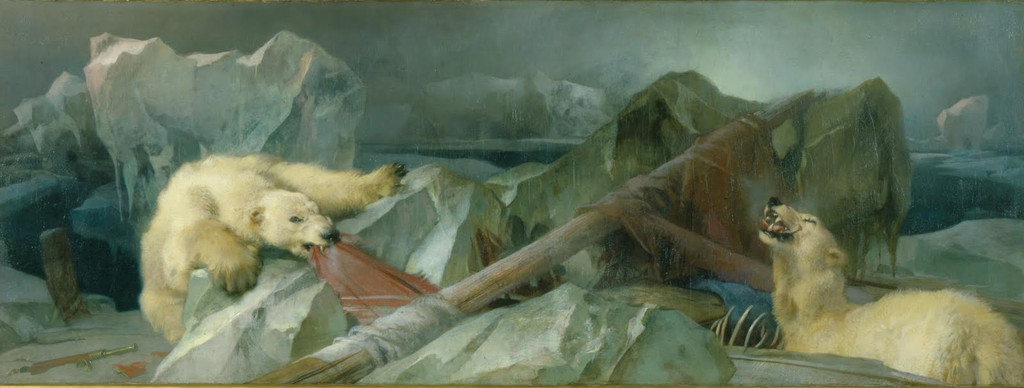
| Man Proposes, God Disposes | 1864 | Painting |
| Nell Gwynne / Diana Vernon | Painting | |
| Neptune | ||
| No Hunting Till the Weather Breaks | Painting | |
| Otterhounds | Drawing | |
| Peace | Painting | |
| Pensioners | Painting | |
| Portrait of a Mule | Painting | |
| Portrait of Mr Van Amburgh, as He Appeared with His Animals at the London Theatres | 1846–47 | Painting |
| Portraits of a Pointer Bitch and Puppy | Painting | |
| Pray Let Me Out | ||
| Prosperity | Painting | |
| Ptarmigan in a Landscape | by 1833 | Painting |
| Queen Victoria and Prince Albert at the Bal Costumé of 12 May 1842 | 1842–46 | Painting |
| Queen Victoria at Loch Laggan | Painting | |
| Queen Victoria at Osborne | 1865–67 | Painting |
| Queen Victoria landing at Loch Muick | Painting | |
| Rat-catching | 1823 | |
| Reclining Lion | Drawing | |
| Reclining Lion, From Back | Drawing | |
| Rent-day in the Wilderness | 1855–68 | Painting |
| Return from Deer Stalking | 1839 | |
| Royal Sports on Hill and Loch | Painting | |
| Sam Lovill, Porter at the Royal Academy | Drawing | |
| Scene from A Midsummer Night's Dream | 1848–51 | Painting |
| Scene in the Highlands, with portraits of the Duchess of Bedford, the Duke of Gordon and Lord Alexander Russell | Painting | |
| Scottish Highlands, Lochs and Figures | Drawing | |
| Shoeing | exhibited 1844 | Painting |
| Sleeping Bloodhound | exhibited 1835 | Painting |
| Spaniel and Rabbit | Painting | |
| Stag at Bay | 1866 | Sculpture |
| Stag at Bay | 1846 | Painting |
| Studies of a staghound and the head of a stag for painting ‘The Hunting of Chevy Chase’ | Drawing | |
| Study for Alpine Mastiffs Reanimating a Distressed Traveler | Drawing | |
| Study for the Monkey in The Cat's Paw | Drawing | |
| Study of a Dog | Drawing | |
| Study of a herding dog facing right | Drawing | |
| Study of the horse of Selene, from the East pediment of the Parthenon | Drawing | |
| Suspense | Painting | |
| Taking a Buck | ||
| The Arab Tent | c. 1865–66 | Painting |
| The Barn | Drawing | |
| The Best Run of the Season | ||
| The Cat's Paw | c. 1824 | Painting |
| The Cavalier’s Pets | ||
| The Challenge | Painting | |
| The Chase | Drawing | |
| The Connoisseurs: Portrait of the Artist with Two Dogs | 1865 | Painting |
| The Death of a Stag in Glen Tilt | Painting | |
| The Drive—Shooting Deer in the Pass | Painting | |
| The Drover's Departure | Painting | |
| The Highland Shepherd’s Dog | 1824; portfolio issue 1848 | |
| The Honourable Mrs Norton | Painting | |
| The Hunting of Chevy Chase | 1825–26 | Painting |
| The Illicit Highland Whisky Still | Painting | |
| The Keeper John Crerar with his Pony | Painting | |
| The Larder Invaded | ||
| The Lion-Dog of Malta | ||
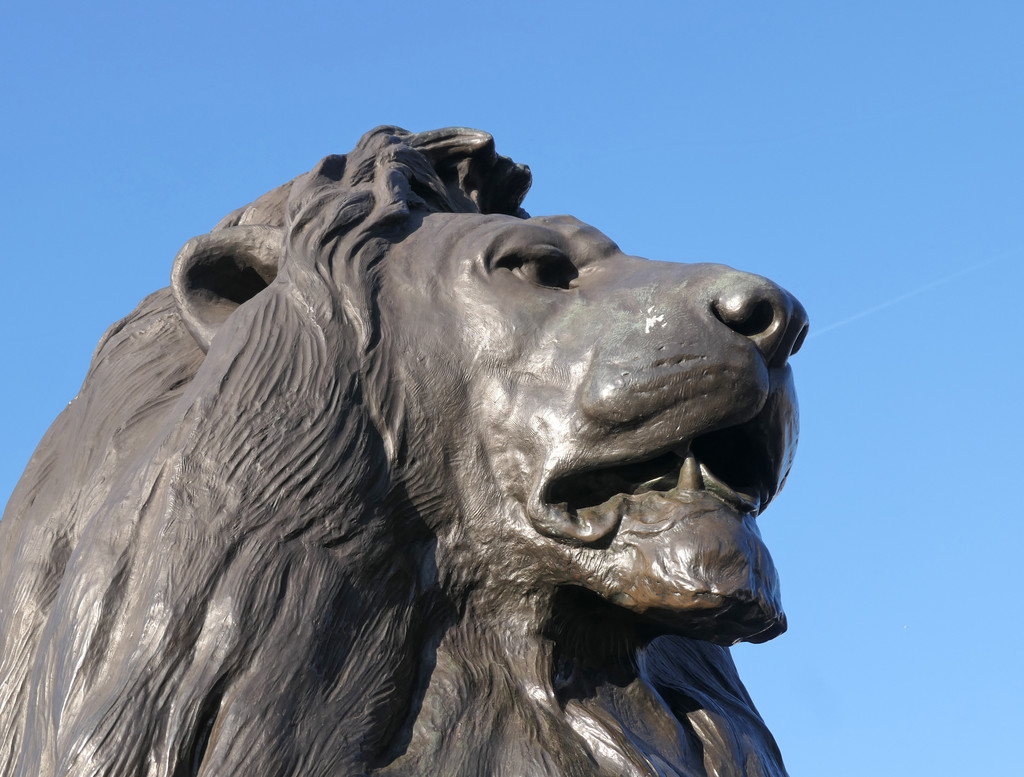
| The Lions at the Base of Nelson's Column | 1867 | Sculpture |
| The Monarch of the Glen | about 1851 | Painting |
| The Mountain Torrent | ||
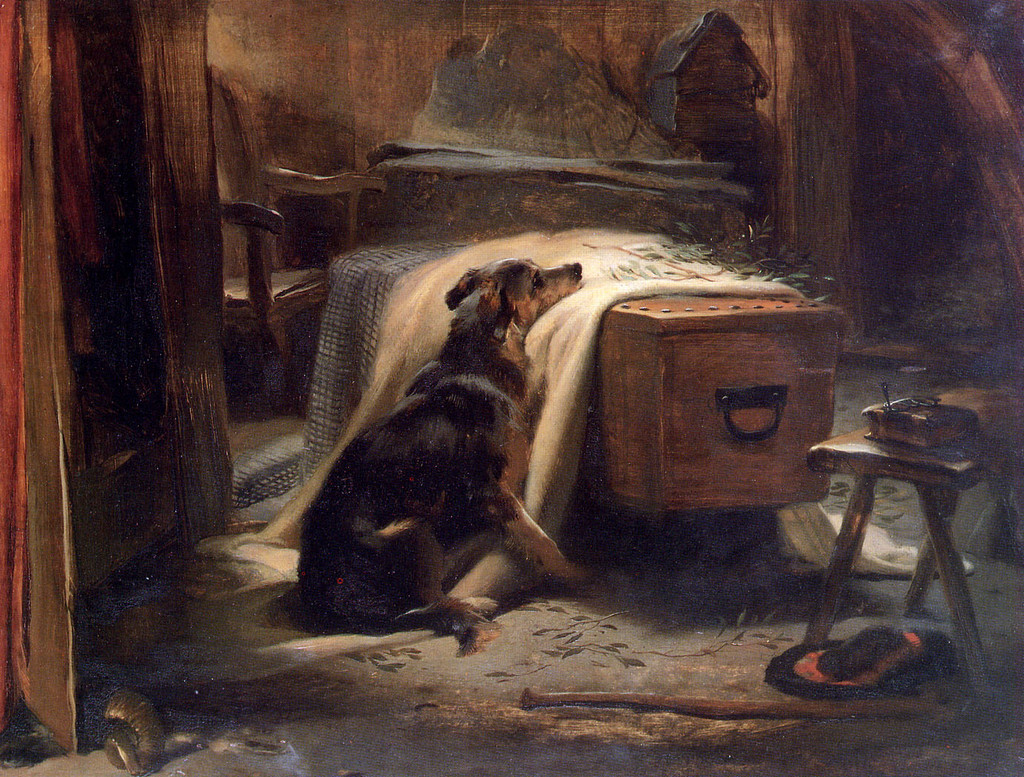
| The Old Shepherd's Chief Mourner | 1837 | Painting |
| The Sanctuary | 1842 | Painting |
| The Stricken Deer | Painting | |
| The Twa Dogs | Painting | |
| Time of Peace | ||
| Two stags running | Drawing | |
| Victoria, Princess Royal, with Eos | Painting | |
| View of Glenfeshie | Painting | |
| War | Painting | |
| White Horse in a Stable | Painting | |
| Windsor Castle in Modern Times | 1841–43 | Painting |
| Woburn Abbey Game Card | 1825; portfolio issue 1848 |
Discussion
Use the article’s images and evidence to develop your own reading of The Arab Tent.
Reader Insights
Which detail is most revealing when you consider “A mare and foal at rest”?
How does the evidence in “Fabrics, fur and a low roof” affect your reading of The Arab Tent?
What further question would you bring to “Conservation and the visible painting”?
Join the Conversation
Share a detail, comparison or question about The Arab Tent below.
References
- Wallace Collection, The Arab Tent, P376, current metadata, Description and Provenance tabs. Accessed 31 October 2026. View source.
- Wallace Collection, colour image of The Arab Tent, P376, accompanying the collection record. Accessed 31 October 2026. View source.
- James Dafforne, Pictures by Sir Edwin Landseer, Royal Academician, with Descriptions and a Biographical Sketch of the Painter, London: Virtue, 1873, pp. 61 and 82. The exhibition title and no. 92 are recorded in Dafforne's list. Accessed 31 October 2026. View source.
- British Royal Commission, The British Section at the Vienna Universal Exhibition, 1873: Official Catalogue, London: J. M. Johnson & Sons, 1873, p. 100, no. 37, The Arab Tent. Accessed 31 October 2026. View source.
- National Gallery of Art, Alpine Mastiffs Reanimating a Distressed Traveler. View source.
- Minneapolis Institute of Art, The Cat's Paw. View source.
- Birmingham Museums Trust, The Hunting of Chevy Chase. View source.
- Victoria and Albert Museum, The Old Shepherd's Chief Mourner. View source.
- Tate, Dignity and Impudence. View source.
- Royal Collection, Eos. View source.
- National Galleries of Scotland, The Monarch of the Glen. View source.
- Royal Holloway, University of London, Man Proposes, God Disposes. View source.
- Wallace Collection, The Arab Tent. View source.
- Trafalgar Square / Greater London Authority, The Lions at the Base of Nelson's Column. View source.
- Anonymous, Royal Academy exhibition review, The Examiner, 5 May 1866, p. 279. Accessed 31 October 2026. View source.
- National Exhibition of Works of Art, at Leeds, 1868: Official Catalogue, p. 79, no. 1341, The Indian Tent. Accessed 31 October 2026. View source.
- F. G. Stephens, Sir Edwin Landseer, London: Sampson Low, Marston, Searle & Rivington, 1880, p. 107. Accessed 31 October 2026. View source.
- W. Cosmo Monkhouse, The Studies of Sir Edwin Landseer, R.A., London: Virtue, 1877, p. 123. Accessed 31 October 2026. View source.
- Richard Ormond, Sir Edwin Landseer, Philadelphia Museum of Art and Tate Gallery, 1981, p. 209, entry 152, No Hunting Till the Weather Breaks. Accessed 31 October 2026. View source.
- Wallace Collection, Annual Report and Accounts 2017–18, p. 10. Accessed 31 October 2026. View source.
- Splash image, The Arab Tent. Wallace Collection. Image source. Public domain.
- Navigation image, One of the bronze lions at Nelson’s Column: modelled by Edwin Landseer and cast by Carlo Marochetti. Photograph by Amanda Slater. CC BY-SA 2.0. Image source. CC BY-SA 2.0. Resized.