by Tom Gurney
Tom Gurney BSc (Hons) is an art history expert with over 20 years experience
Email: tomgurney1@gmail.com / Phone: +44 7429 011000
What is A Deerhound?
A Deerhound is a small oil painting on board made by Sir Edwin Henry Landseer in 1826. It belongs to The Metropolitan Museum of Art in New York, where it is catalogued as object 2018.289.4. The board measures 12 1/16 × 16 1/16 inches, or 30.6 × 40.8 centimetres. It entered the collection in 2018 through the Eugene V. and Clare E. Thaw Charitable Trust.[1]
A fawn-coloured hound stands across the foreground, its head lowered towards the left and its body extending towards the right. Rocks, sparse plants and distant blue-green ridges place it in a Highland-type landscape. Yet the picture is neither a straightforward modern breed portrait nor an uncomplicated record of place. Its title has changed, its earliest ownership is untraced, the same dog reappears in a grand aristocratic composition, and infrared imaging has found the drawing of a woman's head beneath the visible paint.[1]
Those complications make the modest dimensions deceptive. Landseer used a single board to consider an individual animal, a landscape setting and at least one earlier pictorial idea. Later viewers then encountered the work through engraved translations that altered its colour and edges. One writer saw a hound ready to spring; another complained about its foreleg while admitting that the fault might lie in the printed “cut”. The picture's history is therefore also a history of naming and looking.[2][3]
The secure facts should come first. This is an 1826 oil on board, not a work of 1926. It is in a public museum, not an unidentified private collection. The current museum title is A Deerhound, but that title records the earliest known published name rather than proving a pedigree in the modern sense.[1]
At a Glance
- ArtistEdwin Landseer [1]
- Date1826 [1]
- Collection or siteMetropolitan Museum of Art [1]
- Object2018.289.4 [1]
This work across Edwin Landseer’s career
The Cat's Paw
c. 1824 [5]The Hunting of Chevy Chase
1825–26 [6]The Monarch of the Glen
about 1851 [11]Contents
- What is A Deerhound?
- Why the title has a history
- The dog and the Duke of Gordon
- A body stretched across the board
- Head, ears, collar and gaze
- Coat, colour and the modern standard
- Rocks and an unspecified Highland setting
- A study with selective finish
- The woman beneath the dog
- What nineteenth-century engravings made visible
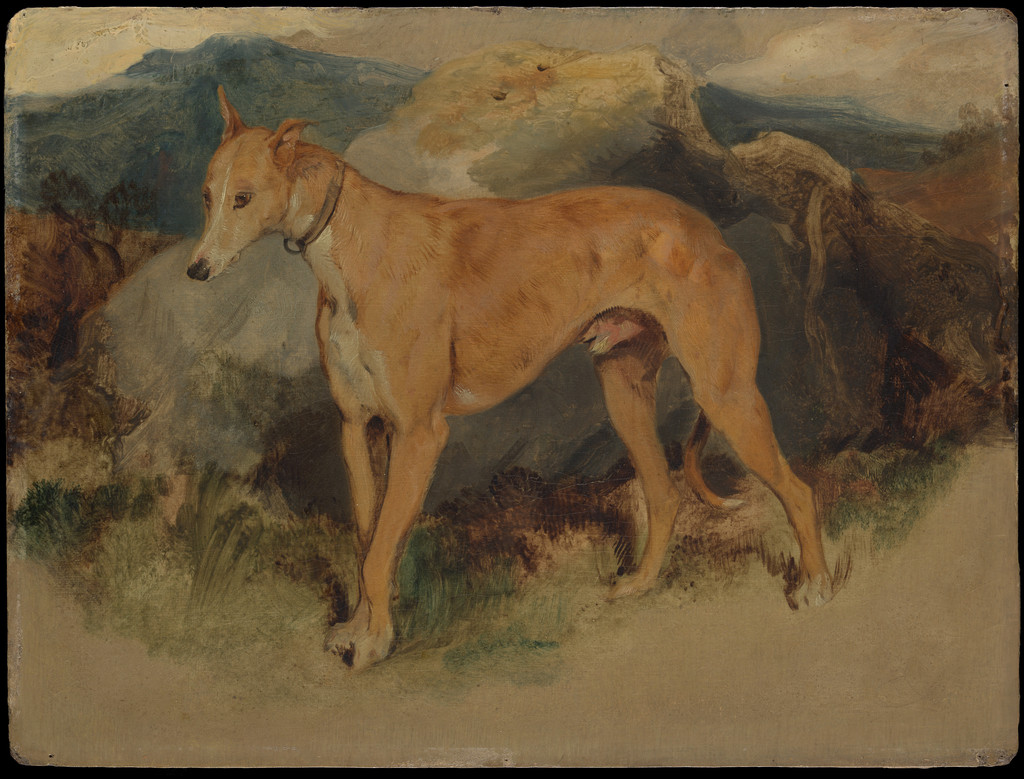
A Deerhound. Metropolitan Museum of Art. Image source. Public domain.
Why the title has a history
The first documented publications of the painting appeared almost half a century after it was made. In 1875 The Art Journal reproduced it as A Deer-hound, dated 1826 and lent by the London firm Henry Graves & Co. W. Cosmo Monkhouse used the same name and date in 1877 and again in a later volume. The Met has adopted that earliest published designation for the current title.[1][2][3]
Other labels followed. An undated cutting attached to the frame calls the animal a greyhound, although the Met has not traced the sale or exhibition catalogue from which the cutting came. When C. Fortescue Webb's picture was sold at Christie's in 1953, it was listed as A Greyhound. In January 1969, Graham Gallery in New York exhibited it as Scottish Lurcher. It still bore that title when it passed from Eugene V. Thaw to the Met in 2018.[1]
These names are not merely three competing answers to a zoological quiz. They belong to different periods of dog classification. The Met explains that a lurcher is a cross involving a sighthound, such as a greyhound or deerhound, and another kind of dog, often a herding dog or terrier. It judges “lurcher” an apt description of the animal's form, while warning that the now-familiar system of pure breeds, pedigrees and crossbreeds was not common practice until the 1850s.[1]
The warning matters because Landseer's board predates that change. The Royal Kennel Club says the earliest formal breed standards arose during the nineteenth century, as breeders began defining preferred types. The club itself was founded in 1873 and subsequently centralised those standards.[14] An animal painted in 1826 can certainly resemble dogs later organised under a breed name. It cannot be assigned a documented lineage merely because a later standard supplies a close visual match.
A Deerhound is consequently the right historical title and an incomplete biological claim. It tells us how the picture was first published and how the Met now catalogues it. It does not tell us the dog's parents, breeder, age or registration. The shifts from deerhound to greyhound to Scottish lurcher, and back again, are evidence of changing descriptive systems rather than evidence that the animal itself changed.
The dog and the Duke of Gordon
The animal was not invented for this little board. The Met identifies the same dog in Landseer's much larger Scene in the Highlands, painted about 1825–28. There it appears in a similar attitude, pressing its muzzle beneath the hand of George Gordon, 5th Duke of Gordon. That recurrence makes the hound an individual observed more than once, even though its name is no longer known.[1]
National Galleries of Scotland records the large canvas as an ambitious early sporting composition set at Glenfeshie in the Cairngorms. The Duke reclines after the hunt while his sister Georgiana, Duchess of Bedford, and her young son Lord Alexander Russell approach. Made on a scale of about 130.5 × 166 centimetres, the painting was exhibited in 1828 and is now a private-collection loan to the Scottish National Gallery.[15]
The relationship between the two works changes how the small one can be read. The board isolates a dog which the larger canvas restores to human company, field sport and aristocratic portraiture. In the group portrait, a hand meets the animal's raised muzzle. On the board, the person is absent and the lowered head has no visible destination. What looks like a self-contained animal portrait is also the close study of a participant later embedded within a social scene.
That connection has limits. The Met calls the Duke the dog's master in the larger painting, but its provenance for the board does not begin with Gordon. No checked record says that he ordered, paid for or first owned this smaller picture. Nor does the Glenfeshie setting of the group portrait prove that every rock and ridge on the board records the same place. Patronage, ownership and topography remain three separate questions.[1][15]
The association is still significant. Landseer's first Scottish visit took place in 1824, and these works stand near the beginning of the sustained Highland engagement that shaped his career. The Met describes the larger canvas as one of his first aristocratic hunting portraits and a milestone in his rise as a painter of animals and sporting life.[1] The small board lets us see that rise at the level of one dog's body before the full ceremonial company closes around it.
A body stretched across the board
The dog's long horizontal axis governs the composition. Its narrow head begins left of centre, the spine travels across the middle, and the hindquarters occupy the right half. The tail descends and bends inward near the rear legs. Instead of racing, leaping or turning sharply, the animal stands with all four limbs contributing to a complicated distribution of weight.
The nearer foreleg reaches down and slightly forward, ending in a broad pale paw. The farther foreleg is partly hidden by the chest and merges with the shadowed rock behind it. This overlap can make the front assembly look uncertain, especially in a monochrome reproduction. In the colour image, changes of warm brown, cream, grey and dark outline help separate shoulder, brisket, leg and stone.[16]
The chest is deep without appearing broad. Behind it, the underside rises towards a tucked waist before dropping into the hind legs. A gentle arch carries the back towards the rump. The near hind leg is almost straight, while the farther one bends and steps inward, its pale foot showing between the other limbs. These variations prevent the stance from becoming a diagram of perfect symmetry.
Male anatomy is visible beneath the abdomen, so Landseer represented a male dog. That is a visual observation rather than a surviving biographical record: the Met does not publish a sex, age or personal name for the sitter.[1] The distinction is worth retaining. A painting can preserve bodily information while the archive loses the animal's identity.
Landseer also varies the degree of resolution across the body. Short strokes pick out the shoulder, ribs, flank and haunch without tracing every contour equally. Some edges are crisp against the rocks; others dissolve into adjacent brown or grey. The result is a body that feels studied through successive decisions rather than polished into a single unbroken outline.
Movement remains potential, not fact. Long legs, a deep chest and a tucked abdomen are compatible with a running hound, but the board shows standing. No deer, handler, command or course is visible. The animal's structure permits a viewer to imagine speed; the depicted event does not confirm that a start is imminent.
Head, ears, collar and gaze
The head is angled down and left. A long tapering muzzle ends in a dark nose, while pale paint runs along the face and around the mouth. A small dark eye sits beneath the brow. It catches attention because the surrounding head is built from warm, light tones rather than because the eye is enlarged or theatrically highlighted.
The ears do not form a matching pair. The ear at the far side rises to a pointed silhouette; the nearer ear folds or twists back, exposing a darker inner turn. This asymmetry makes the head responsive without identifying what, if anything, has caused the response. Calling both ears “pricked” would flatten an important difference.
A narrow dark collar circles the neck. Its simple band provides one of the clearest signs that this is a human-kept dog rather than an anonymous creature encountered in open country. No lead is attached and no inscription or medal is legible. The collar connects the solitary figure to human use and ownership while withholding the owner from view.
The direction of the eye and muzzle has encouraged narrative. A viewer may feel that the dog notices something beyond the left edge. Yet the picture supplies no target. “Looking left” is visible; “watching prey”, “awaiting an order” and “obeying a master” are stories added to that visible direction. Landseer's restraint leaves room for such stories without verifying any one of them.
The Met describes the subject's vivacity and poise, a useful institutional interpretation rather than a clinical account of temperament.[1] Poise belongs to the balance of the painted stance. Vivacity is an effect produced by the uneven ears, intent eye, extended limbs and open space before the muzzle. Neither word requires pretending that a viewer can recover the dog's thoughts.
Coat, colour and the modern standard
The painted coat is warm fawn or sandy red. Darker brown marks run along the back, shoulder and haunch, while cream and white spread over the muzzle, blaze, throat, chest, underside, lower legs, paws and tip of the tail. The contrasts are strongest at the front of the body, where the pale chest stands against grey stone and a darker foreleg.
Much of the coat looks short and close. Landseer uses fine directional strokes around the neck, shoulder and flank, but he does not build the shaggy envelope now commonly associated with a Scottish Deerhound. This visual difference helps explain why later cataloguers saw a greyhound or lurcher. It should not be turned into a claim that the artist misunderstood a fixed breed.
The current Royal Kennel Club standard describes a Deerhound as a “rough-coated greyhound of larger size and bone”. It calls for a shaggy but not woolly coat, with harsh or wiry hair on the body, neck and quarters. It also describes the deep chest, arched loin, powerful hindquarters and long tapering tail that make parts of Landseer's animal look familiar.[17]
Colour produces a second mixture of agreement and difference. The modern standard accepts sandy-red or red-fawn coats with black points, and permits limited white on chest, toes and tail tip. At the same time, it treats a white blaze on the head as unacceptable in today's show ring.[17] Landseer's dog has just such a conspicuous blaze, as well as extensive pale colouring elsewhere.
This comparison is descriptive, not judicial. A show standard revised in 2025 cannot be used to fault a dog painted forty-seven years before the Kennel Club was founded. Nor can a painted surface disclose genes. The comparison instead makes visible the historical problem that the Met's title account describes: the animal shares features with later deerhound, greyhound and lurcher categories without becoming fully recoverable through any one of them.[1][14]
The coat also demonstrates why the colour image matters. In the nineteenth-century engravings, warm fawn, red-brown, blue-green and ochre all collapse into black lines and grey tones. Spots and modelling become hatch patterns. Viewers of those prints were judging a translated body whose surface could look rougher, darker or more anatomically confused than the oil.
Rocks and an unspecified Highland setting
The landscape is compact but carefully organised. A pale grey rock rises behind the dog's head and chest, separating the warm muzzle from the distant ridge. A much larger ochre-grey boulder fills the centre behind the shoulders and back. To the right, darker rocks and brown vegetation gather around the hindquarters, while the far ridge falls away beneath a pale, clouded sky.
The lower edge is open and thinly worked. Patches of light board or pale paint alternate with green, grey and brown strokes. Some marks suggest tufts and low growth, but the image does not allow a secure botanical list. “Vegetation” is safer than gorse; shifts in green and brown are safer than naming moss on the boulders.
The dog and terrain are joined by colour. Warm body tones return in the central rock, while pale markings echo the foreground and sky. Dark accents at the collar, eye, nose and haunch converse with the right-hand mass. The landscape therefore does more than announce Scotland. It creates a set of tonal supports against which different parts of the dog become visible.
Landscapes of this kind can seem topographically persuasive without recording an identifiable viewpoint. Monkhouse called the background “Scotch moorland”, and the related group portrait is documented at Glenfeshie.[15][3] Neither fact names the location of the board. The distant forms may belong to observation, memory, adaptation or a combination of them; the surviving public record does not choose among those possibilities.
The absence of a named place changes the viewing task. Instead of hunting for a mountain's identity, one can watch how the ridges lower the horizon around the animal, how the central boulder anchors the torso and how the open ground gives the legs room. The setting is specific in pictorial function even when it remains geographically unspecified.
A study with selective finish
The Met places A Deerhound among Landseer's small oils on board, works through which he explored subjects and developed technique. It finds this example unusual because the dog can be connected directly to a much more ambitious composition.[1] “Study” here describes a working scale and relationship; it does not mean that the object lacks interest outside the larger canvas.
The dog's face, collar and front of the body carry concentrated attention. Around the eye and muzzle, small changes of tone establish bone, skin and expression. The chest is modelled through pale strokes over warm undercolour. Across the flank and hindquarters, wider touches state volume economically. The landscape broadens still further, especially in the sky and lower ground.
These changes make finish selective rather than simply present or absent. The body can be sharply separated from one rock and nearly absorbed into another. A paw may be carefully modelled while the ground beneath it remains a few strokes. The board's edges and pale lower zone remain visible as parts of the working image instead of being hidden behind a uniformly filled surface.
It would be risky to convert this appearance into a precise account of making. No checked public record gives a sitting schedule, number of sessions, preparatory drawing for the dog, drying interval or sequence of landscape additions. Brushmarks show decisions on the surface; they do not provide a stopwatch.
Nor does selective working amount to a condition report. The Met publishes the medium and size, but no public treatment history, board identification, pigment analysis, ground study or detailed condition statement accompanies the object page.[1] A high-resolution photograph can support close looking at the composition. It cannot reliably distinguish every original thin passage from later wear, cleaning or retouching.
The small scale nevertheless offers a rare kind of access. In the large group portrait, the dog serves a complex arrangement of figures, horse, game and terrain. Here the animal fills the available field. Landseer's choices around a single ear, foreleg or pale paw become the main event rather than subordinate details within aristocratic ceremony.
The woman beneath the dog
The board contains an image invisible in ordinary light. Infrared reflectography undertaken by the Met revealed the drawing of a woman's head beneath the painted surface. The museum's technical note records an OSIRIS InGaAs near-infrared camera with a spectral response of 900–1700 nanometres.[1]
This is an infrared reflectogram, not an X-ray. The distinction matters because calling every greyscale technical image an X-radiograph obscures what the museum actually did. The additional image supplied through the Met's collection data shows the board turned vertically so that the underlying head reads upright. Traces of the visible dog cross that hidden image at a different orientation.[16]
The woman appears in profile or three-quarter profile, with a mass of hair above and behind the head and dark passages around the upper body. The Met suggests that she may be Georgiana, Duchess of Bedford. She was George Gordon's sister and one of Landseer's most loyal patrons.[1] The identification is plausible within the network surrounding the related group portrait, but it remains tentative.
Infrared evidence therefore expands the object's history while setting a firm boundary. It establishes that the board carried another drawn idea beneath the dog. It does not establish when that drawing was made, whether it was intended as a finished portrait, whether a commission was cancelled or why Landseer painted across it. The word “may” protects the difference between recognition and proof.
The hidden head also changes the meaning of economy. A small board might be treated as a conveniently available surface, but availability is not the same as insignificance. Landseer could preserve one observation over another, rotate the support and allow an earlier idea to disappear. The surviving object records that physical succession even though the motives behind it are lost.
For the viewer, the reflectogram creates two orientations. Horizontally, the visible dog occupies a Highland landscape. Vertically, the underlying woman becomes legible. Neither image cancels the other. Together they make the board a site where portraiture of a person and study of an animal literally overlap.
What nineteenth-century engravings made visible
The painting's public history began late. The Met says it was first known through an engraving published in The Art Journal in 1875.[1] On the printed page, A Deer-hound (1826) appears in black and white beneath a study of rams' heads. Henry Graves & Co. is named as lender.[2]
The accompanying writer describes a small oil sketch that is slight yet studied. He sees the near foreleg bent, the head advanced, ears raised and eyes fixed on a distant object. From those features he derives a posture of “readiness for a start”. He also records a light-brown animal with darker marks on its back and haunches, set against green turf.[2]
The account is valuable because it fixes an early title, date, owner and way of seeing. It is not a transcript of canine intention. The distant object belongs to the writer's imagined continuation beyond the frame, just as readiness converts a standing pose into the instant before action. The interpretation shows how successfully the printed figure invited narrative.
Two years later Monkhouse looked differently. His Studies of Sir Edwin Landseer reproduces the work as Plate XI. He finds the moorland more remarkable than the dog, says the animal lacks character and complains that something seems wrong with one foreleg. Then comes the crucial parenthesis: “at least in our cut”.[3]
That qualification recognises the engraving as an intermediary. Dense hatching darkens the dog's torso, while the overlapping front legs can become a single awkward shape. The print also regularises some of the oil's broken edges and replaces its warm and cool relationships with line density. A criticism directed at the cut need not describe the board in the same way.
The two writers do not have to be reconciled into one verdict. The first makes a poised body dynamic; the second finds the printed anatomy deficient. Their disagreement is more illuminating than an invented consensus. It demonstrates that Landseer's study generated different animals in words: one about to launch, another insufficiently characterised, both derived from a reproduction of the same oil.
Returning to the Met image does not make interpretation disappear. It makes the material differences easier to see. Colour separates the forelegs more clearly, and thinly worked ground surrounds the paws. The painting still supports a sense of suspended action, but it no longer needs to be treated as a literal command scene or a flawless anatomical specimen.
The related canvas before the public in 1828
The small board has no documented exhibition in 1826 or 1828. Its related composition does. Scene in the Highlands appeared at the Royal Academy in 1828, during an exhibition that ran from 5 May to 12 July and contained 1,214 works by 640 artists.[15][18]
A review in The Examiner describes the Duke of Gordon resting after the hunt, with the Duchess of Bedford and Lord Alexander Russell approaching after angling. The critic thought broad lights on the horse and dog gave those animals so much importance that they competed with the people for primacy. Despite that imbalance, the picture was called “full of excellent painting”.[19]
This is reception of the large canvas, not of A Deerhound. Its relevance lies in the shared animal. The dog Landseer had isolated on board could command attention even after being placed among aristocratic sitters, horse, dead game and landscape. What the small study gives almost entirely to the hound, the large painting negotiates between animal presence and human rank.
The review also cautions against assuming that a study simply disappears inside its final context. The animal may become one component of a group, yet light and pose can keep it visually competitive. Landseer's reuse of the dog was not just a transfer of outline; it carried forward a concentrated presence powerful enough for a critic to notice.
From Henry Graves to The Met
The documented ownership chain begins in 1875, not 1826. Henry Graves & Co. had the picture when The Art Journal published it and retained it until at least 1880. It later belonged to C. Fortescue Webb of Orchard Hill, Old Bursledon, Hampshire.[1][2]
Webb's ownership ended with a Christie's sale in London on 13 March 1953. Lot 35 was offered as A Greyhound and sold for £3.3 to a buyer recorded simply as Smith. The Met's provenance then lists Smith, followed by Bowden Broadwater in New York by 1969 and Eugene V. Thaw in New York until his death in 2018.[1]
That chain leaves nearly fifty years between the date of the painting and its first documented appearance with Graves. The connection to the Duke of Gordon cannot fill the gap automatically. The same dog in a portrait of the Duke proves a relationship of subject; it does not prove an unbroken descent through Gordon ownership.
The exhibition history published by the Met is equally compact. Graham Gallery included the painting in Birds and Beasts from 4 to 30 January 1969, under the title Scottish Lurcher and lent by Bowden Broadwater. The museum explicitly notes that it was not in the exhibition catalogue.[1] This makes the record useful but qualified: it preserves a title, lender, venue and date without supplying a catalogue entry to inspect.
When the work reached the Met in 2018, the Thaw charitable trust's gift placed it in a public collection. The museum's 2021 catalogue entry restored A Deerhound, the earliest documented name. Provenance and title history thus converge at the present object record, but neither erases what remains unknown about the first decades.[1]
A public-domain image with meaningful edges
The Met marks A Deerhound Public Domain. Its collection API returns `isPublicDomain` as true and supplies both the primary colour image and the additional infrared image.[1][16] Under the museum's Open Access policy, images of public-domain artworks and basic collection data are released under Creative Commons Zero for unrestricted reuse.[20]
The primary image matters for more than convenient illustration. It includes the complete irregular edge of the board against a dark surround. The uneven perimeter, small holes and changing width of the pale margin become part of the visible object. A tight crop can turn that object into a seamless rectangular scene and make the thinly worked lower zone look like an intentional border rather than an exposed part of the board.
Colour is equally consequential. The warm body, grey stones, ochre central boulder, blue-green ridge and pale sky separate elements that merge in nineteenth-century engravings. The image does not deliver pigment measurements or a condition diagnosis, but it permits a more responsible account of the picture's present visible relationships.
The infrared file serves a different purpose. It is not an alternate beauty shot or a closer detail of the hound. It documents technical examination and must be interpreted through the museum's catalogue entry.[1][16] Treating the two images as interchangeable would confuse ordinary-light appearance with information gathered beneath the paint.
Open Access also improves attribution. Instead of relying on a commercial print image or an unexplained cropped copy, a reader can return to the museum's record, object number and downloadable master. That connection keeps title, date, ownership, catalogue interpretation and image identity together.[20]
What the painting does and does not tell us
A Deerhound preserves an unnamed male hound with unusual intimacy. Its long body is spread across a board small enough for the brushwork to remain legible. The lowered head, unequal ears, dark eye and offset forelegs suggest attention without naming its cause. Rocks and ridges create a credible Highland environment without becoming a documented map.
The work also belongs to more than one context. The same dog enters the Duke of Gordon's group portrait; an earlier woman's head survives beneath the paint; engravings carry the image into late nineteenth-century criticism; changing labels track the development of modern breed categories; and a twentieth-century ownership chain ends in the Met's open collection.[1]
What remains unknown is just as precise. The dog's name, age and pedigree have not been recovered. The Duke's connection does not establish ownership of this board. The exact landscape is not identified. The underlying woman may be Georgiana, but the drawing has no published date or purpose. No public technical dossier explains board species, pigments, condition or treatment. The earliest provenance still begins in 1875.
These gaps do not weaken the picture. They prevent a vivid animal from being reduced to a string of confident inventions. The title can be historically correct without functioning as a pedigree certificate. The stance can evoke movement without proving a command. The landscape can feel Highland without naming a mountain. The infrared image can reveal another head without solving its story.
Look first at the visible decisions: one ear up and one turned, the pale muzzle against grey rock, the forelegs separated by colour, the warm back crossing the central boulder, and the tail folding into open ground. Then let the related canvas, old engravings and hidden drawing enlarge the field. Landseer's small board rewards that order because it gives evidence before it gives certainty.
Artworks directory
This directory gathers works discussed in the articles, including drawings, original etchings and prints after Landseer. It is not a complete catalogue of every drawing, version, plate or impression. Distinct media are kept separate; uncertain dates are left blank. Linked titles open individual articles.
| Name | Date | Medium |
|---|---|---|
| A Bellowing Stag | Drawing | |
| A Deerhound | 1826 | Painting |
| A Distinguished Member of the Humane Society | 1838 | Painting |
| A Highland Breakfast | 1834 | Painting |
| A Highland Landscape | c. 1830 | Painting |
| A Highland Shepherd's Home | Painting | |
| A Horse, Goat and Bull | 1811 | |
| A Hunting Horse | Drawing | |
| A Jack in Office | Painting | |
| A Lion Disturbed at His Repast | Painting | |
| A Random Shot | Painting | |
| A Scene at Abbotsford | Painting | |
| Adversity | Painting | |
| Alexander and Diogenes | exhibited 1848 | Painting |
| Alpine Mastiffs Reanimating a Distressed Traveler | 1820 | Painting |
| Contending Group after Nature | Drawing | |
| Copy after Rubens's Wolf and Fox Hunt | c. 1824–26 | Painting |
| Dash | Painting | |
| Deer and Deer Hounds in a Mountain Torrent ('The Hunted Stag') | c. 1832 / exhibited 1833 | Painting |
| Deer Family | ||
| Dignity and Impudence | 1839 | Painting |
| Dog Resting Upon a Couch | Drawing | |
| Eos | 1841 | Painting |
| Favourites, the Property of H.R.H. Prince George of Cambridge | 1834–35 | Painting |
| Her Majesty Sketching at Loch Laggan | ||
| High Life | 1829 / exhibited 1831 | Painting |
| Highland Lassie | Drawing | |
| Isaac van Amburgh and his Animals | 1839 | Painting |
| Lady Godiva's Prayer | Painting | |
| Laying Down the Law | 1840 | Painting |
| Lion Defending Its Prey | c. 1840 | Painting |
| Lioness | Drawing | |
| Little Strollers | ||
| Low Life | 1829 / exhibited 1831 | Painting |
| Man Proposes, God Disposes | 1864 | Painting |
| Nell Gwynne / Diana Vernon | Painting | |
| Neptune | ||
| No Hunting Till the Weather Breaks | Painting | |
| Otterhounds | Drawing | |
| Peace | Painting | |
| Pensioners | Painting | |
| Portrait of a Mule | Painting | |
| Portrait of Mr Van Amburgh, as He Appeared with His Animals at the London Theatres | 1846–47 | Painting |
| Portraits of a Pointer Bitch and Puppy | Painting | |
| Pray Let Me Out | ||
| Prosperity | Painting | |
| Ptarmigan in a Landscape | by 1833 | Painting |
| Queen Victoria and Prince Albert at the Bal Costumé of 12 May 1842 | 1842–46 | Painting |
| Queen Victoria at Loch Laggan | Painting | |
| Queen Victoria at Osborne | 1865–67 | Painting |
| Queen Victoria landing at Loch Muick | Painting | |
| Rat-catching | 1823 | |
| Reclining Lion | Drawing | |
| Reclining Lion, From Back | Drawing | |
| Rent-day in the Wilderness | 1855–68 | Painting |
| Return from Deer Stalking | 1839 | |
| Royal Sports on Hill and Loch | Painting | |
| Sam Lovill, Porter at the Royal Academy | Drawing | |
| Scene from A Midsummer Night's Dream | 1848–51 | Painting |
| Scene in the Highlands, with portraits of the Duchess of Bedford, the Duke of Gordon and Lord Alexander Russell | Painting | |
| Scottish Highlands, Lochs and Figures | Drawing | |
| Shoeing | exhibited 1844 | Painting |
| Sleeping Bloodhound | exhibited 1835 | Painting |
| Spaniel and Rabbit | Painting | |
| Stag at Bay | 1866 | Sculpture |
| Stag at Bay | 1846 | Painting |
| Studies of a staghound and the head of a stag for painting ‘The Hunting of Chevy Chase’ | Drawing | |
| Study for Alpine Mastiffs Reanimating a Distressed Traveler | Drawing | |
| Study for the Monkey in The Cat's Paw | Drawing | |
| Study of a Dog | Drawing | |
| Study of a herding dog facing right | Drawing | |
| Study of the horse of Selene, from the East pediment of the Parthenon | Drawing | |
| Suspense | Painting | |
| Taking a Buck | ||
| The Arab Tent | c. 1865–66 | Painting |
| The Barn | Drawing | |
| The Best Run of the Season | ||
| The Cat's Paw | c. 1824 | Painting |
| The Cavalier’s Pets | ||
| The Challenge | Painting | |
| The Chase | Drawing | |
| The Connoisseurs: Portrait of the Artist with Two Dogs | 1865 | Painting |
| The Death of a Stag in Glen Tilt | Painting | |
| The Drive—Shooting Deer in the Pass | Painting | |
| The Drover's Departure | Painting | |
| The Highland Shepherd’s Dog | 1824; portfolio issue 1848 | |
| The Honourable Mrs Norton | Painting | |
| The Hunting of Chevy Chase | 1825–26 | Painting |
| The Illicit Highland Whisky Still | Painting | |
| The Keeper John Crerar with his Pony | Painting | |
| The Larder Invaded | ||
| The Lion-Dog of Malta | ||
| The Lions at the Base of Nelson's Column | 1867 | Sculpture |
| The Monarch of the Glen | about 1851 | Painting |
| The Mountain Torrent | ||
| The Old Shepherd's Chief Mourner | 1837 | Painting |
| The Sanctuary | 1842 | Painting |
| The Stricken Deer | Painting | |
| The Twa Dogs | Painting | |
| Time of Peace | ||
| Two stags running | Drawing | |
| Victoria, Princess Royal, with Eos | Painting | |
| View of Glenfeshie | Painting | |
| War | Painting | |
| White Horse in a Stable | Painting | |
| Windsor Castle in Modern Times | 1841–43 | Painting |
| Woburn Abbey Game Card | 1825; portfolio issue 1848 |
Discussion
Use the article’s images and evidence to develop your own reading of A Deerhound.
Reader Insights
Which detail is most revealing when you consider “What is A Deerhound?”?
How does the evidence in “Why the title has a history” affect your reading of A Deerhound?
What further question would you bring to “What the painting does and does not tell us”?
Join the Conversation
Share a detail, comparison or question about A Deerhound below.
References
- The Metropolitan Museum of Art, “A Deerhound”, Sir Edwin Henry Landseer, 1826, object 2018.289.4; object information, overview, catalogue entry by Alison Hokanson (2021), provenance, exhibition history, references and notes. View source.
- J. Dafforne, “Studies and Sketches by Sir Edwin Landseer, R.A.”, The Art Journal, new series 1 (1875), pp. 354–55. View source.
- W. Cosmo Monkhouse, The Studies of Sir Edwin Landseer, R.A. (London: Virtue and Company, 1877), Plate XI and p. 49. View source.
- National Gallery of Art, Alpine Mastiffs Reanimating a Distressed Traveler. View source.
- Minneapolis Institute of Art, The Cat's Paw. View source.
- Birmingham Museums Trust, The Hunting of Chevy Chase. View source.
- Metropolitan Museum of Art, A Deerhound. View source.
- Victoria and Albert Museum, The Old Shepherd's Chief Mourner. View source.
- Tate, Dignity and Impudence. View source.
- Royal Collection, Eos. View source.
- National Galleries of Scotland, The Monarch of the Glen. View source.
- Royal Holloway, University of London, Man Proposes, God Disposes. View source.
- Trafalgar Square / Greater London Authority, The Lions at the Base of Nelson's Column. View source.
- Royal Kennel Club, “About Breed Standards”. View source.
- National Galleries of Scotland, “Scene in the Highlands, with portraits of the Duchess of Bedford, the Duke of Gordon and Lord Alexander Russell”, NGL 004.91. View source.
- The Metropolitan Museum of Art, Collection API, object 782306. View source.
- Royal Kennel Club, “Deerhound: Breed Standard”, last updated 1 August 2025. View source.
- Tom Ardill, “1828: Reconstructing The School of Painting”, The Royal Academy of Arts Summer Exhibition: A Chronicle, 1769–2018, Royal Academy of Arts and Paul Mellon Centre, 2018. View source.
- “Fine Arts”, The Examiner, no. 1065, 29 June 1828, p. 405. View source.
- The Metropolitan Museum of Art, “Open Access at The Met”. View source.
- Splash image, A Deerhound. Metropolitan Museum of Art. Image source. Public domain.
- Navigation image, One of the bronze lions at Nelson’s Column: modelled by Edwin Landseer and cast by Carlo Marochetti. Photograph by Amanda Slater. CC BY-SA 2.0. Image source. CC BY-SA 2.0. Resized.