


 by Tom Gurney
Tom Gurney BSc (Hons) is an art history expert with over 20 years experience
Published on June 19, 2020 / Updated on September 27, 2026
Email: tomgurney1@gmail.com / Phone: +44 7429 011000
Paul Klee’s With the Setting Sun
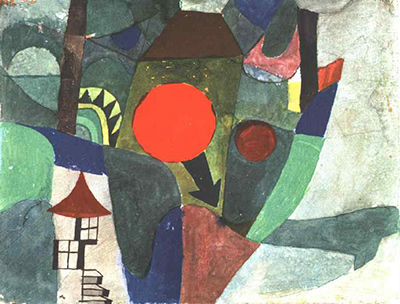
Paul Klee called this work mit der sinkenden Sonne, commonly rendered in English as With the Setting Sun or With the Sinking Sun. The Zentrum Paul Klee, Bern, records it as 1919, 247, a watercolour on prepared paper mounted on cardboard, measuring 19.6/20 × 26.2 cm. The original is in a Swiss private collection, deposited at the Zentrum Paul Klee. Its red disc, geometric landscape and small structure at lower left are visible in the museum's complete reproduction and in the site's older cropped image. That direct comparison identifies the local picture, while the older file's download source remains unknown.[1][2]
Reading the landscape
A bright red circle dominates the middle of the image, immediately suggesting the sinking sun named in the title. Around it, fields of green, blue, grey and pale cream overlap. A dark vertical on the left resembles a tree trunk or post. A little building with a peaked red roof appears at the lower left; stepped shapes continue beneath it. Above and to the right, angular bands and curved colour areas resist an ordinary horizon line. This is a landscape built from adjacent and intersecting shapes, not a faithful view of a documented place.[1][2]
The colour relations do much of the work. Red recurs in a smaller circle and other accents, while the large disc presses against a dark green field. Greens and blues do not simply fill a uniform ground; they make separate pieces of space that partly conceal each other. The pale right edge opens the picture outward. What looks like a tree, house or slope can be found, but none settles the whole arrangement into a single perspectival scene.[1]
The local legacy image crops away the mounted sheet's margins visible in the Zentrum Paul Klee's press reproduction. This makes the coloured scene appear more edge-to-edge on the website than it does in the owner-supplied view. Readers should distinguish the artwork's paper support, the painted area and the present digital crop when comparing proportions. The museum's 19.6/20 × 26.2 cm measurement is retained as recorded rather than simplified into a single height.[1][2]
Title, surface and movement
The German phrase mit der sinkenden Sonne makes the sun a companion to the scene; “setting” and “sinking” are both understandable English translations. The red disc is visually strong, but the work does not show a literal downward path. Instead, the eye can travel from the small house up through colour bands to the disc, then out toward the lighter right side. That path is a viewer's reading of the arrangement, not evidence that Klee encoded a fixed route or a lesson about work and rest.[1][2]
The prepared paper matters materially. The German Zentrum Paul Klee caption specifies Aquarell auf Grundierung auf Papier auf Karton: watercolour on a ground or preparation on paper on cardboard. The museum's French caption likewise gives aquarelle sur papier préparé sur carton. This is more precise than the former site's generic “painting” label. The prepared support and mounted format may affect how the colour appears, but the available press record does not identify the ground's chemical composition or Klee's painting sequence. Those questions require conservation documentation.[1][2][3]
The arrangement has a loose rhythm of repeated circles, strong verticals and broken diagonals. An exhibition at the Philharmonie de Paris included the work in Paul Klee Polyphonies, a presentation concerned with relationships between music and Klee's visual art. That exhibition context is a useful invitation to look at recurrence and variation here. It is not proof that this specific watercolour represents a score, a melody or a particular piece of music.[4]
The work's record and what it does not say
The work number 1919, 247 comes from the Zentrum Paul Klee's own caption, rather than an unverified list of translated titles. The institution also supplies the original German wording and the private-collection/deposit distinction. The Philharmonie's French exhibition checklist independently lists the work as held privately in Switzerland and on deposit in Bern. A deposit means the museum can present the piece without being its owner; the former site's claim that it simply belongs to a “Felix Klee Collection” is not the current institutional ownership wording.[1][2][4]
The older article attached a chain of psychological meanings to its colours: pale passages supposedly told the viewer to rest, red meant “stop,” and the lower-left steps encouraged renewed productivity. The work itself documents none of these messages. Its shapes can feel calm or unsettled, but an emotion is a response to the image, not a documented intention. The same caution applies to calling every angular shape an arrow or assigning the work to Cubism simply because it uses geometry.[1]
The year 1919 places the watercolour after the First World War, but the picture gives no direct evidence of a particular wartime trauma or a programme of recovery. Its title and visual structure are enough to discuss: a setting sun held within a landscape that simultaneously suggests a house, vegetation and shifting coloured planes. The tension between a familiar time of day and a deliberately unstable space is more interesting than an invented moral about the day's end.[1]
Image use
Related artworks
Explore eight other Klee works from the researched artwork cluster.
Hammamet with Mosque
1914
Flower Myth
1918
Angelus Novus
1920
Crystal Gradation
1921
Red Balloon
1922
References
- Zentrum Paul Klee, Kosmos Klee: Press Images, no. 03: artwork image, English title, work number, medium, measurement, deposit and press-image conditions, View source.
- Zentrum Paul Klee, Kosmos Klee: Mediendossier, no. 03: original German title and Aquarell auf Grundierung auf Papier auf Karton, View source.
- Zentrum Paul Klee, Kosmos Klee: Dossier de presse, no. 03: French rendering and prepared-paper description, View source.
- Philharmonie de Paris, Paul Klee Polyphonies: liste des œuvres: work and Swiss private collection on deposit at Bern in a music/art exhibition checklist, View source.