


 by Tom Gurney
Tom Gurney BSc (Hons) is an art history expert with over 20 years experience
Published on June 19, 2020 / Updated on September 27, 2026
Email: tomgurney1@gmail.com / Phone: +44 7429 011000
Rose Garden: when flowers and buildings share a rhythm
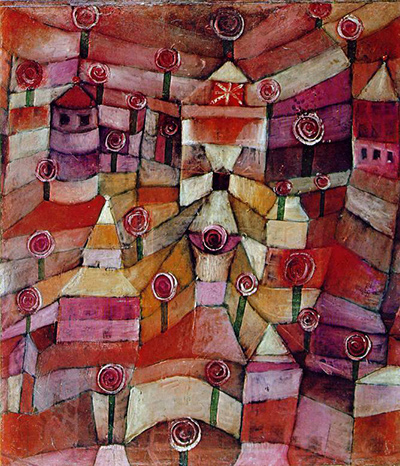
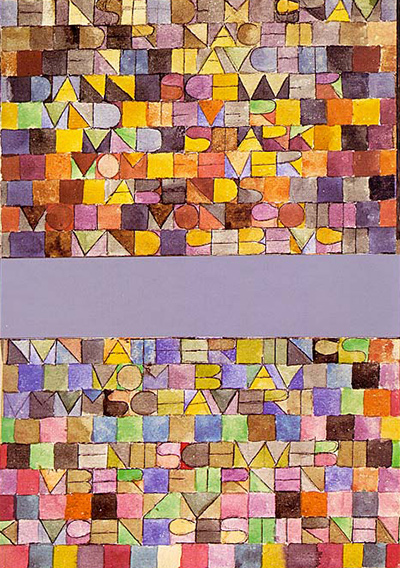
Paul Klee's Rose Garden (Rosengarten) is a 1920 painting held by the Städtische Galerie im Lenbachhaus, Munich as a permanent loan from the Gabriele Münter and Johannes Eichner Foundation. The owner records its date and work number as 1920,44, its medium as oil and pen on paper mounted on card, and its size as 49 × 42.5 cm. The inscription near the right centre reads Klee/1920/44. These details give a firmer starting point than the earlier description on this site, which reduced the material to oil on card and treated the work chiefly as a general example of Klee's colour.[1][2]
Roses appear throughout the picture as upright stems topped by circular, coiled heads. Around them are horizontal bands of pink, red, violet, ochre and muted green. Small roofs, towers and window-like openings rise out of the same bands. The scene is recognisably a garden, yet its built forms can also make it look like a town. The Lenbachhaus describes precisely this fusion of structures that grow and structures that are built: the garden is arranged by human design while its plants suggest organic life.[1]
A garden built in bands
The dark lines outline narrow, irregular rectangles and trapezoids. They resemble courses of masonry, terraces or plots of earth, but do not settle into a single map. The bands shift and step back around the central passage. Their colour is never simply one uniform red: pale pink gives way to wine, orange, plum and brown. The changes make neighbouring areas distinct while tying the picture together as one warm field.[1]
Klee sets several peaked pavilions and larger rounded structures among the stems. At left, a short cylindrical tower rises under a dark roof; at right, a taller block contains two small openings. Other roofs are scattered across the picture. They share the garden's colours and the same black contouring, so it is hard to draw a firm line between house and flowerbed. Architecture does not sit behind the garden as scenery. It grows through it.[1]
The rose heads supply a different kind of mark. Each is roughly circular, but the dark, inward-turning strokes vary from bloom to bloom. Seen together, they repeat across the surface like a motif. Their straight stems cut through the horizontal bands. The Lenbachhaus compares the flower heads to notes on stems: a helpful way to notice how upright and sideways movements cross, without claiming that the roses encode a literal tune.[1]
The former page described “lollipop heads”, a church, a Union Jack, a fish and a bird. A viewer may find some of those resemblances, but the owner's object account does not identify those specific subjects. The flag and animals are especially uncertain in the reproduced image. The revised reading stays with the clearly visible roses, roofs, bands and openings, while allowing the garden-town ambiguity to remain open.[1]
Growth and order
A planted garden is both natural and planned. The Lenbachhaus's interpretation makes that double character central: Klee brings organic growth and constructed order into a rhythmic whole. The rose spirals suggest unfolding, while the rectilinear plots imply measuring, dividing and tending. Neither side wins. The blocks create places for the flowers; the flowers interrupt the blocks.[1]
This was not the only garden image Klee made in 1920. Writing about Garden in the Plain II (with the Little Garden House), Ute Ackermann of the Klassik Stiftung Weimar places Rosengarten among other landscape and garden works of that year, including Hilly Terrain with Tree and Flower Rhythms and Camel (in a Rhythmic Landscape with Trees). Her essay shows that the garden was a sustained subject, rather than an isolated decorative theme. It also describes a different pair of 1920 garden pictures that Klee cut from one larger work. That particular two-part history must not be transferred to Rose Garden; its own history of trimming comes from the Lenbachhaus account.[3][1]
The Lenbachhaus says Klee cut down Rosengarten after completing it to arrive at his intended view. That information changes how its dense edge-to-edge arrangement can be understood. The picture looks as though its bands and stems might continue beyond the present borders, but the borders result from a deliberate choice. A cropped image on a website cannot show the discarded material or establish the precise order of cuts. The museum's account is the evidence for the cut-down format.[1]
Painting and music
Klee was trained as a violinist, and comparisons between painting and music recur in his writings. The owner essay relates the crosswise layering of this garden to rhythmic structure and cites his Bauhaus notes on cultural rhythms. It also connects the work to a 1917 diary entry in which Klee considered painting's capacity to hold several voices at once. The Zentrum Paul Klee reproduces the original German diary passage and identifies it as Tagebuch III, no. 1081. Klee's point is that multiple visual events can appear simultaneously in the space of a picture.[1][4]
That idea is useful when looking at Rose Garden. The horizontal bands, upright stems, circular blossoms and repeated roofs do not arrive one after another, as notes in a performance would. They are visible together, yet the eye meets them in different sequences. A person might first follow the rose heads; another might follow the coloured courses; a third might seek a way through the houses. Calling the picture rhythmic describes those visual relationships, not a proven musical score hidden in the composition.[1][4]
The Lenbachhaus also places this thinking alongside Klee's interest in Robert Delaunay and simultaneous colour. The artists approached pictorial rhythm differently, and the museum account distinguishes Klee's pursuit of precise formal relations from Kandinsky's emphasis on the inner resonance of colour. The comparison clarifies why the painting does not simply illustrate a garden: its red areas, contours and repeated signs are carefully ordered to make the viewer move across the sheet.[1][4]
Date, ownership and display
The date 1920 is important. It is the year of Klee's appointment to teach at the Bauhaus in Weimar, but the Zentrum Paul Klee's chronology places his arrival there in March 1921. Rose Garden should therefore not be described as a painting made while he was already teaching at the school. The museum's later references to his Bauhaus notes help interpret the work; they do not move its date forward.[4][3]
The picture also has a traceable later exhibition history. A Centre Pompidou catalogue of the 1978 Paris–Berlin exhibition lists it under the French title Roserie (Rosengarten), on loan from Galerie Beyeler in Basel. The Lenbachhaus records a 1980 acquisition and its present status as a permanent loan from the Gabriele Münter and Johannes Eichner Foundation. Those entries are snapshots of different moments, not evidence that it remained in a single display room throughout. The owner's current collection page marks it as not on display; exhibition status can change, so a visit should be checked against the museum's current listing.[5][1]
Rose Garden is most rewarding when neither “garden” nor “town” is treated as a puzzle with a hidden solution. The blossoms are real enough to name; the roofs and walls are real enough to suggest habitation. Their shared colours and repeated contours make them parts of one place. Klee's work makes cultivation visible as both growth and arrangement, and asks the viewer to find a route through several simultaneous rhythms.[1][3]
Related artworks
Explore eight other Klee works from the researched artwork cluster.
Hammamet with Mosque
1914

Flower Myth
1918

Angelus Novus
1920

Crystal Gradation
1921

Red Balloon
1922
References
- Städtische Galerie im Lenbachhaus, Rosengarten collection record (in German): object details and Helmut Friedel/Annegret Hoberg's 2007 collection essay on form, music and trimming, View source.
- Staatliche Museen zu Berlin, Das Universum Klee, exhibition worklist, 2008, p. 5 (in German): Rosengarten, work sequence 2389, 1920,44, medium, size and Munich owner, View source.
- Ute Ackermann, “Kleiner Klee – große Freude,” Klassik Stiftung Weimar, 2023 (in German): Klee's 1920 garden group and the separately documented cutting of Garden in the Plain I/II, View source.
- Zentrum Paul Klee, Klee & Kandinsky exhibition chronology, 2015 (German text): 1917 diary no. 1081 on polyphony and March 1921 Bauhaus arrival, View source.
- Centre Pompidou, Paris–Berlin exhibition catalogue, 1978 (in French): Roserie (Rosengarten) on loan from Galerie Beyeler, Basel, View source.