


 by Tom Gurney
Tom Gurney BSc (Hons) is an art history expert with over 20 years experience
Published on June 19, 2020 / Updated on September 27, 2026
Email: tomgurney1@gmail.com / Phone: +44 7429 011000
Revolving House: architecture set in motion
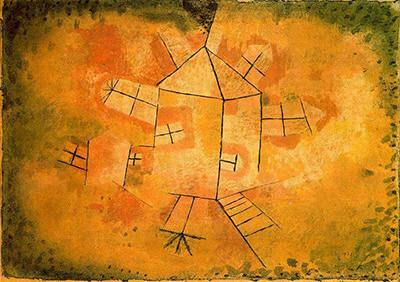
Paul Klee's Revolving House (Drehbares Haus, 1921) is in the Museo Nacional Thyssen-Bornemisza, Madrid. The museum records it as oil and pencil on cotton cheesecloth mounted on paper, measuring 37.7 × 52.2 cm (inventory 624 / 1982.22). A German exhibition checklist identifies the same work as 1921,183, with the catalogue sequence 2774, and calls the fabric Nesseltuch. The English title names a movement, but there is no literal rotating mechanism: Klee makes a building appear to turn by splitting and rearranging its parts.[1][2]
The painting was made during Klee's first months teaching at the Bauhaus in Weimar. It is tempting to read its geometry as a straightforward product of the school's later machine aesthetic. The owning museum relates it to a developing constructivist climate but also stresses Klee's resistance to a purely constructive system. Its more recent tour of domestic design calls the picture playful, almost like someone drawing a house as a child might and then opening it into a spinning arrangement. That context is more precise than treating the painting as an architect's measured plan.[1][3]
Looking at the house
At the top, roof-like slopes rise above a central vertical line. Smaller rectangles and crossed window shapes spread outward. Slanting lines below may suggest a stair, path, supporting structure or pieces released from the central house. Rather than one continuous wall enclosing a stable room, Klee offers parts that can be mentally assembled and disassembled. Some marks face front while others lean or swing away, so the viewer must change viewpoints while looking.[1][3]
The configuration can be seen as one house becoming many, or as a small city turning around an imaginary axis. Paloma Alarcó's museum essay favours the latter: buildings project from a central point, producing a rotation like a wheel. Yet the image does not draw a complete wheel or specify which wall belongs to which building. Those uncertainties are integral to the effect. The work borrows architectural signs without making a blueprint that could be built.[1]
Earthy yellow, orange, pink and brown carry the lines. A darker border surrounds the brighter centre, while the fabric's uneven edges make the image seem both a physical object and a place. The marks can look slight compared with a finished building, but their apparent fragility is what lets the house move. A solid, single-perspective structure would hold its parts still; this one leaves them open to rearrangement.[1][4]
The earlier article on this site counted seven windows, named three particular window types and described a definite front-door path. The reproduction does not warrant that architectural inventory. Its crossed and arched marks invite such associations, but a specific window schedule or entrance cannot be established. The page now describes the marks and the movement they create without assigning a fixed function to every line.[1]
Cotton cloth as part of the meaning
The unusual support deserves as much attention as the drawing. The Thyssen identifies cotton cheesecloth attached to paper, with oil colour and pencil. Alarcó explains that the cloth was fixed loosely, that its edges are uneven, and that thin, incomplete paint layers leave the weave visible in places. The browns and ochres can recall sand and cement, so the surface makes a material analogy to the building it depicts. This is the museum's interpretation, grounded in its examination of the object.[1]
The previous local article called the support “coarse calico cloth stretched over cardboard”. That does not match the current owner record. Nesseltuch, used in the 2008 German checklist, can describe a cotton fabric, but the museum's more specific cheesecloth mounted on paper should govern the English description. A small inherited image is adequate for recognizing the composition, not for deciding the precise weave or whether a particular stroke was scrubbed into it.[1][2]
Sanja Bahun's study The Fabric of Home develops the material point further. She places Revolving House beside other Klee works using muslin or gauze and asks what happens when an ordinary domestic fabric becomes the organising surface of a painted home. In her reading, the cloth is more than a neutral carrier of an image: its looseness and capacity to absorb pigment participate in the picture's instability. The subject is therefore not only a spinning façade but also the making and unmaking of a sense of home.[4]
Bahun proposes that Klee's cloth might have been repurposed from household use and relates this practice to recollections of his working life. That possibility is worth considering, but the present object's prior use has not been documented in the sources consulted. It would overstate the evidence to say this precise piece of cheesecloth once wrapped food. The securely established fact is its presence in the work and the museum's account of how it receives the colour.[1][4]
A Bauhaus picture, with qualifications
Klee began teaching at the Bauhaus in 1921. The Thyssen essay associates the painting's geometric organisation with the constructivist tendencies developing around the school. Its design-history tour also places that tendency in a longer transition: the Bauhaus began with craft and expressive ambitions, then shifted more decisively towards industry and a machine aesthetic by the 1923 public exhibition. Revolving House belongs to this earlier moment. Its lines are geometrical, but its cotton surface, uneven colour and deliberate ambiguity resist a strictly engineered result.[1][3]
The contrast makes the house dynamic. A familiar building normally promises stability and shelter. Klee's roofs, windows and steps fail to lock into one permanent structure. Bahun reads that unsettled home in relation to modernist questions about belonging, movement and the boundary between domestic object and artwork. This is an illuminating scholarly argument, not a documented statement of Klee's private intention for the painting.[4]
The museum's own analysis describes several viewpoints operating at once. That avoids a common oversimplification: the picture is not merely a flat diagram with pieces exploded for inspection. Perspective is loosened so architecture can be experienced as a process. The viewer follows how a building might turn, divide or reform. In that sense, motion is created by the work of looking, even though every line stays still on the support.[1][3]
Making visible
The earlier local page quoted Klee's well-known opening claim from Schöpferische Konfession. The original German reads “Kunst gibt nicht das Sichtbare wieder, sondern macht sichtbar.” A working translation is “Art does not reproduce the visible; it makes visible.” Klee's text was published in 1920, before Revolving House, and the Zentrum Paul Klee has used this claim to discuss how looking at his pictures makes movement, structural relations and colour processes perceptible. It is useful here as a general principle, but there is no evidence in the consulted sources that Klee wrote the sentence specifically about this house.[5][6]
What the painting makes visible is the instability and recombination hidden in an apparently simple house. Its roof, windows, stair-like segments and surrounding ground can be recognised, yet they cannot be settled into a single elevation. Its gauzy surface holds a second transformation: domestic fabric becomes painting support, and pigment evokes the texture of construction. The work is most interesting when both forms of making are kept in view: the imagined building and the physical object on which it appears.[1][4]
The painting's small reproduction conveys the arrangement of its forms, but it cannot show every property of the fabric. The owner record and closer study of the original remain essential for judging how the cotton weave and paint layers interact. The structure and the surface work together: each makes the seemingly familiar house less fixed than it first appears.[1][4]
Related artworks
Explore eight other Klee works from the researched artwork cluster.
Hammamet with Mosque
1914
Flower Myth
1918
Angelus Novus
1920
Crystal Gradation
1921
Red Balloon
1922
References
- Museo Nacional Thyssen-Bornemisza, “Revolving House”, current English collection record and Paloma Alarcó essay: owner, inventory, medium, dimensions and interpretation. Its Spanish counterpart is “Casa giratoria” (in Spanish).
- Staatliche Museen zu Berlin, Das Universum Klee, exhibition worklist, 2008, p. 7 (in German): Madrid's Drehbares Haus, 1921,183, catalogue sequence 2774, material and dimensions, View source.
- Museo Nacional Thyssen-Bornemisza, IKEA y el arte del hogar: Recorrido (in Spanish), section on Casa giratoria: playful form and the Bauhaus design transition, View source.
- Sanja Bahun, “The Fabric of Home: Cotton Cloth between Ontology and Use-Value in Paul Klee's, Varvara Stepanova and Lyubov Popova's Artwork”, University of Essex repository version, 2019, pp. 5–8: cheesecloth, domestic object and home interpretation, View source.
- Paul Klee, Schöpferische Konfession, original German text, p. 28, 1920 (in German): opening statement on making visible, View source.
- Zentrum Paul Klee, “Paul Klee … sichtbar machen!”, 2017 (in German): institutional discussion of Klee's 1920 sentence and active looking, View source.