


 by Tom Gurney
Tom Gurney BSc (Hons) is an art history expert with over 20 years experience
Published on June 19, 2020 / Updated on September 27, 2026
Email: tomgurney1@gmail.com / Phone: +44 7429 011000
Paul Klee’s Puppet Theatre
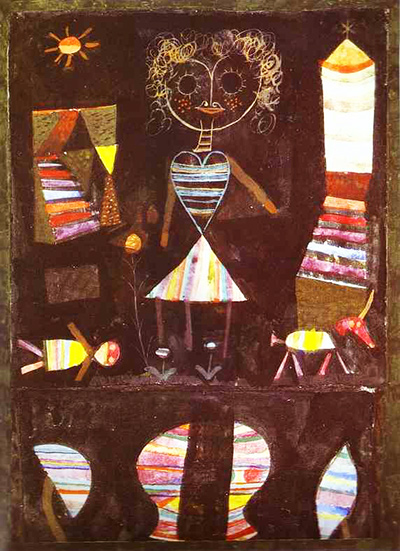
Paul Klee's Puppet Theatre (Puppentheater) is a 1923 watercolour now at the Zentrum Paul Klee, Bern. A Museum of Modern Art Bauhaus exhibition checklist describes it with unusual precision: watercolour on two sheets of paper primed with chalk and glue, joined edge to edge, with watercolour and pen borders, mounted on card. MoMA gives the assembled work as 52.1 × 37.6 cm. This makes the picture a constructed object as well as an image of a stage. The site's former article spent most of its space on the real puppets Klee made for his son Felix and did not explain the sheet's distinctive physical history.[1]
What appears on the stage
Against a nearly black interior, a central round-headed figure with curling hair or threads stands above a striped triangular body. Bright forms flank it: at left, a narrow stepped or striped arrangement; at right, a tall tapering shape. A small orange disc shines near the upper left. Lower down, tiny objects or creatures occupy the platform, and beneath the strong horizontal divide, colourful rounded forms appear in the dark. The image offers recognisable cues of figure, props and theatre while keeping their identities elastic.[1][2]
The dark ground holds the colourful shapes apart and brings them forward like actors under light. Yet the lower portion does not simply complete a naturalistic stage. Its curving openings and striped shapes suggest another layer or compartment, almost a scene beneath a scene. This is a visual observation. The museum-backed German commentary available through museumsfernsehen proposes a more specific reading: a childlike theatrical world with an ambiguous lower, vegetal realm. That is a curatorial interpretation, not a narrative supplied by Klee in the sources used here.[2]
The inherited local reproduction preserves the familiar image but gives no trustworthy measurement of pigment, paper texture or border width. MoMA's detailed material entry therefore governs the object description. Its two-sheet construction is not an incidental technical footnote: the join runs across the pictorial organisation, helping explain why the lower zone appears distinct yet connected.[1]
Two sheets and a related still life
Klee often altered and recombined his own work. The Museo Nacional Thyssen-Bornemisza describes its Still Life with Dice of 1923 as a fragment of a larger Puppet Theatre watercolour, and gives the still life its own collection identity in Madrid. The German museum commentary on Puppen theater describes the present Bern picture as assembled from two parts, with a lower part related to the sheet entered next in Klee's register as Stilleben mit d. Würfel, 1923,22. The sources agree on a material relationship and later separation or recombination, though they describe which sheet became a fragment from different directions. The physical joins and both surviving objects should control any more exact reconstruction.[2][3]
An image can therefore be read as a theatre and studied as paper that Klee cut, reused and joined. The Madrid still life is not a second copy of the Bern scene, and the two titles do not name one unchanged object. The current page does not equate their dimensions or borrow the Madrid work's medium for every part of the Bern sheet. MoMA's 2009 checklist is the specific source for the composite Bern object: two sheets, chalk-and-glue preparation, watercolour and pen borders, and card mount.[1][3]
The numbering reported by the German commentary also gives a useful research clue: Puppen theater appears as 1923,21, followed by the still life as 1923,22. The original register entry was not consulted directly for this page, so those numbers are attributed to the museum-linked account. Neither their sequence nor the material overlap proves the exact order in which Klee cut and reassembled the sheets.[2]
The real hand puppets
The subject connects with Klee's family life, but the painted work is not a documentary photograph of Felix's toys. The Zentrum Paul Klee's exhibition guide says Klee made about fifty hand puppets between 1916 and 1925 for his son, and built a puppet theatre so Felix could perform for friends. Thirty surviving puppets are held by the museum. They incorporate painted heads, cloth scraps and sometimes repurposed household items such as a matchbox or ceramic electrical socket. This is a valuable context for Klee's interest in staged figures and play.[4]
The earlier site article claimed that the first eight puppets were made for Felix's ninth birthday and that about fifty more followed. The Zentrum's guide says about fifty in total across the period, and its separate exhibition guide places the first eight in 1916, when Felix was eight, not nine. The total and chronology are now corrected. The older page also asserted that a specific puppet called Dr Death alone survived a bombing raid; that detailed survival story has not been established in the sources used here and is omitted.[4][5]
The painting and the puppets share theatre as a theme, yet they use different materials and obey different histories. A reader seeking the physical puppets can follow the site's puppets guide. Here the key object is the two-sheet watercolour. Its body, stage, props and lower compartment may draw on Klee's experience of performance, but the sources do not identify the central figure as a portrait of a particular hand puppet.[1][4]
Why the join matters
At first glance, the scene seems cheerful because of its bright stripes and toy-like forms. The black ground, the partly hidden or fallen figures and the lower compartment make that response less secure. The image can hold play and unease at once. The German museum interpretation notes this ambiguity rather than reducing the picture to a single cheerful puppet show.[2]
The paper construction creates a parallel ambiguity. Klee made a whole image from parts whose relation to another work remains visible in the record. A stage itself is an arrangement of separate actors, props and spaces brought together for a performance. That analogy is an interpretive way to connect material and subject; it is not a claim that Klee explained the join in theatrical terms. The article's firmer conclusion is simpler: the physical work is an assembled watercolour, and the viewer's reading should take both its picture and its construction seriously.[1][2][3]
Related artworks
Explore eight other Klee works from the researched artwork cluster.
Hammamet with Mosque
1914
Flower Myth
1918
Angelus Novus
1920
Crystal Gradation
1921
Red Balloon
1922
References
- Museum of Modern Art, Bauhaus 1919–1933: Workshops for Modernity, exhibition checklist, 2009, p. 45: Bern Puppentheater, 1923, composite support, technique and 52.1 × 37.6 cm dimensions, View source.
- museumsfernsehen, “Paul Klee – Puppen theater, 1923”, 2017, Bern museum-linked German synopsis: two parts, relationship to Stilleben mit d. Würfel, attributed interpretation and numbers 1923,21–22, View source.
- Museo Nacional Thyssen-Bornemisza, Still Life with Dice, current Madrid owner record: the separately held 1923 fragment and its relation to Puppet Theatre, View source.
- Zentrum Paul Klee, Kosmos Klee exhibition guide, “Hand Puppets”: roughly fifty puppets for Felix, 1916–25, thirty survivors, theatre and materials, View source.
- Zentrum Paul Klee, Satire – Irony – Grotesque exhibition guide, “Headbirths”: first eight puppets in 1916 when Felix was eight, View source.