


 by Tom Gurney
Tom Gurney BSc (Hons) is an art history expert with over 20 years experience
Published on June 19, 2020 / Updated on September 27, 2026
Email: tomgurney1@gmail.com / Phone: +44 7429 011000
Park bei Lu.: a park made from signs and colour
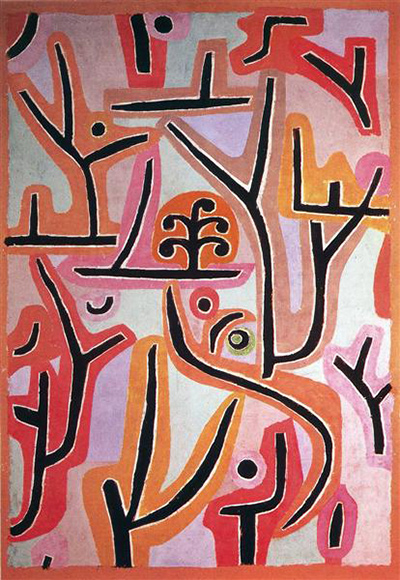
Paul Klee's Park bei Lu., usually translated Park Near Lu., belongs to 1938, the late period of his work in Bern. The Zentrum Paul Klee owns the picture and records it as 1938,129. It measures 100 × 70 cm, with oil and coloured paste on paper mounted on jute and original frame strips. The full stop after Lu. is part of the recorded title. It leaves the place abbreviated rather than turning the painting into a named, mapped park.[1][2]
The picture is upright and large enough to meet a viewer almost as a standing figure. Thick black forms branch, bend and end abruptly across a ground of rose, lilac, orange, pale green and blue. A small, more intricately curled shape gathers near the centre. There is no convincing horizon, avenue vanishing into distance, or single viewpoint from which to survey the place. Klee presents a park as an arrangement of marks and sensations rather than a conventional view.[1][3]
What is visible?
Several black strokes suggest trunks and branches. Others resemble paths, dancing figures, stems or symbols. Their changing directions lead the eye around the whole sheet. Some rise; some turn sharply sideways; a long curve crosses the lower portion. The shapes do not describe a botanical species, and the pale areas between them are as active as the marks themselves. The viewer can follow a route through the image, then find that a supposed path has become a branch or a figure.[1][3]
The small central form gives the composition a point of concentration without making every other shape subordinate to it. Fondation Beyeler's exhibition guide compared this picture with Klee's Felsenlandschaft of 1937. Its account notes that the black signs in Park bei Lu. swing freely a little way in from the outer frame, that the small tree marks a centre, and that each dark line is edged with a pale shimmer and an individual delicate colour. It likens the separated colour areas to flowerbeds. This is a close formal reading, useful because it explains why a work built from forceful black signs can still feel carefully tended.[3]
The broad colour zones also prevent the black network from becoming a diagram. Warm and cool patches alternate rather than forming sky above earth below. Orange may suggest warmth or foliage, while mauve and blue interrupt any easy seasonal label. The eye moves between the strong dark line and the subtle colour beside it. That movement is one of the painting's principal effects. Describing it as an effect does not require identifying every sign as a particular tree, flower or path.[1][3]
Does “Lu.” mean Lucerne?
The Zentrum Paul Klee's digital guide says “Lu.” likely stands for Lucerne (Luzern in German). It also cautions that Klee did not depict a specific park. A separate Zentrum account of its 2023–24 interactive exhibition says that Lilly Klee stayed in a sanatorium near Lucerne during the 1930s and that a park with winding paths and regional vegetation inspired this work. These accounts make a geographical association reasonable, but they do not supply an address or prove that the picture records a particular walk or view.[1][4]
The distinction matters. A viewer expecting a topographical view may search for a gate, a recognisable building or a route to trace on a map. The painting offers none of these securely. A visit or remembered impression could have prompted Klee, while the completed work transformed that experience into a free pictorial order. The abbreviated title allows the real place and the invented park to remain in conversation.[1][4]
The older article on this site stated that Klee walked with Lilly through the park while visiting her. The museum's published accounts establish the sanatorium and the park association, but the precise shared stroll is not documented in the sources used for this page. It is therefore better to discuss the association without presenting that scene as a witnessed fact.[4]
Autumn, or winter and spring?
There is a productive difference between two museum-backed readings. The Zentrum's current digital guide proposes that Klee probably conceived an autumn scene. It sees the colours as recalling a deciduous wood in autumn, the leafless black lines as trees or bushes, and the upward thrust of those lines as growth. The guide also points out that some marks can look like dancing stick figures. Its interpretation centres on the idea and sensory memory of an autumn park.[1]
An older collection description, published through Switzerland Tourism's catalogue of Swiss art museums, reads the same bare branches against the bright colour as winter and spring together. It speaks of passing and blossoming in a single image. That does not establish a second season as Klee's declared intention. It shows what the picture's contrasts have allowed different curators to see: leaflessness and renewal can coexist, while a red or orange field can suggest autumn warmth.[5]
The two readings need not be flattened into a fixed answer. The picture's signs remain open enough to support a walk through the seasons. The Zentrum later used it as the starting point for Lu. Play of the Seasons, a room-sized game at Creaviva from May 2023 to February 2024. Visitors became human-sized playing pieces and explored spring, summer, autumn and winter through six stations. That exhibition was a contemporary response to Klee's nature imagery, not evidence that the painting itself contains four separately illustrated seasons.[4]
The physical picture
The material description is unusually important here. Oil and coloured paste sit on paper attached to jute; the Zentrum also records the original frame strips. The picture is therefore a layered object, not simply paint on a single canvas. The present owner calls the paper simply paper. Fondation Beyeler's earlier exhibition caption specifies newspaper, as do older accounts. Without direct conservation documentation, the page follows the owner's current broader term and notes the more specific historical wording rather than silently choosing between them.[1][2][6]
Likewise, a small digital reproduction cannot show the exact edges, layering or texture of coloured paste. It is useful for following the black signs and colour fields, but it does not allow a confident claim about the weave of the jute or the thickness of an individual passage. An original-size or conservation image would be needed for that level of study.[1][2]
The Zentrum's work number, 1938,129, gives this picture a firmer identity than title alone. It distinguishes it from other late Klee park and landscape compositions. A Fondation Beyeler guide also prints the associated code J 9. These identifiers are useful when comparing exhibition records in different languages, where Park bei Lu., Park Near Lu. and Parc près de Lu. may all appear.[2][3][7]
An open landscape
Park bei Lu. sits between an encountered place and an invented one. The likely Lucerne connection supplies a point of departure; the picture supplies no fixed itinerary. Black signs suggest branches but are allowed to turn into routes and bodies. Coloured areas suggest vegetation and season while staying independent of naturalistic light. The result is a park a viewer must explore by moving across its surface, pausing at the small central growth, and beginning again along another line.[1][3][4]
The Zentrum's own short film about the picture remains embedded below. It is a museum-produced aid to looking, separate from the cited object record and interpretations above.[8]
Related artworks
Explore eight other Klee works from the researched artwork cluster.
Hammamet with Mosque
1914
Flower Myth
1918
Angelus Novus
1920
Crystal Gradation
1921
Red Balloon
1922
References
- Zentrum Paul Klee, digital guide, “Park Near Lu.”: owner, medium, dimensions, autumn interpretation, signs and Lucerne qualification, View source.
- Zentrum Paul Klee, Mapping Klee: work number 1938,129, medium, dimensions and Bern collection identity, View source.
- Fondation Beyeler, Paul Klee exhibition room guide, German, 2017, room 7: comparison with Felsenlandschaft, framing, central tree, line and colour, View source.
- Zentrum Paul Klee, “Lu. Play of the Seasons”, 2023–24: Lilly's sanatorium context, park inspiration and later interactive exhibition, View source.
- Art Museums of Switzerland collection description via Switzerland Tourism, “Park near Lu.”: winter-and-spring reading and collection details, View source.
- Fondation Beyeler, Paul Klee exhibition page, 2017–18: caption specifies newspaper beneath the pigment, View source.
- Zentrum Paul Klee, French 20th-anniversary press dossier, 2025: French title, 1938,129, support, frame and dimensions; press-use restrictions apply to its images, View source.
- Zentrum Paul Klee (EN), “Paul Klee – Park near Lu., 1938”, museum video retained from the earlier article, View source.