


 by Tom Gurney
Tom Gurney BSc (Hons) is an art history expert with over 20 years experience
Published on June 19, 2020 / Updated on September 27, 2026
Email: tomgurney1@gmail.com / Phone: +44 7429 011000
Paul Klee’s The Future Man
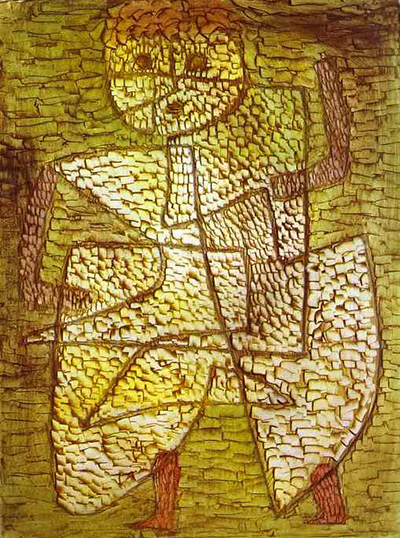
The image on this page depicts Paul Klee’s der Künftige, usually translated The Man of the Future and also known here as The Future Man. Its identifying entry is 1933,265. The Zentrum Paul Klee’s authorised Japanese image archive describes it as coloured paste and charcoal on paper mounted on cardboard, 61.8 × 46 cm, held at the Zentrum Paul Klee in Bern. The site’s inherited small picture matches the archive preview: the stiff, wide-legged figure, raised right arm and dense, crackled marks recur in the same places. The old article gave no object number and floated interpretations without identifying this support. The owner-linked record is the starting point.[1]
A figure that resists a single label
Against a field of green, brown and yellow marks, the figure stands with feet apart. One arm stretches to the side; the other rises. The head and torso are also built from small, irregular patches rather than smooth anatomy. Charcoal line and paste colour create a surface that can look almost like broken masonry at thumbnail size. That texture is visible, while the exact order of materials and layers would require conservation evidence. Calling the picture “oil on canvas” would describe a different Klee object.[1][2]
The pose may recall a salute, a command or a proclamation. It is not a literal portrait with a named sitter. The German title points toward someone “to come” or “of the future,” and the Japanese archive renders it 来るべき者. Those words make a reading about political promises possible, especially in 1933, but the gesture alone does not prove one precise identity. The old article presented a Nazi caricature as though it were established directly by the paint and then wandered into an unsupported anecdote about Klee’s childhood. Neither move helps identify or understand this particular work.[1][3]
The year 1933 and an attributed interpretation
Klee made the work during the year the Nazis took power in Germany and he lost his Düsseldorf teaching post. A German scholarly review of a major Klee exhibition discusses Der Künftige as an exaggerated uniformed figure of a terror regime. That is an attributed interpretation of a recorded 1933 work, not a quotation from Klee explaining every mark. The archive’s annual number and medium establish the object first; the political reading then has a dated historical setting and a named scholarly source.[1][3]
The work also belongs to Klee’s Sonderklasse research context. A German university-linked image-archive essay on Klee’s special class reproduces a detail of 1933,265 and gives its German medium as Kleisterfarbe und Kohle auf Papier auf Karton, agreeing with the Japanese authorised archive’s coloured paste and charcoal. The essay explains that the “special class” was a category Klee used for selected works. It does not mean this figure depicts a special-class person or that its title was a Nazi slogan. Classification in the artist’s work record and interpretation of the pictured subject must remain separate.[2]
A same-title trap
There is another Klee work called Der Künftige in an auction record. Christie’s describes that one as oil on canvas, 61.1 × 49.5 cm, with a chain of private owners and a reproduced catalogue raisonné entry. It must not be used to supply the material, provenance or image for the paper-and-paste work shown here. The two records share a German title and year but diverge in support, size and documented holding; the auction page does not provide a usable image for an exact composition comparison in this pass. This is why the 1933,265 number and visual comparison matter more than the English title alone.[1][4]
The auction lot essay proposes a broader satire of totalitarian “new man” ideals and connects its own oil painting to the crises of 1933. That interpretation belongs to the lot it describes. It cannot be copied over to the Bern work as though the two objects were interchangeable. The German scholarly reading of the Bern image supports a political approach, but even there the viewer can distinguish visible uniform-like elements from a documented statement of Klee’s intention.[3][4]
Reading the page responsibly
The image’s unusual spread of pasted colour and charcoal helps the figure feel both monumental and fragile. The raised arm is legible at once; the surface fractures it into many small units when viewed longer. The title adds a pointed question about who, or what kind of person, can claim the future. Those observations give readers a way into the work without inventing biography, a fixed symbol dictionary or an unsupported declaration of Klee’s private thoughts.[1][2][3]
Related artworks
Explore eight other Klee works from the researched artwork cluster.
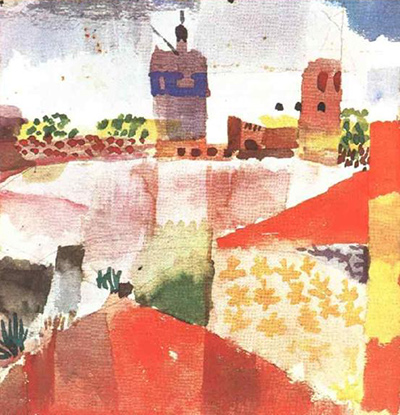
Hammamet with Mosque
1914
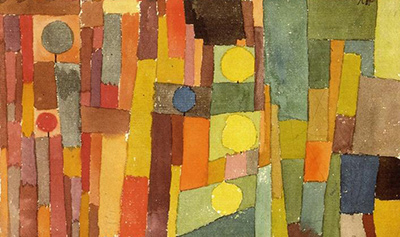
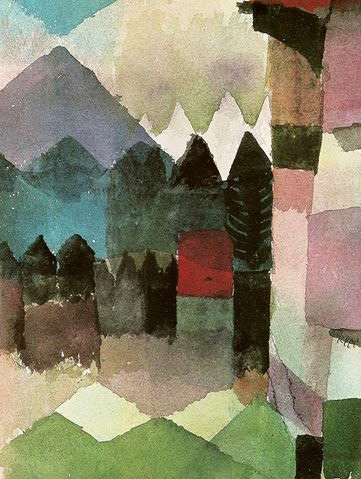
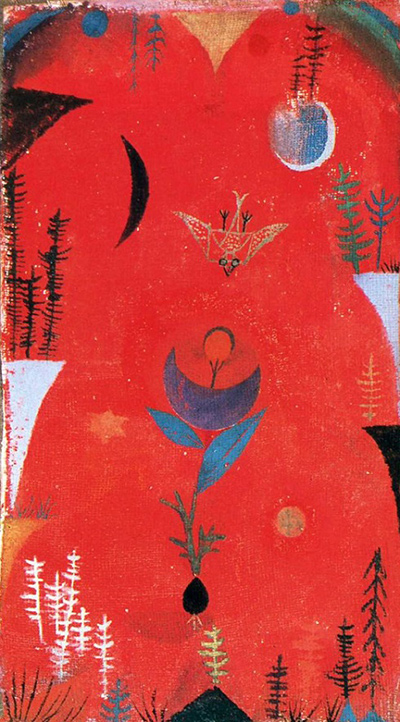
Flower Myth
1918
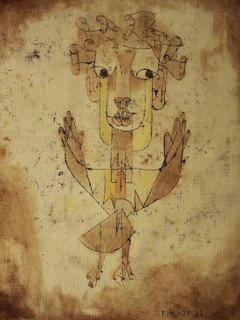
Angelus Novus
1920
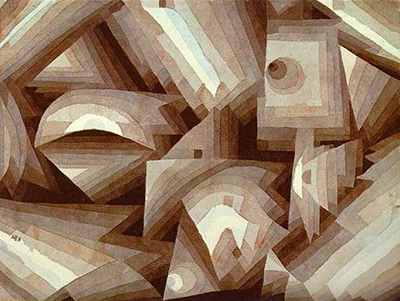
Crystal Gradation
1921
Red Balloon
1922
References
- Zentrum Paul Klee via DNP Art Communications, The man of the future, 1933,265, Japanese/English authorised image and object metadata, work number, medium, dimensions and holding. Preview used for visual comparison only, View source.
- Prometheus / University of Bern image-archive project, “Paul Klee und seine Sonderklasse”, German, caption for Der Künftige and discussion of Klee’s special-class works, View source.
- Scholarly exhibition review, discussion of Der Künftige in the 2016 Centre Pompidou Klee exhibition, German, an attributed political interpretation; not an artist statement, View source.
- Christie’s, distinct oil-on-canvas Der Künftige lot, auction object and provenance record. Its lot essay concerns that separate picture and is not an owner account of the Bern work, View source.