


 by Tom Gurney
Tom Gurney BSc (Hons) is an art history expert with over 20 years experience
Published on June 19, 2020 / Updated on September 27, 2026
Email: tomgurney1@gmail.com / Phone: +44 7429 011000
Paul Klee’s The Angler
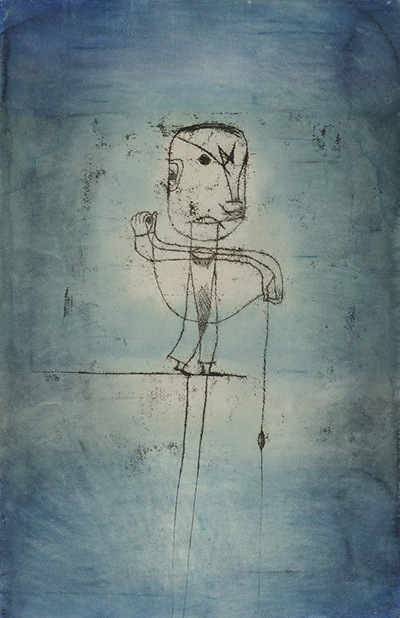
Paul Klee made The Angler, or Der Angler, in 1921. The Museum of Modern Art in New York holds the work as object 64.1961. MoMA describes its medium precisely: oil transfer drawing, watercolour and ink on paper, with watercolour and ink borders on board. The picture measures 50.5 × 31.8 cm. These details make it a mixed-technique work on paper, even though the site groups it under “paintings.”[1]
A fisherman made from lines
A pale blue field surrounds an upright figure with a broad, irregular head. The arms loop inward, a long pole reaches to the right, and a fine line drops toward the bottom edge. Klee has made the fisherman readable with sparse marks while letting the body, rod and line cross one another. MoMA’s gallery label draws attention to the jagged facial marks and the curved parallel lines of the body. It is useful to follow those visible relationships before deciding whether the figure looks comic, uncertain or precarious.[1]
The blue wash does not make this a conventional scene of water, bank and sky. A thin horizontal line under the feet and the nearly empty field leave the figure’s footing ambiguous. The title gives the act of fishing, while the drawing withholds a detailed place. The fish itself is absent. A reader can therefore see the activity at once and still wonder whether the angler controls the line or is held within its network. That is a response to the image, not a documented account of Klee’s intention.[1]
How the surface was made
The dark contours are not simply pen lines laid over finished watercolour. MoMA catalogues an oil transfer drawing alongside watercolour and ink. Its account of another Klee transfer work explains the method: the artist traced a drawing through an inked surface onto a clean sheet, allowing both deliberate lines and incidental texture to register. The Zentrum Paul Klee calls the process Ölpause and places it among Klee’s characteristic experiments with line, colour and layered supports. These sources explain the technique in general; they do not substitute for a conservation examination of The Angler itself.[1][2][3]
In this picture, the transfer line’s irregular edges keep the figure from behaving like a neat illustration. Watercolour sets the tonal field around it, and the ink and watercolour borders form part of the physical object recorded by MoMA. The mounted board and borders would be easy to miss in a cropped tile. They are part of why a material description is more informative than saying merely that Klee “painted” a fisherman.[1][2]
Berlin, confiscation and New York
The work’s later history is unusually well documented in MoMA’s provenance research. The Nationalgalerie, Berlin, acquired it from Klee in 1923 and showed it in a Klee exhibition at the Kronprinzenpalais that February. It remained on view there until 1933. In 1937, the Nazi Reich Ministry removed it from the museum as “degenerate art.” MoMA records it under confiscation inventory EK 16308 and in the Munich Degenerate Art exhibition and subsequent venues. This is evidence about a specific work and state action; the old page’s suggestion that its apparently childlike style alone explains the confiscation is unsupported.[1]
The subsequent chain also needs dates rather than a vague claim that the picture was “fortunately not lost.” According to MoMA, it was consigned to Karl Buchholz in Berlin in 1939, then passed to Curt Valentin’s Buchholz Gallery in New York. John S. Newberry owned it by 1940; MoMA acquired it in 1961 through the Newberry Collection. MoMA notes that its provenance project remains open to new information. The museum cites the printed Paul Klee: catalogue raisonné, volume 3, number 2731, for the early acquisition history, but this page has not independently inspected that volume.[1]
An English-language MoMA catalogue from 1931 paired The Angler and Twittering Machine in its discussion of Klee, showing that American museum audiences had encountered the work before the 1937 confiscation. That reception fact does not undo what happened in Berlin; it gives the work a chronology on both sides of the Atlantic. The picture now belongs to MoMA’s Drawings and Prints department, which fits its layered paper technique more accurately than a bare “painting” label.[1][4]
The local article retains its familiar route and original image while its exact image provenance is checked. The owner’s object record is the best starting point for date, medium and provenance; the visible line and colour remain available for a reader’s own close looking.[1]
Related artworks
Explore eight other Klee works from the researched artwork cluster.
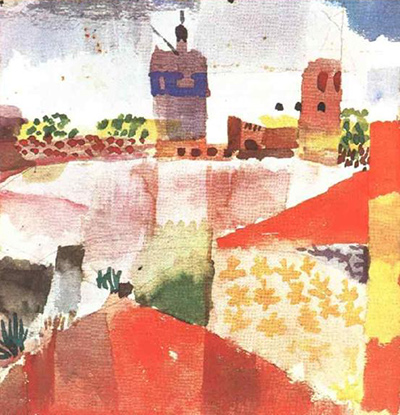
Hammamet with Mosque
1914
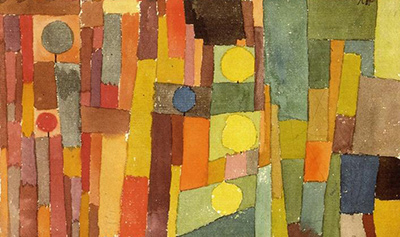


Flower Myth
1918

Angelus Novus
1920

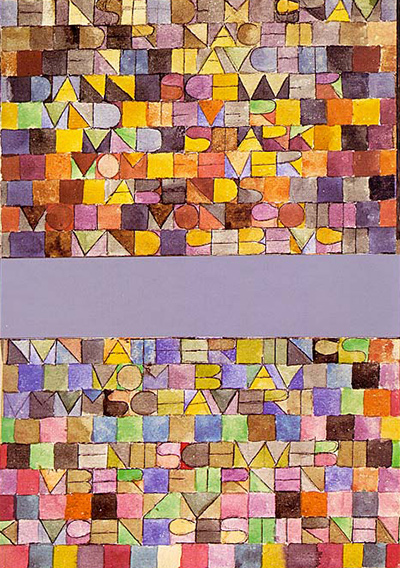
Crystal Gradation
1921
Red Balloon
1922
References
- Museum of Modern Art, The Angler (Der Angler), 1921, current object record, 2010–11 gallery label, provenance research and licensing statement. The record cites Paul Klee: catalogue raisonné, vol. 3, no. 2731; that printed volume was not directly consulted here, View source.
- Museum of Modern Art, Scherzo with Thirteen, owner explanation of Klee’s oil transfer procedure, used only for general technique, View source.
- Zentrum Paul Klee, Die Ölpause and studio and technique exhibition overview, German-language institutional descriptions of the process.
- Museum of Modern Art, German Painting and Sculpture exhibition catalogue, New York, 1931, historical American reception of The Angler and Twittering Machine, View source.