

 Buy Art Prints Now
from Amazon
* As an Amazon Associate I earn from qualifying purchases.
Image reference [image]
 by Tom Gurney
Tom Gurney BSc (Hons) is an art history expert with over 20 years experience
Published on August 14, 2026 / Updated on August 14, 2026
Email: tomgurney1@gmail.com / Phone: +44 7429 011000
The Unwelcome Companion: Introduction
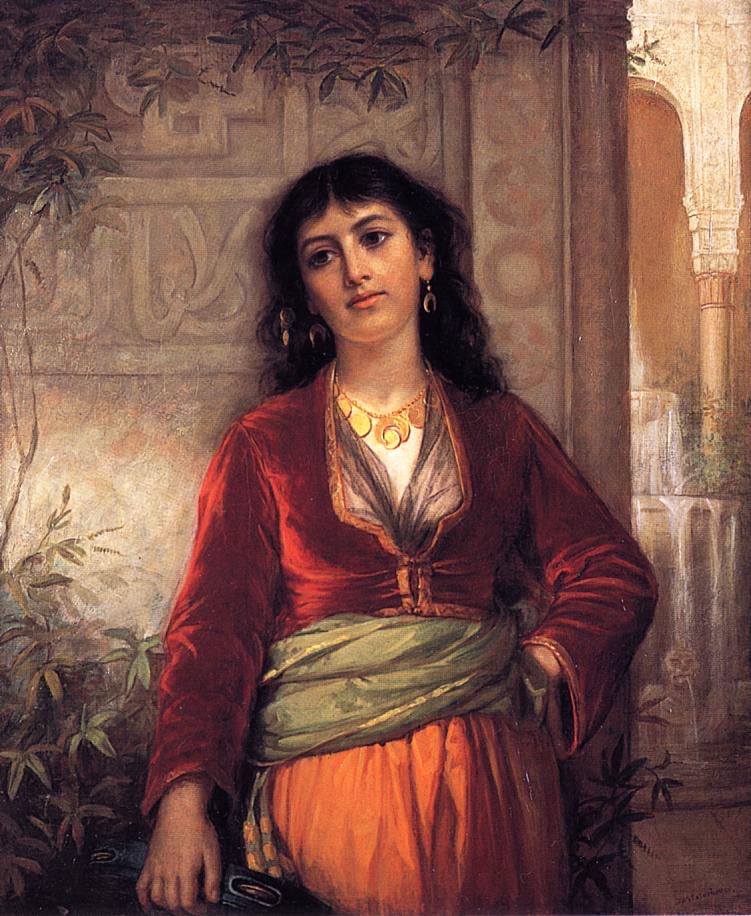
John William Waterhouse's The Unwelcome Companion: A Street Scene in Cairo centres on a young woman in richly coloured, Middle Eastern-styled dress. She occupies a shallow architectural space, her head tilted and her gaze directed beyond the viewer. The title promises an encounter, yet the supposed companion is not clearly present. Narrative pressure falls on someone outside the composition.
Painted about 1872–73 and exhibited by the Society of British Artists in 1873, the work belongs to Waterhouse's earliest professional phase. It is now at Towneley Hall Art Gallery and Museum in Burnley, having entered the collection as a 1951 gift. For years it was misidentified as Spanish Tambourine Girl until its original title was recovered. That history makes the painting a valuable lesson in how a title can transform a decorative figure into an unfinished social situation. [1] [2] [3]
At a Glance
- ArtistJohn William Waterhouse
- DateAbout 1872–73 [1]
- MediumOil on canvas [1]
- Dimensions59.1 × 49.5 cm [1]
- CollectionTowneley Hall Art Gallery and Museum, Burnley [1]
- Accession numberBURGM:paoil166 [1]
- Credit lineGift from Mrs P. Oldman, 1951 [1]
- ExhibitionSociety of British Artists, 1873 [2] [3]
- Recovered titleThe Unwelcome Companion: A Street Scene in Cairo
- Former misidentificationSpanish Tambourine Girl [2] [3]
Contents
- Introduction
- What the painting shows
- Where is the “unwelcome companion”?
- Cairo as title and imagined setting
- Dress, jewellery and decorative attention
- The woman's gaze and withheld story
- Orientalism, fact and fantasy
- Society of British Artists and early Waterhouse
- Misidentification and recovery of the title
- Gift to Towneley Hall
What the painting shows
A single young woman dominates the upright canvas. She stands or leans within a built environment of wall, opening and vegetation. Her body is shown at close range rather than as a small figure in a panoramic Cairo street.
Her clothes combine saturated red, green, gold and pale tones. A necklace and earrings emphasise the face and upper body, while layered fabric supplies much of the picture's visual interest.
The woman's head tilts to one side. Her gaze does not settle comfortably on the spectator; it appears directed towards a person or event just beyond the painted field.
One hand rests near the hip or gathers clothing. The pose is neither an unmistakable dance nor a clear act of refusal.
Architecture establishes enclosure, while glimpsed plants soften it. The “street scene” is therefore intimate rather than topographical.
No companion is securely visible. This absence distinguishes the painting from a two-figure anecdote in which unwelcome attention would be demonstrated through gesture.
The composition functions like one side of a conversation. Expression, costume and setting are given; the cause of discomfort must be inferred.
Where is the “unwelcome companion”?
The title identifies a relationship that the canvas withholds. Someone is unwanted, but the viewer cannot confidently point to them.
The companion may stand outside the frame, occupying the direction of the woman's gaze. This would make the picture a cropped encounter whose second participant is imaginatively supplied.
The spectator may also be placed uncomfortably close to that role. Because the woman is presented for looking yet appears disengaged or wary, viewing can become implicated in unwanted attention.
This is an interpretation, not a documented intention. No surviving statement from Waterhouse says that the companion is the viewer.
It is equally possible that the title belongs to a story whose specific cues have become obscure. Anthony Hobson described the scenario as uncertain and judged that the young artist had not yet fully coordinated setting, pose and gesture into the narrative clarity achieved later. [2]
That criticism should not be turned into a final dismissal. Narrative obscurity can make the work psychologically modern, even if it arose partly from early inexperience.
The recovered title changes the question. Under Spanish Tambourine Girl, the figure appears as an ethnic and musical type. Under The Unwelcome Companion, she becomes a person negotiating presence.
Cairo as title and imagined setting
The subtitle locates the scene in Cairo. It tells viewers how to read costume and architecture before exact topography can do so.
Waterhouse had been born in Rome and trained in London; the accessible sources used here do not document a visit to Cairo before this early painting. The scene may therefore depend on studio costume, photographs, prints, other artists and exhibition conventions rather than direct reportage.
Even artists who travelled commonly rearranged what they saw. “Cairo” in a Victorian exhibition title could mean both a real, complex city and a European imaginative category.
The close framing provides few identifiable monuments. No mosque, street name or architectural inscription makes location verifiable.
This absence matters. The work is not a secure record of daily Egyptian life. Its primary documented reality is a British painter, working for a British exhibition audience, constructing a Cairo subject.
The phrase “street scene” is likewise flexible. The figure fills so much of the canvas that portrait and genre scene overlap.
Cairo contributes distance, colour and social unfamiliarity to the unnamed encounter. It is part of the story's appeal and part of the power imbalance through which Western audiences consumed images of North Africa.
The subtitle also creates an expectation of urban specificity that the close composition only partly fulfils. Waterhouse does not survey crowds, commerce or recognisable monuments. One woman's body becomes the principal evidence for place. That reduction is typical of an exhibition culture in which costume could make geography portable: a model in a London studio might be made to stand for Cairo through textiles, jewellery, plants and masonry.
No surviving documentation used here identifies the model as Egyptian. Her ethnicity should not be inferred from costume. A model performs the visual category constructed by the artist; she does not authenticate it through appearance.
This distinction prevents two opposite mistakes. The scene should not be praised as exact ethnography, but neither should every detail be assumed imaginary. Individual garments or ornaments may have real material sources even when their combination and social meaning are invented. “Orientalist construction” describes that mixture more accurately than either documentary Cairo or pure fantasy.
The painting's scale reinforces the process. Viewers are brought close to material surfaces while denied a wider city. Cairo is encountered as intimate visual difference, not understood as an urban society.
Dress, jewellery and decorative attention
The woman's costume attracts sustained looking. Deep colours and reflective ornament distinguish her from the pale masonry behind.
The clothing should be described as Middle Eastern-styled or Orientalist costume unless a textile specialist and object record identify each garment precisely. Calling every element authentically Egyptian would exceed the evidence.
Jewellery frames the face. Necklace and earrings turn light into small accents while contributing to the figure's presentation as visually “exotic” for Waterhouse's intended audience.
Fabric also gives the pose its structure. A hand at the hip meets folds and sash, making colour and gesture inseparable.
The former title Spanish Tambourine Girl shows how easily costume could be reassigned across European stereotypes. [2] Once the original title was lost, viewers apparently read the figure as another southern “type.”
No clearly functioning tambourine defines the recovered image. The old title should be retained as provenance history, not as a description.
Decorative pleasure and critical awareness can coexist. The painting is genuinely accomplished in colour, yet that colour helped turn cultural difference into a marketable spectacle.
The woman's individuality partly resists the category. Her expression is too guarded to become a simple costume display.
The woman's gaze and withheld story
The face is the composition's emotional centre. Tilted head and sidelong attention imply response without naming the stimulus.
Her gaze seems neither openly welcoming nor theatrically frightened. This ambiguity suits the title's understated adjective: the companion is unwelcome, not necessarily violent.
The woman may be bored, wary, resigned or distracted. Each interpretation changes the imagined relationship outside the frame.
Waterhouse does not give her a spoken line. The viewer reads small differences in eyelid, mouth, neck and shoulder.
This concentration on an inward female figure would become characteristic of his art. Later heroines often confront invisible threats, remembered stories or sounds beyond the canvas.
Yet there is a difference. Mature paintings usually use source text and carefully selected objects to stabilise the moment. Here the title works harder than the visible action.
That imbalance may explain Hobson's reservation, but it also gives the model psychological space. She cannot be reduced to one obvious anecdotal gesture.
The ethically strongest reading begins by acknowledging that she is watched. Whether the absent companion is a specific fictional man or the spectator's position, looking is not neutral.
The adjective “unwelcome” asks the viewer to respect a boundary even though painting makes physical retreat impossible. She cannot leave the canvas or stop its circulation, but the title records refusal within the terms of display.
That creates an important tension with Orientalist spectatorship. European images often treated women coded as Eastern as accessible objects of curiosity or fantasy. [4] Waterhouse's title declares that at least one approach is not desired. The work participates in the system while introducing resistance inside it.
Resistance should not be exaggerated into modern political speech. The woman is still unnamed and visually arranged by a male British artist for exhibition. Her guarded expression cannot undo those conditions.
Nevertheless, it changes the emotional contract. The spectator is not offered a smiling entertainer. The recovered title prevents neutral consumption and asks why attention has become unwelcome.
This makes the former Spanish Tambourine Girl label especially damaging. It replaced a relationship of discomfort with a marketable performance type. Restoring the title gives the figure back the one judgement the historical record preserves.
Her look therefore carries more than narrative ambiguity. It marks a limit. The companion may remain invisible, but the woman's response tells us that visibility is not the same as consent to be accompanied, approached or possessed.
Orientalism, fact and fantasy
Nineteenth-century European art used “Orientalism” for images of the Middle East, North Africa, Greece and Turkey. The field included travel-based observation, historical subjects, imagined harems and commercial fantasies. [4]
The Metropolitan Museum of Art emphasises that Orientalist art developed amid European military, colonial and tourist expansion. Some works claimed documentary truth; others freely constructed luxury, danger or backwardness for Western viewers. [4]
Waterhouse's painting belongs within this history because it presents Cairo through a British studio and exhibition culture. Its title, costume and female subject made cultural difference part of its appeal.
At the same time, it is not a grand imperial propaganda scene. There are no European soldiers, rulers or explicit contrast between “civilised” and “barbaric” worlds.
Power operates more quietly through the right to represent. An Egyptian-coded woman becomes available to a London audience without her name, voice or documented social identity.
The recent Met framing “between fact and fantasy” is useful here. [5] Costume and architecture may draw on real objects, while the encounter and setting remain pictorial construction.
Calling the painting Orientalist should therefore open analysis, not close it. The term describes a historical visual system and invites questions about travel, models, fantasy, gender and empire.
It also prevents the attractive costume from being treated as transparent evidence of how Cairene women dressed in 1873.
Society of British Artists and early Waterhouse
Waterhouse began exhibiting with the Society of British Artists in 1872. [6] The Unwelcome Companion followed in 1873, before his first Royal Academy exhibit of 1874.
The Society provided a practical venue for a young artist still studying and establishing patrons. Its exhibitions offered access to audiences beyond the Royal Academy's selection.
An early Orientalist subject could demonstrate figure painting, colour and imaginative setting at once. It also connected Waterhouse to fashionable international subject matter.
The work should not be labelled mature Pre-Raphaelitism. Waterhouse was still experimenting, and his later absorption of Pre-Raphaelite literary themes had not reached its recognisable form.
Nor had his classical archaeological manner fully developed. The 1870s would bring A Sick Child Brought into the Temple of Aesculapius, Nero and brighter Alma-Tadema-related works.
This painting stands before those changes. Its title-driven situation and close female figure reveal strengths he would refine, while the uncertain setting-action relationship reveals work still underway.
Early date is not an excuse to invent a simplistic apprenticeship narrative. The canvas was exhibited and later collected; it was a public artistic statement.
Misidentification and recovery of the title
When the painting entered later records, it was known as Spanish Tambourine Girl. Anthony Hobson recovered the correct identity after finding or recognising a label with the original title. [2] [3]
This change did more than adjust geography. “Spanish” became “Cairo”; “tambourine girl” became an unnamed woman defined through unwanted social contact.
Misidentification likely persisted because the composition can look like a costume study when detached from its title. The absence of a visible companion made the original wording harder to infer.
The case demonstrates why physical labels, accession files and exhibition catalogues matter. Visual resemblance alone could not recover the work's full identity.
The old title remains useful in provenance notes and historic identification, because earlier publications or databases may still use it. It is not an equal poetic alternate title.
The recovery also affects interpretation of the woman's expression. A “tambourine girl” may be expected to entertain. A woman with an unwelcome companion may be withholding entertainment, attention or consent.
The corrected title therefore restores agency without fully revealing plot. It tells us that her response matters.
Gift to Towneley Hall
The painting belongs to Towneley Hall Art Gallery and Museum in Burnley. Its accession number is BURGM:paoil166. [1]
Mrs P. Oldman gave it in 1951. [1] That date and name should be retained, since donor history is part of the object's passage into public care.
Towneley Hall is a historic house, museum and art gallery operated by Burnley Borough Council. [7] The painting's civic location gives unusual public access to an early Waterhouse work.
Collection wording can vary between “Towneley Hall,” “Towneley Art Gallery” and “Towneley Hall Art Gallery and Museum.” Accession number provides consistency.
The gift date should not be confused with the date when Hobson recovered the title; these are different events in the painting's modern history.
Current display cannot be guaranteed. Museums rotate works for conservation, loans and exhibitions, so visitors should check before travel.
The work forms a useful companion to Waterhouse's Destiny, also associated with Towneley Hall. Together they show the museum holding very different points in his career: tentative early Orientalism and a mature patriotic fundraising work.
What the painting anticipates
The close focus on one woman anticipates Waterhouse's later preference for female figures who dominate the painted field.
The unseen companion anticipates his use of offstage agents. A listener can respond to music we cannot hear; a lover can be reflected in a mirror; a threat can exist beyond the frame.
Colour and fabric likewise remain important throughout his career, although later works integrate them more tightly with literary objects and landscape.
The painting does not directly prepare one named masterpiece. It establishes problems: how can a title activate an ambiguous pose, and how can a viewer infer narrative from gaze?
Its Orientalism also marks a path Waterhouse did not pursue consistently. Classical, medieval and British literary subjects came to dominate his mature reputation.
That limited continuity makes the early Cairo picture especially informative. It records a possible direction tested and largely left behind.
The woman herself resists being treated only as career evidence. Her sidelong expression remains the work's living centre, preserving discomfort even after the original story has become obscure.
This resistance also explains why the painting deserves display beside, but not beneath, Waterhouse's mature heroines. Later technical assurance does not cancel the early work's unusual social tension. Few of his celebrated mythological paintings make unwanted everyday proximity so explicit in their titles.
The canvas ultimately survives through a productive mismatch. Costume and setting offer decorative attraction; expression and title obstruct uncomplicated enjoyment. Waterhouse had not yet perfected narrative clarity, but he had created a figure whose discomfort remains legible across that uncertainty.
That discomfort gives the recovered title its continuing force. The absent companion never becomes visible enough to master the scene; instead, the woman's response remains the only judgement the viewer is entitled to receive.
It remains decisive.
Related Pages
- The Lady Clare: Compare another compact Waterhouse literary figure built around withheld identity.
- Windflowers: Compare a later Waterhouse figure where flowers and mood carry suspended feeling.
- The Shrine: Compare another classically framed early subject with public-facing source cautions.
Frequently Asked Questions
At Towneley Hall Art Gallery and Museum in Burnley, accession BURGM:paoil166. [1]
It measures 59.1 by 49.5 centimetres. [1]
The painting does not securely identify or clearly depict that person. They may be outside the frame.
No source used here documents an early Cairo visit. The setting should be treated as an Orientalist construction rather than travel reportage.
That was a later misidentification. Anthony Hobson recovered the original Cairo title from surviving evidence. [2] [3]
Mrs P. Oldman gave the painting in 1951. [1]
It predates Waterhouse's mature engagement with Pre-Raphaelite literary style and is better introduced as an early Orientalist exhibition work.
Discussion
The Unwelcome Companion is compelling because the title's decisive judgement—unwelcome—meets an image that withholds the judged person. We receive one woman's guarded presence and must recognise the missing social pressure around it.
Its history intensifies that problem. When the title was lost, she became a generic “Spanish Tambourine Girl.” Recovering the original wording restored Cairo and interpersonal discomfort, while leaving the narrative open.
Reader Insights
Which visible detail most changes the way you read this page?
Which source or comparison helps the work feel less familiar and more specific?
What question would you bring back to the painting after reading?
Join the Conversation
Share your reading of this page below.
References
- Image reference
- Wikimedia Commons / Art UK object data, “John William Waterhouse — The Unwelcome Companion: A Street Scene in Cairo,” date, medium, dimensions, collection, accession and credit line. View source
- Anthony Hobson account, reproduced in the Waterhouse catalogue archive, history of the Spanish Tambourine Girl misidentification, recovered title and narrative assessment. View source
- John William Waterhouse catalogue summary, “The Unwelcome Companion: A Street Scene in Cairo,” early exhibition, donation and title-recovery overview. View source
- The Metropolitan Museum of Art, “Orientalism in Nineteenth-Century Art,” historical context for Western representations of the Middle East and North Africa. View source
- The Metropolitan Museum of Art, Orientalism: Between Fact and Fantasy, overview of Orientalist representation, gender, power and Islamic visual culture. View source
- Stephen Ongpin Fine Art, “John William Waterhouse,” professional biography documenting his training and 1872 Society of British Artists debut. View source
- Burnley Borough Council, Towneley Park Management Plan 2024–2029, official description of Towneley Hall as a historic house, museum and art gallery. View source