

 by Tom Gurney
Tom Gurney BSc (Hons) is an art history expert with over 20 years experience
Published on August 14, 2026 / Updated on August 14, 2026
Email: tomgurney1@gmail.com / Phone: +44 7429 011000
A Sick Child Brought into the Temple of Aesculapius: Introduction
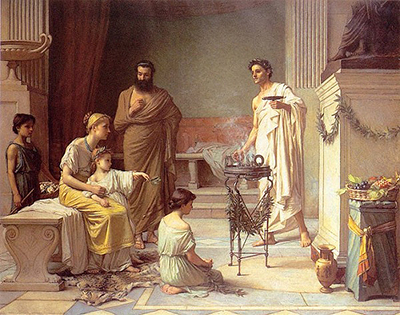
In A Sick Child Brought into the Temple of Aesculapius, John William Waterhouse imagines a family crossing the boundary between illness and hoped-for cure. A mother supports a pale child on her lap while an officiant in white tends a smoking ritual vessel. Around them, architecture, offerings, laurel and the partly visible statue of the healing god turn private anxiety into a public sacred encounter.
Painted in 1877 and exhibited at the Royal Academy that year, the large canvas belongs to Waterhouse's early classical phase. [1] [2] Its subject is neither a miraculous cure nor a modern medical examination. It is the act of bringing a vulnerable child into a sanctuary where religion, bodily care and communal expectation met. The distinction matters: Waterhouse concentrates on waiting and appeal, leaving the result outside the picture.
At a Glance
- ArtistJohn William Waterhouse
- TitleA Sick Child Brought into the Temple of Aesculapius
- Date1877 [1]
- MediumOil on canvas [1]
- DimensionsApproximately 170 × 208 cm [1]
- CollectionPrivate collection / present public location not securely established [1]
- ExhibitionRoyal Academy, London, 1877, catalogue no. 1324 [2]
- SubjectA child and attendants before an officiant in a sanctuary of Aesculapius
- Name noteAesculapius is the Latin form of the Greek healing god Asclepius [3]
- Career contextA major early classical composition, painted before Waterhouse's best-known literary subjects
Contents
- Introduction
- What the painting shows
- Who was Aesculapius?
- The child's arrival
- Ritual, offerings and hoped-for healing
- Architecture and sacred space
- Gesture, gaze and emotional restraint
- Colour, light and material detail
- The 1877 Royal Academy picture
- Medicine, religion and responsible interpretation
What the painting shows
The composition unfolds across a broad classical interior. At left, a mother sits on a carved stone bench with the child against her body. A standing youth or attendant is close behind; a bearded man in brown occupies the shadowed middle ground.
The child stretches one arm towards the centre. The gesture links the family group to a white-robed man at right, who stands beside a tall metal support carrying small vessels. Wisps of smoke rise between them.
A kneeling woman, seen from behind, occupies the foreground. Her pale green garment catches light, while leaves lie across or near her hands. The figure both deepens the space and makes the rite feel communal rather than private.
At the extreme right, only the lower part of a monumental statue is visible above a pedestal. A garland hangs from the stone. The cropping suggests divine presence without turning the god into a living actor in the scene.
A basket of fruit or other offerings rests nearby, covered with brightly coloured cloth. A small vessel stands on the floor. At the left edge a great urn rises above the family group.
Waterhouse thus distributes attention across people, sacred image, ritual equipment and gifts. The child's outstretched arm remains the emotional axis, but the sanctuary is a system rather than a theatrical backdrop.
The painting does not show a diagnosis, surgery or instant cure. It suspends the family at the point of presentation.
Who was Aesculapius?
Aesculapius is the Roman or Latin name for Asclepius, the Greek god of medicine and healing. The British Museum identifies him as a son of Apollo and notes his major following at Epidauros. [3] [4]
Ancient images commonly show the mature god with a cloak and a staff around which a snake coils. The British Museum explains the serpent through renewal and vitality, linked to the shedding of its skin. [3]
The familiar single-serpent rod of Asclepius should not be confused with the winged caduceus associated with Hermes. Waterhouse's painting does not depend on that modern distinction, but accurate discussion of the healing god should preserve it.
The god himself is not safely identified with the white-robed man. The monumental feet and pedestal at the far right indicate a cult statue, while the living figure appears to perform or supervise a rite.
Calling that man a priest is reasonable in context, though the painting provides no inscription naming his office. “Officiant” is the more cautious term.
Aesculapius connected divine aid with practices of healing. His sanctuaries received sufferers, offerings and testimonies of cure. This religious framework is the subject Waterhouse asks a Victorian audience to imagine.
The Getty iconography record preserves the name variants and the later myth in which the centaur Chiron teaches Asclepius the art of healing. [6] Waterhouse does not narrate that biography, but the god's accumulated identity would have lent authority to the partly seen cult image.
Visibility is carefully apportioned. The deity is present through monumental stone and title; the human intermediary is wholly visible; the patient is physically smallest. The arrangement keeps divine power conceptually dominant while human need drives everything the viewer actually sees.
The title's spelling belongs to the nineteenth-century classical vocabulary of the work. Modern sources often prefer Asclepius, but changing the title would alter the historical object.
The child's arrival
The mother and child form a compact group. Her arms support the small body while the child leans and reaches outward, visually fragile amid adult figures and monumental stone.
Waterhouse avoids obvious physical symptoms. The child is identified as sick by the title, posture and reason for the visit, not by a sensational wound.
This restraint protects the central figure from becoming a spectacle of pain. Viewers are directed towards dependence, pallor and uncertain response.
The mother's gaze follows the same direction as the child's arm. Her attention is focused on the rite, and her seated position gives physical stability to a body that cannot stand independently.
The youth at far left carries or stands near a slender object. The bearded man behind the mother draws one hand towards his chest. Their identities are not documented, but they enlarge the human circle around the child.
No one looks at the spectator. Every gaze is contained within the event, allowing the viewer to witness without being acknowledged.
The family has already acted by coming to the sanctuary. The painting therefore presents care as movement and decision: illness has been carried from household into shared sacred space.
The outcome remains unknown. This openness prevents the image from becoming either proof of miracle or declaration of failure.
Ritual, offerings and hoped-for healing
The metal stand in front of the officiant holds smoking vessels. His left hand supports a shallow dish, while the other attends to the objects below. Smoke makes ritual action visible.
Garlands and leafy branches recur across the scene. Laurel crowns the man's head and decorates the stand or statue area; loose greenery accompanies the kneeling figure.
The basket at right appears filled with fruit and flowers. Such objects establish giving, abundance and preparation, though the exact contents and prescribed function should not be asserted from reproduction alone.
The Getty Museum's study of ancient herbs explains that worship of Asclepius spread across the Greek world and that patients left votive tablets and offerings recording complaints and cures. [5] Sacred groves and springs could be associated with the cult.
Waterhouse does not catalogue every practice of an Asclepieion. There is no visible sleeping chamber, recorded dream or anatomical votive. The picture selects a ceremonial meeting that a modern audience can understand through gesture.
That selection creates an emotional bridge. A parent bringing a child to a place of healing was intelligible in 1877 and remains so today, even though the belief system and therapeutic institutions differ.
The smoke also introduces uncertainty. It partially veils the space between child and officiant, giving sensory form to a hoped-for transformation that has not yet occurred.
Architecture and sacred space
Tall fluted columns rise at both sides. Heavy curtains close the rear left, while a green wall and red lower band form a calmer field behind the central men.
Waterhouse uses this simplified background to keep the many figures readable. The broad colour zones prevent architecture from competing with faces and hands.
The statue pedestal projects at right, close to the spectator. By cropping the divine figure above the knees, the composition makes it seem larger than any living participant.
The garland attached to the pedestal confirms cult attention. At the same time, the visible feet keep the god materially represented as a statue rather than literally descending into the room.
Marble flooring, steps and bench establish a hierarchy of levels. The officiant stands; the mother sits; the foreground woman kneels. Posture maps different relationships to authority and need.
The space is not securely identified as Epidauros, Kos or another excavated sanctuary. Aesculapius had cult centres in many places, and the architecture is best treated as Waterhouse's learned reconstruction. [3] [5]
The large format—about 170 by 208 centimetres—would make the figures substantial in a gallery. [1] This scale helps the imagined temple surround the viewer rather than remain a small antiquarian vignette.
Gesture, gaze and emotional restraint
Hands organise the scene. The child's arm extends; the mother holds; the bearded man touches his chest; the officiant balances his dish and reaches towards the smoking stand.
These gestures create a chain without physical contact. The lack of touch between healer and child preserves distance at the decisive moment.
The officiant's expression is grave but not dramatically ecstatic. He looks across the vessels, apparently conscious of both procedure and petition.
The bearded companion's inward hand can suggest concern or reverence, but the exact emotion cannot be known. Waterhouse builds response through conventional bodily signs rather than captions.
The kneeling woman's turned back is equally important. She withholds a face, forcing us to understand her through posture and participation.
The child alone reaches with the openness of someone unable to control the event. That small arm crosses a significant visual gap, turning vulnerability into active appeal.
Waterhouse avoids melodrama. No adult collapses, and no supernatural beam confirms success. The painting's seriousness comes from concentrated attention.
This emotional restraint distinguishes the work from medical illustration. Its purpose is not to explain a condition but to stage the human meanings of seeking help.
Colour, light and material detail
The left group is built from cream, muted yellow, brown and green. At right, the officiant's white garment catches the strongest light.
That white does not simply signify purity. Formally, it separates his body from the green wall and pale architecture, making his role visible across the broad canvas.
The child's garment echoes the white at a smaller scale. This colour correspondence connects patient and officiant before any physical contact occurs.
Warm red appears along the rear wall and in the cloth supporting the offering basket. These accents prevent the classical interior from becoming uniformly pale.
Materials are carefully differentiated. Stone is smooth and weighty; the animal skin on the floor is irregular; draperies fold; metal legs create a thin open structure around the smoky vessels.
The animal skin should not be named by species without better object-level evidence. Digital images can encourage false precision in pattern and colour.
Light falls across the foreground pavement and right-hand figures, while the left curtain creates a deep vertical shadow. The passage from shade to brightness supports the psychological movement from anxious arrival towards hoped-for aid.
Yet light is not proof of cure. It is a compositional resource whose symbolic potential remains suggestive rather than documented.
The 1877 Royal Academy picture
The Royal Academy exhibition record lists A Sick Child Brought into the Temple of Aesculapius in 1877 as catalogue number 1324. [2]
Exhibition at the Academy placed the young Waterhouse before a large, competitive London public. A painting of this scale and complexity announced ambition.
Its extended title performed useful work in the crowded galleries. Even a viewer unfamiliar with the cult could identify the relationship between child, temple and healing god.
Victorian exhibition titles often functioned as narrative prompts. Here the grammar is important: the child “brought into” the temple is the object of adult care, and the event is arrival rather than cure.
No quotation is attached. Unlike later Waterhouse paintings drawn from Tennyson, Shakespeare or Keats, the image does not ask viewers to recall a particular line of poetry.
The work instead joins classical history painting and genre observation. Its architecture and ritual claim seriousness, while family feeling provides immediate access.
The canvas's current public location is not securely documented in the accessible object record. “Private collection” is preferable to repeating unsupported claims that it remains with a London dealer. [1]
The Academy context also changes how the composition can be imagined. Hung among many pictures, it needed a silhouette and subject readable at a distance. White drapery, the broad green wall and the child's extended arm provide that clarity; ritual objects and facial responses reward closer inspection.
Its unusual title may have slowed a visitor down. “Aesculapius” requires classical knowledge, yet “a sick child brought into the temple” supplies an immediate human situation. Learned subject and ordinary sympathy are joined in the same phrase.
Medicine, religion and responsible interpretation
Ancient healing cannot be divided neatly into modern categories. Sacred petition, practical remedies, diet, observation and communal custom could coexist.
The Getty publication notes both the divine lineage claimed for Greek medicine and the development of practices associated with Hippocrates, including observation, dietary control and nursing care. [5]
Waterhouse's scene represents a sanctuary rite, not the total history of ancient medicine. Calling it a “hospital” risks importing modern organisation, while calling it mere superstition erases its social and historical complexity.
Likewise, the painting should not be used to reconstruct a single mandatory treatment. The smoke, offerings and garlands are visible; incubation, dream interpretation or herbal therapy are not.
Modern medical symbols make Aesculapius seem familiar. The British Museum notes that the god's staff and serpent became an enduring emblem of the medical profession. [4] That afterlife does not make the Victorian painting a celebration of contemporary clinical science.
Its central question is older and broader: what do people do when a child is ill and certainty is unavailable?
The answer Waterhouse shows is collective attention. The family carries, the officiant performs, attendants witness, and gifts mark commitment. Whether divine or medical, healing is imagined as a relationship rather than an isolated body.
Place within Waterhouse's career
The 1877 painting belongs to a run of early classical subjects through which Waterhouse established his reputation. Roman interiors, historical costume and ceremonial action came before his mature literary symbolism.
Later works often reduce the cast to one or two figures at a psychologically charged threshold. Here six visible participants and part of a statue share the stage.
That difference reveals development rather than a complete break. Waterhouse already directs a complex narrative through female experience, controlled gesture and surrounding objects.
The mother and child also complicate the popular image of Waterhouse as painter only of beautiful dangerous women. Care, fear and dependence are as central here as beauty.
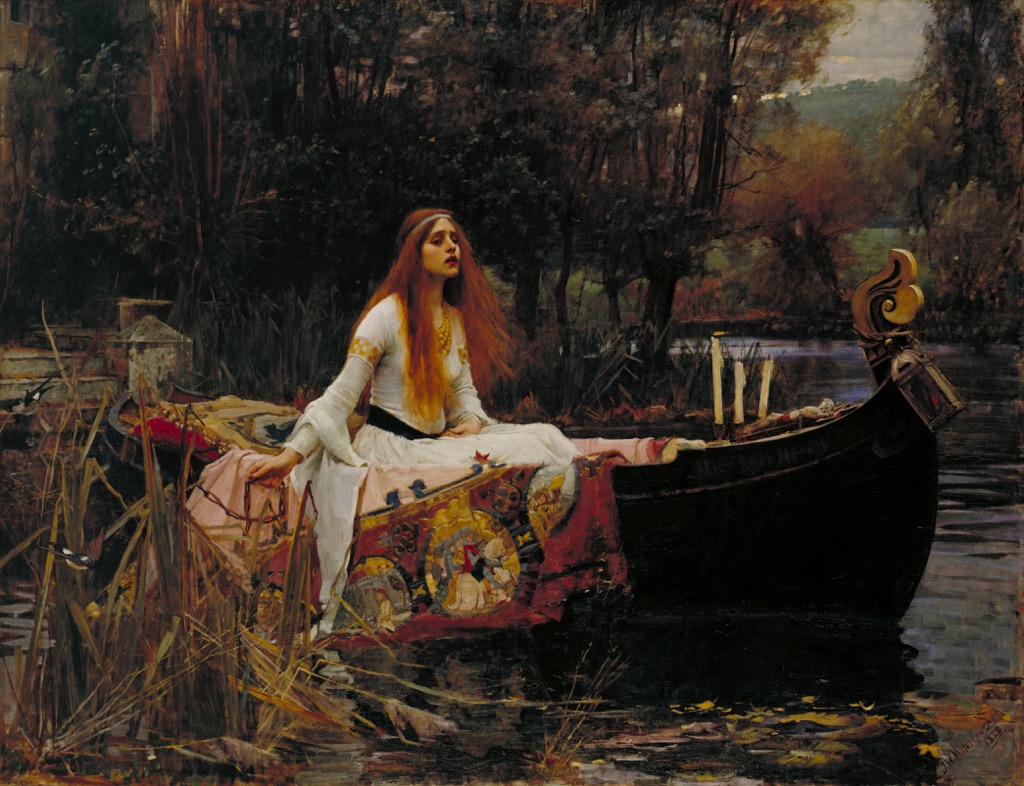
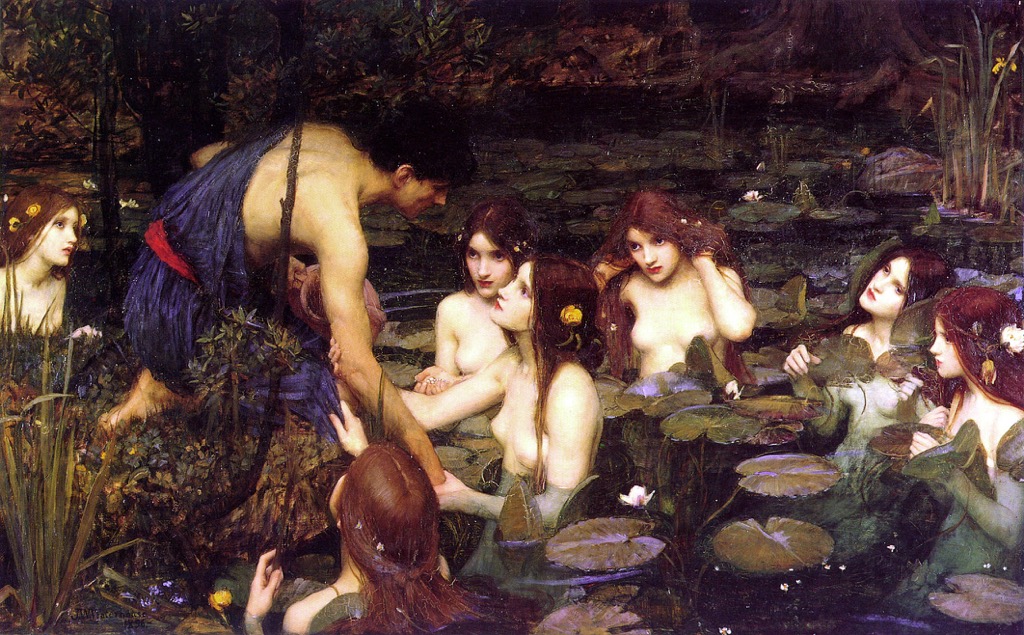
His later fascination with suspended outcomes is already present. Like the Lady of Shalott loosening a chain or Hylas leaning towards the nymphs, this child occupies a moment whose consequences extend beyond the frame.
The work deserves attention not merely as preparation for later masterpieces. Its public ambition, humane focus and clear spatial storytelling make it a major statement in its own right.
It may also alter how later Waterhouse paintings are read. His fascination with vulnerable bodies did not begin with enchanted maidens. Here vulnerability belongs to childhood, and danger comes from illness rather than erotic temptation or mythic fate.
The adults' inability to guarantee an outcome is equally revealing. Authority is distributed among parent, male companion, kneeling participant and officiant, but no figure commands the future. The visual order of the temple contains uncertainty without eliminating it.
It also demonstrates Waterhouse's capacity to treat antiquity as lived belief. Marble and costume matter because people arrive in need.
Related Pages
- The Lady of Shalott: Compare Waterhouse's best-known literary composition.
- Hylas and the Nymphs: Compare another major mythological scene.
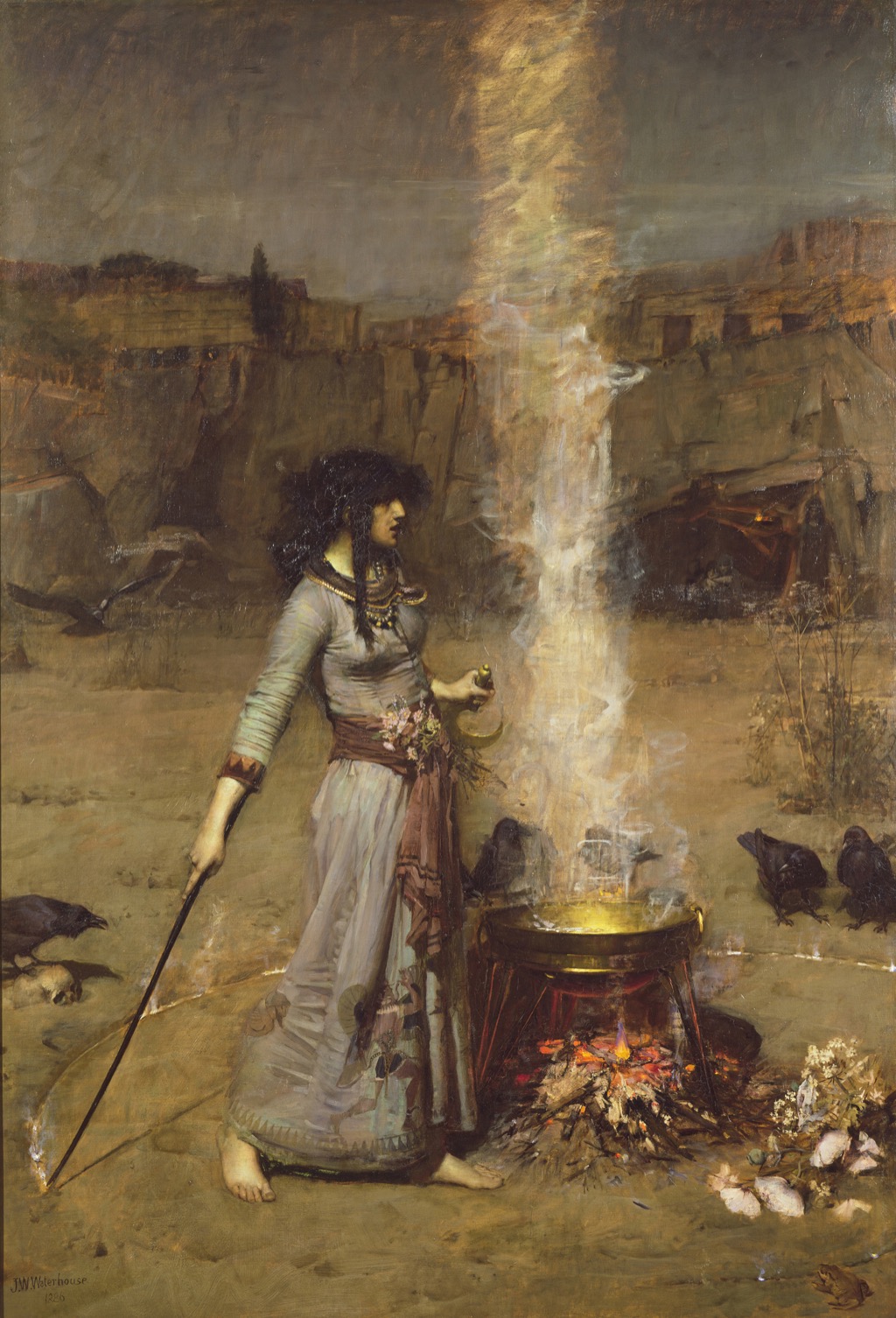
- The Magic Circle: Compare Waterhouse's treatment of ritual and symbolism.
Frequently Asked Questions
Waterhouse painted it in 1877. [1]
Yes. It appeared in the 1877 exhibition as catalogue number 1324. [2]
Aesculapius, or Asclepius, was the Greco-Roman god of medicine and healing, traditionally the son of Apollo. [3] [4]
The safer reading is that he is a priest or officiant. A large cult statue is indicated separately by the feet and pedestal at right.
No. It shows presentation and ritual; the outcome is left unknown.
Approximately 170 by 208 centimetres. [1]
Accessible cataloguing places it in a private collection; a stable current public location is not established. [1]
It concerns healing, but specifically through an imagined ancient religious sanctuary rather than modern clinical practice.
Discussion
Waterhouse's large early canvas finds drama in the distance between a child's hand and an officiant's ritual. The space is filled with adults, offerings and sacred architecture, yet the smallest figure determines its emotional weight.
The painting neither confirms nor mocks belief. Smoke rises, a statue presides, and careful actions proceed while uncertainty remains. That suspension gives the work unusual dignity. It respects the family's hope without converting art into evidence of a miracle.
Reader Insights
Which visible detail most changes the way you read this page?
Which source or comparison helps the work feel less familiar and more specific?
What question would you bring back to the painting after reading?
Join the Conversation
Share your reading of this page below.
References
- Wikimedia Commons object data, John William Waterhouse, A Sick Child Brought into the Temple of Aesculapius, 1877, medium, dimensions and collection status. View source
- *Algernon Graves, The Royal Academy of Arts: A Complete Dictionary of Contributors and Their Work, vol. VIII*, Waterhouse's 1877 exhibition entry and catalogue number. View source
- British Museum, “Gods and goddesses of Roman Britain: Aesculapius,” name, role, attributes and cult at Epidauros. View source
- British Museum, bronze figure of Aesculapius, object record and curatorial account of the healing god, cloak, staff and snake. View source
- J. Paul Getty Museum, Ancient Herbs in the J. Paul Getty Museum Gardens, discussion of Asclepius, healing sanctuaries, votive offerings and Greek medical practice. View source
- Getty Research Institute, CONA Iconography, “Aesculapius,” names, genealogy and iconographic identity. View source