

 by Tom Gurney
Tom Gurney BSc (Hons) is an art history expert with over 20 years experience
Published on August 14, 2026 / Updated on August 14, 2026
Email: tomgurney1@gmail.com / Phone: +44 7429 011000
A Hamadryad: Introduction
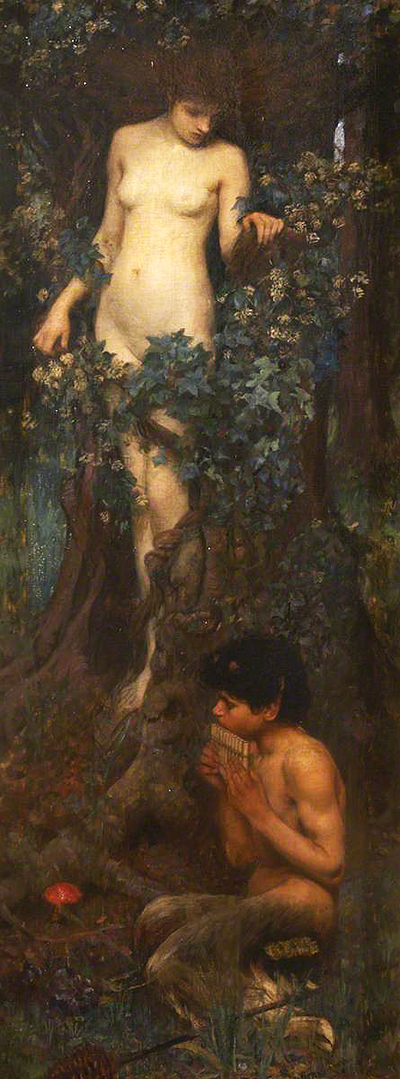
John William Waterhouse's A Hamadryad makes a tree nymph almost inseparable from her living home. A pale nude figure extends vertically against a dark trunk while, far below, a young rustic musician sits among roots and fungi playing pipes. The painting's exceptionally narrow format turns the forest into a column of bark, body, ivy and sound.
Exhibited at the Royal Academy in 1893, the oil belongs to The Box in Plymouth, where it is recorded under accession number PLYMG.1926.17. [1] [2] Its title identifies the woman as a hamadryad—a nymph whose life was bound to a particular tree—but does not name the musician as Pan. He may be understood more cautiously as a satyr, faun or Pan-like woodland figure.
At a Glance
- ArtistJohn William Waterhouse
- TitleA Hamadryad, also catalogued as Hamadryad [1] [2]
- Date1893 [1]
- MediumOil on canvas [1] [2]
- Dimensions158 × 59.5 cm [1] [2]
- CollectionThe Box, Plymouth [1] [2]
- Accession numberPLYMG.1926.17 [1]
- ExhibitionRoyal Academy, London, 1893, no. 98 [1]
- CreditGift of Alfred A. de Pass, 1926 [1]
- SubjectA hamadryad associated with a tree and a seated pipe-playing woodland figure
Contents
- Introduction
- What the painting shows
- What a hamadryad is
- Body and tree
- The pipe-playing figure
- Music, attention and distance
- The extraordinary vertical format
- Forest detail and colour
- Nudity and mythological permission
- Exhibition, gift and collection history
What the painting shows
A nude woman stands high in a tree-filled woodland. Her body runs close to the trunk, one arm rising into foliage while the other follows or crosses the bark.
The head turns downward. Long hair falls beside the face and shoulder, visually joining the nymph to the brown vertical mass behind her.
At the bottom of the canvas sits a smaller male figure. He plays a set of pipes and looks upward towards the woman.
His position is grounded among roots, leaves, flowers and pale fungi. Hers is elevated and elongated, less clearly separated from the tree.
The two figures do not touch. Their relationship is organised by gaze and music across an unusually great vertical distance.
Vegetation surrounds both but performs different work. Around the musician it creates a forest floor; around the hamadryad it obscures boundaries between limb, vine and branch.
The scene includes no violent pursuit and no explicit metamorphosis. The nymph is already present with the tree, while the musician's response supplies the event.
The tall crop makes her discovery gradual. At first glance, the lower player and dark trunk may read more clearly than the body above. Only as the eye ascends does pale flesh detach itself from bark and foliage. Waterhouse turns recognition into a small visual equivalent of encountering a nature spirit.
That delay is not possible in a conventional half-length portrait. It depends upon the enormous interval between the compact musician and the upper figure, and upon the way shadow partially absorbs her contour.
Because reproductions often crop or compress this very tall painting, the relationship of scale is easy to lose. The full format is essential: body and tree rise together far above the seated player.
What a hamadryad is
Greek and later classical traditions distinguish several kinds of nymph associated with landscape. Dryads belong to trees and woodlands; hamadryads are more specifically bound to individual trees, sharing their life and death. [3]
The name combines the idea of “together with” and tree or oak. Ancient sources do not always use modern taxonomies consistently, so a rigid biological classification would be misleading. [3]
The Homeric Hymn to Aphrodite describes long-lived mountain nymphs whose trees spring up with them and whose lives end when bark, branches and tree perish. [4]
That tradition makes Waterhouse's fusion of woman and trunk more than decorative woodland fantasy. Her bodily existence is conceptually inseparable from the vertical organism behind her.
The title is singular: A Hamadryad. Waterhouse does not claim to portray one securely named nymph from a particular myth.
Nor does the painting show a tree being cut or threatened. Ancient stories of injury to a hamadryad's tree illuminate the category, but they are not the depicted narrative.
The lack of a named episode gives the work freedom. It can make an idea—life held jointly by female body and tree—visible without illustrating a sequence of written events.
Public copy should therefore define the term clearly, then return to the painting rather than filling the page with unrelated nymph genealogies.
Body and tree
The hamadryad is not painted as a tiny spirit perched beside a normal tree. Her body and trunk share the canvas's dominant scale.
Pale flesh stands out from brown bark, yet similarities complicate that contrast. Both extend vertically; hair follows the tree's grooves; raised arms approach branching forms.
Her stance appears possible only because of the trunk. It supports, conceals and continues the figure, making it difficult to say where independent pose ends and arboreal identity begins.
Waterhouse does not transform legs into roots through an explicit anatomical metamorphosis like Daphne's in Ovid. The fusion is spatial and tonal rather than literal.
That choice preserves sensual human presence while keeping the mythological bond legible. She is simultaneously a nude model and a being imagined through the tree.
The downward turn of the head prevents the body from becoming merely decorative. She attends to the musician below, establishing awareness across the forest.
Yet she remains inaccessible. Height and vertical enclosure protect her from direct encounter.
The tree is not a neutral background screen. Without it the pose would lose support, identity and meaning. Waterhouse makes environment carry the subject rather than surround it.
This is one reason the title “hamadryad” matters more than the generic “woodland nude.” It explains why the relation of body and trunk is the painting's central formal problem.
The pipe-playing figure
The seated youth is often described as Pan or a satyr. Pipes and woodland place him within the visual family of Greek rustic divinities.
The title, however, names only the hamadryad. No surviving object record cited here explicitly identifies the musician by personal name. [1] [2]
He does not display unmistakable large horns or strongly goat-like legs in the available reproduction. “Pan-like musician,” “satyr” or “rustic youth” is therefore safer than an unqualified “Pan.”
Ancient representations and texts connect Pan with pipes, mountains, nymphs and wooded places. The Homeric hymn presents him wandering with dancing nymphs and playing sweet music at evening. [5]
That context makes the association meaningful even when identity remains open.
His scale creates an asymmetry. The musician is a compact figure at the base; the nymph occupies the towering middle and upper register.
Music travels more easily than bodies. He need not climb towards her because sound rises through the same woodland space.
His upward gaze also directs ours. We find the small figure, follow his attention and then discover the much larger pale form against the trunk.
The player is therefore both participant and viewing guide. His desire or fascination provides a human-like response to a presence the forest has made visible.
Music, attention and distance
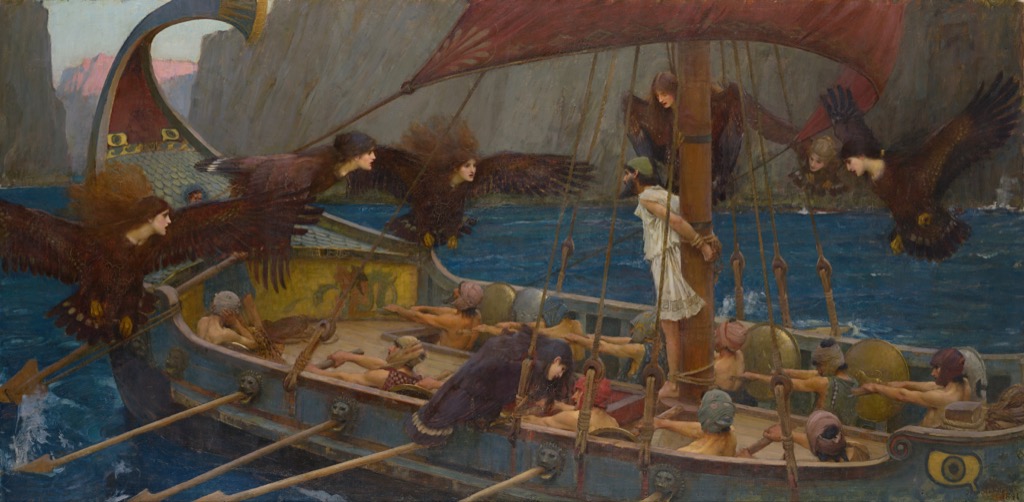
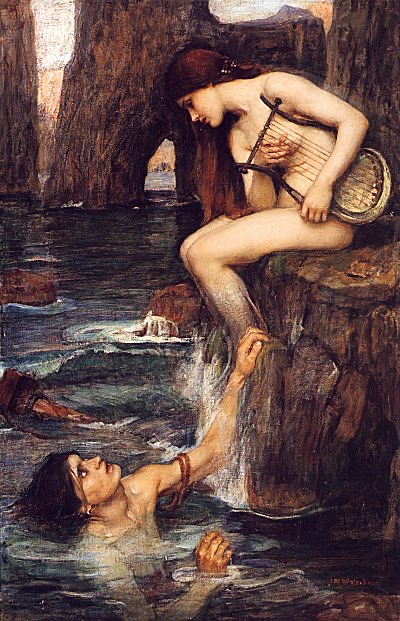
Waterhouse repeatedly painted music as a force that crosses boundaries. Sirens attract sailors, the Charmer moves fish, and Pan's piping holds listeners within landscape.
In A Hamadryad, no physical reaction is shown. The nymph does not descend, dance or flee. Her turned head is enough to confirm that sound has reached her.
This minimal response creates suspense without requiring a later event. The painting can remain an encounter rather than the beginning of pursuit.
Distance prevents possession. Although the nude body is openly visible to the spectator and musician, height and tree make it unavailable.
The vertical forest also changes how sound is imagined. Instead of moving laterally across a pastoral field, it rises through trunk, leaves and shadow.
Pipes echo the grouped verticals of the composition in miniature. Their short parallel reeds become a portable counterpart to trunks and stems.
The musician's breath animates those cut reeds, while the living tree sustains the nymph. Instrument and tree are related forms of vegetation, one transformed by human craft and one inhabited by spirit.
That comparison need not be a coded intention to be visually useful. Waterhouse places made music below a figure whose identity depends upon living wood.
The result is neither simply erotic nor purely devotional. Attention moves between bodily beauty, natural vitality and the cultural act of making sound.
The music may also be understood as a test of responsiveness. A tree cannot visibly hear, but the hamadryad's downward glance personifies the possibility that a living landscape can answer. Waterhouse gives perception to the woodland without making branches move unnaturally.
This is different from enchantment that overrides another will. No gesture shows the player commanding her. His music gains a response, but the nymph remains in her own element and at her own height.
The balance preserves uncertainty about desire. He may serenade, summon or simply play; she may be curious, receptive or watchful. The picture supplies connection without narrating consent or outcome.
The extraordinary vertical format
At 158 centimetres high and only 59.5 centimetres wide, the painting is more than two and a half times as tall as it is broad. [1] [2]
That proportion is unusually narrow even for a standing figure. Waterhouse does not merely fit a body into it; he makes the elongated field the argument of the picture.
The eye begins with fungi and seated musician, moves along the trunk, encounters the nymph and continues into foliage. Viewing resembles looking upward in an actual wood.
Horizontal escape is restricted. There is little open landscape, sky or architectural depth to relieve the vertical pressure.
The format also exaggerates separation between the figures. They could have been placed side by side in a wider mythological scene, but Waterhouse stacks them within different levels of one organism-like environment.
The hamadryad's proportions and pose answer the canvas. Raised arm, long torso and extended leg reinforce ascent.
Her body is not centred like a free-standing statue. It shifts against the trunk, allowing bark to remain visible beside and behind her. That off-centre dependence makes the tree structurally necessary rather than a convenient support added after the figure was designed.
The musician's placement near one lower corner establishes a diagonal of attention inside the vertical scheme. His face and pipes point upward, countering the tendency of gravity to pull the viewer back towards roots and ground.
By contrast, the musician folds into a seated knot. His compact body forms a base from which the painting grows.
The arrangement has something of a decorative panel, yet its spatial drama prevents flatness. Dark recesses, overlapping foliage and projected roots create a habitat rather than a pattern alone.
Any later page layout must preserve the whole aspect ratio. A square crop would make the nymph larger but destroy the crucial interval of music and height.
Forest detail and colour
The colour structure depends upon pale flesh set against deep browns and greens. The nymph is the largest light passage, making her appear discovered within shade.
The musician's skin and clothing repeat warmer notes at the bottom but with less luminosity. This binds the two bodies without equalising them.
Ivy or other climbing vegetation crosses the trunk. Small leaves break large verticals and help the nymph's contours merge with growth.
Fungi near the forest floor are especially appropriate visual details. They indicate dampness, decay and renewal at the tree's base without serving as fixed symbols.
Flowers and low plants prevent the ground from becoming an empty dark strip. Their minute scale intensifies the height of the upper figure.
Waterhouse's woodland is not a botanical survey of one documented site. Species identification should be conservative where reproduction and painterly handling are insufficient.
The forest contains little open blue sky. Light filters locally, producing the sensation of enclosure that allows a mythic body to remain plausible.
Texture carries meaning: smooth skin, grooved bark, soft leaves and irregular fungi propose different kinds of living surface.
The nymph's pallor is not evidence that she is ghostly or dead. It is the compositional device by which human form becomes visible within dense vegetation.
Nudity and mythological permission
Victorian academic art frequently used classical and mythological subjects to legitimise the nude within public exhibition.
Waterhouse's title places the figure in that tradition. She is not presented as an identifiable contemporary sitter undressed in a modern wood, but as a nature spirit whose body expresses her category.
That convention does not eliminate erotic viewing. The musician looks upward, and the spectator is invited to discover the same exposed body.
The painting complicates access, however. The hamadryad is not arranged frontally at ground level. Tree, shadow, height and downward gaze maintain distance.
Her nudity can therefore signify both natural embodiment and desired appearance. Treating one explanation as exhaustive would flatten the work.
Nor should the pose be described as helpless. She commands the largest scale and occupies the vertical centre; the clothed or darker musician is physically subordinate.
Ancient nymph traditions supplied Waterhouse with a language for joining femininity to landscape. Modern interpretation can acknowledge the gendered idealisation within that language without pretending the figure is simply “nature itself.”
The secure claim is more precise: the named hamadryad is visually bound to her tree, and the male musician's gaze makes that bond an encounter.
Exhibition, gift and collection history
A Hamadryad was shown at the Royal Academy in 1893 as catalogue number 98. [1]
That date should govern the manuscript despite later reproductions that label the work 1895. An 1893 exhibition provides a firm terminus and public context.
The painting entered Plymouth's collection as a gift from Alfred A. de Pass in 1926 and is now held by The Box under accession number PLYMG.1926.17. [1] [2]
De Pass was an important donor to British public collections. The credit line records the civic route by which a privately circulating Royal Academy picture became publicly accessible.
Collection ownership also distinguishes this manuscript from the many Waterhouse pages dependent entirely on auction records. Dimensions, medium, accession and credit can be tied to a permanent object record.
The current institutional name is The Box, Plymouth. Historical references to Plymouth City Museum and Art Gallery describe the same civic collection in an earlier organisational form.
Public-domain image records sometimes reproduce the date ambiguity. They remain useful for access, but museum and exhibition data should be reconciled rather than copied without comment. [1]
The work's unusual format makes direct public display especially valuable. Scale that looks merely slender on screen becomes architectural when seen at 158 centimetres high.
Its public ownership also changes the conditions of interpretation. Unlike a privately held study known chiefly through market photography, A Hamadryad can be checked against a stable accession, credit line and institutional collection. Future conservation or display information can attach to the same object rather than to a title shared by variants.
That stability is especially welcome because the date has circulated as both 1893 and 1895. The Royal Academy record and collection metadata give the page a reasoned basis for preferring 1893 while acknowledging the later label in image archives. [1] [2]
Place within Waterhouse's art
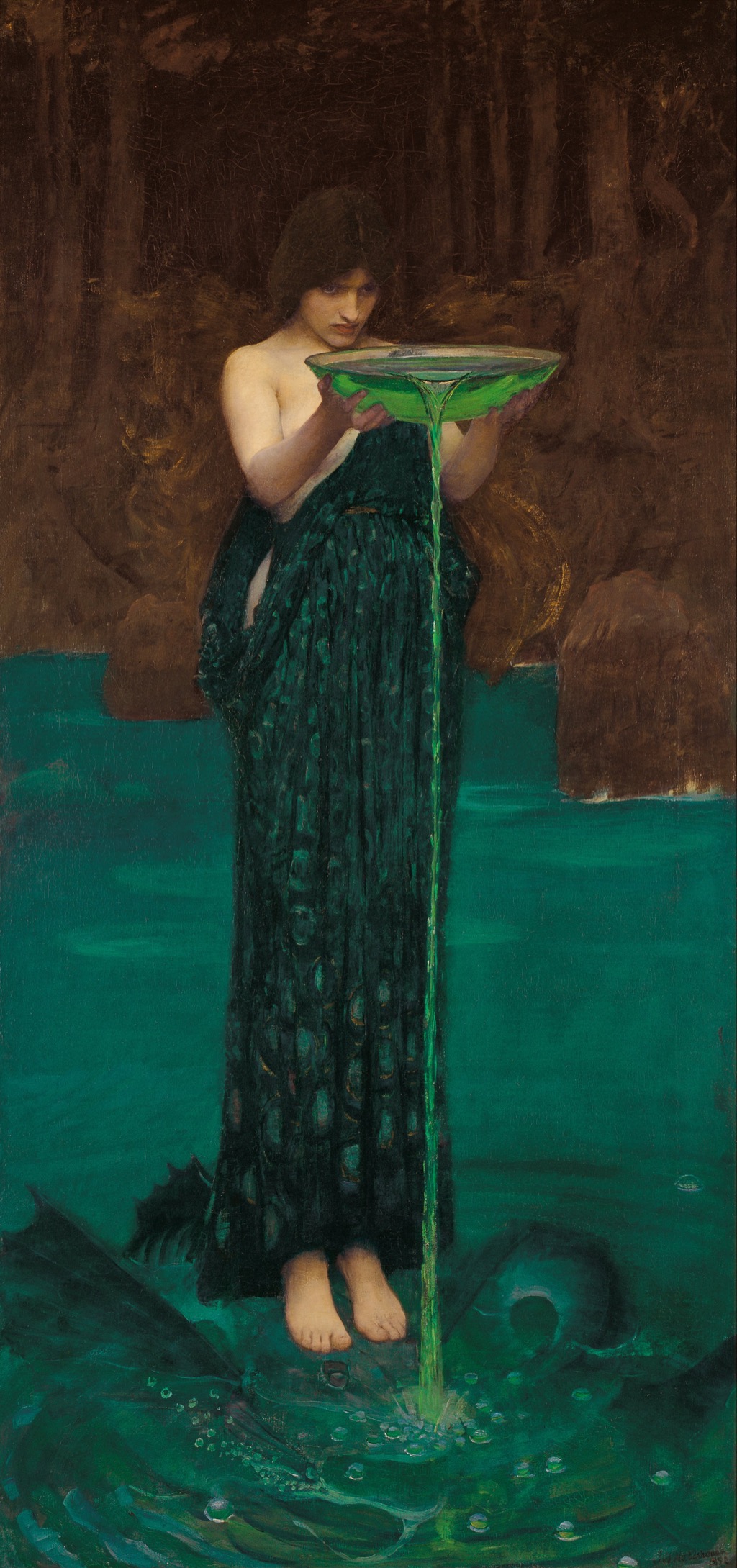
The 1890s brought Waterhouse repeatedly to dangerous or elusive female beings: Circe, the nymph beside Hylas and later the sirens and mermaids.
The hamadryad differs from a sorceress because her power is not an acquired technique. It belongs to identity and habitat.
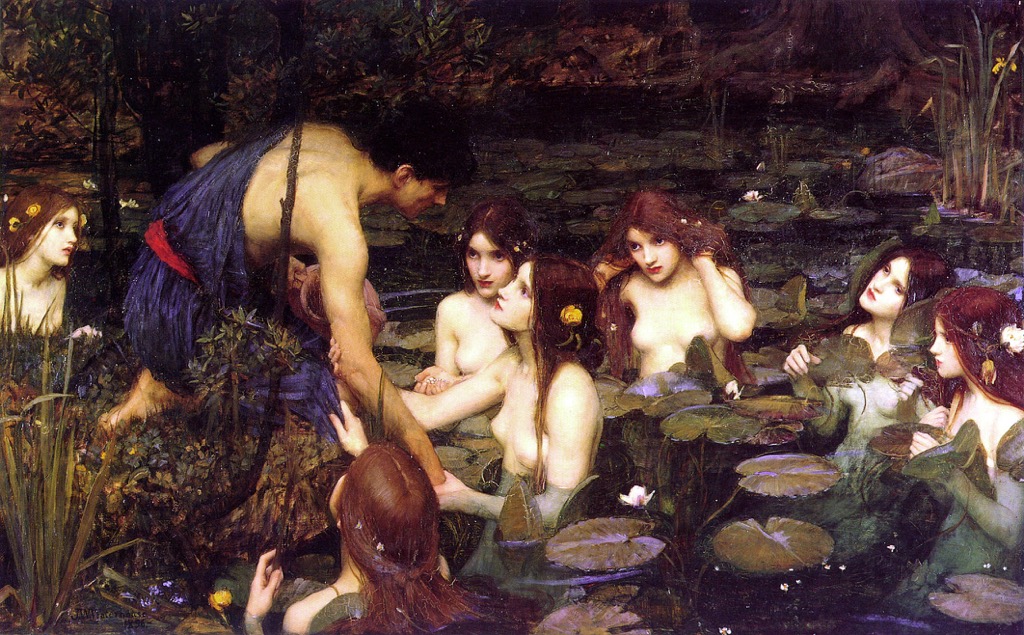
She also differs from the seven nymphs of Hylas and the Nymphs. There the women share one pool and reach towards a mortal; here one nymph is separated vertically from one musician.
Music provides a link to later works such as The Charmer and Listening to My Sweet Pipings. Across them, sound makes otherwise silent natural presences responsive.
The panel format anticipates Waterhouse's continued interest in isolating a female figure within dense vegetation. But few works make composition and mythological category fit so exactly.
A Hamadryad is therefore more than a supporting woodland nude. Its narrow field gives visual form to the meaning of a life “together with tree.”
Related Pages
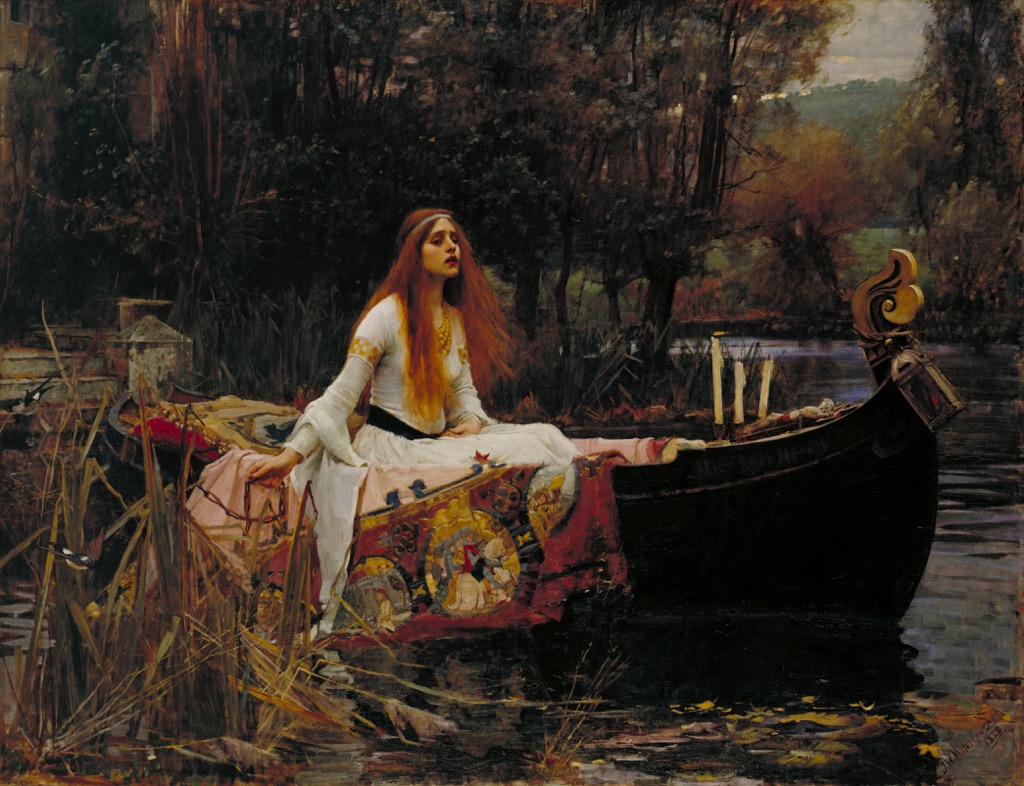
- The Lady of Shalott: Compare Waterhouse's best-known literary composition.
- Hylas and the Nymphs: Compare another major mythological scene.
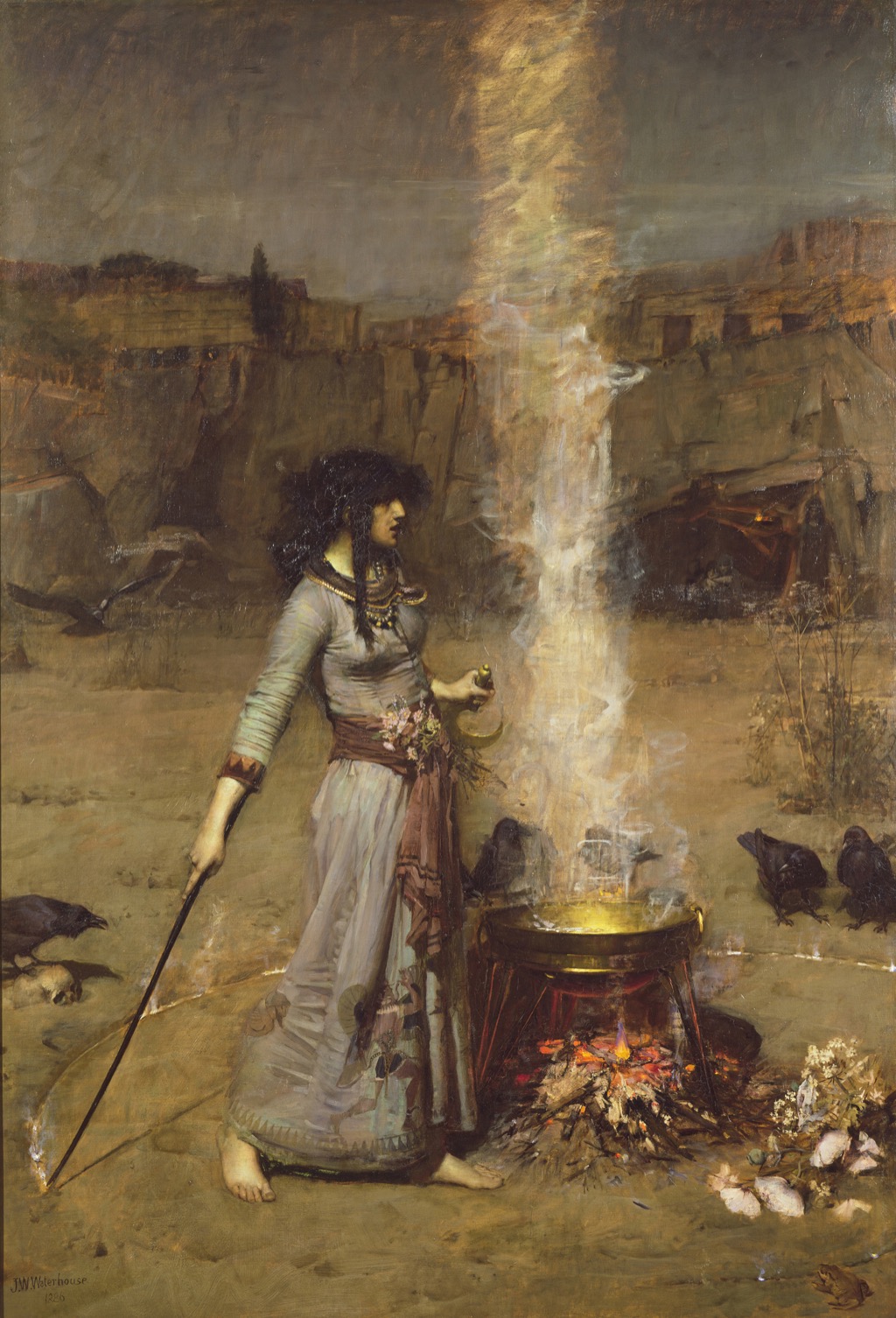
- The Magic Circle: Compare Waterhouse's treatment of ritual and symbolism.
Frequently Asked Questions
It was exhibited at the Royal Academy in 1893. [1]
He is Pan-like and may be a satyr or faun, but the title names only the hamadryad. His personal identity is not securely fixed by the object record.
A set of rustic pipes associated in classical tradition with Pan and woodland music. [5]
Alfred A. de Pass gave it in 1926. [1]
No explicit sequence of transformation is shown. Her body is visually joined to the trunk because a hamadryad's life and tree are conceptually bound.
Discussion
A Hamadryad uses format as mythology. Its narrow canvas rises like a trunk, carrying the eye from the small musician on the forest floor to the pale figure held against living wood.
The title explains the intimacy of body and tree, but Waterhouse avoids literal metamorphosis. Skin remains skin and bark remains bark. Their shared vertical rhythm makes the bond convincing without turning the nymph into an anatomical puzzle.
Reader Insights
Which visible detail most changes the way you read this page?
Which source or comparison helps the work feel less familiar and more specific?
What question would you bring back to the painting after reading?
Join the Conversation
Share your reading of this page below.
References
- Wikimedia Commons / Art UK object data, John William Waterhouse, Hamadryad, date, medium, dimensions, Royal Academy exhibition, accession and de Pass gift. View source
- Art UK, “Hamadryad by John William Waterhouse,” collection record for The Box, Plymouth. View source
- Theoi Classical Texts Library, “Dryads and Oreads,” definition of dryads and hamadryads with ancient-source references. View source
- Homeric Hymn to Aphrodite, lines 256–272, the shared life cycle of mountain nymphs and their trees, translated in the Theoi Classical Texts Library. View source
- Homeric Hymn to Pan, Pan's woodland wandering, nymphs and evening piping. View source