

 by Tom Gurney
Tom Gurney BSc (Hons) is an art history expert with over 20 years experience
Published on August 14, 2026 / Updated on August 14, 2026
Email: tomgurney1@gmail.com / Phone: +44 7429 011000
Listening to My Sweet Pipings: Introduction
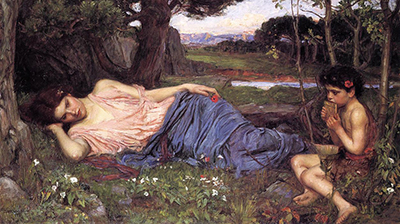
John William Waterhouse's Listening to My Sweet Pipings turns a woodland performance into a landscape-wide act of attention. A young pipe player sits beneath trees at the right, watching a reclining woman whose pink and blue draperies echo distant water, hills and sky. She hears him without returning his gaze, absorbed in a state between repose and reverie.
Painted in 1911 and exhibited at the Royal Academy that year as number 141, the work takes its title from Percy Bysshe Shelley's Hymn of Pan. [1] [2] It was also known as The Piping Boy and was acquired by Major the Honourable Alexander P. Henderson. [3] The literary source supports identification of the musician with Pan, but the woman's identity as Earth is an interpretation rather than a name stated in the title.
At a Glance
- ArtistJohn William Waterhouse
- TitleListening to My Sweet Pipings [1] [2]
- Alternative titleThe Piping Boy [3]
- Date1911 [1] [3]
- MediumOil on canvas [1]
- DimensionsApproximately 60 × 104 cm [1]
- CollectionPrivate collection [1]
- ExhibitionRoyal Academy, London, 1911, no. 141 [1] [3]
- Literary sourcePercy Bysshe Shelley, Hymn of Pan [2]
- Early ownerMajor the Honourable Alexander P. Henderson [3]
- Related workThe Charmer, also exhibited by Waterhouse in 1911
Contents
- Introduction
- What the painting shows
- Shelley's Hymn of Pan
- The youthful pipe player
- Who is the reclining woman?
- Listening without looking
- Landscape as part of the subject
- Colour, rhythm and horizontal design
- Studies and artistic preparation
- Exhibition and ownership
What the painting shows
A woman reclines in a wooded landscape, her torso raised against a bank or tree. Her garments combine soft pink, blue and pale tones, with a darker band at the waist.
The head turns away from the musician. Her eyes appear unfocused, directed into middle distance rather than towards a specific object.
At right sits a youthful figure holding a set of pipes to his mouth. He watches her as he plays.
The two are close enough to share one shaded place, but they do not touch. Music is the visible reason for their relation.
Trees frame both figures, opening beyond them towards a river or stream, fields, hills and sky. The landscape is unusually expansive for an intimate two-person Waterhouse subject.
Wild plants and flowers occupy the foreground. A cave-like or shadowed recess appears among the varied terrain, adding depth and connecting the image with Shelley's inventory of Pan's world.
The woman's body runs across the picture and repeats the horizontal recession of land and water. The musician forms a more compact vertical accent.
No dance, pursuit or overt spell occurs. The painting depicts listening as an inward bodily state rather than a public reaction.
Shelley's Hymn of Pan
Shelley's poem is spoken by Pan. Its opening summons forests, highlands, islands and waters into a world made silent by his piping. [2]
Wind in reeds, bees, birds, cicadas and lizards all become listeners. Later Sileni, Sylvans, Fauns and nymphs gather at river-lawns and caves, silent with love while Apollo listens with envy. [2]
The refrain “Listening to my sweet pipings” gives Waterhouse his exact title. [2]
This source changes the painting from a generic pastoral concert into a response to a particular poetic voice. The pipes do not merely entertain one woman; in the poem they command the attention of living nature.
Waterhouse includes several of Shelley's landscape categories: trees, water, grass, hills and a shaded rocky or cave-like place. He does not illustrate the poem line by line or populate the scene with all its creatures.
The poem's last movement is less placid than the opening. Pan sings of stars, earth, heaven, war, love, death and birth, then recalls pursuit, transformation into a reed and shared sorrow. [2]
Shelley structures the poem as a response to Apollo. Pan insists upon the reach and emotional range of his rustic music before an Olympian associated with the lyre. The repeated piping is therefore both performance and claim to artistic power.
Waterhouse eliminates the competitive listener named in the poem. Apollo is not visibly present; the reclining woman receives the music instead. This substitution moves the work away from a contest between gods and towards the psychological experience of hearing.
It also softens the poem's final violence without erasing its undertone. The landscape is calm, yet the woman's withdrawn expression prevents calm from becoming uncomplicated delight.
That change complicates the painting's serenity. Sweet music carries desire, rivalry and pain as well as harmony.
The title is therefore not evidence that the reclining woman is simply relaxed. Listening can involve enchantment, memory, emotional distance or resistance.
The youthful pipe player
Shelley's title source makes Pan the most persuasive identification for the musician. Yet Waterhouse does not emphasise the mature horned, goat-legged god common in later imagery.
The figure looks boyish. He sits low, with smooth limbs and a flower or red accent in his hair, making him closer to a beautiful rustic youth.
The alternative title The Piping Boy confirms that his youthfulness was recognised in the work's early history. [3]
Waterhouse may be softening Pan's animal otherness to fit the intimate late style of the picture. The pipes and poem carry identity without requiring grotesque anatomy.
His gaze is more direct than the woman's. While playing, he studies the listener, joining visual desire to musical address.
The pipes conceal part of his mouth. Breath passes through an instrument rather than speech, and the poem's verbal complexity is translated into silent paint.
He is small relative to the landscape. This does not weaken him: in Shelley's poem, sound travels beyond the body that produces it and stills a whole environment.
Calling him “a youthful Pan” keeps literary and visual evidence together. Calling him merely an anonymous shepherd would ignore the title source; describing horns or hooves not clearly visible would invent detail.
Who is the reclining woman?
Peter Trippi has interpreted the reclining woman as Earth, noting how her form and colours repeat sky, hills and water. [4]
That interpretation is attractive because Shelley's Pan sings of “daedal Earth” and because the poem imagines nature collectively responding to music. [2]
Waterhouse does not inscribe the woman “Earth,” “Gaia” or a named nymph. The Royal Academy title describes the activity of listening rather than identifying her. [3]
She can therefore be approached at several levels: a mortal listener in mythic landscape, a nymph, or a personification whose body gathers the colours of nature.
The visual evidence strongly supports integration with landscape. Pink fabric corresponds with warm distant light; blue repeats water and sky; the reclining contour follows hills.
Integration is not the same as fixed identity. Waterhouse often used clothing and setting to bind a figure to mood without converting her into an allegorical personification.
The uncertainty benefits the picture. A named Earth would make her response universally symbolic; an unnamed woman preserves individual inwardness.
Public copy should present Trippi's Earth reading as attributed interpretation, not object fact. [4]
Listening without looking
The painting's most important psychological choice is the separation of hearing and sight. Pan watches the woman; she listens without looking back.
This makes their relationship unequal. He seeks a response that the music may already have produced, but he receives no confirming gaze.
Her distant expression can be described as absorbed, pensive or inward. It should not be diagnosed as sadness, hypnosis or rejection without qualification.
Listening is often visually difficult because it involves no object the painter can show. Waterhouse makes it legible through stillness, a turned head and the contrast with active playing.
The woman's reclining pose suggests receptivity but not surrender. One arm and the raised torso maintain bodily independence.
Shelley's refrain describes animals, landscape beings and Apollo held silent by the pipes. Waterhouse translates that collective hush into one figure's lack of outward movement. [2]
The absence of eye contact also preserves duration. A returned glance could become a decisive romantic exchange; the averted gaze lets music continue without resolution.
The spectator sees both sides at once and occupies a privileged position. We can follow Pan's look, inspect the woman's response and observe the landscape supposedly sharing the music.
That triangular arrangement creates an ethical question familiar in Waterhouse's art. Pan's attention is directed, the woman's is withheld, and ours ranges freely over both. The painting acknowledges attraction without rewarding it with eye contact.
Her pose further resists a single emotional label. Reclining can signify ease, but the raised torso and turn of the neck introduce tension. She has not fallen asleep under the pipes; she remains bodily alert even as her gaze travels elsewhere.
The title describes an action in the present continuous. “Listening” is not a completed response. Waterhouse holds the scene for as long as the imagined music lasts.
Landscape as part of the subject
The setting contains more kinds of terrain than Waterhouse needed for simple pastoral plausibility. Water, wooded banks, open land, distant uplands and rocky shade appear within one broad view.
That variety answers Shelley's poem, which moves through forests, highlands, islands, river valleys, mountains and caves. [2]
The landscape should not be identified as one documented Greek site. Names such as Tempe, Pelion, Peneus, Tmolus and Maenalus belong to the poem, while Waterhouse creates a composite visual country.
Trees perform two roles. They provide intimate shade for the figures and frame the far distance through which the idea of music expands.
Water draws the eye away from the foreground. It may also recall the reeds from which Pan's instrument is made, though specific plant identification remains uncertain.
Foreground flowers contribute colour without becoming a coded bouquet. Their most secure role is to make listening take place inside active growth.
The cave-like darkness matters because Shelley's nymphs gather at the brink of dewy caves. [2] Waterhouse need not match the line exactly for the visual echo to be meaningful.
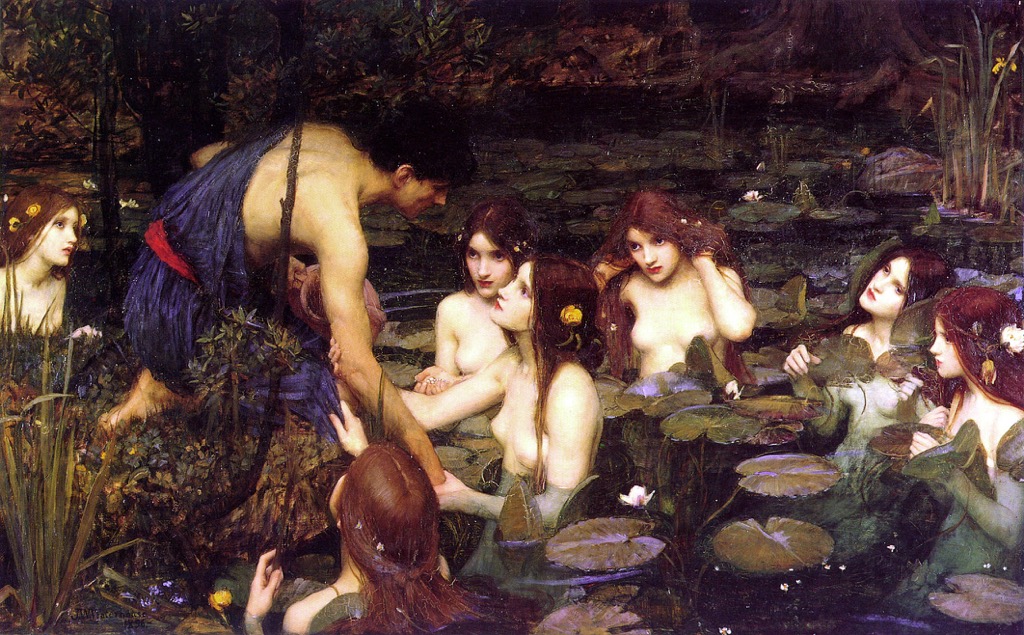
Unlike the enclosed pools of Hylas and the Nymphs or The Charmer, this landscape remains open. Music does not trap the listener in one secret place; it reaches across the world behind her.
Colour, rhythm and horizontal design
The canvas is almost twice as wide as it is high. Its horizontal format accommodates the reclining body and a sequence of landscape zones.
Pink and blue drapery forms the brightest central mass. Those colours recur more diffusely in distant land, water and sky.
This repetition makes the Earth interpretation possible without requiring an emblem or label. The body looks made from the same palette as its environment.
The musician is warmer and more compact. Hair, skin and red floral accent give him a concentrated presence against surrounding green-brown vegetation.
Curves dominate: the woman's limbs and garments, rounded bank, watercourse and distant hills. The pipes provide a small bundle of straight lines interrupting this flow.
The visual rhythm resembles music without trying to diagram sound waves. Repeated colour and contour carry the eye across intervals in the way a refrain links stanzas.
The woman's dark waistband has been interpreted as an umbilical connection to Earth, but that precise symbolic claim goes beyond the object's secure evidence. It is better read first as a compositional boundary within the pastel drapery.
Digital reproductions vary considerably in saturation. Claims about exact pigments or late technical procedure require conservation evidence not located for this privately held work.
Studies and artistic preparation
A pencil study for Listening to My Sweet Pipings survives with sketches on the reverse, including a figure connected with Narcissus. [1]
Christie's records the sheet at 17.5 by 24.8 centimetres and notes its descent through the artist's great-nephew. [1]
The drawing is close to another study formerly in the collection of Dennis T. Lanigan, although the Christie's example is sketchier and may precede it. [1]
Such evidence confirms that Waterhouse planned the relation of reclining woman, musician and landscape through drawing rather than beginning only on the final canvas.
The sheet's reverse connects two late projects materially. Studio paper could carry multiple ideas, and the survival of both sides challenges the neat separation created by finished titles.
Preparation did not eliminate openness in the final handling. The distant landscape remains broad and atmospheric, while faces and principal gestures receive greater definition.
The drawing should not be treated as proof of every compositional intention. It establishes a related stage, not a verbal explanation by the artist.
Its strongest value is comparative: viewers can see how the essential two-figure relationship existed before colour tied the woman's body to the land.
The verso sketches are equally instructive. A study for Narcissus occupies the same physical sheet as preparations for the piping scene. [1] The conjunction shows Waterhouse developing separate stories through related problems of bent bodies, directed attention and figures placed beside water.
Paper economises studio labour, but it also preserves unexpected connections. Finished paintings may look like self-contained worlds; a double-sided drawing reveals the practical continuity of the artist's thinking.
Exhibition and ownership
The painting appeared at the Royal Academy in 1911 as number 141 under the title Listening to My Sweet Pipings, or The Piping Boy. [3]
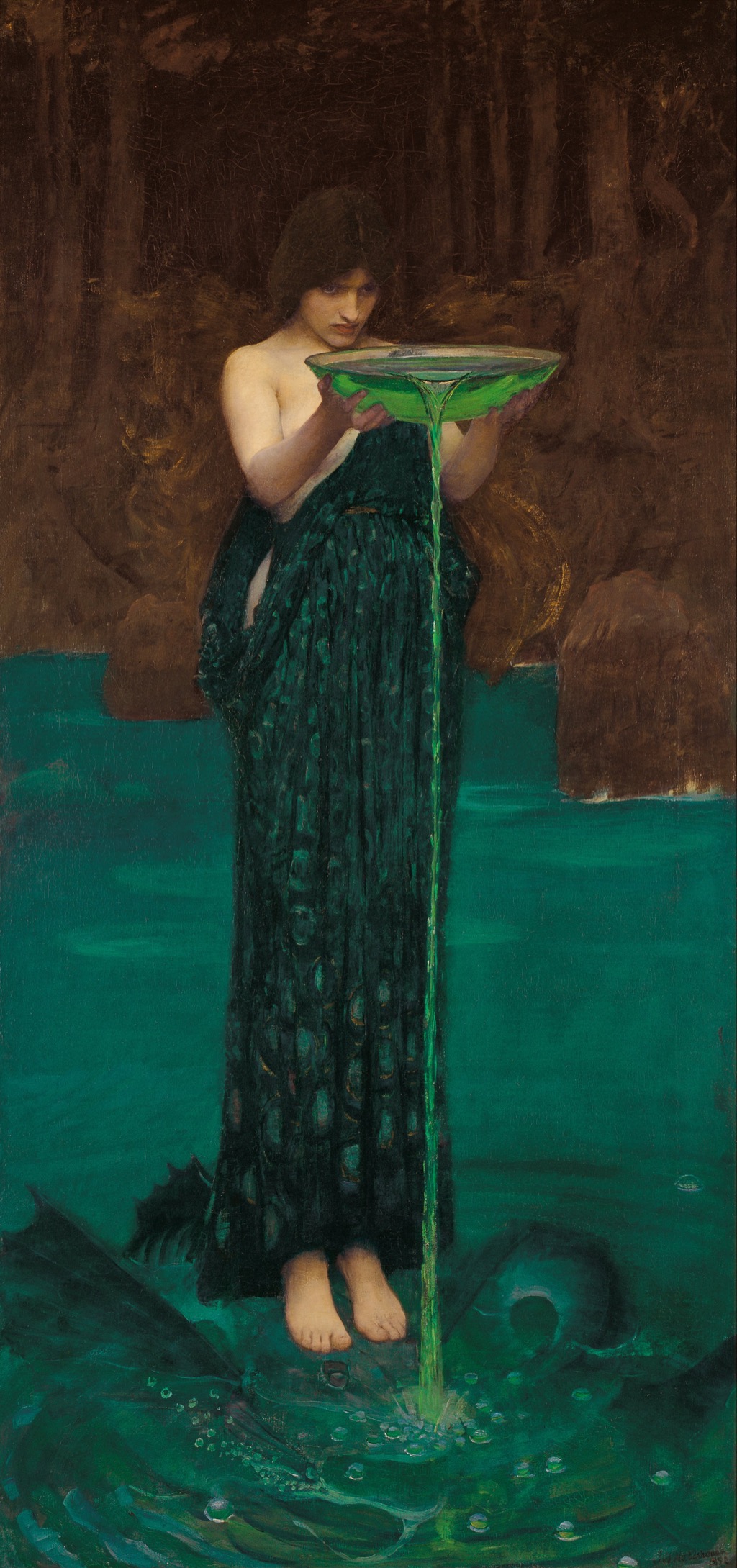
Waterhouse also exhibited The Charmer that year. Both paintings make music active within nature, one through Pan's effect on a woman and landscape, the other through a woman's effect on fish.
Major the Honourable Alexander P. Henderson acquired Listening to My Sweet Pipings. [3] Members of the Henderson family were among Waterhouse's most important later patrons and collectors. [5]
Patronage should not be confused with proof of commission. The record establishes purchase or ownership, not necessarily that Henderson chose the subject in advance.
The picture later appeared at Christie's on 8 November 1996, lot 59, and remains recorded in a private collection. [1]
Private ownership limits access to conservation and display information. It also makes study drawings, exhibition catalogues and sale records especially valuable.
No current public collection should be invented from an old owner. “Private collection” is the responsible location statement until a newer authoritative record appears.
Place within Waterhouse's late work
In the years around 1910–13, Waterhouse repeatedly explored women in landscape through flower gathering, listening, reflection and mythic encounter.
Listening to My Sweet Pipings belongs to this phase but retains a precise Romantic literary source. Shelley's poem prevents the scene from becoming generic decorative pastoral.
The picture also revisits Pan and nymph imagery found in A Hamadryad. The earlier work stacks musician and tree spirit vertically; the 1911 canvas spreads youthful Pan, listener and environment horizontally.
Its companion relationship with The Charmer creates a reversal. In one, a male player addresses a woman; in the other, a female player draws aquatic life upward.
The settings reverse agency as well. The Charmer bends over a confined pool and watches the visible effect of her music. Pan plays within an open country and looks for a response he cannot fully read. One image makes enchantment demonstrable through splashing fish; the other makes it inward and uncertain.
Exhibited together, the pair allowed the Royal Academy audience to compare musical influence across gender, species and space. Their shared year is therefore more than chronology: it identifies a sustained artistic investigation. [3]
Waterhouse's interest is less the mechanics of instruments than the power of absorbed attention. Music makes otherwise separate beings share a temporary state.
The painting's late importance lies in its synthesis. Poetry, landscape, body and colour do not illustrate one another redundantly. Each supplies something the others cannot: Shelley gives voice, Pan gives action, the woman gives response, and landscape gives scale.
Related Pages
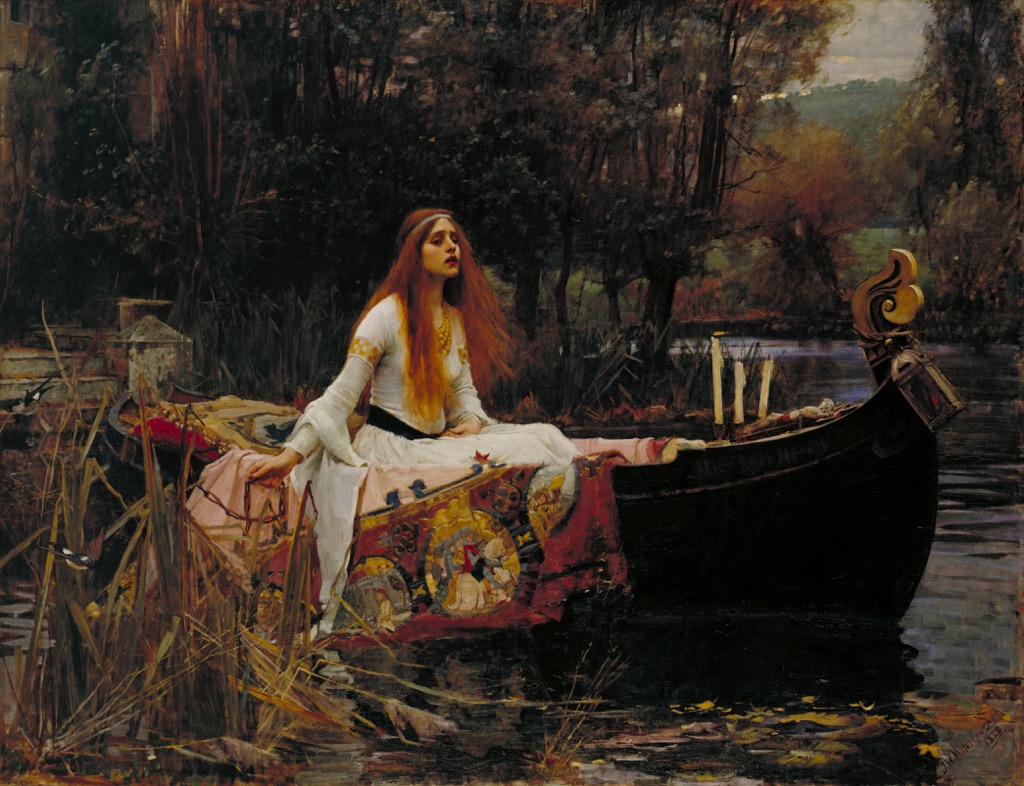
- The Lady of Shalott: Compare Waterhouse's best-known literary composition.
- Hylas and the Nymphs: Compare another major mythological scene.
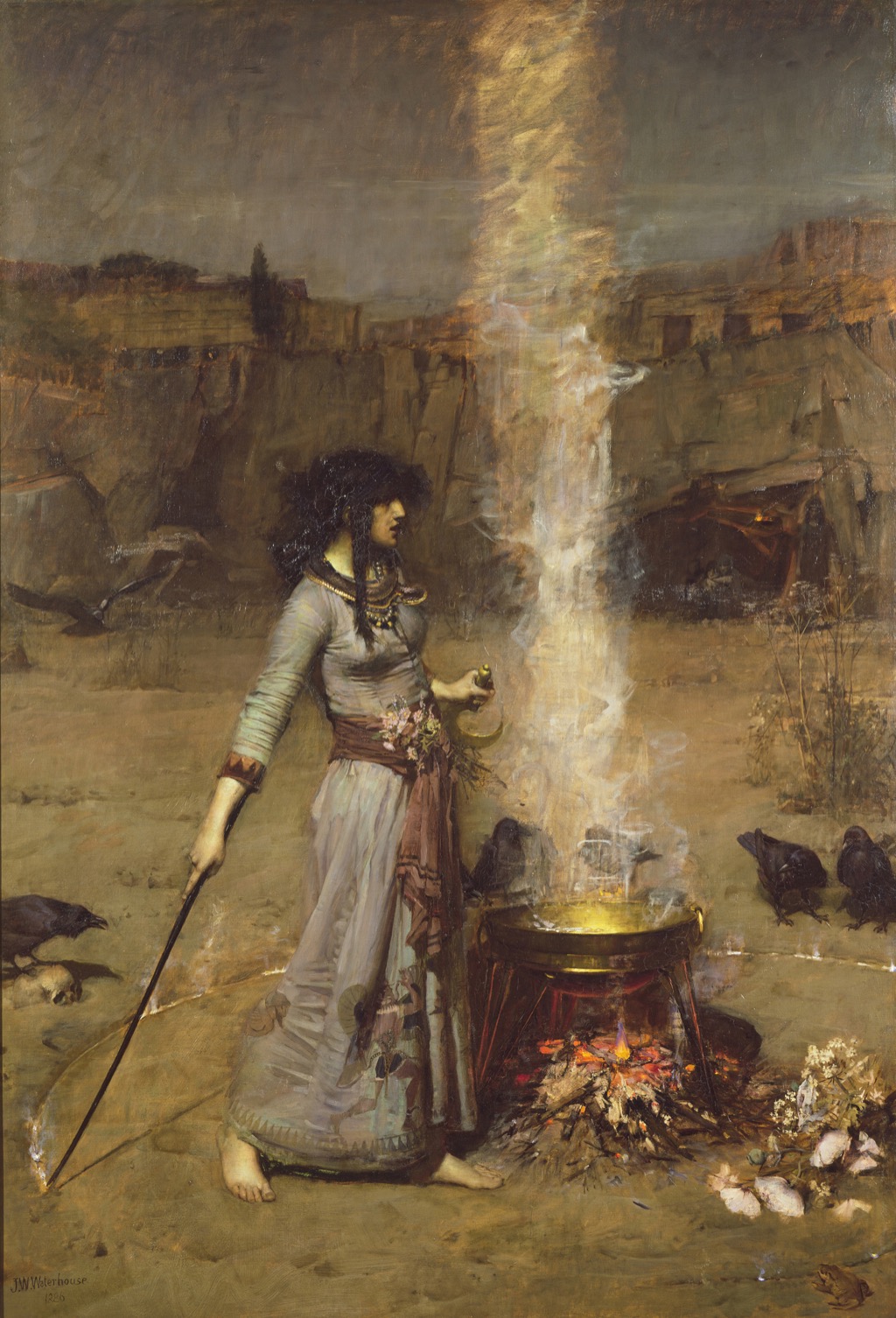
- The Magic Circle: Compare Waterhouse's treatment of ritual and symbolism.
Frequently Asked Questions
From the refrain of Percy Bysshe Shelley's Hymn of Pan. [2]
The literary source and pipes support identification as a youthful Pan, although Waterhouse minimises the god's usual animal features.
She is unnamed. Peter Trippi interprets her as Earth because her form and colours echo the landscape, but this remains an attributed reading. [4]
The Piping Boy. [3]
Approximately 60 by 104 centimetres. [1]
Major the Honourable Alexander P. Henderson acquired it from Waterhouse's 1911 output. [3]
It is recorded in a private collection. [1]
Discussion
Listening to My Sweet Pipings is not simply an image of music heard. It is a painting about how attention moves. Pan looks towards the woman, the woman turns inward, and the landscape expands behind both as the poem's true field of influence.
Shelley's refrain supplies the title, but Waterhouse avoids literal inventory. A single youthful musician and listener stand for a world quieted by sound. Trees, water, fields, hills and shade extend that silence beyond the bodies.
Reader Insights
Which visible detail most changes the way you read this page?
Which source or comparison helps the work feel less familiar and more specific?
What question would you bring back to the painting after reading?
Join the Conversation
Share your reading of this page below.
References
- Christie's, “Study for Listening to My Sweet Pipings (recto); sketches including a study for Narcissus (verso),” drawing details, relation to the 1911 painting and 1996 sale record. View source
- Poetry Foundation, Percy Bysshe Shelley, “Hymn of Pan,” complete primary text and title refrain. View source
- Christie's, catalogue note identifying Listening to My Sweet Pipings, alternative title The Piping Boy, Royal Academy 1911 no. 141 and Alexander P. Henderson ownership. View source
- Peter Trippi / catalogue interpretation, discussion of the Shelley source and the reclining figure as Earth, reproduced with object data by the John William Waterhouse project. View source
- Sotheby's, catalogue note for Vain Lamorna, Henderson-family patronage and collection history. View source