

 by Tom Gurney
Tom Gurney BSc (Hons) is an art history expert with over 20 years experience
Published on August 14, 2026 / Updated on August 14, 2026
Email: tomgurney1@gmail.com / Phone: +44 7429 011000
Echo and Narcissus: Introduction
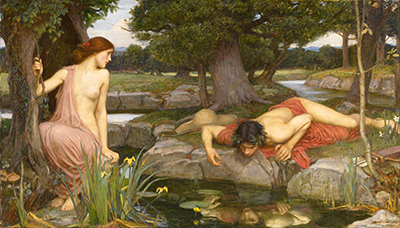
John William Waterhouse’s Echo and Narcissus is a painting about two people who cannot reach what they desire. Echo looks across a stream towards Narcissus, but he does not return her gaze. Narcissus leans over the water towards a face that appears to meet his own, yet it is only a reflection. Waterhouse gives each figure an object of love and makes both objects unavailable.
Painted in 1903 and now in the Walker Art Gallery, Liverpool, the wide canvas turns a long episode from Ovid’s Metamorphoses into one suspended encounter. Echo remains bodily present although Ovid says that she wastes into voice; Narcissus is already absorbed by the pool although that happens later; flowers bearing his name already grow beside him although his transformation belongs to the end. The picture does not illustrate one instant. It makes several times visible together, using water, posture and the direction of looking to reveal a tragedy of failed communication.
At a Glance
- ArtistJohn William Waterhouse (1849–1917)
- TitleEcho and Narcissus
- Date1903
- MediumOil on canvas
- Dimensions109.2 × 189.2 cm, unframed
- CollectionWalker Art Gallery, National Museums Liverpool
- Accession numberWAG 2967
- AcquisitionPurchased in 1903
- First exhibitedRoyal Academy, London, 1903, catalogue no. 16
- Related workFull-scale black-chalk study for the figure of Echo, private collection [1] [2] [3]
Contents
- Introduction
- A Story Constructed Through Looking
- Ovid’s Two Intersecting Tragedies
- A Composite Moment Rather Than a Literal Illustration
- Echo: A Visible Body for a Story About Voice
- Narcissus: Reflection Without Reciprocity
- The Stream as Divider, Mirror and Measure of Time
- Flowers, Trees and the Unsettled Landscape
- The Full-Scale Study for Echo
- Royal Academy Reception in 1903
A Story Constructed Through Looking
The first fact of the composition is separation. Echo occupies the left bank of a narrow stream. Narcissus lies on the right. They share the same open landscape and appear close enough for speech, but the water divides their bodies and their attention. Echo looks diagonally across towards Narcissus; Narcissus looks sharply down; the reflection looks back from the pool. The viewer alone sees the whole circuit.
That circuit replaces conventional dramatic action. There is no embrace, rejection, divine punishment or visible death. Waterhouse chooses three directions of sight and lets them explain the relationships. Echo’s gaze travels towards someone who does not notice her. Narcissus’s gaze returns to him in altered form. His reflected face seems responsive while Echo’s living face receives no answer.
The title joins the names with “and”, but the conjunction does not make a couple. The painting gives the two figures equal narrative status by setting them at opposite ends of a broad horizontal canvas. They belong to one story while inhabiting different emotional worlds. James Williams contrasts Waterhouse’s solution with Solomon J. Solomon’s 1895 treatment, in which Echo presses close to Narcissus in a frustrated near-embrace. Waterhouse leaves a charged interval between them. [4]
The breadth of the landscape is therefore not empty scenery. It gives rejection physical dimensions. Trees, bank and river hold the figures apart; the stream lengthens into the distance, suggesting that their division continues beyond the immediate foreground. The viewer can cross that space with the eye, but neither protagonist changes direction.
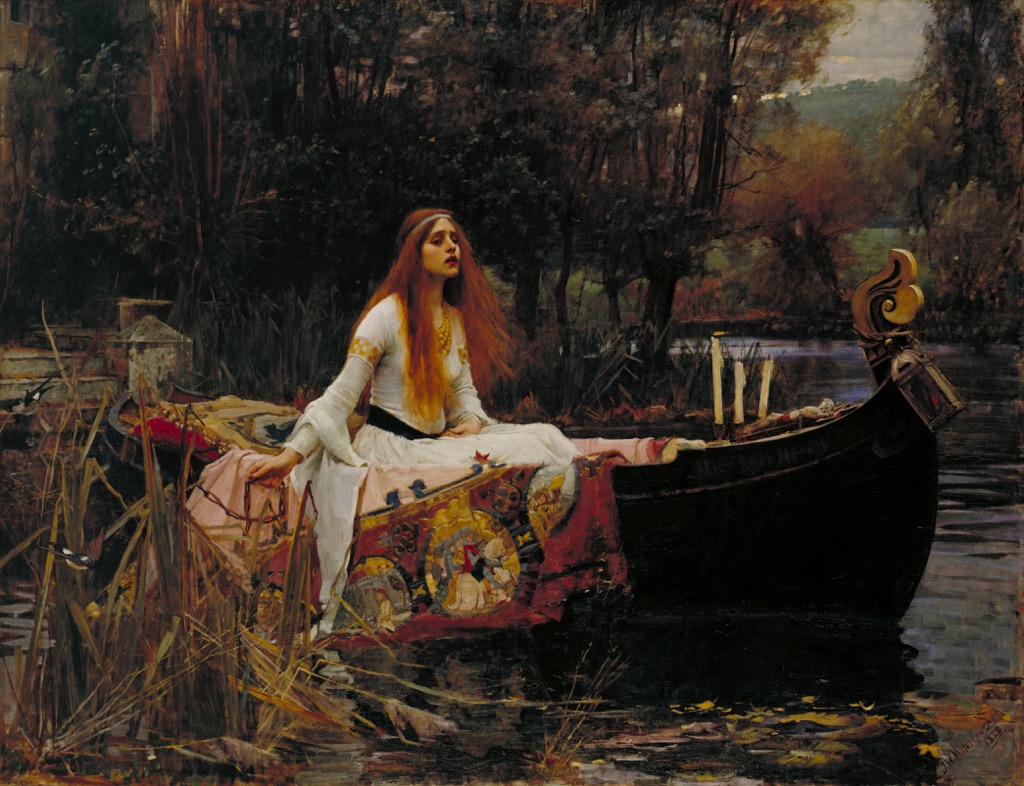
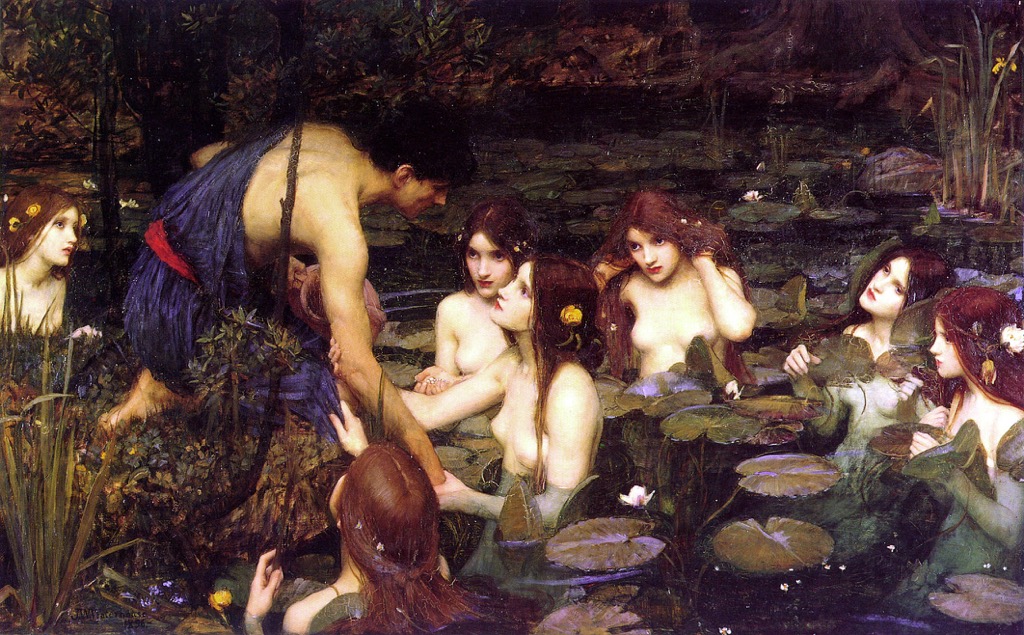
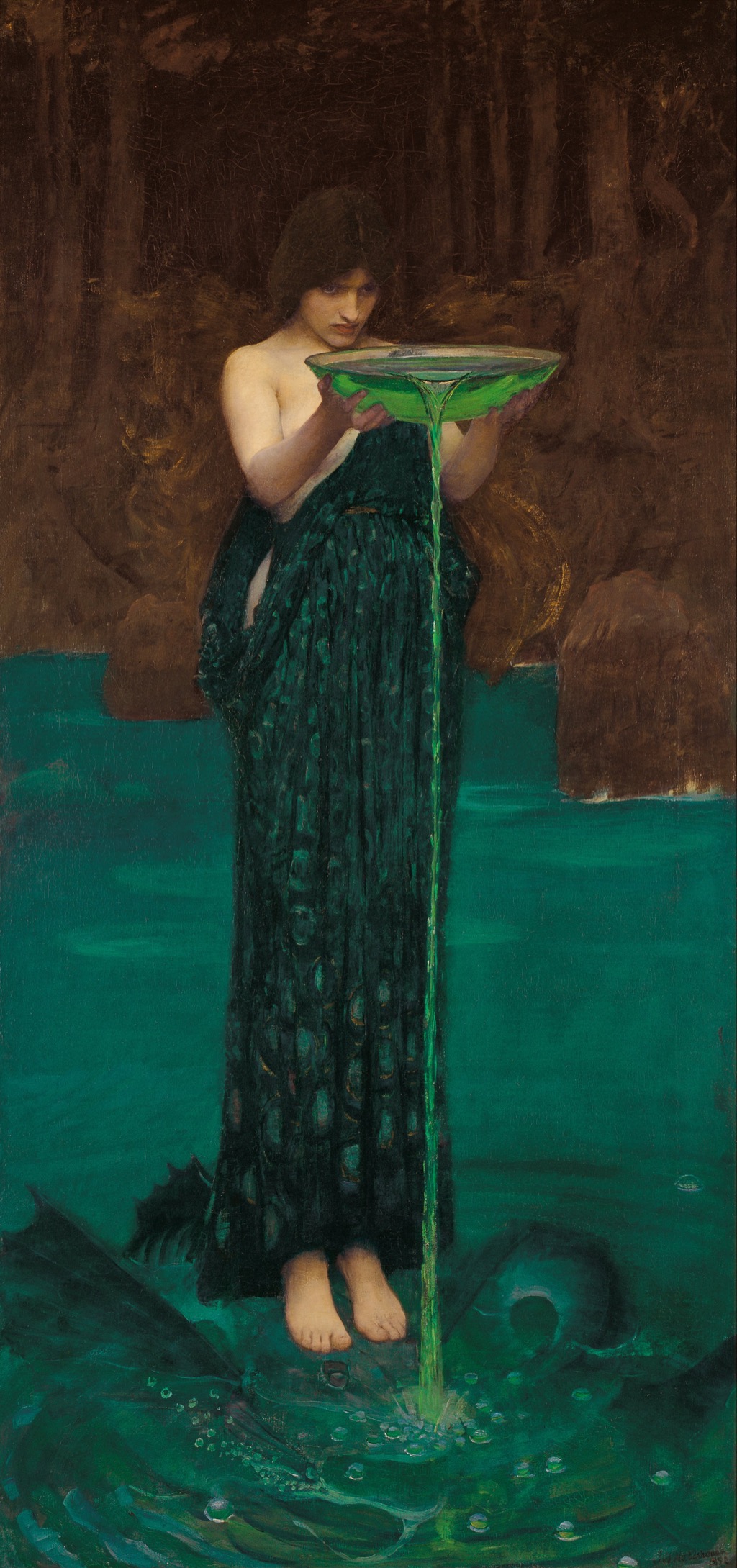
Waterhouse often made narrative depend on a decisive object: the chain in The Lady of Shalott, Circe’s cup, the dangerous flowers in Hylas and the Nymphs. Here the object is an image that has no substance. Narcissus reaches towards water whose surface can return sight but not touch. Echo, whose own curse concerns repetition, watches a second form of repetition trap him. His face returns visually as her words return audibly.
Ovid’s Two Intersecting Tragedies
The principal ancient source is Book III of Ovid’s Metamorphoses. The story begins before Echo appears. Narcissus is the beautiful son of the nymph Liriope and the river-god Cephisus. Asked whether the child will live to old age, the seer Tiresias answers that he will—if he does not come to know or recognise himself. The prophecy sounds obscure until reflection turns self-recognition into destruction. [5]
Narcissus grows into a youth desired by girls and boys alike, but he rejects them all. Ovid does not present a simple moral fable in which ordinary vanity receives an appropriate lesson. The youth’s beauty inspires widespread desire, his resistance is absolute and divine punishment follows the prayer of a rejected lover. He is condemned to love without possessing what he loves.
Echo enters while Narcissus hunts in the woods. She is already under Juno’s punishment. Having once detained the goddess in conversation while Jupiter pursued other nymphs, she can no longer begin speech or express a thought in her own words. She may only repeat the end of something another person has said. When Narcissus calls for a companion, his words accidentally allow her to answer. Their exchange sounds mutual while meaning something different to each speaker. She finally emerges and attempts an embrace; he rejects her and she repeats words that turn his refusal into her declaration. [5]
Ashamed, Echo retreats to woods and caves. Her body diminishes until only voice remains. Narcissus later finds a clear, undisturbed spring, bends to drink and falls in love with the beautiful figure he sees. At first he treats the reflection as another being. Every apparent response encourages him: when he smiles it smiles, when he stretches his arms it stretches its own. Yet any disturbance destroys the image, and touch is impossible.
Recognition eventually comes. Narcissus understands that the desired boy is himself but cannot free himself from desire. He wastes beside the spring and dies. When the nymphs prepare his funeral, a flower has taken the body’s place. Echo returns at his death not as a visible lover who expects fulfilment, but as a voice that repeats his final lament and farewell. [4] [5]
Waterhouse thus inherits two related stories of repetition. Echo can answer but cannot originate. Narcissus receives an answering image that has no independent life. Her words sound like dialogue while remaining borrowed; his reflection looks like a partner while remaining himself. Ovid’s brilliance lies in bringing those failures together. Waterhouse translates them from language into space.
A Composite Moment Rather Than a Literal Illustration
No single point in Ovid contains everything Waterhouse shows. If this were the first meeting, Narcissus would not yet be entranced by a pool. If it were his final decline, Echo would no longer possess the emphatic body shown on the left. The white narcissi growing beside his foot anticipate the metamorphosis that follows death. Past, present and future coexist.
Williams calls the result an emblematic tableau: a whole narrative telescoped into one visual arrangement. [4] This is more precise than asking what exact line Waterhouse illustrates. The painter chooses the elements that make the myth recognisable and organises them so their relationships can be understood at once.
The compression alters emphasis. Ovid lets the reader encounter Echo, follow her disappearance, leave her behind and then return to her voice at Narcissus’s death. Waterhouse refuses that disappearance. She is fully visible, warmly coloured and physically substantial. Her survival within the image restores attention to a character whom the story progressively removes from sight.
Narcissus’s metamorphosis is likewise made present before its time. The flowers do not necessarily mean that he is already dead. They allow viewers who know the myth to see the end beside the living body. Nature becomes prophetic: what he will become grows within reach while he remains unable to recognise the mortal body he already has.
This composite method is characteristic of ambitious narrative painting. A single instant may be dramatic, but a carefully constructed impossibility can explain more. Waterhouse does not fail to follow Ovid’s sequence. He changes sequence into comparison. Echo’s unreturned gaze and Narcissus’s unreturnable image become simultaneous forms of the same condition.
The lack of a definitive moment also protects emotional ambiguity. Echo may be looking with desire, grief, pity or some combination of them. In Ovid she pities Narcissus and echoes him as he dies even after he has rejected her. Waterhouse’s healthy-looking youth and embodied nymph do not settle whether this is longing before rejection or compassion after it. Her expression can carry more than one stage of feeling because the painting carries more than one stage of time.
Echo: A Visible Body for a Story About Voice
Echo sits or kneels against a tree on the left. Her pose is constrained: the torso rises, the legs fold beneath drapery and one arm appears to brace her against the trunk or ground. The Walker Art Gallery describes the position as cramped and links it with frustrated love. [1] She is neither approaching Narcissus nor retreating. Waterhouse makes stillness feel forced.
Her pink-red garment has slipped from one shoulder, exposing part of the breast and upper torso. The detail establishes vulnerability and bodily presence without turning the scene into an active seduction. Echo’s body is the thing Ovid will take away. Waterhouse therefore gives it visual weight—warm skin, coloured cloth, bent limbs—at the very moment her capacity to make herself understood has already been removed.
Her face turns towards Narcissus, but the mouth does not visibly call. Painting cannot make her restricted speech audible. Instead Waterhouse places her in a landscape that seems capable of carrying sound: water moves through a shallow corridor, trees enclose an open space and distance separates speaker from listener. The myth encourages the viewer to imagine a voice crossing terrain even though the painted figure remains silent.
The paradox of Echo is that she is not simply voiceless. She has too much voice and too little control. She must repeat, cannot decide when to begin and can transform another person’s words only through context. Her condition concerns authorship as much as sound. The painted gaze performs a similar restriction: she can direct attention towards Narcissus, but she cannot make him look back.
The poppy-like red flower in her hair and the yellow irises near her side contribute to her identification with a living, flowering bank. It is tempting to assign each plant a fixed symbolic meaning, but the evidence used here does not establish a symbolic programme devised by Waterhouse. Their safer functions are visual and narrative. Red intensifies Echo’s head against green; yellow marks the bank; the living flora contrasts with the named flower that foretells Narcissus’s end.
Echo’s position also affects the viewer ethically. We see Narcissus partly through her attention. Her gaze tells us where to look, but looking with her does not make us share her exclusion. Unlike Narcissus, we can look back at Echo. Waterhouse lets the spectator recognise the person whom the beautiful youth ignores.
Narcissus: Reflection Without Reciprocity
Narcissus lies along the right bank, his pale body extended almost horizontally. One arm supports or steadies him while the other reaches towards the water. A red cloth gathers around his lower body and connects him chromatically with Echo, but the shared colour does not create mutual attention. It binds the design while the gazes remain separate.
His posture brings beauty close to danger. To see the reflection he must lower his face towards the pool; to touch it he must disturb the surface that produces it. The body makes a long diagonal ending at the water, as though the composition itself were drawing him down. The movement is controlled rather than violent, but it cannot achieve its object.
Modern language often reduces Narcissus to vanity or diagnoses him through the later psychological term “narcissism”. That shortcut misses the strangeness of Ovid and of Waterhouse’s image. Narcissus does not initially admire himself knowingly. He mistakes a reflection for another beautiful being. His tragedy lies in recognition arriving too late: once he knows the image is his own, knowledge does not dissolve desire. [4] [5]
The painting predates Sigmund Freud’s 1914 essay on narcissism. It belongs to a long Victorian engagement with the myth rather than illustrating a later clinical concept. Contemporary viewers could certainly read self-absorption, rejected desire, gender and sexuality into the subject. Williams notes that Ovid’s Narcissus attracts both young men and women, a detail sometimes lost when the story becomes a narrow warning against pride. [4] Waterhouse does not identify the reflected figure as a different sex or simplify the myth into a courtship lesson.
Narcissus is also an object of looking. Echo studies him; the viewer studies him; the painted reflection doubles his face. The male body, not only the female figure, becomes the beautiful spectacle. Yet Waterhouse protects Narcissus from simple availability by turning his face downward. The reflection reveals what the living figure withholds, and even that face belongs to an unstable surface.
His lack of response should not erase his own punishment. Echo suffers because she cannot make another person answer. Narcissus suffers because the apparent answer can never become independent. Their desires are not morally identical, but their structures rhyme. Each is trapped by a form of return that resembles reciprocity without delivering it.
The Stream as Divider, Mirror and Measure of Time
Water occupies the centre and carries the composition from foreground into depth. It divides the banks, produces Narcissus’s reflection and opens a path through the crowded vegetation. No other element does so much narrative work.
As a divider, the stream gives physical form to the gap between Echo and Narcissus. It is narrow enough to make his obliviousness painful rather than inevitable. He could apparently see her by changing the angle of his head. She could perhaps cross it by moving. But myth fixes their attention more firmly than landscape fixes their bodies.
As a mirror, water is less stable than glass. Its image depends on light, viewpoint and stillness. Narcissus reaches towards a likeness generated at the border between air and depth. Any contact would produce ripples and break the apparent face. The object of desire is therefore created by the condition that prevents possession.
As a measure of time, the stream leads the eye away from the foreground. Williams notes that Narcissus himself is born from a river story: his father is the river-god Cephisus, who assaults Liriope. [4] Waterhouse does not label the painted stream as Cephisus, and it should not be identified literally. Yet water surrounds the myth from parentage to reflection. Its flow opposes the stillness in which Narcissus is caught.
The reflection establishes another time. It exists only now, renewed instant by instant as long as the surface and pose remain aligned. The flowers beside Narcissus point towards a future after the body has disappeared. Echo’s embodied presence evokes an earlier stage before she becomes only voice. The stream runs between these temporal conditions, allowing Waterhouse to organise the myth as a landscape rather than a chronology.
The pool’s dark colour makes the reflected head legible but not perfectly secure. It is an image within an image, painted matter representing water that represents a face. The viewer knows it is an illusion while still responding to its apparent depth. That double awareness approximates Narcissus’s predicament: seeing remains persuasive even when knowledge says there is nothing to hold.
Flowers, Trees and the Unsettled Landscape
The Walker Art Gallery describes the background as both decorative and sinister. [1] Those qualities coexist. Individual plants, bends in the river and strongly shaped masses of foliage create surface pattern, while shadowed trees and compressed distance prevent the setting from becoming a harmless pastoral retreat.
White narcissi grow near Narcissus’s foot. They are the clearest botanical narrative clue because Ovid ends with a flower in place of his body. [4] [5] Waterhouse again reverses sequence: the transformed state is visible while the youth remains alive. The flowers may look delicate, but their presence makes the outcome unavoidable.
Other plants resist a fixed code. Yellow flag irises rise near Echo; a water lily occupies the stream; small blooms and leaves articulate the banks. Botanical recognisability matters because metamorphosis joins human fate to the natural world. Yet not every species has to translate into an abstract virtue or vice. The plants can establish season, colour and habitat while the narcissi bear the principal narrative load.
The trees frame rather than shelter. Echo rests against a trunk, but the wooded setting recalls the place of pursuit and withdrawal in Ovid. Narcissus’s clear spring is described as remote from shepherds and animals, its surface previously undisturbed. [5] Waterhouse does not reproduce every textual detail. He creates an enclosed but open woodland whose beauty has a watchful quiet.
Landscape also prevents the figures from becoming detachable studio nudes. Echo’s pose depends on tree and bank; Narcissus’s body follows the edge of water; the reflection exists only within the stream. Human action is built into place. The tragedy is not staged before a backdrop but distributed through the ground.
The Full-Scale Study for Echo
A surviving black-chalk study on blue-grey paper records Waterhouse’s preparation for Echo. The sheet measures 79.4 × 46 cm and is inscribed “Echo & Narcissus”. Christie’s identifies it as drawn at the same scale as the figure in the finished painting. [2]
The scale is significant because Waterhouse more often developed poses in smaller sketchbooks before working on canvas. According to the catalogue, a full-size study was unusual in his practice and indicates the importance he assigned to the 1903 composition. [2] It allowed him to solve bodily tension before transferring the figure into landscape.
The model is nude in the study. Drapery was added in the painting after the structure of shoulder, back, hips and folded limbs had been understood. This working method is not evidence that the finished Echo is intended as a portrait of the sitter. The model supplied anatomy and pose; costume, mythic identity and setting transformed that studio information.
Hands and feet remain unresolved on the sheet. Christie’s proposes that these extremities awaited the final setting. [2] That makes practical sense: feet depend on the slope of the bank, and the bracing hand depends on tree or ground. The incomplete drawing shows that figure and environment could not be fully separated in the final design.
The study also corrects an impression created by the polished canvas. Echo’s posture may appear effortlessly elegant, but the large sheet reveals deliberate construction. Sweeping chalk lines seek the compression of a body that is alert, exposed and unable to act. Waterhouse’s emotional effect rests on anatomical decisions as much as facial expression.
No published technical examination located for this manuscript supplies infrared imaging, pigment analysis or a complete record of changes beneath the paint surface. The drawing proves a preparatory stage and clarifies the handling of the figure. It does not permit a full reconstruction of every revision to the canvas.
Royal Academy Reception in 1903
Echo and Narcissus appeared at the Royal Academy’s 1903 exhibition as catalogue number 16 and was Waterhouse’s major submission that year. [2] [3] The placement of a large, wide mythological picture within the annual exhibition linked him to the public institution in which he had trained, exhibited since the 1870s and become a full Academician in 1895.
Contemporary response was notably strong. The Art Journal called it “one of the best examples of imaginative art” in the Academy, while The Studio judged that Waterhouse had seldom reached so high a level. [1] [2] These assessments matter because they show that the painting’s status is not a purely modern recovery. Critics recognised its ambition when new.
“Imaginative art” was an apt category. The canvas demonstrates that fidelity to a literary source need not mean literal transcription. Viewers could identify Ovid while also appreciating the painter’s synthetic solution: two figures, a stream, a reflection and prophetic flowers replacing a succession of speeches, rejections and transformations.
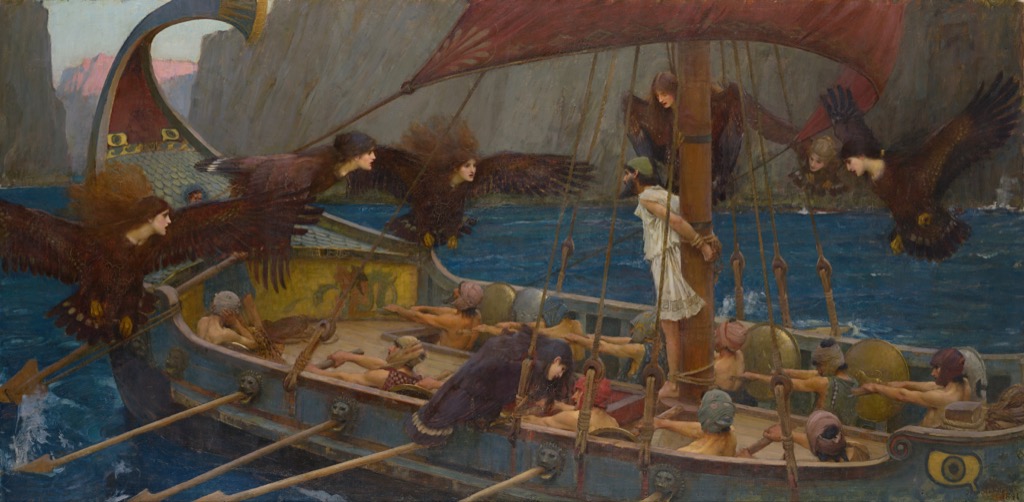
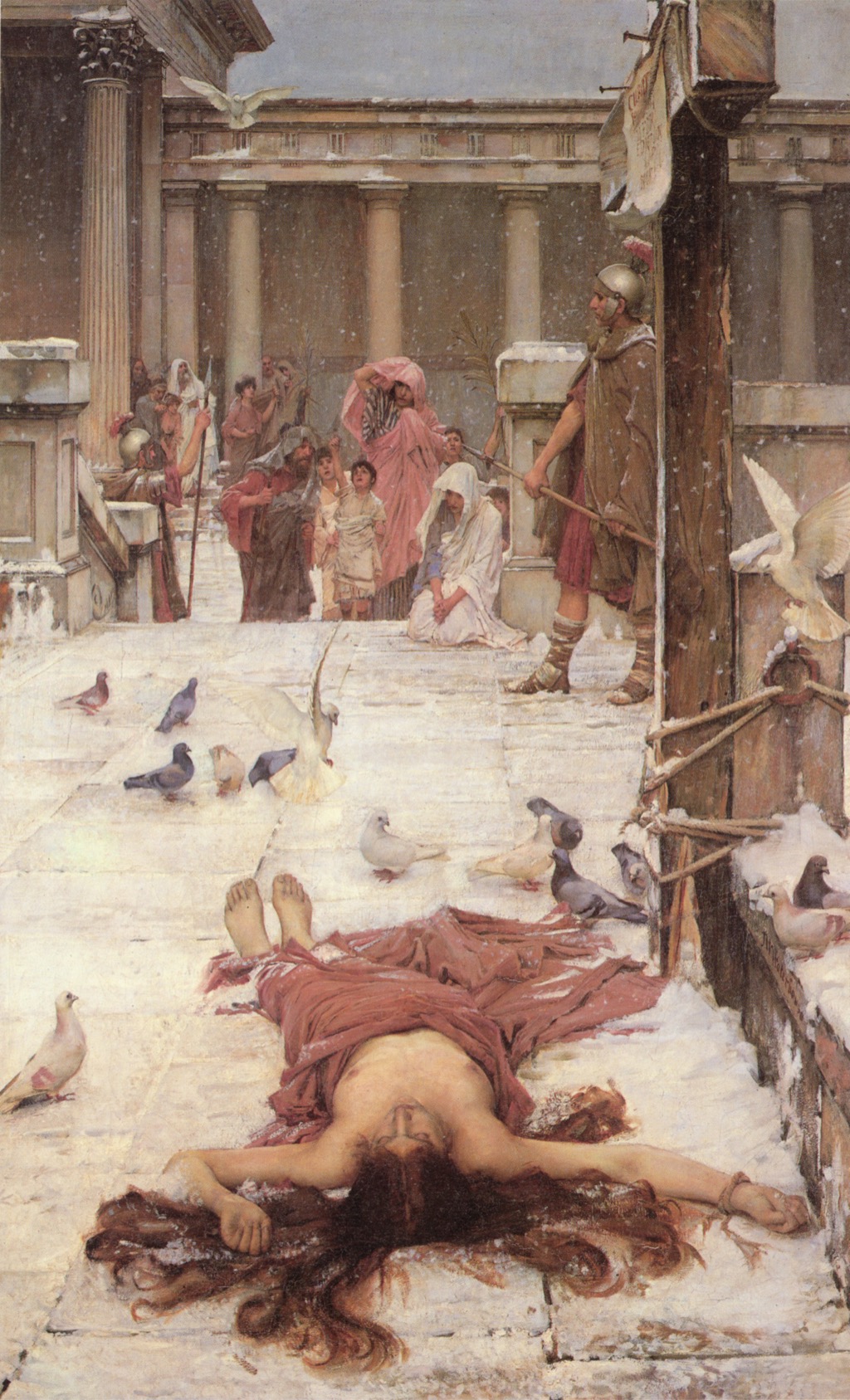
The praise also came at a point when Waterhouse was an established rather than emerging artist. He had already produced Saint Eulalia, The Lady of Shalott, Circe Offering the Cup to Ulysses, Ulysses and the Sirens and Hylas and the Nymphs. Echo and Narcissus did not inaugurate his mythological manner. It showed how selectively he could refine it.
The painting’s calm surface may conceal that ambition from modern viewers familiar with reproductions. At almost 1.9 metres wide, it gives landscape and bodies near life-size presence. Its narrative directions unfold across a physical span: from Echo, over water, to Narcissus, down to the reflection and back towards the spectator’s understanding.
Purchase by the Walker Art Gallery
The Walker Art Gallery purchased Echo and Narcissus in 1903, the year it was exhibited. [1] It remains in Liverpool under accession number WAG 2967. [6] Early public acquisition preserved the painting as part of a civic collection rather than allowing its history to disappear within private ownership.
Liverpool was important to Waterhouse beyond this single purchase. The Walker’s account notes that his work appeared regularly at the gallery from 1879 until 1916. [1] That long relationship places Echo and Narcissus within an exhibition culture connecting London’s Royal Academy with major municipal institutions.
The purchase date also gives the collection a different kind of authority. The painting was not acquired only after Waterhouse’s later revival in popularity. It entered public ownership as a contemporary work, when its Academy reception and place in the artist’s career were immediate.
Today the Walker setting allows comparisons with Victorian narrative, classical and Pre-Raphaelite art beyond the limits of a monographic display. Waterhouse is often called a Pre-Raphaelite, but he was born after the Brotherhood was founded and never belonged to it. The gallery’s biographical account usefully describes him as a Romantic Classicist whose later work revived literary subjects associated with the movement while retaining classical and Italian foundations. [1]
That mixed identity is visible here. The clear botanical foreground, intense colour and literary seriousness recall Pre-Raphaelite priorities. The balanced nude figure, Ovidian source and controlled Academy composition belong equally to a classical tradition. The picture’s strength comes from the combination, not from assigning it to one label.
Repetition, Recognition and Failed Communication
The most productive way to interpret the painting is to begin with structures the image demonstrates. Echo looks and receives no look. Narcissus looks and receives only his own. Water returns an image; the imagined landscape returns a voice. Flowers repeat a human name after the human body is gone. Repetition is everywhere, but communication never becomes mutual.
This makes the reflection more than an emblem of vanity. It is a perfect answer with no difference. Genuine exchange requires another perspective, the possibility of surprise and a response not controlled by the first speaker or viewer. Narcissus’s image seems attentive because it copies him exactly. Its perfection is the reason it cannot love.
Echo has the opposite problem. She is another person with another desire, but her language has been reduced to sameness. She can use tone, timing and context, yet the verbal material belongs to someone else. Narcissus cannot recognise her difference as an answer. Waterhouse translates this contrast into two forms of looking: her independent gaze is ignored, while his dependent image is mistaken for independence.
Recognition does not provide an easy cure. Tiresias’s prophecy makes self-knowledge fatal, but ignorance is not happiness: Narcissus remains trapped by the image before he understands it. [5] Echo knows whom she loves but cannot make that knowledge effective. Each figure exposes the limits of the common belief that understanding oneself or declaring feeling necessarily brings freedom.
The painting can also sustain readings concerned with gender and desire. Echo is the desiring female subject, not merely the desired object. Narcissus is a beautiful male body looked at by a woman, a reflection and the viewer. Ovid states that people of more than one sex desire him. [4] [5] Waterhouse leaves that history present without converting the scene into a single modern identity category.
What should be resisted is a punitive summary in which Echo represents proper heterosexual love and Narcissus is condemned simply for refusing her. Ovid’s world is harsher and more complex. No person is obligated to return another’s desire; the divine punishment responds to a pattern of contempt and makes Narcissus suffer the same impossibility that his rejected lovers suffered. Waterhouse gives Echo sympathy without turning consent into a debt.
Place in Waterhouse’s Mythological Painting
Episodes from Ovid occupied Waterhouse throughout his mature career. Circe Invidiosa, Flora and the Zephyrs, Echo and Narcissus and the late Apollo and Daphne use metamorphosis or magical change to test what a single image can contain. Christie’s notes that Ovidian scenes account for more of his work than the Tennysonian subjects for which he is often best known. [2]
Echo and Narcissus follows the dangerous waters of Hylas and the Nymphs but changes their function. In Hylas, the pool is inhabited by figures who lure a man beneath its surface. Here the water generates a figure from Narcissus’s own position. External enchantment becomes optical self-entrapment.
The picture also belongs with Nymphs Finding the Head of Orpheus, completed around 1900. Both works give riverbank landscape a grave narrative charge and ask living women to confront a beautiful male figure displaced from ordinary bodily life. Yet Echo and Narcissus withholds the violence of the Orpheus subject. Death remains a future contained in flowers. The modern scholarly setting for this comparison includes the 2008–10 Waterhouse retrospective and catalogue, which reassessed his career as a whole. [8]
Later flower-women such as The Soul of the Rose use absorption without explicit danger. Comparing them reveals how Waterhouse could retain a bowed head, intense sensory focus and rich vegetation while changing the stakes. The woman smelling a rose withdraws into an experience she controls; Narcissus bends towards a sensation that controls him.
The 1903 painting is therefore central rather than transitional. It combines large Academy scale, classical literary knowledge, Pre-Raphaelite colour, psychological ambiguity and an increasingly decorative landscape. Few Waterhouse works distribute narrative information so evenly between human figure and natural setting. The National Portrait Gallery’s biographical record establishes the wider professional context: Royal Academy training and full membership underlay this sustained work with literary subjects. [7]
How to Look Closely at Echo and Narcissus
Begin at the centre rather than with either face. Follow the stream from the bottom edge into the distance and notice how it establishes the painting’s depth. Then look at the banks: Echo rises in a relatively vertical arrangement, while Narcissus extends horizontally. Their contrasting postures make her attention alert and his self-absorption heavy.
Next trace the gazes. Echo looks across. Narcissus looks down. The reflection looks up. Ask which of those directions the viewer follows first and whether a reproduction changes the answer. At full scale, the distance between bodies is more forceful; in a small image, the reflected face can disappear.
Compare the two red areas of drapery. They create a formal relationship across the water even as the figures fail to establish a personal one. Then compare flesh with flowers: Echo is surrounded by diverse living plants, while the narcissi closest to the youth name his singular fate.
Look for moments in which finish changes. Faces, limbs and important flowers carry narrative clarity; woodland and distant water merge into broader masses. This is a visual observation, not a laboratory account of technique. The available sources used here do not document pigments or underdrawing in the finished canvas.
Finally, look at what Waterhouse leaves out. There is no Nemesis, no rejected lover asking for revenge, no Juno, no spoken text and no corpse. The picture is not crowded with causes. It concentrates on the emotional mechanism that connects the consequences: desire directed towards someone or something incapable of an independent answer.
Related Pages
- The Lady of Shalott: Compare Waterhouse's best-known literary composition.
- Hylas and the Nymphs: Compare another major mythological scene.
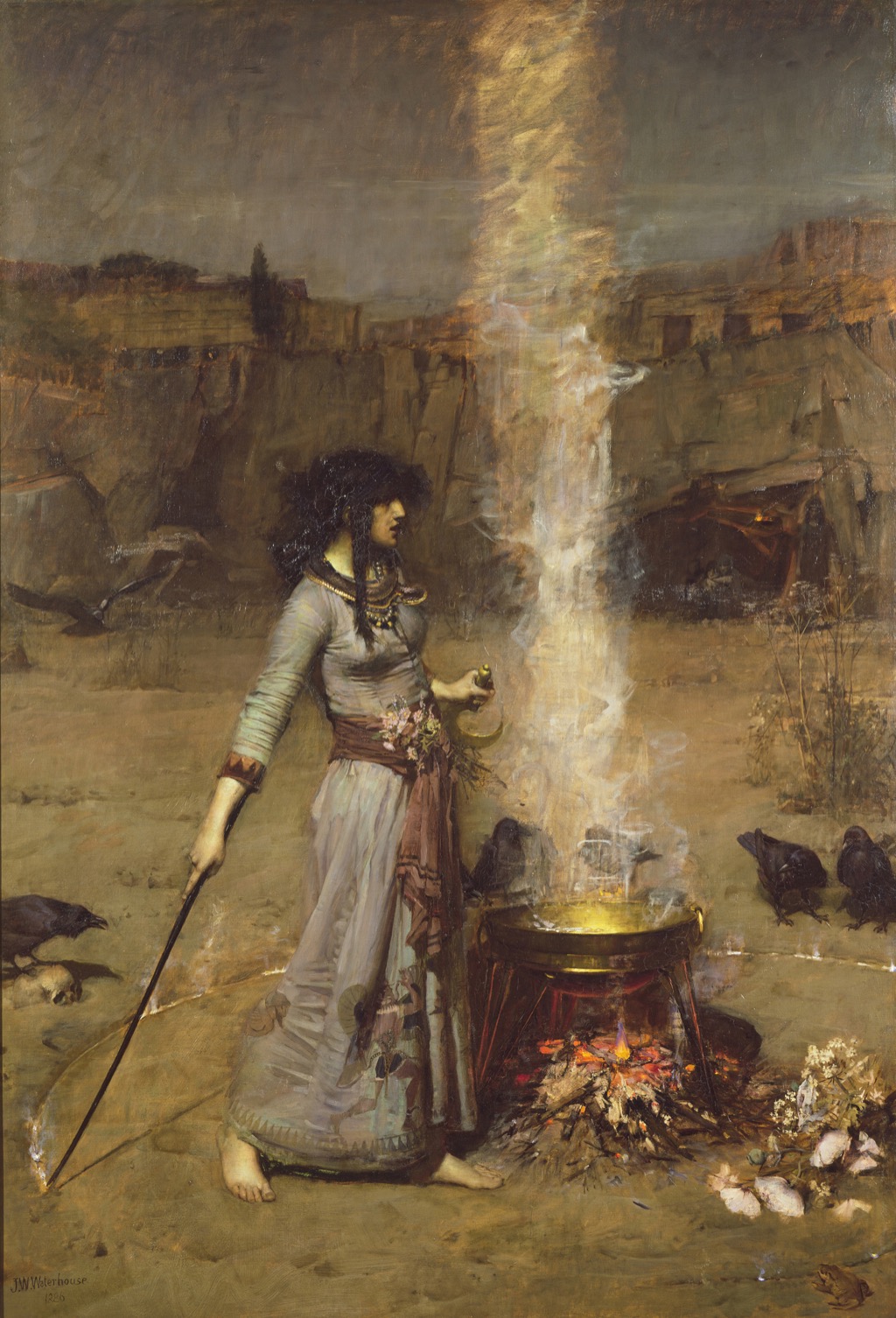
- The Magic Circle: Compare Waterhouse's treatment of ritual and symbolism.
Frequently Asked Questions
He painted it in 1903 and exhibited it at the Royal Academy that year. The Walker Art Gallery purchased it in 1903. [1] [3]
It is in the Walker Art Gallery, part of National Museums Liverpool, under accession number WAG 2967. [1] [6]
The oil painting measures 109.2 × 189.2 cm without its frame. Its width is important to the separation of Echo and Narcissus across the landscape. [1]
It draws on Book III of Ovid’s Metamorphoses. Echo can only repeat the speech of others and is rejected by Narcissus; Narcissus later falls in love with his reflection, dies beside the water and is replaced by a flower. [5]
No. Waterhouse combines multiple moments: Echo remains bodily present, Narcissus is already captivated by the pool and narcissi already grow beside him. The temporal compression is a deliberate way of making the entire tragedy legible together. [4]
Painting cannot represent her voice directly, and the chosen scene emphasises looking rather than dialogue. In Ovid, Juno has restricted Echo to repeating the end of words spoken by someone else. [5]
That is too narrow. He initially mistakes the reflection for another person and only later recognises himself. The painting concerns mistaken recognition, impossible reciprocity and self-absorption, not merely pleasure in one’s appearance. [4] [5]
They anticipate the ending of Ovid’s story, when a flower is found in place of Narcissus’s body. Waterhouse shows them before his death, making the future visible within the present. [4] [5]
Yes. A full-scale black-chalk study for Echo survives in a private collection. It shows the nude model before Waterhouse added the drapery and landscape. [2]
Discussion
Echo and Narcissus is not merely a picture of one person ignored by another. It compares two defective returns. Echo sends attention towards Narcissus and receives nothing. Narcissus sends attention towards the water and receives a flawless copy of himself. Her failure is absence; his is sameness.
Reader Insights
Does the presence of Echo’s body and the narcissus flowers make the scene clearer, or does it deepen its mystery?
Which figure commands your sympathy first, and does that change after you notice the reflection?
Does the stream feel like a narrow obstacle that could be crossed or an absolute division created by the myth?
Join the Conversation
Describe the route your eye takes across the painting. Do you begin with Echo, Narcissus, the dark reflection or the bright water between them?
References
- Walker Art Gallery, National Museums Liverpool, “Echo and Narcissus,” institutional object account hosted by Google Arts & Culture, including date, medium, dimensions, acquisition, exhibition history and interpretation. View source
- Christie’s, “John William Waterhouse, R.A., Study for the figure of Echo in Echo and Narcissus,” object record and catalogue essay, including material, scale, working method and contemporary reception. View source
- Algernon Graves, The Royal Academy of Arts: A Complete Dictionary of Contributors and Their Work from Its Foundation in 1769 to 1904, vol. VIII, exhibition record for Waterhouse, including Echo and Narcissus, Royal Academy no. 16 in 1903. View source
- James Williams, “Echo and Narcissus in Victorian Poetry,” Essays in Criticism, 69, 2019, pp. 178–202, accepted manuscript and peer-reviewed publication record, including analysis of Waterhouse’s composite moment and Victorian reception of the myth. View source
- Ovid, Metamorphoses, Book III, “Narcissus and Echo,” translated by Brookes More, Theoi Classical Texts Library. View source
- George P. Landow, “Waterhouse’s Echo and Narcissus,” The Victorian Web, object note recording the Walker Art Gallery accession number and collection history. View source
- National Portrait Gallery, London, “John William Waterhouse (1849–1917), Figure Painter,” biographical record including Royal Academy status and studio chronology. View source
- Elizabeth Prettejohn, Peter Trippi, Robert Upstone and Patty Wageman, J. W. Waterhouse, 1849–1917: The Modern Pre-Raphaelite, exhibition-catalogue and retrospective record, University of Bristol Research Portal, 2008. View source