

The Double Secret
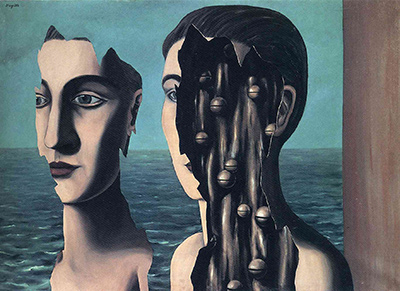
A face appears to have slipped away from a head. At the left, the detached features retain the smooth modelling of a human likeness; at the right, a jagged opening exposes a dark interior filled with small bells. Beyond them lies an apparently ordinary sea. René Magritte makes the face both familiar and difficult to understand as part of a complete body.
The Centre Pompidou catalogues The Double Secret, or Le double secret, as an oil painting of 1927, measuring 114 × 162 centimetres. It belongs to the Musée national d'art moderne, inventory AM 1980-2, acquired in 1980. The museum's catalogue places its construction within Magritte's encounter with collage and the artificial nature of painted images. [1]
At a Glance
Early and later disruptions of familiar space
Contents
A face separated from its head
The left-hand fragment is immediately recognisable as a face. Nose, eyes, mouth and cheek are modelled through light and shadow, giving the surface an apparent solidity. Yet its broken upper edge prevents us from accepting it as an ordinary portrait seen against a landscape.
The fragment's position makes it seem related to the opening in the larger head. We can imagine one surface belonging to the other, but the painting does not provide a practical account of removal. Instead, it shows the outer likeness and the exposed interior together, allowing our attention to move between them.
That movement complicates the usual experience of a face. Features normally help us recognise an individual and infer an expression. Here they also become a separate shape, something that can apparently be displaced within the picture. Recognition survives even as the familiar relationship between face and body breaks down.
The open head
The larger head remains partly intact. Dark hair, an ear and the curved outline of the skull establish a plausible human form around the opening. These recognisable boundaries matter because they give the extraordinary interior a precise place to appear.
The torn-looking edge cuts through the face and continues downward. It suggests a thin outer layer more readily than a solid anatomical structure. What we see is disturbing partly because the boundary can be read in several ways: as an opening in a body, a cut in a picture or the edge of a displaced mask.
These readings do not settle into one reliable explanation. The head still has volume, but its visible front behaves like a surface that can be moved. Magritte makes the illusion of depth and the suggestion of flatness occupy the same space.
Bells in the darkness
Small bells interrupt the dark interior. Their rounded forms and bright highlights make a sequence of points across the vertical, streaked background. They can be recognised individually, yet their repetition also produces a pattern that draws the eye up and down the exposed area.
A bell brings an association with sound into a silent image. We know such objects through both appearance and use, but the painting offers no event in which they are rung. Their stillness becomes especially noticeable because of what we ordinarily expect them to do.
In his published interpretation, curator Didier Ottinger relates the bells to the figure of the fool in carnival tradition. This gives the motif a historical association without making every bell a direct transcription of a private thought. It is an interpretive context for the image, rather than an anatomical explanation of what lies inside a person. [1]
A calm sea behind an impossible figure
The seascape provides a contrasting kind of space. A horizon divides the cooler sky from the darker water, while smaller marks suggest the sea's surface. These are familiar conventions for a distant view, and they remain comparatively easy to read beside the fractured foreground head.
At the right, a vertical wall or panel interrupts that opening. It creates a firm edge against which the larger head is placed. The painting therefore combines an expansive distant sea with a more compressed foreground encounter. The scene can feel both open and enclosed.
The contrast helps the strange figure remain convincing as a painted presence. The surroundings do not dissolve into the same instability as the face. They provide enough ordinary space for us to register the precise point at which our expectations about the body fail.
Collage translated into painting
Ottinger's analysis emphasises the importance of collage to Magritte's thinking. A fragment can be cut out, shifted and placed beside another part of an image. In The Double Secret, the represented movement of the face makes that procedure visible within an oil painting. [1]
The distinction between procedure and depicted event is useful. The work is catalogued as oil on canvas, and the apparent cut belongs to what it represents. The detached likeness looks capable of sliding across the composition, even though both it and the head are painted on the same support.
Notice how carefully the face is modelled. Magritte retains the means of giving it volume while also making it look like a movable layer. The picture's disturbance depends on those two qualities working together. A convincing surface becomes an unreliable guide to the space it seems to describe.
An early Surrealist inquiry
MoMA's account of Magritte's work between 1926 and 1938 places concealment, doubling and disruptions of representation among his central strategies. It traces his move from Brussels to Paris, where he lived from 1927 to 1930, within his developing relationship with Surrealism. [2]
The Double Secret belongs to that period of experimentation. Its effects arise from recognisable things arranged in ways that make ordinary looking uncertain. The face is not rendered incomprehensible; it is made clear enough for the separation to become a problem we cannot dismiss.
This is also why a biographical explanation can be too quick. The painting does not identify a sitter or narrate a particular episode from Magritte's life. Its construction gives us substantial things to examine before we supply an emotional history for the person who painted it.
The two secrets
The title encourages a comparison between what the exterior reveals and what the opening seems to disclose. Yet showing an interior does not end the mystery. The bells and dark vertical forms are as enigmatic as the face they apparently replace.
We can see more without knowing more in any straightforward sense. The detached features offer a likeness; the open head offers another visible arrangement. Neither becomes a final, authoritative explanation of the other. The title's doubling is sustained through the picture's two competing kinds of disclosure.
Look again at the edge between flesh-coloured surface and darkness. It is a small boundary within the painting, but it changes how the entire head can be understood. Magritte makes that boundary carry an unusually large question: how much can an outward image, or an apparently exposed interior, actually tell us about what we see?
Selected Magritte works
Five separately documented Magritte works. This selected directory distinguishes the 1948 Memory gouache from paintings sharing its title; it is not a complete catalogue. Each record links to its individual source.
| Name | Date | Medium |
|---|---|---|
| The Double Secret | 1927 | Oil on canvas Catalogue record. |
| Memory — 1948 gouache | 1948 | Gouache on paper Catalogue record. |
| The Invisible World | 1954 | Oil on canvas Catalogue record. |
| Clear Ideas — dated 1955 | 1955; possible 1958 execution | Oil on canvas Catalogue record. |
| The Blank Signature | 1965 | Oil on canvas Catalogue record. |
Frequently Asked Questions
It is an oil painting. The Pompidou's analysis connects the displaced face with Magritte's interest in collage. [1]
Ottinger relates them to carnival's fool motif. The association is an interpretation, not a complete solution to the image. [1]
Discussion
Look at the boundary between the face and the dark interior.
Reader Insights
Does the detached face seem solid, thin or both?
How do the repeated bells affect your reading of the dark interior?
What does the ordinary seascape contribute to the strange head?
Join the Conversation
Share a detail, comparison or question about The Double Secret below.
References
- Centre Pompidou, Le double secret, 1927, AM 1980-2. Object record and Didier Ottinger's analysis from the collection catalogue edited by Brigitte Leal, 2007. View source.Splash image: The Double Secret, 1927. Oil on canvas, 114 × 162 cm. Centre Pompidou, Musée national d’art moderne; AM 1980-2.
- The Museum of Modern Art, Magritte: The Mystery of the Ordinary, 1926–1938, 2013 exhibition website. Early Surrealist strategies and Brussels/Paris chronology. View source.
- The Menil Collection, Memories of a Voyage: The Late Work of René Magritte, 2014 gallery guide. Separate 1954 Invisible World and the later stone motif. View source.