

 by Tom Gurney
Tom Gurney BSc (Hons) is an art history expert with over 20 years experience
Published on June 19, 2020 / Updated on July 5, 2026
Email: tomgurney1@gmail.com / Phone: +44 7429 011000
The Blank Signature by Rene Magritte
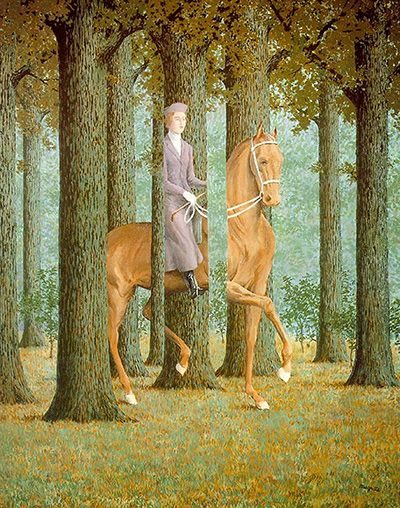
The Blank Signature is one of Rene Magritte's great late paintings about seeing. Painted in 1965, it shows a woman in a mauve-pink dress riding a horse through a wooded landscape. The image looks calm at first, but its logic is impossible: parts of the horse and rider appear in front of some trees and behind others, while areas of forest that should be hidden suddenly come forward. [1]
The National Gallery of Art in Washington records the work as oil on canvas, measuring 81.3 x 65.1 cm, with the credit line Collection of Mr. and Mrs. Paul Mellon and accession number 1985.64.24. The painting entered the museum in 1985 as a Mellon gift, after having been sold by Galerie Alexandre Iolas in Paris to the Mellons in 1966. [1]
The painting matters because Magritte makes a familiar visual rule break down. In ordinary seeing, a tree in front hides what is behind it. In The Blank Signature, that rule is applied and suspended at the same time. The viewer keeps trying to rebuild the space, but the picture refuses to settle. [2]
At a Glance
- Artist: Rene Magritte [3]
- Title: The Blank Signature [1]
- Date: 1965 [1]
- Medium: oil on canvas [1]
- Dimensions: 81.3 x 65.1 cm (32 x 25 5/8 in.) [1]
- Collection: National Gallery of Art, Washington [1]
- Accession number: 1985.64.24 [1]
- Status: not on view at the time the NGA page was accessed [1]
Contents
- Why this painting matters
- Museum perspective
- Historical background
- Visual description
- Looking carefully
- Meaning and interpretation
- Comparison works
Why This Painting Matters
The Blank Signature matters because it turns depth into a puzzle. The image is not chaotic. It is crisp, legible and almost decorative, with slim trunks, green foliage, grass and a rider moving through the trees. The trouble comes from the order of the layers. [2]
Magritte uses the most ordinary problem in representational painting: what is in front, and what is behind? He then makes that problem unsolvable. The woman's body, the horse's body and the vertical trees do not obey one continuous space. They interlace in a way that the eye can follow locally but not resolve as a whole. [5]
Museum Perspective
The National Gallery of Art's visual description is especially useful because it starts with the surface facts. A woman wearing a mauve-pink dress rides a reddish bay-brown horse. She sits upright, holding the reins. The surrounding forest is built from tall, narrow trunks and repeated touches of green. [2]
The museum then identifies the central perceptual disturbance: because the horse and rider are "unpredictably covered by trees," the viewer keeps shifting between possible readings of distance. That is the painting's museum moment. The work is not just a picture of concealment. It is a picture that makes concealment unreliable. [2]
Historical Background
Magritte painted The Blank Signature in 1965, two years before his death. By this stage he had long since developed the lucid, anti-expressionist method that made his images so memorable. The strange event is presented without painterly drama. [6]
The painting also arrived at a moment of strong institutional visibility. NGA records that it appeared in the 1965-1966 Rene Magritte exhibition that travelled from the Museum of Modern Art, New York, to the Rose Art Museum, the Art Institute of Chicago, Pasadena Art Museum and the University Art Museum at Berkeley. [1]
Visual Description
The composition is vertical and wooded. Slender tree trunks run upward through the picture, creating an almost patterned screen. Behind and between them are patches of green forest and grass. [2]
The rider wears a mauve-pink dress and cap. Her pale face and blond hair are visible in profile. The horse is reddish brown and moves through the scene with raised hooves, but the body never becomes spatially stable. [2]
The most important detail is not a single hidden object. It is the inconsistent overlap. Some trunks pass naturally in front of the horse and rider. Elsewhere, the horse and rider pass in front of trunks. In still other places, strips of greenery that should sit behind the figures appear to interrupt them. [2]
Looking Carefully
Start at the horse's body. The eye expects one continuous animal moving through a forest. Instead, the body is sliced by vertical bands of tree and foliage. Some interruptions feel plausible, while others contradict the space established just beside them. [2]
Then follow the rider. Her upper body is clear enough to seem stable, but the relation between her dress, the horse and the trees remains uncertain. The picture never tells us whether we are looking at a rider behind a screen of trunks, in front of those trunks, or somehow woven through them. [5]
Finally, look at the forest itself. It is not painted as a deep, atmospheric space. It behaves more like a flat set of alternating bands. That flatness is what allows the impossible layering to feel quiet rather than spectacular. [6]
Things You Might Miss
- The painting's trick is not only that the rider is hidden. The trick is that the rules of hiding change from one part of the image to another. [2]
- The title does not explain the scene. It adds another kind of openness, as if the picture gives permission for meaning without filling it in. [5]
- The inscription recorded by NGA reads "Le Blanc Seing / 1965" across the top reverse, anchoring the French title to the object itself. [1]
- The work was already circulating internationally almost as soon as it was made, appearing in the 1965-1966 Magritte retrospective. [1]
Technique and Composition
Magritte's technique is deliberately restrained. The trees, grass, horse and rider are all readable. Nothing dissolves into painterly mist. That clarity matters because the illusion depends on understanding what each element should do. [6]
The composition is built from vertical rhythm. The trunks divide the picture into strips. The horse and rider introduce a horizontal movement through that field, but their motion is repeatedly stopped and restarted by the tree pattern. [4]
This is why The Blank Signature feels different from a conventional optical illusion. It is not a puzzle with one correct solution. It is a painting that makes the act of sorting foreground from background visible. [5]
Meaning and Interpretation
The strongest interpretation begins with perception, not symbolism. The Blank Signature shows how easily a picture can make us accept spatial rules, then revoke them. The forest is believable enough to invite ordinary looking, but impossible enough to expose how that looking works. [5]
The title is suggestive without being a code. A blank signature or blank authorisation implies permission, openness or an empty authority waiting to be filled. The painting behaves similarly: it offers a scene that looks complete but withholds the stable visual contract that would make it fully legible. [4]
This is why speculative readings should be kept modest. The rider does not need to stand for one fixed idea. The point is that she cannot be placed securely in the world the painting gives her. [6]
Title Analysis
The NGA page gives the English title The Blank Signature, while the reverse inscription records Le Blanc Seing. Exhibition history also shows that the painting has appeared as Le blanc-seing or Carte blanche in some catalogues. [1]
Those title variations matter because they all circle ideas of permission, blank authority and open-ended meaning. Magritte does not give the viewer a key. He gives the viewer a visual document whose terms cannot be completed. [5]
Museum Moment
The National Gallery of Art record supplies one of the page's strongest factual stories. The painting passed through Galerie Alexandre Iolas, was sold in 1966 to Mr. and Mrs. Paul Mellon, and entered the NGA in 1985 as a Mellon gift. [1]
Its exhibition history is unusually rich for a late Magritte painting. It travelled in major retrospectives and thematic shows from the 1960s through the 2020s, including exhibitions in New York, Chicago, London, Houston, Brussels, Tokyo, Paris, Vienna, Basel, Madrid and Barcelona. [1]
Comparison Works
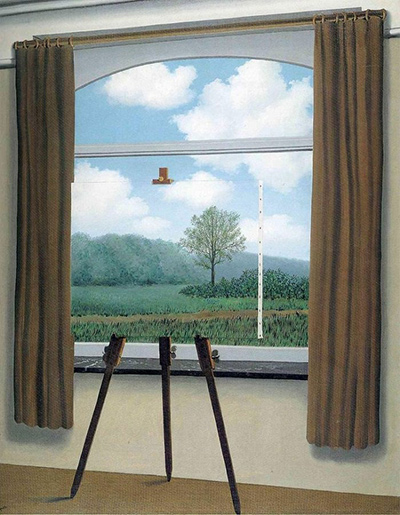
The closest internal comparison is The Human Condition. Both paintings make front and back unstable, and both ask whether a picture can be trusted to represent the space it seems to show. [5]
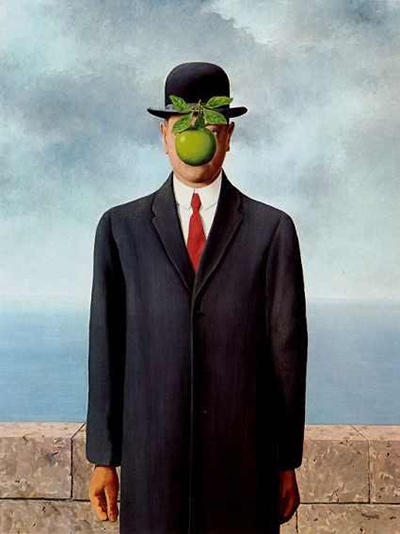
The Son of Man is another useful comparison from the 1960s. In that painting a green apple hides a face; in The Blank Signature the trees do not simply hide the rider, because concealment itself becomes inconsistent. [4]
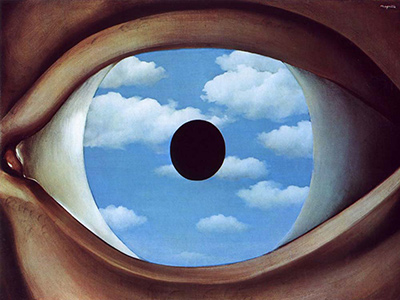
The False Mirror also belongs nearby. It replaces an eye's expected surface with sky, just as The Blank Signature replaces normal depth with contradictory layers. The Listening Room and Personal Values show Magritte using ordinary things in simple settings to make perception feel newly unreliable. [6]
Reception and Exhibition History
The painting's exhibition history shows that it quickly became part of Magritte's late-career museum identity. It appeared in the 1965-1966 Rene Magritte exhibition and then continued to circulate in major retrospectives and thematic shows. [1]
The NGA record notes that the 1992-1993 Magritte exhibition at the Hayward Gallery, the Metropolitan Museum of Art, the Menil Collection and the Art Institute of Chicago listed it as Le blanc-seing or Carte blanche. Later exhibitions continued to use variant title forms, which is useful evidence for readers who encounter different names for the same painting. [1]
Timeline
- 1965 - Magritte paints The Blank Signature. [1]
- 1965-1966 - The painting appears in the Rene Magritte exhibition organised through MoMA and other US venues. [1]
- 1966 - Galerie Alexandre Iolas sells the painting to Mr. and Mrs. Paul Mellon. [1]
- 1985 - The Mellons gift the painting to the National Gallery of Art. [1]
- 1992-1993 - The painting appears in the major Magritte exhibition at the Hayward Gallery, the Met, the Menil Collection and the Art Institute of Chicago. [1]
- 2021-2022 - The painting appears in La Maquina Magritte in Madrid and Barcelona. [1]
FAQs
The Blank Signature is in the collection of the National Gallery of Art, Washington. [1]
Magritte painted The Blank Signature in 1965. [1]
It shows a woman riding a horse through a wooded landscape, but the horse, rider and trees overlap in contradictory ways. [2]
The strongest reading is about perception and unstable depth. The painting makes the viewer question how foreground, background and concealment work in a picture. [5]
NGA records the inscription on the reverse as Le Blanc Seing / 1965, and exhibition history includes the forms Le blanc-seing and Carte blanche. [1]
References
- National Gallery of Art, "Rene Magritte, The Blank Signature, 1965," accessed July 4, 2026, https://www.nga.gov/artworks/66422-blank-signature.
- National Gallery of Art, visual description for The Blank Signature, accessed July 4, 2026, https://www.nga.gov/artworks/66422-blank-signature.
- Museum of Modern Art, "Rene Magritte," artist record, accessed July 4, 2026, https://www.moma.org/artists/3692-rene-magritte.
- David Sylvester and Sarah Whitfield, eds., Rene Magritte: Catalogue Raisonne, Houston and London: Menil Foundation / Philip Wilson, 1993.
- Harry Torczyner, Magritte: Ideas and Images, New York: Harry N. Abrams, 1977.
- Suzi Gablik, Magritte, London: Thames & Hudson, 1970.