

 by Tom Gurney
Tom Gurney BSc (Hons) is an art history expert with over 20 years experience
Published on June 19, 2020June 19, 2020 / Updated on July 6, 2026
Email: tomgurney1@gmail.com / Phone: +44 7429 011000
René Magritte Biography: Life of the Belgian Surrealist
René Magritte's life was less flamboyant than many people expect from one of Surrealism's most famous painters. He did not cultivate the public eccentricity of Salvador Dalí, and he spent much of his career in Brussels rather than at the centre of Parisian celebrity. Yet from that relatively ordinary setting he created some of the most enduringly strange images in modern art. [1]
Magritte was born in Belgium in 1898 and died in Brussels in 1967. Between those dates he moved through academic training, commercial design, early modernist experiments, Parisian Surrealism, financial difficulty, wartime stylistic disruption and late international fame. His biography matters because it shows how an artist of apparent restraint became one of the twentieth century's great makers of visual mystery. [1]
His paintings often look detached from everyday biography: a pipe, an apple, a bowler hat, a window, a curtain, a sky. But Magritte's life helps explain the discipline behind that clarity. He was shaped by Belgian culture, commercial graphics, literary Surrealism, marriage, patronage, politics, economic pressure and a lifelong interest in the unstable relationship between things and images of things. [1]
At a Glance
- Full name: René François Ghislain Magritte
- Born: 21 November 1898, Lessines, Belgium
- Died: 15 August 1967, Brussels, Belgium
- Spouse: Georgette Berger Magritte
- Movement: Surrealism
- Known for: The Son of Man, The Treachery of Images and The Human Condition
Contents
- Early Life in Belgium
- Training and First Experiments
- Georgette and Brussels
- The Move into Surrealism
- Paris and the Surrealist Circle
- Return to Brussels
- War Years and Stylistic Experiments
- Later Recognition
- Personal Life and Character
- Death and Legacy
Video Guide
This selected video from Great Art Explained offers useful visual context before the detailed analysis continues.
Early Life in Belgium
René François Ghislain Magritte was born on 21 November 1898 in Lessines, a town in the province of Hainaut, Belgium. His father, Léopold Magritte, worked in textiles and tailoring, while his mother, Régina, had worked as a milliner. Magritte's childhood was Belgian, provincial and middle-class, a background that later makes the ordinary bourgeois settings of his paintings feel especially relevant. [1] [7]
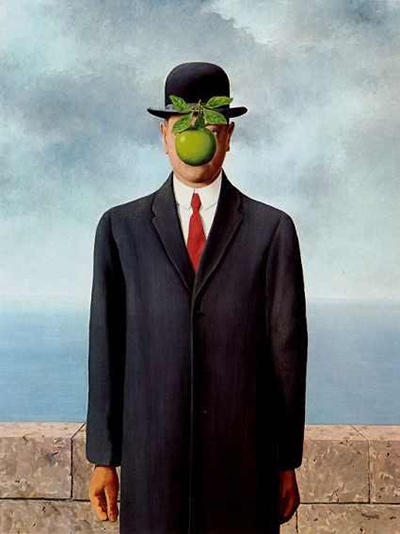
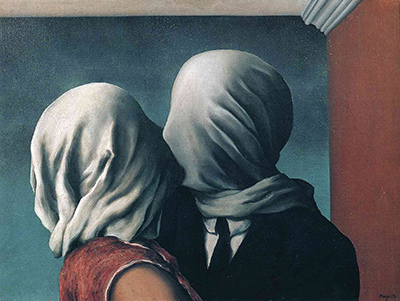
The most discussed event of his early life was the death of his mother in 1912. She died by suicide when Magritte was a teenager. Writers have often connected this tragedy with the covered or hidden faces that appear in later paintings such as Les Amants and The Son of Man. That connection should be treated cautiously. It may be suggestive, but Magritte's art cannot be reduced to a single childhood trauma. [1]
What can be said more safely is that Magritte grew up with an acute awareness of secrecy, absence and the limits of what can be known. Whether or not a direct line can be drawn from biography to motif, his mature paintings repeatedly return to the experience of seeing something and not being allowed full access to it. [1]
Training and First Experiments
Magritte began drawing lessons as a boy and later studied in Brussels at the Académie Royale des Beaux-Arts. Like many young artists of his generation, he absorbed modern movements before finding his own voice. His early work passed through Impressionist, Futurist and Cubist influences, and he experimented with different ways of organising form and colour. [1]
This early period matters because Magritte's later clarity can seem almost inevitable. It was not. The cool precision of his mature Surrealist paintings emerged from a process of selection and rejection. He gradually moved away from visible painterly experiment toward a harder, cleaner and more conceptual use of images. [1]
He also gained experience outside fine art. In the early 1920s he worked as a draughtsman in a wallpaper factory and later as a poster and advertisement designer. This commercial work helped form his sense of legibility. A good advertisement must be read quickly; a mature Magritte painting can also be grasped quickly, but then refuses to settle into a simple message. [1]
Georgette and Brussels
Magritte married Georgette Berger in 1922. She had known him when they were young, and she remained one of the central figures in his life. Their marriage was not always simple, but Georgette's presence was constant across much of his personal and artistic world. She appears directly or indirectly in several works and was closely connected to the domestic life from which Magritte made his strange images. [1] [5]
Brussels was equally central. Magritte's biography is not the story of an artist who abandoned home for a permanent international stage. He spent crucial years near Paris, but Brussels remained the centre of gravity. The city's middle-class interiors, commercial culture, literary circles and Belgian Surrealist friendships helped shape his mature imagination. [1] [3]
The contrast is important. Magritte painted impossible images, but he did not need an exotic studio mythology to do it. The ordinary apartment, the dining-room table, the suit, the hat, the curtain and the window were enough. His Surrealism grew from the everyday world rather than from escape into decorative fantasy. [1]
The Move into Surrealism
Magritte's move toward Surrealism accelerated in the mid-1920s. The Lost Jockey, painted in 1926, is often identified as his first major Surrealist work. It introduced a world in which familiar elements are rearranged into an irrational but controlled scene. [1]
In 1927 Magritte held his first solo exhibition in Brussels. The reception was poor, and the disappointment contributed to his decision to move near Paris. This period could easily have ended in failure. Instead, it became the beginning of the most decisive phase of his career. [1]
What separated Magritte from many other artists was the way he used Surrealism. He was not simply interested in painting dreams. He became interested in making the ordinary world reveal its hidden instability. The pipe, apple, face, room and sky became instruments for philosophical disturbance. [1]
Paris and the Surrealist Circle
From 1927 to 1930 Magritte lived near Paris and came into closer contact with André Breton and the Surrealist group. These years were productive and important. They helped place him within the international Surrealist movement and sharpened his interest in language, contradiction and poetic displacement. [1]
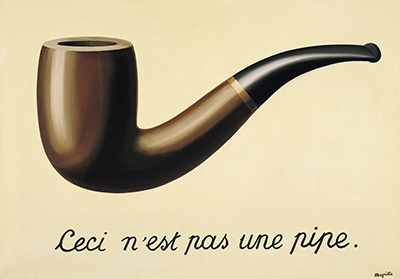
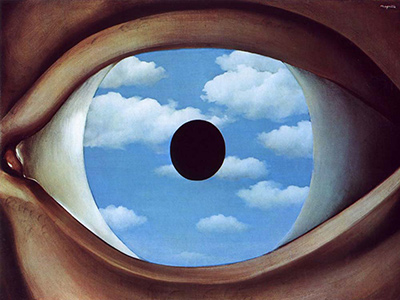
Works from this broader period include some of the paintings that made his reputation: The Lovers, The False Mirror, The Treachery of Images and other images in which ordinary recognition is disrupted. The famous pipe painting of 1929 belongs to this world of linguistic and visual provocation. [1]
Yet Magritte was never simply absorbed into Parisian Surrealism. His temperament remained different. He was less theatrical, less publicly flamboyant and more attached to deadpan clarity. His paintings often feel like visual propositions rather than dream records. That difference is one reason his work still feels so modern. [1]
Return to Brussels
In 1930 Magritte returned to Brussels after the closure of Galerie Le Centaure affected his financial situation. He resumed commercial work and continued to develop his painting. The return was not a retreat from artistic seriousness. It was the setting in which he consolidated much of his mature language. [1]
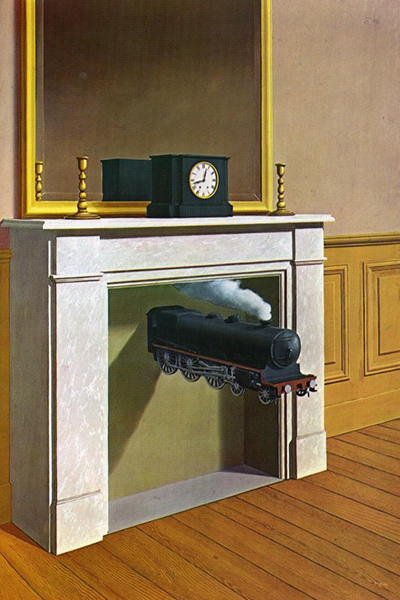
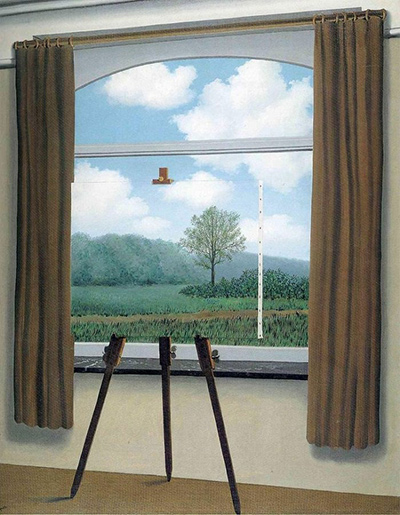
The 1930s brought some of his most important works and relationships. He developed images around windows, mirrors, substitutions, hidden faces and the confusion between painting and reality. The Human Condition, Not to Be Reproduced, The Red Model and Time Transfixed all belong to the larger period in which his mature method became increasingly exact. [1]
Patronage also mattered. Figures such as Edward James helped support Surrealist art, and Magritte's connections beyond Belgium increased the circulation of his work. Still, he remained strongly identified with Brussels and with a Belgian Surrealist network that was more literary, sceptical and understated than many popular ideas of Surrealism. [1]
War Years and Stylistic Experiments
The Second World War and the German occupation of Belgium disrupted Magritte's life and art. During the 1940s he moved away from his familiar cool manner into brighter and more painterly modes, often discussed as his Renoir period. He later produced the rougher, deliberately provocative Vache works. [1] [9]
These phases can surprise viewers who know only his polished icons. They are important because they show Magritte testing the emotional and political possibilities of style. The brighter works were, in part, a response to darkness and pessimism; the Vache works challenged taste and expectation in a different way. [1]
By the end of the 1940s, Magritte returned to the clearer Surrealist language for which he is best known. That return should not be seen as simple repetition. It was a renewed commitment to the method that best suited his thinking: ordinary objects, exact placement and conceptual disturbance. [1]
Later Recognition
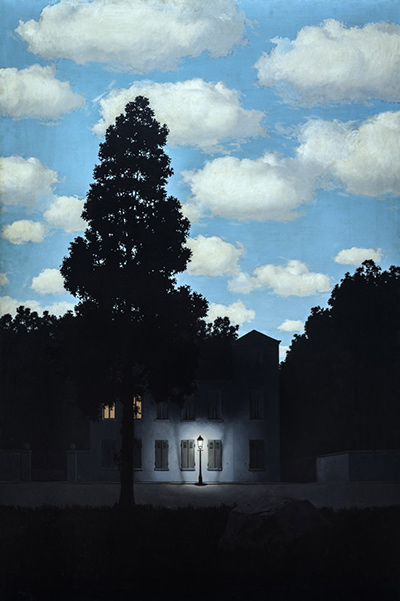
Magritte's fame grew substantially in the 1950s and 1960s. The works of these decades include many of the images that now define his public reputation. The Listening Room, The Empire of Light and The Son of Man belong to the later flowering of his motifs, where the images become exceptionally clear and memorable. [4]
The Son of Man, painted in 1964, is especially important to his late reputation. It condenses many of his lifelong concerns: the hidden face, the bowler-hatted man, the ordinary object, the problem of portraiture and the viewer's desire to see what has been concealed. [4]
Museum recognition also increased. MoMA and other major institutions helped secure his place in modern art history, while later retrospectives and publications presented him as a central figure in Surrealism and in the wider development of modern image-thinking. [4] [2]
Personal Life and Character
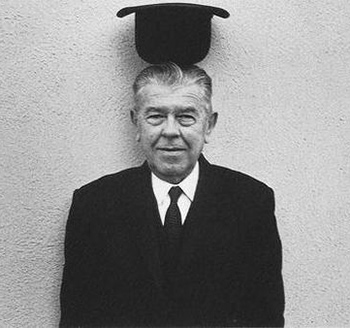
Magritte's public persona was restrained compared with the mythology surrounding some Surrealists. He often appeared in photographs as a conventional man in a suit and bowler hat. That image has sometimes been read as a mask, sometimes as a joke and sometimes as a genuine part of his middle-class identity. In his art, the same kind of figure becomes both ordinary and uncanny. [1]
His marriage to Georgette was central but not without difficulty. The couple experienced tensions and affairs, yet they remained together, and Georgette continued to occupy an important place in his personal world. [1]
Politically, Magritte had connections with the left and with Communist circles, though his relationship to politics was not reducible to party identity. His art is often subversive less because it illustrates a programme than because it unsettles certainty, authority and habit. [1]
Death and Legacy
René Magritte died in Brussels on 15 August 1967. Since his death, his reputation has expanded far beyond Surrealism. He is now understood as a major artist of representation, language, perception and modern visual culture. [1]
His paintings influenced Pop art, conceptual art, graphic design, advertising, film and music. The apple hiding the face, the pipe that is not a pipe, the men in bowler hats and the cloudy blue sky have become part of the shared language of modern imagery. [1] [8]
The best measure of Magritte's legacy is that his images remain clear without becoming exhausted. They can be recognised instantly, but they still withhold final explanation. His biography leads back to that paradox: a quiet Belgian painter who made the ordinary world permanently strange. [1] [6]
Timeline
- 1898 — René Magritte is born in Lessines, Belgium. [1]
- 1912 — His mother dies by suicide, an event often discussed in relation to later themes of concealment, though direct interpretations require caution. [1]
- 1922 — Magritte marries Georgette Berger. [1]
- 1926 — The Lost Jockey marks a decisive step toward Surrealism. [1]
- 1927 — His first solo exhibition in Brussels receives a poor critical response; he moves near Paris. [1]
- 1929 — The Treachery of Images establishes his famous pipe-and-caption problem. [1]
- 1930 — Magritte returns to Brussels. [1]
- 1940s — The wartime and postwar years bring the Renoir and Vache periods. [1]
- 1964 — Magritte paints The Son of Man. [1]
- 1967 — Magritte dies in Brussels. [1]
FAQs
René Magritte was born on 21 November 1898 in Lessines, Belgium. [1]
Magritte died on 15 August 1967 in Brussels, Belgium. [1]
Magritte married Georgette Berger in 1922. She remained a central figure in his personal life and appears directly or indirectly in parts of his artistic world. [1]
Magritte moved near Paris after the poor reception of his first solo exhibition in Brussels. The move brought him into closer contact with André Breton and the Surrealist circle. [1]
Yes. Although his Paris years were important, Magritte spent much of his life in Belgium, especially Brussels. Belgian culture and Belgian Surrealism were central to his mature work. [1]
The Lost Jockey, painted in 1926, is often identified as Magritte's first major Surrealist painting. [1]
References
- MoMA, "René Magritte", View source.
- Royal Museums of Fine Arts of Belgium, "Magritte Museum", View source.
- René Magritte Museum, "Welcome to the René Magritte Museum", View source.
- Anne Umland, ed., Magritte: The Mystery of the Ordinary, 1926-1938, Museum of Modern Art, 2013.
- Harry Torczyner, Magritte: Ideas and Images, New York: Harry N. Abrams, 1977.
- David Sylvester, Magritte: The Silence of the World, Houston: Menil Foundation, 1992.
- David Sylvester, Sarah Whitfield and Michael Raeburn, René Magritte: Catalogue Raisonné, London: Menil Foundation / Philip Wilson, 1992-1997.
- Suzi Gablik, Magritte, London: Thames & Hudson, 1970.
- Patricia Allmer, René Magritte: Beyond Painting, Manchester: Manchester University Press, 2009.