

 by Tom Gurney
Tom Gurney BSc (Hons) is an art history expert with over 20 years experience
Published on June 19, 2020 / Updated on July 5, 2026
Email: tomgurney1@gmail.com / Phone: +44 7429 011000
The Mysteries of the Horizon by Rene Magritte
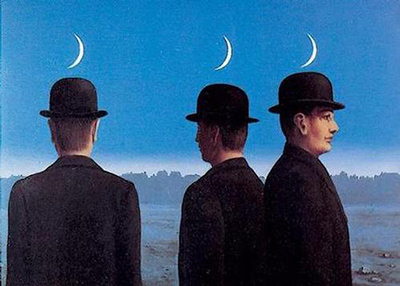
The Mysteries of the Horizon is one of Rene Magritte's most memorable paintings of divided reality. Painted in 1955, the work is also known by the fuller title The Masterpiece or The Mysteries of the Horizon, from the French Le Chef-d'Oeuvre ou les Mysteres de l'Horizon. It shows three bowler-hatted men standing outdoors at twilight, each with his own crescent moon in the sky above him. [1]
The oil painting is recorded as measuring 50 x 65 cm and is held in a private collection. A related 1964 gouache repeats the subject, which confirms that Magritte continued to see the image as a productive visual problem. [1] [2]
The painting matters because it creates a contradiction without making the scene look chaotic. The three men appear to share one landscape, yet each seems to belong to a different horizon. They stand near one another, but the three moons divide the sky into separate mental spaces. [5]
At a Glance
- Artist: Rene Magritte [3]
- Title: The Masterpiece or The Mysteries of the Horizon [1]
- French title: Le Chef-d'Oeuvre ou les Mysteres de l'Horizon [1]
- Date: 1955 [1]
- Medium: oil on canvas [1]
- Dimensions: 50 x 65 cm [1]
- Collection: private collection [1]
- Related work: 1964 gouache with the same subject [2]
Contents
- Why this painting matters
- Museum and source perspective
- Historical background
- Visual description
- Looking carefully
- Meaning and interpretation
- Comparison works
Why This Painting Matters
The Mysteries of the Horizon matters because it condenses several of Magritte's most important ideas into a quiet scene. The bowler-hatted man, the twilight sky, the repeated figure and the impossible relation between near and far all appear without melodrama. [6]
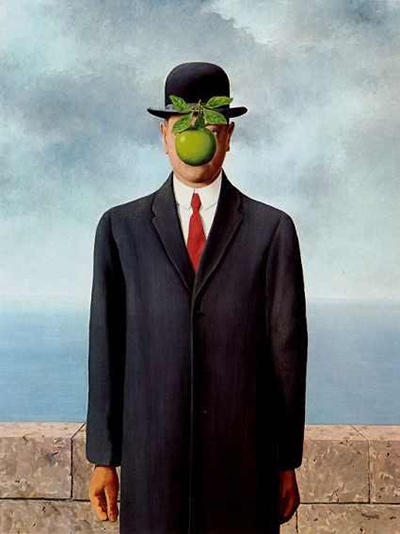
The painting is also a useful counterpoint to Magritte's single-figure images. In The Son of Man, one face is hidden by one apple. Here, three figures are almost identical, but each is separated by a private moon. Identity is not concealed by an object; it is divided by space. [5]
Museum and Source Perspective
Because the 1955 oil is privately held, this page cannot lean on a public museum object record in the same way as pages for MoMA, SFMOMA or the National Gallery of Art works. The strongest work-specific anchors are the catalogue raisonne and sale-catalogue data for the oil, plus the catalogue raisonne record of the related 1964 gouache. [1] [2]
MoMA's artist record helps with broader context. It places Magritte among the Belgian Surrealists and identifies bowler hats as one of his most recognisable motifs. In The Mysteries of the Horizon, that motif is multiplied and made stranger by the three moons. [3]
Historical Background
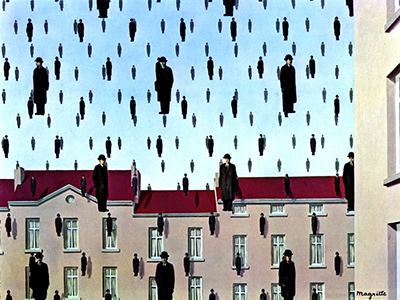
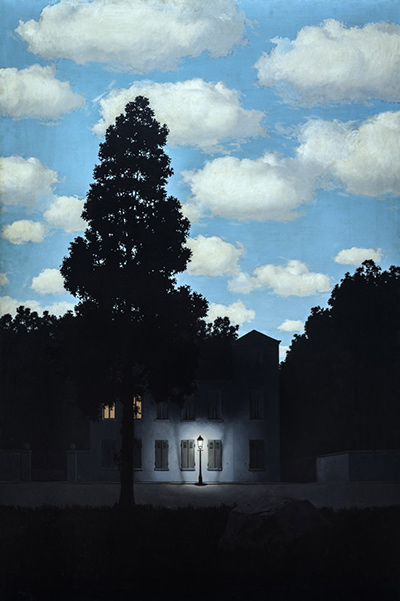
Magritte painted the work in 1955, during the mature postwar period when many of his images became simpler, cleaner and more iconic. This was close to the years of Golconde, The Listening Room and major versions of The Empire of Light. [4]
The painting belongs to a phase in which Magritte returned again and again to ordinary figures, skies and landscapes. Rather than inventing exotic dream imagery, he made familiar elements incompatible with one another. [7]
Visual Description
The scene is set outdoors at dusk. Three men in dark suits and bowler hats stand in an open landscape. They are similar enough to seem like repetitions of one figure, but they face different directions. [1]
Above each man is a crescent moon. The moons are not arranged as one shared astronomical event. They behave like personal signs, one moon for each figure. [1]
The horizon glows faintly in the distance. The atmosphere is calm, almost still, but the logic is impossible. One sky seems to contain three separate skies. [5]
Looking Carefully
Start with the figures. They do not interact. Their closeness suggests a group, yet their orientations prevent them from forming a conversation or shared event. [6]
Then look at the moons. If the men occupy one space, the moons should belong to one sky. Magritte gives each man a moon, turning the shared landscape into a set of private worlds. [5]
Finally, look at the horizon itself. The title tells us to notice it, but the horizon does not clarify anything. It becomes the line where the painting's separate realities meet without merging. [7]
Things You Might Miss
- The figures are not identical in posture, even though they look alike at first. [1]
- The moons are the key to the painting's logic. They make the sky behave as if it were divided. [5]
- The title The Masterpiece is not a neutral label. It makes the image sound definitive while the scene remains unresolved. [2]
- The painting is not only about anonymity. It is about separate viewpoints placed side by side. [7]
Technique and Composition
Magritte's technique is deliberately calm. The figures, hats, ground and sky are readable. The strangeness comes from arrangement, not from painterly distortion. [6]
The composition is balanced around three vertical figures and three small moons. The figures anchor the earth; the moons punctuate the sky. That pairing makes the image easy to remember and difficult to explain. [5]
The twilight setting matters because it sits between day and night. Like The Empire of Light, the painting uses sky and light to make ordinary space philosophically unstable. [7]
Meaning and Interpretation
The strongest interpretation begins with separated perception. The three men appear to stand together, but each has his own horizon and moon. The painting makes proximity and shared reality come apart. [5]
This does not require a simple claim that the men represent alienation or modern loneliness. Those ideas may be suggested, but Magritte's image is more precise. It shows a world in which the same outward figure can belong to different inward spaces. [7]
The bowler hat is important because it gives the figures a social uniform. They look ordinary, respectable and anonymous. The moons undo that sameness by assigning each figure a private cosmic sign. [3]
Title Analysis
The fuller title, The Masterpiece or The Mysteries of the Horizon, is unusually grand. Calling the image The Masterpiece might sound ironic, but it also points to the painting's self-conscious clarity. [1]
The mysteries are not hidden symbols. They are visible facts: three figures, three directions, three moons, one horizon. Magritte's mystery is produced by what is plainly shown. [6]
Series and Versions
The 1955 oil was not the only treatment of the subject. The catalogue raisonne records a 1964 gouache with the same title and subject. The later work shows that Magritte continued to find value in the arrangement of repeated figures and separate moons. [2]
This kind of return was typical of Magritte. He often repeated and adjusted successful visual problems, not because he had run out of ideas, but because each version tested the image again. [4]
Museum Moment
The painting's private-collection status changes how we should write about it. There is no stable museum display status to report, and no public object page with current location, provenance or exhibition history was found during this pass. [1]
That limitation should not weaken the article. It should make it more careful. The available evidence supports the title, date, medium, dimensions, private collection status and related gouache; interpretation should stay close to what the image and sources support. [2]
Comparison Works
Golconde is the closest comparison for repeated bowler-hatted men. In Golconde the figures multiply across a townscape; in The Mysteries of the Horizon three figures are enough to divide reality. [4]
The Son of Man is useful because both paintings use the bowler-hatted figure to unsettle identity. One hides the face; the other gives similar figures separate moons. [5]
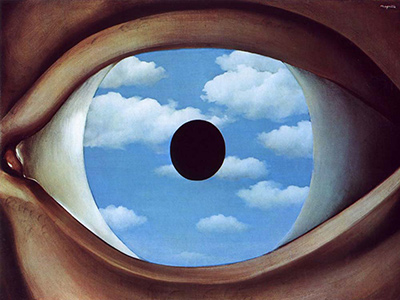
The Empire of Light and The False Mirror belong nearby because both use sky as a philosophical device. The Blank Signature also helps because it separates one visual field into incompatible spatial rules. [7]
Timeline
- 1953 - Magritte paints Golconde, another major work using repeated bowler-hatted men. [4]
- 1955 - Magritte paints The Masterpiece or The Mysteries of the Horizon. [1]
- 1955 - Magritte also works in a mature period of concise visual problems, including Euclidean Walks and related images. [4]
- 1964 - Magritte makes a gouache version of The Masterpiece or The Mysteries of the Horizon. [2]
- 1964 - Magritte paints The Son of Man, another major bowler-hatted figure image. [4]
FAQs
The 1955 oil painting is recorded as being in a private collection. [1]
Magritte painted the oil version in 1955. [1]
It shows three bowler-hatted men standing outdoors at twilight, each with a separate crescent moon above him. [1]
The fuller title is The Masterpiece or The Mysteries of the Horizon, from the French Le Chef-d'Oeuvre ou les Mysteres de l'Horizon. [1]
The strongest reading is about separate perception within a shared space. The figures appear to stand together, but the three moons suggest private horizons or separate realities. [5]
References
- Sotheby's, Impressionist & Modern Art sale catalogue entry for Rene Magritte, The Masterpiece or The Mysteries of the Horizon, cited in published listings.
- David Sylvester, Sarah Whitfield and Michael Raeburn, Rene Magritte: Catalogue Raisonne, vol. IV, Gouaches, Temperas, Watercolours and Papiers Colles, London: Philip Wilson, 1994, no. 1547.
- Museum of Modern Art, "Rene Magritte," artist record, accessed July 4, 2026, https://www.moma.org/artists/3692-rene-magritte.
- David Sylvester and Sarah Whitfield, eds., Rene Magritte: Catalogue Raisonne, Houston and London: Menil Foundation / Philip Wilson, 1993.
- Harry Torczyner, Magritte: Ideas and Images, New York: Harry N. Abrams, 1977.
- Suzi Gablik, Magritte, London: Thames & Hudson, 1970.
- Patricia Allmer, Rene Magritte: Beyond Painting, Manchester: Manchester University Press, 2009.