

 by Tom Gurney
Tom Gurney BSc (Hons) is an art history expert with over 20 years experience
Published on June 19, 2020 / Updated on July 5, 2026
Email: tomgurney1@gmail.com / Phone: +44 7429 011000
Golconde by René Magritte
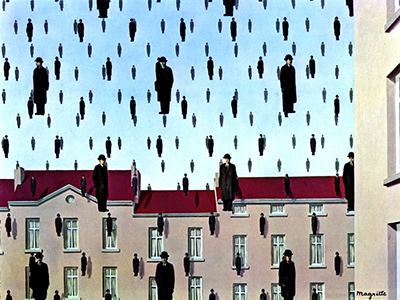
Golconde is one of René Magritte's most memorable images of the bowler-hatted man. Painted in 1953, it shows dozens of nearly identical men in dark coats and hats arranged across the sky in front of a quiet suburban street. They appear to be falling, floating, rising or standing in mid-air. Magritte gives no clear answer. [3] [1]
That uncertainty is the painting's power. The men are ordinary in dress but impossible in placement. The houses are ordinary, the sky is ordinary, and each figure stands with a strange composure. Yet together they turn the whole scene into a problem of identity, repetition and everyday life made uncanny. [3]
Golconde is often known in English as Golconda, but the live site and French title use Golconde. The title points toward the historic Indian city associated with diamond wealth, but as with many Magritte titles, it should not be treated as a simple explanation. It adds another layer of suggestion to an image that remains deliberately unresolved. [3]
At a Glance
- Artist: René Magritte
- Title: Golconde
- English/search variant: Golconda
- Date: 1953
- Medium: Oil on canvas
- Collection: Menil Collection, Houston
- Main motif: Bowler-hatted men suspended above a suburban street
Contents
- Why Golconde Matters
- Historical Background
- Visual Description
- Are the Men Falling or Floating?
- The Bowler-Hatted Man
- Title Analysis
- Individual and Crowd
- Technique and Composition
- Influence and Popular Memory
- Timeline
Why Golconde Matters
Golconde matters because it turns one of Magritte's most ordinary human types into a repeating visual system. The bowler-hatted man is not shown once, as in a portrait, but multiplied across the sky like weather, pattern or population. The result is both comic and unsettling. [3]
The painting is often remembered as the image of men raining from the sky, but that description is only partly right. The men are not clearly falling. Their feet are flat, their bodies are upright, and they show no panic or motion. They seem as if they could be descending, rising or simply occupying impossible positions in space. [3]
This ambiguity makes the painting more interesting than a one-line surreal joke. Magritte does not show a dramatic event. He shows an impossible condition made calm. The men do not behave as individuals caught in crisis. They behave like repeated units in an orderly arrangement. [3]
Historical Background
Magritte painted Golconde in 1953, during a period when his imagery was becoming increasingly crisp, memorable and iconic. By this stage, many of his major motifs were well established: bowler hats, ordinary houses, clear skies, impossible placement and the transformation of familiar things through repetition or displacement. [3]
The painting belongs to Magritte's postwar maturity. After the stylistic experiments of the 1940s, including the Renoir and Vache periods, he returned to the cooler, more precise visual language that made him famous. Golconde shows how powerful that language could be when reduced to a simple structure: one kind of figure, repeated in space, against an ordinary urban background. [3] [2]
The suburban setting also matters. Magritte often made the ordinary middle-class world strange from within. He did not need ruins, monsters or theatrical fantasy. Houses, coats, hats and a blue sky were enough. [3]
Visual Description
The painting shows a row of pale buildings with reddish roofs below a blue, lightly clouded sky. In front of and above the buildings are many men wearing dark coats and bowler hats. They are arranged at regular intervals, receding into space and varying in size according to their apparent distance from the viewer. [3]
Most of the men face outward. They appear formally dressed, anonymous and controlled. Their bodies remain upright, their feet are flat, and their postures are oddly stable. They do not tumble, gesture or look alarmed. This restraint is what makes the scene uncanny. [3]
The buildings provide order and normality. They are quiet, repetitive and domestic. The sky should normally be empty, but Magritte fills it with a pattern of human figures. The everyday city becomes a stage for an impossible population. [3]
Are the Men Falling or Floating?
One of the most common questions about Golconde is whether the men are falling like rain or floating upward like balloons. Magritte refuses to decide. There is no visible motion line, no wind, no panic, no impact and no obvious source. The figures are suspended in a state between movement and stillness. [5]
This uncertainty is important. If the men were clearly falling, the painting would become a strange disaster. If they were clearly rising, it might become a fantasy of ascent. Instead, Magritte holds the image at the exact point where the viewer cannot choose. The mind wants a direction, but the painting withholds it. [5]
The flatness of the men's feet intensifies the problem. They stand as if on invisible ground. That makes them less like falling bodies and more like people displaced from the street into the sky. They are not behaving like airborne figures. They are behaving like pedestrians whose ground has disappeared. [5]
The Bowler-Hatted Man
The bowler-hatted man is one of Magritte's most famous motifs. It appears in several works and has become closely associated with the artist himself. In Golconde, however, the figure is not singular. He is repeated until individuality becomes uncertain. [4]
The suit and hat suggest respectability, office life, social conformity and modern urban anonymity. The figures are not heroic. They are ordinary men multiplied into a pattern. Their repetition makes the viewer ask whether each one is an individual or whether the whole group is more important than any single person. [4]
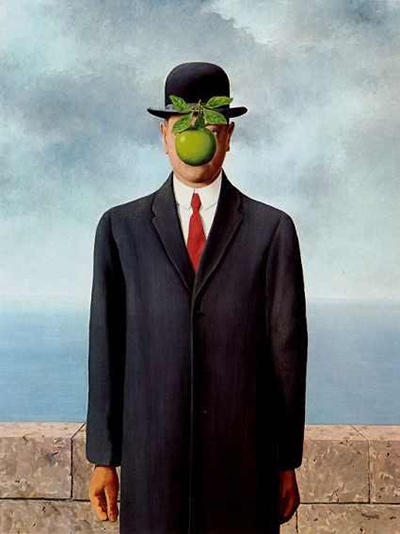
This theme connects Golconde to The Son of Man and Man in a Bowler Hat. In those works, the bowler-hatted figure is more isolated and portrait-like. In Golconde, he becomes a crowd, a field, almost a weather system of modern identity. [4]
Title Analysis
The title Golconde refers to Golconda, the historic Indian city associated with diamond mines and legendary wealth. That association matters, but it should not be treated as a code that solves the painting. Magritte's titles often open mystery rather than close it. [4]
The idea of a mine of wealth may suggest abundance, multiplication or value. The painting certainly multiplies its human figures as if they were units in a strange economy. Yet the men do not look wealthy in an extravagant sense. They look controlled, uniform and middle-class. [4]
The title's distance from the Belgian suburban scene is also part of its force. A name associated with exotic wealth is attached to a grey urban world of repeated office-like men. The mismatch between title and image gives the painting another layer of unease. [4]
Individual and Crowd
Golconde is one of Magritte's strongest paintings about the tension between individual identity and collective pattern. At first glance, the men look identical. They wear the same clothes, occupy the same general posture and appear in a repeating arrangement. [6]
Look longer, and small differences begin to matter: position, size, face, distance, angle. The painting asks the viewer to move between the group and the individual. Are we looking at many men, one man repeated, or the idea of modern man as a repeatable type? [6]
This question gives the painting its psychological depth. Magritte does not need to show emotion. The anxiety comes from the social pattern itself. The men are not trapped by ropes or walls. They are trapped by sameness. [6]
Technique and Composition
Golconde is technically precise without being showy. Magritte uses clear outlines, controlled colour and a structured arrangement of figures. The repeated men form a loose grid that recedes into depth, while the buildings below create a stable horizontal base. [3]
The composition balances order and impossibility. The men are spaced carefully enough to feel patterned, but not mechanically identical. The buildings are plain enough to make the sky event stand out. The palette remains calm, dominated by blues, greys, dark coats and muted roof colours. [3]
This restraint matters. Magritte does not paint a chaotic storm of men. He paints an orderly impossibility. The scene is almost bureaucratic in its calmness, which makes the surreal event more disturbing. [3]
Influence and Popular Memory
Golconde has become one of the most instantly recognisable Magritte images because its central idea is so clear. The phrase men raining from the sky is easy to remember, even though the painting is more ambiguous than that phrase suggests. [6]
Its influence lies partly in the way it turns a crowd into a pattern. The repeated figures have the visual force of wallpaper, weather and social commentary at once. The painting can be read in relation to conformity, anonymity, bourgeois respectability, modern urban life and the fragile difference between one person and many. [6]
Like many of Magritte's strongest works, Golconde survives reproduction well. The composition remains legible even at small scale: blue sky, suburban houses, dark repeated men. That graphic clarity is one reason the painting has stayed so powerful in books, posters and popular memory. [6]
Timeline
- 1898 — René Magritte is born in Lessines, Belgium. [3]
- 1920s — Magritte develops his Surrealist language after early modernist experiments and commercial design work. [3]
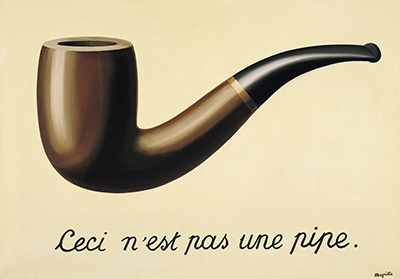
- 1929 — The Treachery of Images establishes his interest in ordinary objects and conceptual contradiction. [3]
- 1953 — Magritte paints Golconde. [3]
- 1964 — The Son of Man gives the bowler-hatted figure one of its most famous later forms. [3]
- 1967 — Magritte dies in Brussels. [3]
FAQs
Golconde shows many bowler-hatted men suspended in the sky in front of a quiet suburban street. They may be falling, floating, rising or simply held still in impossible space. [3]
The French title is Golconde, while Golconda is often used as an English search variant. The live TheHistoryOfArt.org URL uses /rene-magritte/golconde/. [3]
The title refers to Golconda, a historic Indian city associated with diamond wealth. In the painting, the title suggests abundance and value, but it does not explain the image in a simple way. [3]
They may look as if they are falling, but Magritte gives no clear direction of movement. Their upright posture and flat feet make them seem suspended rather than simply descending. [3]
The bowler hat suggests ordinary middle-class respectability, anonymity and modern identity. Magritte used the motif repeatedly, including in The Son of Man and Man in a Bowler Hat. [3]
Golconde is generally listed as part of the Menil Collection in Houston. [3]
References
- MoMA, "René Magritte", View source.
- Royal Museums of Fine Arts of Belgium, "Magritte Museum", View source.
- David Sylvester, Sarah Whitfield and Michael Raeburn, René Magritte: Catalogue Raisonné, London: Menil Foundation / Philip Wilson, 1992-1997.
- Harry Torczyner, Magritte: Ideas and Images, New York: Harry N. Abrams, 1977.
- Suzi Gablik, Magritte, London: Thames & Hudson, 1970.
- Patricia Allmer, René Magritte: Beyond Painting, Manchester: Manchester University Press, 2009.
- Anne Umland, ed., Magritte: The Mystery of the Ordinary, 1926-1938, Museum of Modern Art, 2013.