

 by Tom Gurney
Tom Gurney BSc (Hons) is an art history expert with over 20 years experience
Published on June 19, 2020June 19, 2020 / Updated on July 6, 2026
Email: tomgurney1@gmail.com / Phone: +44 7429 011000
The Empire of Light by Rene Magritte
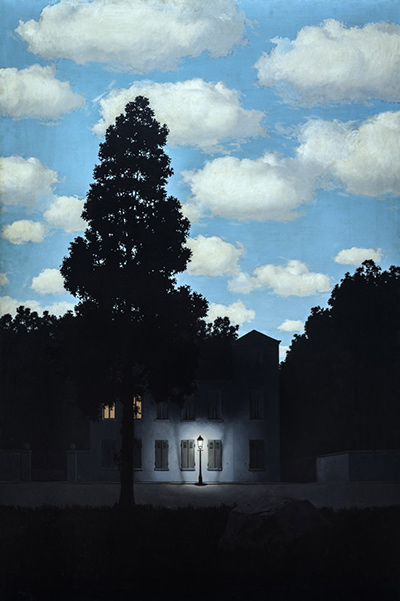
The Empire of Light is one of Belgian Surrealist Rene Magritte's clearest and most haunting ideas: a quiet night street under a full daylight sky. The subject is not a monster, a dream creature or an impossible machine. It is a house, trees, a lamp and clouds. The shock comes from the fact that two ordinary conditions, night and day, occupy the same calm image. [3] [1]
That simplicity is why the painting has become one of Magritte's most memorable inventions. The image feels instantly readable, then refuses to settle. Is the lower half night, or is the sky wrong? Is the sky beautiful, or does its brightness make the dark street more disturbing? The painting does not answer those questions. It holds them in balance. [1]
Strictly speaking, The Empire of Light is not one canvas but a group of related works. Public versions and related examples are associated with major collections including the Peggy Guggenheim Collection, the Museum of Modern Art and the Royal Museums of Fine Arts of Belgium. The Guggenheim's Venice version, dated 1953-54, is a strong anchor because its museum record confirms the medium, scale and central interpretation. [2]
At a Glance
- Artist: Rene Magritte
- Title: The Empire of Light
- French title: L'Empire des lumieres
- Date: mainly 1950s; the Guggenheim version is dated 1953-54 [2]
- Medium: oil on canvas for the principal museum versions [2]
- Guggenheim version dimensions: 76 15/16 x 51 5/8 in. (195.4 x 131.2 cm) [2]
- Key collection: Peggy Guggenheim Collection, Venice, The Solomon R. Guggenheim Foundation [2]
- Subject: a nocturnal street or house scene beneath a blue daytime sky [1]
Contents
- Why this painting matters
- Museum perspective
- Historical background
- Visual description
- Looking carefully
- Meaning and interpretation
- Series and versions
- Comparison works
Why This Painting Matters
The Empire of Light matters because it shows how little Magritte needed in order to disturb reality. Many Surrealist images depend on metamorphosis, dream violence or erotic dislocation. Magritte often works more quietly. Here, almost everything looks normal. The streetlight belongs to night. The blue sky belongs to day. The white clouds belong to ordinary weather. The impossible part is their coexistence. [1]
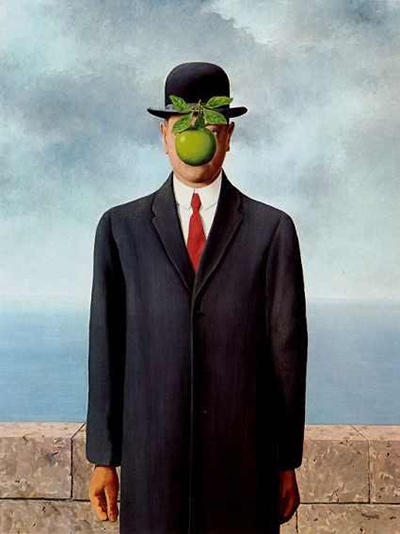
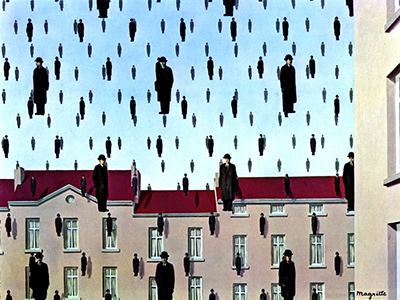
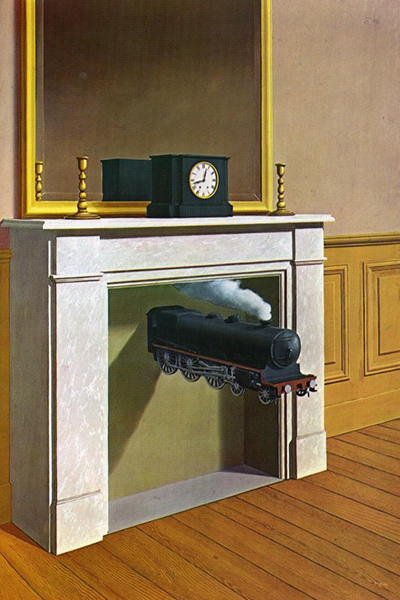
The painting also belongs to Magritte's late public fame. By the 1950s his motifs became increasingly clear, repeatable and memorable. The Empire of Light sits with works such as Golconde, The Listening Room and The Son of Man as a late image that can be grasped in seconds and thought about for years. [6]
Museum Perspective
The Guggenheim commentary identifies the central drama with unusual precision. In its reading, the painting contains no fantastic element except the single paradox of day and night. That is important. Magritte is not inventing an elaborate fantasy world; he is changing one rule inside a recognisable world. [1]
The museum also notes that sunlight normally clarifies things, while darkness traditionally brings uncertainty. In The Empire of Light, that relationship is reversed. The daylight sky does not explain the scene. It makes the darkness underneath feel stranger. The sky is not simply beautiful; it becomes an agent of unease. [1]
The Brussels Magritte Museum gives the painting an additional institutional context. It is part of the public story of Magritte as a Belgian modern artist whose works are dispersed across major international museums while remaining deeply connected to Brussels. [4]
Video Guide
This selected video from Sotheby's offers useful visual context before the detailed analysis continues.
Historical Background
Magritte had returned to a controlled, crisp Surrealist manner after the disruptions of the 1940s. In the 1950s, he increasingly developed images that could function almost like visual propositions: one clear object or condition placed against another in a way that reason cannot comfortably absorb. [6]
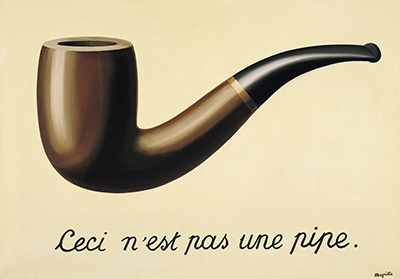
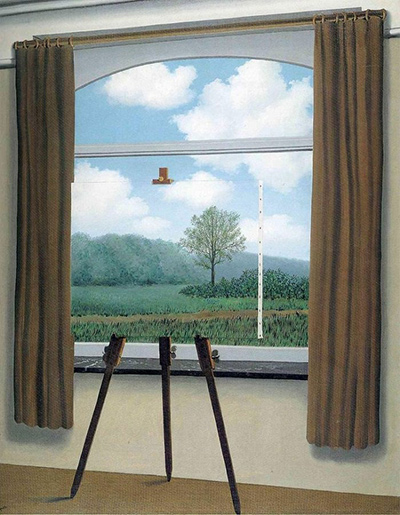
The Empire of Light belongs to that later phase. It is related to his long-standing interest in contradiction, but its mood is distinct. Earlier paintings such as The Treachery of Images challenge language and representation. The Human Condition challenges the boundary between a painted image and the world it seems to depict. The Empire of Light challenges something even more basic: the division between night and day. [5]
Visual Description
A dark house or street occupies the lower part of the picture. Trees and architecture are almost swallowed by night. A streetlamp or house light gives just enough illumination to make the scene legible. Above this dark zone, the sky is a clear daytime blue with white clouds. The split is not theatrical. Magritte paints the two conditions as if both were perfectly ordinary. [1]
That restraint matters. If the sky were stormy, or if the street were violently distorted, the painting would become an illustration of fantasy. Instead, the scene is sober. The contradiction is not announced by gesture. It arrives through stillness. [1]
Looking Carefully
Start with the lamp. It seems to belong to the night scene and helps persuade the viewer that the lower half is dark. Then look upward. The sky contradicts that reading, but it does not behave like a supernatural sign. It is a normal blue sky, painted with the same calm precision as the street below. [1]
The painting also changes as the eye moves. The lower half asks the viewer to peer into darkness, while the upper half gives open clarity. The result is not a simple contrast between good and evil, or hope and fear. Those readings are tempting but unsupported. The stronger point is perceptual: the painting makes two incompatible visual certainties occupy the same surface. [7]
Things You Might Miss
- The title does not necessarily mean that light wins. If anything, the painting makes light less reassuring, because the light produces the paradox. [1]
- The series format is important. Magritte repeated the motif in several versions, so the image is best treated as an idea he kept testing rather than a one-off composition. [6]
- The sky is not a fantasy sky. It is painted as ordinary daylight, which is why the contradiction is so effective. [1]
Technique and Composition
Magritte's technique is deliberately plain. The paint handling avoids expressive drama. Edges are controlled, forms are readable and the composition is stable. This precision is central to the effect. A loose, emotional handling would make the painting feel subjective. Magritte instead makes the impossible look factual. [1]
The vertical organisation is simple: dark earthly scene below, luminous sky above. Yet the simplicity is a trap. Viewers expect the upper and lower halves of a landscape to belong to the same time of day. Magritte keeps the conventional landscape format while breaking the time logic that normally holds it together. [8]
Meaning and Interpretation
The safest interpretation begins with Magritte's own explanation. He described the represented things as a nighttime landscape and a daytime sky, and he connected their combination with poetic power. In a widely cited statement, he said, "I call this power: poetry." [7]
He did not present the image as an allegory in which light means virtue and darkness means evil. That distinction matters. The painting is not empty of feeling, and it is deeply atmospheric. But its meaning grows from a precise visual contradiction, not from a fixed moral code. The painting asks what happens when ordinary perception is divided against itself. [7]
Magritte's broader art often resists interpretation in this way. He wanted mystery to remain mystery. The Empire of Light is mysterious not because it hides a secret message, but because the visible facts cannot be reconciled. [5]
The Title
The French title, L'Empire des lumieres, carries a plural sense of lights or illuminations, though English titles often appear as The Empire of Light. That small translation issue is useful because the painting itself contains competing kinds of illumination: daylight in the sky, artificial light below and the mind's expectation that light should explain what it touches. [7]
The title sounds grand, almost political. The image is domestic and quiet. That gap between title and scene is very Magritte. The words do not solve the picture. They enlarge it. [5]
Series and Versions
Several versions of The Empire of Light exist, and they should not be collapsed into one object. The Guggenheim's Venice version is dated 1953-54 and measures 195.4 x 131.2 cm. Other versions and related works are associated with MoMA, Brussels and private collections. [2]
This repetition was not mechanical. Magritte often returned to ideas that continued to generate mystery. In The Empire of Light, the motif is unusually durable because the central contradiction is so direct. Change the house, trees or format, and the idea still works: night below, day above. [6]
Provenance and Collection Context
The Peggy Guggenheim Collection version belongs to The Solomon R. Guggenheim Foundation and is housed in Venice. The Guggenheim media record identifies it as Empire of Light, 1953-54, oil on canvas, and gives its large vertical dimensions. [2]
The Brussels Magritte Museum and the Royal Museums of Fine Arts of Belgium are also important to the painting's public context. The Magritte Museum holds one of the world's major Magritte collections and presents the artist as a central figure in Belgian modern art. [4]
Exhibition and Market History
The Empire of Light has a major exhibition and market afterlife because the image is both museum-famous and instantly recognisable. It has also entered broader visual culture through film, design and popular reference, though those later echoes should not be mistaken for the painting's meaning. [8]
In November 2024, an Empire of Light from the Mica Ertegun collection sold at Christie's in New York for roughly $121.2 million. That sale set a record for Magritte and made the series newly visible in press coverage of the Surrealist market. [9]
Comparison Works
The Human Condition is the closest conceptual comparison within Magritte's work. Both paintings use a calm, realist surface to make perception uncertain. The Human Condition collapses the difference between painting and view; The Empire of Light collapses the difference between day and night. [5]
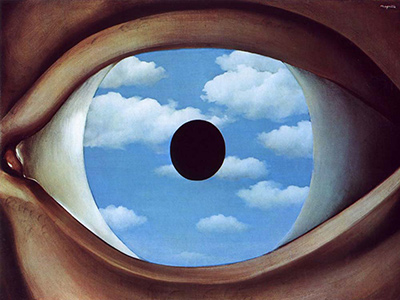
The False Mirror is another useful comparison because it turns the sky into something displaced and uncanny. The Treachery of Images works differently, through language, but it shares the same intellectual clarity. Magritte gives the viewer a simple proposition and then makes that proposition impossible to settle. [5]
The late works Golconde, The Listening Room and The Son of Man show how Magritte's mature style could become iconic without becoming simple. Like The Empire of Light, they use a clear image to protect a difficult idea. [6]
Reception and Influence
The Empire of Light is one of Magritte's most widely recognised images because it is easy to remember and hard to resolve. Its influence in popular culture comes from that same quality. A dark house under strange light can suggest suspense, dream, cinema or psychological unease, but the painting itself remains more exact than any one borrowing. [8]
Its lasting power comes from restraint. Magritte does not tell us what to fear or what to believe. He shows two ordinary kinds of light occupying one impossible world. [7]
Timeline
- 1930s - Magritte develops many of his core pictorial strategies around windows, objects, words and substitutions. [5]
- 1940s - He passes through wartime stylistic experiments before returning to a precise Surrealist mode. [6]
- 1950s - The Empire of Light motif becomes one of his major late inventions. [6]
- 1953-54 - The Guggenheim/Peggy Guggenheim Collection version is dated to this period. [2]
- 2024 - An Empire of Light canvas from the Mica Ertegun collection sells for about $121.2 million at Christie's. [9]
FAQs
It is about the impossible coexistence of night and day inside one believable scene. Magritte combines a dark street or house with a blue daytime sky. [1]
It is best understood as a series or group of related works. Several versions exist in museum and private collections. [6]
Important versions are associated with the Peggy Guggenheim Collection in Venice, MoMA in New York and the Royal Museums of Fine Arts of Belgium in Brussels. [2]
It uses a realistic style to create an impossible situation. The scene looks ordinary until the viewer realises that its basic conditions contradict each other. [1]
That is a possible viewer response, but it is not the best evidence-first reading. Magritte's own explanation points to night and day, poetry and astonishment rather than a fixed moral allegory. [7]
References
- Guggenheim, "Rene Magritte | Empire of Light," collection commentary, accessed July 4, 2026, https://www.guggenheim.org/artwork/2594.
- Guggenheim media metadata for Empire of Light, identifying date, medium, dimensions and Peggy Guggenheim Collection status, accessed July 4, 2026, https://www.guggenheim.org/wp-json/wp/v2/media/119416.
- Museum of Modern Art, "Rene Magritte," artist record, accessed July 4, 2026, https://www.moma.org/artists/3692-rene-magritte.
- Royal Museums of Fine Arts of Belgium / Magritte Museum, collection and museum context, accessed July 4, 2026, https://musee-magritte-museum.be/en.
- Anne Umland, ed., Magritte: The Mystery of the Ordinary, 1926-1938, New York: Museum of Modern Art, 2013.
- David Sylvester and Sarah Whitfield, eds., Rene Magritte: Catalogue Raisonne, Houston and London: Menil Foundation / Philip Wilson, 1992.
- Harry Torczyner, Magritte: Ideas and Images, New York: Harry N. Abrams, 1977.
- William Rubin, Dada and Surrealist Art, New York: Harry N. Abrams, 1968; A. M. Hammacher, Magritte, New York: Harry N. Abrams, 1973.
- Wall Street Journal, "Rene Magritte Painting Sells for a Record-Breaking $121.2 Million," November 20, 2024.