by Tom Gurney
Tom Gurney BSc (Hons) is an art history expert with over 20 years experience
Published on June 19, 2020 / Updated on November 5, 2026
Email: tomgurney1@gmail.com / Phone: +44 7429 011000
René Magritte Quotes and Their Context
Magritte's words are most useful when they lead us back to looking. A sentence inside a painting can challenge what its image seems to show; a statement about mystery can describe a way of attending to ordinary things. These two short passages have identifiable museum sources, and they serve different purposes.
One is a painted inscription from 1929. The other is an English statement attributed to Magritte in 1962 by an exhibition learning resource. Keeping those distinctions visible helps us read the words without turning them into interchangeable slogans.
At a Glance
Contents
The painted sentence beneath the pipe
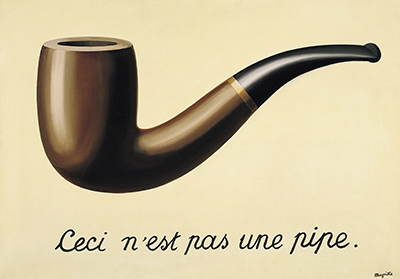
“Ceci n'est pas une pipe” — “This is not a pipe.”
These words appear beneath the image of a smoking pipe in The Treachery of Images, the 1929 oil painting in the Los Angeles County Museum of Art, accession 78.7. They belong to the painted composition itself. They are not a separately documented remark made while Magritte was discussing it. [1]
The sentence creates a difficulty because the image is so readily recognisable. We see the familiar curved bowl and stem, and identifying the subject seems easy. Reading the words forces us to consider whether identifying an image is the same as possessing the thing it depicts.
The distinction is simple enough to test. A painted pipe can be recognised, described and remembered, but it cannot perform the practical work of a smoking implement. The picture gives access to an appearance. Its caption asks us to notice the difference between that appearance and the object we name.
The handwriting is also part of what we see. It sits within the same painted surface as the pipe, so the sentence is an image of writing as well as a statement we can read. Magritte brings two familiar habits together: recognising a depicted thing and trusting a written label. Their encounter makes both habits worth examining.
You can explore the composition further in The Treachery of Images.
Mystery within familiar reality
“The surreal is reality which has not been separated from its mystery.”
The Art Gallery of New South Wales places this statement at the beginning of its Magritte learning resource and attributes it to René Magritte, 1962. This is the museum's English wording and dating; the resource's opening page does not identify a particular speech or letter as its occasion. [2]
The statement offers a useful approach to paintings whose individual components look ordinary. A cloud, a rock, a bell or a jacket can be described clearly. The mystery may arise when those things enter an unexpected relationship, rather than from an inability to recognise what they are.
Consider The Present. The eagle's head, dark jacket and talons remain distinct. Looking more closely clarifies their appearances without making their combination routine. The image's precision sustains the uncertainty instead of removing it.
The Representation offers a different example. Footballers and a house appear at two scales within one landscape. We can trace the repeated arrangement and identify its parts, yet the space never becomes an ordinary continuous view. Familiarity supplies the very clues through which the puzzle becomes apparent.
These comparisons are ways of using the statement while looking, rather than claims that it was written specifically about either painting. A general remark can guide attention without becoming a complete explanation of every work.
Reading quotations with their sources
A useful quotation has more than a name attached to it. Its source tells us whether the words were written on a canvas, recorded in correspondence, printed in an essay or translated for a later exhibition. Those settings affect what can reasonably be claimed about the passage.
The two examples here show why that matters. The inscription can be checked against a particular painting and its collection record. The later statement is presented through a museum's attribution. Both can be discussed, but they do not carry identical kinds of documentation.
Translation adds another layer. English wording can make a French artist's thought accessible while still belonging to a particular translator or publication. Preserving the source allows readers to distinguish an attributed English version from an assertion about the artist's exact original-language phrasing.
For further reading, begin with the museum records below and the individual paintings linked in the text. Read a passage alongside a visible detail, then ask what it helps you notice. Magritte's words reward that return to the image: they can sharpen a question without requiring the picture to surrender a single final answer.
Paintings discussed here
Three paintings discussed on this page, with individually cited records.
| Name | Date | Medium |
|---|---|---|
| The Treachery of Images | 1929 | Oil on canvas |
| The Present | 1939; also dated 1938 or 1939 | Gouache on paper |
| The Representation | 1962 | Oil on canvas |
Discussion
Compare the words with the images and sources around them.
Reader Insights
How does a painted sentence differ from a label outside the picture?
Which familiar object becomes most puzzling when you look at its relationship with another?
What information would you want to know before repeating an artist quotation?
Join the Conversation
Share a detail, comparison or question about René Magritte Quotes and Their Context below.
References
- Los Angeles County Museum of Art, The Treachery of Images, 1929, accession 78.7: collection record and painted inscription. View source.
- Art Gallery of New South Wales, Magritte: Learning Resource (2024), p. 2: English statement attributed to René Magritte, 1962. View source.