

 by Tom Gurney
Tom Gurney BSc (Hons) is an art history expert with over 20 years experience
Published on June 19, 2020 / Updated on July 5, 2026
Email: tomgurney1@gmail.com / Phone: +44 7429 011000
The Human Condition by Rene Magritte: When a Window Becomes a Painting
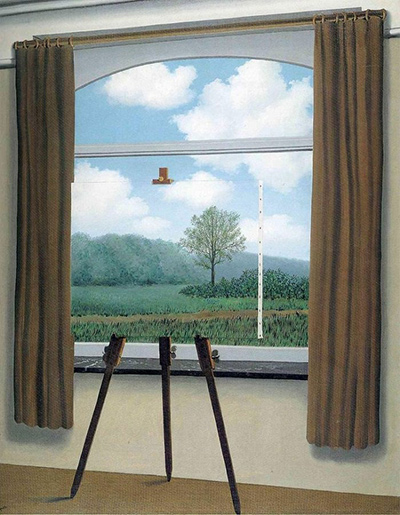
The Human Condition, or La condition humaine, is one of Rene Magritte's clearest and most unsettling paintings about the act of seeing. Painted in 1933, it shows a room with a window, curtains, an easel and a canvas that appears to continue the landscape outside. The National Gallery of Art records the work as oil on canvas, measuring 100 x 81 x 1.6 cm, and holds it as accession number 1987.55.1. [1]
At first, the painting seems to show a clever illusion: a canvas placed in front of a window depicts the exact portion of landscape it hides. But the longer one looks, the more the illusion changes. The landscape outside the window and the landscape on the canvas both belong to the same painting. The difference between outside view and painted image is something the viewer supplies. [1]
That is why The Human Condition is more than a trompe-l'oeil game. It is a painting about representation itself: how the mind decides what is real, what is pictured and what is hidden. Magritte makes the viewer feel the habit of believing in images, then quietly removes the ground from underneath that habit. [5]
At a Glance
- Artist: Rene Magritte
- Title: La condition humaine / The Human Condition
- Date: 1933
- Medium: Oil on canvas
- Dimensions: 100 x 81 x 1.6 cm
- Collection: National Gallery of Art, Washington
- Accession Number: 1987.55.1
Contents
- Why This Painting Matters
- Museum Perspective
- Historical Background
- Visual Description
- Looking Carefully
- Meaning and Interpretation
- Provenance
- Comparison Works
Why This Painting Matters
The Human Condition matters because it turns a familiar window view into a philosophical trap. A window usually promises direct access to the outside world. A painting usually promises representation. Magritte places one inside the other until the distinction collapses. [1]
The National Gallery of Art identifies two of Magritte's favoured themes here: the window painting and the painting within a painting. This is one of his earliest major combinations of those themes, and the gallery describes it as one of his most subtle statements of their shared meaning. [1]
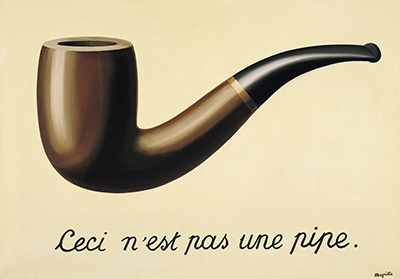
The painting also belongs to the same family of Magritte works as The Treachery of Images. One painting tells the viewer that a pipe image is not a pipe; the other lets the viewer assume that a landscape is outside the painted image before revealing that the whole scene is an image. Both works expose the assumptions hidden inside ordinary seeing. [3]
Museum Perspective
The NGA object page is unusually valuable because it explains the work from the viewer's first assumption outward. At first, the viewer assumes that the painting on the easel depicts the piece of landscape it conceals. After a moment, however, that assumption breaks down: both the easel painting and the window landscape are parts of the same painted fabrication. [1]
That museum reading gives the page its central argument. The painting does not simply trick the eye. It reveals that the eye is already working with mental categories: room and outside, painting and reality, representation and thing. Magritte makes those categories visible by making them fail. [1]
The work's institutional record also matters. NGA documents the painting's medium, dimensions, provenance, exhibition history and bibliography. That evidence helps keep the interpretation grounded in a specific object rather than a loose idea about illusion. [1]
Historical Background
Magritte painted The Human Condition in 1933, after the crucial late-1920s formation of his Surrealist language. By this point he had already developed many of the strategies that define his mature work: ordinary settings, precise objects, hidden relations and images that interrupt the viewer's first answer. [3]
The painting belongs to a period when Magritte was deepening his interest in representation rather than merely producing strange scenes. His Surrealism is not a flight from reality into fantasy. It is a pressure applied to reality's ordinary appearances. [6]
The work also anticipates later variations and related paintings. Magritte returned to the problem of framed views, paintings within paintings and landscapes that appear both present and represented. The live cluster's The Human Condition II page gives one related route into that wider theme. [4]
Visual Description
The National Gallery of Art describes an interior window framed by brown curtains, opening onto a landscape of grass, shrubs, trees, a dirt path, blue sky and white clouds. In front of the window stands an easel holding an unframed canvas. The canvas image aligns with the outdoor view so closely that it seems to complete the hidden part of the landscape. [1]
Several details reveal the device. The easel legs are visible. A clip appears at the top. The white edge of the canvas draws attention to the fact that a painting is resting directly before the window. These details are crucial because Magritte does not hide the trick completely. He lets the viewer see how the illusion is made. [1]
The painting therefore asks for two kinds of looking. From a distance, the canvas seems to disappear into the view. Up close, the objecthood of the canvas returns. The work moves between transparency and obstruction, as if the image wants to be both window and wall. [7]
Looking Carefully
The first thing to notice is the edge of the canvas. Without that edge, the viewer might read the scene as a simple landscape through a window. The edge tells us that a picture has been inserted into the view. [1]
The second thing to notice is the alignment. The painted landscape on the canvas continues the outdoor scene with such precision that the viewer is tempted to believe it shows what is hidden behind it. That temptation is the painting's engine. [1]
The third thing to notice is that the viewer can never check. There is no actual landscape behind the canvas, because the entire scene is painted. The hidden tree, path or sky exists only as an assumption. Magritte turns the viewer's confidence into part of the artwork. [5]
Things You Might Miss
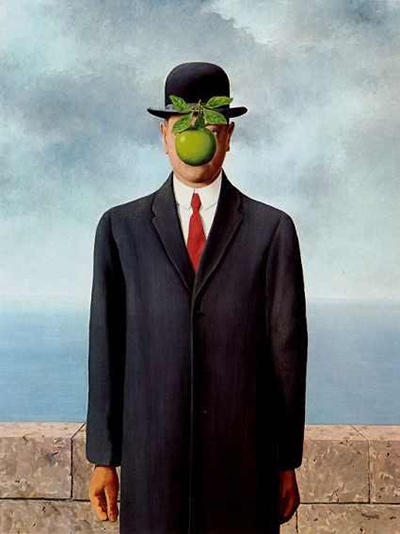
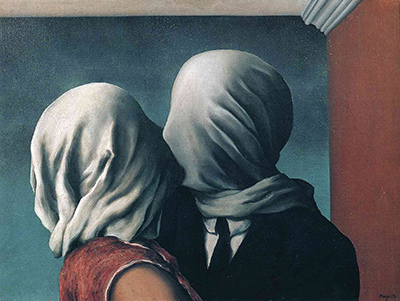
The painting hides by showing. In many Magritte works, an object blocks something behind it: an apple hides a face, cloth hides lovers, a mirror refuses an expected reflection. Here the blocking object is itself an image of what it blocks. [4]
The room matters too. The curtains and window frame create a theatrical structure. They make the outside world appear as if it were already staged, already framed, already pictorial. The easel does not introduce art into reality; it reveals that the view was already being treated like an image. [7]
The title is easy to skip, but it changes the scale of the painting. The Human Condition does not only describe a visual puzzle. It suggests that this is how human perception works: we experience the world as outside us while knowing it through representations inside us. [5]
Technique and Composition
Magritte's technique is restrained and precise. The landscape, curtains, easel and canvas are all readable. The surface does not call attention to expressive brushwork. As in much of his mature painting, clarity is the condition that allows the contradiction to work. [6]
Compositionally, the window and easel occupy the centre of the image. The painting within the painting is not a minor detail. It is the mechanism of the entire work. The viewer's eye moves from curtain to landscape to canvas edge and back again, repeatedly testing the boundary between view and representation. [1]
The vertical format helps the image feel controlled. The window, curtains and easel create a stable structure, while the conceptual instability happens inside that order. This balance between visual calm and intellectual disturbance is one of Magritte's signature strengths. [3]
Meaning and Interpretation
The meaning of The Human Condition begins with a simple problem: we think we are looking through a window, but we are looking at a painting of looking through a window. Within that painting is another painting that pretends to be continuous with the view. The viewer's mind separates reality and representation, then discovers that the separation is unstable. [1]
This is why the work should not be reduced to optical illusion. A trompe-l'oeil painting tries to deceive the eye into mistaking a painted thing for a real thing. Magritte's painting is more philosophical. It shows the viewer the deception, then asks why the deception was so easy to accept. [7]
Magritte's own explanation, preserved by Torczyner, makes this point. He described placing a picture in front of a window so that the image hid what it represented, making the tree appear both inside the room as a picture and outside in the landscape as the imagined thing behind it. [5]
Title Analysis
The title The Human Condition gives the work a broader reach than a title such as Window or Easel would have done. It suggests that the painting is not only about art. It is about the way human beings experience the world. [5]
The title does not explain the painting in a straightforward way. It opens the image outward. The human condition, in this case, may be the condition of never having unmediated access to reality. We see the world as outside us, but we know it through perception, memory, images and mental representation. [5]
This makes the title one of Magritte's most effective. It does not decode the scene. It raises the stakes of the visual problem. [7]
Provenance
The National Gallery of Art records that the painting was purchased from the artist by Claude Spaak of Choisel, France. NGA acquired it in 1987 through L. & R. Entwistle & Co., London. [1]
This concise provenance is important because Claude Spaak was part of the Belgian cultural network around Magritte. The painting's later acquisition by NGA placed one of Magritte's central representation works into a major American public collection. [1]
Exhibition History
NGA records a substantial exhibition history. The work appeared in the major 1992-1993 Magritte exhibition that travelled to the Hayward Gallery, the Metropolitan Museum of Art, the Menil Collection and the Art Institute of Chicago. It also appeared in Deceptions and Illusions: Five Centuries of Trompe l'Oeil Painting at the National Gallery of Art in 2002-2003. [1]
Later exhibitions include Magritte and Contemporary Art: The Treachery of Images at LACMA in 2006-2007, Magritte: The Mystery of the Ordinary, 1926-1938 in 2013-2014, Rene Magritte: The Fifth Season at SFMOMA in 2018 and The Double: Identity and Difference in Art Since 1900 at NGA in 2022. [1]
This exhibition history confirms the painting's flexibility. It can be understood through Surrealism, trompe-l'oeil, identity, doubling, representation and modern visual culture. [1]
Comparison Works
The closest internal comparison is The Human Condition II, which shows Magritte returning to the framed-view problem in a later variation. The existence of multiple related works shows that the window and easel were not a one-off trick but a recurring method. [4]
The Treachery of Images is equally important. There, Magritte separates object, image and word. In The Human Condition, he separates view, picture and assumption. Both works ask viewers to examine the trust they place in representation. [3]
The Son of Man offers another kind of obstruction. The apple hides the face by standing in front of it. In The Human Condition, the canvas hides the landscape by presenting an image of it. The second is subtler because concealment arrives disguised as revelation. [5]
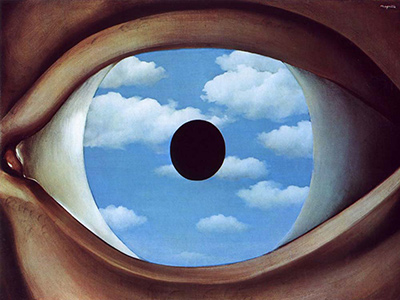
The painting also connects naturally to The False Mirror, Not to Be Reproduced and Les Amants. Each interrupts access: through the eye, the mirror, the face or the framed landscape. [7]
Reception and Influence
The painting remains one of Magritte's most cited images because it explains his intellectual method so clearly. It is visually calm, almost diagrammatic, but the diagram rearranges the viewer's sense of reality. [6]
Its influence also comes from its usefulness as a model for thinking about images. In an age saturated with screens, reproductions and framed views, The Human Condition feels newly direct. It reminds viewers that images do not merely show the world; they help produce the world we think we are seeing. [7]
For readers who want to place the work inside Magritte's broader Belgian context, the Magritte Museum in Brussels remains a central institution for the artist's work, archive and reception. [8]
Timeline
- 1898 - Rene Magritte is born in Lessines, Belgium. [2]
- 1933 - Magritte paints La condition humaine. [1]
- 1987 - The National Gallery of Art acquires the work. [1]
- 1992-1993 - The painting appears in the major travelling Magritte exhibition. [1]
- 2013-2014 - The painting appears in Magritte: The Mystery of the Ordinary, 1926-1938. [1]
- 2022 - NGA includes the work in The Double: Identity and Difference in Art Since 1900. [1]
FAQs
The Human Condition explores the unstable boundary between reality and representation. A painting on an easel appears to continue the landscape behind it, but both the landscape and the easel painting are part of the same painted image. [1]
The 1933 painting La condition humaine is in the National Gallery of Art, Washington, where it is accession number 1987.55.1. [1]
The canvas in front of the window appears to show the portion of landscape it hides. Magritte uses this device to make the viewer question the difference between seeing reality and seeing a representation. [1]
It uses trompe-l'oeil-like illusion, but its purpose is more philosophical than decorative. The painting exposes how quickly the viewer assumes that one part of the image is real and another part is representation. [7]
Both works question representation. The Treachery of Images separates a pipe from the image and words used to describe it; The Human Condition separates a landscape from the painting that seems to continue it. [3]
References
- National Gallery of Art, "La condition humaine", View source.
- MoMA, "Rene Magritte", View source.
- Anne Umland, ed., Magritte: The Mystery of the Ordinary, 1926-1938, Museum of Modern Art, 2013.
- David Sylvester and Sarah Whitfield, eds., Rene Magritte: Catalogue Raisonne, Menil Foundation / Philip Wilson, 1992.
- Harry Torczyner, Magritte: Ideas and Images, New York: Harry N. Abrams, 1977.
- Suzi Gablik, Magritte, London: Thames & Hudson, 1970.
- Patricia Allmer, Rene Magritte: Beyond Painting, Manchester University Press, 2009.
- Royal Museums of Fine Arts of Belgium, "Magritte Museum", View source.