

 by Tom Gurney
Tom Gurney BSc (Hons) is an art history expert with over 20 years experience
Published on August 14, 2026 / Updated on August 14, 2026
Email: tomgurney1@gmail.com / Phone: +44 7429 011000
Two Little Italian Girls by a Village: Introduction
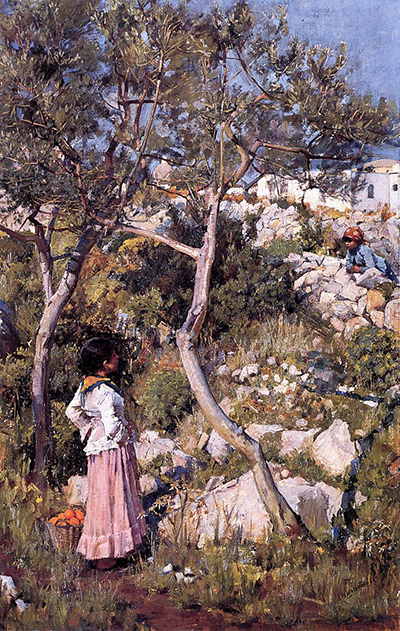
Two girls occupy a steep, sunlit corner of Capri. One stands near a basket of oranges with a mauve kerchief at her neck; the other leans over weathered stone above her. Behind them, trees and pale architecture rise towards the dome of Santo Stefano. John William Waterhouse turns a brief exchange into a vertical journey through colour, labour and island space. [1]
The familiar title Two Little Italian Girls by a Village was probably assigned later by Waterhouse scholar Anthony Hobson. Peter Trippi has argued that the picture is more likely the work exhibited in 1889 as Under the Olives, Capri. [1] That recovery matters: the “village” is not generic Italy, and the girls belong to Waterhouse’s concentrated group of Capri genre scenes made around 1889–90.
At a Glance
- ArtistJohn William Waterhouse (1849–1917)
- Familiar titleTwo Little Italian Girls by a Village
- Probable exhibited titleUnder the Olives, Capri [1]
- DateAbout 1889 [1]
- MediumOil on canvas
- DimensionsApproximately 61 × 38 cm [1] [2]
- CollectionPrivate collection [1]
- Probable exhibition historyExhibited in London and Birmingham in 1889 as Under the Olives, Capri [1]
- Location depictedCapri, with the dome of Santo Stefano in the distance [1]
- Related workAn Orange Garden, 1889–90, featuring the same young model and a basket of oranges [1]
- Essential distinctionA modern Capri genre scene, not a classical or mythological subject
Contents
- Introduction
- Two Figures on Different Levels
- Recovering Under the Olives, Capri
- Santo Stefano and the Specificity of Place
- Oranges, Kerchief and Repeated Model
- Waterhouse’s Capri Journeys
- Naturalism, Colour and Selective Finish
- The Tourist Gaze and Italian Girlhood
- From Fruit Gatherers to Myth
- A Composition Built Like a Staircase
Two Figures on Different Levels
The painting is narrow and vertical. Waterhouse uses the format to place one girl low in the foreground and another higher behind a wall or rocky structure. [1]
Their separation creates conversation through height. The lower girl looks or turns upward; the upper girl bends or leans down.
Neither shares our eye line. Attention passes between them.
The lower figure’s hands rest at or near her hips, a posture that can suggest confidence, impatience or simply a pause in work.
A basket of oranges anchors the foreground. Its vivid circular fruit offers a material reason for the girls’ presence.
The upper figure is partly absorbed into architecture and vegetation. She belongs to a higher terrace within Capri’s steep built landscape.
Waterhouse therefore makes geography social. Stairs, walls and slopes determine how bodies meet.
The conversation is silent, but its direction is clear. One figure’s upright stance answers the other’s lean.
This diagonal exchange prevents the vertical composition from becoming static. The eye climbs from oranges to kerchief, face, upper girl and church dome.
Trees add another set of rising lines. Their trunks and branches connect levels that the walls divide.
No narrative title tells us what the girls say. The scene may concern fruit, work, play or something beyond the frame.
Calling them “little” emphasises youth, but the lower figure’s posture gives her agency. She is not presented merely as an ornament within landscape.
The setting is ordinary and carefully designed. Waterhouse turns a passing island encounter into a composition whose every level carries attention upward.
Recovering Under the Olives, Capri
Anthony Hobson’s catalogue used the descriptive title Two Little Italian Girls by a Village. The wording identifies figures and broad setting but lacks a documented local name. [1]
Peter Trippi’s research proposes that the painting is more likely Under the Olives, Capri, shown in London and Birmingham in 1889. [1]
The identification rests on internal and contextual evidence: the dome of Capri’s Santo Stefano, the olive-like trees, date, repeated model and relation to other island pictures.
“More likely” must remain visible. A probable title recovery is stronger than a guess but different from an inscription on the canvas.
The recovered title transforms the page. “By a Village” encourages a generalized picturesque Italy; “Capri” establishes an island with a specific artistic economy.
“Under the Olives” also makes trees part of the subject rather than background.
Exhibition history becomes possible. The picture was not necessarily an unshown travel sketch but may have entered British displays under the lost title. [1]
This case demonstrates how paintings acquire identities. A work separated from early records receives a modern descriptive title; later scholarship reconnects image and catalogue entry.
Both names should survive. Search users know the Hobson title, while historical accuracy requires the probable 1889 identity.
The page should not silently rename the object. It should explain the evidence and let readers understand degrees of certainty.
At the same time, the title Two Little Italian Girls deserves critical attention. It defines the subjects by nationality and youth from an external British viewpoint.
Under the Olives, Capri shifts attention from ethnic type towards place, though the painter’s tourist gaze remains.
Santo Stefano and the Specificity of Place
The distant cream-coloured dome has been identified as Capri’s church of Santo Stefano. [1]
That architectural marker prevents the landscape from floating into timeless Mediterranean fantasy.
Santo Stefano stands in Capri town and is associated with the island’s principal square. Its visibility helps orient Waterhouse’s terraces and walls.
The artist does not create a topographic panorama. The church appears as one pale shape among vegetation and stone.
This selectivity allows it to function both as evidence and compositional summit. The eye reaches the dome after climbing through the girls’ exchange.
Architecture carries age through worn surfaces rather than archaeological detail. Waterhouse valued cracked paving, weathered walls and imperfect stairs in his Capri work. [1]
Such wear makes the island picturesque to a visiting artist. It suggests continuity and distance from industrial Britain.
That aesthetic has costs. Picturesque seeing can turn lived places into surfaces for outsiders and make poverty or maintenance look charming.
The manuscript should recognise this without denying Waterhouse’s attentive painting. He observes specific wall, tree and church while arranging them for sale to British collectors.
The cloudless or nearly cloudless blue sky intensifies sunlight.
Pale stone reflects that light; dark green leaves provide shade; mauve and orange accents direct the eye.
Place therefore emerges through colour as much as landmark.
Capri is not simply a symbol of Italy. It is the island where terrain, model availability, artistic tourism and classical associations converged.
Oranges, Kerchief and Repeated Model
The basket of oranges is one of the strongest links with An Orange Garden. [1]
Peter Trippi identifies the same young girl in both works, wearing the same mauve kerchief. [1]
Repeated costume and face suggest that Waterhouse worked with local models across related compositions rather than recording a single spontaneous event.
The orange basket may also have been moved or reused as a studio-like prop outdoors. Its presence connects labour, colour and island economy.
Oranges were harvested on Capri between May and October, the likely season of Waterhouse’s summer work there. [1]
In An Orange Garden, fruit gathering is a collective action distributed across stairs. In Two Little Italian Girls, the basket remains while conversation pauses.
The lower girl’s mauve kerchief guides vision towards her face. Trippi notes Waterhouse’s use of lake pigments to direct the eye through Capri compositions. [1]
Orange and mauve are small but saturated accents against green and pale stone.
Their colour does not prove symbolic meaning. The kerchief is clothing; the fruit is produce.
Yet ordinary objects can carry compositional intelligence without becoming codes.
The repeated girl remains unnamed. Calling her “the same model” does not recover biography.
Her anonymity reflects the unequal archive. Waterhouse’s movements, payments and sales receive scholarly reconstruction; local sitters often survive only as visible bodies.
The page should not invent a romantic friendship or family identity to fill that absence.
What can be respected is her contribution. Posture, face and clothing help make the Capri series coherent.
Waterhouse’s Capri Journeys
Waterhouse was born in Rome in 1849 to British artist parents and moved to London as a child in 1854. [1]
His Italian birth gave later journeys personal resonance, but he should not be described as having been “raised in Rome” beyond early childhood.
He returned to Italy as an adult in 1877, visited Rome and Venice during the 1880s and had certainly stayed on Capri by 1889. [1]
His pupil Herbert Draper sought advice from him about Capri accommodation that year, confirming practical familiarity. [1]
The island attracted international artists through light, sea, scenery, models and associations with ancient Greece and Rome.
Frederic Leighton, Walter Crane, Elihu Vedder and John Singer Sargent were among those who worked there. [1]
Sargent’s Ricordi di Capri similarly uses outdoor stairs and young island figures, showing that Waterhouse entered an established visual culture rather than discovering an untouched place. [1]
Waterhouse’s Capri pictures were often small enough to transport back to London. They could be sold through dealers rather than created for the scale and prestige of the Royal Academy. [1]
This practical market shaped format. A 61 × 38 cm canvas could travel and fit a collector’s domestic interior.
The pictures also let Waterhouse experiment away from monumental history painting. Modern girls, fruit and walls offered different problems of light and arrangement.
Travel did not eliminate studio thinking. Sketchbooks show him moving figures and developing orange-gathering compositions through repeated drawings. [1]
Capri was therefore both observed location and working laboratory.
The resulting paintings should be called genre scenes rather than ethnographic records. They interpret island life for an external market.
Naturalism, Colour and Selective Finish
Waterhouse combined sharply observed faces with looser surroundings. Trippi connects this strategy with French naturalism, especially Jules Bastien-Lepage, and with British artists who adapted it. [1]
The lower girl’s face may receive almost photographic clarity while foliage and receding masonry dissolve into brushwork.
This uneven finish controls attention. The human encounter stays legible within bright, moving colour.
It also produces depth. Defined foreground contrasts with open distance.
Waterhouse admired Lawrence Alma-Tadema’s use of stairs and historic architecture, but his surfaces were often less archaeologically exact and more painterly. [1]
In the Capri scene, this freedom suits modern life. He need not reconstruct antiquity when the actual island already contains worn stone and layered building.
Green is not one colour. Olive, foliage and ground require shifts of warm and cool tone.
Pale walls similarly contain reflected blue, yellow and grey rather than flat white.
The bright fruit supplies chromatic punctuation. Mauve fabric answers it without copying it.
Waterhouse’s technique makes the scene feel immediate while its composition remains deliberate.
The term “Impressionist” should be qualified. He responded to modern outdoor light and freer handling, but did not adopt the full programme or broken brushwork of French Impressionism.
“French-related naturalism” describes the combination more accurately: observed rural figure, selective focus, atmospheric setting and decorative arrangement.
This modern current coexists with the artist’s growing interest in myth.
The Tourist Gaze and Italian Girlhood
British and northern European artists often represented southern Italian girls as picturesque types. Costume, complexion and outdoor labour signalled attractive difference.
Trippi notes that Waterhouse presented appealing local models who would seem “Italian” to British buyers without appearing too unfamiliar. [1]
This process involved lightening or moderating features contemporary writers described as darker. It translated real sitters into marketable ideals.
The painting should therefore not be praised as transparent cultural documentation.
Its girls are individual enough to engage us, yet their title initially reduces them to age, gender and nationality.
The orange basket and kerchief contribute to the type. They may be accurate objects and also signs selected for foreign viewers.
Recognising this structure does not require accusing Waterhouse of personal hostility. It locates him within a commercial and imperial art world where northern collectors consumed images of southern people.
The girls’ mutual attention offers some resistance. They are engaged with each other rather than available for direct inspection.
Their communication creates a social world the visiting viewer cannot enter.
The lower figure’s hands-on-hips stance can appear assertive. She occupies foreground space rather than shrinking within scenery.
The upper girl’s lean answers rather than dominates. Their relation is reciprocal despite unequal height.
A responsible page can enjoy colour and light while asking who names, who buys and who remains unnamed.
This double vision strengthens the painting. Beauty becomes historically situated rather than denied.
From Fruit Gatherers to Myth
Waterhouse’s Capri studies contributed directly to his later mythological development. Sketchbook pages place orange-gatherer studies near early studies of bird wings for Ulysses and the Sirens. [1]
The geographical connection is suggestive. Ancient tradition located the Sirens near southern Italy, and Capri’s classical heritage could encourage the transition.
More importantly, Waterhouse learned compositional patterns from modern work: women reaching up and bending down among fruit, stairs dividing levels, saturated colour guiding attention.
He would reuse the women-gathering-in-nature motif in flower pictures from the 1890s through 1914. [1]
The move from oranges to Persephone-like flowers did not erase the observed bodies beneath myth.
Modern Capri girls supplied poses through which ancient heroines could become physically convincing.
This history complicates the division between “realist early Waterhouse” and “ideal late Waterhouse.” The two phases overlap through studio memory.
It also raises questions about transformation. A local model can lose name and contemporary context when her pose becomes a timeless goddess.
The present painting preserves the modern setting more clearly. Santo Stefano and oranges keep the body on Capri.
Internal comparison with An Orange Garden, At Capri and The Orange Gatherers should therefore precede a leap to myth.
The genre scene matters in its own right. It records Waterhouse’s negotiation of travel, market and modern painting at a crucial career point.
A Composition Built Like a Staircase
Waterhouse’s Capri pictures repeatedly turn steep terrain into a device for looking. Even where steps are not fully visible, the composition makes the eye climb. [1]
The basket forms the lowest landing. Its oranges are bright, countable units close to the spectator.
The foreground girl rises above it. Her skirt and kerchief create the next vertical link.
Her gaze then sends attention towards the second girl, whose body occupies the upper boundary. Trees and pale buildings carry the movement on towards the dome.
This sequence resembles a staircase because every stage is both destination and route. We pause at each figure, then continue.
The girls’ conversation humanises the geometry. The eye does not climb an abstract arrangement; it follows one person looking towards another.
Waterhouse had used stairs in classical compositions to separate status, reveal architecture and stage entrances. On Capri he finds comparable structure in contemporary terrain. [1]
The shift is important. Formal knowledge developed through academic history painting becomes available to genre, and observed island space refreshes an established device.
The narrow canvas intensifies upward movement. A horizontal format would spread village and sea; this one withholds panorama and concentrates on ascent.
The church dome acts almost like a visual period at the top of a sentence. Its rounded pale form resolves the branch and wall diagonals below.
Yet the composition is not rigidly symmetrical. Trees twist, stone edges break and the figures occupy unequal levels.
This irregularity lets built structure feel inhabited rather than engineered for display.
Colour performs another climb. Orange at the bottom gives way to mauve at the girl’s neck, green around the upper figure and pale cream near the dome. [1]
The sequence separates adjacent forms while unifying the whole.
It also controls emphasis without spotlight. Mediterranean sunlight reaches everything, so Waterhouse must guide vision chromatically.
The result reveals how decorative effect and natural observation can coexist. He did not choose between accurate wall and pleasing arrangement; he made the wall serve arrangement through accurate-looking variation.
This method is central to Waterhouse’s modernity in the late 1880s. The scene appears casually encountered but has been intensely orchestrated.
The girls may be pausing within work, yet the painting gives their pause architectural permanence. Their glances become as structurally important as terraces and church.
Close looking should therefore resist moving immediately to biography or mythology. The first drama is spatial: who occupies which level, how attention crosses between them and where the viewer is allowed to stand.
We remain below both girls, near the basket. Our upward look resembles the foreground child’s and makes the island rise beyond her.
That low implied viewpoint increases monumentality without enlarging the canvas. Young figures in a small genre scene organise an entire vertical world.
Related Pages
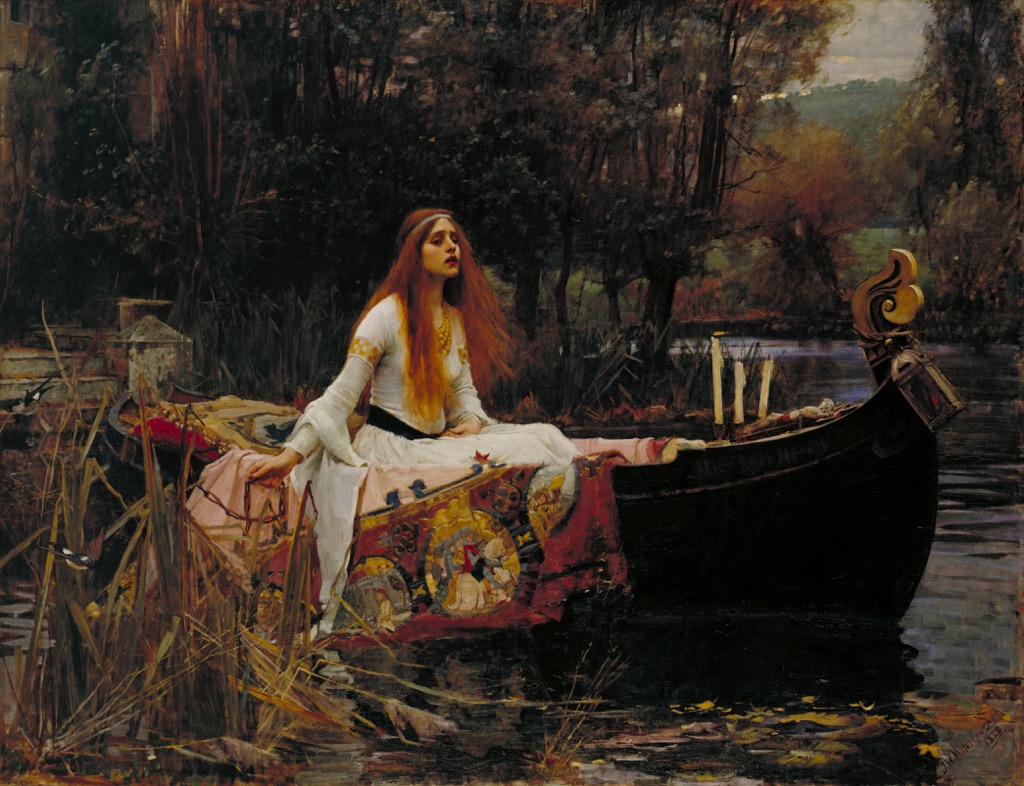
- The Lady of Shalott: Compare Waterhouse's best-known literary composition.
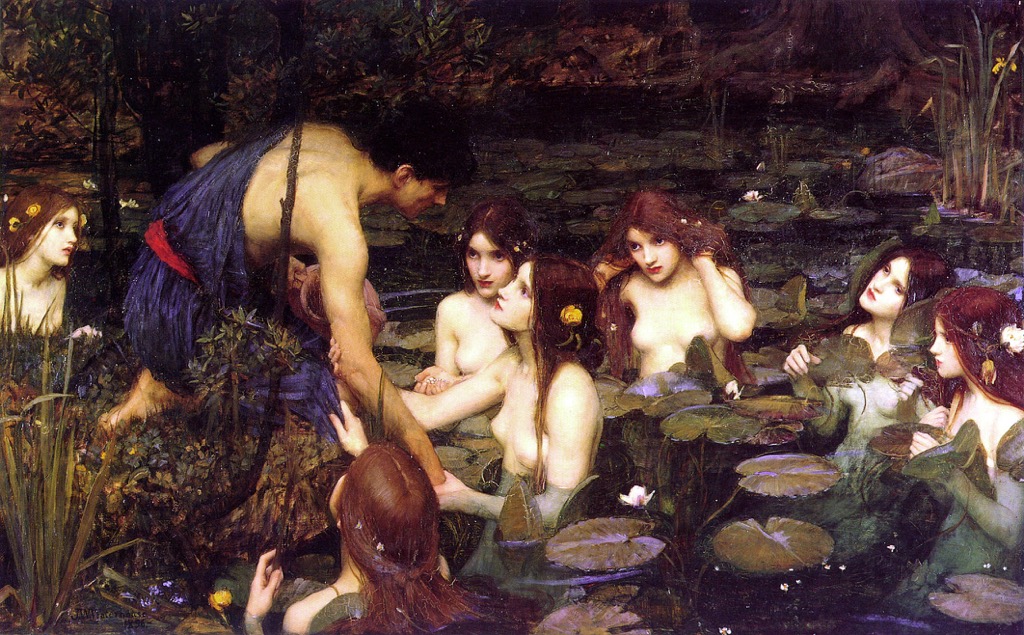
- Hylas and the Nymphs: Compare another major mythological scene.
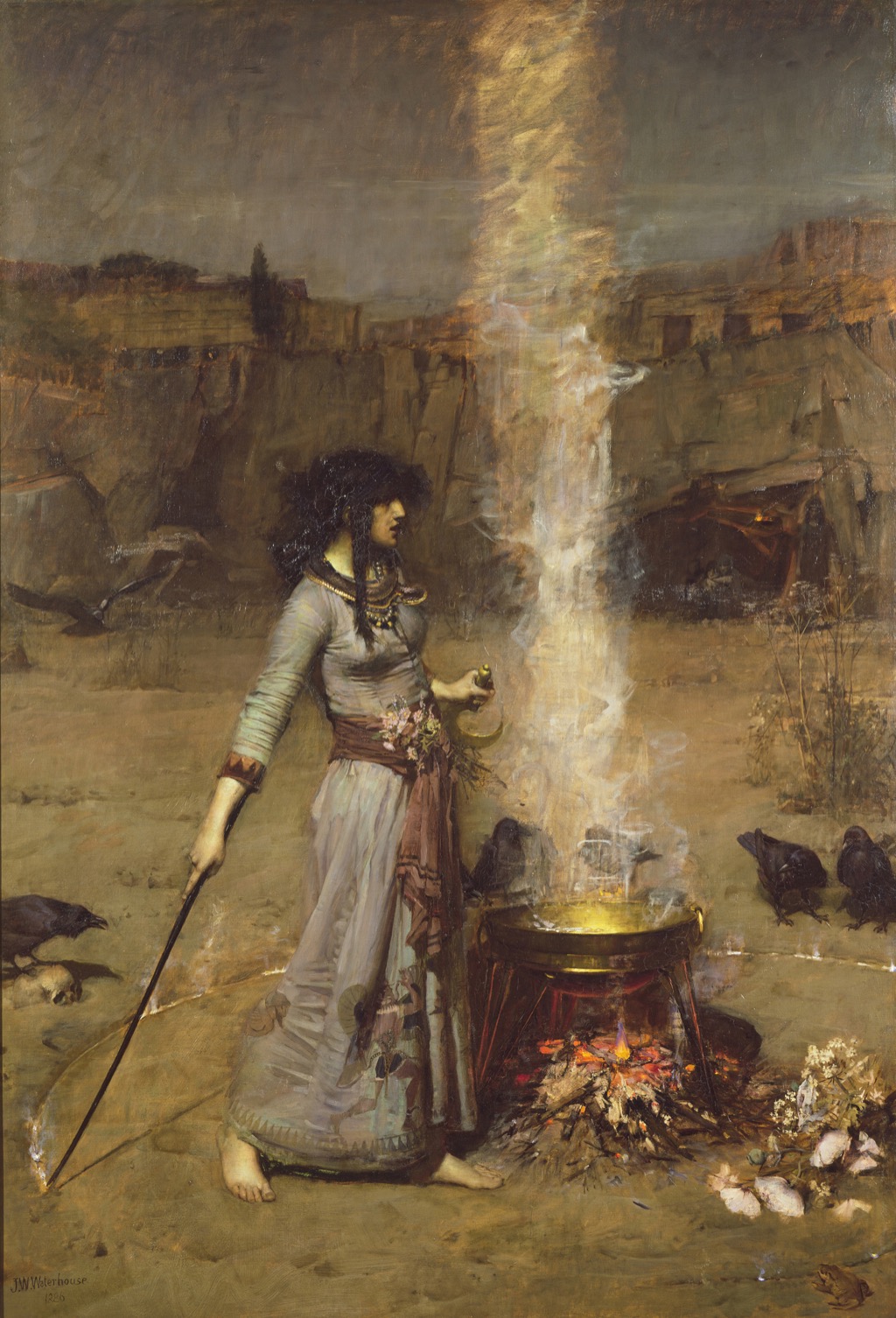
- The Magic Circle: Compare Waterhouse's treatment of ritual and symbolism.
Frequently Asked Questions
It is best dated to about 1889, during Waterhouse’s Capri work. [1]
The dome of Santo Stefano identifies Capri, and the work may be the painting exhibited as Under the Olives, Capri. [1]
Published specialist dimensions are approximately 61 × 38 cm. [1]
No. One appears to be the same local model in An Orange Garden, but her identity is not documented. [1]
Fruit gathering was a recurring subject in Waterhouse’s Capri pictures, and the basket links this work to An Orange Garden. [1]
It is privately owned. [1]
Discussion
The painting’s familiar title makes it sound generalized, but close research restores specificity. These are figures on Capri, under olive-like trees, beneath the distant dome of Santo Stefano, probably in the picture British audiences saw in 1889 as Under the Olives.
That recovery does not remove the tourist gaze. Waterhouse still selects local girlhood, costume and fruit for an external market. Yet the figures’ exchange gives them a relation beyond the viewer, and the island’s steep space becomes something they actively inhabit.
Reader Insights
Which visible detail most changes the way you read this page?
Which source or comparison helps the work feel less familiar and more specific?
What question would you bring back to the painting after reading?
Join the Conversation
Share your reading of this page below.
References
- Peter Trippi, “John William Waterhouse: An Orange Garden,” Kilgore Gallery research catalogue, including the Capri group and probable identification of Under the Olives, Capri. View source.
- Wikimedia Commons, “John William Waterhouse: Two Little Italian Girls by a Village,” object summary and public-domain image record. View source.