

 by Tom Gurney
Tom Gurney BSc (Hons) is an art history expert with over 20 years experience
Published on August 14, 2026 / Updated on August 14, 2026
Email: tomgurney1@gmail.com / Phone: +44 7429 011000
Psyche Opening the Door into Cupid's Garden: Introduction
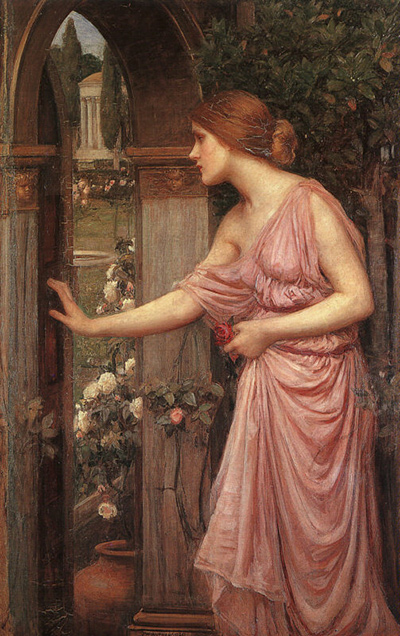
A young woman eases open a heavy wooden door and peers into a flowering garden. Her body remains outside while her face crosses the threshold. John William Waterhouse turns one small movement into a complete drama of desire, hesitation and discovery.
Exhibited at the Royal Academy in 1904, Psyche Opening the Door into Cupid's Garden draws on the ancient story of Cupid and Psyche without literally illustrating a described incident. Waterhouse invents a threshold through which to concentrate the myth's central tensions: love that cannot yet be fully seen, curiosity that brings both knowledge and loss, and a mortal woman approaching a divine world.
At a Glance
- ArtistJohn William Waterhouse (1849–1917)
- TitlePsyche Opening the Door into Cupid's Garden, also known as Psyche Entering Cupid's Garden [1]
- Date1903 in the collection record; first exhibited in 1904 [1] [2]
- MediumOil on canvas [1]
- CollectionThe Harris, Preston, Lancashire [1]
- Accession numberPRSMG: P773 [1]
- First exhibitedRoyal Academy, London, 1904, no. 30 [2]
- Ancient literary sourceThe story of Cupid and Psyche in Books IV–VI of Apuleius's Metamorphoses, commonly called The Golden Ass [3]
- Companion in Waterhouse's 1904 Royal Academy displayBoreas [2] [4]
- Related Waterhouse workPsyche Opening the Golden Box, exhibited in 1903 [5]
- Important interpretive cautionApuleius does not describe Psyche secretly opening a forbidden garden door; the action is Waterhouse's invention [3]
Contents
- Introduction
- The Drama of a Half-Open Door
- Cupid and Psyche in Apuleius
- Waterhouse's Invented Moment
- Curiosity and the Right to See
- Psyche's Body at the Threshold
- The Garden as Promise
- Door, Wall and Partial Revelation
- Two Psyche Paintings
- Royal Academy and The Harris
The Drama of a Half-Open Door
The action could be completed in an instant. Psyche has pushed the door far enough to see through it but not far enough to enter freely.
That pause gives the painting its emotional duration. She is neither securely outside nor fully inside, so the image holds anticipation rather than arrival.
Waterhouse places the viewer behind and slightly beside her. We cannot see her full expression, and the opening reveals only a narrow part of the garden. Her discovery remains partly private.
The door is not a thin screen. Its thickness and weight make access physical. Psyche must apply hand and body to move the barrier between worlds.
Her pose contains contrary impulses. Head and shoulder lean towards the opening, while most of her body and dress remain on the near side.
The garden appears desirable because it is withheld. Flowers, light and colour are concentrated in the glimpse beyond the door rather than offered as an expansive landscape.
Nothing visibly threatens her. Suspense arises from incomplete knowledge and from the myth viewers bring to the image.
The result is psychologically exact even though the event is not found in the ancient narrative. Waterhouse makes curiosity legible through the simplest possible structure: a person, a barrier and a partial view.
Cupid and Psyche in Apuleius
The fullest surviving ancient narrative of Cupid and Psyche appears inside Apuleius's second-century Latin novel Metamorphoses, also known as The Golden Ass. [3]
Psyche is the youngest daughter of a king and queen. Her extraordinary beauty attracts worship that should belong to Venus. Angered, the goddess orders her son Cupid to make the mortal love a wretched man. [3]
Cupid instead falls in love with Psyche. After an oracle sends her family to expose her on a mountain as the bride of a feared creature, the West Wind carries her to a marvellous valley and a divine palace. [3]
Psyche enters the palace and is served by invisible voices. A husband visits in darkness and forbids her to look at him. She knows his tenderness but not his identity. [3]
Her jealous sisters persuade her that the unseen husband must be a monster. Psyche takes a lamp and knife to the bed, looks upon the sleeping Cupid and discovers a beautiful god. A drop of hot oil wakes him, and he leaves because trust has been broken. [3]
Psyche then wanders in search of him and submits to Venus, who assigns a sequence of seemingly impossible tasks. The final one sends her towards the underworld to obtain a box containing beauty from Proserpine. [3]
Although warned not to open the box, Psyche does so and falls into a deathlike sleep. Cupid revives her, Jupiter grants her immortality and the lovers marry among the gods. [3]
The story repeatedly links love with restricted knowledge. Psyche must live with an unseen husband, resists that condition, suffers for looking and eventually reaches a union in which mortal and god meet as equals.
Waterhouse's Invented Moment
The title appears to identify a precise narrative action, but Apuleius does not describe Psyche furtively opening a door into Cupid's garden. [3]
When she first arrives in Cupid's domain, the West Wind places her gently in a flowering valley. She wakes, sees a grove and clear spring, discovers the magnificent palace and enters it in wonder. No locked or forbidden garden gate blocks her. [3]
Waterhouse therefore does not illustrate one sentence. He condenses the palace, garden, unseen lover and the larger theme of prohibited sight into a new scene.
This distinction improves rather than weakens interpretation. The painter's invention shows what he found psychologically central in the story.
The door materialises separation. On one side stands the mortal woman; on the other lies Cupid's domain. The narrow opening lets desire precede possession.
It may also evoke the palace's conditions of partial knowledge. Psyche receives comfort, treasure and love there, but cannot see the husband who provides them.
Her peeping pose anticipates the later lamp scene without reproducing it. In both, she tries to see beyond a limit, but the consequences should not be automatically transferred from one action to the other.
Nothing in Apuleius allows a claim that this particular door is forbidden. It is safer to call the image an imaginative threshold than an act of literal trespass.
Curiosity and the Right to See
“Curiosity” can sound like a minor fault, yet in the myth it raises serious questions about knowledge, trust and unequal power.
Cupid asks Psyche to accept a marriage in which he knows and sees her while remaining invisible to her. The condition protects him but denies her reciprocal knowledge. [3]
Her sisters manipulate genuine vulnerability. Their claim that the unseen lover is a monster is malicious, but Psyche has been given no ordinary way to disprove it.
The lamp scene is therefore both betrayal and discovery. She breaks a promise, yet she also learns the identity of the husband with whom she shares a bed.
Waterhouse's door places viewers earlier and makes the conflict gentler. Psyche does not carry a weapon or lamp. She approaches beauty rather than a feared monster.
Still, the arrangement associates looking with risk. Her careful movement and incomplete entry imply that sight has conditions.
The viewer repeats her action. We look through the same opening and want a wider view of the garden, so curiosity is not confined to the painted heroine.
Waterhouse avoids showing Cupid. The god's absence preserves the structure of the myth: Psyche seeks a world defined by someone she cannot yet see.
The picture also postpones the asymmetry's solution. At the end of Apuleius's tale, Jupiter gives Psyche immortality and the lovers marry publicly among the gods. [3] The mortal peeping through the door has not yet reached that equality.
For this reason, the threshold can stand for status as well as space. It divides a human observer from a divine household, then lets her begin to cross through her own action.
Psyche's Body at the Threshold
Psyche is shown from the back and side rather than as a conventional frontal beauty. Her pose makes action more important than display.
One hand controls the door while the other gathers her dress. She manages both obstacle and movement, preparing to cross without becoming entangled.
The fabric falls from one shoulder, exposing skin at the point where her body leans towards the opening. This can suggest vulnerability and sensory attraction without requiring a moral judgement.
Her head enters the gap before the rest of her. Sight leads the body.
The curve of her back and the flow of the dress contrast with the door's rigid boards and the wall's fixed surface. A living figure adapts herself to architecture.
Because her face is only partly visible, viewers must infer emotion from posture. She can appear hesitant, eager, cautious or absorbed.
The lack of wings is noteworthy. Psyche was often represented with butterfly wings in ancient and later art; the Metropolitan Museum notes the winged tradition in Canova's version of the subject. [6]
Waterhouse presents her here as a mortal young woman. That choice keeps the threshold meaningful: she has not yet reached the divine status granted at the story's end.
The name Psyche accumulated associations with the soul and butterfly, and artists often gave her butterfly wings. Ancient Roman reliefs could even represent Psyche as a butterfly embraced by Eros. [6]
Waterhouse does not need that attribute because the title supplies identity. Removing it makes her less like a fixed allegorical emblem and more like a person experiencing uncertainty.
Her exposed shoulder and gathered dress also show a body negotiating passage. “Soul” is not separated from physical sensation; curiosity appears as lean, grip, balance and touch.
The Garden as Promise
The garden is seen in fragments. Blossoms, foliage and light press towards the opening, but the full space remains concealed.
Roses naturally invoke Cupid's mother Venus and the wider language of love. In Apuleius, flowers and grove belong to the beautiful valley around Cupid's palace, although Waterhouse arranges his own specific doorway and planting. [3]
The garden can signify sensual fulfilment, divine privilege or a protected interior life. These are interpretive possibilities rather than a single documented allegory.
Its abundance contrasts with the relatively plain near side of the wall. Psyche moves from restraint towards richness.
Yet a garden is also an enclosed and cultivated space, not unlimited nature. Cupid's domain promises pleasure under particular conditions.
The flowers nearest the threshold soften the barrier. Nature seems to cross where architecture divides.
The garden's attraction depends upon this pressure. Growth appears capable of exceeding the wall, while Psyche's body follows in the other direction.
The door therefore does not separate barren danger from safe abundance. Psyche stands in a beautiful world and seeks another degree of beauty. Desire is intensified rather than explained by contrast.
Waterhouse often uses flowers to measure emotional intensity. Here they do not merely decorate Psyche; they occupy the world she wants to enter.
The glimpse is narrow enough that imagination must complete it. The garden becomes more extensive in the viewer's mind than on the painted surface.
Door, Wall and Partial Revelation
The door divides the canvas into unequal territories. Psyche belongs mostly to the exterior zone, while a thin vertical opening contains the desired world.
Its rounded top introduces a gentler form than a severe rectangular gate. Curves in figure, arch and foliage establish continuity across the division.
Decorative architectural details suggest an old, idealised setting without reconstructing a specific ancient Roman building.
The wooden surface carries weight and texture. Waterhouse gives substantial form to a boundary that, in Apuleius, is more often made of spoken rules and darkness.
The opening is a picture within the picture. It frames a smaller garden image and turns Psyche into its first viewer.
That internal frame also controls us. We receive exactly as much access as she creates, no more.
The door hides Cupid as completely as it reveals flowers. Love is present through ownership and setting but absent as a body.
Waterhouse later returned to the image of a woman pressed towards a hard boundary. In Thisbe of 1909, the heroine listens at a wall that separates her from Pyramus; in The Soul of the Rose of 1908, a woman leans towards flowers at a wall. Christie's specifically connects these compositions with Psyche Entering Cupid's Garden. [7]
The comparison reveals how differently a surface can function. Thisbe's wall transmits sound but blocks bodies. The rose wall concentrates scent and touch. Psyche's door can move, making her barrier the most visibly negotiable.
In each case, Waterhouse turns inward attention into physical nearness. A face approaches stone, wood or flower because desire has become a matter of distance.
The repetition does not reduce the women to one type. Psyche seeks entry, Thisbe seeks communication and the woman of The Soul of the Rose seeks sensory absorption. Similar design carries different emotional structures.
Waterhouse's title turns an ordinary architectural action into myth. Without it, the woman might be entering any private garden; with it, the threshold separates mortal experience from the house of a god.
Two Psyche Paintings
Waterhouse exhibited Psyche Opening the Golden Box at the Royal Academy in 1903 and Psyche Opening the Door into Cupid's Garden there in 1904. [2] [5]
The sequence moves backwards through Apuleius's narrative. The golden-box episode belongs near the end of Psyche's trials; the garden belongs to the beginning of her life with Cupid. [3]
In the 1903 painting, Psyche sits in a rocky landscape and opens the container she was explicitly warned to keep closed. Sleep from the underworld will overcome her. [5]
In the 1904 work, she stands at a garden threshold that Waterhouse invented. The action suggests curiosity but does not reproduce the myth's stated prohibition.
The two images are often paired because each title begins “Psyche Opening.” A container and a door provide different scales of boundary: one small enough to hold, the other large enough to cross.
Both delay consequence. Viewers see the opening action, not its completed result.
They also treat obedience differently. The underworld box comes with an explicit instruction and an immediate penalty. The garden door carries no such textual warning, so its tension is generated by pictorial hesitation rather than stated law. [3]
Conflating the two can turn Psyche into a heroine who endlessly disobeys. Separating them reveals Waterhouse's more varied interest in her: she is curious, but she is also courageous enough to move towards an unknown divine world.
A surviving study for Psyche Opening the Golden Box is distinct from a drawing for the garden painting. Sotheby's notes that the latter drawing was illustrated in The Studio in 1908. [5]
Waterhouse's repeated interest was not simply in Psyche's beauty. It was in the instant when an object yields to her hand and knowledge is about to change her condition.
Royal Academy and The Harris
The Royal Academy's dictionary of exhibitors records Psyche Opening the Door into Cupid's Garden as Waterhouse's catalogue number 30 in 1904. [2]
A contemporary review in The Studio discussed it with Boreas, calling the two Waterhouse works small canvases that retained the charm of his style. [4]
The contemporary record establishes the exhibition year, while the collection record dates the work to 1903. [1] [2] Those statements are compatible: the canvas may have been completed before it appeared publicly. The 1903 Royal Academy Psyche was Psyche Opening the Golden Box; the garden-door picture entered the exhibition the following year. [2]
The date matters because it restores the exhibited sequence. Waterhouse first showed the fatal opening of the small box, then returned a year later to an earlier and more hopeful threshold.
At the 1904 exhibition, Psyche appeared with Boreas, another solitary woman whose dress and body register movement. The contemporary critic grouped their charm while recognising that both were smaller in scale than some of Waterhouse's usual Academy pictures. [4]
The painting belongs to The Harris in Preston and carries accession number PRSMG: P773. [1]
Its public collection distinguishes it from the privately owned Golden Box. It also makes the work one of Waterhouse's accessible mythological paintings outside London.
The title itself varies slightly across records. “Opening the Door into Cupid's Garden” describes the visible action most exactly; “Entering Cupid's Garden” is a familiar shorter form.
Both titles refer to the same Preston painting. Images should show a standing Psyche viewed largely from behind at a partly opened wooden door.
How to Look at the Painting
Begin with the gap, not the figure. Notice how little of the garden Waterhouse actually reveals.
Then trace Psyche's movement from feet and gathered dress through her leaning back to the head crossing the threshold.
Compare her curved body with the door's rigid structure. The drama depends on resistance without violence.
Look for Cupid and notice his complete absence. The garden belongs to him, but Psyche's act occupies the painting.
Finally separate the image from the ancient text. The myth explains why incomplete sight matters; Waterhouse invented the door that makes it visible.
Compare it with the golden-box painting. One opening reveals sleep and deathlike danger; the other reveals flowers. Waterhouse uses nearly the same verb to hold opposite possibilities.
Then imagine the door fully open. The loss of tension clarifies why he chose the exact width of partial revelation rather than a completed entrance.
Related Pages
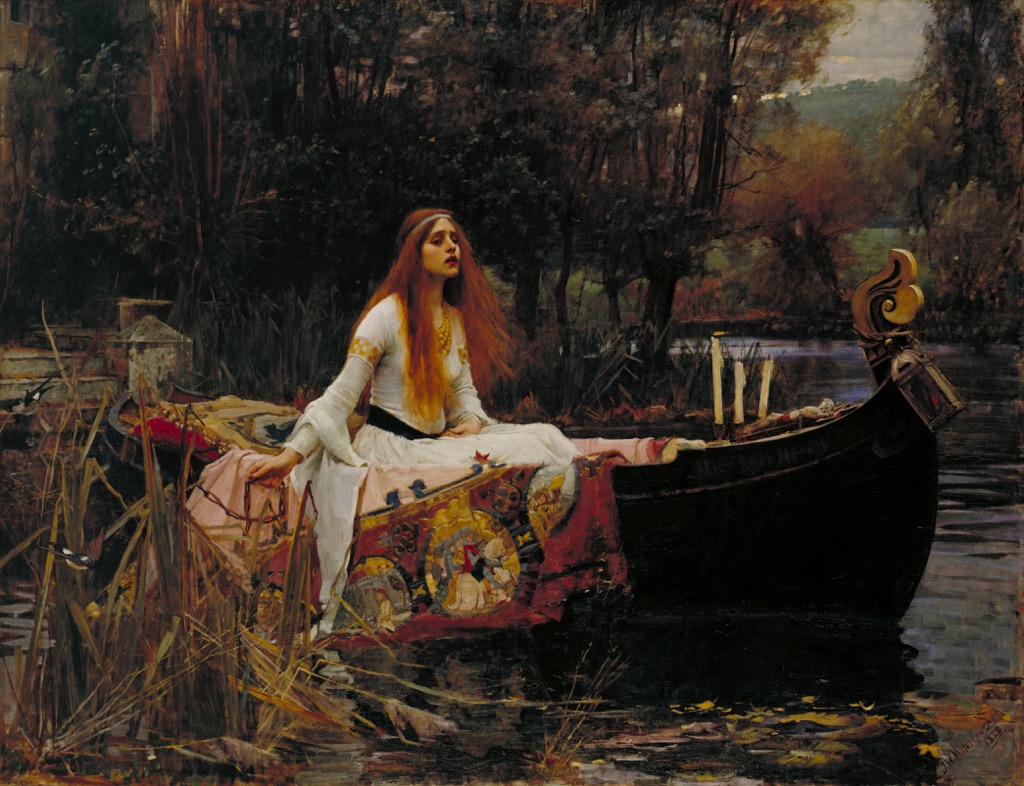
- The Lady of Shalott: Compare Waterhouse's best-known literary composition.
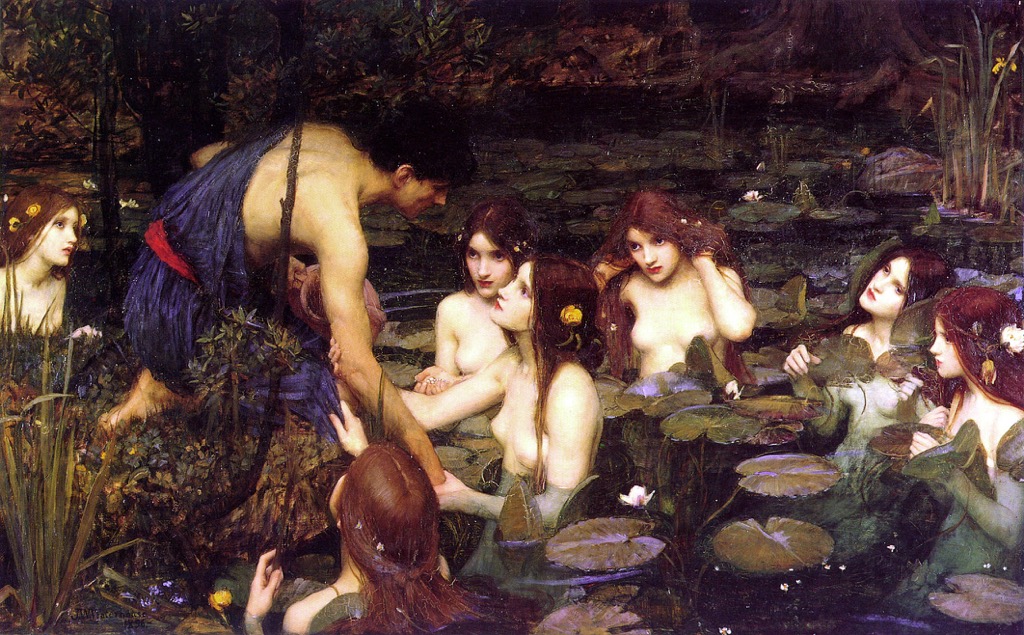
- Hylas and the Nymphs: Compare another major mythological scene.
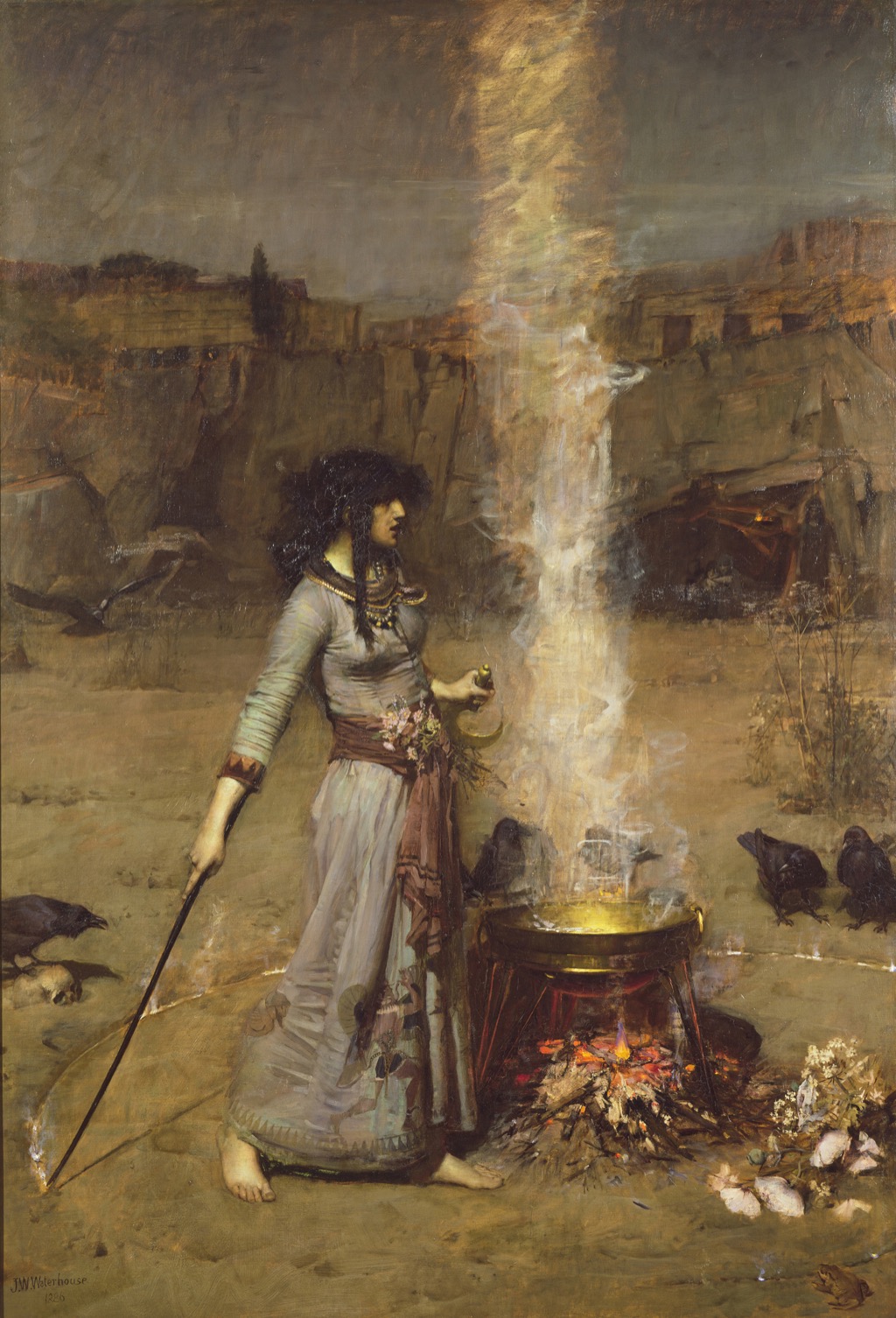
- The Magic Circle: Compare Waterhouse's treatment of ritual and symbolism.
Frequently Asked Questions
Psyche is a mortal princess whose beauty angers Venus. Cupid falls in love with her, and after separation and trials she is made immortal and married to him. [3]
Not literally. Apuleius describes Psyche arriving in a flowering valley and entering Cupid's palace, but not secretly opening a forbidden garden door. Waterhouse created the threshold action. [3]
No such prohibition appears in the ancient text. Cupid forbids her to look at his identity, and Venus later warns her indirectly through instructions not to open the underworld box. [3]
Her partial entry and careful pose suggest caution, but the painting does not state a single emotion. Hesitation, desire and curiosity can coexist.
He is not visible. His presence is implied by the garden named in the title, preserving Psyche's approach towards an unseen lover.
No. The golden-box picture was exhibited in 1903 and shows a later episode from the myth. The garden-door painting was exhibited in 1904. [2] [5]
It is in the collection of The Harris in Preston, Lancashire, accession number PRSMG: P773. [1]
The Harris/Art UK collection record dates the painting to 1903, while the Royal Academy record documents its exhibition in 1904. It could have been completed before its public display. [1] [2]
No. Although butterfly wings were a familiar attribute of Psyche, Waterhouse represents her as a mortal woman at this point in the story. [6]
Discussion
Waterhouse gives Psyche neither wings nor Cupid nor a complete garden. He builds the painting from things not yet possessed. Her mortal body has not crossed into the divine space; her lover remains invisible; the desired world exists as a sliver of colour.
That incompleteness makes the picture faithful to the myth at a deeper level than literal illustration. Psyche's story repeatedly tests whether love can survive unequal sight. She wants knowledge that has been withheld, and the viewer wants to see what the door withholds.
Reader Insights
Which visible detail most changes the way you read this page?
Which source or comparison helps the work feel less familiar and more specific?
What question would you bring back to the painting after reading?
Join the Conversation
Share your reading of this page below.
References
- Art UK / The Harris. “Psyche Entering Cupid's Garden,” collection record for the Preston painting and accession number PRSMG: P773. View source
- Algernon Graves. The Royal Academy of Arts: A Complete Dictionary of Contributors and Their Work from Its Foundation in 1769 to 1904, vol. 8, Waterhouse entries recording the 1903 and 1904 Psyche exhibits. View source
- Project Gutenberg. Lucius Apuleius, The Golden Asse, translated by William Adlington, including the tale of Cupid and Psyche. View source
- The Studio. “The Exhibition of the Royal Academy, 1904,” contemporary review naming Boreas and Psyche Opening the Door into Cupid's Garden. View source
- Sotheby's. “John William Waterhouse, Study for Psyche Opening the Golden Box,” object essay distinguishing the 1903 painting and the related drawing for the garden subject. View source
- The Metropolitan Museum of Art. “Antonio Canova, Cupid and Psyche,” collection essay on Apuleius's story and the butterfly-winged tradition for Psyche. View source
- Christie's. “John William Waterhouse, Thisbe,” catalogue essay connecting Waterhouse's woman-and-barrier compositions, including Psyche Entering Cupid's Garden and The Soul of the Rose. View source