

 by Tom Gurney
Tom Gurney BSc (Hons) is an art history expert with over 20 years experience
Published on August 14, 2026 / Updated on August 14, 2026
Email: tomgurney1@gmail.com / Phone: +44 7429 011000
The Mystic Wood: Introduction
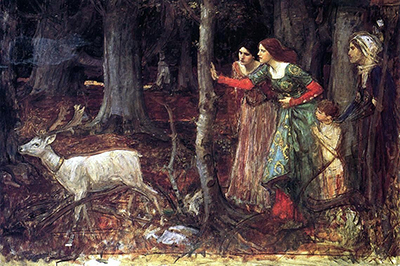
John William Waterhouse's The Mystic Wood leads a small boy and three women into a dark stand of ancient trees, where a white stag appears like a vision. The large canvas remained unfinished at the artist's death, yet it had reached an advanced stage and preserves both a compelling symbolic scene and unusually direct evidence of Waterhouse's late working method. [1]
The Queensland Art Gallery | Gallery of Modern Art dates the painting to about 1910, following Anthony Hobson; Peter Trippi has proposed about 1914–17. [1] [2] That disagreement should remain visible. The work's mystery lies not in a securely identified legend but in Waterhouse's combination of protective figures, child, animal and forest passage.
At a Glance
- ArtistJohn William Waterhouse
- TitleThe Mystic Wood [2]
- DateAbout 1910 in the QAGOMA record; alternatively dated about 1914–17 by Peter Trippi [1] [2]
- MediumOil on canvas [2]
- Dimensions98 × 146.2 cm [2]
- CollectionQueensland Art Gallery | Gallery of Modern Art, Brisbane [2]
- Accession number1:0868B [2]
- AcquisitionAcquired before 1962 [2]
- StateUnfinished at Waterhouse's death, but in an advanced stage [1]
- SubjectThree women and a small boy in an ancient wood, with a white stag
Contents
- Introduction
- What the painting shows
- The white stag
- The women and child
- Why the wood feels “mystic”
- An unfinished painting
- Waterhouse's working method
- Competing dates
- Literary and symbolic possibilities
- Landscape, naturalism and late style
What the painting shows
The canvas is broad and filled by the trunks, roots and canopy of an old wood. Trees do not merely frame the scene; they create its architecture.
Three women occupy the shadowed foreground or middle ground. Their pale and coloured garments separate them from the dark vegetation while remaining integrated into the woodland palette.
A small boy stands or moves close to them. His scale and position make him appear accompanied, guided or protected rather than independent.
Beyond the human group is a white stag. Its bright body catches the eye through the dim trees and creates the painting's strongest point of wonder.
The figures seem to pause at an encounter rather than complete a recognisable action. No one attacks the animal, and there is no visible hunt.
Paths and openings through the trees suggest movement deeper into the wood. The painting therefore combines stillness with passage: the group has arrived somewhere but may also be on its way.
Ancient trunks rise and branch across the canvas, interrupting easy sight lines. The viewer must look through the forest rather than over it.
Waterhouse's unfinished passages make some details less resolved than others. That condition should not be mistaken for poor reproduction or damage.
QAGOMA describes the work as advanced enough to capture much that was typical of his subject and style. [1] The central imaginative structure is clear even where finish varies.
The visible ingredients are simple—wood, women, child, stag—but their combination resists ordinary genre description. The title confirms that the forest is to be experienced as charged, not merely picturesque.
The white stag
The stag is the scene's most conspicuous symbolic element. White animals are rare in nature and have long attracted legendary meanings.
In medieval and later storytelling, a white hart can lead hunters away from ordinary territory, signal a quest or mark contact with the supernatural.
Christian imagery can connect the stag with spiritual longing or conversion, while Celtic and Arthurian traditions use an elusive white animal as a boundary-crosser.
Waterhouse does not supply attributes that select one tradition conclusively. The animal is not labelled, wounded or paired with a named hero.
Its function within the composition is nevertheless clear. Pale against shadow, it pulls sight into the wood and gives the human group something extraordinary to confront.
The stag appears distant enough to remain untouchable. That distance helps create vision rather than possession.
Unlike a hunted animal, it does not flee across an open field. The forest encloses it and makes it seem native to a realm the figures have entered.
The boy's presence changes the encounter. A hunting narrative would usually emphasise adult men, weapons and pursuit; Waterhouse instead gathers women and child around a moment of recognition.
The animal may therefore represent guidance, innocence, the soul, death or simply the marvellous life of the wood. These are interpretive possibilities, not interchangeable facts.
Its whiteness also has a formal role. Without the stag, the large dark landscape might hold the gaze near the figures. The bright body creates depth and an inward destination.
The painting asks a question the figures cannot answer for us: do they follow, worship, fear or merely witness?
The women and child
QAGOMA's interpretive account describes a small mortal boy protected by three women and notes that two of the women appear to have been based on the same unidentified model. [1]
“Protected” is a compelling visual description, but it need not imply a documented story. Their arrangement creates care through proximity and gesture.
The child introduces mortality and vulnerability into a setting that feels ancient. The trees may have stood for centuries; the boy has barely begun life.
The women can be read as guardians, guides, fates, nymphs or maternal presences. No surviving title names them.
Three female figures naturally invite comparison with mythological triads: Graces, Fates, Hours or goddesses at a judgement. Their visible roles do not match any one group securely enough for identification.
Waterhouse often used repeated models across related figures and paintings. If two faces derive from the same sitter, visual kinship need not mean that the characters are sisters or supernatural doubles. [1]
Their clothing combines idealised drapery with the artist's late pictorial language. It suggests a timeless realm rather than an archaeologically precise period.
The human group is neither wholly classical nor modern. That temporal ambiguity suits a mystic wood where ordinary chronology seems suspended.
The boy's relationship to the stag is particularly important. Both carry associations of innocence, yet one belongs to the human group and the other remains beyond it.
The women occupy the threshold between them. Their bodies form a protective social enclosure while their attention opens towards the animal and deeper forest.
Modern viewers may be tempted to turn the scene into a biographical allegory of the ill Waterhouse approaching death. QAGOMA acknowledges possible autobiographical and afterlife readings as questions, not established explanation. [1]
That distinction should be preserved. The painting's late, unfinished state makes farewell readings emotionally attractive, but attraction is not documentary proof.
Why the wood feels “mystic”
Waterhouse creates mystery through enclosure rather than special effects. There is no painted apparition in the sky and no overt magical object.
Large trunks divide the visual field. Their age is suggested by thickness, irregular roots and the dense canopy described in QAGOMA's account as ancient oaks and elms. [1]
Light enters unevenly. Bright garments and the stag emerge against darkness, making ordinary visibility feel revelatory.
The wood is both place and psychological condition. Its obscured routes prevent complete knowledge of what lies ahead.
The title “mystic” differs from “mysterious.” It can imply contact with realities beyond ordinary sense, not simply a puzzle awaiting solution.
Waterhouse therefore does not need to explain the stag. Its appearance is enough to change the quality of the landscape.
The viewer occupies a similar position to the figures. We see into the wood but cannot master it; trunks and shadow withhold as much as they reveal.
Ancient woodland also carries cultural memory. It can precede houses, roads and modern institutions, offering an imagined survival of older belief.
Yet the trees are not generic stage scenery. Their mass and spatial complexity show Waterhouse's serious attention to landscape.
The tension between observed nature and symbolic atmosphere is the painting's central achievement. The forest feels otherworldly because it remains convincingly physical.
Branches, leaf masses and roots create a living system around the human visitors. They are not owners of the space.
An unfinished painting
The Mystic Wood was unfinished when Waterhouse died in 1917. [1] This fact affects both how it looks and how it should be interpreted.
“Unfinished” does not mean barely begun. QAGOMA explicitly calls it an advanced work that captures characteristic choices of subject and style. [1]
Major figures, setting and symbolic relation are established. Some passages, however, retain broad laying-in, thin paint or unresolved transitions.
Such variation offers access to stages usually concealed beneath a completed surface.
Viewers should resist two opposite errors. The first is to imagine every loose area as deliberate final expressiveness; the second is to dismiss the painting as only preparation.
Because Waterhouse could no longer complete or approve the final state, we cannot know precisely which passages he would have strengthened, altered or removed.
The title itself is attached in authoritative collection records, but the accessible museum discussion does not settle every question about when it was chosen.
An unfinished work often acquires retrospective drama. Knowledge of the artist's death can make open paths and pale stag seem prophetic.
That reaction is legitimate as viewer response but should not be presented as Waterhouse's declared intention.
The advanced state nevertheless permits meaningful formal analysis. Composition, scale, principal colours and relation of figures are not accidental traces.
It also makes the work central to understanding technique. Areas at different stages expose a sequence from tonal wash towards modelled form.
The canvas is therefore both a powerful imaginative picture and a working document.
Waterhouse's working method
QAGOMA's account draws attention to Waterhouse working directly on the canvas with broad tonal washes of thinned paint. [1]
The institution contrasts this visible method with a rigid transfer made by squaring up a preparatory drawing. In The Mystic Wood, the developing image appears to have been established more freely.
Thin washes let an artist place large masses, test light and shadow and adjust relationships before committing to opaque detail.
In the unfinished canvas, darker trees and shadow can be understood as structural tone as well as finished atmosphere.
More developed faces or drapery show where Waterhouse concentrated attention. Less resolved ground reveals how forms were built around them.
This evidence complicates the popular image of Pre-Raphaelite painting as uniformly minute and laborious from edge to edge.
Waterhouse admired natural detail but could begin broadly, allowing composition and tonal unity to precede finish.
His method also connects him with nineteenth-century naturalism. QAGOMA compares aspects of the picture with Jules Bastien-Lepage and the Newlyn painters, whose figures inhabit observed landscape rather than float before an artificial backdrop. [1]
The comparison does not make Waterhouse a strict naturalist. His stag and timeless guardians preserve symbolist ambiguity.
Instead, naturalistic handling gives the fantasy credibility. The marvellous encounter occurs in weighty ground, damp shadow and believable woodland depth.
A related drawing titled Study for Mystic Wood survives, with a study of a woman in an autumnal landscape on the reverse. [3] Such sheets show that direct work on canvas did not exclude preparatory thought.
Drawing and free oil construction were complementary tools.
Competing dates
QAGOMA catalogues The Mystic Wood as about 1910, following Waterhouse scholar Anthony Hobson. [1] [2]
Peter Trippi has dated it about 1914–17, placing it very close to the artist's death. [1]
The difference is significant. An early date connects the work with Waterhouse's 1900s and early-1910s woodland pictures; the later range makes it one of his final large inventions.
The unfinished state alone cannot decide the question. A canvas might remain in a studio for years before an artist's death.
Style can suggest chronology but rarely provides exact proof when documentary evidence is absent.
QAGOMA responsibly publishes both scholarly positions in its interpretive material while retaining c.1910 in the object record. [1] [2]
A manuscript should do the same. Silently choosing 1917 or c.1910 would conceal a meaningful uncertainty.
The dating dispute also warns against reading biography directly from subject. If the painting began around 1910, a specific deathbed allegory becomes less plausible; if worked on in 1914–17, it remains possible but still unproven.
An artist may revisit an older canvas, so even a starting date and final working period need not be identical.
Without technical examination tied to dated materials or a firm exhibition record, the broad range should remain open.
For public display, “c.1910 (QAGOMA; alternatively c.1914–17)” is both concise and honest.
Literary and symbolic possibilities
No single literary source has been securely established for The Mystic Wood. That absence should shape the interpretation rather than be filled by invention.
The white stag recalls quest literature and supernatural guides. Three women recall mythic triads. A child led through a forest recalls initiation, fairy tale and passage between worlds.
These motifs are culturally powerful precisely because they recur across traditions.
One possibility is that the group approaches a revelation. The stag's brightness and distance support that reading.
Another is that the women guide the boy from mortal life towards an unknown realm. The ancient trees then become a threshold, and the animal a conductor or sign.
An autobiographical reading sees the painting as Waterhouse's meditation on death and whatever follows. QAGOMA presents such questions while declining to turn them into fact. [1]
The protected boy could also imply childhood memory or the vulnerable human soul. Again, no label settles this.
The painting's unfinished condition magnifies openness. Viewers cannot know whether later attributes would have narrowed the story.
Responsible interpretation should distinguish three levels: what is visible, what motifs conventionally suggest and what Waterhouse demonstrably intended.
Visible are women, child, wood and stag. Suggested are guardianship, passage and revelation. Demonstrated intention remains limited to the composition and title.
This hierarchy does not impoverish the work. It lets the title's mysticism operate without reducing the picture to an illustration with a missing caption.
Landscape, naturalism and late style
The scale—almost one and a half metres wide—allows the wood to rival the figures in importance. [2]
Waterhouse's earlier famous narratives often organise landscape around a named heroine. Here the woodland seems to generate the encounter.
That ambition is consistent with the institutional stature recorded by the Royal Academy: Waterhouse had been elected a full Academician in 1895 and remained one until his death. [4] The unfinished woodland is consequently a senior painter's large, unresolved rethinking of figure and landscape rather than an untrained experiment.
QAGOMA emphasises the dark canopy of old oaks and elms and relates the approach to modern French naturalism and the Newlyn School. [1]
Those connections matter because they position Waterhouse within contemporary painting rather than an isolated survival of Pre-Raphaelitism.
His late art absorbed broader handling and tonal atmosphere while retaining literary and symbolic interests.
The result is neither documentary woodland nor pure fantasy. Observed tree structure supports an invented spiritual event.
Colour is restrained compared with jewel-like early Pre-Raphaelite surfaces. The pale stag and figures gain force from subdued earth, green and brown.
The broad format encourages lateral movement, but trunks repeatedly stop it. Progress through the scene must be negotiated.
This spatial difficulty parallels interpretation. The eye, like the figures, cannot take a straight route to certainty.
The painting's late style is therefore not simply “looser.” It uses variable finish and tonal breadth to make atmosphere part of meaning.
Even incomplete, the work shows Waterhouse adapting his visual language to a landscape-dominated symbolic painting.
Collection history and significance
QAGOMA records the work as acquired before 1962 and gives it accession number 1:0868B. [2]
It is currently listed as not on public display, a status that can change and should be checked before planning a visit. [2]
Its presence in a public collection is especially valuable because so many late Waterhouse works remain privately owned.
Museum stewardship permits direct conservation, cataloguing and comparison. It also makes the unfinished surface available for technical study.
The work's significance extends beyond subject. It documents Waterhouse's process, preserves a major unresolved composition and demonstrates his sustained ambition late in life.
Public-domain photography makes its design widely available, but QAGOMA remains the authority for title, dimensions, date and status. Wikimedia's image record is helpful for visual comparison while also showing why inherited online dates must be checked against the museum's fuller account. [5]
The canvas also counters the polished works through which Waterhouse is usually known. Its exposed tonal structure lets viewers distinguish invention from completion: a face may approach resolution while nearby foliage still declares the provisional choices beneath it. That unevenness gives the object unusual teaching value.
The competing dates and unknown narrative are not defects in the record. They are active research questions that a museum object page can present transparently.
The Mystic Wood also broadens popular understanding of the artist. Waterhouse was not limited to solitary heroines in polished literary scenes; he could construct an expansive, sombre landscape whose meaning remained deliberately unstable.
The white stag gives immediate recognition, but the dark trees supply lasting psychological force.
Whether the group is entering, leaving or pausing, the viewer senses a threshold. That unresolved motion makes the unfinished picture feel strangely complete as an experience.
Related Pages
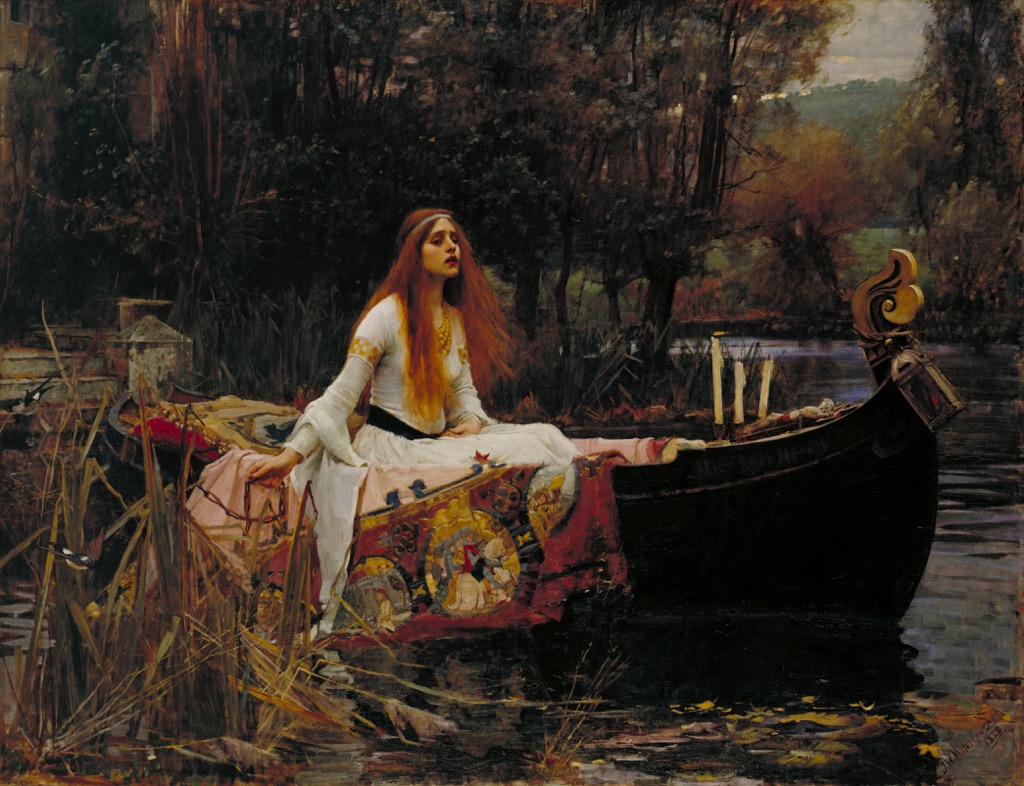
- The Lady of Shalott: Compare Waterhouse's best-known literary composition.
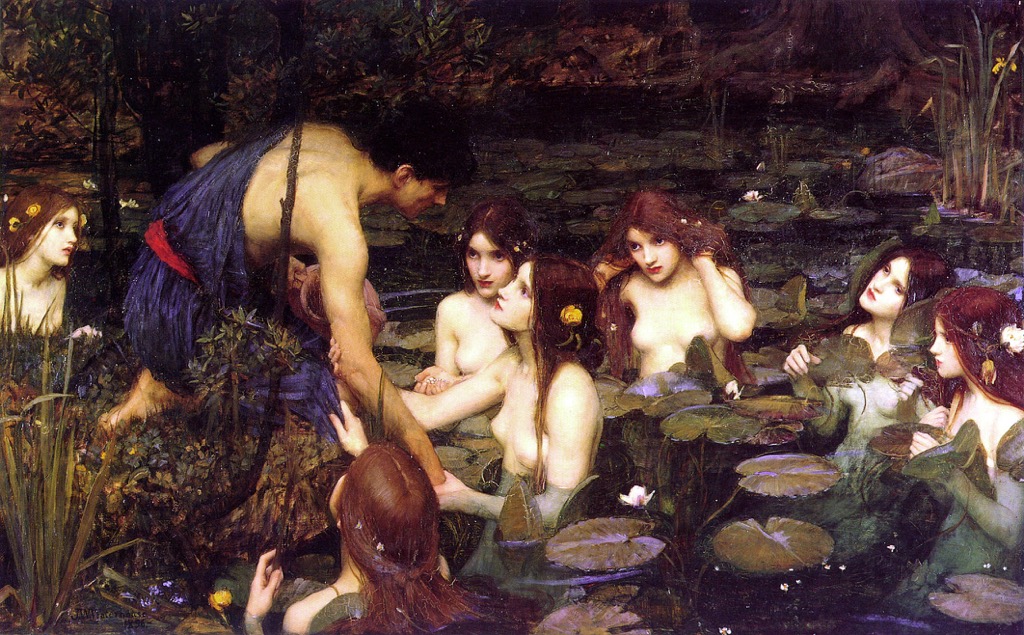
- Hylas and the Nymphs: Compare another major mythological scene.
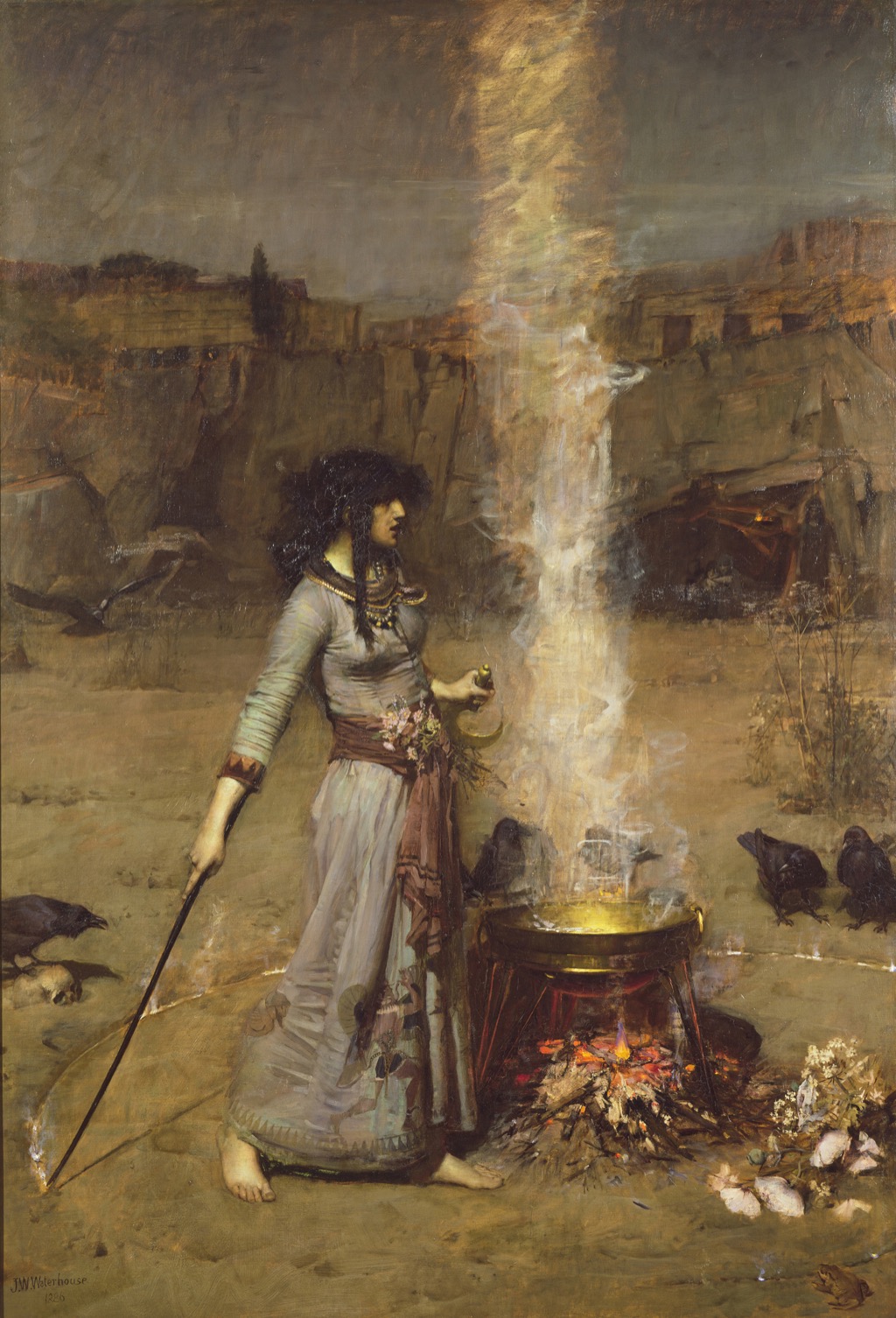
- The Magic Circle: Compare Waterhouse's treatment of ritual and symbolism.
Frequently Asked Questions
No. It remained unfinished when Waterhouse died, although QAGOMA describes it as being at an advanced stage. [1]
QAGOMA dates it c.1910 following Anthony Hobson. Peter Trippi has proposed c.1914–17. [1] [2] Both positions should be acknowledged.
It belongs to the Queensland Art Gallery | Gallery of Modern Art in Brisbane, accession 1:0868B. [2]
No single source is securely established. The women, child, ancient wood and white stag evoke guardianship, quest and supernatural passage without identifying one narrative.
It can suggest a guide, spiritual sign or unattainable quest. In the painting its most certain functions are to draw the eye inward and make the woodland encounter extraordinary.
Yes. A drawing titled Study for Mystic Wood is recorded by Christie's, with another figure study on its reverse. [3]
Discussion
The Mystic Wood is strongest when its uncertainties are preserved. The white stag need not be assigned one mythology, the women need not be named as a particular triad, and the boy need not become a disguised portrait of the artist. The painting works through the pressure these possibilities exert together.
Its incomplete surface deepens that condition. We can see an image approaching definition without receiving the artist's final decisions. Broad washes and resolved figures coexist, turning process into atmosphere.
Reader Insights
Which visible detail most changes the way you read this page?
Which source or comparison helps the work feel less familiar and more specific?
What question would you bring back to the painting after reading?
Join the Conversation
Share your reading of this page below.
References
- David Burnett, “John William Waterhouse, The Mystic Wood, c.1910,” Queensland Art Gallery | Gallery of Modern Art, Artlines, no. 1, 2009, pp. 34–35. View source.
- Queensland Art Gallery | Gallery of Modern Art, “The Mystic Wood,” collection record, accession 1:0868B. View source.
- Christie's, “John William Waterhouse, Study for Mystic Wood (recto); Study of lady in autumnal landscape (verso),” lot record. View source.
- Royal Academy of Arts, “John William Waterhouse RA,” artist profile and institutional context. View source.
- Wikimedia Commons, “John William Waterhouse: The Mystic Wood,” image and object metadata. View source.