

 John William Waterhouse.jpg)
 by Tom Gurney
Tom Gurney BSc (Hons) is an art history expert with over 20 years experience
Published on August 14, 2026 / Updated on August 14, 2026
Email: tomgurney1@gmail.com / Phone: +44 7429 011000
A Mermaid: Introduction
John William Waterhouse's small 1892 oil study shows a red-haired mermaid seated at the edge of the sea, combing salt water from her long hair. Painted eight years before the large A Mermaid that became his Royal Academy Diploma Work, it establishes the pose and private grooming ritual that would survive through years of revision. [1]
The sketch is signed and dated, measures only 33.5 × 19.5 cm and remains privately owned. [1] It must be kept separate from a larger related sketch dated about 1892–95 and from the finished 1900 canvas deposited at the Royal Academy. [2] [3]
At a Glance
- ArtistJohn William Waterhouse
- TitleThe Mermaid / Sketch for A Mermaid [1] [2]
- Date1892; signed and dated lower left [1]
- MediumOil on canvas [1]
- Dimensions33.5 × 19.5 cm [1]
- CollectionPrivate collection [1]
- InscriptionSigned and inscribed “THE MERMAID / J. W. WATERHOUSE, R.A.” on the stretcher [1]
- SubjectA mermaid seated by water, combing long red hair
- Related final workA Mermaid, completed 1900, Royal Academy Diploma Collection [3]
- Version controlNot the larger 70.5 × 45.2 cm sketch dated about 1892–95 [4]
Contents
- Introduction
- What the study shows
- Hair, comb and salt water
- Mermaid without a fixed story
- The sea and the body
- From 1892 to the Diploma Work
- What changes in the 1900 painting
- Small scale and oil technique
- Model, beauty and the viewer
- Provenance and private ownership
What the study shows
A solitary mermaid sits in profile or three-quarter view near the water.
Her long red hair falls across her body and towards her hands. She draws a comb through the strands.
The action is intimate and ordinary despite the supernatural identity.
Rock, water and distant atmosphere are stated economically around the figure.
The narrow upright canvas follows the seated body and descending hair.
Waterhouse concentrates finish around head, skin and central gesture while allowing the marine setting greater softness.
No sailor, ship or victim appears. The mermaid is not actively singing or luring anyone.
Nor does the scene show a violent transformation between woman and fish. Her hybrid nature belongs calmly to the coastal environment.
The small dimensions encourage close viewing. She is not monumental but jewel-like.
The study already contains the essential idea of the final work: an absorbed female being attending to her hair at the boundary of land and sea.
Hair, comb and salt water
Christie's describes the mermaid combing lustrous red hair free of salt spray. [1]
The comb gives a practical explanation for the familiar artistic motif of a woman arranging her hair.
Hair links body and water. It falls in waves, catches moisture and requires repeated care.
Red creates warmth against cooler sea and rock. It also became a recognisable feature of Waterhouse's mature female type.
The gesture is self-directed. She does not arrange her appearance for a visible admirer.
At the same time, the spectator receives privileged access to a private toilette.
This duality recurs in Waterhouse's mirror, jewellery and grooming pictures. Absorption protects the figure psychologically while making her unaware of being watched.
The comb can imply civilisation within wild nature: a crafted tool used by a nonhuman being.
It also avoids the conventional musical instrument of the siren. Her hands are occupied with care rather than seduction.
Waterhouse later added pearls to the final conception. The 1892 mermaid combs; the 1900 figure is about to string her hair with pearls. [1]
That change enriches adornment without altering the fundamental inward action.
Mermaid without a fixed story
Mermaids belong to broad European folklore rather than one authoritative classical text.
They can warn of storms, attract sailors, embody dangerous sexuality or represent longing between sea and land.
Waterhouse's title is indefinite: A Mermaid, not a named heroine.
No documentary evidence ties this study to one poem by Tennyson, legend of Lorelei or specific sailor tale.
Commercial pages sometimes attach convenient literary tags, but they should not control the manuscript without source evidence.
The visible story is deliberately minimal. A sea-being grooms herself beside her element.
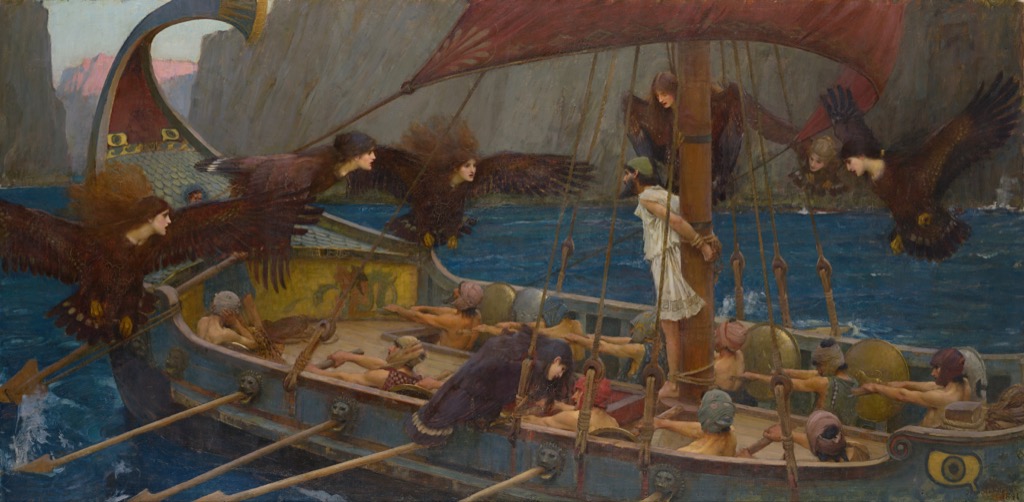
This calmness distinguishes her from Waterhouse's Homeric Sirens of 1891, painted as predatory bird-women attacking Odysseus's ship.
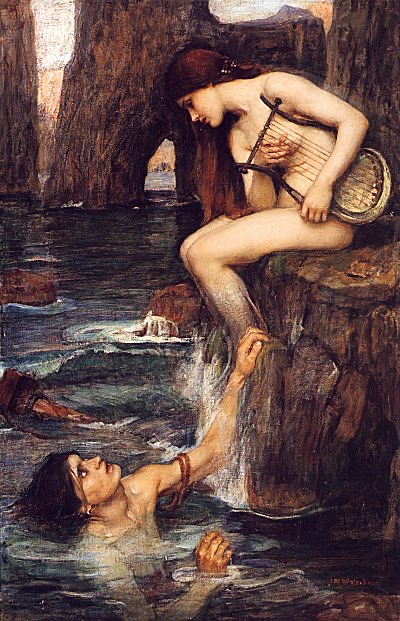
It also differs from The Siren around 1900, where a mermaid-like singer confronts a shipwrecked sailor.
The 1892 figure's potential danger remains latent. Her beauty can recall the fatal tradition without any victim being shown.
Ambiguity is therefore essential. She may be innocent, indifferent or dangerous beyond the represented moment.
Waterhouse makes mythology psychological by showing what a supernatural being does when no human narrative needs her.
The sea and the body
The mermaid occupies a threshold: part human, part aquatic, seated where rock meets water.
This boundary gives visual form to hybrid identity.
Her upper body belongs to the conventions of the female nude, while the lower form connects her with marine life.
Water and atmosphere soften edges, preventing the figure from appearing pasted into a hard studio setting.
The sea is not merely background. It explains salt spray, bodily adaptation and isolation.
Its depth also carries unseen possibility. A calm surface can conceal the mermaid's world.
Waterhouse repeatedly used water as barrier, mirror and dangerous habitat. Here it is home.
The seated pose lets body and rock support one another. She appears temporarily emerged, neither swimming nor walking.
That pause makes grooming believable and suspends the question of what happens next.
The narrow format reduces open horizon. Attention remains with the bodily threshold rather than expansive seascape.
In the finished canvas, marine details and the shoreline become more fully articulated, but the basic relation is already present. [3]
From 1892 to the Diploma Work
Waterhouse signed this small sketch in 1892. [1]
He was elected a Royal Academician in 1895, after which he was expected to deposit a Diploma Work representing his art in the Academy's collection. [1] [3]
He did not complete A Mermaid until 1900, and it was exhibited at the Royal Academy in 1901 as number 138. [1] [3]
Christie's notes that he was criticised for the delay. [1]
The eight-year interval shows that the motif was not a late invention created merely to satisfy the institution.
He had carried and revised the seated combing mermaid from at least 1892.
Another larger oil sketch, about 70.5 × 45.2 cm and dated roughly 1892–95, documents further development. [4]
The existence of multiple studies suggests sustained compositional testing rather than simple enlargement.
Diploma status raised the stakes. The final work would remain permanently associated with his Academy identity.
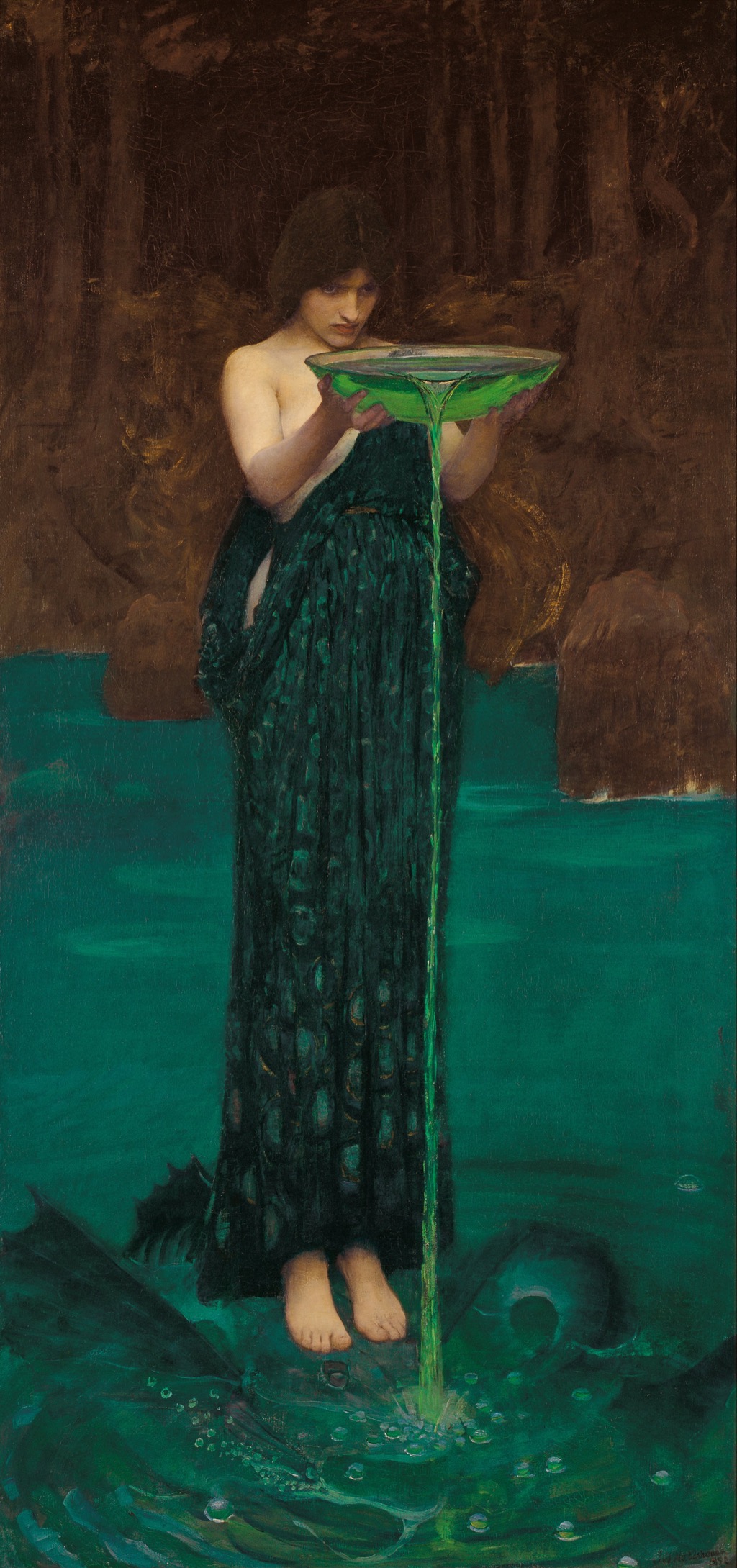
Waterhouse chose neither his famous Lady of Shalott nor Circe but an unnamed mermaid absorbed beside the sea.
The choice brings together ideal female beauty, myth, water and private attention—central features of his mature art.
What changes in the 1900 painting
Both the 1892 sketch and final work show the model seated and combing long red hair. [1]
In the later canvas, she is about to string the hair with pearls, adding a chain of pale ornaments near her hands. [1]
The final painting is much larger, approximately 96.5 × 66.6 cm in the Royal Academy record. [3]
Greater scale permits fuller description of rock, water, shell, hair and distant atmosphere.
The figure becomes more stable and iconic, designed for public exhibition and permanent institutional display.
The study retains greater compression. Body and setting can merge through freer handling.
Composition develops without abandoning the essential action. Waterhouse's long revision refined rather than replaced the idea.
Pearls introduce additional symbolic possibilities: treasure from the sea, adornment, tears or the conversion of nature into jewellery.
Those meanings should not be projected backwards as visible objects if pearls do not appear clearly in the small study.
Comparing versions shows the difference between motif and elaboration. Combing is the motif; pearls, expanded coast and exhibition finish are later elaborations.
The study should therefore be interpreted on its own surface before the final canvas fills every gap.
Small scale and oil technique
At 33.5 × 19.5 cm, the canvas is closer to a portable study than a major Academy exhibit. [1]
Small scale allows rapid decisions about silhouette, colour and light.
Oil provides more direct preparation for a future oil painting than pencil alone. Waterhouse can test how red hair sits against sea tones and how flesh emerges from atmospheric shadow.
Loose passages should not be judged by the uniform finish expected of the Diploma Work.
Their purpose includes flexibility. Edges can shift and background masses can remain open.
The signed date is important because it anchors the project firmly in 1892.
Signature also suggests that Waterhouse acknowledged the sketch as a work worth preserving, even though it remained preparatory.
The stretcher inscription uses his later “R.A.” designation, which may have been added after his 1895 election or during later handling. [1]
It should not be used to redates the painted signature.
The contrast between tiny object and long development is striking. A composition that eventually represented Waterhouse to the Academy began in a canvas scarcely larger than a sheet of paper.
Model, beauty and the viewer
Christie's calls the sitter one of Waterhouse's favourite models but does not name her. [1]
Without documentary evidence, resemblance to other red-haired figures cannot establish identity.
The mermaid's face belongs to the developing “Waterhouse woman”: pale skin, flushed colour, abundant hair and absorbed expression.
This ideal type increased continuity across different myths but could also reduce individual models to a recognisable brand of beauty.
The grooming pose intensifies availability to the viewer. She attends to herself and does not challenge our gaze.
Yet her marine body prevents complete possession. She belongs to an element the spectator cannot inhabit.
This tension—visible intimacy and ontological distance—helps explain the motif's appeal.
A feminist reading can note the tradition of women at toilette offered to external looking.
A mythic reading can emphasise self-sufficient supernatural life rather than seduction.
A formal reading can follow hair as the line connecting head, hand and sea.
None requires a named sitter or poem.
Provenance and private ownership
Christie's records Mrs Herbert Young as an early owner before a 1925 sale, where the work sold to Sampson. [1]
W. W. Sampson offered it again at Christie's in 1930, when Wadham bought it. [1]
It later passed through Louise Whitford in London. [1]
The object remains in a private collection, and current ownership should not be guessed.
Auction records provide valuable title, inscription, dimensions and early provenance but do not guarantee continuous public access.
They also distinguish this small signed work from the other larger sketch. [4]
Price history is secondary to version control. The important point is that a dated 1892 composition circulated independently before the final Diploma Work became famous.
Public-domain image records have widened access while often rounding the dimensions to 33.3 × 19.3 cm. [2]
The Christie's measurement of 33.5 × 19.5 cm should govern this manuscript because it derives from the handled auction object. [1]
Place in Waterhouse's mermaid imagery
Waterhouse's marine women occupy several distinct categories.
His 1891 Ulysses and the Sirens follows the ancient bird-woman tradition rather than modern fishtailed mermaids.
The 1892 study establishes the solitary combing figure later used for A Mermaid.
Around 1900, The Siren creates a narrative encounter between a mermaid-like singer and a drowning sailor.
These works should not be treated as interchangeable illustrations of one myth.
The study's quietness is its distinctive contribution. It imagines supernatural life outside the moment of human danger.
It also links the sea creature with Waterhouse's broader interest in women absorbed by objects: combs, pearls, mirrors, books and flowers.
The final Diploma Work made that formula institutional, but the 1892 canvas proves its earlier origin.
As a study, it reveals duration. Waterhouse did not discover his iconic mermaid in 1900; he refined her across much of the 1890s.
Mermaid traditions and Waterhouse's restraint
Royal Museums Greenwich summarises how mermaid traditions have shifted across cultures, joining wonder, danger, beauty, prophecy and the sea's unknowability. [5]
Waterhouse does not attempt to illustrate that whole history. He selects a modern western fishtailed woman and removes the shipwreck narrative.
This restraint matters. A mermaid need not be caught at the instant of luring a sailor to remain culturally charged.
Her comb and hair recall traditions in which marine women possess mirrors, combs or treasures. Such objects connect supernatural identity with familiar rituals of beauty.
Yet no mirror appears in the documented description, and the comb's practical relation to salt spray is sufficient. [1]
The study avoids a moral verdict. The mermaid is neither punished monster nor romantic victim.
She exists before human contact, absorbed in maintaining a body adapted to two realms.
That autonomy separates the image from stories that define sea-women only through male danger or desire.
At the same time, Waterhouse relies on the spectator's knowledge of those stories. Calm is intriguing because potential peril remains outside the frame.
The result is not narrative emptiness but narrative suspension.
Hair as composition and identity
The long red hair is the study's dominant line. It falls from head to hand, crosses flesh and leads towards the water.
Unlike ordinary drapery, hair belongs to the body while remaining capable of independent movement.
Wetness changes its weight and texture, giving the combed action physical credibility.
Colour turns it into a warm current against cool marine surroundings.
Waterhouse would use abundant hair repeatedly to express beauty, danger, concealment and absorption. Here it does all four without requiring an elaborate prop.
It beautifies the figure, carries the association of seductive mermaids, partly covers the body and occupies her complete attention.
The comb divides and orders what the sea has tangled. Grooming becomes a small act of control at a boundary defined by flux.
This action may help explain why Waterhouse retained the motif for eight years. It is formally clear and symbolically flexible.
In the final version, pearls enrich the hair's relation to the sea. They are marine products converted into personal ornament.
The study's simpler gesture may feel more self-sufficient: hair, hand, comb and salt water already make a complete visual circuit.
Hybrid body and the limits of visibility
A mermaid asks painting to join anatomical systems that cannot exist together in nature.
Waterhouse solves the challenge through pose and cropping. A seated turn lets the human torso remain graceful while the lower body belongs near rock and water.
Soft atmospheric transitions reduce the need for diagrammatic explanation of the join.
The viewer recognises hybridity without being invited to inspect it medically.
This selective visibility belongs to the image's sensuality. The upper body is familiar, while the lower form guarantees otherness.
The marine setting makes the hybrid plausible within the fantasy. She is not a specimen transported into a drawing room.
Her position on the shore is temporary. At any moment she might return to water, limiting the spectator's access.
That implied departure counterbalances the intimacy of grooming.
The study's small scale intensifies elusiveness. Details must be approached closely, but the loose oil surface prevents complete possession.
Waterhouse's final canvas clarifies the body for Academy viewing. The early study preserves a more fugitive apparition.
The long delay as artistic evidence
Eight years between signed sketch and completed Diploma Work should not be narrated only as procrastination.
Christie's records contemporary criticism of Waterhouse's delay, but the surviving studies demonstrate continued thought rather than absence of an idea. [1]
Election as a Royal Academician in 1895 gave the final painting institutional obligation. The 1892 signature shows personal interest preceded that duty.
Waterhouse may have tested model, shoreline, scale, pearls and finish across several canvases.
The larger 1892–95 sketch confirms a stage between the tiny oil and Academy work. [4]
Not every revision is documented, so the manuscript should avoid inventing a continuous sequence.
What can be said is that the central pose survived. Persistence suggests Waterhouse considered it essential.
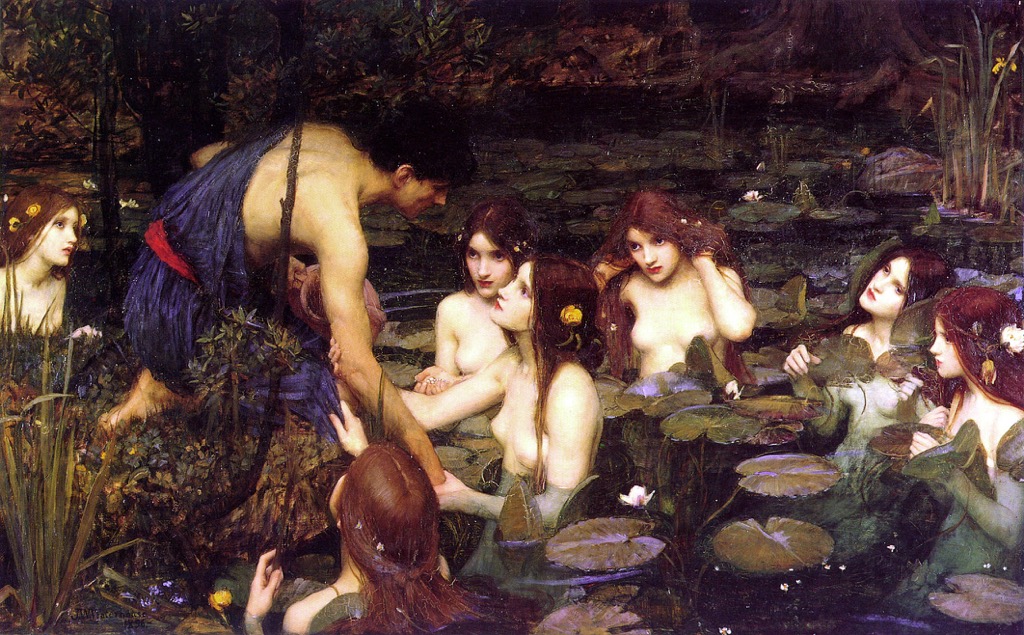
The delay also places the mermaid across a transformative decade in his career, from Ulysses and the Sirens through Hylas and the Nymphs to his full Academicianship.
When finally deposited, A Mermaid condensed several mature concerns into a single image already rooted in 1892.
Reading a study without treating it as lesser
The word “study” describes function, not quality. This canvas prepared a later composition, but it was signed, dated and preserved.
Its small size encouraged decisions that would be impossible to recover from the final work alone.
Looser water and rock show how Waterhouse established atmosphere around a more concentrated figure.
The sketch can reveal initial confidence: he did not need a full narrative setting to recognise the strength of the pose.
It can also reveal uncertainty where edges remain unresolved.
Viewers should avoid praising looseness merely because it looks modern. The relevant question is what the variable finish accomplishes.
Here it makes the mermaid emerge from marine atmosphere while securing head, hair and hands.
The final Diploma Work offers public definition; the study offers the visual idea near its origin.
Both are complete as historical evidence, even though only one was intended as the definitive Academy canvas.
Related Pages
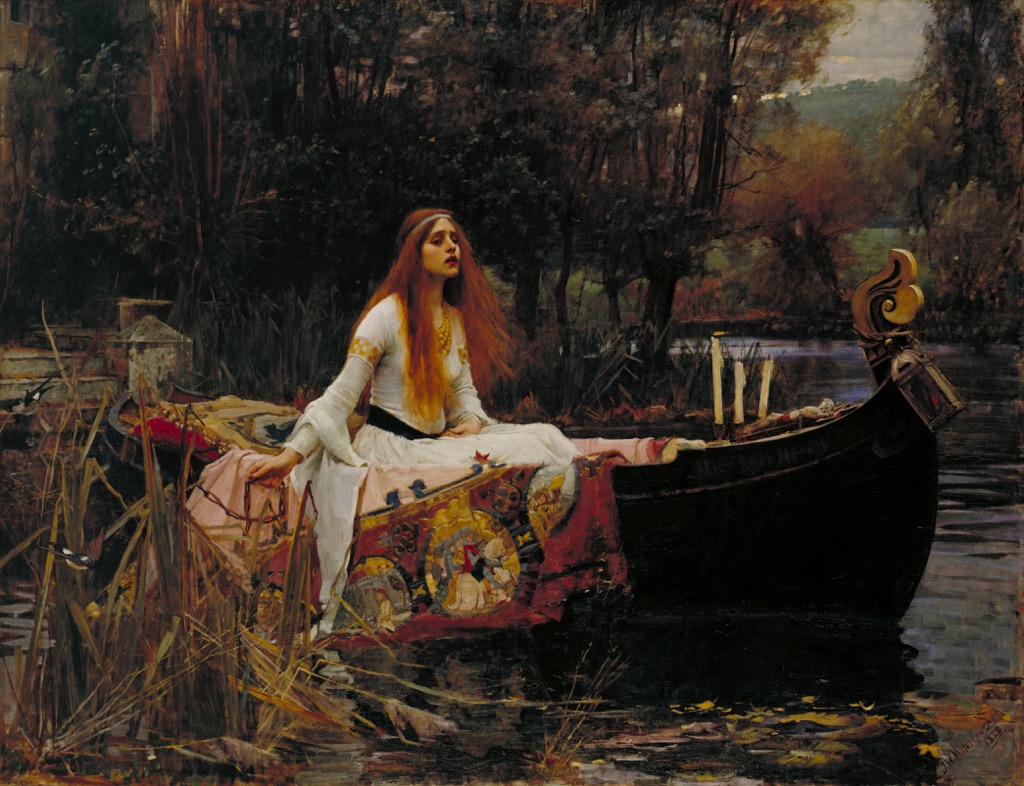
- The Lady of Shalott: Compare Waterhouse's best-known literary composition.
- Hylas and the Nymphs: Compare another major mythological scene.
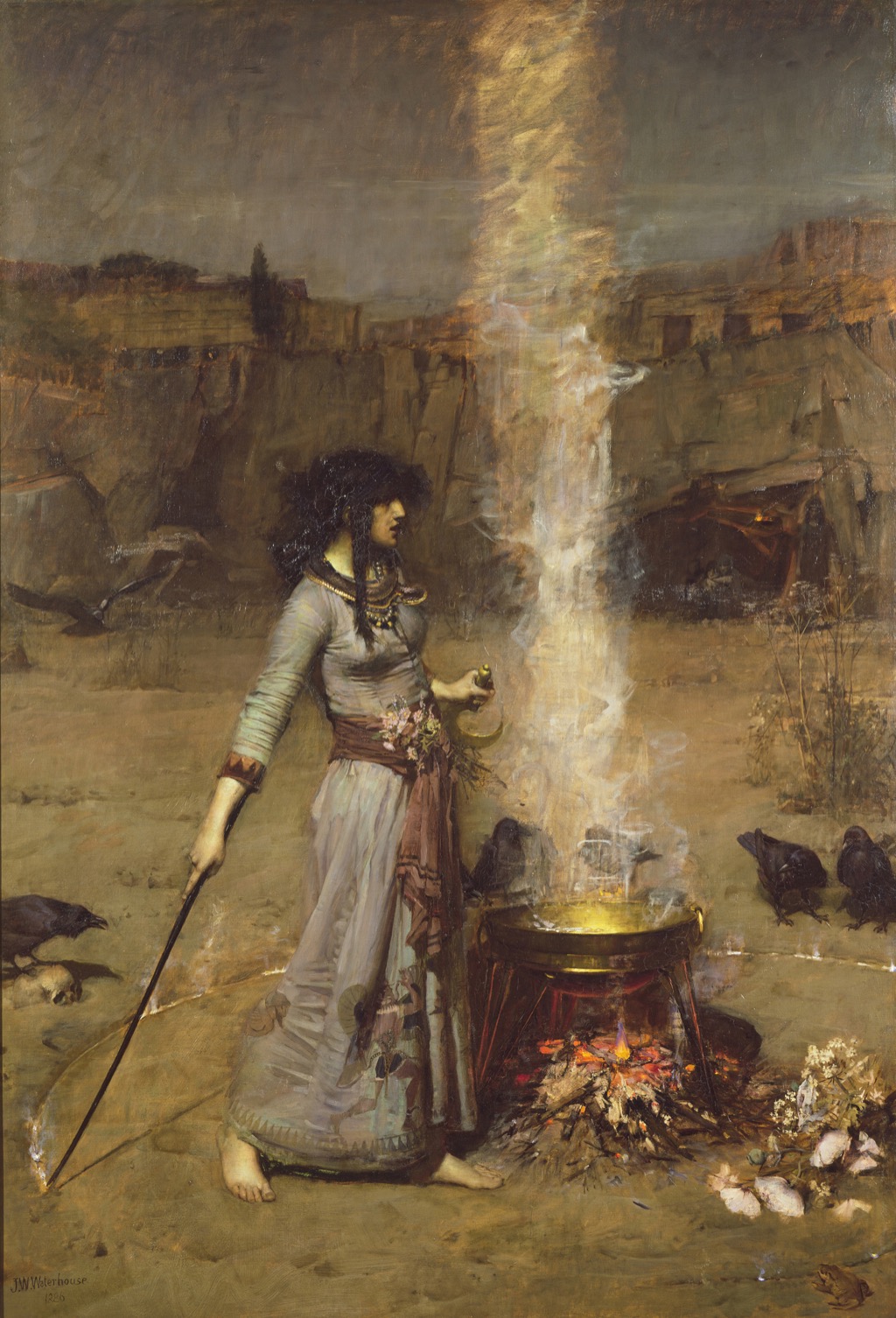
- The Magic Circle: Compare Waterhouse's treatment of ritual and symbolism.
Frequently Asked Questions
He signed and dated it 1892. [1]
Only 33.5 × 19.5 cm. [1]
It is privately owned. [1]
Christie's describes her removing salt spray. The gesture also gives Waterhouse a self-contained image of grooming, flowing hair and marine identity. [1]
Yes. A larger oil sketch dated about 1892–95 measures approximately 70.5 × 45.2 cm. [4]
Discussion
The 1892 study is remarkable for how fully it contains the final idea. Scale, pearls and setting would change, but the mermaid's absorbed care of her hair remained.
That continuity shifts interpretation away from a one-off Academy obligation. The Diploma Work grew from a motif Waterhouse had considered for at least eight years.
Reader Insights
Which visible detail most changes the way you read this page?
Which source or comparison helps the work feel less familiar and more specific?
What question would you bring back to the painting after reading?
Join the Conversation
Share your reading of this page below.
References
- Christie's, “John William Waterhouse: The Mermaid,” lot record and essay for the signed 1892 oil, including dimensions, provenance and relation to the Diploma Work. View source.
- Wikimedia Commons, “John William Waterhouse: A Mermaid (1892 sketch),” image and object metadata. View source.
- Royal Academy of Arts, “John William Waterhouse: A Mermaid,” collection record for the 1900 Diploma Work. View source.
- Christie-related catalogue discussion, “A Mermaid (sketch),” record for the separate 70.5 × 45.2 cm oil dated about 1892–95. View source.
- Royal Museums Greenwich, “Mermaids and their cultural meanings,” contextual overview. View source.