

 by Tom Gurney
Tom Gurney BSc (Hons) is an art history expert with over 20 years experience
Published on August 14, 2026 / Updated on August 14, 2026
Email: tomgurney1@gmail.com / Phone: +44 7429 011000
Head of a Girl II: Introduction
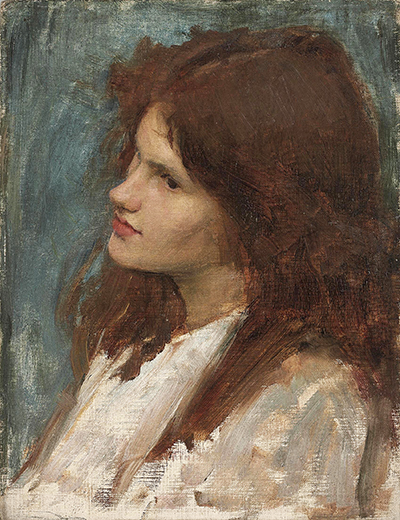
John William Waterhouse’s Head of a Girl II is a small, freely handled oil study of a young woman in left-facing profile. Brown-red hair fills much of the compact composition; a pale blouse and blue-grey ground are laid in with broad, visible strokes. The face alone approaches sustained modelling, turning the work into a concentrated demonstration of how Waterhouse moved from observation to pictorial type.
The title used here is an editorial means of distinguishing the painting from other Waterhouse works called Head of a Girl. It is commonly dated about 1896 and remains privately owned, but a secure public record of its dimensions and early provenance has not been located. [1] Those gaps should remain visible rather than be filled with measurements belonging to a different study.
At a Glance
- ArtistJohn William Waterhouse (1849–1917)
- Recorded descriptive titleHead of a Girl [1]
- Website titleHead of a Girl II
- DateCommonly c.1896 [1]
- MediumOil on canvas [1]
- DimensionsNot securely published in the sources used here
- CollectionPrivate collection [1]
- SubjectUnnamed young woman in left-facing profile
- Distinguishing featuresBrown-red hair, white blouse, blue-grey ground and loose peripheral handling
- Page controlNot the 35.5 × 25.4 cm canvas-board study catalogued as Head of a Girl by Christie’s [2]
Contents
- Introduction
- Which Head of a Girl?
- A Profile Built in Paint
- Hair as Mass, Colour and Edge
- The Unfinished Blouse and Ground
- Study, Sketch or Independent Work?
- The Model and the Waterhouse Type
- Comparison with Head of a Girl I
- Dating and Private Ownership
- Why the Study Matters
Which Head of a Girl?
Waterhouse made many head studies, and several circulate under nearly identical descriptive titles. Object control is therefore the first task of this page.
The featured image shows a young woman facing left, with abundant brown-red hair, a pale loosely painted blouse and a cool blue-grey background.
It is not the better-documented canvas-board oil in which a red-haired woman raises her hand to her hair beside water. That work measures 35.5 by 25.4 centimetres and passed through Waterhouse’s 1926 studio sale. [2]
It is also not the red-and-black chalk drawing on buff paper often returned by searches for “Head of a Girl,” nor Princeton University Art Museum’s signed black-chalk profile.
The numeral “II” helps website navigation, but it does not establish a sequence created by Waterhouse. No visible inscription in the reproduction numbers the work.
The underlying title is generic because the model is unnamed and no literary identity is supplied. “Head of a Girl” describes the image rather than narrating it.
That generic status makes physical details especially important. Profile direction, medium, support, hair arrangement and background distinguish objects more reliably than a shared title.
The page should therefore avoid importing the measurements, provenance or exhibition history of Head of a Girl I. Similarity is not identity.
This discipline may seem technical, but it protects interpretation. If two studies are conflated, differences in pose and finish disappear, and Waterhouse’s process looks less varied than it was.
A Profile Built in Paint
The model turns fully or nearly fully to the left. Her forehead, nose, lips and chin form a continuous boundary against the blue-grey field.
Profile removes the symmetry of a frontal face. Waterhouse must make likeness and expression through one visible contour and the placement of a single dominant eye.
The nose projects into open space, while hair creates a much larger mass behind the head. Face and hair therefore balance as light and dark, narrow structure and broad colour.
The model’s gaze seems slightly raised or directed away. It can appear thoughtful, but no exact emotion should be treated as fact.
A studio model holds a pose; the resulting stillness is partly practical. Waterhouse turns it into pictorial absorption.
The face receives the painting’s finest transitions. Flesh changes gradually around cheek, jaw and neck, although the small reproduction cannot reveal every layer.
Lips introduce a compact red accent. Their colour echoes the warmer hair without collapsing into it.
The ear is largely obscured, allowing hair and cheek to meet without a secondary anatomical focus.
The long neck descends towards a blouse only partly resolved. That taper gives the head elegance but should not be used to infer the model’s class or biography.
Waterhouse’s profile is an arrangement as well as an observation. He selected the angle because it makes the face readable through silhouette and lets the hair dominate the opposite half of the field.
Hair as Mass, Colour and Edge
Hair occupies an exceptional proportion of the study. It spreads from crown to shoulders in a broad brown-red shape.
Waterhouse does not describe every strand. Large strokes establish volume, then lighter or warmer lines indicate movement across the surface.
The colour shifts between auburn, brown and deeper red depending upon light and reproduction. “Brown-red” is safer than assigning one precise shade.
At the face, hair creates a soft irregular edge. Small locks break the clear profile and prevent the sitter from resembling a cut silhouette.
At the outer boundary, the mass partially merges with the blue-grey ground. Those softened edges make atmosphere visible.
Hair was a recurrent Waterhouse motif. Loose hair could help identify mermaids, enchanted women, mourners or figures absorbed in grooming.
Here no action or story accompanies it. The model does not hold, comb or braid her hair. It is primarily material for colour, shape and touch.
This difference separates the study from Head of a Girl I, where hand and hair create a gesture. [2]
The abundant mass also lets Waterhouse test how much modelling is needed before paint becomes convincing hair. Some passages remain nearly abstract when viewed closely.
At normal distance, the viewer’s eye joins them into volume. The study demonstrates the economy of suggestion.
The Unfinished Blouse and Ground
The pale blouse is laid in with broad, broken strokes. Parts of the darker underlayer or ground remain visible between them.
Its incompleteness draws attention upward. Clothing supports the head without competing through pattern, embroidery or fully defined folds.
The neckline is sufficient to locate neck and shoulder. Beyond that, fabric dissolves into the act of painting.
This looseness should not be mistaken for accidental damage, although direct examination would be needed to separate original surface from later wear.
The blue-grey background is similarly active. It contains variations, rubbed-looking patches and visible brush movement rather than one flat colour.
Cool ground makes warm hair advance. It also sets off the pale face without the severe contrast of black.
At the edges of the small canvas, handling remains especially exposed. The rectangle feels like a field Waterhouse occupied quickly rather than an illusionistic window.
Face, blouse and background form three levels of resolution. The face is most sustained, the hair intermediate and the surrounding zones broadly stated.
That hierarchy records priorities. Waterhouse needed enough clothing and atmosphere to judge the head, but he did not need to complete an entire costume or room.
Modern taste often prizes precisely these passages because they reveal brushwork. Waterhouse may have understood them principally as working means.
Both perspectives can coexist if modern admiration is not projected backwards as documented intention.
Study, Sketch or Independent Work?
The image’s selective finish is consistent with a fast oil study between drawing and a more developed composition. Its selective finish supports that broad function.
No definitive final painting has been securely attached to it in the public sources used here. It should not be labelled a study for The Rose Bower, A Mermaid or another specific work without evidence.
“Study” can mean an investigation of a feature rather than a direct preparatory stage. Waterhouse may have been testing profile, colouring and surface for later use across several pictures.
“Sketch” emphasises speed and openness, but the carefully modelled face may have required more sustained work than that word implies.
The terms overlap. What matters is the unequal development visible on the surface.
An oil study differs from a drawing because colour, opacity and the physical behaviour of paint can be tested directly. It is closer to the medium of a final canvas.
At the same time, compact scale lowers the cost of revision. Waterhouse could change an edge, wipe a passage or leave an experiment unresolved.
The work later became independent through survival, reproduction and collection. Whatever its original studio role, it can now be encountered as a complete object.
That afterlife does not erase process. It makes process the reason for display.
The best manuscript language therefore calls it an oil head study while acknowledging that no final destination has been proved.
The Model and the Waterhouse Type
The sitter’s name is not securely recorded. Her profile should remain anonymous rather than be linked to Muriel Foster, Esther Waterhouse or a named portrait sitter through resemblance alone.
Anonymity in the archive does not mean the model lacked identity. It means her name has not travelled with this canvas.
The study demonstrates how a living model could become part of the recognisable “Waterhouse woman” type. Pale face, long red-brown hair, elongated neck and absorbed gaze recur across his art.
Type does not eliminate individual observation. The specific angle, mouth and fall of hair had to be studied from a body in the studio.
Nor does recurrence prove that a single woman posed for every similar head. Waterhouse could idealise multiple sitters towards common preferences.
The model contributed time and bodily stillness. Holding a profile may be easier than raising an arm, but small movement changes the silhouette that Waterhouse was trying to secure.
Her labour is therefore present even where her biography is absent.
Late Victorian models occupied a professional world whose records are uneven. Artists’ and collectors’ names survive more consistently than those of paid sitters.
The generic title repeats that imbalance. It identifies age and gender but not person.
Responsible writing can neither solve the name through guesswork nor treat the model as interchangeable decoration. It should keep both her anonymity and her agency visible.
Comparison with Head of a Girl I
The two website pages form a useful comparison precisely because they are not the same object.
Head of a Girl I shows a woman handling long red hair. Face and neck are developed, but a visible hand introduces action; water, rocks and vegetation suggest an environment. [2]
Head of a Girl II removes the hand and reduces the setting to a cool ground. Profile and hair become nearly the entire subject.
The first study can be connected persuasively with the long development of A Mermaid. The second has no equally secure specific destination in the sources used here.
Their supports also differ in published descriptions: Christie’s specifies canvas board for the first, while the second is generally described as oil on canvas. [1] [2]
Finish operates differently. In the first, gesture and setting remain cursory around a resolved face. In the second, the blouse becomes a field of exposed broad marks while the hair is a great central mass.
Comparison reveals a method rather than a formula. Waterhouse repeatedly concentrated on head and neck, yet varied the information needed around them.
It also exposes the danger of title-based cataloguing. Searching “Head of a Girl” can return both images, several chalk drawings and unrelated portraits.
The collection therefore benefits from editorial numerals, but every page must state what those numerals mean.
They organise a website; they do not rewrite Waterhouse’s studio archive.
Dating and Private Ownership
The work is commonly dated about 1896 and listed in a private collection. [1] No dated inscription or continuous provenance is supplied.
The proposed year places it within the period of Hylas and the Nymphs and near Waterhouse’s sustained engagement with red-haired profile studies.
Stylistic fit supports plausibility but does not establish an exact day or commission. “Circa 1896” should remain qualified.
Private ownership restricts access to labels, reverse inscriptions and conservation evidence that could improve dating.
It also makes dimensions difficult to verify. Reproduction sellers may display selectable print sizes that belong to their products, not the original canvas.
Those numbers must not enter the object record. A manuscript is more reliable when it says “not securely published” than when it supplies an attractive but unrelated measurement.
The absence of public provenance similarly prevents a detailed chain of ownership. It would be unsafe to assign this painting to the 1926 studio-sale lot documented for Head of a Girl I.
Future auction research may identify it through an old photograph or catalogue description. Until then, profile, medium, approximate date and private status form the responsible core.
Uncertainty here is not a writing failure. It is accurate representation of the source record.
Why the Study Matters
The painting matters because it makes Waterhouse’s allocation of attention visible. A finished narrative canvas can hide the stages by which a face was tested and integrated.
Here the stages remain side by side. Delicate modelling meets unblended stroke; illusion meets material.
The young woman appears present, yet the lower body is scarcely established. Her identity is vivid as image and inaccessible as biography.
This duality is central to studio studies. They bring viewers close to artistic process while reminding them how little process records about the collaborator who posed.
The work also complicates the idea that Waterhouse depended upon elaborate literary subjects. No Tennyson, Keats or Ovid is needed to sustain interest.
Profile, hair and colour are enough.
At the same time, the study helps explain why later heroines feel coherent. Waterhouse repeatedly trained his attention on small relations—eye to brow, cheek to hair, neck to cloth—before placing a figure inside a story.
The anonymous head is not secondary to those stories. It is one of the conditions that made them possible.
Colour Without a Story
The limited palette demonstrates how colour can create atmosphere before narrative begins. Warm hair, cooler background, pale flesh and the broken white of the blouse provide the entire structure.
Waterhouse does not need a poisoned cup or reflected lover to organise these colours. Their relation is already dramatic.
The blue-grey field makes the profile feel exposed to air. Had it been warm brown, hair and background might have merged; had it been black, the face might have appeared more formally spotlit.
The chosen coolness therefore affects mood even though it does not name an emotion.
Warm red-brown spreads through the hair in large, uneven passages. It gives the right side of the composition weight and keeps the small pale face from dominating through brightness alone.
The blouse returns light lower down, but its broken finish prevents it from becoming an equal focal point. Colour hierarchy and finish hierarchy reinforce one another.
This is useful evidence for Waterhouse’s technique. He could solve the broad tonal relations early, then decide where further modelling was worth the time.
It would be unsafe to name pigments from a digital reproduction. Vermilion, madder, lead white or specific blue compounds require technical analysis.
The manuscript can instead describe perceived relationships: warm against cool, opaque against thin, resolved against open.
Those relations survive reproduction more reliably than exact hue. They also explain why the study remains visually satisfying despite its incomplete passages.
Colour, in other words, supplies coherence where story is absent.
Reproduction and the Missing Object Record
For many viewers the painting exists chiefly as a small online image. That mode of access brings visibility but creates risks.
Digital files crop edges, alter saturation and conceal physical scale. A 400-pixel reproduction can make a cabinet-sized study and a large canvas appear equivalent.
Commercial sites then offer the image at many print dimensions. Those options describe merchandise, not Waterhouse’s original support.
The problem is especially acute for generically titled works. Metadata from another Head of a Girl can attach itself to the image and circulate without obvious contradiction.
This manuscript therefore treats the absence of dimensions and provenance as meaningful catalogue information. The blank should remain blank until a collection, auction or scholarly record supplies evidence.
Visual analysis must also be calibrated. The reproduction clearly supports observations about left profile, warm hair, pale blouse and cool ground. It cannot settle varnish colour, canvas weave, paint thickness or later restoration.
Direct examination might reveal an inscription, preparatory drawing or change beneath the surface. None should be anticipated as fact.
The discipline protects the painting from false certainty while leaving room for future discovery.
It also provides a model for the wider Waterhouse collection. When titles repeat, the highest-quality page is not the one with the most numbers. It is the one that knows which numbers belong to which object.
Related Pages
- The Lady of Shalott: Compare Waterhouse's best-known literary composition.
- Hylas and the Nymphs: Compare another major mythological scene.
- The Magic Circle: Compare Waterhouse's treatment of ritual and symbolism.
Frequently Asked Questions
No. The Christie’s work is the 35.5 × 25.4 cm canvas-board study used here as Head of a Girl I. [2]
It is commonly dated about 1896, although the exact date is not documented in the sources used here. [1]
Oil on canvas. [1]
A reliable original measurement has not been located. Sizes offered by print sellers should not be mistaken for object dimensions.
Her identity is not securely known.
The numeral separates this image from other similarly titled studies on the website. It is an editorial label, not a known inscription.
Discussion
Head of a Girl II turns incomplete resolution into a record of method. Waterhouse models the profile sufficiently to give it presence, builds hair as a warm mass and lets blouse and ground remain exposed as paint.
The manuscript’s first responsibility is separation. This canvas must not inherit the measurements and provenance of Head of a Girl I or the medium of Waterhouse’s chalk heads. Its own record is smaller: c.1896, oil on canvas, private collection and unnamed sitter.
Reader Insights
Which visible detail most changes the way you read this page?
Which source or comparison helps the work feel less familiar and more specific?
What question would you bring back to the painting after reading?
Join the Conversation
Share your reading of this page below.
References
- Bridgeman Images record reproduced by MeisterDrucke, “Head of a Girl, c.1896,” secondary object summary recording oil on canvas and private ownership. View source.
- Christie’s, “John William Waterhouse, R.A., Head of a Girl,” lot record for the distinct 35.5 × 25.4 cm canvas-board study used on this site as Head of a Girl I. View source.