

 by Tom Gurney
Tom Gurney BSc (Hons) is an art history expert with over 20 years experience
Published on August 14, 2026 / Updated on August 14, 2026
Email: tomgurney1@gmail.com / Phone: +44 7429 011000
Circe II: The Sorceress: Introduction
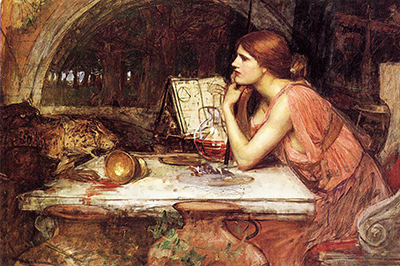
John William Waterhouse’s unfinished The Sorceress is more securely understood as a final return to Circe. Her name is inscribed on the reverse. She sits at a table with her chin upon her hands while enchanted animals occupy the shadows and a woven image evokes the Sirens whom Odysseus will meet after leaving her island. [1] [2]
The route title distinguishes the canvas as Circe II. Object evidence points to about 1911 and identifies a work measuring roughly 29 × 43½ inches. Its unfinished state is central rather than embarrassing: Waterhouse’s incomplete passages expose how he assembled figure, attributes and imagined memory into one of his last meditations on female knowledge. [1] [2]
At a Glance
- ArtistJohn William Waterhouse (1849–1917)
- Route titleCirce II
- Alternative titleThe Sorceress [1] [2]
- Inscription“Circe” on the reverse of the canvas [1]
- DateAbout 1911; sometimes broadly dated 1911–15 [1]
- MediumOil on canvas [1]
- DimensionsAbout 29 × 43½ in. (approximately 73.7 × 110.5 cm) [1]
- StateUnfinished [1] [2]
- CollectionPrivate collection [1]
- Related workThe more concentrated Circe of about 1911, 86.3 × 77.2 cm [2]
- Literary contextHomer’s account of Circe, her loom, transformed animals and advice about the Sirens [3]
Contents
- Introduction
- An Unfinished Room of Enchantment
- Why the Title Should Be Circe
- Reading the Animals
- Loom, Tapestry and the Absent Voyage
- The Table as a Field of Knowledge
- What Unfinished Paint Reveals
- Comparing Circe I and Circe II
- Circe after Odysseus
- Circe, the Sirens and Women’s Voices
An Unfinished Room of Enchantment
The composition is horizontal and relatively wide. Circe occupies the centre or right of a space filled with table, vessels, textile and shadowed creatures. [1]
Her seated body is compact. Elbows rest on the table and hands support the chin, turning the pose inward.
At the left, two animals appear as evidence of her transforming power. The Victorian Web identifies them as leopards in this version while noting bears in another related treatment. [1]
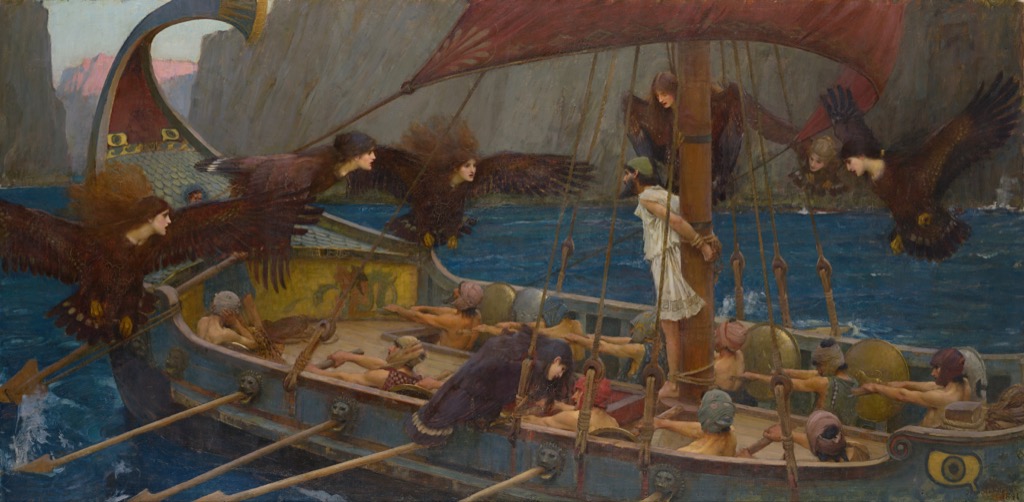
At the right, a loom or tapestry carries a scene interpreted as Odysseus’ encounter with the Sirens. [2]
These elements create a temporal room. The animals recall what Circe has done; the woven voyage imagines what will happen after Odysseus departs; the seated woman inhabits the present between them.
Waterhouse therefore avoids a single dramatic instant. The painting is structured by memory, anticipation and pause.
Its unfinishedness makes that structure visible. Some objects are legible while other areas remain thin, abbreviated or unresolved.
The effect can feel dreamlike, but “dream” should not excuse weak description. The picture’s open surface results from an interrupted working process, not necessarily a deliberate Symbolist haze.
Even incomplete, the composition establishes hierarchy. Circe’s face and pose carry psychological focus; animals and textile expand narrative; containers and book-like objects identify work.
Nothing requires a male figure to appear physically. Odysseus is present through consequence and image.
This absence distinguishes the canvas from Waterhouse’s 1891 encounter scene, while its interior stillness also contrasts with the active poisoning of Circe Invidiosa in 1892. [4] [5] The hero no longer needs to stand before Circe for the relationship to organise her world.
Why the Title Should Be Circe
The generic title The Sorceress describes type but loses identity. The inscription “Circe” on the back restores the work’s proper mythological centre. [1]
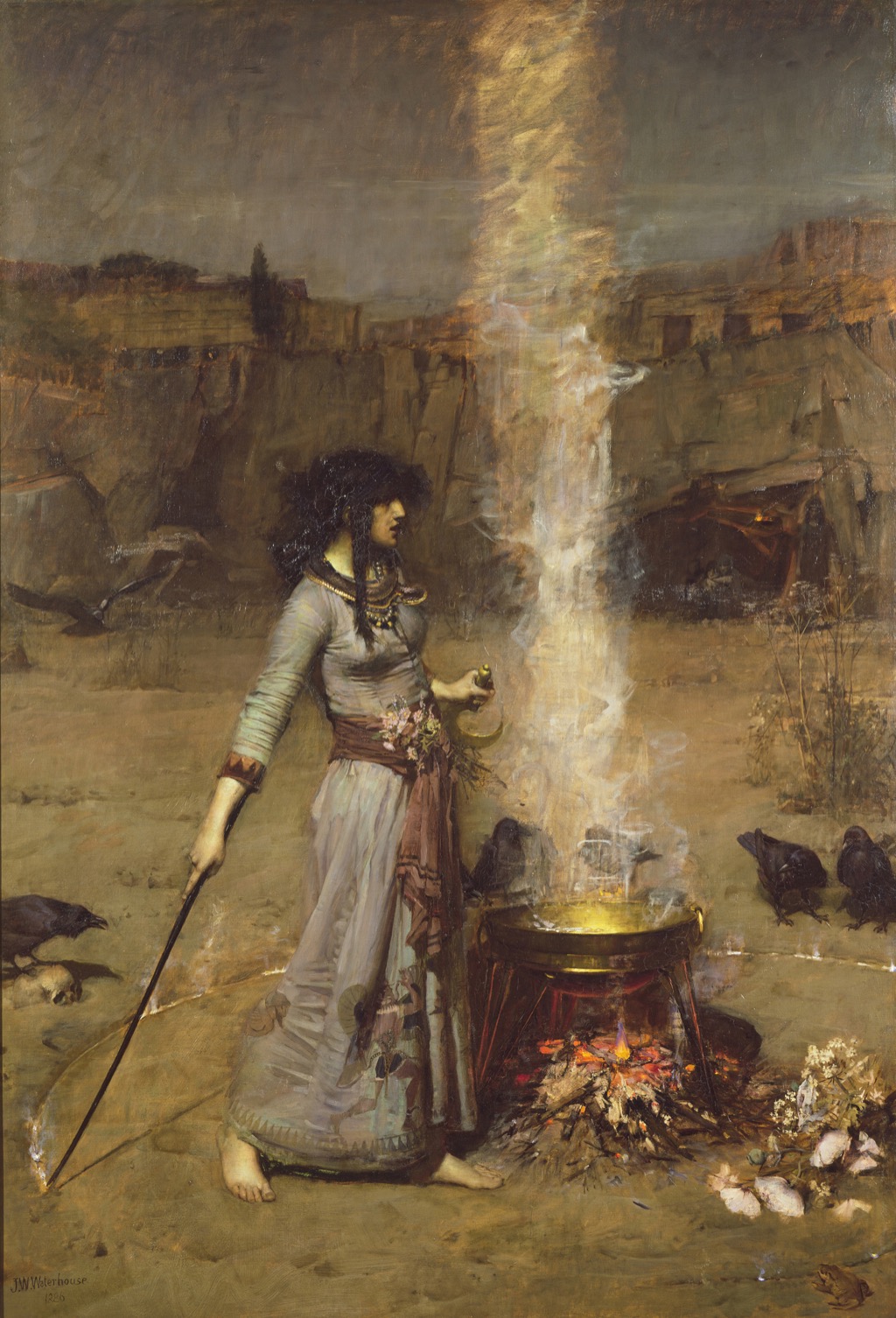
This matters because Waterhouse painted several unnamed or loosely named magical women. The Magic Circle does not securely identify its practitioner; Consulting the Oracle presents ritual without giving the priestess a personal name.
Circe has a specific literary house, history and set of attributes. Homer introduces her singing at a loom while transformed or enchanted wolves and lions move around her dwelling. [3]
The canvas joins loom and animals in a way that makes the identification unusually strong even without the inscription.
Calling it The Sorceress can nevertheless preserve part of its reception history. The title may have arisen because the unfinished canvas circulated without full documentation or because viewers treated Circe as an example of a broader late Victorian type.
The label Circe II keeps this work distinct from the smaller 1911 Circe.
Numbering can mislead if it implies an authorised pair exhibited as Circe I and Circe II. No such lifetime display is documented.
The best title therefore carries both systems: Circe II: The Sorceress. Readers find the existing page, then learn the object’s evidence.
Waterhouse’s inscription also limits interpretive drift. The woman is not simply “a witch,” an occult medium or an allegory of thought.
She may invite comparisons with all three, but the myth of Aeaea remains primary.
Title recovery changes the ethical reading. A generic sorceress can be judged by visual stereotype alone; named Circe must be read through a narrative in which threat, hospitality, sexuality and guidance coexist.
Reading the Animals
Animals are Circe’s most immediate witnesses. In Homer, wolves and lions stand around her house and fawn upon Odysseus’ men rather than attacking. [3]
Their unnatural gentleness signals enchantment before the potion scene begins. They make the domestic exterior uncanny.
Waterhouse places beasts within or near the room, compressing Homer’s setting. Their eyes and forms emerge from reduced paint, at once present and difficult to grasp.
The Victorian Web describes leopards in this version. [1] Descriptions still need checking against the image and specialist records.
The animals are commonly understood as victims transformed by Circe. That is consistent with the mythological tradition, though Homer’s exact account does not narrate each individual transformation. [3]
They carry two emotional possibilities. As victims, they make the room a record of coercion. As tame companions, they also create an alternative household beyond ordinary human relations.
Circe does not look at them. Their presence is normal to her, which makes their abnormality more disturbing to the viewer.
They also alter scale and bodily rhythm. The seated human face draws focus, while low animal bodies extend the composition laterally.
In an unfinished canvas, eyes may become especially prominent because small dark accents remain legible after fur and surrounding shadow dissolve.
This can make the beasts seem spectral. Yet their function is material: they turn previous magic into bodies occupying the present.
Waterhouse avoids the theatrical metamorphosis itself. No half-human figure changes before us.
The choice shifts attention from spectacle to aftermath. Transformation is not a flash of effect but a condition that continues around its maker.
Loom, Tapestry and the Absent Voyage
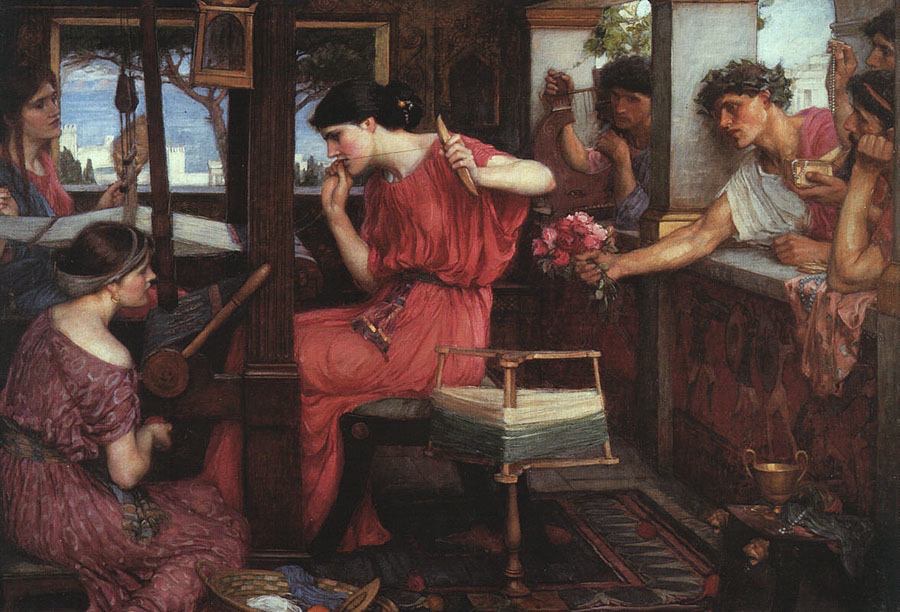
Homer first presents Circe through sound and labour. The men hear her singing beautifully as she moves about an imperishable web of the kind goddesses make. [3]
Weaving is therefore not an arbitrary symbol of feminine domesticity. It is a textual attribute.
Waterhouse develops it into an image-bearing textile. Christie's interprets the related composition as showing Circe imagining Odysseus’ later encounter with the Sirens, woven at the right. [2]
Circe knows that danger because she gives him instructions. He must stop his companions’ ears with wax and have them bind him upright if he wishes to hear the Sirens without steering towards death. [3]
The tapestry can thus operate as counsel made visible. What Circe describes in epic speech becomes a picture within Waterhouse’s picture.
It can also function as memory in advance. She remains on Aeaea while her knowledge travels with Odysseus.
The relationship between woman and textile is not fully explicit. We do not see her actively weaving in the final pause.
That gap allows several readings. She may have woven the scene, imagined it, or simply sit beside an image that symbolises the absent voyage.
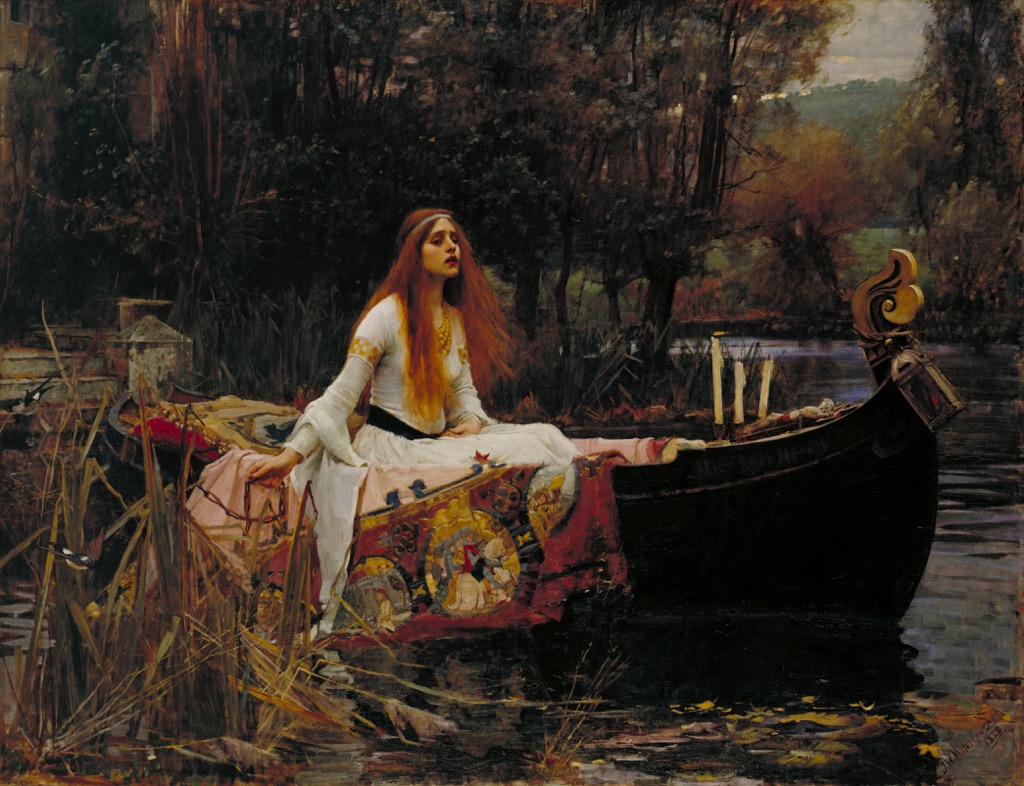
Waterhouse regularly used framed or reflected inner pictures. Mirrors in his earlier Circe and Lady of Shalott paintings bring absent or mediated reality into the heroine’s space.
The textile is less optically literal than a mirror. It is made, patterned and interpretive.
That difference gives Circe authorship. A reflection occurs according to light; a woven image requires labour and selection.
The unfinished surface may prevent every motif from being identified, but the structural idea is clear: Waterhouse gives narrative space to something beyond the room without opening a conventional window.
Odysseus is physically absent yet visually recoverable. Circe’s knowledge becomes the medium through which he returns.
The Table as a Field of Knowledge
The table gathers objects connected with making and study. The image shows large vessels, an illustrated book and a spilled red liquid.
Each detail should be described with calibrated certainty because unfinished passages and reproductions can confuse form.
Together, the objects make one strong point: Circe’s power has apparatus.
This is important within a culture that often represented female enchantment as instinctive sexuality. Waterhouse gives her containers, text, ingredients and workspace.
The book suggests accumulated or externalised knowledge. It does not prove a specific spellbook title.
Vessels imply storage and transformation. One substance can be measured, mixed, heated or spilled into another state.
The overturned glass interrupts order. It may indicate completed action, frustration or simple compositional movement.
Red liquid can evoke wine, potion or blood without becoming any one of them securely. Symbolism grows from ambiguity, not from pretending we can chemically test painted colour.
Circe’s arms rest within this field. Hands capable of handling objects have temporarily ceased work.
The tabletop therefore marks the boundary between action and reflection. Below or upon it lie material consequences; above it rises the thinking face.
Its horizontal line also opposes the vertical or diagonal pull of the textile. The composition balances a stable present against an imagined voyage.
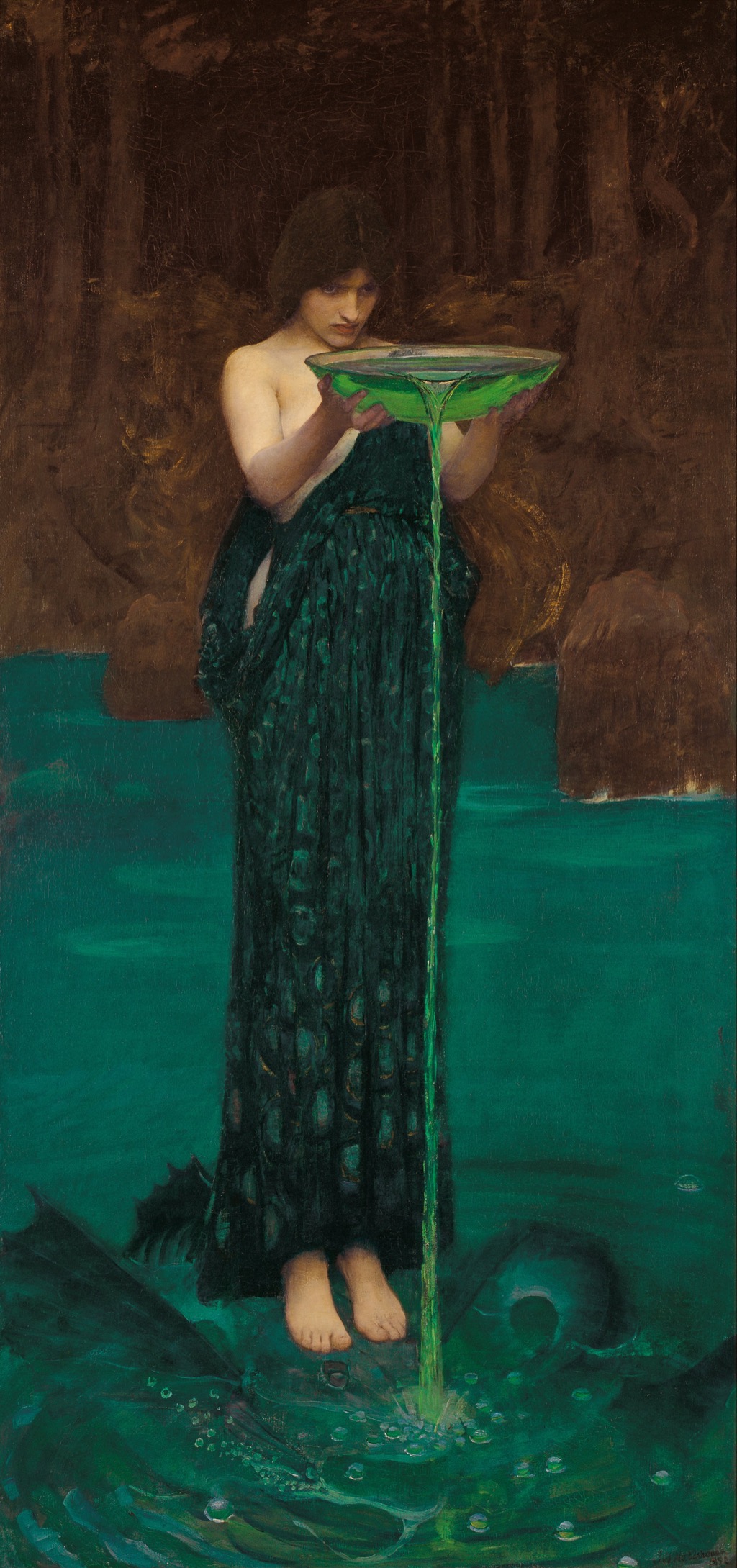
Waterhouse’s choice of a working interior separates this Circe from the open water of Circe Invidiosa. Nature is no longer the recipient of poison; the room itself contains transformed life.
The table can even be read as a secular altar. It supports ritual materials but lacks the public ceremony of a temple.
Magic here is private practice, stored among familiar things.
What Unfinished Paint Reveals
An unfinished painting is evidence of process, but it does not automatically reveal the artist’s final intention.
Waterhouse may have stopped because of dissatisfaction, competing work, illness, sale circumstances or death. No accessible document fixes the reason.
What the surface does reveal is sequence. More resolved passages likely received sustained attention; thin or blocked areas preserve earlier stages.
The painter first had to secure the overall arrangement: seated figure, table, animals and textile. Detail could follow once those relations worked.
Faces and hands often receive priority because narrative credibility depends upon them. Background can remain a tonal field while gesture is tested.
Edges show decision. A finished contour tells the viewer where one object ends; an open contour lets figure and shadow merge.
In Circe II, such merging suits the enchanted animals and woven future, but viewers should not assume every atmospheric effect was intentional.
The surface also resists the polished completeness associated with Waterhouse reproductions. We see an artist who revised and staged rather than merely transferring a perfectly formed mental image.
Comparison with the smaller Circe helps identify alternatives. There the related pose exists in a more concentrated, apparently finished treatment measuring 86.3 × 77.2 cm. [2]
The wider canvas asks for more narrative coordination. Animals, furniture and textile must remain legible without weakening the face.
Its incompletion may record the difficulty of that balance. Or it may simply record time running out on a composition Waterhouse still valued enough to retain.
The painting survived because unfinished studio works entered the market after his death. That history lets modern viewers examine decisions never intended as a public lesson.
Ethically, the page should not romanticise failure. Unfinished does not mean more authentic than finished; it means differently informative.
Comparing Circe I and Circe II
Both late canvases use nearly the same seated attitude: elbows on the table, hands beneath the chin, face absorbed in thought. [2]
The smaller Circe I concentrates that attitude in a more compact vertical or near-square field. The wider Circe II embeds it within a narrative environment.
Christie's notes a related drawing whose softer brow and neckline correspond more closely to Circe I. The unfinished canvas sharpens the brow and jaw, creating greater tension. [2]
This difference matters more than any invented hierarchy of “first” and “second.” Waterhouse used the same structural pose to test distinct psychological pressures.
In the compact work, objects remain subordinate to the woman. In the wider work, animals and tapestry insist that thought has causes and effects.
The compact version is easier to encounter as an aesthetic portrait. The unfinished version resists that isolation by naming victims and voyage around her.
Neither replaces the other. One interiorises myth; the other materialises it.
Together they also show that repetition can be investigative. Waterhouse returned to a pose because it had not exhausted its meanings.
The correct internal-linking strategy should send readers between the two pages and onward to the 1891 and 1892 Circe paintings. Each page must keep its own object facts and close looking.
A combined “Circe series” overview could later compare chronology, sources and iconography, but it should not collapse the four canvases into one text.
The late pair is especially valuable because it shows Waterhouse moving away from decisive narrative climax. By 1911 he preferred a mind holding multiple times at once.
Circe after Odysseus
The Odyssey leaves Circe behind when the hero sails. Her counsel remains active, but the epic’s movement follows him. [3]
Waterhouse imaginatively stays in the room the poem departs.
That change of viewpoint creates the painting’s emotional originality. A supporting figure in the hero’s itinerary becomes the centre of her own aftermath.
The Sirens may occupy the textile because they are the next danger her advice controls. Circe knows how Odysseus can hear them and live.
Yet knowledge cannot prevent separation. She equips his movement away from her.
The animals embody another relationship to departure. Former travellers or intruders may have been transformed and kept, permanently absorbed into Aeaea.
Odysseus escapes both potion and permanence. The room contains those who did not.
Circe’s meditative posture stands between these outcomes. She can retain through transformation or release through advice.
Waterhouse does not tell us whether she regrets either power.
This ambiguity prevents an easy romance of abandonment. Circe is not simply waiting faithfully for the man who left; she is the ruler and danger of the place he survived.
At the same time, the woven voyage lets viewers recognise loss without excusing coercion. Power and loneliness can coexist.
The canvas’s incomplete state intensifies the open ending. Odysseus’ epic has a known destination; Circe’s painted future remains literally unresolved.
Circe, the Sirens and Women’s Voices
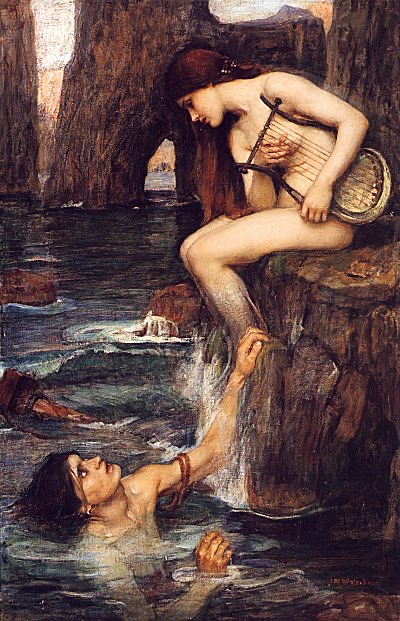
The proposed tapestry subject creates a subtle relationship between Circe and the Sirens. All are women whose voices alter a traveller’s fate, but their forms of knowledge and danger are not identical. [2] [3]
The Sirens sing what mortal listeners desire to know. Their promise draws ships towards death unless sailors make listening physically impossible.
Circe also sings when Homer first introduces her, yet she supplies the method by which Odysseus can hear the Sirens safely. [3]
Waterhouse can therefore place one female voice in the position of interpreting another. Circe is not merely a precursor to the Sirens as the next seductive obstacle. She is the authority who understands how seduction works.
The loom strengthens that relationship between voice and making. Homer’s Circe sings while weaving; the Sirens’ song may become the subject woven into the late canvas. [3]
Song turns into image, and advice turns into a scene. Waterhouse translates the epic’s sound through a silent medium while retaining the idea of dangerous attention.
Circe’s own mouth is closed or supported by her hands. The woman who advises speech and song is shown without speaking.
This silence can register reflective control. It may also underline the limits placed upon her after Odysseus leaves: the epic records what she tells him, then follows his experience of following it.
The unfinished painting gives her a second representational space. The woven voyage belongs within her room, so his later adventure remains partly her intellectual creation.
That does not make Circe the literal author of the Odyssey. It identifies Waterhouse’s compositional transfer: the heroic episode is subordinated to the woman who foresaw it.
The comparison also complicates the femme fatale category often used for Waterhouse’s mythological women. Circe and the Sirens all possess potentially lethal allure, but Circe’s warning protects the same man she once threatened.
Her knowledge is double-edged rather than essentially evil. Potion can transform, counsel can save, weaving can remember, and song can attract without producing one stable moral identity.
For modern readers, this structure is more valuable than a simple opposition between virtuous hero and dangerous women. Odysseus survives because he listens selectively: to Circe’s instruction, then to the Sirens under restraints she has prescribed.
The late Circe remains outside the famous mast scene, yet Waterhouse’s inner image brings her back into it. Absence becomes influence.
Related Pages
- The Lady of Shalott: Compare Waterhouse's best-known literary composition.
- Hylas and the Nymphs: Compare another major mythological scene.
- The Magic Circle: Compare Waterhouse's treatment of ritual and symbolism.
Frequently Asked Questions
Yes. The label Circe II distinguishes the unfinished work often called The Sorceress. The inscription “Circe” on the reverse supports the named identification. [1]
The object is usually placed around 1911, though some summaries give the broader range 1911–15. [1]
No secure surviving explanation identifies why Waterhouse stopped work. Illness or late-career circumstance may be relevant, but should not be asserted as the cause.
The version has been described as including leopards, understood as victims or creatures transformed by Circe. [1]
Christie's interprets the related imagery as Odysseus’ encounter with the Sirens, a danger about which Circe advises him. [2] [3]
It is in a private collection. [1]
Discussion
The unfinished Circe II is the most expansive of Waterhouse’s late Circe meditations. It surrounds contemplation with a material history: transformed animals on one side, an absent hero’s future on the other, and the tools of knowledge between.
Its open paint does more than add atmosphere. It lets us see narrative being assembled. Homeric attributes are not copied mechanically; they are repositioned to create an aftermath Homer never narrates.
Reader Insights
Which visible detail most changes the way you read this page?
Which source or comparison helps the work feel less familiar and more specific?
What question would you bring back to the painting after reading?
Join the Conversation
Share your reading of this page below.
References
- The Victorian Web, “Circe by John William Waterhouse,” object note for the unfinished canvas inscribed “Circe.” View source.
- Christie's, “John William Waterhouse: Study for ‘Circe’,” catalogue essay comparing the drawing, Circe and The Sorceress. View source.
- Homer, Odyssey, Books X–XII, translated by A. T. Murray, Perseus Digital Library. View source.
- Art UK, “Circe Offering the Cup to Odysseus,” Gallery Oldham collection record. View source.
- Art Gallery of South Australia, “J. W. Waterhouse: Circe Invidiosa,” collection record. View source.