

 by Tom Gurney
Tom Gurney BSc (Hons) is an art history expert with over 20 years experience
Published on August 14, 2026 / Updated on August 14, 2026
Email: tomgurney1@gmail.com / Phone: +44 7429 011000
Consulting the Oracle: Introduction
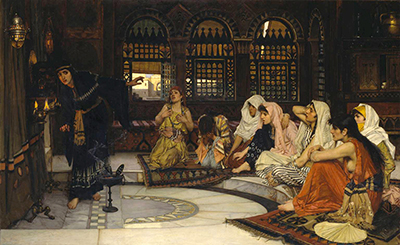
In a dark ancient chamber, a woman leans towards a severed head fixed high upon the wall. Lamps burn beneath it. Behind her, a close crescent of women waits for an answer, their faces registering attention, anxiety and fascination. John William Waterhouse's Consulting the Oracle does not show a prophecy clearly delivered. It paints the charged interval in which belief, imagination and silence might become a voice.
Exhibited at the Royal Academy in 1884, the large canvas was one of the works that established Waterhouse as a serious painter of the ancient world. Its subject was strange even by the standards of Victorian history painting. Rather than choosing Delphi or a familiar classical myth, Waterhouse described an “Oracle or Teraph” made from a preserved human head. The picture draws its power from that object, but equally from the people gathered around it: prophecy becomes a collective act of listening.
At a Glance
- ArtistJohn William Waterhouse (1849–1917)
- TitleConsulting the Oracle
- Date1884
- MediumOil paint on canvas
- Dimensions119.4 × 198.1 cm
- CollectionTate, London
- Accession numberN01541
- First exhibitedRoyal Academy, London, 1884, no. 559 [1] [2]
- AcquisitionPresented by Sir Henry Tate in 1894 [1]
- SubjectA group of women seeking prophecy from a preserved head described in the Academy catalogue as an “Oracle or Teraph”
- Related workA reduced replica of the composition, 44.5 × 72.5 cm, was painted in 1884 and later entered a private collection [3]
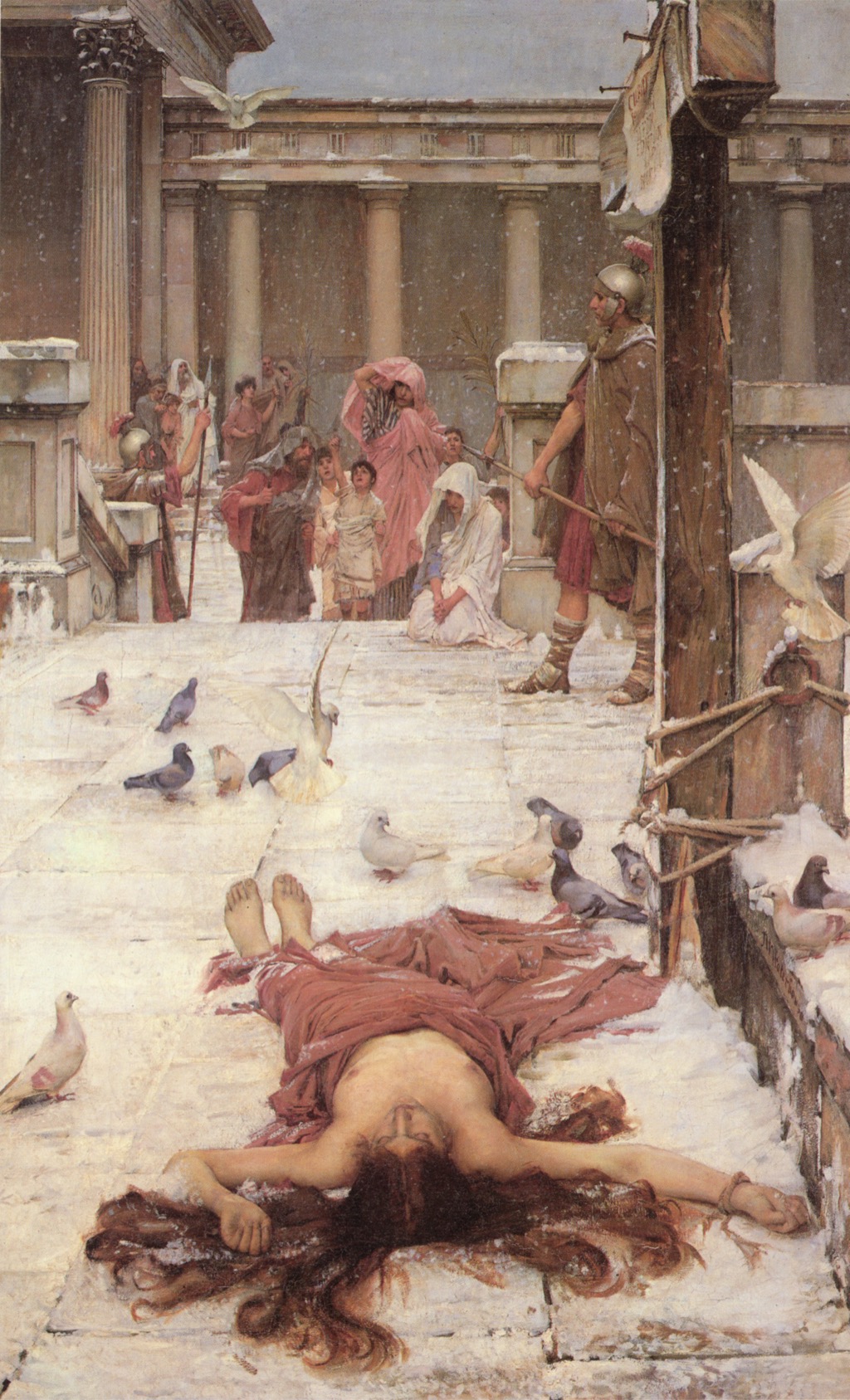
- Career contextPainted between The Favourites of the Emperor Honorius (1883) and Saint Eulalia (1885), during Waterhouse's early concentration on the ancient world
Contents
- Introduction
- A Room Organised Around Listening
- The “Oracle or Teraph” in the Royal Academy Catalogue
- Head, Voice and the Uncanny Object
- The Priestess and the Threshold of an Answer
- The Listening Women as a Chorus
- Geometry and the Architecture of Attention
- Lamps, Textiles and a Controlled Sensory World
- Victorian Archaeology, Spiritualism and the Limits of Context
- The Royal Academy of 1884 and Waterhouse's Rising Reputation
A Room Organised Around Listening
The first action in Consulting the Oracle is not speaking but leaning. At the left, the officiating woman inclines her body towards the head on the wall. At the right, the seated and standing women curve inward. Every posture narrows the distance between silence and possible revelation.
Waterhouse gives the oracle a fixed, elevated position. It cannot approach its listeners, so their bodies must orient themselves around it. The arrangement makes attention visible. Bent heads, widened eyes, clasped bodies and the priestess's diagonal pose turn an invisible sound into a compositional force.
The head is disturbing because it lies between person and object. It possesses a human face but no living body. It is mounted like an image, trophy or ritual implement, yet the company expects it to speak. Waterhouse does not resolve that contradiction. He makes it the premise of the scene.
Nothing in the canvas confirms that a supernatural answer actually occurs. No inscription appears in the air and no apparition materialises. The Royal Academy explanation said that diviners, after lamps and rites, imagined that they heard a low prophetic voice. [3] The word “imagined” keeps the event suspended between revelation, heightened suggestion and deception.
This ambiguity is crucial. A painting of an unquestionably talking head would visualise a miracle or magical fact. Waterhouse instead paints expectancy. The ritual's psychological reality—its ability to command fear and concentration—does not depend on proving the oracle true.
The spectator occupies another circle of attention. We watch the women watch and listen. Because the oracle faces across the room rather than directly outward, we do not receive its message. We are close enough to share the suspense but excluded from the content.
That exclusion gives the work durability. A prophecy answered would close the narrative. A question held in silence can be asked again each time the picture is seen.
The “Oracle or Teraph” in the Royal Academy Catalogue
Waterhouse supplied an unusually explicit note when the painting appeared at the Royal Academy. It explained that the “Oracle or Teraph” was a human head preserved with spices, fixed to a wall, and consulted after lamps were lit and other rites performed. The diviners' imagination became so excited that they believed they heard a low voice predicting future events. [3]
The note guides nearly every principal element. The head is attached to the wall. Lamps burn below. A specialist or priestess approaches it. The company waits for speech. Waterhouse was not asking viewers to identify a familiar mythological episode; he was teaching them how to read an unfamiliar rite.
The explanation also makes imagination part of the subject. Waterhouse could have stated simply that the head spoke. Instead, the catalogue language introduces the possibility that expectation produces the voice. The women may be in contact with another realm, or they may be interpreting sound under conditions designed to intensify belief.
The word “teraph” or teraphim has biblical associations with household images or cult objects, but Waterhouse's preserved speaking head does not correspond neatly to a single uncontested ancient practice. Christie's research on the reduced replica suggests that his immediate source may have been a nineteenth-century edition or retelling of Josephus's Antiquities of the Jews. [3] “May have been” is important: no surviving statement from the artist identifies the precise book he consulted.
A preparatory conception apparently treated the scene as Greek and involved a Pythian or Delphic figure before Waterhouse arrived at the more unusual subject. [3] This development shows that the painting was designed through transformation, not simply copied from one ancient text.
It is therefore misleading to call the scene straightforwardly Egyptian, Greek, Roman or Hebrew without qualification. Costumes, objects and architecture create a broadly ancient Eastern or Mediterranean setting. The title and Academy note remain more secure than a modern attempt to assign the room to one exact culture.
This uncertainty does not weaken the painting. It explains its hybrid atmosphere. Waterhouse sought an antiquity credible enough to absorb viewers and strange enough to make prophecy feel remote from familiar religion.
Head, Voice and the Uncanny Object
The oracle is small in relation to the canvas, but it governs the room. Its authority comes from placement and gaze rather than physical mass. Raised against the wall and framed by surrounding objects, it becomes the point from which every line of attention seems to return.
A severed head traditionally carries evidence of death. Here preservation turns death into supposed access. The absent body is not merely a sign of violence; it is the condition through which the face has become an instrument.
Waterhouse avoids obvious gore. The head is dry, dark and contained. That restraint makes it more uncanny. A bloody object would belong to recent action; this one suggests repetition, age and established ritual.
Its mouth is the crucial feature because the gathering depends upon sound. Yet a still image cannot allow us to decide whether the lips move. The apparent voice must be created in the imagination of the women and the viewer, precisely as the Academy note describes.
The wall gives the head a relation to art itself. Like a portrait, it is a human likeness detached from a living person and made permanently visible. The ritual asks that likeness to cross back into speech. Waterhouse's painted oracle is thus an image of an image believed to come alive.
That relation need not be treated as a coded statement about painting, but it enriches the scene. Spectators in a gallery also stand before a silent surface and infer voices, intentions and events. The women enact an intensified version of ordinary imaginative looking.
The oracle may repel modern viewers because it converts human remains into a tool. Waterhouse does not show who the person was, how the head was obtained or whether consent had any place. The ritual's authority rests upon an erased life.
Keeping that violence in view prevents the scene from becoming only decorative occultism. The beautiful chamber is organised around a body reduced to one useful part.
The Priestess and the Threshold of an Answer
The woman nearest the oracle is separated from the others by position and action. She leans across the open interval, approaching the face as though to ask, listen or interpret. Her diagonal body breaks the stronger verticals and horizontals of the room.
Whether “priestess,” “diviner” or “officiant” is the best title cannot be proven from a named historical office. Her distinct role is nevertheless clear. She manages the contact on behalf of the group.
Her nearness carries risk. The others can recoil into one another; she has crossed the room and brought her face within the oracle's field. Knowledge requires an approach that is physical as well as mental.
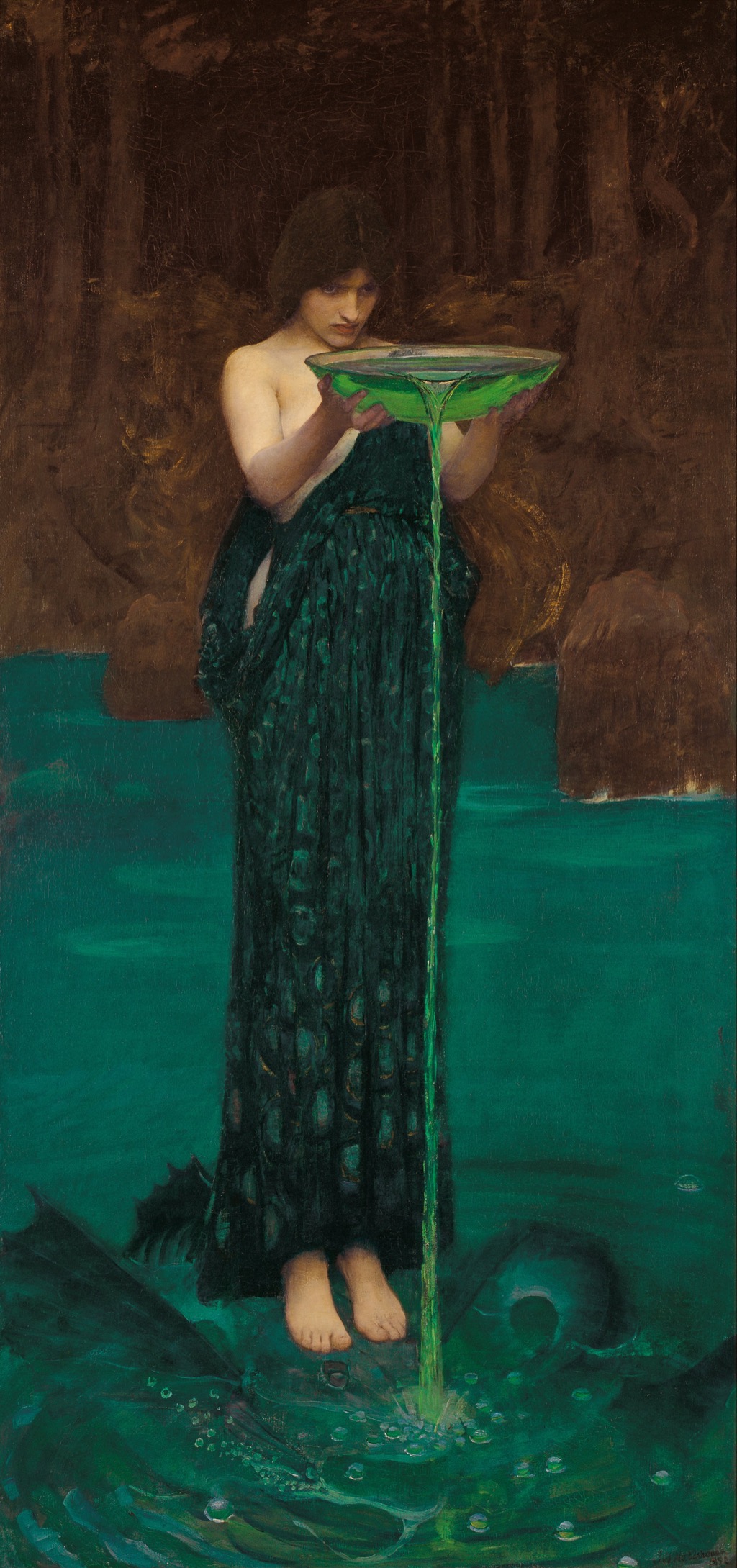
Waterhouse makes her active without making her dominant in the manner of his later Circe. She does not sit enthroned or direct a spell outward. Her pose is responsive. Even as leader, she submits to the possibility of a voice above her.
The inclined torso creates a question mark within the composition. A more upright stance would make the ceremony official and controlled. Leaning communicates uncertainty—perhaps the sound is faint, perhaps the answer has not begun, perhaps she fears what she asks.
Her isolation also establishes two kinds of community. She belongs to the women yet stands apart through knowledge or responsibility. The group depends on her interpretation while sharing the emotion that gives the rite its power.
No male authority appears to regulate the encounter. Waterhouse stages an enclosed female community seeking knowledge through a female intermediary and an ambiguous relic. That choice contributes to the work's distinctive atmosphere, although it does not by itself prove an argument about female religion or resistance.
The priestess is the hinge between object and audience. The oracle cannot move; the women do not yet approach. Her body carries the request from one side of the canvas to the other.
The Listening Women as a Chorus
The women at the right form more than a background group. Their differing reactions allow Waterhouse to show a sequence of emotional possibilities within one suspended moment.
Some lean forward, unable to resist. Others draw closer to their companions or partly hide. Curiosity and fear do not divide neatly between separate people; the crescent as a whole seems attracted and repelled.
Their proximity makes emotion contagious. One person's alarm heightens another's attention. Bodies touch, overlap and shelter. The ceremony is communal even if the prophecy concerns one question.
This group has often been described as part of a “keyhole” composition, a term used by Waterhouse scholar Anthony Hobson for the curving company gathered around the isolated officiant. [4] The image is useful because the figures form an enclosure while leaving a narrow visual passage towards the oracle.
The women also work like a chorus in drama. They do not perform the central rite, but their faces instruct spectators in how consequential it feels. Through them, a nearly motionless scene gains a range of tempo: recoil, strain, stillness and expectation.
Waterhouse avoids repeating one ideal type without variation. Even when faces and garments share a general beauty, their angles and expressions distinguish degrees of engagement. The group is unified by attention rather than by identical response.
Their elegant fabrics and composed arrangement can aestheticise fear. This is part of the painting's appeal and part of its distance from lived ritual. Waterhouse designs apprehension into a harmonious pattern suitable for the Academy wall.
Yet harmony does not cancel unease. The closer the figures gather, the more the room seems to contain them. Their curved formation can be read as mutual support or as a trap created by shared belief.
Geometry and the Architecture of Attention
The broad horizontal format is essential. It gives Waterhouse enough room to separate oracle and group while keeping them inside one dark interior. The unoccupied floor between them becomes the space across which the expected voice must travel.
Strong verticals in walls, hanging textiles and the oracle's support stabilise the room. Horizontal ledges and flooring keep the composition measured. Against that grid, the priestess's diagonal and the women's curve create tension.
The composition is asymmetrical in population but balanced in weight. A large group occupies the right; the oracle and officiant occupy the left. The small head counterbalances many bodies because every gaze gives it borrowed force.
Perspective draws the eye inward without opening onto a distant landscape. This is a closed world. Curtains, walls and patterned surfaces block escape, making listening more concentrated.
The low lamps establish a secondary rhythm beneath the oracle. Their flames repeat the alertness of the watching faces, while their light helps detach the head from shadow.
Waterhouse's archaeological furnishings create density, but no object is allowed to become wholly independent still life. Rugs guide the group, lamps serve the rite, vessels imply preparation, and textiles control enclosure.
The painting's geometry was praised in later scholarship as evidence that Waterhouse could build classical structure from vertical, horizontal, circular and diagonal relations. [4] That analysis is persuasive because the emotional story and formal design coincide: uncertainty appears as a diagonal crossing order.
The surface remains richly descriptive, but description is disciplined by direction. Every decorative element either frames attention or delays it briefly before returning the eye to the head.
Lamps, Textiles and a Controlled Sensory World
Warm lamps burn in a chamber of deep reds, browns, blacks and muted gold. Their light does not illuminate the whole interior evenly. It creates pockets of visibility, appropriate to a rite in which incomplete perception matters.
The Academy note specifically mentions lamps being lit before the oracle. [3] They are therefore functional, not generic symbols added to make the scene mystical. Their flame marks that the prescribed conditions have been established.
Textiles soften the architecture and intensify enclosure. Patterned rugs receive the group, while heavy hangings make the space feel insulated from ordinary life. Sound imagined in such a room would seem private and close.
Rich fabrics also locate the painting within Waterhouse's early interest in material antiquity. He offers viewers surfaces to enjoy while making that enjoyment uneasy through the preserved head.
Colour differentiates roles. The officiant's figure must remain readable against the darker left side; the group creates a band of varied garments at right; the head is isolated by tone and placement. Exact colour descriptions vary with reproductions, so interpretation should remain attached to broad relationships rather than to digital hue values.
No published conservation source cited here identifies Waterhouse's pigments or underdrawing. Claims about a specific mineral colour, glaze sequence or hidden revision would therefore exceed the evidence. The collection record securely identifies oil paint on canvas. [1]
The visible handling supports the scene's double character. Faces and key objects receive enough definition for psychological reading, while shadowed fabrics and architecture merge. Certainty decreases towards the room's edges.
Waterhouse's sensuous material world does not explain the oracle. It makes belief plausible by showing the labour and setting that surround it. Lamps have been lit, objects arranged and people assembled. The possible voice emerges from preparation.
Victorian Archaeology, Spiritualism and the Limits of Context
The 1880s British public had a strong appetite for images of antiquity. Archaeological discoveries, museum displays, translations and illustrated histories offered artists a large vocabulary of ancient costume and interiors. Contemporary commentary praised Consulting the Oracle for combining archaeology and history with forceful drawing and rich colour. [2]
The same audience was familiar with spiritualism, séances, table-turning and debates about communication with the dead. A darkened room, expectant sitters and a faint voice could therefore produce modern associations even within an ancient setting.
Those associations are valuable context, but they should not be promoted into undocumented intention. No source cited here records Waterhouse saying that the painting was a satire on séances, an endorsement of spiritualism or a coded portrait of a particular medium.
The Academy note itself encourages psychological ambiguity by saying the diviners supposed they heard a voice after their imagination was excited. [3] That wording could invite scepticism from Victorian viewers without turning the women into fools.
Waterhouse treats their belief seriously. Expressions may show fear, but the scene is not caricature. The ritual has structure and emotional cost. Even if the voice is imagined, the experience is real to those present.
This balance distinguishes the work from a simple contrast between rational modernity and superstitious antiquity. The painting allows modern spectators to feel the suspense it might also ask them to doubt.
Gender adds another layer. Victorian culture often imagined female sitters as especially susceptible to occult influence, while women also played prominent roles as mediums. Waterhouse's all-female gathering may resonate with that history, but the absence of documentary evidence calls for interpretation rather than certainty.
The safest conclusion is also the richest: Consulting the Oracle stages the manufacture of attention. Ancient rite and modern viewing meet in a room where people strain to hear what cannot be verified.
The Royal Academy of 1884 and Waterhouse's Rising Reputation
The painting appeared as no. 559 at the Royal Academy exhibition of 1884. [2] [5] A contemporary survey, English Art in 1884, treated it as a marked advance after The Favourites of the Emperor Honorius and reproduced the work while discussing its unusual subject and technical ambition. [2]
The Illustrated London News also reproduced it prominently and praised its combination of archaeology, historical study, drawing and colour, according to the documented account attached to the later replica. [3] Such attention shows that the canvas was visible in Waterhouse's contemporary rise, not only rediscovered after his death.
Sir Henry Tate acquired the large version, and it entered the national collection with his gift in 1894. [1] That provenance connects the work to the formation of Tate's British collection.
Waterhouse painted a much smaller replica in the same year. The reduced version preserves the composition at 44.5 × 72.5 cm and was exhibited in the Royal Academy's 1922 memorial display while owned by the horticulturist Sir Harry Veitch. [3]
The existence of the replica suggests sustained value in the image, but it should not be confused with the Tate canvas. Their dimensions, ownership histories and material presence differ.
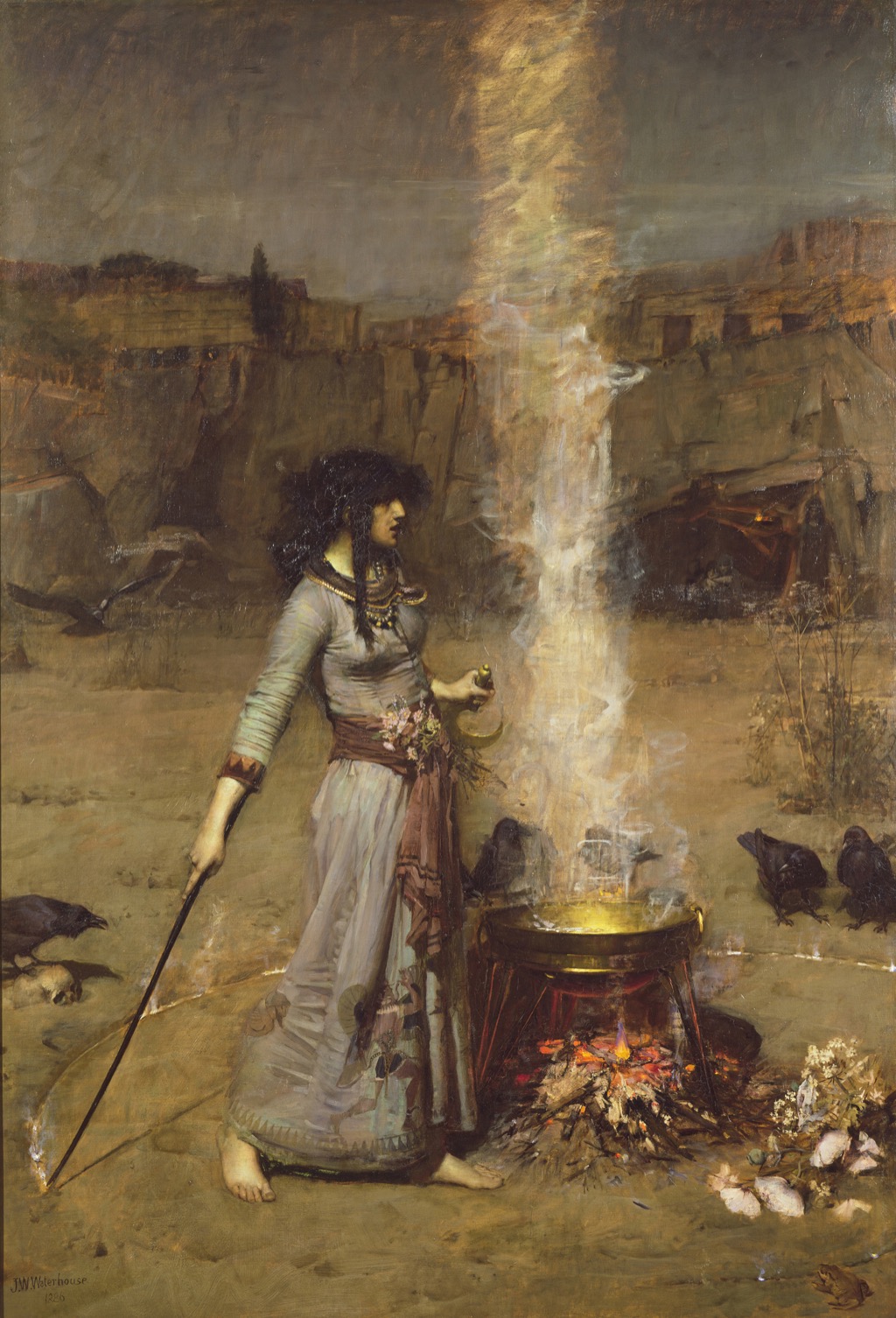
In the next year, Waterhouse exhibited Saint Eulalia and was elected an Associate of the Royal Academy. In 1886 came The Magic Circle. Seen in sequence, Consulting the Oracle is central to his movement from Roman historical narrative towards images of ritual, magic and psychologically isolated women.
The later sorceresses are more individually commanding. Here power is distributed among object, officiant and audience. That difference makes the painting an experiment Waterhouse did not simply repeat.
Its importance lies not only in being an early success. It demonstrates that his mature concerns—dangerous knowledge, female community, inward attention and the material work of magic—were already present before the famous literary heroines of the 1890s and 1900s.
Fear of Knowledge Rather Than Fear of Attack
No visible enemy threatens the women. Their fear, where it can be read in faces and bodies, comes from an answer they have deliberately sought. This makes Consulting the Oracle a painting about knowledge desired and dreaded at the same time.
Prophecy is unlike ordinary information because it can appear to change the listener's relation to the future. If an answer is believed, freedom may contract around it. The women do not merely risk hearing bad news; they risk receiving a story that will govern later choices.
Waterhouse does not tell us the question. That omission prevents interpretation from settling into a specific romance, journey, illness or political event. The oracle can contain any feared future a spectator brings to it.
The unknown question also equalises the group. One woman may have requested consultation, or all may share concern, but the picture gives no reliable distinction. Reaction circulates across the crescent as a collective state.
The head's lack of body intensifies authority through limitation. It cannot explain, revise, comfort or enter dialogue in an ordinary human way. A low voice from such an object would seem detached from consequence. The listeners must carry its words back into life.
If the voice is imagined, the painting becomes no less consequential. Expectations can create experiences that direct action. The Academy note's psychological language makes suggestion itself a form of power. [3]
This is why the work remains more complex than an image of credulous women. It asks a universal question about consultation: when people desperately seek certainty, how much of the answer has already been prepared by the conditions of asking?
The ritual may offer community as well as danger. The women do not face uncertainty alone. They gather close, share attention and permit one person to approach on their behalf. Fear becomes a form of connection.
Waterhouse holds these meanings in equilibrium. The gathering might be manipulated, spiritually receptive, psychologically suggestible or courageously confronting the unknown. The painting shows what each possibility looks like before evidence settles it.
A Female Community and an Absent Male World
The company appears entirely female, apart from the uncertain identity once attached to the preserved head. This is not incidental to the image's emotional organisation. The room becomes a space in which women ask, interpret and respond without a living male authority visible.
Waterhouse's later art often concentrates supernatural knowledge in one woman: Circe prepares drugs, a figure draws The Magic Circle, and sorceresses study vessels or books. Consulting the Oracle distributes such knowledge across a group. One woman officiates, but belief is socially sustained.
It would be too simple to call this empowerment. The women may control the ceremony, yet they submit themselves to an object whose answer cannot be challenged. Their closeness offers support while amplifying apprehension.
Nor should the preserved head automatically be gendered male merely because later retellings imply a human victim. The painting does not provide enough evidence to identify the original person. What matters is that human remains have been separated from identity and institutionalised as authority.
The room excludes ordinary civic, domestic and religious structures. There is no husband, father, magistrate or recognisable priesthood to authorise the consultation. That absence helps the rite feel secret, marginal or forbidden to Victorian eyes.
At the same time, the scene is carefully ordered. Lamps, textiles, positions and gestures show established procedure. What appears marginal from outside can feel fully institutional from within.
Waterhouse often painted women as objects of spectatorship, and the elegant group remains arranged for a gallery audience. Yet the women primarily look elsewhere. Their attention does not return ours; it passes towards the oracle. This refusal of reciprocal gaze makes spectators feel secondary to the ritual.
The company therefore has a partial privacy even while publicly displayed. We see the gathering but do not hear its question or answer. Waterhouse gives access to appearance while withholding knowledge, reproducing the very condition that brought the women to the oracle.
How to Look at Consulting the Oracle
Start with the oracle rather than the people. Ask how such a small object controls so large a room. Then trace the lines of gaze that enlarge its authority.
Notice the distance between the head and the women. That interval is where the unheard voice exists. Waterhouse keeps it visually open so that expectation has room.
Follow the priestess's body. Her lean breaks the architectural grid and turns stillness into approach. Compare her relative isolation with the compressed group.
Read the women's faces as variations, not as one repeated expression. Some seek knowledge; some appear to fear it; most do both. Their reactions make sound imaginable.
Look at lamps and furnishings after the human drama. Each object contributes to preparation and enclosure. The room has been made ready to produce belief.
Finally, consider whether the picture asks you to believe the oracle. It supplies no proof. Its deeper question is how people come to hear an answer—and what happens when a group has arranged every condition for an answer to be expected.
Related Pages
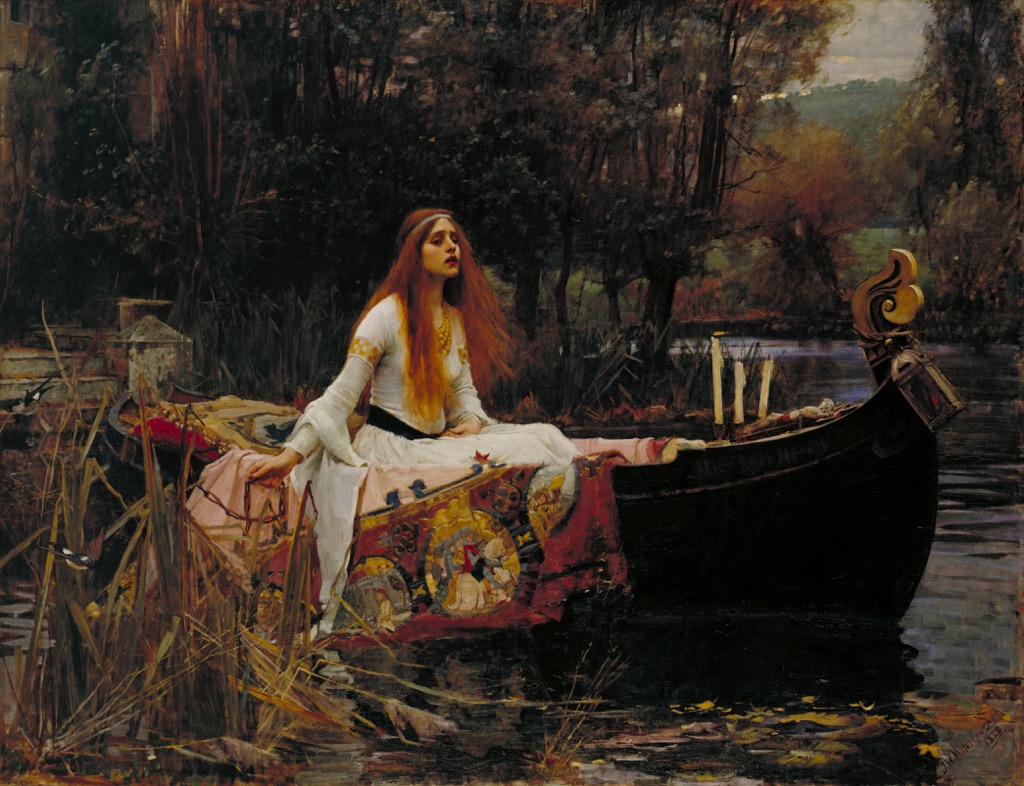
- The Lady of Shalott: Compare Waterhouse's best-known literary composition.
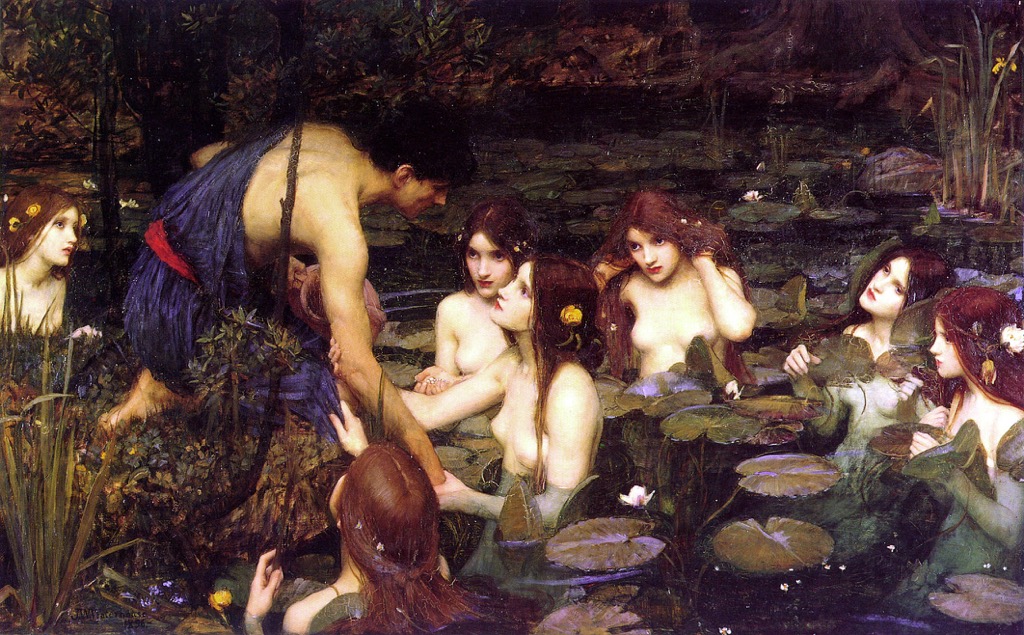
- Hylas and the Nymphs: Compare another major mythological scene.
- The Magic Circle: Compare Waterhouse's treatment of ritual and symbolism.
Frequently Asked Questions
A female officiant approaches a preserved human head fixed to a wall while a group of women waits for a prophecy. Lamps and other ritual preparations are visible. Waterhouse's Academy note said that diviners imagined they heard the head speak in a low voice. [3]
The term is related to ancient teraphim, often understood as household cult images. Waterhouse used “Oracle or Teraph” for a preserved speaking head, but the exact ancient and textual basis of this description is uncertain. Christie's research suggests a nineteenth-century retelling connected with Josephus. [3]
Not in the finished painting's stated subject. A preparatory idea may have involved the Pythian oracle, but the exhibited work was explained as consultation of an “Oracle or Teraph.” [3]
It measures 119.4 × 198.1 cm, making it a substantial horizontal Academy canvas. [1]
Yes. Waterhouse made a reduced replica in 1884, measuring 44.5 × 72.5 cm. It has a separate private-collection provenance. [3]
Its darkened gathering and possible voice from the dead could evoke séances for a Victorian audience, but no cited statement proves that Waterhouse intended a direct commentary on spiritualism. The connection should remain contextual and interpretive.
The large original belongs to Tate, accession N01541, and was presented by Sir Henry Tate in 1894. [1]
Discussion
The painting leaves its central question unanswered: does the oracle speak? That uncertainty shifts interpretation from supernatural fact to human attention. The women have prepared the room, accepted the authority of the object and gathered their emotions around an expected voice. Belief may reveal something, deceive them or do both at once.
Waterhouse neither mocks nor confirms them. He makes their listening beautiful, serious and unsettling. The severed head remains a reminder that systems of knowledge can be built around possession and violence; the women's community shows how fear can also create intimacy. What the oracle says matters less than the charged human need for it to say something.
Reader Insights
Which visible detail most changes the way you read this page?
Which source or comparison helps the work feel less familiar and more specific?
What question would you bring back to the painting after reading?
Join the Conversation
Share your reading of this page below.
References
- Tate. “Consulting the Oracle, 1884, John William Waterhouse.” Collection record, accession N01541. View source
- Henry Blackburn, ed. English Art in 1884, contemporary review and reproduction of Waterhouse's Royal Academy painting. View source
- Christie's. “John William Waterhouse, R.A., Consulting the Oracle,” lot essay for the 1884 reduced replica, including the Royal Academy catalogue explanation, preparatory history, dimensions and provenance. View source
- Anthony Hobson. J. W. Waterhouse, Oxford: Phaidon/Christie's, 1989, pp. 31, 33–34, discussion of the painting's geometry and “keyhole” composition.
- Algernon Graves. The Royal Academy of Arts: A Complete Dictionary of Contributors and Their Work from Its Foundation in 1769 to 1904, Waterhouse exhibition entries. View source