 by Tom Gurney
Tom Gurney BSc (Hons) is an art history expert with over 20 years experience
Published on June 19, 2020 / Updated on October 17, 2026
Email: tomgurney1@gmail.com / Phone: +44 7429 011000
Looking at Weasels at Play
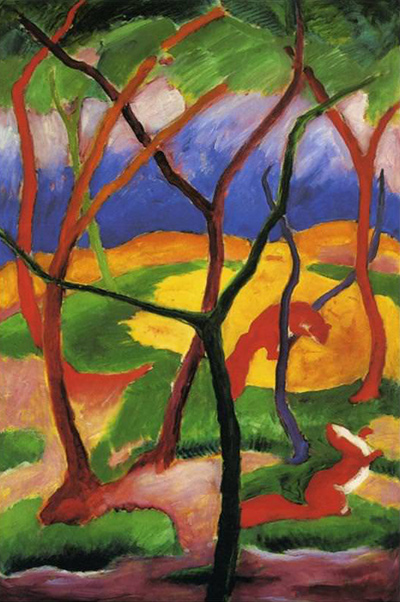
Two small reddish animals occupy the lower part of a tall, brilliant landscape. One appears near a tree while the other looks upward from the ground. The branches and foliage are much larger than either weasel, filling the picture with intersecting curves and patches of blue, pink, yellow and green. Franz Marc’s Weasels at Play is an animal painting in which the creatures do not command the entire surface. Searching for them makes us travel through the landscape. [1]
Watch: Franz Marc
Explore Marc’s blue horses, the Blue Rider circle and the move towards abstraction in English-language videos.
Franz Marc, Blue Horses and Der Blaue Reiter
An English-language introduction to Marc’s blue horses, animals, spirituality and the Blue Rider.
Watch on YouTubeA small encounter in a large setting
Marc painted the work in 1911, in oil on canvas. It measures 101 × 68 cm, a tall format that gives the rising trees room to dominate the view. The small animals form a point of attention near the bottom, but the bending trunks and canopy make their environment active too. The National Gallery of Art’s description identifies two red shapes among the branches and foliage. Looking at the image, the viewer can follow the curve above them and return to the exchange below. [1]
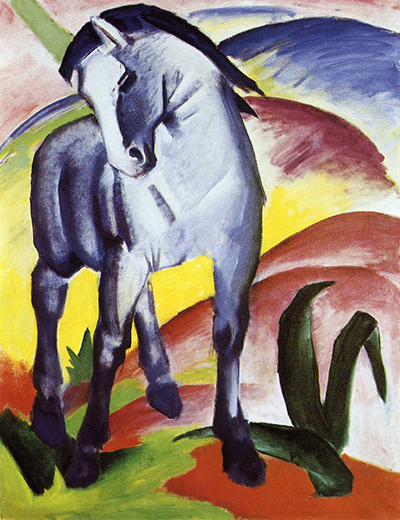
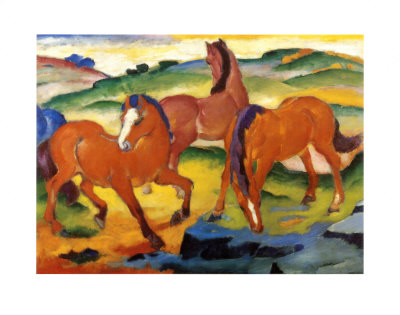
The colours do not merely identify species or season. Warm marks near the weasels stand out against a wider field of cool blues and greens; pale yellow and pink areas keep the forest from settling into a single dark mass. The painting belongs to the period when Marc was testing how animal bodies and landscape could be joined by colour. It has a different scale and rhythm from Blue Horse I, although both were made in 1911. The horse is a large central presence; these weasels have to be discovered. [1] [2]
Collection history
The work is National Gallery of Art accession 2020.112.2, credited to the collection of Arnold and Joan Saltzman and presented to the gallery in 2020. The museum traces an earlier path through Bernhard Koehler’s collection by 1936, later owners and dealers, and the Saltzman collection. That history is more specific than a general statement that Marc’s art moved from Germany to America: it names the documented custodians of this canvas. The gallery identifies the image available on its object page as public-domain media. [1]
The title asks us to see play. Marc gives only a few clues to the creatures’ action while making their shared surroundings unusually vivid. The little red forms are enough to animate an entire forest. They invite a close look at where animal life sits within the picture rather than a search for a fixed message attached to each colour.
Artwork Directory
This source-checked selection contains 192 identified works and print designs from the current Franz Marc research set. It is a curated selection, not a complete catalogue raisonné. Some works link to their article here; others link to a collection record. Unresolved identifications are omitted.
Discussion
Two small weasels occupy the lower part of a brilliant tall landscape.
Reader Insights
Observation
Where do you find each weasel among the large plants?
Comparison
How does this scale difference compare with Forest with Squirrel?
Interpretation
What gives the scene a sense of play rather than danger?
Join the Conversation
Which detail changed the way you saw this work? Share a close observation or a comparison with another Marc picture.
References
- National Gallery of Art, Weasels at Play. View source.
- Lenbachhaus, Blue Horse I. View source.
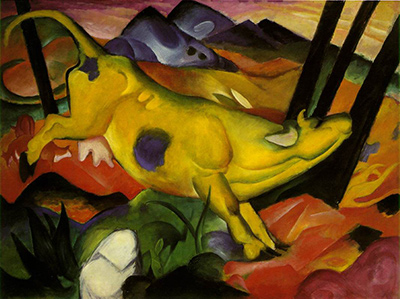
- Related artwork image, Yellow Cow: Photograph by Dr. Alexey Yakovlev; resized without crop or colour change, CC BY-SA 2.0.
- Splash image: Franz Marc, Weasels at Play, 1911, oil on canvas. National Gallery of Art, Washington, 2020.112.2. Public-domain image from the NGA. Object record.