 by Tom Gurney
Tom Gurney BSc (Hons) is an art history expert with over 20 years experience
Published on June 19, 2020 / Updated on October 17, 2026
Email: tomgurney1@gmail.com / Phone: +44 7429 011000
Looking at Mountains (Stony Path)
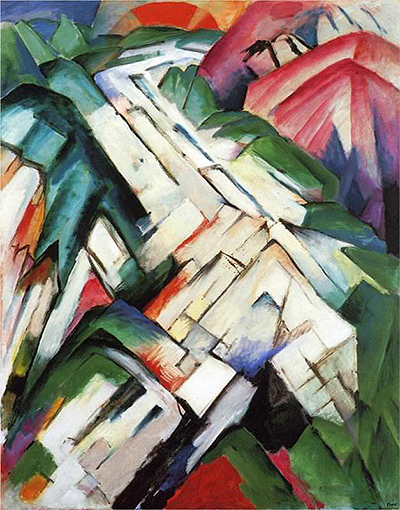
The painting long called Mountains has a more specific current title at the San Francisco Museum of Modern Art: Steiniger Weg (Stony Path), formerly Gebirge/Landschaft (Mountains/Landscape). Franz Marc began the landscape in 1911 and repainted it in 1912, producing the angular image seen here. SFMOMA holds the oil on canvas as 51.4095; it measures 130.8 × 101.1 cm. Keeping the titles together prevents this older English route from suggesting a second mountain painting. [1]
Watch: Franz Marc
Explore Marc’s blue horses, the Blue Rider circle and the move towards abstraction in English-language videos.
Franz Marc, Blue Horses and Der Blaue Reiter
An English-language introduction to Marc’s blue horses, animals, spirituality and the Blue Rider.
Watch on YouTubeA path through fractured mountains
A pale, zigzagging band runs up the centre of the upright canvas, broken by dark diagonal marks. Green and blue planes press in from the left; pink and violet ridges rise at the upper right. Near the summit, a small orange sun appears above the fractured landscape. The path gives the eye a direction through shapes that otherwise seem to tilt and collide. SFMOMA's audio account describes the central light form as a path thought to evoke a Bavarian mountain route; the exact place remains an interpretation, not a securely identified site. [1]
The contrast between the nearly white centre and the darker edges makes the landscape feel both open and difficult to cross. Edges do not settle into a conventional foreground and distant horizon. Instead, the coloured facets bring mountain, path and light onto one busy surface. The painting still names a landscape, even while Marc asks viewers to construct its depth from overlapping planes rather than an easy view into space.
One canvas, revised
SFMOMA says Marc showed the original Landschaft in 1911, then reworked the same canvas after visiting Robert Delaunay in Paris in 1912. The museum describes the earlier version as softer and more curved, and the surviving state as more angular. That history matters more than trying to assign every red or blue passage a fixed symbolic meaning. The painting records a substantial change of pictorial method on one object. Its present title Stony Path gives a concrete point of entry; Mountains and Landscape remain part of its documented title history. [1]
Artwork Directory
This source-checked selection contains 192 identified works and print designs from the current Franz Marc research set. It is a curated selection, not a complete catalogue raisonné. Some works link to their article here; others link to a collection record. Unresolved identifications are omitted.
Discussion
The stony path draws the eye upward through coloured and fractured mountain planes.
Reader Insights
Observation
Where does the pale central path become hardest to follow?
Comparison
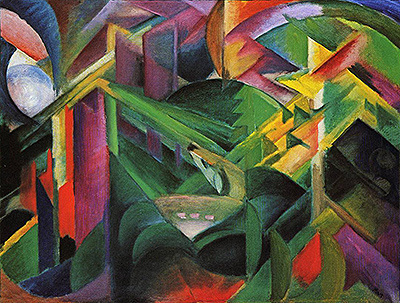
How does this landscape organise space differently from Marc’s earlier Indersdorf?
Interpretation
What does the painting’s 1912 revision change about its title history?
Join the Conversation
Which detail changed the way you saw this work? Share a close observation or a comparison with another Marc picture.
References
- SFMOMA, object 51.4095. View source.
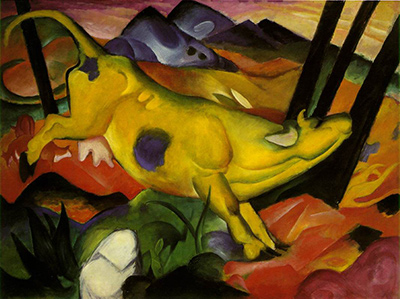
- Related artwork image, Yellow Cow: Photograph by Dr. Alexey Yakovlev; resized without crop or colour change, CC BY-SA 2.0.
- Splash image: Franz Marc, Steiniger Weg (Stony Path), formerly Gebirge/Landschaft (Mountains/Landscape), 1911–12, oil on canvas, 130.8 × 101.1 cm. SFMOMA, 51.4095. Public-domain faithful reproduction from a gallery photograph, resized without crop or colour adjustment. Image file and rights.