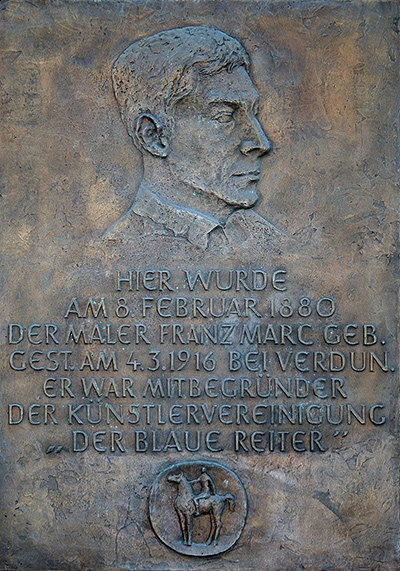
 by Tom Gurney
Tom Gurney BSc (Hons) is an art history expert with over 20 years experience
Published on June 19, 2020 / Updated on October 17, 2026
Email: tomgurney1@gmail.com / Phone: +44 7429 011000
Explore Marc’s prints
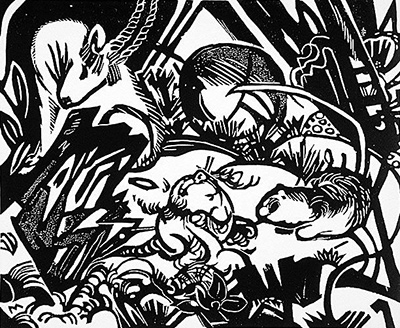
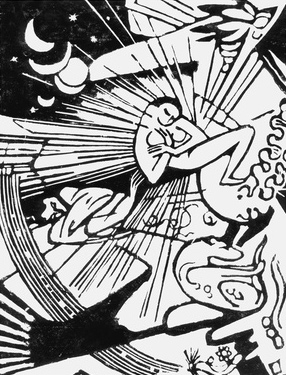
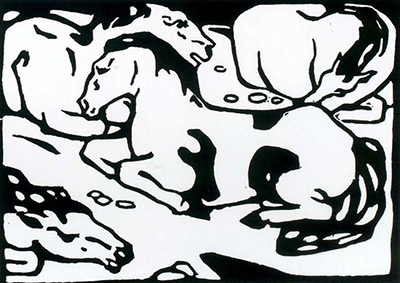
Franz Marc is best known for paintings of horses, deer and other animals, but he also made original prints. A woodcut starts with a carved block: raised areas receive ink and transfer an image to paper, so several impressions can be made from one design. That process is different from a modern poster reproducing a photograph of one of Marc’s paintings. The distinction matters if we want to understand his choices of line, surface and edition, rather than simply shop for an image. MoMA identifies Horses Resting as Marc’s first woodcut and counts 46 prints across his short career. [1]
Marc began woodcutting during the years when he and Wassily Kandinsky worked on Der Blaue Reiter. The medium gave him another way to simplify an animal body and fit it into a strong pattern. A carved line cannot be moved as freely as a brushstroke once the block is cut. The constraints encourage decisions about what to leave white, what to print dark and where one shape should meet another. [2] [1]
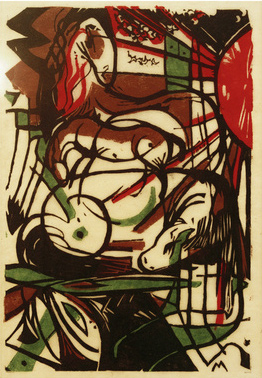
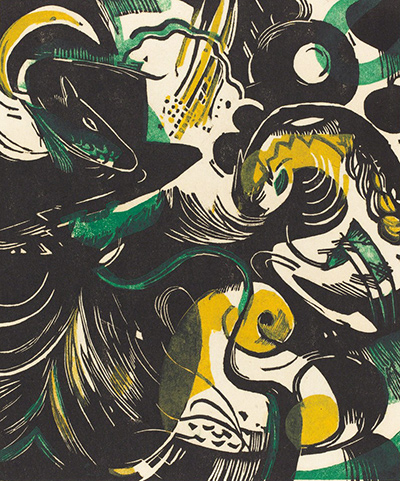
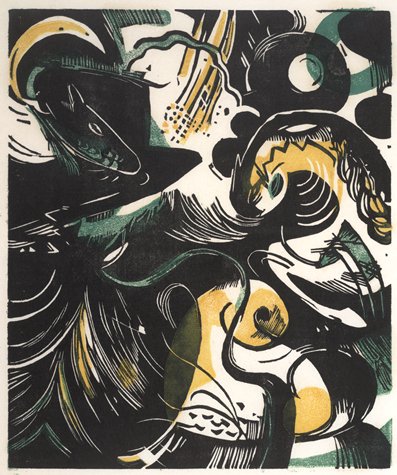
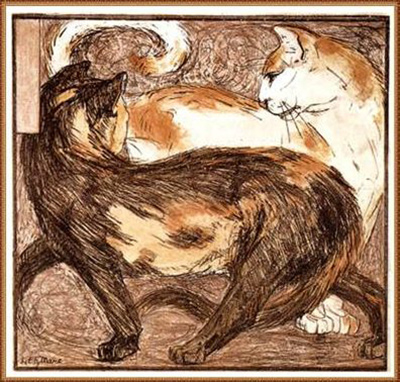
Marc also made lithographs. The Lenbachhaus identifies Two Cats as a colour lithograph of 1909–10, a printed work rather than a sketch despite the older name of this site's article route. The browse list below includes that work alongside two separately catalogued impressions of the 1914 Genesis II colour woodcut: one held by the National Gallery of Art and one by the Cleveland Museum of Art. The two museum pages document individual sheets from one design, not two different compositions. [3] [4] [5]
From block to impression
In relief printing, the areas left raised on the block take ink; the cut-away areas remain the colour of the paper. A print can therefore express an animal with a few broad contrasts rather than the full modelling of an oil painting. The final image also appears reversed from the design on the block. Different papers, inks or later additions can make impressions from one matrix visibly different. A museum record for a particular print identifies the actual impression—its paper, additions and sometimes edition—rather than merely naming the design. [1]
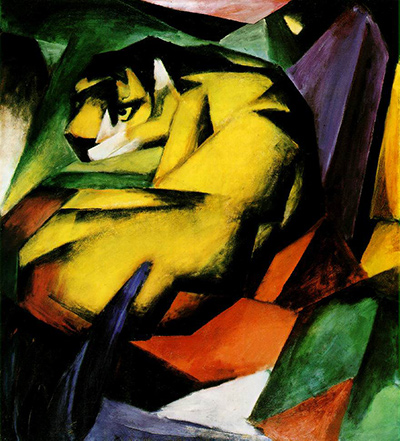
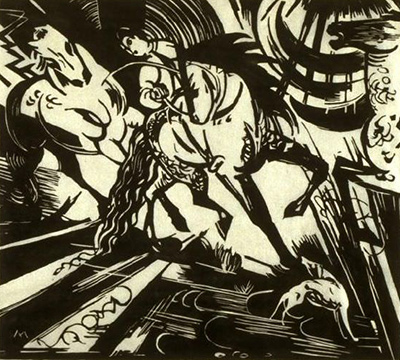
Marc’s Tiger painting of 1912 has a related but separate woodcut title. The two must not be used as interchangeable images. The painting has colour and a large oil surface; the woodcut communicates through cut shapes and printed contrast. Looking at such pairs can show how Marc tested an animal’s posture in different media without assuming every print is a copy of a canvas. [6] [7]
Watch: Franz Marc
Explore Marc’s blue horses, the Blue Rider circle and the move towards abstraction in English-language videos.
Franz Marc, Blue Horses and Der Blaue Reiter
An English-language introduction to Marc’s blue horses, animals, spirituality and the Blue Rider.
Watch on YouTubePrints in Der Blaue Reiter
The 1912 Der Blaue Reiter almanac included Marc’s Fabeltier or Fantastic Creature woodcut in its deluxe and museum editions. MoMA’s detailed record describes an impression with tempera additions, printed on Japanese paper and bound into the book. The ordinary edition did not include those two original woodcuts by Marc and Kandinsky. This means that two copies of the same almanac can differ materially. The image’s place within a particular edition is part of its history. [8]
The almanac brought reproductions and writings by many makers into one publication. An original woodcut inserted in some copies had another role: it was a physical work made from a block, with ink transferred to paper. Marc’s presence in the book was therefore editorial, textual and graphic. The print was one object among a larger exchange of ideas rather than a decoration added after the writing was finished. [9] [8]
Looking at an original impression
The Lenbachhaus records Marc’s 1912 Drinking Horse as a woodcut on beige-brown Japanese paper with embedded fibres. Those material details tell us more than the title alone. The animal’s bending neck and the contrast of ink against warm paper become parts of one printed object. A cropped digital image may make the paper seem neutral; the museum’s record reminds us that the support has its own colour and texture. [10]
Printed editions complicate the idea of an “original” without making it meaningless. A museum impression can belong to a documented edition, and blocks may be printed at different times. MoMA’s records include edition and publisher details for Marc’s prints, including later issues. When comparing impressions or browsing images online, check the museum’s date for the design and the date of the particular printing. A posthumous impression can preserve Marc’s cut image while having its own later production history. [7] [8]
To explore Marc’s graphic work, start with Horses Resting, move to an animal woodcut such as Drinking Horse, then look at Fabeltier in its book context. Ask what Marc has left uncut, where a printed line changes direction and how the animal fills the available paper. Those questions lead back to the paintings with a sharper eye for their own simplifications, while keeping print and canvas as different kinds of object. [1] [10] [8]
Browse original prints
Artwork Directory
This source-checked selection contains 192 identified works and print designs from the current Franz Marc research set. It is a curated selection, not a complete catalogue raisonné. Some works link to their article here; others link to a collection record. Unresolved identifications are omitted.
Discussion
Marc’s prints turn line, cut shapes and repeated impressions into different ways of seeing animals.
Reader Insights
Observation
Which printed animal is most clearly built from light and dark rather than painted colour?
Comparison
How does a woodcut’s edge differ from the edge of a painted animal?
Interpretation
What can a printed state reveal that a single reproduction may hide?
Join the Conversation
Which detail changed the way you saw this work? Share a close observation or a comparison with another Marc picture.
References
- MoMA, German Expressionist woodcut essay. View source.
- MoMA, Franz Marc printmaker biography. View source.
- Lenbachhaus, Two Cats. View source.
- National Gallery of Art, Genesis II. View source.
- Cleveland Museum of Art, Genesis II. View source.
- Lenbachhaus, Tiger painting. View source.
- MoMA, Marc Tigers woodcut record. View source.
- MoMA, Fabeltier and Der Blaue Reiter edition record. View source.
- MoMA, Der Blaue Reiter publication history. View source.
- Lenbachhaus, Trinkendes Pferd woodcut. View source.
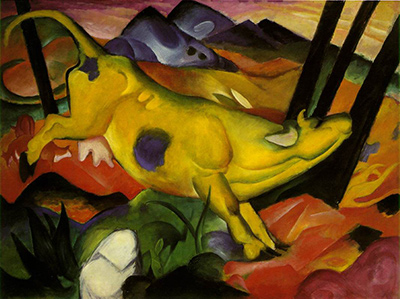
- Related artwork image, Yellow Cow: Photograph by Dr. Alexey Yakovlev; resized without crop or colour change, CC BY-SA 2.0.