 by Tom Gurney
Tom Gurney BSc (Hons) is an art history expert with over 20 years experience
Published on June 19, 2020 / Updated on October 17, 2026
Email: tomgurney1@gmail.com / Phone: +44 7429 011000
Looking at Leaping Horse
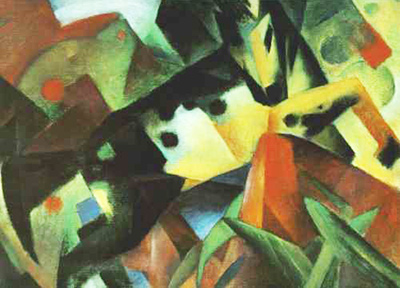
A dark horse crosses Franz Marc’s Leaping Horse through a field of jagged green, yellow, red and black. Its legs and body are partly taken apart by the coloured planes around them. The movement is unmistakable even when the animal’s exact outline takes time to find: a long dark diagonal carries the body across the canvas, while sharp angles seem to meet and resist it. Marc painted the work in 1912, when the horse remained central to his art but could be built from a far more fractured visual language than in his paintings of only a year or two before. [1]
The German title is Springendes Pferd. It is also identified as Bild mit Pferd in a Bavarian museums record. The painting is shown in connection with the Franz Marc Museum in Kochel am See, which names it among its major works. The Bavarian museums record describes it as a permanent loan from a private collection. Its presence at the museum should therefore not be taken to mean the museum owns the canvas. A separate Lenbachhaus drawing called Springendes Pferd is another object altogether. [1] [2]
Watch: Franz Marc
Explore Marc’s blue horses, the Blue Rider circle and the move towards abstraction in English-language videos.
Franz Marc, Blue Horses and Der Blaue Reiter
An English-language introduction to Marc’s blue horses, animals, spirituality and the Blue Rider.
Watch on YouTubeReading the movement
The horse is not set against a calm distant field. Dark strokes and coloured facets press against it from every side. Follow the black band from left to right: it gives the animal a strong forward direction, but it also crosses green and pale areas that complicate where body ends and setting begins. Marc lets us recognise a leap through the force of the whole arrangement, not only through a clear outline of four legs. [1]
A bright yellow region near the upper centre and red-orange planes below it push against the dark body. Green wedges appear to tilt upward from the lower edge. These parts seem almost to spring with the horse. They make the setting active, as though the ground and air were responding to movement rather than waiting as a neutral backdrop. The result differs from a snapshot of a horse suspended in mid-jump. It is an image of motion distributed across an entire painted surface. [1]
The face and limbs are less immediately legible than the sweep of the dark body. That difficulty is part of looking at the work, but it should not be turned into a puzzle with a single diagrammatic answer. Marc allows the angled pieces to retain their colour and shape even when they also help form an animal. The viewer moves back and forth between seeing a horse and seeing a network of opposing forces. [1]
From horse portrait to broken space
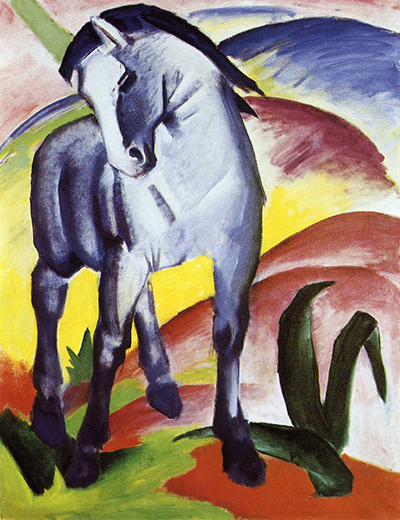
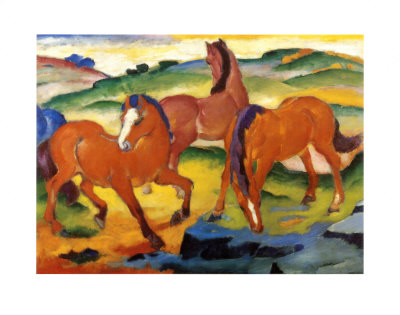
Marc’s Horse in a Landscape of 1910 places an animal close to the viewer, looking across wide colour bands. The 1912 leap turns the horse across our field of vision and breaks the surrounding space into much shorter, harder pieces. Both paintings make the horse inseparable from its environment. They differ in how a viewer feels that relationship: one through a shared outlook, the other through a rapid crossing of planes. [3] [1]
The Large Blue Horses of 1911 makes three bodies into a connected, curving group. Their rhythm is broad and continuous. In Leaping Horse, angular interruptions work against the horse’s single directional surge. The pictures show that Marc did not have one fixed formula for horses. Posture, number of animals and the space surrounding them all alter the kind of encounter the viewer has. [4] [1]
The museum’s broader collection includes paintings, drawings and sketches from Marc’s development. That context is useful here: the leap does not represent an abandonment of close animal study. It shows one way he used familiarity with the horse to take more liberties with outline and space. Because the animal is still recognisable, the viewer can feel the distance Marc has travelled from natural description without losing the physical event that prompted the picture. [1]
The work in Kochel
The Franz Marc Museum presents Springendes Pferd in its account of the collection, alongside works such as Great Landscape I, Red Deer II and Donkey Frieze. The museum’s pages date it to 1912. A separate Bavarian museum listing makes the private loan status explicit. These sources give the painting a secure identity and current institutional context, while they do not supply a dependable set of original dimensions or a full ownership history. Those details are best left open until an object catalogue establishes them. [1] [2]
Return once more to the diagonal dark horse. The eye follows its apparent leap, then discovers how many green and yellow edges help propel it. Marc gives movement to the animal and to the world touching it. That shared energy is what makes Leaping Horse more than a horse picture with a dynamic pose. [1]
Artwork Directory
This source-checked selection contains 192 identified works and print designs from the current Franz Marc research set. It is a curated selection, not a complete catalogue raisonné. Some works link to their article here; others link to a collection record. Unresolved identifications are omitted.
Discussion
A lifted horse cuts through a landscape that is starting to break into planes.
Reader Insights
Observation
Which limb or diagonal most strongly carries the leap?
Comparison
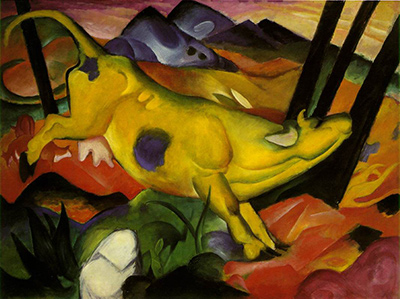
How does this horse’s movement differ from Yellow Cow’s?
Interpretation
Does the broken space make the animal seem freer or more constrained?
Join the Conversation
Which detail changed the way you saw this work? Share a close observation or a comparison with another Marc picture.
References
- Franz Marc Museum, collection overview and Springendes Pferd image. View source.
- Museen in Bayern, Franz Marc Museum gallery and loan credit. View source.
- Museum Folkwang, Pferd in Landschaft. View source.
- Walker Art Center, The Large Blue Horses. View source.
- Related artwork image, Yellow Cow: Photograph by Dr. Alexey Yakovlev; resized without crop or colour change, CC BY-SA 2.0.
- Splash image: Franz Marc, Leaping Horse (Springendes Pferd / Bild mit Pferd), 1912. Public-domain reproduction via Wikimedia Commons, from the Franz Marc Museum image; resized from 1032 × 781 without crop or colour adjustment. Museum loan credit.