 by Tom Gurney
Tom Gurney BSc (Hons) is an art history expert with over 20 years experience
Published on June 19, 2020 / Updated on October 17, 2026
Email: tomgurney1@gmail.com / Phone: +44 7429 011000
Looking at Siberian Dogs in the Snow
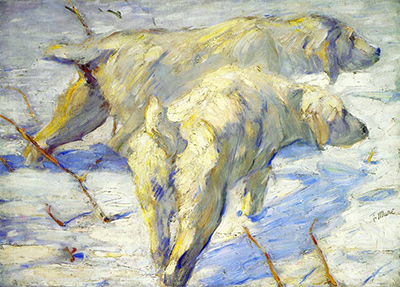
Two pale dogs lower their heads in a field of snow. Their bodies fill a broad horizontal canvas, yet the blue shadows, broken white strokes and dry yellow grasses are as carefully observed as the animals. Franz Marc painted Siberian Dogs in the Snow in 1909–10, before the boldly simplified blue horses for which he is often remembered. The painting shows that his interest in animals began with sustained attention to particular bodies, coats and surroundings. [1]
Watch: Franz Marc
Explore Marc’s blue horses, the Blue Rider circle and the move towards abstraction in English-language videos.
Franz Marc, Blue Horses and Der Blaue Reiter
An English-language introduction to Marc’s blue horses, animals, spirituality and the Blue Rider.
Watch on YouTubeLooking at the dogs
The National Gallery of Art records an oil painting measuring 80.5 × 114 cm. Both long-haired dogs face to the viewer’s right, with heads held low. Marc builds their ivory-white coats from textured strokes and gives the ground cool blue shadows. Straw-coloured stems angle up from the snow. The animals and the winter field share a palette, but their muzzles, ears and legs remain distinct. The artist’s signature appears at the lower right. [1]
The canvas is sometimes filed on older websites as “Siberian Sheepdogs.” The owning museum uses Siberian Dogs in the Snow. The German Sibirische Schäferhunde helps explain the alternate label, but the two English titles refer here to one painting, not two works. That matters when comparing it with the later Jumping Dog Schlick or Marc’s other dogs: the posture, snowy ground, date and accession identify this particular object. [1]
A documented journey
The gallery’s provenance follows the painting from the Munich art trade to Ludwig and Alice Hopf by about 1910. The Hopf family later lived in London and Dublin after Ludwig, a physicist, lost his position under Nazi persecution. Alice Hopf lent the painting to a Dublin exhibition in 1944. It was sold in 1958 through Lea Bondi Jaray to Stephen Kellen and given to the National Gallery in 1983. These documented steps make the work’s later history more than a simple acquisition date. The gallery credits the gift of Mr. and Mrs. Stephen M. Kellen and numbers it 1983.97.1. [1]
Blue in this early painting is the colour of shadow and cold light, not yet the entire body of a symbolic horse. That does not make the work merely a preliminary exercise. Its close, side-by-side animals and textured surface have their own quiet force. The National Gallery makes the object image available as public-domain media for a closer look at the brushwork. [1]
Artwork Directory
This source-checked selection contains 192 identified works and print designs from the current Franz Marc research set. It is a curated selection, not a complete catalogue raisonné. Some works link to their article here; others link to a collection record. Unresolved identifications are omitted.
Discussion
Two pale dogs occupy a broad snowy landscape.
Reader Insights
Observation
How do their lowered heads relate to the dry grasses?
Comparison
How does this pair differ from Dog Lying in the Snow?
Interpretation
Which marks make the cold setting feel observed rather than imagined?
Join the Conversation
Which detail changed the way you saw this work? Share a close observation or a comparison with another Marc picture.
References
- National Gallery of Art, Siberian Dogs in the Snow. View source.
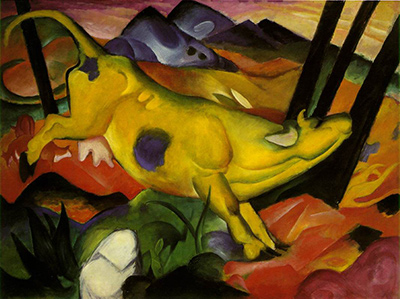
- Related artwork image, Yellow Cow: Photograph by Dr. Alexey Yakovlev; resized without crop or colour change, CC BY-SA 2.0.
- Splash image: Franz Marc, Siberian Dogs in the Snow, 1909–10, oil on canvas. National Gallery of Art, Washington, 1983.97.1. Public-domain image from the NGA. Object record.