
Franz Marc Quotes Buy Art Prints Now
from Amazon

* As an Amazon Associate I earn from qualifying purchases.


by
Tom Gurney BSc (Hons) is an art history expert with over 20 years experience
Published on June 19, 2020 / Updated on October 17, 2026
Email: tomgurney1@gmail.com / Phone: +44 7429 011000

Explore Marc’s words in context

Franz Marc’s letters and notes can bring us closer to the questions behind his paintings, but a memorable English sentence is only as useful as its source. A dated letter may describe a thought he held at one moment; an undated note may survive through a later editor; an obituary tells us about a friend as much as about Marc. This page keeps a small number of traceable passages and gives their setting. English explanations below are paraphrases of the German, not claims that Marc wrote in English. [1] [2]

How might an animal see?

In notes that the 1920 editor dates probably to 1911–12, Marc asks: “Wie sieht ein Pferd die Welt?”—how does a horse see the world? He goes on to ask the same of an eagle, a deer and a dog, and challenges painters who place animals in landscapes arranged only for human eyes. The short question is often repeated as a general saying. In its source it is the start of a sustained artistic problem about perspective, imagination and the limits of human observation. [1]

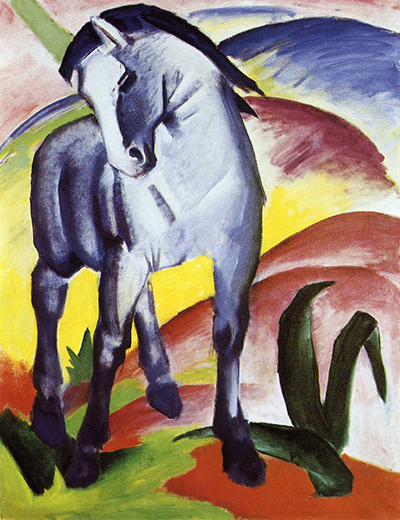
The question does not mean that Marc claimed to reproduce a horse’s actual vision. Horse in a Landscape gives us a horse between ourselves and a banded field; Blue Horse II makes us look past an animal seen from behind. They are imaginative answers in paint, not scientific diagrams of eyesight. Reading the note alongside the pictures keeps the question open and productive. [3] [4]

Watch: Franz Marc

Explore Marc’s blue horses, the Blue Rider circle and the move towards abstraction in English-language videos.

A letter about colour

On 12 December 1910 Marc wrote to August Macke to set out a theory of blue, yellow and red. One short clause reads: “Blau ist das männliche Prinzip, herb und geistig.” In our English paraphrase, Marc associated blue with a masculine, severe and spiritual quality. He continued with yellow and red and with the effects of colours placed or mixed together. The letter shows him thinking through relationships, not issuing a permanent label to attach to every blue patch in every later canvas. [2]

That dated context matters. Marc’s Blue Horse I of 1911 and Little Yellow Horses of 1912 can be read with his letter in mind, but their forms, poses and settings still need attention. The Stuttgart museum compares the yellow horses with an earlier blue group and discusses Marc’s gendered colour language as part of the painting’s historical interpretation. It does not turn the letter into a substitute for looking. [5] [6]

Remembering August Macke

August Macke died in September 1914. Marc’s later tribute mourns the loss of a fellow artist through a musical image of colour: “Er hat vor uns allen der Farbe den hellsten und reinsten Klang gegeben.” In English paraphrase, Marc felt Macke had given colour an unusually bright and pure resonance. The line is praise of Macke, not a statement that Marc was describing his own achievement. Its placement in a memorial text changes how it should be used. [1] [7]

Read the source, then the picture

These three passages show different forms of writing: a speculative note, a private letter and a public act of mourning. They should not be merged into a timeless list of sayings. Many English quotations attributed to Marc online have no named edition or translator, and polished translations can hide the uncertainty of the original wording. Where an English version is used here, it is identified as a paraphrase, with the German source linked so readers can check it. The words are most valuable when they send us back to specific works with better questions. [1] [2]

Artwork Directory

This source-checked selection contains 192 identified works and print designs from the current Franz Marc research set. It is a curated selection, not a complete catalogue raisonné. Some works link to their article here; others link to a collection record. Unresolved identifications are omitted.

192 artworks

NameDateMedium
Abstract Composition1913 - 14Drawing
Alpine Herdsman in the Hut1902Painting
Altar Sheep from Lana (postcard to Gabriele Münter)11. April 1913Drawing
Animal Legend1912Print
Animals in Landscape1914Painting
Bathing Girls1968Painting
Belt Clasp (Lioness Pierced by an Arrow)1909/10Sculpture
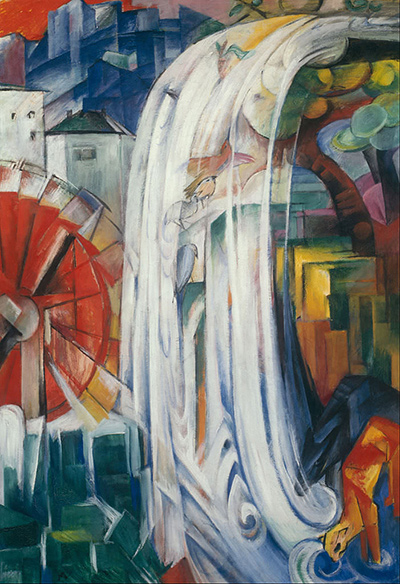
Bewitched Mill1913Painting
Birds1914Painting
Birth of the Horses1913Print
Blue Fox1911Painting
Blue Horse1911Painting
Blue Horse II1911Painting
Blue Horse with Rainbow1913Drawing
Bluish Mythical Creature (Messages to Prince Jussuff)1913Drawing
Boy with Sled in a Winter Landscapeum 1902Painting
Broken Forms1914Painting
Bull1911Painting
Caliban1914Drawing
Cat Behind a Tree1910–11Painting
Cat behind a Tree1910-1911Drawing
Cat on a Yellow Pillow1912Painting
Cats1909–10Painting
Chimera1914Sculpture
Colored Flowers1913–14Drawing
Conciliation1912Print
Cottages on the Dachau Marsh1902Painting
Cows Yellow, Red & Green1911Painting
Crouching Deer1911Painting
Cup (alabaster)—Sculpture
Dead Deer1913Drawing
Dead Sparrow1905Painting
Deer at Dusk1909Painting
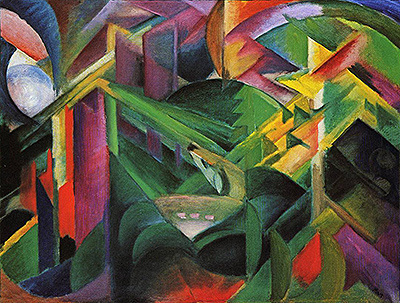
Deer in a Monastery Garden1912Painting
Deer in the Forest1913Painting
Deer in the Forest II1914Painting
Deer in the Forest II (Lenbachhaus, 1912)1912Painting
Deer in the Reeds1909Painting
Deer in the Snow1911Painting
Design for a Keyhole Escutcheon: Two Mythical Animals1913Drawing
Dog1912Painting
Dog Lying in the Snow1911Painting
Donkey Frieze1911–12Painting
Dream1912Painting
Dream Rock1913Drawing
Dreaming Horse1913Drawing
Elephant1907Drawing
Elephant (1913 MoMA pencil drawing)1913Drawing
Elephant, Horse and Cow1913–14Painting
Fabulous Beast II (Horse)1913Drawing
Fairy Animals I1913Drawing
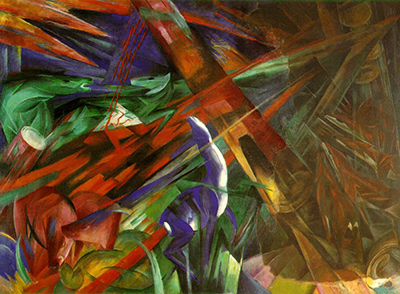
Fate of the Animals1913Painting
Female Nude Study1909Painting
Female Torso1910Sculpture
Fighting Forms1914Painting
Fire Ox, Green Horse and Ibex1913Drawing
Forest with Squirrel1913Painting
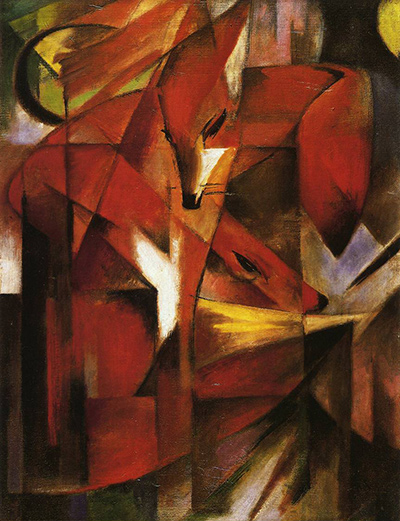
Four Foxes1913Drawing
Fox1913Painting
Fox and Gazelle (Messages to Prince Jussuff)1913Drawing
From King Jussuff's Nights1913Drawing
From Prince Jussuff's Hunting Grounds1913Drawing
From the Ancient Royal City of Thebes1913Drawing
Gazelles1913–14Drawing
Genesis II (NGA impression)1914Print
Girl with Cat II1912Painting
Grazing Horses1910Painting
Grazing Horses I1910Painting
Hay Wagon1905Painting
Haystacks in the Snow1911Painting
Horse (1913 Art Institute drawing)1913Drawing
Horse and Dog1913Drawing
Horse in a Landscape1910Painting
Horses (museum title partly redacted)1913Drawing
Horses by the Sea1907Painting
In the Rain1912Painting
Indersdorf1904Painting
Inside a Forest with a Bird1912Painting
Jumping Dog Schlick1908Painting
Keyhole Fitting (Panther Leaping at a Horse)1910Sculpture
Keyhole Fitting Shaped Like a Sword Guard (Adam and Eve)1910Sculpture
King Abigail's Toy Horse1913Drawing
King Jussuff's Three Panthers1913Drawing
Lamb1913–14Painting
Landscape with Red Animal (postcard to Alfred Kubin)18. März 1913Drawing
Larch Sapling1908Painting
Large Blue Horses1911Painting
Large Lenggries Horses1908Painting
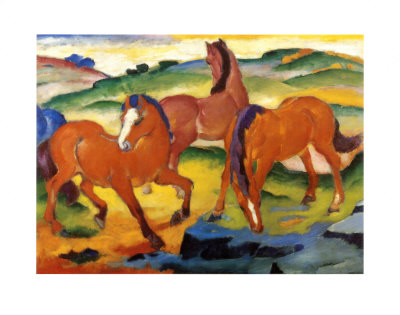
Large Red Horses1911Painting
Leaping Horse1912Painting
Leaping Horse (1912 drawing)1912Drawing
Little Blue Horse1912Painting
Little Yellow Horses1912Painting
Long Yellow Horse1913Painting
Mandrill1913Painting
Mandrill (1913 sketchbook study)1913Drawing
Monkey1912Painting
Monkey and Humanum 1912Painting
Monkey Frieze1911Painting
Mortar and Pestle1910Sculpture
Mother Mare of the Blue Horses1913Drawing
Mountain Goats1914Painting
Mountains1911–12Painting
New Year's Card1913Drawing
New Year's Greeting (postcard to Gabriele Münter)30. Dezember 1912Drawing
Nude Lying in the Flowers1910Painting
Nude with Cat1910Painting
Orpheus Among the Animals (Design for a Tapestry)Um 1907/09Painting
Park Landscape1908Drawing
Picture with Cattle1913Painting
Playing Dogs1912Drawing
Portrait of a Woman Painter with Palette (Maria Marc Painting in the Snow)1906Painting
Portrait of Henri Rousseau (reverse-glass painting)1911Painting
Portrait of the Artist's Father1902Painting
Portrait of the Artists Mother1902Painting
Prince Juss's Four Companion Dogs1914Drawing
Prince Jussuf's Lemon Horse and Fire Ox1913Drawing
Prince Jussuff's Warhorse7. April 1913 (Poststempel)Drawing
Reclining Deer (pencil study)1911/12Drawing
Red and Blue Horse1912Drawing
Red and Blue Horse (1913 postcard)5. April 1913Drawing
Red Bull1912Drawing
Red Deer1913Painting
Red Deer Grazing1910Painting
Red Deers1912Painting
Red Horse and Yellow Cow (postcard to Alfred Kubin)21. Mai 1913Drawing
Red Woman1912Painting
Resting Horses1911–12Print
Rising Mist1903Painting
Scene from Jussuff's Peaceful Days1. Mai 1913 (Poststempel)Drawing
Seated Mythical Animal1912/13Drawing
Seated Saint (1913 postcard)8. Juni 1913Drawing
Self Portrait1904Painting
Sheaf of Grain1907Painting
Sheep1912Painting
Shepherd Boy1902Painting
Shepherds1912Painting
Siberian Sheepdogs1909/1910Painting
Sleeping Animals1913Painting
Small Composition I1913Painting
Small Composition II1913/14Painting
Small Composition III1913–14Painting
Small Horse Picture1909Painting
Small Horse Study1905Painting
Small Reed Stack near Brunnenbach1908Drawing
St. Julian the Hospitaler1913Drawing
Stables1913Painting
Staffelalm (II) with Sheep1902Painting
Standing Horse with Trees1910Drawing
Tale of Creation (Cleveland impression)1914Print
The Blue Rider and His Horse1912Drawing
The First Animals1913Drawing
The Holy Little Calf1913Drawing
The Little Violet Elephant1913Drawing
The Panther1908Sculpture
The Riding School1913Print
The Trees Showed Their Rings, the Animals Their Veins (work on paper)1913Drawing
The Unfortunate Land of Tyrol (paper study)1913Drawing
The Watering Place at Ruby Mountain1913Drawing
The World Cow1913Painting
Three Cats1913Painting
Three Horses1912Drawing
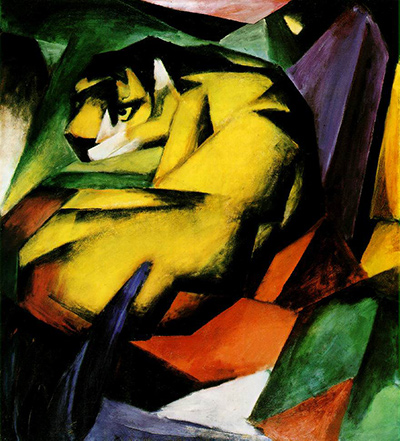
Tiger1912Painting
Tower of Blue Horses1913Painting
Tower of Blue Horses postcard1912Drawing
Two Animals (postcard to Kandinsky)15. Februar 1913Drawing
Two Bathing Girls1909Painting
Two Blue Horses—Drawing
Two Blue Horses1913Drawing
Two Blue Horses before a Red Rock1913Drawing
Two Cats (colour lithograph)1909/10Print
Two Cats Blue and Yellow1912Painting
Two Cows in a Mountain Landscape1913Drawing
Two Horses (1913)1913Drawing
Two Horses (bronze sculpture)1908/09Sculpture
Two Horses, Red and Blue (1912)1912Drawing
Two Sheep (postcard to Kandinsky)1. Mai 1913Drawing
Two Women on the Hillside1906Painting
Tyrol1914Painting
Unfortunate Land of Tyrol1913Painting
Untitled (Sheep with Bent Head)—Sculpture
Untitled (Standing Sheep)—Sculpture
Vermilion Greeting (postcard to Kandinsky)19. April 1913Drawing
Water Pool1906Painting
Waterfall1912Painting
Weasels Playing1911Painting
White Pigs1912Painting
Wild Boars in the Water1910–11Drawing
Wild Pigs Boar and Sow1913Painting
Wolves Balkan War1913Painting
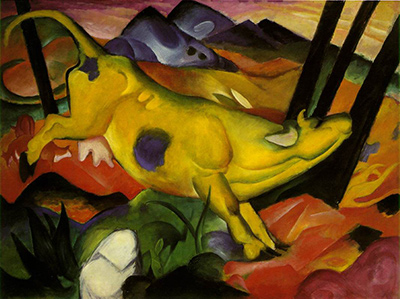
Yellow Cow1911Painting
Young Oak Tree1909Painting

Discussion

Marc’s surviving words are most useful when read beside the works and the occasion of each text.

Reader Insights

Observation

Which statement sends you back to look at a particular painting?

Comparison

How does a private letter differ from a public statement of artistic aims?

Interpretation

Where does the image resist a simple reading of Marc’s words?

Join the Conversation

Which detail changed the way you saw this work? Share a close observation or a comparison with another Marc picture.


References

  1. Franz Marc, posthumous letters and notes, Project Gutenberg scan of the 1920 edition. View source.
  2. Marc–Macke correspondence, 12 December 1910. View source.
  3. Museum Folkwang, Pferd in Landschaft. View source.
  4. Albertina record crediting Kunstmuseum Bern, Blaues Pferd II. View source.
  5. Lenbachhaus, Blue Horse I. View source.
  6. Staatsgalerie Stuttgart, Little Yellow Horses. View source.
  7. Fondation Beyeler, Blue Rider chronology for Macke’s death and Marc’s October tribute. View source.
  8. Related artwork image, Yellow Cow: Photograph by Dr. Alexey Yakovlev; resized without crop or colour change, CC BY-SA 2.0.